%20(1).png)
What is Chrome Water?
Chrome Water is an original cyberpunk story set in 2089 Northern California, where real water is scarce and the memory of it can be sold.
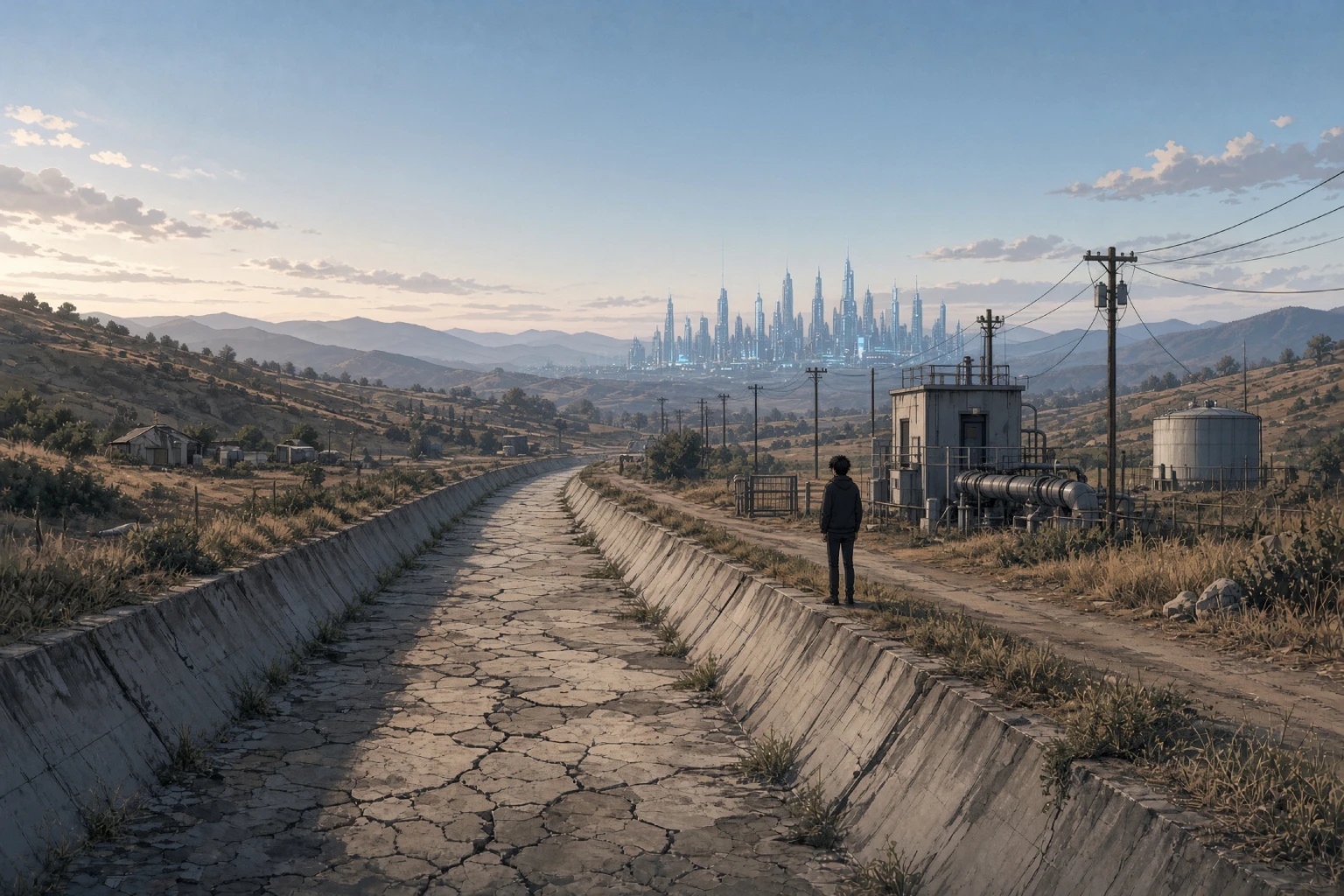
Chrome Water is an original cyberpunk story from Epic Anime Lore, set in Northern California in 2089. It is a thriller about scarcity, memory, technology, and control.
The story moves between Sacramento Deep, a massive arcology built over the Sacramento region, and the Feather River foothills above Oroville. Between those places is a California shaped by old reservoirs, irrigation systems, aging infrastructure, corporate technology, and a population living with restrictions earlier generations would have called extraordinary.
At the center of Chrome Water is a simple contradiction: real water has become hard for ordinary people to get, but the sensation of water can be bought almost anywhere.
California, 2089
Chrome Water does not take place in a generic neon city. Its future grows out of Northern California.
Sacramento Deep rose after decades of population growth, drought anxiety, technological expansion, and pressure on the state’s water systems. Everyday life inside the Deep runs through layers of corporate infrastructure.
Beyond the city, the landscape changes. The Feather River foothills still have winding roads, small properties, agriculture, canals, pumps, reservoirs, and towns spread across the hills. The landscape is still shaped by canals, orchards, pumps, reservoirs, and irrigation systems, even as access to the water moving through them has become increasingly controlled.
Oroville matters because water has always shaped the region. In Chrome Water, that geography becomes part of a larger future in which control over water is control over daily life. The setting stays recognizably California even after decades of technological change.
When water becomes something you remember
The central technology of Chrome Water is Filament, a neural system that can replay recorded human sensation.
A person does not just watch rainfall. Filament can make them feel cool rain on their skin. Someone who has never stood in a mountain stream can buy the memory of cold water around their feet. Another person might buy swimming in a lake, drinking cold water on a hot afternoon, walking through mist, or standing outside in a storm.
Those experiences can be packaged, licensed, copied, modified, stolen, and sold. People who cannot easily get enough real water can still buy the memory of having more than they need.
The wealthy and connected still reach the genuine thing more often. Everyone else lives inside a system that taught them to accept scarcity and then sold them substitutes. Chrome Water is not only a drought story. It is a story about technology that can sell the experience of something after the real version has been placed out of reach.
A cyberpunk world built around scarcity
The water crisis in Chrome Water did not start as a complete invention. Droughts happened. Infrastructure came under pressure. People worried about long-term supply.
The opportunity came afterward. Powerful interests learned that scarcity could be managed, exaggerated, and maintained. Restricting access created dependence. Dependence created markets. Once people were used to receiving less, the system no longer had to promise improvement. It only had to convince them the restrictions were permanent.
That is where Chrome Water becomes cyberpunk. Technology has advanced, but it has not erased ordinary human problems. It has created new ways to profit from them.
Sensory memories become subscription products. Access systems decide who receives what. Corporate networks know more about the infrastructure than the people who depend on it. Black-market operators work around those systems, sometimes for money, sometimes because somebody needs what the official system will not give.
The technology is futuristic. The motives are old.
The people outside the system
Chrome Water follows a loose network of specialists rather than a conventional team. They know one another through jobs, reputation, contacts, and necessity. Their skills overlap when the work demands it. Each has a life outside the others.
Kai “Circuit” Reyes is a former corporate netrunner who understands the systems that keep Sacramento Deep running. Precise and technically gifted, he works inside networks, security architecture, and the assumptions built into supposedly protected systems.
Mika “Spark” Tanaka reads those same systems differently. Where other people see a locked door, she sees the decisions that made somebody believe the door could not be opened. Access, infrastructure, and overlooked weaknesses are how she understands the world.
Ghost belongs to the physical side of a future often described only through software and implants. Older and used to working alone, he moves through rooftops, tunnels, service corridors, forgotten infrastructure, dangerous neighborhoods, and long foothill roads — places where getting through the real world matters as much as getting through a network.
Together they show what kind of cyberpunk story Chrome Water is. The technology matters, but the story does not live only inside computers. It moves through streets, industrial systems, old water routes, private facilities, foothill roads, and the machinery that still keeps California alive.
Why it is called Chrome Water
Chrome is the technological future: neural systems, corporate infrastructure, cybernetic modification, digital access, artificial experience, and the polished systems around everyday life.
Water is older and more basic. People can survive without virtual rain. They cannot survive without actual water. That difference sits under the entire story.
In Sacramento Deep, technology can reproduce almost every sensation associated with water. A person can remember rain that never fell on them, swim in a lake they have never visited, or feel the relief of cold water without gaining a single extra drop.
A memory cannot irrigate an orchard. A subscription cannot fill a reservoir. A recorded sensation cannot satisfy thirst. The more sophisticated the technology becomes, the sharper that contradiction gets. That tension is Chrome Water.
Northern California as cyberpunk
Cyberpunk is often enormous cities, neon, corporations, hackers, implants, and crowded tech. Chrome Water has those things, and it also lets the genre leave the city.
Sacramento Deep can be dense, artificial, connected, humid, and managed. The Feather River foothills can be dusty, quiet, agricultural, mechanically practical, and dependent on visible physical infrastructure. Oroville connects those worlds through water: reservoirs, dams, canals, irrigation, and the roads around them.
The future did not erase Northern California. It grew on top of it.
Read Chrome Water
Chrome Water is an original cyberpunk story from Epic Anime Lore about technology, water, memory, corporate power, and the people who operate outside the systems controlling them.
Start with the main Chrome Water story, then read characters including Kai “Circuit” Reyes, Mika “Spark” Tanaka, and Ghost — the people moving through California in 2089.
Chrome Water is fiction: a cyberpunk world where the real thing has become scarce, the memory of it can be sold, and the difference between those two things is getting harder to ignore.

.svg)




Join Our Newsletter
Get a weekly selection of curated articles from our editorial team.

.png)
.png)
.png)