%20(1).png)
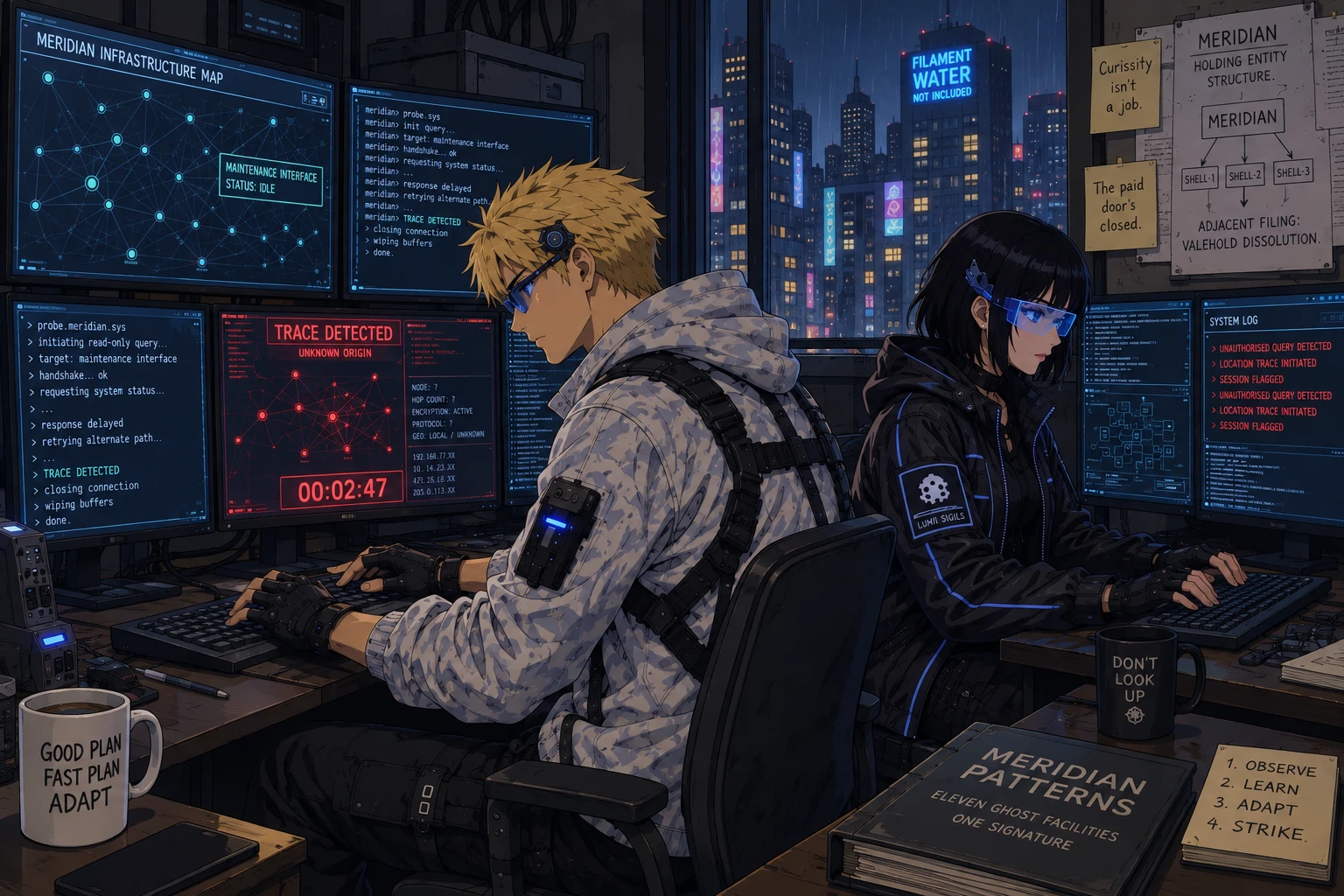
The apartment Kai worked out of wasn't much to look at, which was exactly the point. Four screens arranged in a shallow arc around a single chair, cabling run along the baseboards instead of through the walls so nothing about the place would show up as unusual on a building scan, blackout film on the one window that faced the street. Mika had her own corner of it, a smaller desk angled away from his, close enough to talk without shouting, far enough that neither of them accidentally worked in the other's data. It was past midnight, the particular quiet hour when the building's other tenants had gone still and the only sound left was the low electrical hum of four screens and whatever the street outside was doing without them.
"Tell me again why we're doing this tonight instead of sleeping," Mika said, not looking up from her own screen.
"Because it's been eleven days since Warehouse Nine and I'm done letting this sit," Kai said. He turned his primary screen so she could see it — a schema, sparse in places, built entirely from what they'd actually walked out of that warehouse with. "I went back through everything. The false manifest entry. The real transfer log. The vault the module actually went to."
"The one we decided was somebody else's job."
"The one we decided was too hard to walk into with four people and no plan," Kai said. "That's different from too hard to look at from here." He tapped the screen, walking her through it the way he'd walk a client through a job's shape. "Transfer log named the destination — private secured storage, industrial corridor, north end. I pulled its registration. It's held under a holding entity called Meridian. Boutique data-custody outfit, the kind corporate legal keeps around for exactly the sort of thing nobody wants centrally networked. On paper, unremarkable."
"And off paper."
"Off paper, Meridian's ownership chain runs through two more shells before it reaches anyone with a name attached, and one of those shells shows up — barely, if you're not already looking for it — in a filing adjacent to Valehold's old dissolution paperwork. The same dissolution paperwork that fed the false manifest entry into the exact records broker we bought our information from." He sat back. "That's not proof of anything. But it means the false entry, the real transfer, and the vault it landed in aren't three separate things. They're one thing, built carefully enough that a normal search would never connect them."
"What did the client say," Mika asked. "About funding a real second trip at the actual vault."
"Juno asked. Client passed. Said the module wasn't worth the price of a harder job, which either means they never cared that much in the first place, or means they already know exactly what happens to people who go looking too hard at where it ended up." Kai shrugged, a small, tired motion. "Either way, the paid door's closed. This is what's left if I want to keep going."
"Which is why you're doing it at midnight instead of asking Juno to sign off on it properly."
"I didn't say it was a good plan," Kai said. "I said it was the plan I have."
"And Sable's empty cages."
"Consistent with it. Not proof. Consistent. If Meridian's been doing this at scale — pulling specific items out of specific facilities, cleanly, then burying the record of it — eleven other buildings with the same signature isn't a coincidence anymore. It's a pattern with a name attached to part of it, finally."
Mika leaned back in her chair, arms crossed, not quite committing to either agreeing or arguing yet. "Ghost said something in that warehouse I keep coming back to. Curiosity's not the same as a job. He wasn't wrong."
"He wasn't," Kai agreed. "And this isn't a job anymore. The client passed on the vault. We got paid for what we did at Warehouse Nine, and that's where their involvement ended."
"So this is curiosity."
Kai looked back at the schema. "Call it that if you want. Somebody falsified the record we were supposed to trust, moved the module somewhere they expected nobody to follow, and buried the destination behind Meridian. I want to know why."
Mika watched him for a moment. "And nobody's paying us to find out."
"No," Kai said. "This part's mine."
Mika studied the schema for a long moment, tracing its gaps the way she'd trace the weak points in a credential before deciding whether to trust it near a real door. "Walk me through what you actually want to do tonight."
"There's an access point in Meridian's public-facing infrastructure that reads like a maintenance interface. Old-style — the kind built for a technician to check system status without needing full operational access. Read-only, low-privilege, exactly the sort of door nobody locks as tightly as everything else because nobody thinks a health check is worth the effort." He said it plainly, without dressing it up. "I want to knock on it. Not push through it. Just knock, see what it tells me about what's actually running on the other side, and back out before anything downstream notices."
"And if you're wrong about it being low-privilege."
"Then the query bounces off something with more teeth than a health check, and whatever's on the other end logs an unauthorized attempt with my fingerprint on it. Best case, the fingerprint means nothing to them. Worst case, somebody good enough to unpick it learns that somebody's been looking at their architecture closely enough to find a door they thought was invisible." He met her eyes. "I don't think total certainty exists here. That's why I wanted you watching instead of doing this alone."
Mika didn't answer right away. She pulled her own terminal closer, opening a second monitoring feed beside his, the specific quiet preparation of someone deciding that if this went wrong, she wanted to already be moving instead of already reacting.
"You said 'knock,'" she said. "Not push. If you get a response you don't like, you back out the second it happens. Not after one more look. I'm not interested in watching you decide something's interesting enough to justify staying in it a beat longer than we agreed."
"Agreed."
"Say it back to me."
"One anomalous response, I disengage," Kai said. "No second look."
"Do it," she said.
---
Across the city, in a different apartment on a different unremarkable street, Reid was doing inventory on a gear bag he hadn't needed to open in two weeks, the specific restless maintenance of someone who preferred having his hands busy to having them idle. Ghost sat across from him on the floor, back against the wall, a tablet propped on one knee showing a live feed of the street outside Kai's building — an old habit, unasked-for, the kind of thing Ghost did without anyone needing to request it and without expecting thanks for it either.
"They're running something tonight," Reid said. It wasn't a question. He'd gotten a two-line message from Kai an hour ago: *checking something on the Meridian lead, low risk, will update.* Reid had read it three times and decided the words "low risk" were doing more work in that sentence than Kai probably intended.
"Mm," Ghost said, which meant agreement, and also meant Ghost had already decided to keep the street feed open regardless of what anyone officially needed.
Reid set the gear bag down half-checked and picked it back up again a minute later, the same restlessness cycling through him without quite resolving into anything productive. "You ever get the feeling Kai's 'low risk' and everyone else's 'low risk' aren't measuring the same thing?"
"Every time," Ghost said.
"Every time," Reid agreed, and went back to the bag, running through the contents a second time even though nothing about them had changed since the first pass — the specific kind of preparation that wasn't really about the gear at all, just something to occupy the hands while the rest of him waited for a message he hoped wouldn't come.
The street feed on Ghost's tablet showed nothing worth mentioning — a cab idling two doors down, someone walking a dog that didn't want to be walked, the ordinary late-hour traffic of a block that had no idea anything about tonight was different from any other night. Ghost watched it anyway, unhurried, the way Ghost watched most things that probably didn't matter, on the theory that probably wasn't the same as definitely.
"You think it's really the Meridian thing," Reid said. "Not just Kai finding a reason to stay up."
"Does it matter which," Ghost said. "Either way we're both awake."
Reid huffed something that wasn't quite a laugh and zipped the bag shut for the second time.
---
Kai built the query slow, layering it, testing each piece against a sandboxed mirror of Meridian's expected traffic before letting any of it near the real thing. The sandbox alone took most of ten minutes to build properly — a synthetic double of the interface's expected behavior, timing windows, handshake sequence, the specific rhythm of a device that had asked this exact question many times before rather than once, nervously, for the first time. Mika watched over his shoulder, not interfering, the specific quiet she gave him when a job was genuinely his to run and hers to catch if it went wrong.
"On your signal," she said.
"Sending."
The query went out clean — a small, unassuming packet, structured to look exactly like the routine health-check traffic the interface was built to expect.
For four seconds, nothing happened. Kai counted every one of them, watching the small green marker that meant *sent, awaiting response* refuse to change, and let himself think, for exactly as long as the silence lasted, that maybe this was going to be nothing.
Then the response came back, and it wasn't a health-check reply. It was fast — faster than the interface's documented profile allowed — and it carried a return address that didn't belong to the maintenance system at all. Something else had intercepted the query, examined it, and answered in the target's place.
"That's not the interface," Kai said, sitting forward. "Something's sitting in front of it." He watched a new line bloom across his secondary screen. "It's tracing the query back. Right now."
"Cut it," Mika said.
"Cutting." His hands moved fast, killing the open connection, collapsing the sandboxed tunnel, pulling every layer of obfuscation back down around the packet's origin. It should have been enough. It had always, before tonight, been enough.
For a moment it looked like it had worked. The activity on his secondary screen stuttered, thinned, and Kai let himself half-believe the trace had lost the thread entirely.
The trace didn't stop. It rerouted.
He watched it happen almost lazily at first — a single new connection attempt, then two, then a cluster of them converging on the same false origin from slightly different angles, patient, methodical, nothing about it that looked like panic or improvisation.
The first false origin — the outermost layer Kai had built to absorb exactly this kind of pursuit — fell in under two minutes.
"First layer's gone," Kai said.
"Second's holding." Mika had her own feed up now, mirroring his, watching the shape of the intrusion rather than just its progress. "For now."
The apartment had gone very quiet except for the two of them — no music, no ambient noise, just the small mechanical sounds of two people working fast, keys and the occasional sharp exhale, the blue light off both screens the only light in the room now that neither of them had thought to turn anything else on.
It wasn't holding for long. The second layer fell in under a minute — not because it was weaker than the first, Kai would think later, but because whatever was on the other end had learned something from taking the first one apart and spent less time relearning it the second time.
"That's faster," Mika said. Flat. A fact, not a question.
"I see it."
"How much faster."
"First layer, two minutes. Second, under one." Kai was already restructuring the third, throwing resources at it he'd meant to save. "It's not brute-forcing these. It's studying how each one's built and using that against the next."
"Then building the same kind of wall four times isn't going to work."
"I know."
"So don't." Mika was already pulling up a second window, scanning the apartment's own exposed footprint — every device still live on the network, every open port, everything that could become one more thread for whatever was on the other end to pull. "Kai, your slate's still bridged to the building router. Kill that link. If they get far enough to see the apartment's network at all, I don't want your slate handing them anything extra."
"Killing it." He did, one-handed, without looking away from the trace. "Third layer's under attack."
"How long."
"I don't know yet."
The third layer held for forty seconds — the longest of the three, but not because it was better built. Kai had changed the pattern this time, deliberately, structuring it to look less like a copy of the first two and more like something unrelated, forcing whatever was hunting it to start its analysis over instead of applying what it had already learned. He watched the intrusion hesitate at the new shape, actually pause, the first pause of the night that hadn't been immediately followed by progress.
"It doesn't recognize this one," he said. "It's not attacking it the same way. It's testing it first."
"Testing costs it time."
"Testing costs it time," Kai agreed, and for a moment, watching the pause hold, let himself hope the whole night might end there.
It didn't. The testing resolved, the pattern got read, and the third layer began to fail anyway — slower than the second, but failing, the specific unhurried thoroughness of something that had decided novelty wasn't the same as safety and was willing to spend the extra seconds to prove it.
"That bought us something," he said, watching it finally give.
"It bought us forty seconds," Mika said. "Fourth layer's the last one before this apartment's real address. What do you actually have left."
"A decoy. Not a wall — a decoy. Something that looks like the connection collapsing under its own weight instead of being actively defended." He was already building it, hands fast, voice flat with the specific calm of someone who had stopped having room to sound anything else. "If it works, they hesitate. If it doesn't—"
"Send it."
He sent it. The trace slowed — not stopped, slowed, the particular hesitation of something that had been chasing a scent and suddenly wasn't sure it matched what it expected.
"That's confusion," Kai said. "I don't know how long it holds."
Neither of them moved. Somewhere outside, three floors down, a siren passed on the main road and faded, ordinary, unconnected, and Kai registered it anyway, the way anything ordinary became briefly suspicious when everything else in the room had stopped feeling that way. Mika's eyes stayed fixed on her own mirrored feed, watching for any sign the hesitation was resolving in the wrong direction.
"Then we don't wait to find out." Mika was already reaching for her comm. "Reid needs to know now, not after we've used up whatever that decoy bought us."
---
The message that reached Reid wasn't two lines this time. It was one word: *hot.*
Reid was moving before he'd finished reading it, gear bag already zipping shut, Ghost up off the floor in the same motion, tablet still live in one hand.
"Define hot," Reid said into the comm, already at the door.
"Active trace, four layers down to a decoy that might not hold," Kai's voice came back, tight. "I don't think they have this location yet. I don't think that's permanent."
"Ghost and I are five minutes out. Mika — kill anything that doesn't need to be running. Kai, keep doing exactly what you're doing. Buy us the five minutes."
"Copy," Mika said, already moving, physically disconnecting two of the apartment's non-essential devices from the network rather than trusting a software kill switch to do it fast enough.
---
Kai watched the decoy hold, watched it waver, watched it hold again — a slower, more uncertain rhythm than the clean collapses of the first three layers, which told him the confusion was real even if he couldn't measure how long it would last.
"They're not gone," he said, mostly to keep his own hands steady. "They're deciding."
"Deciding what."
"Whether the collapse was real or whether I built it to look real." He threw one more piece of noise into the decoy, thin, improvised, bought from instinct rather than anything he'd had time to prepare properly. "I don't know which way they're going to land."
Reid and Ghost came through the door four minutes and thirty seconds after the word *hot* had gone out, Reid scanning the room out of pure reflex, Ghost immediately crossing to the window to check the street through a gap in the blackout film. Neither of them had bothered knocking. The door had been unlocked on purpose, an old habit from a dozen jobs that had never needed it until tonight.
"Report," Reid said.
"Trace slowed, might not stay slowed," Kai said, without looking away from his screen. "I don't think they have this location yet."
"Then we don't wait to find out if that changes. What do you need to walk away clean?"
"Ten minutes to strip this apartment's network presence down to nothing. Less if Mika helps instead of watching me do it."
"Already on it," Mika said, hands moving across her own terminal.
Reid crossed to the small kitchen at the apartment's rear, checked the fire escape through the window, confirmed the route was clear, came back. "Talk numbers. What's actually still live in here that ties back to any of us."
"Two terminals, four drives, the router, whatever cache is sitting in the building's own hardware from six weeks of us being here," Kai said, already answering his own question by starting the wipe instead of finishing the inventory out loud. "Router's fastest — rental unit, not ours, goes back to looking unremarkable the moment we're gone. Drives are the real risk. Anyone with physical access and the right tools could still pull something off them wiped, if they had enough time."
"Then the drives don't stay here." Reid was already pulling a lined bag from his own gear, built to defeat passive signal-reading even from a powered-down drive. "Mika. Fill this. Kai — finish the router, get off the network entirely. I don't want this place broadcasting anything at all by the time we leave, not even silence that looks deliberate."
---
The eight minutes felt considerably longer than eight minutes.
Kai worked fast and silent, stripping the apartment's network fingerprint layer by layer — device identifiers, cached credentials, the decoy signature itself, all of it erased rather than simply disconnected, because disconnected still left traces and erased mostly didn't. His hands didn't shake, which surprised him distantly, in the part of his mind that had room to be surprised by anything right now. Mika worked beside him, physically pulling drives rather than trusting a remote wipe to finish in time, dropping each one into Reid's bag with the quick, economical motion of someone who'd rehearsed exactly this kind of hurry before, even if she'd never had to actually run it for real.
Ghost did a final pass of the apartment, checking for anything that could read as more than an ordinary vacated rental to someone who came looking later — a mug still warm on the counter, a jacket left on a chair, the small human residue that separated *nobody's been here in weeks* from *somebody left in a hurry.* Ghost cleared what could be cleared and left the rest, because there wasn't time to make the apartment perfect, only time to make it plausible.
"Two minutes," Reid said, at the seven-minute mark, not because two minutes mattered specifically but because saying it kept everyone's pace honest.
"I'm done," Kai said, closing the last drive into the bag himself, standing so fast his chair rolled back into the wall and stayed there, forgotten, a small crooked detail in a room that was about to stop being anyone's. "Network side's as clean as I can make it. It's not perfect. It's the best version of perfect that existed in eight minutes."
"Perfect wasn't on the table tonight," Reid said. "Move."
---
They went out through the service stairwell, four sets of footsteps fast and quiet on old concrete, Ghost taking point with the same unhurried, tactical stillness he brought to anything, except tonight the stillness had an edge underneath it that hadn't been there before — the specific alertness of someone treating an empty alley as though it might not stay empty.
Halfway down the alley, Ghost's hand came up, flat, a silent stop. Everyone froze. For three full seconds nobody moved, nobody breathed louder than they had to, while Ghost's attention fixed on something at the alley's far mouth — a shape that resolved a moment later into nothing more than a delivery drone finishing a late-night route, running lights blinking their ordinary pattern as it crossed the intersection ahead and kept going.
Ghost's hand dropped. They kept moving.
"That's going to happen a lot tonight," Reid said, quiet, once they were moving again. "Everything's going to look like something for a while. Better that than the alternative."
It stayed empty the rest of the way. They reached the car three blocks over without further incident, Reid taking the wheel while Ghost rode shotgun with the street feed still live, watching the mirrors as much as the road ahead, and Kai and Mika sat in the back with the bag of drives between them like something that might still be radioactive even wrapped and shielded.
Reid cut through two unnecessary turns anyway, doubling back once on a route that made no navigational sense on its own — the kind of driving that only made sense if you assumed someone might be trying to follow and wanted to make it as expensive as possible for them to succeed.
"Talk to me," he said, once the silence had gone on a beat too long. "What actually happened."
"I queried a low-privilege interface on Meridian's infrastructure," Kai said. "Something was sitting in front of it, live, and it came after the query the moment it recognized the shape of it. Not a script. Something that got faster with each layer it took apart, because it was learning how I'd built the last one and using it against the next."
"How fast."
"First layer, two minutes. Last one before the apartment, under a minute. I threw a decoy at it right before we called — it slowed, it didn't stop. I don't know if it would have held another ten minutes or another thirty seconds."
"And now?"
"Now the wipe's done and we're not there anymore. That's the whole honest update I have."
"You said it learned," Reid said. "Explain that part again. Slower."
"It didn't take the second layer apart the same way it took the first," Kai said. "It took less time. That only happens if whatever's on the other end was actually paying attention to how the first one broke, not just repeating a script against a new target."
"So it's a person."
"Or something running with a person's patience. I don't know which yet, and I don't think the difference changes what we do next."
Reid absorbed that in silence for a block or two, hands steady on the wheel, eyes moving between the road and the mirrors in the same unhurried rotation he'd have used checking a building for exits. "Ghost. Anything behind us."
"No," Ghost said, not looking up from the tablet. "Nothing behind us the whole way."
"Keep watching anyway."
"Always do."
Nobody said anything for a while after that. Ghost watched the road behind them through the side mirror, methodical, unhurried, not fully convinced the night was over even though every visible sign said it was.
"We're not going back to that apartment," Reid said finally. "Not tonight, not this week, maybe not ever. Kai, Mika — I need to know by morning whether anything in that wipe was incomplete enough to matter."
"I'll know by morning," Kai said. "I won't like the answer either way, but I'll know it."
---
The place they ended up was a short-stay rental Reid had used before under a different name, paid for months ago in a lump sum specifically so that a night like this one wouldn't require a decision made under pressure. Two rooms, a window that didn't face the street, furniture that belonged to nobody in particular. It smelled faintly of someone else's cleaning solution and had the specific, slightly unreal stillness of a space nobody had ever actually lived in.
Kai sat on the edge of a couch that wasn't his, laptop bag still across his shoulder because he hadn't yet made the decision to put it down, and stared at a wall that had nothing on it worth staring at. Mika sat beside him, close enough that their shoulders nearly touched, neither of them saying anything, both of them still running on the particular flat adrenaline that came after a thing was over but before the body had caught up to believing it.
"You did everything right," she said eventually.
"I know," Kai said. "That's the part I keep getting stuck on."
In the kitchenette, Reid stood at the counter doing nothing in particular with his hands, the restless energy he'd carried all night with no gear left to check and nowhere left to drive. Ghost leaned in the doorway behind him, arms crossed, watching the room the way Ghost watched most rooms, cataloguing exits out of a habit that didn't care whether tonight's danger had followed them here or not.
"You good," Reid said, not quite looking at him.
"Fine," Ghost said.
"That's not what I asked."
Ghost considered that for a moment, the specific consideration Ghost gave to questions that deserved more than the automatic answer. "Nobody got hurt. Nobody got found. That's a good night by the numbers I use." A pause. "Doesn't mean I liked how close the numbers ran."
"No," Reid agreed. "Me either."
---
Juno took the call at four in the morning, and to her considerable credit, didn't ask why they were calling her at four in the morning before she'd heard the reason.
"We got traced," Kai said, without preamble. "I touched a low-privilege interface tied to the Meridian vault the module went to, and something on the other end came after the query fast and adaptive. We burned the apartment. We're clear for now. I don't know for how long."
Juno was quiet for a moment. "Walk me through the numbers. Not the mechanics. The numbers."
"Four redundancy layers. First one fell in two minutes. Last one, under a minute. Eight minutes total from first contact to walking out the door."
"That's not a system doing its job," Juno said slowly. "That's someone doing theirs."
"That's what I think too."
"Then it's not a pattern you can outthink because it isn't paying attention anymore," Juno said. "Someone's paying attention now. Someone good enough to be worth being afraid of." A pause. "Where are you."
"Somewhere new," Reid said. "Staying somewhere new until we know it's safe to be anywhere old."
"Good. Stay there, together, until morning at the earliest. I don't want anyone alone tonight." Another pause. "Is there anything in that apartment that leads back to any of you specifically — not the crew, not the work, you personally?"
Kai thought about it, running back through six weeks of files, everything he'd let exist in a space he'd believed was safe enough to be careless in.
"I don't think so," he said. "But I thought a lot of things tonight that turned out to be wrong faster than I expected them to."
"That's the most honest answer you could have given me," Juno said. "I'd rather have that than false confidence." A longer pause. "I'm going to ask you something, and I want the real answer, not the one you think I want to hear. Do you want to keep pulling this thread, knowing now what it's actually connected to?"
Kai didn't answer immediately. Beside him, Mika was watching him with the specific attention of someone who genuinely didn't know which answer he was going to give.
"Yes," he said finally. "Differently than before. More carefully than before. But yes."
Juno didn't sound surprised. She didn't sound pleased about it either.
"Then we do this smarter starting tomorrow," she said. "No more knocking on doors alone at midnight because you got tired of waiting. Whatever we build from here, we build it together, on purpose, with everyone knowing exactly what's being risked before we risk it." A beat. "Reid. Ghost. Either of you disagree with anything he just said?"
"No," Reid said. "But I want it on record that I'd have said the same thing before tonight and meant it less."
"Noted," Juno said, something almost like dry humor in it, worn thin by the hour. "Tonight, you sleep, if any of you actually can."
The line went quiet. In the dark of a room none of them had ever slept in before, four people who had spent eleven days treating a pattern like a puzzle sat with the considerably heavier fact that the puzzle had just, for the first time, treated them like one too.
Outside, the city went on the way it always did, indifferent to any of it — the metered rain somewhere over the Deep, four minutes on, six minutes off, and beyond that, out past the reclaimed rail corridor, a warehouse with a broken roof and a dead security drone standing exactly where they'd left it, holding whatever was left of its secrets in the dark.


.png)
.png)
.png)