%20(1).png)
There was a ripple felt through the station’s network, subtle enough that no alarm recognized it as a threat. Authentication requests hesitated, passenger profiles briefly lost their owners, and several advertising feeds dropped their personalized overlays before correcting themselves.
For a few seconds, systems that were never meant to speak directly to one another seemed to become aware of the same invisible interruption. A maintenance channel opened without authorization, closed again, and left behind no valid access record.
Then the ripple was gone.
The station recovered almost immediately, classifying the scattered errors as routine synchronization noise and moving on.
No identity was attached to any of it.
Jonah Voss's apartment recognized him by habit rather than intelligence. The biometric retrofit had stopped getting updates years ago, and these days the door seemed to identify the slightly uneven rhythm of his bad left knee more reliably than his face. He had once told the management company that anyone who learned to imitate his limp could probably get inside. They had thanked him for the feedback and done nothing.
He made coffee with grounds and a kettle because he preferred the taste. The utility display embedded in the kitchen tile informed him that he'd used forty-one percent of his weekly water allocation and was comfortably under budget. He glanced at it and moved on.
At sixty-one, Jonah had spent thirty-one years as a Sacramento PD detective before predictive-triage software and departmental restructuring pushed him into independent work. He wasn't nostalgic about it. He used a neural interface, city databases, overlays, navigation and whatever else did the job. He simply had less faith than most people in the idea that a clean record was the same thing as a true one.
He was reviewing a skip-trace file when his apartment chimed. A woman named Mara Ellison was waiting downstairs. Her visitor credential carried no employer tag, only a message: I need to talk to someone about my brother.
"Families are often confident about what someone would never do," Jonah said, not unkindly. It was a line he'd delivered more times than he could count, and it had a purpose beyond simple caution — it told him how a person reacted to having their certainty questioned, which told him something about how reliable that certainty actually was.
Mara didn't get defensive. She nodded, like she'd expected the pushback and had already thought it through. "I know how this sounds. I've heard myself say it, and I know every family says it. But I'm not telling you he wouldn't leave because I think I know his soul. I'm telling you because of his cat."
Jonah raised an eyebrow, which was as much surprise as he generally allowed himself to show. "His cat."
"Bishop. Eleven years old, older than my last relationship." A small, tired attempt at a joke that didn't quite land, not because it wasn't funny but because neither of them had the room for it yet. "Adrian has never — not once in eleven years — left that animal overnight without arranging care. He has a service. He has a neighbor as backup. He has redundancies for his cat's dinner that most people don't have for their own medical directives. When I let myself into his apartment two days ago because he wasn't answering anything, the automatic feeder was empty. Completely empty. Bishop was starving. And there was a full, sealed bag of food sitting right next to the feeder unit that Adrian obviously hadn't gotten around to loading yet."
Jonah sat with that for a moment, turning it over the way he turned over most small physical facts — not yet a conclusion, just a stone worth picking up. "He expected to be back before the feeder ran dry."
"That's what I think. That's the whole thing. He didn't leave planning to be gone. Something happened to him on an ordinary day when he thought he'd be home in time to feed his cat."
She told him the rest in pieces, the way people generally did, circling back to fill in details she'd forgotten the first time through. Adrian had called her Monday night, the evening before he disappeared, about their mother's birthday — logistics, mostly, who was bringing what, whether their mother's building would let them run the small in-home event without tripping the noise threshold that some apartments enforced automatically now. It had been an ordinary conversation. He'd sounded tired, she said, but tired the way he always sounded by Monday, worn down by whatever his week at Atmospheric Services had thrown at him. At one point in the call he'd asked her the same question twice, only a few minutes apart — what time their mother's actual birthday fell on, a Thursday or a Friday — and hadn't seemed to notice he'd already asked it.
"That's not nothing," Jonah said, "but it's not necessarily something either. People get distracted. People work long hours and their attention slips."
"I know. I thought about that too. I'm not saying it proves anything. I'm telling you because it's the kind of small detail I keep turning over, trying to decide if it means he was already somewhere else in his head that night, thinking about something he hadn't told me."
"Did he mention anything specific bothering him? Work, otherwise?"
"He complains about work constantly, but it's background noise, the way anyone complains about a job they've had for over a decade. Management doesn't listen to the people who actually do the work. Inspection schedules get set by people who've never physically been to the sites they're scheduling. Software tells everyone a system's fine and nobody checks whether it's actually fine. That's just — that's just Adrian talking about his job. He's said some version of that for years. Nothing about it sounded different Monday night. He didn't sound scared. He sounded tired and a little distracted, and if I hadn't already known something was wrong, I wouldn't have thought twice about the call."
Jonah nodded slowly, filing it without weighting it yet. A man distracted enough to repeat a question, complaining about the same tired frustrations he always complained about, planning for his cat's dinner and his mother's birthday in the same week. Nothing in it screamed danger. That was, in its own way, useful information. The absence of drama was itself a data point.
"I want to see his apartment," he said. "And I want you to walk me through his morning route to work — not tell me about it. Walk me through it. Physically."
Mara blinked, clearly having expected a request for a map pull or a transit record request, something that stayed inside a display. "You mean actually walk it."
"I mean actually walk it. A map tells you what a route is supposed to look like. It doesn't tell you what it's actually like to walk it on a given Tuesday. If something got to your brother, it probably didn't happen inside a database. It happened somewhere with pavement."
Adrian's apartment was on the fourth floor of a mid-tier residential block in the northern part of Sacramento Deep, one of the huge, competent, characterless towers that had gone up in the fifties to absorb the population that older, less climate-resilient neighborhoods could no longer safely house. The building's entry authentication read Mara's visitor credential and Jonah's identity without complaint, a soft chime and a status light shifting from amber to green, and a small courteous synthetic voice welcomed them both by name, which always struck Jonah as a faintly absurd kind of hospitality — a wall that knew who you were and pretended to be glad about it.
Bishop met them at the apartment door, thin, indignant, and clearly starving for attention as much as food, weaving figure-eights around Mara's ankles the moment she stepped inside. The apartment itself told its own quiet, coherent story. It was tidy in the specific way of a man who kept things orderly out of habit rather than anxiety — dishes clean and put away, laundry folded rather than piled, a shelf of actual paperback books that suggested a private stubbornness matching Jonah's own. His travel bag, a mid-size case meant for anything longer than a weekend, sat undisturbed on the top shelf of his closet, dust-free, clearly not touched in months. His good coat hung by the door. His everyday shoes sat beside it in their usual place, but a pair of lighter work boots — the kind meant for uneven ground rather than an office — were missing from the row.
"He doesn't wear those to the office," Mara said, following Jonah's gaze. "Those are for site visits. When he actually has to go out to a physical installation instead of sitting at a terminal."
Jonah crouched by the shoe rack for a moment, not because there was anything more to see there, but because it was useful to look at a small thing for slightly longer than necessary; it made people around him slow down too, stop narrating, let him actually observe instead of being guided.
The toothbrush was still in its charging cradle in the bathroom. A half-used tube of something sat beside the sink. Nothing about the personal-care shelf suggested a man packing to leave anywhere, even briefly.
On the small desk near the apartment's single window, beside a terminal that had gone to sleep days ago, Jonah found three handwritten notes on actual paper, torn from the same small pad, in the same blunt, economical handwriting. He'd noticed, over the years, that the people least trusting of digital record-keeping were often the ones who worked closest to the infrastructure that generated it. A man who spent his professional life inside systems that could misreport, lag, or simply lie by omission might reasonably keep a paper backup of the things he most needed to remember.
CALL MARA
FILTER 7B
TUES — 16:30
"Do these mean anything to you?" he asked, holding the pad so she could see without touching it herself.
"Filter 7B, no idea. That's work stuff, has to be — some piece of equipment. Call me, obviously, he did that Monday night, so maybe this is an older note. Tuesday, four thirty — I don't know what that is. Could be a meeting. Could be anything."
"Could be," Jonah agreed, and photographed the note with a flick of thought that fired his interface's camera function, the image logging itself automatically into a case file he'd already started building in the back of his mind before he'd finished his first coffee that morning.
"It's twenty minutes," Mara said, when they reached the door. "We could just look at the route."
"Twenty minutes is nothing," Jonah said, already moving toward the elevator.
She didn't argue further, just fell into step beside him as they left the building and entered the covered pedestrian corridor that ran between residential towers in that part of the district — a wide, climate-regulated walkway, its ceiling a lattice of atmospheric processors quietly managing temperature and humidity so that even in late-summer heat the air moving through it stayed comfortable, faintly cool, carrying a chemical cleanness that no natural breeze in California had produced in decades. Fine mist drifted down at intervals from nozzles set into the overhead structure, reclaimed water, cycled and treated and re-cycled again, just enough to keep public plants alive and pedestrians from baking, metered so precisely that the corridor's own status display near the entrance reported, in small green numbers, exactly how many liters had been used that day against the corridor's allocation.
They passed an authentication field at the corridor's midpoint, one of the soft blue curtains of light that Jonah had walked through so many thousands of times in his life that he no longer consciously registered it. He'd stopped finding that unsettling around the same time he'd stopped finding traffic lights unsettling. It was simply the water he swam in.
A tall advertising panel occupied the corridor's far wall, cycling through a slow rotation of licensed sensory previews — Chrome Water product placements, the corporate end of the market, polished and legal and expensive. As they passed, the display shifted to a woman stepping into an alpine lake, sunlight fracturing on the surface, her breath visibly catching at the cold the moment her ankles broke the waterline, a small subtitle offering a ninety-second full-immersion license for a price that Jonah automatically converted into a week of his own modest earnings.
"My mother buys those," Mara said, glancing at it without much interest, the way you'd glance at a billboard you'd seen a hundred times. "The lake ones, specifically. She says it's the closest she'll ever get."
"Probably true," Jonah said.
"Do you ever do it? The experiences?"
"No."
"Why not?"
He didn't slow his pace, didn't turn to look at her, just kept walking, the mist drifting faintly against the back of his neck as they passed beneath another nozzle array. "I remember lakes."
Mara looked at him for a moment like she expected him to say more, and when he didn't, she let it go, filing the comment away the way people filed away things about Jonah that didn't quite explain themselves. It was, in its own way, a professional habit of his own — say exactly as much as was true and no more, let people wonder about the rest, and see what they did with the wondering.
The corridor eventually opened onto an older street level, and here the layering of the city became more visible, newer glass-and-composite retrofits sitting atop concrete structures that had clearly stood since before Jonah was born, transit lines running overhead on rails that had been reinforced and modernized so many times that the original steel beneath the newer casing was probably a museum piece in its own right. They reached the Green Line's North Basin station a few minutes later, its entrance marked by a bank of turnstile gates, each one crowned with a slim identity scanner that read commuter credentials off neural interfaces, wrist units, or physical transit cards for the minority of residents who still preferred them.
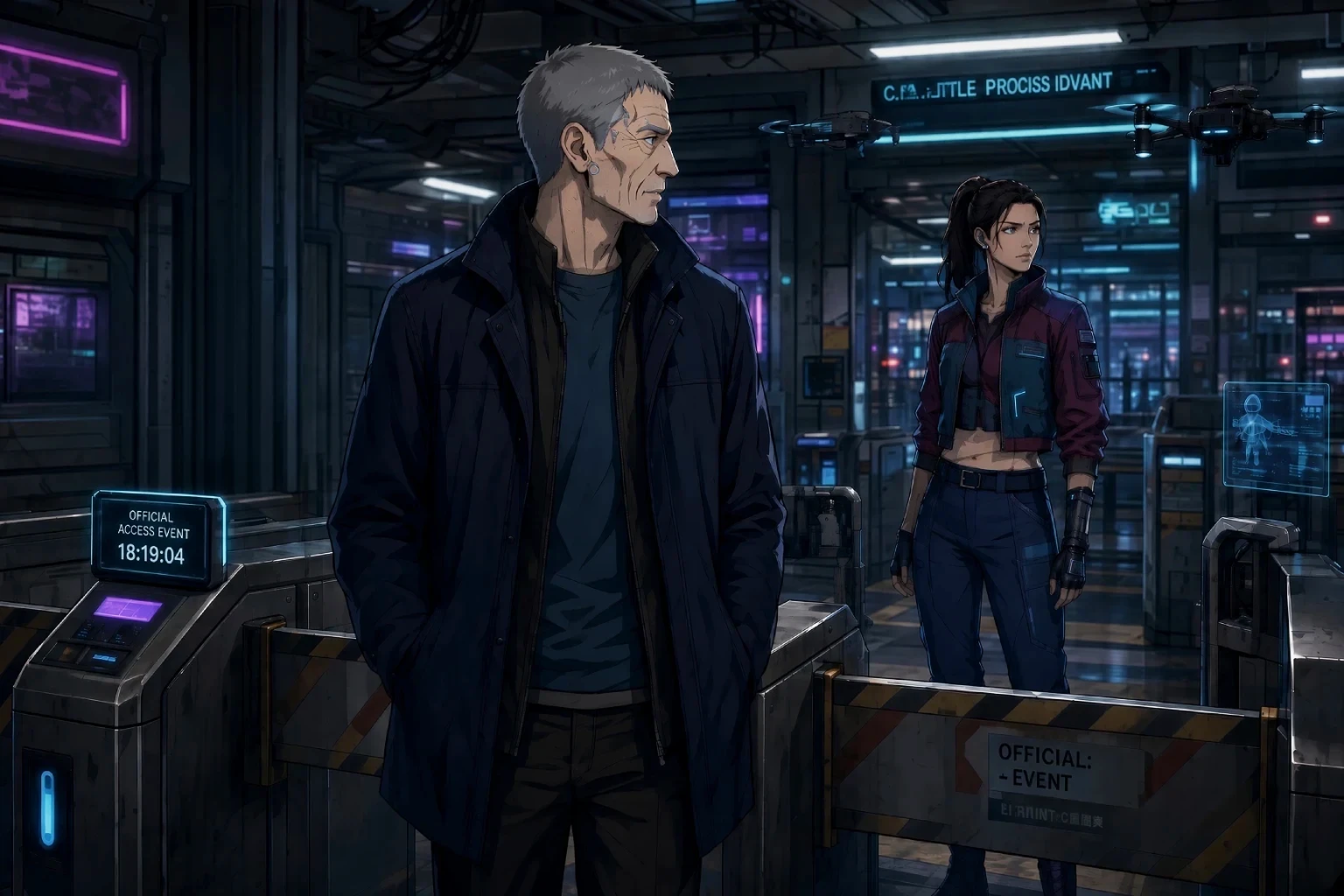
Three of the gates were in active use, commuters flowing through in a steady, unhurried rhythm, the soft chime of successful authentication repeating every few seconds like a heartbeat. The fourth gate, Gate 3, was dark.
A heavy steel maintenance barrier had been bolted directly across its frame, industrial and unglamorous, the kind of temporary fix that had clearly been in place for a while — its surface dulled with a fine layer of grime, a faded municipal maintenance tag zip-tied to one corner, the printed text mostly legible: SCANNER FAULT — SEE SUPERVISOR — DO NOT REMOVE.
Jonah stopped in front of it.
"How long's that been closed?" he asked a transit worker restocking a nearby credential kiosk, a young man in the pale blue of the regional transit authority.
"Couple months, at least," the worker said, not particularly interested. "Scanner behind it fried, and getting parts approved took forever, something about the model being out of production. They just barricaded it instead of leaving it open and unmonitored."
Jonah crouched, the way he had at Adrian's shoe rack, and examined the bolts fixing the barrier to the frame. Rust had begun forming at the joints, faint but real, the specific kind of oxidation that took weeks to develop and didn't simply appear overnight. The dust along the barrier's base sat undisturbed in a uniform film, no scuff marks, no drag lines, nothing to suggest the panel had been recently moved and replaced. He ran a finger along the lower edge and it came away gray.
"This hasn't been touched in a long time," he said, more to himself than to Mara or the transit worker.
He pulled up Adrian's transit record through the case authorization Mara had granted him that morning — a standard family-authorized data request that any licensed investigator could file, the kind of access that existed specifically because institutions needed some legal channel for private citizens to chase down what the police wouldn't. The record rendered itself in his overlay, clean and precise and utterly confident in its own accuracy.
GREEN LINE NORTH BASIN
GATE 3
18:19:04
He looked at the number, then looked at the barricade in front of him, bolted, rusted, undisturbed, and let the two facts sit next to each other without immediately trying to force one into agreement with the other.
"Someone changed that," Mara said quietly, an edge of something rising in her voice that hadn't been there before. "Someone altered the record."
"Maybe," Jonah said. "Or maybe the system's confused about something else — a mislabeled gate ID, a caching error, some batch job that reassigned an old reading to the wrong terminal. I've seen systems produce garbage for reasons that have nothing to do with anyone touching anything." He straightened, knees protesting faintly, and looked at the barrier a moment longer. "All I know right now is the record and the door disagree. I'm not going to decide which one's lying before I've actually asked somebody who was here."
"Who was here?"
"There's a supervisor logged on that shift. Lena Park. She comes on this evening." He checked the schedule the transit worker pulled up for him without much curiosity about why a private investigator wanted it. "We've got hours before she's on. Let's not waste them standing in front of a locked door."
Sacramento Climate Operations Cooperative occupied a squat, unglamorous administrative campus a few kilometers east, the kind of building that existed to be functional rather than impressive — public-facing enough to satisfy the transparency requirements written into its charter as a public-private hybrid, but clearly not designed with visitors in mind. SCOC had been formed decades earlier out of the messy consolidation of half a dozen older municipal water and air agencies, folded together with private infrastructure contractors under a cooperative governance model that nobody outside the organization fully understood and, Jonah suspected, not everyone inside it did either. Its logo, a stylized cloud over a stylized droplet, appeared on public information kiosks throughout the district, usually beside reassuring language about resilience, stewardship, and responsible allocation.
The receptionist, a harried woman managing three simultaneous authentication queues, gave Jonah exactly the kind of unhelpful, technically accurate answer he'd expected. Adrian Ellison was indeed an employee. His current status was "on approved absence," a phrase that told Jonah someone in HR had quietly reclassified an unexplained disappearance into paperwork that wouldn't trigger any awkward internal alarms. She could not discuss personnel matters. She could direct him to a general inquiries channel that would respond, she assured him, within five to seven business days.
Jonah thanked her and did what he always did when the front door produced nothing: he went looking for a side door made of people instead of policy.
He found it in the break area outside the field technicians' locker room, where he struck up an unhurried conversation with a broad-shouldered man in a work uniform who was reloading a maintenance drone's diagnostic cartridge and looked like he'd rather be doing almost anything else with his lunch break than talking to a stranger, right up until Jonah mentioned Adrian's name.
"You're actually looking for him?"
"His sister hired me."
Tomas looked past Jonah toward Mara and lowered his voice. "Adrian's solid. If he vanished, something happened."
"Anything at work lately?"
"Same argument he's been having for years, just louder lately. Too much old infrastructure gets trusted because the telemetry says it's fine. Adrian hated signing off on equipment nobody had physically looked at."
"Anything specific?"
Tomas hesitated. "River Annex. Old flood-control district, south end. He asked me a couple weeks ago if I still had the old paper maintenance maps."
"Why paper?"
"Because the digital maps don't match what's actually down there anymore." Tomas rubbed a hand across his jaw. "The place is sealed. Mostly. But some of the old equipment still reports as active."
"Filter 7B mean anything to you?"
That stopped him for half a second.
"It's tied to River Annex."
Jonah didn't ask him to explain the machinery. He didn't need a lesson in what the system was supposed to do. He needed to know why Adrian had written the name of a sealed site on a scrap of paper and then disappeared wearing his field boots.
By the time they returned to North Basin station, Lena Park was in the supervisor's booth. Jonah showed her Adrian's record: GREEN LINE NORTH BASIN. GATE 3. 18:19:04.
She looked at it for two seconds.
"That's bullshit."
"Gate 3's been off the live backbone for almost two months," she said. "Scanner fault. Physically disconnected. It shouldn't be able to authenticate anybody."
"Could somebody make it generate an event anyway?"
"If they got behind the barricade and knew the old hardware, maybe. Local injection into the terminal cache. But they'd need physical access and tools." She checked the maintenance log. "Nobody was authorized back there Tuesday."
Jonah glanced through the booth glass toward the dust-coated barrier. "So the record says he walked through a door nobody could use."
"Pretty much."
The record and the door still disagreed. Now he knew the disagreement wasn't routine.
They ate at a noodle counter near the station. Mara barely touched hers.
"You still think there's a boring explanation?" she asked.
"I think boring explanations deserve a chance before interesting ones," Jonah said. "That doesn't mean they always win."
Jonah had chosen the counter for a reason. The woman working it, Celeste, had been on the evening shift Tuesday, and Adrian's name produced immediate recognition when Jonah showed her the photograph.
"Yeah, I remember him," she said. "He came in with a woman. Sat over there."
Jonah glanced toward the booth she indicated. "Did they seem to be arguing?"
"Not really. Tense, maybe. Quiet. Like a conversation that mattered more than either of them wanted to show. She left first — didn't finish her drink, didn't say much on the way out, just left. He stayed another ten, fifteen minutes. Barely touched his own glass. He had this folded-up piece of paper he kept looking at — I thought it might've been a map, the old kind, the actual paper kind, because he had it creased along fold lines like something that'd been folded and unfolded a hundred times before that night."
"Which way did he go when he left?"
Celeste pointed, without hesitation. "Out the side, not the front. That side door doesn't have any of the fancy stuff the front does — no scanner, nothing that logs you. People use it mostly to duck out without dealing with the wait at the front authentication field during busy hours. He went west after that. I remember because I was taking out the recycling right after and saw him heading off down toward the old maintenance district, which struck me as an odd direction for a guy who I always figured lived up north somewhere."
Jonah thanked her, tipped generously enough to make up for whatever Adrian owed her karmically, and stepped back out onto the street beside Mara, who had gone very still.
"West," she said. "Jonah, River Annex is west."
"It is."
"So he lied. To whoever tracks him. He made it look like he went east, back toward the station, and he actually went west instead."
"Or somebody else made it look that way," Jonah said. "I'm not going to tell you your brother went to River Annex. I'm telling you a bartender watched him walk west, and his official record says he went east. That's the whole fact right now. Everything past that is a story we haven't confirmed."
"You want to walk it. Don't you. All the way there."
"I do."
The walk west took them through a slow, deliberate unraveling of the polished city they'd started in that morning. The covered corridors and their gentle mist systems gave way, block by block, to older open streets where the climate infrastructure thinned out and the air carried the specific mineral dryness of unregulated Sacramento heat. Newer construction gave way to municipal buildings decades old, their façades studded with retrofitted equipment that had clearly been bolted on rather than designed in — external cooling units, patched-in fiber conduits running along exterior walls in ugly, functional bundles, security cameras mounted on brackets that looked older than the cameras themselves.
They passed repair shops with hand-painted signs beside their digital storefront displays, a habit that had never quite died among small operators who didn't fully trust that customers would find them through search alone. They passed a loading area where automated freight units queued in a silent, orderly line, waiting for clearance from a dispatch system that occasionally stuttered and reissued the same instruction twice, an old inefficiency nobody had bothered fixing because the delay cost pennies and the fix would have cost thousands. They passed a flood-control levee wall, concrete gone the color of old bone, stenciled with faded municipal markings from an agency that Jonah was fairly sure hadn't existed under that name in twenty years.
River Annex itself announced its modern face first: a controlled vehicle entrance, clean, recently maintained, its gate arm painted a bright cautionary yellow, a scanner post standing beside it that looked considerably newer than most of what surrounded it. A small sign identified it as a SCOC-managed access point, restricted, monitored, authorized personnel only.
Jonah didn't approach it directly. He walked the perimeter instead, following the retaining wall as it curved away from the main entrance and out of the scanner's obvious sightline, Mara following a half step behind him, quiet now in the particular way people got quiet when they sensed they were getting close to something.
The gate itself looked exactly as old as the plate suggested. But the chain wrapped through its bars, and the heavy padlock securing that chain, were not old at all. Both were clean, unweathered, the kind of hardware you could buy at any municipal supply counter this year.
Jonah crouched at the gate's base, the way he had at the shoe rack, the way he had at the barricade. Fresh tire marks curved through the dust just inside the gate's threshold, distinct tread patterns overlapping each other in a pattern that suggested repeated visits rather than a single event.
Somewhere beyond the wall, muffled by concrete and distance, something mechanical clicked on — a low hum that might have been a pump, or a fan, or some other piece of equipment cycling through an automated routine — and ran for perhaps twenty seconds before clicking off again into silence.
"I thought this place was abandoned," Mara said quietly.
"Nobody said abandoned." Jonah stood, knees protesting again, and looked at the gate a moment longer, at the old iron and the new lock and the tire marks that shouldn't have belonged to a sealed, forgotten corner of the city's infrastructure. "Tomas said sealed. That's a different word."
That night, back in his apartment, Jonah laid the day out across his desk in the way he always did — not because he distrusted his own memory or his interface's recall, both of which were perfectly serviceable, but because there was something about physically arranging information in front of him that let a different part of his mind work on it. He printed the transit anomaly, the workplace exit record, Celeste's account, a rough hand-sketched map of the walk west, and set them beside the photographed image of Adrian's three handwritten notes, arranging and rearranging them the way another man might have shuffled tarot cards, less for the ritual than for the way it forced him to consider each fact next to different neighbors.
He built a simple working map on his desk terminal alongside the paper — Adrian's apartment, the Green Line station, the SCOC campus, the bar, River Annex — a pentagon of ordinary city geography that had, over the course of one day, become considerably less ordinary.
The official trail put Adrian eastbound through Gate 3 at 18:19:04. The gate had been physically dead for weeks. Celeste had watched Adrian leave the bar heading west. River Annex was west. Adrian had asked for its old paper maps, written down FILTER 7B, and gone missing in field boots. Behind an old access gate secured with a new lock, something was still running.
That was enough for one day. More than enough, if he was careless with it.
He wrote three lines on a fresh sheet of paper and set them beside Adrian's handwriting.
Trail says east. Feet went west. Something down there still runs.
Jonah looked at it a while longer, then turned off the desk light.


.png)
.png)
.png)