%20(1).png)
The corridor beyond the antechamber ran straight for forty feet, then turned, then ran straight again, and the walls changed character as they went deeper.
Near the entrance the stone had been raw limestone, worked to flat surfaces but nothing more. Here it was finished — plaster over the rock face, long since gone grey and cracked, painted once with something that might have been a kingdom border pattern and was now just a suggestion of pigment in the mortar lines. Iron sconces on the walls, empty, the brackets still sound. Doors, twice, in the left-hand wall — both closed, both carrying the faint shimmer of active wards, not war-era kingdom work but older, the same deeper layer Dovar had felt in the antechamber. He touched neither handle. Lucian noted both and kept walking.
The floor was the most informative surface. Elanor moved five feet ahead of the group, half her attention on the ceiling and walls, the other half on the flagstones, and the story she was reading from the dust and residue was consistent: something had come through here recently, moving away from the entrance, stride long and irregular, the trace it left on the stone a faint luminescence that wasn't quite visible except at the right angle, the way oil shimmers on water in dim light.
"Consistent direction," she said quietly. "It knows where it's going."
"Or where it was going," Lucian said, behind her. "Before it was interrupted by the noise of us."
"Does it know we're here?" Elara asked.
"Almost certainly," Lucian said. "The entrance ward failed, but the interior wards are still running. Or something is. The air has been moving — you can feel it, very slightly — which means something is managing ventilation, which means there is still active magic maintaining this complex." He paused. "Whether that magic distinguishes between the entity that lives here and six intruders is the question."
"We'll know when something tries to kill us," Dovar said.
"We usually do," Brakka said.
---
The corridor ended at a door.
Not a ward-sealed slab like the north mouth had been — this was a proper door, iron-banded oak set in a dressed stone frame, with a handle and a keyhole and two heavy bolts drawn on the corridor side. Someone had locked it from the inside, which meant either someone had been on the inside when they locked it, or this kind of door was designed to lock itself. Given everything else about the Underbreach, Elara found herself prepared to believe the latter.
Elanor crouched at the threshold. The residue trace ran directly under the door.
"It went through," she said.
"Through a bolted door," Dovar said flatly.
"The bolts are on our side," Elanor said. "Something could have shut this behind itself from the inside if the door opens both ways." She looked at the handle. "Or it came through the door the way some things come through doors, and the door shut itself again after."
Nobody found this comforting.
Lucian stepped to the frame and put his palm against the stone to the right of the door, above the upper hinge. He stood there long enough that Brakka shifted his weight and Dovar stopped trying to look casual about being ready with his warhammer.
"There's a chamber beyond this," Lucian said. "Larger — I can feel the resonance change. The wards in there are war-era, not older. Kingdom standard combat-chamber work." He lowered his hand. "It's still running."
"Running," Elara said.
"Active. Whatever function this chamber was built to perform, it has not ceased performing it. The magic is old — I would estimate it has been degrading for some time — but it has not stopped." He looked at her. "If the chamber has an activation threshold — and combat chambers built during the final campaign almost always did — then opening this door may trigger it."
"What was the threshold?" Odo asked.
"Typically? Unauthorized entry." Lucian paused. "Which is what we are."
Elara looked at the door. She looked at Brakka, who looked back at her with the patient, settled expression of a creature who had been through enough doors to have stopped having opinions about what was on the other side, and had opinions only about being ready for it.
She looked at the rest of them. Elanor, one hand near her quiver, already tracking the sight-lines she'd have once the door opened. Dovar, warhammer in hand, reading quietly — she couldn't hear the words but she knew the prayer by the shape of his lips, the fast practical blessing of a cleric who didn't expect divine intervention so much as a running account kept in good order. Odo, three paces back from the door, lute unstrapped and in his hands. Lucian, stepping to the left of the frame to give himself a clear angle on the room beyond.
"Brakka," she said.
"Ready," he said.
She drew the bolts — both of them, clean, no hesitation — and Brakka opened the door.
---
The chamber was large.
That was the first thing. Forty feet across, maybe fifty deep, the ceiling vaulted high enough that Lucian's light barely touched it. The walls were finished stone, well-worked, and set into alcoves along both sides at intervals of six feet were — had been — suits of armor. Kingdom plate, full, the kind that took a year of a blacksmith's work and a knight's considerable income. They stood on iron brackets at shoulder height, each set positioned with the deliberate formality of a display — visor down, gauntlets at the side, heater shields on the wall behind them with faded heraldry still visible on the faces. Ten suits on the left wall. Ten on the right.
In the center of the far wall, on a low dais, a larger suit stood upright without brackets. Heavier plate. A great helm with a closed visor worked with a pattern of interlocked keys — a commander's mark, the old campaign symbol for someone who held authority over sealed roads.
The chamber smelled of rust and old stone and the particular cold of a room that had not been breathed in for two years.
For three full seconds, nothing happened.
Then the suit on the far left — first in the row, nearest the door — fell off its bracket.
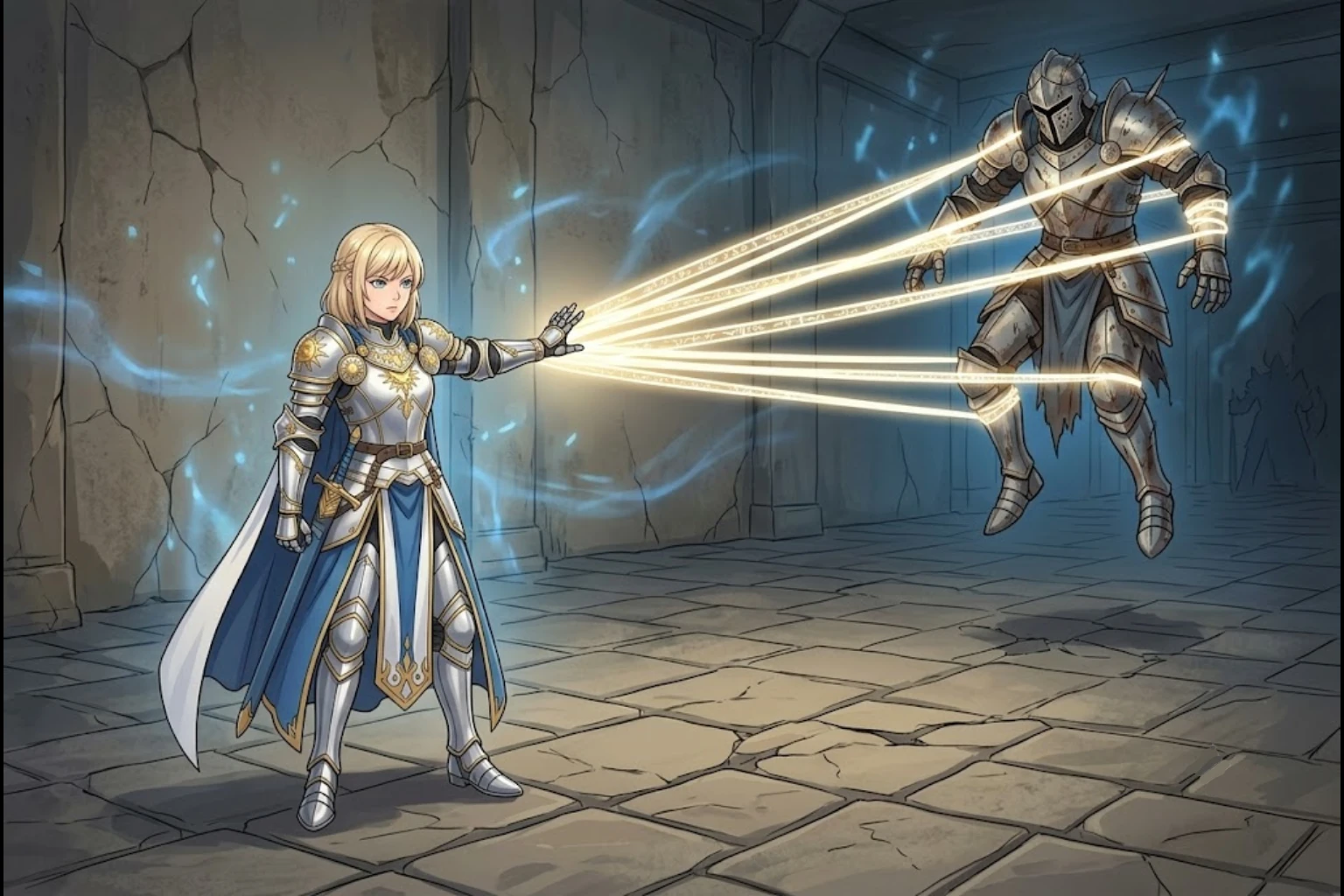
Not collapsed. Not crumbled. It stepped down, one foot finding the floor with a clang that rang off the vault, then the other foot, and then it was standing, and the empty visor swung toward them, and the right gauntlet reached for the empty air beside the wall where a weapon should have been and found nothing.
The weapons were on the floor. Piled at the base of the far wall — swords, spears, maces — everything that would have been stacked separately from the armor displays. They were rusted solid. They had been rusted solid for years, maybe decades.
The second suit stepped down. The third. Down the line, left to right, iron bracket after iron bracket releasing with a sound like a bell struck badly, each suit finding its feet in sequence, until all twenty were standing and the chamber was full of the sound of dead metal breathing.
Then blue light ran through them like lightning through a fence.
It came from the floor — from the flagstone pattern, old wards laid into the stone itself, the blue-white of war-magic that had been stored and waiting, and it ran up through the armored feet and through the legs and through the chest pieces and lit the visors from behind and the weapons on the floor dragged themselves across the stone in a screaming scrape of rusted metal and rose to gauntleted hands and the rust burned away in the blue light and the edges came clean.
"Back," Elara said, sharp and flat. "Brakka — center."
He was already moving.
On the dais, the captain suit turned its helm toward the door.
It raised one arm. The gauntleted fist opened.
And it said — in a voice that had no lungs behind it, no throat, no living body, only the shaped memory of a voice pressed into enchanted steel by whoever had built this thing — one word.
*"Hold."*
The command in it was absolute and old and aimed at soldiers that had been dead for decades. It expected compliance. The room expected compliance. Twenty armored shapes turned toward the door in the same instant, weapons rising, and the door frame shimmered and the light at the threshold changed quality and Lucian said, with the particular controlled calm of a man reporting a professional problem:
"The chamber has sealed. I have perhaps three minutes to counter it before the lock becomes permanent."
"Do that," Elara said. "Everyone else — work."
---
Brakka hit the first three before they finished closing the distance.
He came off the left side of the door frame at an angle, shield driving into the lead guardian at full momentum, and the suit — dead metal, nothing inside, no give of muscle or bone — went back into the second one behind it and they both went into the third, and the sound of it was enormous in the sealed chamber, the crash of plate on plate on flagstone, and Brakka was already turning to find the next one.
He was not fighting to win. He was fighting to hold the space — to keep the mass of them from forming up, to stop twenty from becoming a wall, to ensure that whatever Elara needed to do she had room to do it. He swung the tower shield like a bludgeon, corner-first, into a helmet and the helmet caved and the suit went down and he stepped over it without looking.
"Left side, three advancing," Elanor said, from somewhere above him.
He looked left. Three. He went left.
Elanor was not on the floor. She had gone up the right-hand wall at the moment the chamber sealed — there were brackets along the wall above the armor displays, empty now, and she had used them as handholds, smooth and fast and without apparent effort, until she was eight feet above the melee with a clear angle on the room. She had an arrow to the string before any of the guardians had thought to look upward, which was the advantage of fighting things that had been built to fight at floor level.
The first arrow went through a visor slit and hit whatever the blue light used as a core, and the suit dropped mid-stride.
The second went into the joint between a gorget and a pauldron, the weak point there on that particular pattern of kingdom plate — she knew it because she had spent years learning the weak points of every piece of kingdom gear that might be turned against a party in a dungeon — and the arm dropped, useless, the weapon clanging on the stone. Third arrow, ward crystal. She could see them now that the suits were active — nodes of blue light embedded in the chest pieces, the source of whatever kept them moving. She adjusted her aim.
"Crystals in the chest," she said, in the even voice she used to give information during a fight, not loud, not urgent, calibrated to carry to the party and nobody else. "Below the gorget, above the sternum. Covered on the front — side and rear aspect are exposed."
"Good to know," Dovar said, from somewhere behind two guardians who had cornered him against the left wall.
He was not in trouble. He was occupying two of them, which was the correct use of a dwarf cleric in a melee — not to win those fights, but to own the space and keep the threats accounted for, and he had his warhammer in both hands and was making a very clear case for the left wall being his. When the nearest guardian got its sword down toward his shoulder he stepped inside it and let the blade scrape off his shoulder guard, and the blue fire of the blade edge hit his pauldron and the curse in it began to spread and he said, through his teeth, a short, specific word of counterclaim against the divine register, and the curse-fire went out.
"Coming off blades," he said, louder now. "Don't let it hold contact."
Elara was at the center of the room.
She had let Brakka open the space, trusted Elanor to thin the numbers from above, trusted Dovar to manage his wall and call the hazards — and she was moving through the gap all of that created, not fighting the common guardians, leaving them to the others, going directly for the dais.
The captain had not moved from its position. It stood on the low platform with the stillness of something that did not need to come to you, that simply waited for you to arrive. Its great sword was in its hand — longer than a standard issue, the blade broad and dark and crackling with old war-magic that was not blue but deep purple, the specific color of warding enchantments pushed past their original purpose. The interlocked keys on the helm caught Lucian's light and threw small bright fragments across the wall behind it.
It was watching her. There was nothing behind that visor that could watch anything, and it was watching her.
She came within binding range and stopped.
Her oath magic was not flashy. It was not the bolt-from-heaven dramatics of a battle-temple paladin or the radiant sunburst of high-church divine work. It was a contract enforced — the specific, structural power of a paladin whose gift was command, whose magic ran along the lines of authority and obligation rather than light and fire. When she invoked it the air didn't crack or flare. The space between her and the captain simply became something it could not cross. A boundary drawn in covenant language, older than the war, older than the kingdom's ward-work, the kind of authority that didn't argue with enchanted steel so much as predate it.
The captain raised its great sword and stepped forward and hit the boundary and stopped.
It did not understand stopping. It tried again, the same step, the same swing, and stopped again. The purple light of the sword flared against the boundary and scattered and Elara held her ground and held the line and felt the cost of it running through her palm and up her arm in the slow burn of sustained oath-work, which was the price and she had always been willing to pay it.
"Bound," she said, through her teeth.
"Understood," said Lucian, still at the door frame, both hands on the stone, his light fluctuating as he worked — his attention divided in the particular way Lucian's attention divided in complex magical problems, which was not a reduction of focus so much as a redistribution of it across several layers simultaneously. The chamber lock was war-era kingdom work, specific patterning he knew well, and he was taking it apart the way you took apart any lock — not by forcing it but by understanding it well enough that you could simply open it. "One minute," he said.
Odo played.
He had found a position behind Brakka's path of movement, not against a wall but in a pocket of open floor that the ogre's controlled chaos had created and maintained, and he played from there — not the heroic soaring kind of battle-music that songs about battles always described, but the low, rhythmic, precisely timed work of someone who understood that sound was structure, that a formation of animated armor was as susceptible to rhythm as anything else that moved, that if you found the frequency at which a set of enchanted joints had been calibrated to march and you put a dissonant interval into that frequency at the right moment, you didn't break the armor, you broke the coordination.
Two guardians on the right side stumbled simultaneously, not from any physical blow, just from the rhythm going wrong under them for a quarter-beat. Brakka, who had been fighting long enough to recognize opportunity by its shape regardless of its source, hit them both while they were finding their footing.
He fought with an economy that was almost peaceful. No wasted movement. No drama. He had learned years ago that the work of being the wall was the work of conservation — every swing had to be worth its energy cost, every position had to be the right position, and the shield was as much a weapon as the axe if you held it correctly. He was not winning the room by himself. He was holding the room open for the party to win it, which was what he was for, and he was very good at what he was for.
Three minutes in, there were six guardians still standing.
Four minutes in, there were two, and Elanor had both of them marked.
Her fifth arrow went into the exposed rear crystal of the last standing guardian, and the blue light died, and the suit clattered to the floor and lay still, and the room went quiet except for Brakka breathing and Dovar muttering a closing word over the curse-burn on his shoulder guard.
The captain was still standing on the dais, great sword raised, pressing against the boundary with the patient, inexorable pressure of something that did not know how to stop. The purple light of its sword had dimmed. It was running down, slowly, the way a fire runs down when the fuel runs out.
"Lucian," Elara said.
"Done," he said, at the door frame. The shimmer at the threshold vanished. The door swung open an inch on its own, the lock releasing. "The chamber is unsealed."
Elara held the binding for another thirty seconds, watching the captain's sword light dim further, watching the movement in the dead limbs slow to a shudder. Then she stepped back, precisely, and let the boundary drop.
The captain stood still for a moment that stretched. Then, with the grinding finality of a machine running out of power, it lowered the great sword, and lowered its arm, and was still.
The blue light faded from the ward crystals across the room. The fallen armor stayed fallen.
Silence.
Dovar walked through the scattered wrecks of guardians, nudging a helmet with his boot to confirm it wasn't getting back up. He stopped beside Elara and looked at the captain on the dais — the purple light in the chest almost entirely gone now, a last slow flicker.
"That," he said, with a dwarf's compact sense of editorial, "was a good room."
"Don't compliment the dungeon," Odo said, settling his lute across his knee and checking the strings.
"I'm complimenting us."
"That's fine," Brakka said. He rolled his shoulder once, experimentally, and then lowered the shield. Nothing broken. Good enough.
Elara was looking at the door at the far end of the chamber — a second door, this one smaller, set deep in the rear wall, no ward shimmer on it, no locks visible. The residue trail from the creature's passage went under it.
She started to say something — to give the next direction, the next move, the forward step that was always her job — and then from below them, from somewhere deep beneath the flagstone floor, from a direction that was simply *down* and *far* and *old,* a sound rose through the stone.
A horn.
Not a war-horn, not a signal horn, not anything designed for a human mouth. A chamber horn, built into the dungeon itself — she had read about them, years ago, in a field report from the first campaign's advance scouts: *deep-trigger alarms, set to activate on significant magical disturbance within the complex, carrying through the stone to wake whatever the dungeon's builders had placed at the lowest level.* She had read that report. She had filed it. She had never heard one before.
It lasted four seconds, resonant and dark, rising through the soles of their boots, through the floor, through the wall of the captain's chamber, and fading.
The party stood in the wreckage of twenty suits of armor and the silence after the horn and nobody spoke for a moment.
Then, from somewhere far below, in a part of the Underbreach they had not yet reached, had not yet mapped, had not yet set a sunburst mark for —
Something answered it.


.png)
.png)
.png)