%20(1).png)
Dawn in Ashfen came gray and cold, the kind of morning that arrived without ceremony and made no promises about the afternoon.
The village was already awake. Farming villages at the edge of harvest were always awake before the light, moving through the first tasks of the day by memory and lantern, and Ashfen was no different — but this morning there was a particular quality to the wakefulness, the way people paused at their doors and looked east before going about their work. Not staring. Just checking. The way you check a weather vane when the wind has been doing something you don't understand.
The First Party was in the road by the time the sun cleared the ridge.
Toven had sent them off with bread and hard cheese and a clay jug of something hot that Dovar identified, after a careful sniff, as mediocre tea made better than it had any right to be. He'd said nothing when they'd settled their packs and checked their gear in the inn's yard, just watched from the doorway the way the whole village watched everything, that careful Ashfen economy of attention that gave nothing away until it had to.
Harven's farm was two hundred yards off the east road, visible through a gap in the hedgerow — a solid stone farmhouse with fresh board across the shutters on the ground floor. Not in disrepair. Not abandoned. The boards were new wood, pale against the old grey stone, put up with the focused urgency of a man who had decided something and acted on it. There was smoke from the chimney, which meant people inside and a fire lit. Which meant they were awake and staying in.
Elara looked at the farmhouse as they passed the gap in the hedge.
"We'll speak to the girl when we come back," she said.
"If she'll talk," Dovar said.
"She'll talk," Odo said, from behind them. "She ran home and told her father what she saw. She didn't invent it and she didn't minimize it. She wants someone to know." He paused. "She just wants to be believed first."
Nobody argued with that.
The war-road ran east along the base of the ridge for a mile, then began to climb. Not steeply — the old kingdom's road engineers had been thorough about grade — but enough that the fields dropped away below them and the ridge opened up overhead, scrub oak and limestone outcroppings and the occasional twisted stand of hawthorn that had been old before the war. The road surface up here was worse than in the village. The frost-heave was worse. In two places it had cracked straight across, a clean fracture in the old stonework, and the cracks ran at angles that had nothing to do with ice or settling.
Lucian crouched at the second crack without breaking stride — just slowing, dipping down, running two fingers along the edge of the fracture, then straightening and walking on.
"War-magic," he said. "Not recent. But the crack's been widening. You can see where the old edge was." He didn't elaborate. He didn't need to — they'd all seen war-magic damage before, and they all knew what it looked like when the ground hadn't finished settling after two years.
"How wide was it before?" Elara asked.
"A finger's width, maybe. Now it's three." He adjusted his spectacles. "The ground here is still releasing. Like an echo."
Dovar made a low sound that was not quite a word. He was looking at the road ahead, at the way the crack continued up the slope and disappeared into the limestone. "Like an echo," he repeated. "That's cheerful."
They walked on.
---
Elanor stopped without warning.
She did it the way she always did — not a sudden halt, not a flinch, but a gradual subtraction of momentum, as if she'd simply decided to be standing still rather than walking, the transition so smooth that it took the others a half-second to register it had happened. By the time they'd stopped around her she was already crouched at the left edge of the road, one knee down, her eyes moving across the ground with the particular focus of someone reading text in a language most people had never learned.
The road here was old enough that the mortar between the stones had accumulated dirt over decades — not mud, but the compressed, layered accumulation of road dust and leaf matter and the passage of many feet and wheels and hooves over many years. A natural surface layer that was, for someone like Elanor, a record.
"Two sets," she said. "Something went out. Here, and here." She pointed at two distinct disruptions in the surface layer, barely visible — a compression pattern, a disturbance in the line of settled dust along the crack between two stones. "The stride is wrong for anything I'd call natural. Too long for the weight, or too heavy for the stride — one or the other, I can't tell which yet. It went north off the road. Into the scrub."
She moved laterally three feet without standing up, shifted her angle, pointed again.
"Then it came back. Same night, I think — the dew pattern on both sets is the same. It went out, it came back, and it went back in." She looked up at the north mouth.
The rest of them looked.
The entrance to the Underbreach was set into the base of a limestone cliff face forty yards off the road, half-obscured by two years of unchecked hawthorn growth that had crept up the rock face in the way hawthorn crept everywhere it wasn't cut back. It would have been invisible from the road to anyone who didn't already know it was there. The old seal — a fitted stone door, single slab, inscribed with kingdom-era warding glyphs — had been intact, the last time any of them had seen it. It was not intact now.
The slab had cracked. Not cleanly — it had fractured from the inside, a spiderweb of breaks radiating from a point roughly at chest height on the right side, and the largest piece had shifted outward, leaving a gap eighteen inches wide between the broken edge and the door frame. Not wide enough for a person to walk through without turning sideways. Wide enough for something that didn't mind turning sideways.
From where they stood on the road, the gap was just shadow. No sound. No movement. The hawthorn branches across the cliff face were still.
"Right," said Dovar. He was already unshouldering his pack.
---
They moved off the road and through the scrub with the practiced ease of people who had done this kind of approach more times than they could count. Brakka went wide, circling to put himself between the cliff face and the road — not close to the entrance yet, just establishing the geometry, making himself the thing that stood between whatever might come out and wherever they needed to fall back to. He set his shield on his arm and stood, and became, to all appearances, a piece of terrain.
Elanor went along the cliff face, parallel to it, crouched, reading the ground as she moved. She marked two more track sets with a gesture — hand out flat, two fingers pointed, and they all noted the locations without speaking. She worked toward the gap in the broken seal and stopped six feet from it, listening with her whole body.
Lucian approached the door slab directly. He stood in front of the cracked stone and looked at the warding glyphs the way he looked at everything — with the specific, patient attention of a man who was letting the object explain itself. The glyphs were kingdom-era work, old standard, the kind of thing any competent court mage would have set on a sealed dungeon during a military campaign. Designed to contain, to warn, to notify the relevant authorities if the seal was broken. He touched the stone beside the largest glyph with two fingers.
"The notification ward failed first," he said, quietly, to no one in particular. "Probably eighteen months ago. The containment held longer — but it was a physical ward, not an active one. It was designed for the door. Not for what happens to the door if the rock around it shifts." He traced a line in the air along one of the cracks. "The fracture propagated from outside. The ground movement opened the door; the creature inside didn't force it. It simply — found it open."
"So it didn't break out," Elara said.
"It walked out," Lucian said. "Which is different."
Dovar had gone down to one knee at the base of the cliff face, both hands flat on the ground, his eyes closed. This was not a posture he adopted for effect — he had stopped caring about effect approximately forty years ago — but because the particular kind of divine sensing he was doing worked better with direct contact and minimal distraction. He stayed that way for the time it took Elanor to complete her circuit of the entrance and return.
Then he opened his eyes and stood up, brushing limestone dust from his palms.
"Curse residue," he said. "Old. War-era. Nothing fresh, nothing active — whatever was bound in there, it wasn't bound with a curse, it was bound with a ward, and the ward is gone." He looked at Elara. "The ground itself has been soaked in enough old war-magic that I can't get a clean read on anything specific. But nothing is actively reaching out. Nothing is trying to touch us."
"Yet," said Elanor.
"Yet," Dovar agreed, without inflection.
Odo had positioned himself eight feet back from the entrance, between Dovar and the road. His eyes were closed. He was not listening with his ears — or not only with his ears — but with the trained, expanded sense that a battlefield bard developed over years of learning to feel the shape of a space before he put sound into it. Magic left resonance, the way a bell left resonance after the ringing stopped. A sealed dungeon with decades of ward-work in the walls would hum with it, even after the wards failed. Even, sometimes, especially after they failed — the way a broken instrument sometimes rang in frequencies a whole one wouldn't.
He opened his eyes.
"There's a song in there," he said. "Not a real one. The residue — the shape of what was put in those walls. It's — discordant now. Like a chord where someone has changed two of the strings without retuning the rest." He looked at Lucian. "There's something alive in the resonance. Not the wards. Something underneath them."
Lucian looked at him steadily. "Underneath the wards," he repeated.
"The wards were the top layer. There's something older under them. Something the wards were put there specifically to contain." He paused. "And the wards are gone."
Silence. The hawthorn shifted in the morning wind.
"So we go in," Elara said.
It wasn't a question. They all knew it wasn't a question. The shape of the situation had been pointing at this conclusion since the farmer had turned around at the inn last night, and they were people who went in. That was the oldest and most essential thing about them. They went in.
Brakka moved from his position at the road and came to the entrance, and this time there was no door to calculate — the gap in the broken slab was wide enough for him if he turned, and he turned without ceremony and went through. One hand on the edge of the stone, a small cascade of grit from the top of the frame. Then he was inside, and the darkness had him.
The others followed in order. Elanor. Dovar. Lucian, pausing to cast a soft light — a pale gold sphere that rose to head height and stayed, steady, without being asked to do anything dramatic. Odo last, ducking through the gap with one hand on his lute to keep it from catching on the stone.
Elara went second to last, just ahead of Odo. She put her hand on the broken edge of the door slab as she came through, feeling the rough stone under her palm, the sharp edge of the fracture.
Then she was inside.
---
The Underbreach opened up behind the north mouth into a vaulted antechamber, the ceiling lost in shadow above Lucian's light. The walls were limestone, worked but not finished — the surfaces had been flattened and squared, the worst of the irregularities chipped away, but no one had bothered to plaster them. Dungeon construction, practical. The floor was flagstone, older than the walls, which meant it had been here before the dungeon was built around it, which meant there was something older at the bottom of this complex than the war-era sealing, and Lucian was already looking at the floor with an expression that suggested he found this professionally interesting and personally concerning.
The air was cold. Underground cold, cave cold, the specific temperature of stone that hadn't felt sunlight in decades. And it carried a smell — not rot, not mold, not the sharp tang of active magic. Something more basic than all of those. The smell of a space that had been closed for a very long time and had accumulated only itself.
Brakka had moved to the far side of the antechamber and positioned himself at the corridor opening, shield up, not advancing. Holding the threshold. Elanor was moving along the left wall, reading the floor as she went, and her face said she was finding things.
"It came this way," she said, low. "And went back this way." She crouched at a dark streak on the flagstone. "Whatever it is, it's not bleeding — this is something else. Residue from the passage itself. Like it's leaving a trace without meaning to."
"Can you follow it?" Elara asked.
"Easily." She didn't say it with pride. Just as a fact.
Dovar was moving along the right wall with his hand out, palm facing the stone, not touching it — reading it the way a smith reads metal, by proximity and sense. He stopped at a section of wall and frowned.
"There's old work here. Old old — not war-era. Older than the kingdom standard." He pressed his palm flat. "Someone bound something here before the kingdom troops arrived and set their wards on top. Like building a new wall in front of a door you don't want people asking about." He looked at Lucian. "You're going to want to look at this."
"I am already looking at it," Lucian said, from four feet away, his light floating closer to the wall. "Give me a moment."
Odo had stopped in the center of the antechamber, still, his eyes moving slowly around the space. Listening. The resonance was stronger in here — not painful, not threatening, but present, the way a low note on a large instrument was present. You felt it before you heard it. He could taste the shape of what had been in this room, the long weight of something contained. He did not yet have language for what it was.
Elara moved through the antechamber toward the corridor mouth where Brakka stood, checking the angles, marking the ceiling height, noting the two alcoves on the right-hand wall — empty, iron-fitted, the brackets still there for torches that were long gone. She put her hand on Brakka's arm as she came up beside him, a brief contact, and he shifted an inch to give her the sightline into the corridor.
Dark. Still. Lucian's light didn't reach far enough from the antechamber.
She looked back at the room — Elanor, Dovar, Lucian, Odo, all working, all exactly where they should be — and then she turned back to the corridor.
And she saw the mark on the wall.
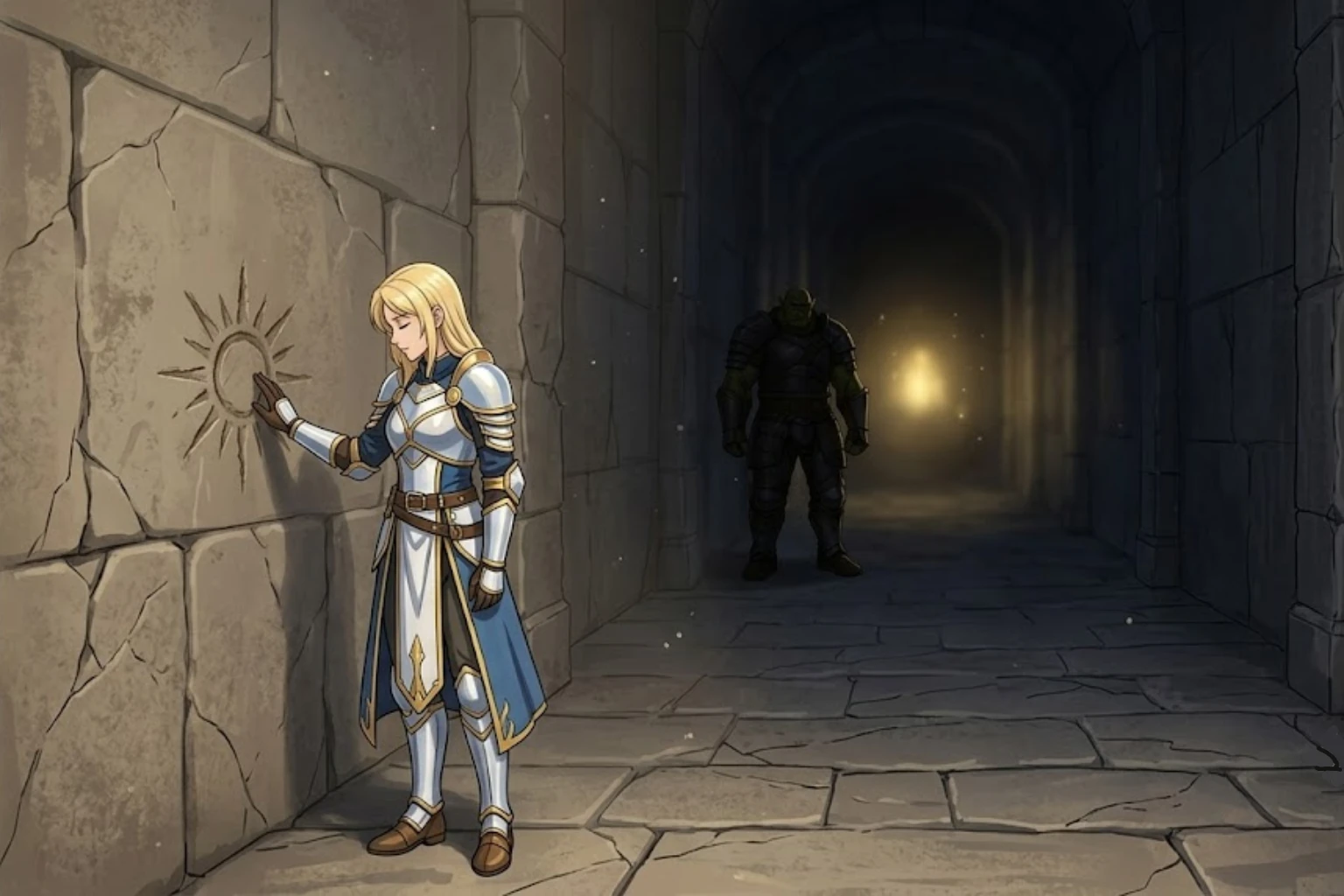
It was at shoulder height, to the left of the corridor mouth, on a flat section of limestone that someone had smoothed some time ago with deliberate effort. Not a symbol. Not a ward glyph. Just a shape, cut into the stone with the point of a knife, the way you cut something when you want it to last: a small sunburst, six lines radiating from a central point, rough but deliberate. The kind of mark you made when you were moving fast and needed to know, if you came back this way, that you had been here before.
Elara went very still.
Then she reached out and put her fingers against it. The cuts were old. The edges had weathered and accumulated grit. But the shape was precise — she knew the shape precisely, because she had made it.
The party noticed. They noticed the way they always noticed things about each other — not all at once, but in sequence, each of them picking up the stillness from the corner of their attention and looking toward it. Brakka first, because he was closest. Then Elanor. Then Dovar, who stopped moving his hand along the wall. Then Lucian, who looked up from the stonework. Then Odo, who had been listening to the room and now listened differently.
Nobody spoke.
Elara's fingers rested against the sunburst mark. She felt the cut edges under her fingertips, the particular depth and angle of a strike she had made in this corridor — how many years ago now? Six. Seven. In the first campaign, when the roads to the keep were still being mapped, when they had gone as far as anyone had gone and not yet far enough, when someone had said *we should mark how deep we reached in case we have to find this passage again* and she had taken her belt knife and cut six lines into the wall and thought: *we'll be back.*
She hadn't known, then, that it would be the Hero Party who came back. She hadn't known she was marking the passage for someone else's use.
She took her hand from the wall.
"We've been here before," she said. One line, even, addressed to the corridor and not the party, and then she moved forward into the dark.
Behind her, after a moment, Lucian brought his light.
The First Party walked deeper into the Underbreach, and the sunburst mark on the wall watched them go, six lines in old stone, patient as everything else down here, waiting to be passed again.


.png)
.png)
.png)