%20(1).png)
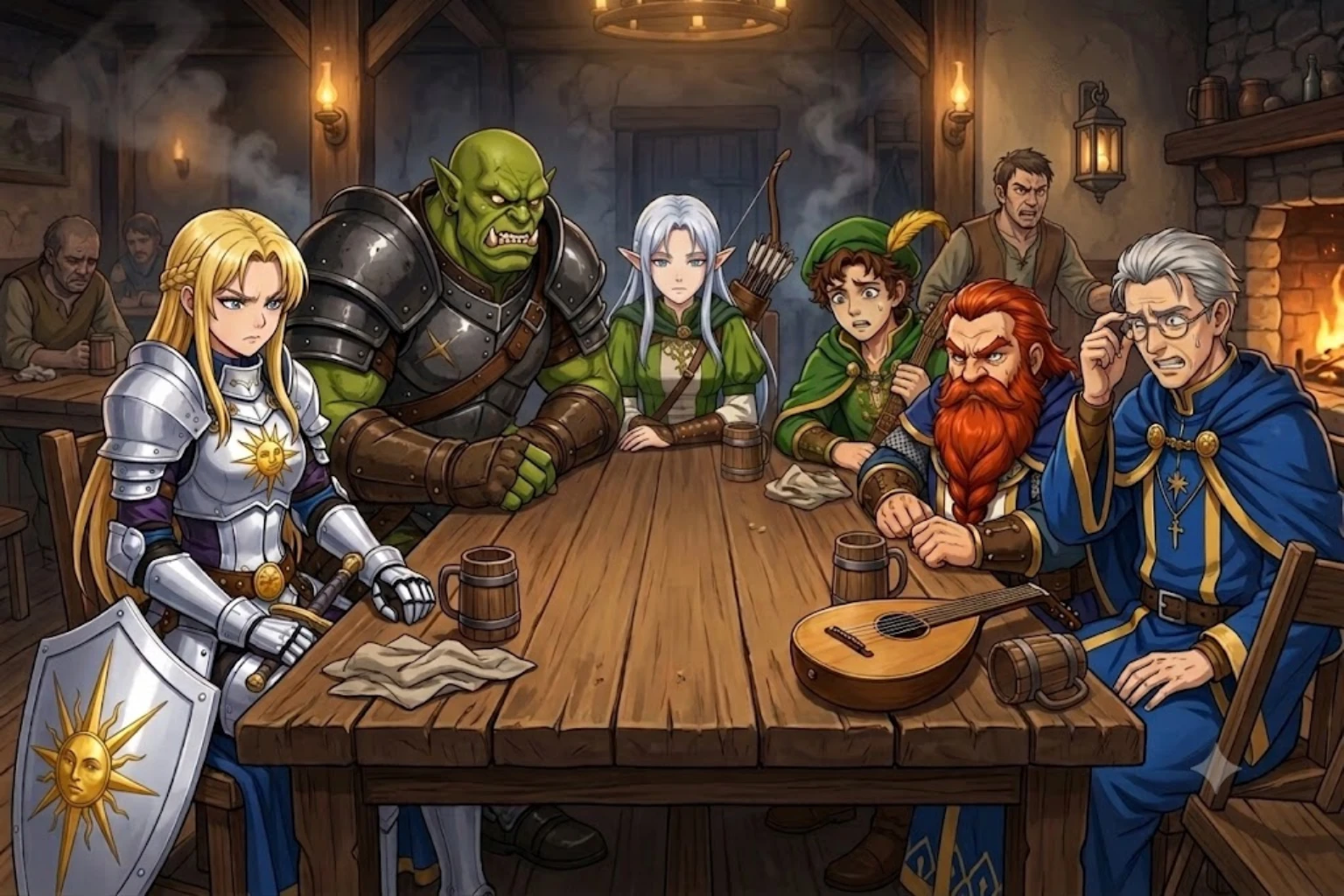
The war-road east of Millhaven hadn't been properly maintained in two years, and it showed.
The cobblestones were still there — the old kingdom had built its roads to last and they'd outlasted plenty of kingdoms — but frost-heave had buckled the edges and nobody had come to reset them. Weeds had pushed through the mortar. In two places the road dipped where the ground beneath it had shifted, drainage ditches gone uncleared, water finding its own way. Before the war those dips would have been patched by the following spring. There were people whose job it had been, small crews moving road by road, maintaining the kingdom's reach. After the war there were fewer people and more road and the math had stopped working out.
Elanor noted this without commenting on it. She noticed most things without commenting on them. She moved at the front of the column, slightly left of center, reading the road the way she read forest trails — not looking at it directly but letting it exist at the edge of her attention while she watched the fields on either side and the tree line beyond and the particular quality of the sky above the low ridge to the east that suggested the wind would shift before nightfall.
Behind her, the road gave a clear picture of the others by sound.
The deep, settled rhythm of Brakka's stride. He was the heaviest thing on the road by a significant margin, but he walked without violence — not the crashing weight of something too big to be careful, but the measured tread of something that had learned to carry itself. The tower shield on his back was slung and strapped so it didn't shift. He was the reason the farmhands at the field's edge were going to stop what they were doing when they rounded the next bend.
Behind Brakka, Elara's lighter step, the small chime of her pendant against her breastplate when she moved. Then Dovar's dwarf-heavy, no-nonsense pace, each boot coming down with the same flat conviction, like a statement being repeated. Then Lucian, uneven — faster than you'd expect, then slowing for no visible reason, then faster again, his attention somewhere in the journal he was reading as he walked, which was a habit Dovar found infuriating and Elara had long ago decided was safer than arguing about. And last, quiet as a question, Odo.
The hobbit was not small the way children were small. He was small the way a knife was small — compact and without waste, built for exactly what it was built for. His lute was on his back, his eyes were moving, and he had the faintly amused expression of a man who had walked enough roads in enough company to find the whole enterprise interesting rather than exhausting.
"How far?" Dovar asked.
"Sign back said seven miles to Ashfen," Elara said. "We've done four."
Dovar considered this. "Fine."
"You asked the same thing an hour ago," Odo said.
"I know. The answer was different then."
The road curved around a stand of old willows, and the first of Ashfen's fields opened up to the right — a patchwork of harvested wheat and late-season root crops, the rows running straight and deliberate, the kind of order that spoke to generations of people working the same ground. A low stone wall ran along the road's edge. A crow watched them from a fence post and decided they weren't worth the energy.
Then the two farmhands saw Brakka, and one of them dropped a fence rail.
---
Ashfen was small and knew it, which gave it a particular kind of dignity.
Two rows of stone and timber houses along a packed-earth main road, built close against each other the way that villages this age built everything — shared walls keeping the heat in, shared alleys keeping the mud somewhere manageable. The mill at the northern end was old and solid and still turned. The chapel to the Lightbringer was modest, recently repointed along the south wall, the effort suggesting a community that couldn't afford a stonemason but had done it themselves and done it correctly. The public well at the center of the road had a new rope on the windlass and four children sitting on its edge, all of whom stared at Brakka with the specific intensity of children who had not yet learned to pretend they weren't staring.
The harvest was mostly in. That was the bone-deep tiredness in Ashfen — not poverty, not misery, but the particular exhaustion of people who had been working since before sunrise for six weeks and could smell the end of it and were not there yet. Barrels stacked beside doorways, grain sacks waiting for the mill, the good heavy smell of turned earth and dried straw. A woman in a doorway was mending harness leather with the focus of someone doing a necessary thing in the last of the good daylight. An old man on a bench outside the cooper's shop watched them pass with the evaluating patience of a man who had seen everything at least once and was reserving judgment on whether this was that.
Nobody came out to welcome them. Nobody came out to warn them off. They were simply watched, the way the village watched the weather — carefully, from a distance, waiting to see what it was going to do.
Odo walked with his eyes moving across all of it. The harness woman. The old man. The children who had abandoned the well and were now trailing at a distance, which he'd noticed without needing to look. The shape of the village common — how long the evening shadow fell from the mill, which buildings had light in their windows already, which households were still outside in the last of the afternoon. He read villages the way Elanor read roads.
"Tired place," he said quietly.
"Good tired," Elara said, just as quietly. "The kind that comes from work."
"Yes," Odo agreed. "That's what I meant."
The Millepost Inn was at the center of the village, its name explained by the iron post planted outside it, painted with faded distances to larger towns — Millhaven, seven miles; Brackton, fourteen; Durnfeld, twenty-two. The post had been there long enough that the village had grown around it rather than the other way around. The inn itself was old stone, low-ceilinged, with a sign above the door that swung in the first cold push of the evening wind.
Brakka stopped outside it and looked at the door.
The door was the right height for a tall man. It was not the right height for Brakka. He looked at it the way he always looked at doors, which was the look of a creature making a precise structural calculation and accepting the result. Then he took off his shield, turned sideways, and went through. There was a soft collision at the top of the frame he didn't react to.
Inside, the room went quiet table by table as people noticed him.
---
It was half full — farmers at the end of their day, a couple of road merchants by the look of their coats, two local boys nursing ales too slowly at the bar, the way young men do when they're waiting to see if anything happens. Woodsmoke, good stew, the low sound of conversation that drained out by the time the rest of the party had filed in.
The innkeeper was a thickset man in his fifties, grey at the temples, with the appraising stillness of someone who'd learned to take the measure of strangers before he decided how to speak to them. He looked at Brakka. He looked at the tower shield, now held at Brakka's side. He looked at Elara, who had stepped up and met his eyes.
"Lodging for six," she said. "Supper, if there's enough."
"There's enough," the innkeeper said. His name, it turned out, was Toven. He was fair about the rooms — he gave them the east side, two doubles and a single. He had started to say something about the barn for Brakka and thought better of it, which Brakka noticed and chose to say nothing about. Instead, Toven arranged for the large storage room off the back hall to be cleared and a proper bed moved in before dark, and he offered it without apology, which was the right way to do it.
"Thank you," Brakka said, and meant it.
They settled at the long table nearest the hearth. Elanor took the seat with her back to the wall and a clean sightline to the door, Lucian opened his journal before he'd sat down, Dovar ordered ale and received it and drank with the focused satisfaction of a man reunited with something he valued. Odo laid his lute carefully under the bench, against his knee, close.
The room came back to life around them, quieter than it had been, with more side-glancing. Standard. Elara watched the fire and held her cup and let it be what it was. Villages like this had long memories and short patience for anything that complicated the life they'd built. She didn't blame them. She hadn't blamed a village for its suspicion in a long time.
It was Odo who heard it first. He always heard it first.
He went still — barely, the way he went still, which was less a stopping of movement than a redirection of attention so complete that everything else ceased. His head tilted, fractionally. Then he looked into his cup and his face did the particular thing it did when he was hearing music and had already formed an opinion of it.
Lucian noticed Odo, which meant he closed his journal without being asked.
Then the rest of them heard it.
From a corner table — a man sitting alone with what was probably his fourth drink, in the comfortable, unselfconscious way of someone who had crossed the threshold where awareness of audience stopped mattering — a voice came rough and low, half-humming at first, then shaping itself into words the way a mouth shapes words it's made ten thousand times, without needing to think:
*"Oh, gather round and hear the tale of heroes brave and bold,*
*Who set out for the Darkened Keep when the war was bought and sold—*
*They marched so fine, they looked so bright, their armor shined like dawn,*
*But when the dark came calling, boys — the First Party was gone."*
The room did not go fully quiet. It went listening, which was worse. Conversations dropped to a murmur. Heads didn't turn, or turned carefully, the way people look at something they want to watch but don't want to be caught watching.
*"Ran so fast they left their boots, ran so fast they left their swords,*
*Left the fighting to the Hero Party, left us all their pretty words—"*
"That's enough of that," said Toven, from behind the bar. Flat, not unkind.
The drunk looked up. He looked at the table by the fire. His face moved through several things — recognition, uncertainty, a flicker of something that might have become shame if he'd been two drinks fewer in — and landed on the soft, harmless vacancy of a man too far gone to manage whatever social calculation was required of him.
"No offense meant," he said, to the room in general.
No one said anything.
Brakka had not moved. His hands were flat on the table. He was looking at the fire. He would not move until Elara decided something, because that had always been how it worked between them — his instinct was to end things, hers was to choose whether they needed ending, and he'd learned a long time ago that her judgment about that was better than his. So he waited, the way he always waited. Still as stone and twice as patient.
Elanor was watching the drunk with a flat, unhurried attention.
Dovar was looking into his ale with the particular expression of a man who has swallowed something he wasn't going to mention.
Lucian had not put his journal away, but he wasn't reading it.
Odo was watching Elara. He was always watching Elara in these moments, not from concern — she didn't need concern — but because the way she handled them was part of the ongoing study he'd made of her across more years than he cared to count. She was going to do something. She always did something, and it was never the something anyone expected, and it was always right.
The silence had gone on long enough to become its own kind of statement. The whole room knew it. She let it sit one moment longer — not from cruelty, but because timing was everything, and she had always known where the moment was.
Then she picked up her cup, drank, and set it down.
"He's not wrong about the boots," she said. Mild, conversational, directed at no one. "I did leave a good pair behind."
Dovar made a sound that was not quite a laugh but functioned as one. Elanor's mouth moved. Lucian adjusted his spectacles and looked back at his journal with the air of a man who had just witnessed a technique he approved of. Even Brakka's shoulders — still carrying the question she hadn't answered until just now — settled downward, half an inch, the specific drop of a man standing down from something he'd been ready to do.
The drunk stared at her. He seemed to be working out whether he'd just been forgiven or dismissed, and was finding, correctly, that the answer was both. He turned to face the wall, picked up his cup, and did not sing again.
The room breathed. Conversations resumed their natural level. Toven appeared with a bread round and the first bowl of stew and set it in front of Brakka with the quiet care of a man offering something to a situation he was relieved wasn't worse, and Brakka received it with the uncomplicated gratitude of a creature that had eaten enough bad meals in enough bad places to mean it when he said thank you.
The fire crackled. Outside, the wind had shifted, as Elanor had predicted.
It was the older farmer woman two tables over — weathered face, rough hands, the particular directness of someone who had been working this land for forty years and had no patience for delay — who turned around without ceremony and addressed them.
"You're looking for work," she said. Not a question.
"If there is any," Elara said.
"There might be." She looked at Elara, then at Brakka, then back. Measuring, the way the whole village had been measuring them since the road. "The Underbreach. Old dungeon complex under the war-road, three miles east. Been sealed since the night of the final battle — we heard the explosion from here, half the sky went white, road cracked for miles in both directions. Whatever was inside, we assumed it went down with the rest." A pause. "Two nights ago, Harven's youngest saw something come out of the north mouth. She's fifteen and not prone to stories. She came home and Harven nailed the shutters and hasn't opened them since."
The table was quiet.
"What did she describe?" Lucian asked.
"Tall," the farmer said. "Wrong proportion. The way it moved, she said, was like something that had forgotten how legs worked and was remembering while it was doing it." She held Lucian's eyes steadily. "She's not a child. I want that understood."
"I believe her," Lucian said, simply.
Dovar set down his ale. "Wrong proportion. And the dungeon's been sealed since the final battle."
"Since the night of it," the farmer confirmed.
Lucian was quiet for a moment, in the way he was quiet when he was deciding how much to say. "The final battle produced an enormous release of destabilized war-magic. Wards that had been maintained for years — containing things, binding things — would have fractured in the discharge. Not immediately." He paused. "Some bindings don't fail at once. They erode. Two years is consistent."
The farmer watched him with the attention of a person who didn't need things explained twice. "Can it be stopped?"
The party looked at each other. The particular economy of people who had been doing this long enough that a look carried weight — Brakka waiting, Elanor already running the eastern ridge in her head, Dovar thinking through what he'd need to bring, Lucian already two problems deep, Odo watching all of it and waiting to see what shape it took.
Elara put her cup down.
"We'll look at the north mouth at first light," she said. "Keep everyone away from the war-road tonight."
The farmer nodded once — not with relief exactly, but with the plain, functional expression of someone whose problem had been acknowledged by people who might be able to solve it.
Toven brought the rest of the stew and did not ask any more questions.
The drunk in the corner had fallen asleep with his head on his arms. The ballad was done. The fire settled lower. Outside, Ashfen folded itself into the ordinary dark of a farming village at the end of a long day, shutters latching, lanterns burning down, the last few sounds of the evening fading until the only thing moving was the wind off the eastern ridge.
Three miles east, the war-road ran into the dark.
Below it, below the cracked and scorched earth that had never quite healed from the night the sky went white, the corridors of the Underbreach extended through the deep stone — old chambers, sealed passages, the faded remnants of wards that had once been carefully maintained and were now the barest tracery of their former shape. In one of those corridors, in the lightless space between a collapsed archway and the dust of what had been a door, something moved.
Not quickly. Not with purpose yet. The way a sleeper moves in the last minutes before waking — shifting, finding position, becoming aware in increments of the weight and shape of itself. It had been bound for a long time. It had felt the binding weaken over months, over seasons, felt it thin and fray the way old rope thins, felt the moment, two nights ago, when it finally came apart.
It had used the north mouth because the north mouth was closest.
It had not gone far. It was not ready yet to go far.
But it was remembering. In the slow, patient way of things that measure time in decades, it was remembering what it was, what it had been set to do, and what it had been interrupted from finishing.
In the morning, the First Party would come to the north mouth with their shields and their questions and their worn, experienced eyes.
And the Underbreach would be waiting.


.png)
.png)
.png)