%20(1).png)
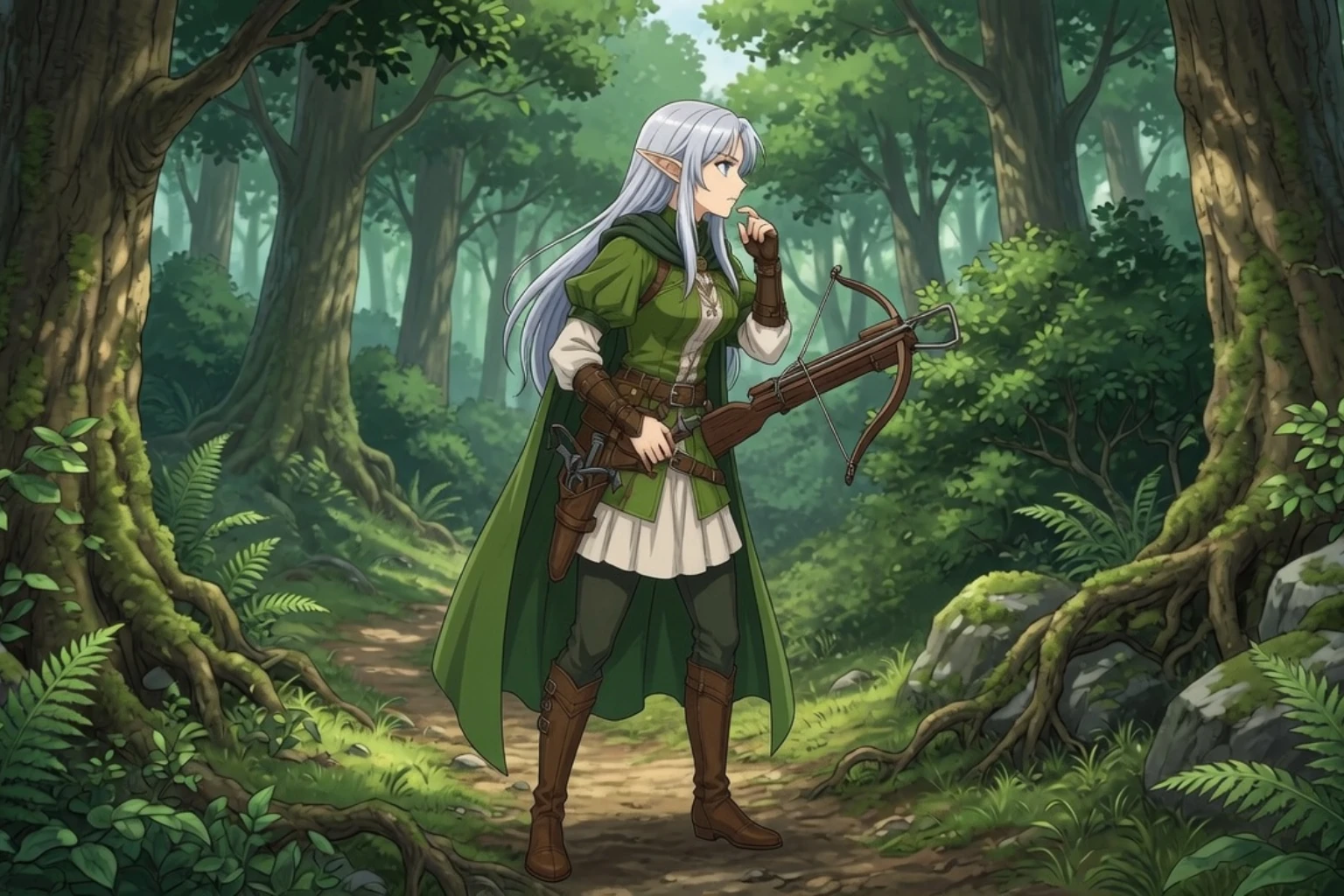
The Ashwood had a reputation as a safe forest.
This was not common. Most forests on the western roads had reputations that ran from neutral to actively discouraging, and the reputations were usually earned. The Ashwood was different — managed timber country, two generations of careful cutting and replanting, the kind of forest that existed in deliberate relationship with the three villages on its edge rather than in spite of them. The villagers took what the forest offered within limits they'd agreed to. The forest, in its non-sentient way, continued offering. There were deer and boar and a reliable river for fishing and the specific density of old ash and oak that the villages needed for building.
It had been managed this way for sixty years.
For the last four weeks, something had been wrong with it.
The party didn't learn this until they reached the first of the three villages — Thresh, at the Ashwood's eastern edge — and found the mood of a settlement that was watching something it didn't understand develop in the place it depended on. The village headwoman, a practical woman in her fifties named Calla who had the specific directness of someone who had been dealing with problems her whole life and had no patience for preliminary conversation, told them in about eight sentences.
Hunters weren't going into the deep wood anymore. Not because they'd been forbidden to go — because the animals that used to be in the deep wood were now in the shallow wood, packed in at the margins in a way that made no sense, leaving the deep wood empty in a way that also made no sense. And the animals at the margin were behaving wrong — spooked, restless, the deer bolting from sounds that hadn't previously bothered them, the boar behaving with the specific aggressive uncertainty of creatures that had been forced out of familiar territory and hadn't found comfortable territory to replace it.
"Something's in the deep wood," Calla said. "Something that wasn't there before. The animals know what it is. We don't."
"How deep does the Ashwood run?" Elanor asked.
"Four miles to the heart," Calla said. "The old shrine is at the center — pre-kingdom, we don't tend it, it's just always been there. The river runs past it."
"Has anything come out of the deep wood?" Elara asked. "Besides displaced animals?"
Calla looked at her steadily. "Not yet," she said. "That's why I'm telling you."
---
The party entered the Ashwood at the second hour of the morning, while the light was still the pale grey of a forest before the canopy committed to the day.
Elanor went first, which was always how they entered forests. Not by arrangement — by the gravity of the situation pulling the right person to the front. She moved at the pace of someone reading a text, which was exactly what she was doing. The forest was a text, and it was a text that had been written on by something that didn't belong here, and she was reading for that writing.
The shallow wood told the first part of the story.
It was crowded. Not visibly crowded — the forest looked like a forest — but the density of animal sign was wrong for the space. Too many prints in the soft ground at the stream crossings. Too many rubs on the saplings where the deer had been marking, packed together in a section that would normally have sustained a fraction of this population. The boar wallows were churned to mud from overuse, the surrounding ground compacted by repeated passage.
"They've been here for weeks," she said, stopping at a wallow to read the layering of the prints. "The older sign is underneath. Whatever pushed them out of the deep wood, it happened gradually — they moved over days, not all at once."
"Gradual displacement," Lucian said, from behind her. He was doing his version of reading the forest, which was less about the ground and more about the quality of the light and the air and the specific quality of the magic that saturated old managed woodland. "Whatever moved in wasn't sudden. It's been establishing itself."
"Establishing itself how?" Dovar asked.
"That's what we're going to find out," Elara said.
They moved deeper.
---
The transition from shallow to deep wood was not a line but a gradient.
The crowded displaced animal sign thinned as they went further in — not because the animals were present in fewer numbers, but because the animals were no longer present at all. The margin between populated and empty was roughly a mile from the edge, and on the deep side of that margin the forest had a quality that Elanor registered immediately and spent several minutes trying to name precisely.
Not corrupted. Not wrong in the way of war-magic or curse-residue or the specific bad feeling of a place where something terrible had happened and left its mark. The Ashwood's deep section felt more like a room that had recently been occupied by something very large — the absence not of wrongness but of everything else. The normal small presences of a healthy forest, all the minor life that filled a wood's spaces — the birds, the insects, the rustling that came from things moving in the leaf litter — were gone. Not dead. Just elsewhere.
"Nothing's nesting," she said, stopping at a stand of old ash where the branches should have been active. "No birds in this section. They haven't been here for at least a week."
"What kind of creature clears birds?" Odo asked. He was looking up into the canopy with the expression he used when he was listening to a space and finding it deficient.
"Most large predators don't," Elanor said. "Birds avoid specific threats but they return. Whatever this is, the birds have decided that remaining in the vicinity is not compatible with continuing to be birds." She moved to the next tree, read the bark, moved to the next. "No insect activity on these trunks either. Something has changed the chemistry of this section of the forest."
"Scent," Lucian said. He had his focus-staff out — not raised, just in hand, the posture of a mage who was reading the ambient magic of an area. "There's a marking behavior. Something has been moving through this section repeatedly, leaving a territorial trace. I can feel the residue of it in the undergrowth."
"What kind of creature?" Elara asked.
"Old," Lucian said. "The residue has the texture of something that has been alive for a very long time. Not a young predator establishing new territory. Something that has had territory before, probably extensive territory, and has been displaced from it." He paused. "Which is interesting."
"Because something displaced the displacer," Dovar said.
"Because something displaced the displacer," Lucian agreed.
Elanor had moved ahead while they were talking. She stopped at a point where a deer trail crossed a section of soft ground and crouched over the prints.
"Here," she said.
The prints were large. Not the largest she'd ever seen — she'd seen wyvern prints and the ground sign of creatures that made these look modest — but large for a forest, for a creature moving between trees rather than across open ground. Four-footed, the gait pattern of something heavy and deliberate. The rear feet overstepped the front feet by six inches, which was a specific walking pattern associated with patience and confidence — the gait of something that was not hurrying because it did not feel the need to hurry.
"Forest troll?" Dovar said, reading the prints beside her.
"Larger than a forest troll," she said. "The stride is longer and the depth of the impression is too great for the foot size — this animal is denser than it looks from the track. And forest trolls mark with musk at shoulder height. Whatever this is marks at—" she stood, moved to a nearby trunk, pointed at a smear of dark resin-like substance at a height of approximately eight feet— "here."
Eight feet. In a standing forest, an eight-foot marking height meant a creature that needed to reach up to make it.
"How tall?" Elara asked.
"Moving on all fours, the shoulder height is six feet," Elanor said. "Standing bipedal, if it does that, nine or ten."
Brakka looked at the eight-foot mark on the tree. Then he looked at Elara. "So about my height," he said.
"In the same way that a fire is about as warm as the sun," Elanor said.
They moved.
---
The shrine was at the wood's center, as Calla had said. Pre-kingdom construction, which meant it predated the roads and possibly the villages, built with the specific flat-stone stacking of a tradition that was old when the kingdom was young. It sat in a clearing of maybe thirty feet across, the forest held back by the open space the way forest held back around permanent clearings — a circle of old light, the sky visible above it, the undergrowth thin where the shade rarely reached.
The river ran past the clearing's western edge, shallow and cold, the sound of it constant.
And at the northern edge of the clearing, pressed against the base of the largest ash tree, was the creature.
It was sleeping.
Or it had the posture of something sleeping — head down, the massive barrel of its chest rising and falling slowly, its four limbs folded beneath it in the specific arrangement of a creature that was resting rather than alert. It was grey-green, the color of old stone and old moss, and its hide had the texture of something that had accumulated the forest around itself for a very long time. Twelve feet from nose to tail haunch. The shoulder height, even with it lying down, was visible as substantial.
A cave troll. Not a cave-dweller by birth — the body plan was wrong for a pure cave species, the limbs too long and too articulated for low ceilings — but a cave troll by habit, which was different. Something that had been living underground for years, possibly decades, and had been driven up by whatever had happened to the cave system it lived in.
"The war," Elanor said, very quietly. She was reading the animal the way she read everything — with the specific attention of someone who was not going to stop reading until the story was complete. "It's been living underground. Its hide has the pallor of long underground occupation — the pigmentation has reduced. It hasn't been in sunlight regularly in years. The weight of it, the density — it's been eating the kind of prey you get in deep cave systems, not surface prey. It's not adapted to this forest."
"Then why is it here?" Odo asked, equally quiet.
"Because the cave system isn't there anymore," Lucian said, even more quietly. He was reading the magical residue again, and his face had the quality it got when the evidence was telling him something he'd half-expected. "The final battle. The discharge of war-magic destabilized underground structures for miles in certain directions. Cave systems collapse, cave-river courses change." He looked at the sleeping creature. "This animal lived somewhere that doesn't exist anymore. It came up because it had to."
"And it came here because the forest is the closest thing to enclosed darkness it could find," Elanor said. "The canopy cover. The low light in the deep sections." She paused. "It's not threatening the village. It's not attacking the displaced animals. It's simply here, in the darkest section of the nearest large woodland, trying to find a place that is close enough to what it remembers to be tolerable."
The party stood at the edge of the clearing and looked at the sleeping cave troll.
It was, in its way, the same kind of problem as the river-trolls at the Blackwater Crossing, except that the river-trolls had been learning a new predatory behavior and this animal was simply lost. The distinction mattered. What you did with a lost thing was different from what you did with a predatory one.
"It's going to get hungrier," Dovar said. "Cave prey and surface prey are different. If it can't learn to hunt the forest, it'll start taking livestock. And then it'll stop being lost and start being a problem."
"If we drive it out of this forest, it goes somewhere else and becomes someone else's problem," Elara said. "And then someone else's. And eventually it runs out of somewhere else and becomes a disaster for whoever is last."
"So we don't drive it out," Brakka said. He was watching the animal with the specific attention he gave to large things. Not wariness — assessment.
"We can't take it back to a cave system," Odo said. "We don't know where one is that would suit it."
"Lucian," Elara said. "The cave system it came from — is there anything left of it? Anything accessible?"
Lucian was quiet for a moment. He closed his eyes and did the specific extended read that he used when he was trying to feel the magical geography of an area rather than its immediate ambient quality.
"There are collapsed sections in the limestone formation two miles south of here," he said, when he opened his eyes. "The collapse is not total — there are sections still intact below. Whether they're accessible from the surface—"
"There's a karst formation south of the Ashwood," Elanor said. "I saw it on the map. Limestone country, broken ground, the kind of topography that usually has cave openings if you know how to find them."
"If there's a cave entrance accessible from the surface, within range of this animal's range," Lucian said, "it would find it. Cave trolls navigate by ground vibration and air current. It already went underground once to reach this forest — it can do it again."
"Can you find the entrance?" Elara asked Elanor.
"Give me an hour in the limestone country south of here," Elanor said.
"Then we need to wake it up," Elara said. "Gently. And convince it that south is a better direction than wherever it's currently settled."
Everyone looked at this problem for a moment.
"Gently," Brakka repeated.
"Gently," Elara confirmed.
"It's twelve feet long and nine feet tall when standing," Brakka said.
"Yes," she said.
"And dense," he added.
"Lucian," she said.
"I can produce a working that is aversive without being painful," Lucian said. "It will encourage movement away from the clearing. The direction of movement will depend on what presents as the path of least resistance." He paused. "Which means Elanor needs to find the cave entrance and give us the direction before we encourage movement."
"I'll go now," Elanor said.
"Take—" Elara started.
"Alone is faster," Elanor said, already moving.
She was right, and Elara let her go.
---
The limestone country south of the Ashwood was exactly what Elanor had expected from the map: broken ground, grey stone pushing through the thin soil, the specific topography of a place where water had been working on rock for centuries. She moved through it at the quick, reading-pace of someone who knew what they were looking for and how to look for it.
She found the first karst opening twenty minutes in — a narrow crack in a limestone shelf, the air coming out of it the specific cold damp of deep underground, promising but too small. She found the second in a dry streambed, larger, the passage descending at an angle that suggested significant depth. She measured it by eye against what she knew of the creature's dimensions.
Too narrow for the shoulder width.
She moved further, reading the ground for the signs that indicated subsurface void — the specific hollow sound of certain footfalls, the way grass grew differently over cave roofs, the subtle depression in ground that had settled over a space below it.
At the thirty-minute mark she found it.
A sinkhole opening in a south-facing limestone face, screened by a fall of broken rock that had mostly covered it but not entirely. The exposed section was approximately eight feet wide and six feet high — not comfortable for a twelve-foot cave troll, but accessible with the specific determined movement of a creature that had been navigating irregular underground spaces for most of its life. The air coming out of it was cold and damp and had the particular quality of a substantial void below.
She marked the position on her mind's map — distance from the edge of the Ashwood, bearing, landmarks — and went back.
---
She was at the clearing's edge in forty-five minutes.
The cave troll was still sleeping. The party was still in their observation positions at the clearing's edge, with the specific quality of six people who have been asked to wait quietly near a large sleeping animal and have done it correctly.
She briefed Lucian on the opening's position, bearing, and dimensions.
"South-southwest," he said. "Approximately a third of a mile past the Ashwood's edge."
"Yes."
"If I avert the clearing in a southward direction—"
"It's the natural path out of the forest at that bearing," she said. "The canopy thins in that direction — there's a natural gap that runs south-southwest. If it moves south from the clearing, the path presents itself."
Lucian looked at the sleeping animal. "I'll need everyone back from the clearing," he said. "When it wakes, I want its first instinct to be moving south, not assessing threats."
"If it assesses threats and finds us, what happens?" Dovar asked.
"It expresses its opinions," Lucian said. "Vigorously."
They withdrew to the tree line on the clearing's eastern edge, forty feet back, where the undergrowth was dense enough to screen them and the wind was coming from the west rather than carrying their scent south. Lucian worked from the tree line, placing a working in the center of the clearing that was specifically designed to create ambient discomfort without targeting the creature directly — the magical equivalent of a room that had become subtly wrong, too bright, too resonant, the kind of wrongness that cave-adapted things found intolerable.
The cave troll woke up.
Not dramatically. It lifted its head and its eyes — pale, reduced from years of dark living, the pupils very wide even in the forest's limited light — moved across the clearing without fixing on any specific point. It made a sound low enough that Elanor felt it more than heard it. Then it stood.
Twelve feet of cave troll standing in a forest clearing was a significant quantity of animal. The ash tree behind it was a mature specimen and the troll's head was level with the first branching. It stood and turned, slowly, reading the clearing with the ground-sense of its kind, and it found the discomfort of the working Lucian had placed and it found the thickening of the air in the southern direction where Lucian had opened a channel, and it decided.
It moved south.
Not fast, not panicked — the deliberate movement of a large animal that had made a decision about direction and was pursuing it. It crossed the clearing in six strides, pushed through the forest's south edge with the indifference of something that was substantially larger than most of the obstacles it encountered, and was gone.
They listened to it moving for several minutes. The direction held.
"It'll find the opening," Elanor said, when the sound was far enough south to read clearly. "The air current from the sinkhole will lead it in. It may take a day or two but it'll find it."
"And then?" Dovar said.
"And then it's underground where it belongs," she said, "and the forest can go back to what it was."
"The displaced animals will return to the deep wood within a week," Lucian said. "Once the scent marking disperses."
"The village gets their forest back," Elara said.
Nobody made more of it than that. It wasn't the kind of situation that required more than that.
---
They stayed one more hour in the forest, long enough for Elanor to confirm that the cave troll's direction was holding and nothing unexpected had emerged from the deep wood in the disturbance of its departure. Then they moved back toward the Ashwood's edge.
It was in that hour, in the quietest section of the deep wood, that Elanor felt it.
She was moving slightly ahead of the group — four or five paces, the standard spacing she maintained in forest travel, close enough for communication and far enough to give her a clean read on what was ahead. The forest had begun to relax around them: birds were tentatively returning to the canopy overhead, the first sign in hours that the ambient wrongness of the cave troll's occupation was already beginning to disperse. The light through the ash canopy was the afternoon gold of autumn, the kind of light that made forests look like paintings of themselves.
She stopped.
Not in response to any sound. Not in response to any sight. In response to something that had no better name than the pressure of being watched — the specific quality of attention that the back of the neck recognized before the eyes had anything to report.
She stood still and let her senses range outward in the way she'd trained them to range: not looking for any specific thing but reading the totality of the space around her, the way a forest read when it was healthy and the way it read when it wasn't.
The birds overhead had gone quiet.
Not all of them. Not dramatically. But the two nearest trees, which had been hosting a small argument between two residents, had gone silent in the space between one breath and the next.
She searched the undergrowth in a hundred-and-eighty-degree arc. Nothing. No shape, no movement, no broken branches, no compression in the leaf litter that indicated a recent passage. The undergrowth was undisturbed in every direction she could read.
The wind shifted.
The feeling passed.
The birds resumed their argument in the branches overhead.
She stood for one more moment, cataloguing: no tracks, no movement, no visible figure. The forest was doing what forests did when they were no longer disturbed by something large. The quiet had been the quiet of a space adjusting to the absence of the cave troll's presence, or it had been something else, and she could not read which with the certainty she would have required to name it.
She filed it.
She moved on.
Behind her, the party followed, and she did not slow her pace and she did not look back and she said nothing, because what she had was the feeling of attention in a forest that had just been host to a large animal whose departure had disrupted all its small rhythms, and a feeling in those conditions was not yet evidence.
In a forest adjusting to a departed cave troll, a moment of quiet and the pressure of being watched could mean anything.
She would remember it.
---
They came out of the Ashwood at the fourth hour of the afternoon, into the open ground between the forest's eastern edge and the village of Thresh.
Calla was in the village yard when they arrived, doing the work she'd probably been doing all day regardless of whether or not the party had returned, which was the work of someone who managed a settlement and didn't stop managing it because she was waiting for news.
She looked at them. She looked at the forest behind them.
"Done?" she said.
"There was a cave troll," Elara said. "Displaced from its original territory by the war. It's been relocated to the limestone karst south of the Ashwood. It should find an entrance within a day or two. The displaced animals will return to the deep wood within the week."
Calla looked at her.
"A cave troll," she said.
"Yes."
"You relocated it."
"We encouraged it in the right direction," Elara said. "Elanor found an appropriate opening in the karst formation. Lucian made the clearing inhospitable. It left."
Calla absorbed this.
"How many people did that take?" she said.
"Six," Elara said.
"Six," Calla said. She turned and looked at the forest. The afternoon light was doing what it did at this hour — the gold deepening, the shadows lengthening, the Ashwood standing in it the way a healthy forest stood in late afternoon light, which was well. "Last week I sent a message to the guild in Millhaven," she said. "Requesting a monster clearance team. They quoted me a price and a timeline." She paused. "The timeline was three weeks."
"Three weeks is about right for a full clearance team to mobilize," Elara said.
"And your timeline was one day," Calla said.
"Our timeline was one afternoon," Elanor said, from behind Elara.
Calla turned back toward them. "I don't know who you are and I'm not going to ask," she said. "But I'm going to tell the guild they can stand down." She paused. "And I'm going to ask what you'll take for this."
"Dinner and a night's lodging," Elara said.
Calla looked at her as if she'd said something faintly absurd. "Done," she said.
---
Dinner in Thresh was simple and plentiful — the harvest table of a village that had worked hard through the autumn and knew how to feed people who had done work for them. Calla sat at the end of the table and ate without ceremony and asked reasonable questions and received straightforward answers, and the conversation had the comfortable quality of people who understood each other's time constraints and were not wasting them.
Odo played after the meal, which was not a professional engagement but the natural outcome of being in a small hall with good acoustics and several people who wanted music and an instrument already present. He played the old road songs mostly — the ones that everybody knew, that required no announcement and asked nothing of the audience except to be there, which they were.
Dovar had the mountain clan provision pack out and was doing a quiet assessment of the supplies against what he estimated they'd need for the next section of road, which was the kind of task he performed with the same focused attention he brought to everything else.
Brakka sat by the fire. One of the village children — a boy of about seven — had been staring at him since dinner with the specific transfixed attention of a child who has encountered something that has rearranged their understanding of possible size and has not yet decided what to do about it. After about twenty minutes of this, Brakka looked at him.
"Well?" Brakka said.
The boy considered. "Are you the biggest thing you've ever seen?" he asked.
Brakka thought about it seriously. "No," he said. "I've seen bigger."
The boy absorbed this. "What's bigger than you?"
"The cave trolls," Brakka said.
"Oh," the boy said. He seemed to find this acceptable rather than sad, in the way that children found the division of large tasks between many people acceptable. "What are you finishing now?"
Brakka looked at the fire. "Whatever needs finishing," he said.
The boy nodded. He sat down on the floor near the fire, close enough to Brakka's general vicinity to be within the warmth of it, and that was the end of the conversation, and both of them sat by the fire until the evening was done.


.png)
.png)
.png)