%20(1).png)
The Blackwater Ford appeared on Elanor's new map with a note in the cartographer's margin: *seasonal; confirm before crossing autumn through spring.* This was the kind of annotation that meant the crossing was passable in the dry months and a gamble in the wet ones, which described approximately a third of the ford crossings on roads this far from the kingdom's maintenance budget.
What the map did not have an annotation for was the current situation, because the current situation was three weeks old and maps didn't update themselves.
They came around a bend in the road at the second hour past midday and found it.
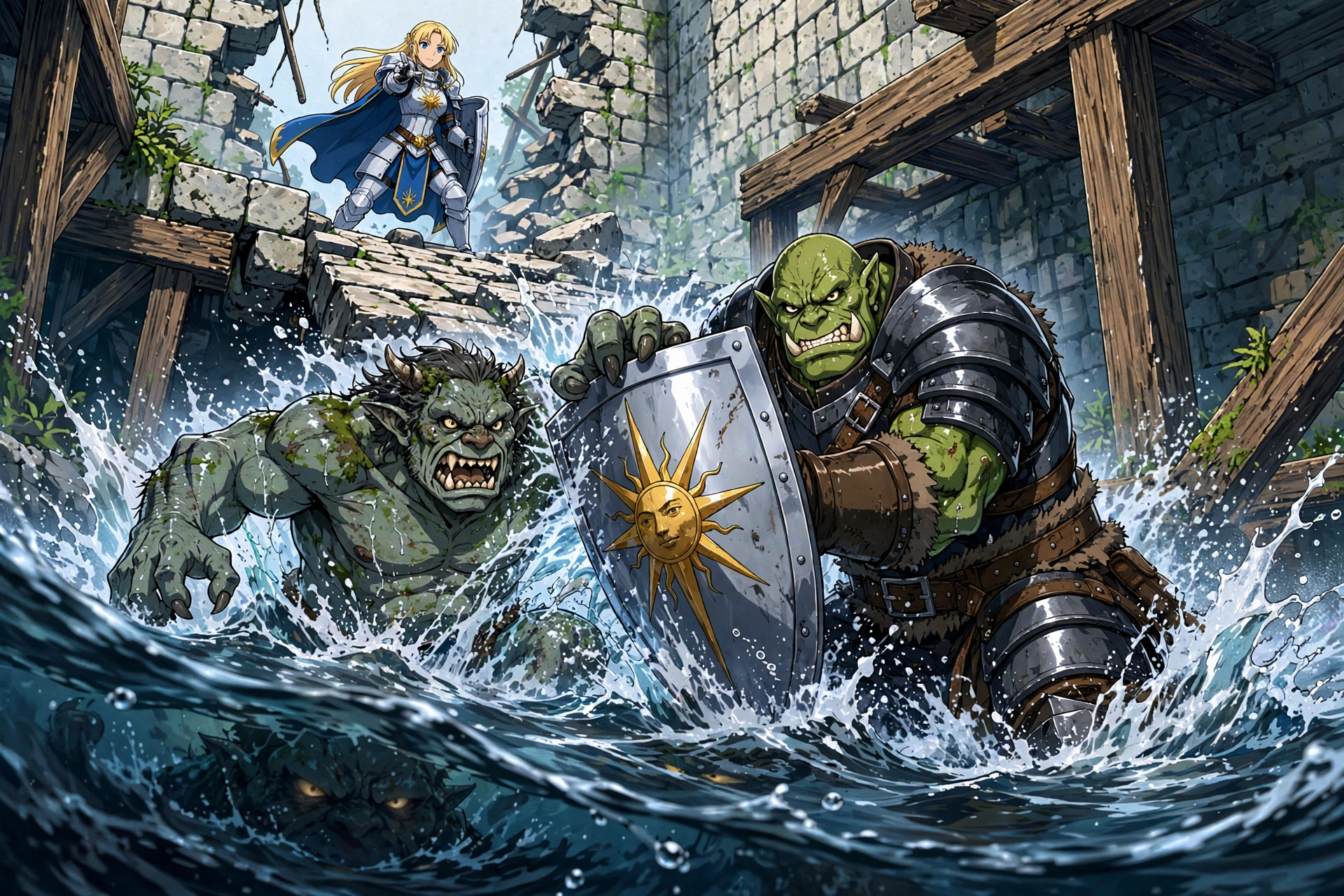
The ford had been damaged — not by flooding, or not only by flooding. The stone causeway that had allowed wheeled traffic to cross at controlled depth was broken in the middle, a ten-foot section collapsed or displaced, leaving a gap that a person might wade through if they were willing to go chest-deep in autumn river water and were not carrying anything they wanted to keep dry. For a wagon it was impassable. For a loaded cart it was impassable. For a merchant with goods on horses it was a calculation that several people had apparently made and found unfavorable, because there were seven wagons stranded on the near bank, with their teams unhitched and grazing along the verge, and a camp of sorts had developed in the field beside the road — cookfires, bedrolls under wagon beds, the specific settled look of people who had been here for days and had stopped expecting immediate resolution.
A repair crew was visible at the crossing itself. Four men with tools and timber, working at the gap with the focused labor of people who had been at it long enough to know what they were doing but hadn't finished yet. Two of them were in the water.
And on the far bank, in the shadows of the willows that overhung the river's edge fifty feet downstream from the crossing, something was watching the men in the water.
Elanor saw it before she'd fully registered the rest of the scene. She didn't say anything. She changed her pace — slightly, perceptibly to the party and imperceptibly to anyone else — and when Elara came up beside her she indicated the shadow with a turn of her eyes only.
Elara looked.
Then she looked at the stranded travelers. Then at the repair crew in the water. Then back at the shadow on the far bank.
"River-trolls," Elanor said, quietly. "The shadows are wrong for the bank. There are at least two, possibly more. They've been here long enough that the repair crew has learned to get out of the water when they start moving."
"How do you know the crew has learned that?" Elara asked.
"Because they're all on the bank right now," Elanor said. "Two of them were in the water a minute ago. Something made them come out."
Elara looked at the crew. They were standing at the water's edge now, tools down, watching the far bank with the specific attention of people watching something they'd learned to watch for.
"How long has this been going on?" Elara said.
Not to Elanor. She was already moving toward the stranded travelers.
---
The answer was eleven days.
The crossing had broken nine days before the repair crew arrived, during the heavy rains that had run through the region in the last weeks of summer. The break itself was straightforward — a section of the old causeway had shifted on its foundation, probably weakened by years of freeze-thaw and the particular violence of the autumn spate. The repair crew was contracted by the three towns that maintained the road and had arrived with timber, tools, and the specific expertise of men who fixed road infrastructure for a living.
The river-trolls had arrived on day three.
"They weren't here before," said the crew's foreman, a heavyset man named Harst who had the permanent squint of someone who spent his working life outdoors and had made peace with it. He was talking to Elara in the measured way of a man who had decided to say what needed saying and not waste words on it. "This stretch of river, I've worked two crossings upstream from here, never had troll trouble. They came down from somewhere."
"The war," Elara said. It wasn't a question.
Harst looked at her steadily. "That's what I think. They were somewhere further north and whatever the war did to the territory up there, it pushed them south. They found the ford and they found that people have to slow down at the ford and they figured out that slow people are easier than fast ones." He rubbed the back of his neck. "They don't attack every time. That's what makes it bad. If they came every time we'd have a pattern. They come when they come. You're in the water working and then they're moving and you get out." He paused. "On day five they didn't move fast enough."
"How bad?" Elara said.
"Man lost the use of his hand," Harst said. "He's in the camp. He's not dead."
"The travelers?" Elara said, indicating the wagon camp.
"First two wagons showed up day six. It's been building since. People try the crossing, they hear about the trolls, they stop." He looked at the wagons. "There's a merchant in the third wagon who's been very vocal about my crew's progress. I'd appreciate it if you didn't spend too much time with him."
"How close are you to finishing the repair?" Elara asked.
"If we can work a full day without interruption, we finish tomorrow," Harst said. "We haven't had a full day without interruption."
Elara looked at the ford. At the shadow line on the far bank. At the gap in the causeway, the timber already in place for the repair, the tools laid out with the organization of a crew that knew its job.
"How many trolls?" she said to Elanor, who had come up beside her.
"I've counted three distinct shadows," Elanor said. "River-trolls in packs usually run four to six. I'd estimate four as the working number, possibly five."
"Territory behavior," Elara said.
"Opportunistic territory," Elanor said. "They didn't have this crossing before — they found it. The behavior is recent enough that they haven't fully committed. They're still testing, which is why the attacks are inconsistent. They haven't decided yet whether the gains are worth the risk."
"Which means if we make the risk high enough, they'll decide it isn't," Elara said.
"Possibly," Elanor said. "River-trolls learn. If we clear them from the crossing convincingly, they may not come back. If we clear them halfway, they'll adapt."
Elara stood at the bank and looked at the situation.
It was not a complicated situation. It was a practical situation — the kind that required accurate assessment and coordinated execution rather than heroics. The crossing needed to be repaired. The repair crew needed to work without interruption. The trolls needed to be driven off convincingly enough that they didn't return before the work was done. The travelers needed to stay out of the way.
She began working it out.
---
"Here's what we do," she said, and the party arranged themselves around her in the loose semicircle they used when she was planning, because planning was different from commanding — planning was collaborative, at least in the way she did it, the way she'd always done it, bringing in what each of them knew before she decided what to do with it.
"Elanor, I need the far bank read before we start. Specifically: the willows on the downstream side, whether there's a second approach from upstream, and how deep the water is between the near bank and the gap."
"I can give you the willows and the upstream now," Elanor said. "Water depth requires getting closer."
"Get closer, then. Carefully."
Elanor moved without comment toward the bank, downstream of the crossing, moving with the unhurried quality that meant she was doing something deliberate rather than simply walking.
"Lucian," Elara said. "River-trolls. What do you know about their response to fire and to area workings?"
"Fire is effective but unreliable near water," Lucian said. "They'll retreat from it if it's sustained, but a river-troll can simply submerge and wait. Area workings are more useful — a concussive ward set at the waterline will make the near bank untenable for them while it holds. I can set three. They'll hold for approximately four hours."
"Can you set them without going into the water?"
"From the bank, yes. I'll need a clear line and about twenty minutes."
"You have twenty minutes once Elanor gives me the far bank report," she said.
"Dovar," she said.
"The injured man," Dovar said. It wasn't a question. He'd already identified the same priority.
"The injured man," she confirmed. "And keep the crew calm while we set up. They'll want to watch. Tell them to stay back."
Dovar headed for the camp without further direction.
"Odo," she said.
"The travelers," Odo said, reading her correctly. "Particularly the vocal merchant."
"Particularly the vocal merchant," she agreed. "We need them back from the bank and out of our way. They don't need to know the details. They need to know that someone with a plan is handling it."
"I can do that," Odo said.
"I know," she said. She looked at Brakka.
He was already looking at the ford. Not at the shadows on the far bank — at the gap in the causeway, the water on either side of it, the specific geometry of the space.
"You know what I'm going to say," she said.
"The gap," he said. "You want the trolls to come through the gap rather than around the bank."
"The gap is a natural funnel," she said. "If they come through it one or two at a time, you can manage them. If they come around the bank from both sides simultaneously, it's a different problem."
"So we give them the gap," he said. "Make the bank unattractive."
"Lucian's wards make the near bank untenable from the water," she said. "That pushes them toward the crossing itself. The gap is the path of least resistance."
"And I'm at the gap," Brakka said.
"You're at the gap," she said. "Elanor covers you from the near bank — she'll pick off anything that gets around you. I hold the anchor position at the center." She paused. "Odo, once the travelers are back, I want you behind Lucian. If something comes at him from an angle, it needs to find you first."
"Understood," Odo said. He wasn't a combat asset in the way Brakka was, and he knew it, but he was also not without resources in a pinch, and more importantly he was small and quick and could put himself between a threatened mage and a threat without the threat being able to do much about it for the necessary seconds.
"Harst," she said, raising her voice toward the foreman. "Can your crew work while there's fighting at the crossing?"
Harst had been listening from a respectful distance. He came forward. "They can if they know the threats are being managed," he said. "What they can't do is work through uncertainty. You tell them what's happening and they'll work."
"Good," she said. "I'll talk to them before we start."
Elanor came back from the bank.
"Far bank," she said. "The willows run forty feet downstream. The trolls have a den site under the bank at the downstream end — I can see the disturbed mud and the channel they've been using to approach and retreat. Upstream approach is open water, no cover for forty yards. Water depth between the near bank and the gap is four feet at the shallowest, six at the channel center."
"One approach route," Elara said. "The willows to the gap."
"Yes. Upstream is possible but exposed — they'd be in open water for the approach and they'll know it."
Elara looked at Brakka.
"This is going to come to you through the gap," she said. "Most of it."
"Good," he said.
---
Lucian set the wards in seventeen minutes.
He worked from the near bank, reading the waterline and placing three concussive ward points at intervals along the ford's approach — not touching the water, anchored to the exposed stone of the old causeway foundation, the working precise and controlled and quiet in the way that Lucian's workings were always quiet. No light, no visible effect. Just the specific quality of air near an active ward, which Odo registered as a slight change in the acoustic texture of the bank and nobody else registered at all.
"They'll feel that when they cross the line," Lucian said, straightening. "They won't understand what it is — river-trolls aren't sophisticated about wards — but they'll feel it. It'll sting. Repeatedly if they persist. They'll dislike the bank."
"Which pushes them to the gap," Elara said.
"Which pushes them to the gap," Lucian agreed. "The wards don't cover the gap itself because I'd be warding the repair crew's working area. That's where you need Brakka."
Brakka was already at the gap.
He had waded into the water up to his thigh — the gap was accessible from the near side, the broken edge of the causeway giving him a platform to stand on at the downstream edge of the break. The footing was awkward: broken stone, uneven depth, the river current pushing at his legs with the specific indifference of a large body of water that had no interest in his plans. He planted his feet, tested the surface, shifted his weight, and found the position that was going to work for the next several hours.
Shield on his arm. Axe at his side but not in hand — in the water, an axe was a liability on the downswing; better to use the shield and his weight and deal with the axe on anything that came up out of the water rather than coming through it.
He looked at the far bank. The shadows had moved. The trolls had noticed the activity and were responding to it, repositioning toward the crossing.
"They're moving," he said, without looking back.
"I see them," Elanor said, from the near bank, fifteen feet upstream of him. She had her crossbow out. "Four. Two in the willows, two in the channel."
"Harst," Elara said. "Get your men working. Now."
The repair crew went back into the water on the near-side edge of the gap, staying behind Brakka, working the section they could reach without crossing the break. The sound of tools on timber resumed — the specific productive sound of people doing a job.
The trolls came off the bank.
---
They came through the water rather than over it, which was the river-troll preference when the cover was good — low in the channel, using the current's noise to mask their approach, the kind of movement that was invisible until it wasn't. Elanor picked up the leading one at twenty feet, the displacement in the water wrong for the current, and put a bolt into it.
The bolt connected. The troll wasn't stopped by it — river-trolls had the specific durability of creatures that had evolved to take damage in violent water — but it broke the approach, the troll pulling back, and in the pull-back the second one broke left toward the bank.
The ward caught it.
The concussive effect at the waterline wasn't large — it wasn't designed to be a weapon, it was designed to be aversive — but a river-troll crossing an active ward line was like a river-troll running into an invisible wall that hit back. The troll went backward into the water with a sound of confused aggression and didn't immediately try the bank again.
The other two came through the gap.
Brakka was ready.
The first one came up over the broken edge of the causeway with the speed of something that had done this kind of assault before, low and fast, and it hit the face of Brakka's tower shield at the gap's edge and the impact was significant. The river troll was large — not his large, but large for what it was, maybe five hundred pounds of dense muscle and river-slick hide, coming up out of cold water with the full force of the current behind it. The impact drove Brakka back half a step on the broken stone.
He drove back.
Not with the axe. With the shield, pushing forward, using his weight rather than his strength, pinning the troll against the far edge of the broken causeway where it had come up, where the stone edge worked against it instead of with it. The troll clawed at the shield face and the claws did nothing useful and Brakka kept the pressure on, the specific sustained pressure of an eight-hundred-pound ogre who had decided that nothing was going through this gap and meant it.
The second one came up beside the first.
Elara was there.
She hadn't rushed to the gap — she'd moved to it deliberately, reading the approach, timing her arrival to when she had the angle. Her oath binding wasn't a combat weapon in the way that a sword was a combat weapon. It was a command enforced, a specific kind of authority that predated the war and the kingdom and the binding tradition both, and when she invoked it at the second troll the troll stopped.
Not stunned. Not damaged. Simply stopped, mid-motion, the binding holding its next action in abeyance — a fraction of a second, two, three — and in those fractions of a second Brakka got his axe off his belt one-handed and brought it down on the first troll's reaching arm at the shoulder joint where the reach was extended and the leverage was wrong for it.
The troll pulled back. Brakka let it pull back — not pursuit, no space for pursuit — and reset his position at the gap.
The two in the channel were testing the wards again. One came back at the bank and hit the ward line a second time and retreated again with the same aggressive confusion as before. The other was circling in the channel.
"The circler," Elanor said. "Upstream."
Elara looked. The upstream troll had committed to the open water approach, the forty yards of exposed river she'd assessed as unlikely. It was in the channel, moving toward the gap's upstream side, trying to come around Brakka from the angle he couldn't cover while holding the gap.
"Lucian," she said.
"I see it," he said, from behind her.
He put something into the upstream water. Not large, not dramatic — Lucian's working economy in situations where he was being careful about cost — but the effect was that the upstream section of water became something the troll found suddenly untenable, a specific quality of wrongness that river-trolls, which were sensitive to their medium in the way of things that lived in it, responded to by vacating. The troll pulled back from the upstream approach and rejoined the others in the deep channel.
Four trolls in the deep channel. One mildly injured. Two confirmed reluctant about the wards. One that had tested the upstream approach and found it closed.
The repair crew behind Brakka kept working.
The situation held for ninety seconds, which in an engagement was a long time.
Then the trolls did the thing that was the most dangerous version of the behavior Elanor had described: they adapted.
All four came at once.
Not through the gap — through the gap and over the near-bank downstream edge simultaneously, splitting the attack to force a choice between the gap and the bank. Two at Brakka, two testing whether the wards could be pushed through with enough momentum.
"Odo," Elara said, sharp.
Odo was already playing.
What he put into the riverbank air was not music in any conventional sense — it was the specific working she'd seen him use in the Underbreach's holding corridor, the frequency that found the coordination rhythm of a pack and put friction in it, the quarter-beat of wrongness that broke a simultaneous attack into sequential parts. The two trolls going for the bank stumbled in their approach — not much, not long — but enough.
Elanor took one.
The bolt went through the ward line alongside the troll rather than into it, angled to hit the exposed shoulder as the troll pushed through. River-troll hide was dense but not plate armor, and Elanor's bolt heads from the Drenmouth fletcher were the specific profile for this kind of target. The troll went into the bank wrong, off-balance, and the ward caught it full and it went backward.
The fourth hit the ward line with momentum and got partially through and Dovar, who had come back from the camp and taken a position at the downstream bank end, put his warhammer into it with the flat efficiency of a cleric who had twenty years of exactly this kind of practical field work.
Brakka handled the two at the gap.
He let the first one come up over the edge and then drove it back with the shield rim rather than meeting it directly — the angle of the gap's broken stone edge meant that a well-placed push from the shield rim would send an incoming troll off the edge and into the deeper water on the far side rather than onto the causeway. He did this twice in eight seconds and both times the physics worked as intended, and both times the troll went back into the deep channel and had to make the approach again.
The second time, it didn't make the approach again.
None of them did.
The four trolls in the deep channel circled once, twice. The ward line stood. The gap was occupied by Brakka. The downstream bank had produced a warhammer and the upstream approach had produced Lucian's working. The pack circled and circled and didn't commit.
River-trolls learned.
These had learned that the crossing was a reliable source of prey. Now they were learning something else: that this crossing, today, had a configuration they couldn't resolve. The ward line hurt. The gap was occupied by something too large and too decided to displace. The flanking approach had been closed.
They held in the deep channel for three more minutes.
Then the current took them downstream.
Elanor watched from the bank until the displacement in the water that indicated their position was well past the crossing and moving further.
"They're going," she said.
"For now," Elara said.
"For today," Elanor corrected. "They may come back tonight. We'd need to clear them more definitively to be certain they won't return."
Elara looked at the repair crew. Harst was looking at her.
"How long until morning?" she said. "Can your crew work the night through?"
"If we have light," Harst said.
"You'll have light," Lucian said, from behind her. He was already assessing the ward placements, recalibrating.
Harst looked at his men. They were still in the water, tools in hand, the work continuing with the specific efficiency of people who had just watched someone else deal with the problem that had been stopping them for eleven days and were going to make the most of however long they had.
"We'll finish by the third hour past midnight," Harst said.
"Then we hold the crossing until you finish," Elara said.
---
They held it.
The trolls came back once, at the first hour after dark, testing — a single probe from downstream, sensing whether the configuration had changed. Brakka was still at the gap, or rather was at the gap again, having eaten at the bank while Elanor and Dovar held the position through the early evening. Lucian had refreshed the wards. The probe found the same configuration it had found in the afternoon and the troll withdrew within thirty seconds.
Elanor tracked it downstream until she was satisfied it wasn't simply repositioning.
It wasn't. It was leaving.
The repair crew worked through the night with torchlight and Lucian's light and the specific driven focus of people who had been stuck for eleven days and were not going to waste a clear run at the finish. Harst organized them in shifts — two working, two resting, rotation every two hours — and the work was good, professional, the careful fitting of prepared timber into the gap that was exactly the right way to repair a causeway section rather than the fast way, which would have failed by spring.
At the second hour past midnight, Harst walked across the completed crossing.
He did it without ceremony — he walked across, tested the footing at the former gap, crouched and checked the timber fitting with a lantern, straightened, and walked back.
"Done," he said.
The repair crew cheered. Not loudly — they were tired and it was the middle of the night — but with the genuine satisfaction of people who had finished a thing that had been difficult to finish.
The travelers in the wagon camp heard it and came out of their bedrolls.
By the first hour of dawn, the first two wagons were across.
---
The First Party ate breakfast on the far bank.
Harst brought food over from the camp — not a celebration meal, just provisions, the practical generosity of a man who understood that the people who had held his crossing for a night might be hungry. He sat with them for a while and they ate without ceremony and the river moved past them with the indifference it had maintained throughout.
"You're the First Party," Harst said, at some point in the breakfast. He said it the way you said something when you'd been sitting on it for a while and had decided it was simpler to say it than to keep not saying it. Not with any particular valence — not the false ballad's version, not the veteran's respect, just a man who had put two things together.
Nobody confirmed or denied it.
"I thought so," Harst said. He looked at his food. "The crossing thanks you. The towns it connects thank you. And Pell—" he glanced toward the camp, toward a man whose right hand was wrapped, sitting apart from the others— "Pell's wife and his three kids thank you, because he's going home with all his fingers."
"The fingers were Dovar's work," Elara said.
Harst looked at Dovar.
"Three cups of that mountain spirit you've got in your pack would have helped more," Dovar said. "Fortunately I had other options."
Harst smiled. It was the smile of a man who had spent eleven days at a problem and was now on the far side of it.
"Safe roads," he said.
"Safe roads," Elara said.
They left the Blackwater Crossing with the morning's first wagon traffic starting to move across it, the sound of wheels on new timber steady and functional behind them, and the road west opened ahead.


.png)
.png)
.png)