%20(1).png)
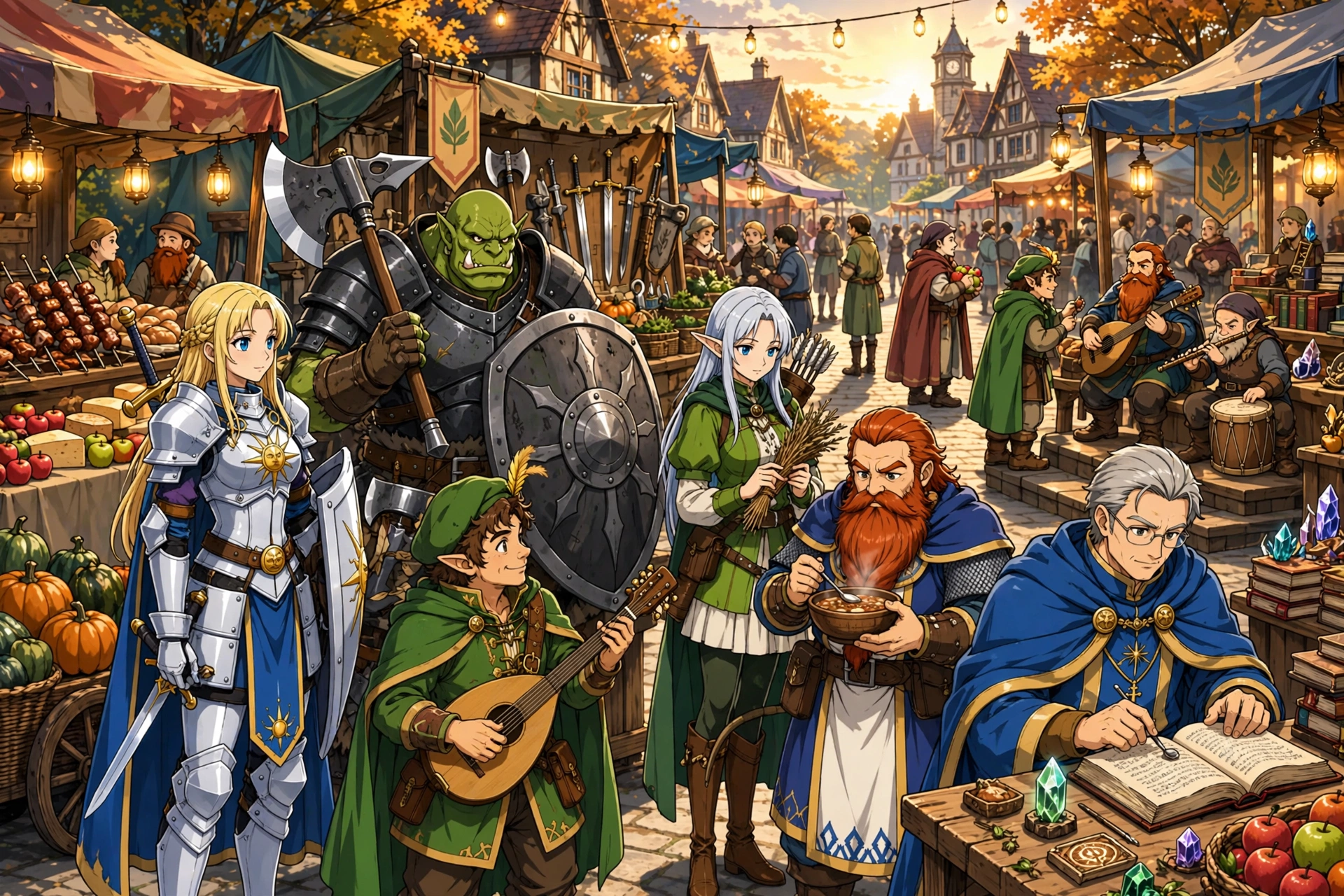
The road west from Ashfen ran for eleven miles before it joined the Millway, and the Millway was a different kind of road entirely.
Where the Ashfen road had been the post-war version of itself — buckled in places, weeds in the mortar, maintained by nobody in particular — the Millway was the old kingdom's arterial logic made stone, twenty feet wide and cambered for drainage and repaired every spring by the three towns it connected, because all three towns depended on what moved along it. Merchants, drovers, mail coaches, seasonal labor, pilgrims heading to the river shrine at Teln, and at this time of year the specific concentrated traffic of the Drenmouth Crossroads Fair, which happened every autumn at the junction of the Millway and the Southern Post Road and had been happening there for longer than anyone could reliably document.
They heard it before they saw it.
The fair carried its own sound — not any single sound but the aggregate of several thousand people and their animals and their commerce and their enjoyment of commerce, compressed by distance into a low continuous presence that was somehow both festive and purposeful. Odo heard it first and his head came up in the specific way it did when something interesting was entering his range. Lucian looked up from his journal. Even Brakka's pace changed slightly, a fractional increase, which was the closest he came to showing anticipation.
"Drenmouth Fair," Elara said, reading the milestone they were passing. "I didn't realize we were this close."
"We made good time on the Millway," Elanor said, from ahead. She was reading the road the way she always read roads — automatically, cataloguing — but her attention had shifted to the approaching sound as well. "There's a ford two miles further that was impassable in spring. It'll be clear now."
"And crowded," Dovar said.
"And crowded," Elanor agreed.
They came around a long curve and the fair opened up below them.
Drenmouth was a proper town — not a village like Ashfen, not a capital, but the settled permanent infrastructure of a place that understood its own function and had built accordingly. It sat at the junction of two rivers and two roads, which gave it a natural shape: two bridges, a main square, a market district that ran for four blocks in each direction from the square, and then the residential and working quarters spreading outward to the town walls. The walls were old and had been repaired piecemeal over centuries and showed it, sections of different stone and different vintage, but they were upright and the gates were open and through the gates the town was absolutely full.
The fair had expanded well beyond the market district. Stalls and pavilions lined both approach roads for a quarter-mile before the gates, the grass of the verge covered in canvas and trestle tables and the carefully arranged displays of people who had traveled significant distances to sell things and were determined to present them correctly. Livestock in temporary pens to the south of the road. Wagons and horses and mules in every available space that wasn't actively selling something. The particular dense smell of many people and their animals and their cooking fires and their goods, which was the smell of trade, and which was not pleasant exactly but was the smell of the world functioning.
"How long do we have before we need to be anywhere?" Odo asked.
Everyone looked at Elara.
She looked at the fair, then at the sky, then at the fair again.
"Tomorrow morning," she said. "We have a night here and most of the day."
The silence that followed was the silence of six people absorbing the specific gift of unstructured time.
"Right," said Dovar, and adjusted the grip on his pack.
---
They found an inn first, because Elara insisted on knowing where they were sleeping before anyone disappeared into the fair, which was the correct logistical instinct and which generated a moderate amount of grumbling from the people who wanted to disappear into the fair immediately. The inn was called the River and Post and sat at the main square's western corner, positioned to receive travelers from both approach roads and priced accordingly. Toven the Ashfen innkeeper would have found it expensive. They found it acceptable and negotiated a rate for five rooms that Lucian handled with the calm efficiency of someone who understood that negotiating with festival-fair innkeepers was a specific subspecialty and had developed opinions about it.
"Five rooms," Brakka observed.
"The large store room at the back has been arranged for your specific requirements," Lucian told him.
"I don't require anything specific," Brakka said.
"The ceiling does," Lucian said, and went inside.
Brakka looked at the inn's ceiling height through the open door and made the assessment he always made. Then he went inside too.
Packs left, coats straightened, the party emerged onto the main square of Drenmouth at the third hour of the afternoon and immediately, without any discussion or formal dispersal, separated.
This was not unusual. They had been traveling together long enough that they had no anxiety about each other's whereabouts and no requirement for collective entertainment. They would find each other again when the day required it or when it became time for dinner, whichever came first. Until then they were six individuals with a rare afternoon and their own ideas about what to do with it.
---
The thing about Drenmouth was that it genuinely did not care who the First Party was.
This was not hostility and it was not the careful studied indifference of a place that recognized them and chose not to acknowledge the recognition. Drenmouth at fair time was a cosmopolitan place in the specific sense of a town that received enough variety on a regular basis that variety itself had ceased to be notable. A dwarf cleric was not remarkable here because there were three dwarven merchant clans with established relationships with the town's metalwork trade. A hobbit with a lute raised no eyebrows in a town that hosted professional entertainers from four different regions twice yearly. An elf in a ranger's coat was simply someone in a ranger's coat.
Even Brakka, who drew eyes on any road in any settlement he entered, found that Drenmouth's eyes were different from the usual ones. Not less present — people looked, Drenmouth people were not blind — but the looking had a quality of interest rather than alarm, the assessment of a trading town sizing up a potential customer, which was a fundamentally different social transaction than the one he was used to.
A weaponsmith in the market district looked at him the way a weaponsmith looked at a person who might need weapons of a specific size.
"I work to commission," the smith said. He was a human, mid-fifties, with the compact deliberate movements of a man who had spent decades moving heavy things with precision. His display was organized: one weapon of each type in his range, not an abundance, a demonstration of competence rather than volume. "I've done work for ogre-kin before. Not many come through, but I keep the knowledge."
Brakka looked at the display. He was not in the market for a weapon — his axe had been with him since the campaign and had given him no reason to consider replacing it — but there was something in a well-made weapon that was worth looking at regardless. The way a library was worth looking at even if you weren't there to borrow anything.
"The shield brackets," Brakka said. He was looking at the metalwork on a display shield — the way the arm bracket was fitted, the angle of it. "You've done ogre-scale work on these."
"Had to think about it," the smith said. "Standard bracket angle doesn't work for the larger arm geometry. Too much torque at the shoulder joint in extended carry." He indicated the modification. "Brought the angle in eight degrees. Distributes differently."
Brakka picked up the display shield. Tried the bracket. The smith watched without comment. The angle was right — not the same as his own shield's brackets, but right for the logic it was solving for.
"Good work," Brakka said. He set the shield back with the care of someone handling something that had been made correctly.
The smith nodded. The nod of a craftsman acknowledging a competent assessment.
They didn't speak further. It wasn't that kind of conversation. Brakka moved on and the smith returned to his display and both of them had gotten what they'd come for, which was the specific satisfaction of a professional interaction with someone who knew what they were looking at.
---
Dovar took the food seriously.
This was not a departure from his usual character — he took most things seriously, it was simply that the register of his seriousness shifted depending on the subject. Divine wards and curse removal, he was serious in a focused, technical way. Food and drink at a fair with access to provision from four different trading regions, he was serious in a way that was considerably more pleasant for everyone nearby.
He ate his way through the stalls on the south side of the market with the methodical attention of a dwarf who had strong opinions and the experience to back them up. A spiced meat pie from a Bracken Province baker that he ate in three bites and then stood thinking about for nearly a minute before pronouncing it competent but under-peppered. A small clay cup of a distilled spirits from the mountain country two weeks north that made him close his eyes for a moment and then give the vendor a look of genuine respect. A smoked fish from the river traders, which he ate standing at the stall and declared superior to the version from the eastern settlements which he had always found faintly overworked.
At a stall selling sweet pastries from the southern style — small, honey-dipped, layered — he bought six and ate four of them on the spot and wrapped the other two carefully in his supply cloth and put them in his pack. When Odo found him an hour later and asked about the wrapped pastries, Dovar said they were for later, and his expression made it clear that later was not open to further discussion.
"For later as in tonight or for later as in never?" Odo asked.
"For later as in when I decide," Dovar said.
He found, toward the end of the afternoon, a stall run by a dwarven family from the northern clans — a husband and wife and their eldest, selling preserved provisions of the mountain kind, the dense, long-lasting preparations that were built for hard travel rather than celebration. He stood at the stall and talked with the husband for twenty minutes about mountain roads and the current state of the northern passes, and the husband's wife brought out a small jar of something that wasn't for sale, just for trying, and the three of them stood at the back of the stall and shared it without ceremony.
It was the best thing he'd tasted all day and he didn't try to buy any and they didn't offer. Some things weren't for selling.
He left with two months' worth of mountain provision packed well, and the feeling of a man who had spent an afternoon doing exactly what he'd wanted to do.
---
Lucian went to the books.
There were three book stalls at Drenmouth Fair, which was more than he'd expected and evidence that the fair's clientele included a meaningful proportion of literate merchants. Two of the stalls were practical — manuals, ledgers, almanacs, the literature of commerce and navigation. The third was operated by a woman with grey braids and the specific unhurried quality of someone who had been selling books for long enough to know exactly which customers were worth her time.
He spent an hour at her stall.
Not browsing — reading, which was a distinction she recognized and accommodated by moving her folding chair slightly to give him better light. He worked through the two shelves she'd allocated to what she called the unusual and what he recognized as a curated collection of texts that someone had actually looked at before buying them for resale. A treatise on ward construction from the old border kingdom tradition, two generations out of date but containing foundational geometry he hadn't seen worked out explicitly before. A small volume of collected field notes from a survey expedition into the cave systems east of the Brackton range, written in the compressed notation of someone expecting to be read by specialists.
And at the back of the lower shelf, wedged between a geographical almanac and something in a binding he didn't recognize: a monograph on the binding traditions of pre-kingdom practitioners.
He bought all four without haggling. The bookseller named a price that was fair and he paid it, which was the correct response to a fair price from someone who actually knew what they were selling.
He also found, at the practical stall, a current-year almanac with updated road conditions for the western regions and a small reference work on old kingdom military installation types that Elanor had mentioned wanting and that he bought without comment, intending to leave it somewhere she'd find it.
At a component stall he found a small quantity of stabilized resonance chalk — the kind used for precise ward geometry, difficult to source — and a glass vial of something the vendor called river-dark, which was either a moderately useful alchemical reagent or a confidence trick, and he bought it on the theory that if it was the reagent it was worth ten times the price and if it was a confidence trick he'd learn something from examining it.
He spent the walk back to the inn reading the monograph.
---
Odo was everywhere.
This was his natural state in a festival environment — not aimless, but broadly attentive, moving through the fair the way he moved through all spaces, which was with the specific openness of someone who was permanently interested in what was happening around them and had made a life of that interest.
He listened to the musicians first, because there were seven different musical acts operating at various points around the fair and a festival's music was a document of its character. Two were commercial — the kind of performance designed to attract foot traffic to nearby stalls, competent and cheerful. One was a fiddle player who was genuinely excellent and knew it and was playing at a level that suggested she thought of the fair crowd as an audience worth the effort. One was a quartet performing music from the river country, a tradition he knew well and found interesting in its local variations. One was a street performer with a drum and two small bells who had the quality of someone who had invented their own instrument language and was in full conversation with it.
He tipped all of them. More than was expected, because he understood what it cost to perform well in an outdoor environment for a crowd that was paying partial attention.
He stopped at a storyteller — an old man on a folding stool with a cloth laid out on the ground in front of him and a small audience of children and three adults sitting in it. The storyteller was midway through a tale about a sailor and a river spirit, and the tale was structured well, the pacing correct, the ending earned rather than convenient. Odo stood at the back of the audience until the tale finished and gave the man a coin when he left, and they exchanged a look that acknowledged a specific kind of shared professional understanding without requiring words.
At a crafts stall he found a set of new strings for his lute — the correct gauge, which was not always easy to find outside large cities — and bought three sets against the usual rate of wear. At a herbalist's stall he bought a small preparation for keeping instrument wood stable through cold weather, which was more expensive than it should have been and worth it anyway.
He spent an hour in the afternoon near the central square where three performers were operating in loose proximity to each other, listening to how they navigated the shared space, the way their performances overlapped or yielded or competed. It was interesting. Most things were interesting if you paid enough attention to them.
He found a particular kind of content in festivals that he didn't find in dungeons or on roads, which was the particular content of a man in his right environment. Not more himself than usual — he was always himself — but more obviously so. The fair saw what he was immediately in the way that the dungeon had seen Brakka and the road had seen Elanor and the component stalls had seen Lucian.
He was the last one back to the inn, arriving just as the dinner crowd was beginning to fill the main room, carrying new strings and a small carved bird that he'd bought from a woodcarver because it had been made with unusual care and deserved to belong to someone who noticed.
---
Elanor did not stop watching.
This was not a choice. It was as much a choice as breathing — the specific attention she'd spent years developing had long since become structural, the thing that ran underneath everything else she was doing. She browsed the stalls on the north market row with the same surface presentation she brought to civilian environments: unhurried, casually interested, the posture of someone with an afternoon and no agenda.
The difference was that the stalls were not what she was reading.
She read the crowd. The flow of it, the way it moved and pooled and thinned at different points, the natural pressure systems of a large gathering moving through defined channels. She read the exits — the four streets off the main square, the service alley beside the well, the gate south toward the livestock pens. She read the people who were watching the crowd rather than participating in it, which was not suspicious in itself at a fair — vendors did it, entertainers did it, people waiting for companions did it — but which she noted anyway with the automatic notation of a ranger in a space she didn't know.
She found, at a fletcher's stall, a particular style of bolt head she'd been looking for since the Underbreach had informed her she needed more of them. The fletcher was a halfling woman with the decisive hands of someone who had been doing this work for decades, and they talked for ten minutes about materials and profiles and the specific geometry of what Elanor was looking for, and the fletcher produced from a back tray a set of twelve bolt heads she'd made from a salvaged spring-steel source that was better than standard and she knew it.
Elanor bought all twelve and watched the fletcher's hands while she packaged them and thought about the Underbreach's holding corridor and the particular angle that had found the war-hound's joint, and made a mental note about the flight characteristics she'd want from these heads.
She also found, at a leatherwork stall, a new shoulder strap for her quiver that was better distributed than the current one and would matter on long marches. She bought it without the internal argument she usually had with herself about unnecessary gear weight, because it wasn't unnecessary.
At the edge of the south market she stood for a long time at a cartographer's stall.
The cartographer was selling copies of a regional survey — not the old campaign maps, which were guild-held and not for general sale, but a current survey of the western roads done by a commercial mapping firm three years ago. She looked at the section covering the territory west of Ashfen.
The road conditions were marked with the usual symbols. She read them and thought about the routes ahead and the choices they would face and the specific kind of attention she'd need to give certain stretches that the map flagged as uncertain.
She bought the relevant sections and folded them into the inside of her coat with the care of someone who understood that a good map was a tool that would be used in bad weather while moving fast.
Then she walked the fair's perimeter, once, at a pace that looked like a person who'd finished shopping and was moving back toward the square. She covered the whole circuit in twenty minutes and noted what she'd noted and returned to the inn.
---
They reconvened for dinner without anyone organizing it.
This was one of the things about six people who had been moving together long enough — the coordination that would have required explicit planning in the first weeks had become implicit, unconscious, a shared sense of where the evening was tending that produced convergence without anyone directing it. By the sixth hour after arriving in Drenmouth, all six of them were at the long table near the hearth in the River and Post, ordering from the board, and the fire was lit and the main room was full and the sound of many people in a warm space was the specific comfort of a place that knew what it was supposed to be.
The River and Post's kitchen was good. Not exceptional — not the kind of cooking that became a story in itself — but good in the reliable way of an establishment that had been feeding large numbers of fair-goers for many years and had learned exactly how to do it without drama. Roasted river fowl, braised roots, bread that had been baked that morning and was not yet stale, a mushroom preparation that Dovar tasted with professional attention and then ate in its entirety without commenting on, which was high praise.
Brakka ate with the settled satisfaction of someone who had spent the afternoon in a way that had suited him and was now at a table with food and the party around him, which was a complete description of a good evening.
Lucian had the monograph on the table beside his plate. He was not reading it — it was present in the way the journal was always present, available if something came to mind that needed checking — but once he reached for it and ran a finger down a page and then set it aside again, and Odo watched this with the quiet attention he brought to small characteristic behaviors, adding it to the long detailed account he maintained of every person in the party.
"What did you find?" Elara asked Lucian, meaning generally, meaning the day.
He considered. "A monograph on pre-kingdom binding traditions that may be relevant to the Underbreach's lower seals," he said. "A useful almanac. The river-dark is genuine, which was the more interesting possibility." He paused. "The bookseller knew what she had. That's rarer than the books."
"I found strings," Odo said.
"We know," Dovar said. "You came in carrying them like they were sacred objects."
"They're the right gauge," Odo said, with the dignity of someone whose position required no further defense.
"What's the right gauge?" Brakka asked.
Odo explained. Nobody fully followed it but Brakka listened with genuine attention, the way he listened to things he didn't understand but that clearly mattered to the person explaining them, which was a form of respect that Odo had always noticed and never mentioned.
Elara had a second cup of the inn's house wine, which she did not usually do, and sat with her shoulders at a different angle than usual, which was the angle of someone whose habitual tension had reduced by a measurable amount without their deciding to reduce it. She didn't comment on this. Nobody commented on it.
Dovar produced one of the two wrapped pastries from his pack at the end of the meal.
"I thought those were for later," Odo said.
"This is later," Dovar said.
He ate it. He offered the second one to Elanor, who sat beside him, which was the most anyone had seen him offer food to another person outside of a medical situation. She took it without comment and ate it and nodded once, which was the appropriate response.
"The day treated you well," Dovar said, meaning it as a statement.
"The day treated me well," Elanor agreed.
They sat with that for a while, the inn's main room warm and loud around them, a musician somewhere in the corner playing something competent and unhurried, the fire doing what fires did.
---
An hour later, when the evening had fully committed to being an evening and the inn crowd had reached its comfortable maximum and the plates had been cleared and the drinks were at the second-cup stage, Elanor felt the eyes.
Not imagined. She'd been in enough situations where the back of the neck was the first to know something that the eyes hadn't caught yet, and she'd learned to take that information seriously rather than dismissing it as the paranoia of someone who'd spent too much time expecting ambushes. The back of the neck was rarely wrong.
She let a natural beat pass — long enough not to be a reaction — and then turned her head in the direction of the south wall of the room, as if she were looking for the serving staff, as if there were something to look at there that had nothing to do with the table in the far corner.
There was a man at that table.
Cloaked, the hood back now that he was inside, but the coat still the kind that could have a hood. Not young, not old — the middle distance of someone in their experienced prime. He had a cup in front of him and the surface presentation of a man occupying his own evening alone, unremarkably, as hundreds of people did in hundreds of inns every night.
He was looking at their table.
She gave him the fraction of a second it took to confirm that the look was directed and not accidental, and in that fraction of a second she also confirmed that he had noticed her noticing him, because in the moment she turned his eyes dropped — to the cup, to the table — with the controlled naturalness of someone who had looked away quickly enough to be deniable but not quickly enough to have not been seen looking.
She turned back to the table.
Dovar was saying something to Odo about the mountain provisions he'd bought. Brakka was listening to Lucian explain the river-dark's properties. Elara was watching the fire with the expression of someone who had temporarily set down the weight of being the person everyone else checked with, and it sat well on her.
Elanor picked up her cup.
A crowded festival inn. A man who looked at them. People looked at them — they always looked at them, it was the consequence of the party's particular composition. A man at a table in Drenmouth who had briefly made eye contact and looked away was not evidence of anything except the ordinary social behavior of a room full of people.
She took note of his position, the coat, the face at the fraction of a second she'd had it, and let the evening continue.
Nothing else happened.
The musician in the corner shifted to something she recognized from the river country tradition, and Odo's head came up the way it came up at music, and he listened with the specific quality of someone learning from what they were hearing, and after a while he set his cup down and went to find the musician and that was the evening's last note — Odo's voice joining something in the corner, quiet and knowing, and the room adjusting around it in the particular way that a room adjusted when it discovered that the music was better than it had realized.
Elara looked at the fire.
The man at the south wall table was still there, or wasn't, and either way the evening was the evening and they would leave in the morning and the road west was long and the next thing after that was the next thing, which was how it had always worked.
She was at rest, almost.
That was enough.


.png)
.png)
.png)