%20(1).png)
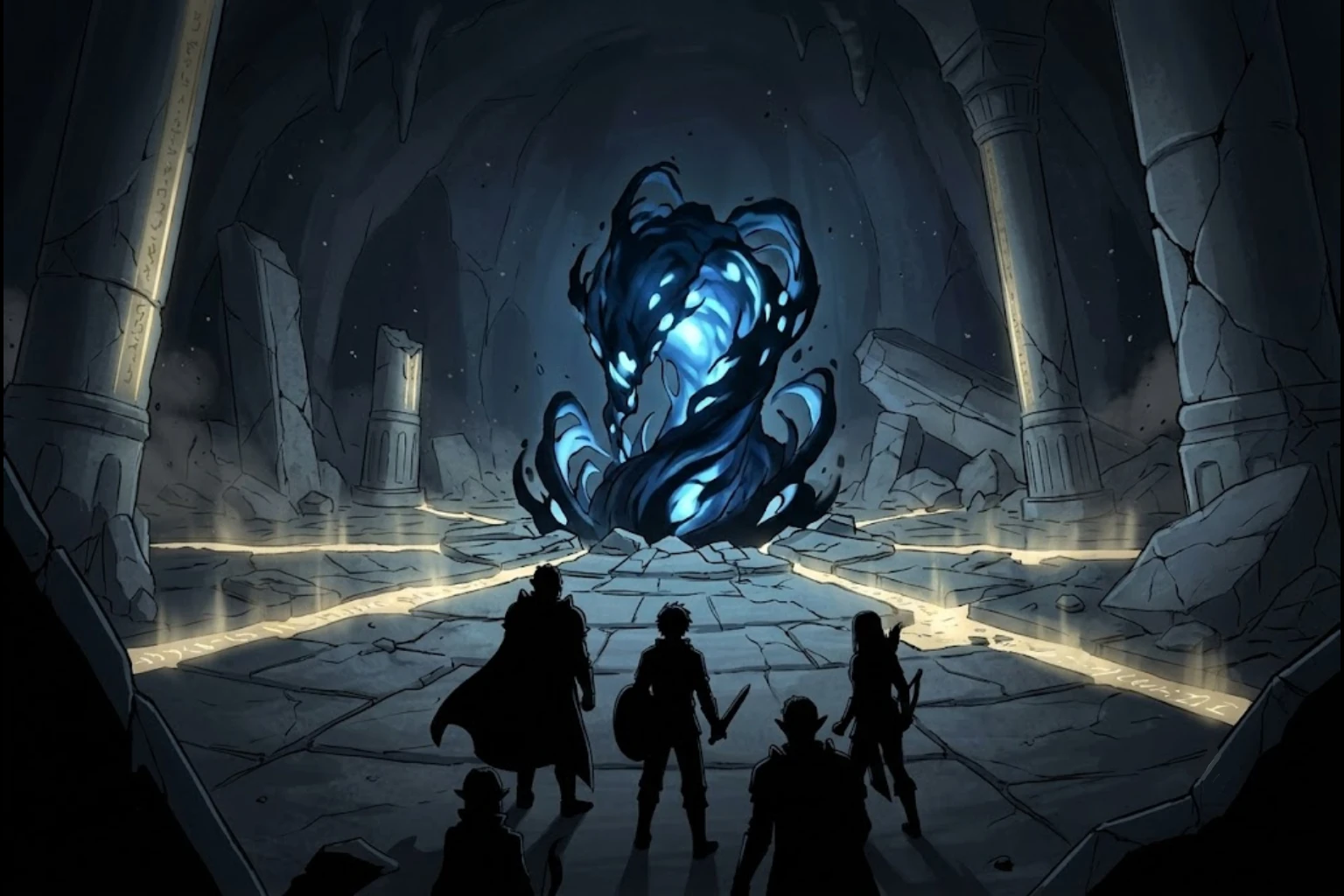
The final chamber was not built.
That was the first thing Elara understood when she stepped through the ancient door — not a thought, not a deduction, but the immediate understanding that arrived through the soles of her feet and the skin of her hands and the part of her training that had always been about knowing what she was standing in. The dungeon above had been built: cut stone, fitted courses, engineering and intention made physical. What she stepped into now had been found. A natural cavern in the deep limestone, vast and irregular, the ceiling lost in dark above the reach of any light they carried, the walls following the shapes that water and time had made rather than any human decision about where walls should be.
The kingdom had not made this place. They had found it, and built their dungeon over it, and spent the war trying to keep what was in it from getting out.
Lucian's light rose to full as they came through and found the chamber, and even at full it was a small thing in the scale of what opened around them. The floor was uneven — natural stone, smoothed in places by water that had moved through here in some earlier geological era, broken in others by old seismic movement, the surface requiring attention with each step. Formations rose from the floor and descended from the invisible ceiling: columns of mineral deposit, centuries of accumulation, some intact and some fractured and some reduced to stubs where something had broken them recently. Not recently in geological terms. Recently in dungeon terms. Within years.
The kingdom had added to the natural space. Not to make it more functional — to make it more sealed. Along the walls, at intervals, stood pillars of worked stone that were not natural formations — square-cut, inscribed with the dense pre-kingdom warding script they had seen on the door, each pillar connected to the next by a chain of inscription that ran along the base of the wall at floor level and tied the whole chamber together into a single continuous containment working. Eighteen pillars. Elara counted them as she moved further in. Eighteen, and six of them were cracked, and one was down, reduced to rubble at the base of the far wall.
Between the remaining pillars, in the cracks that ran through the floor where the natural stone had been stressed beyond its tolerance, a light moved.
Not Lucian's light. Not any light with a source that could be identified or a color that belonged to fire or crystal or enchantment. It was black-blue — the color of deep water in the moment before it goes entirely dark, the color of a bruise in old tissue, the color of something that had been light once and had been underground for so long that it remembered the concept of light without retaining the quality of it. It moved through the cracks in the floor the way water moved through cracks in stone — finding the path of least resistance, spreading, patient, present.
Dovar stood at the threshold of the chamber and felt it the way he had felt the chapel above: with the part of his training that registered the presence of divine workings not as sensation but as information. What he felt in the chapel had been the residue of faith, warm and faded. What he felt here was the negative of that — the shape that faith left behind when it had been pressed against something for a very long time and the something had pushed back and the faith had held, but barely, and the barely was ending.
"Generations," he said, quietly. "There have been generations of clerics working this chamber. What I feel is the accumulated structure of their work — not active, not current, most of it years dead. But the pattern of it is still here." He moved to the nearest intact pillar and put both hands on it, reading the inscription and what was beneath the inscription. "The deepest binding is still functional. What failed was the reinforcement work — the maintenance layers that kept the core seal healthy. Without maintenance the core degrades. Slowly, but—"
"It's been two years without maintenance," Elara said.
"More," Dovar said. "The last active reinforcement I can feel was done during the war. Before the evacuation. No one has touched this since."
The black-blue light in the floor cracks pulsed. Once. The pulse moved outward from the center of the chamber, running through every crack simultaneously, and where it ran the air changed — not colder, not darker, but different, the way air changed in the moment before a storm committed to arriving. The remaining mineral formations in the chamber rang, very faintly, in frequencies below the threshold of normal hearing that Odo felt in his sternum and Brakka felt in the soles of his feet.
Then the weight arrived.
It was not sound. It was not light. It was not the approach of a physical thing across physical space. It was simply — presence, pressing in from everywhere and nowhere simultaneously, the way deep water pressed: equally, from all sides, the specific quality of something very large becoming aware that what it had been waiting for had arrived. The chamber was vast and the presence filled it without occupying it, the way cold filled a room without being anywhere in particular.
Elara felt it reach the party like a hand finding the shape of a thing in the dark.
Then the images came.
---
They came without preamble, without the courtesy of transition. One moment she was standing in the chamber reading the layout of the pillars, and then she was also somewhere else — the same moment, the same standing, but overlaid with something that was not memory because it wasn't hers. Not vision. Not hallucination. Something more fundamental: the feeling of being known, which was not the same as being seen, and was worse.
It showed her what it knew.
The First Party, six years ago, on the road to the final keep. The formation they had moved in, precise and coordinated, the same formation they had moved in through this dungeon — Brakka ahead, Elara at his shoulder, Elanor forward, the back line protected. The road through the enemy territory. The days of hard travel. The night they had found the forward scouts' report nailed to a collapsed gate and understood, for the first time, how far there still was to go and how much had already been spent.
Then the moment.
She felt the weight of the thing finding that specific image and pressing on it, the way you pressed a bruise to see if it was still tender. The moment she had given the order to fall back. The particular quality of that night, the particular calculation she had made — the paths they had mapped, the weaknesses they had found, the intelligence they had gathered, the assessment that going forward from that position would spend the party for ground that the Hero Party could cover with the information the First Party had died to collect. The decision she had made and had not made lightly and had made correctly and would make again.
And then: the ballad.
Not heard. Felt. The shape of it, the specific cruelty of the image it carried — the First Party running, boots left behind, the Hero Party inheriting a cleaned road and a clear path and the celebration that followed, and the drunk in the corner of the Millepost Inn finding the chorus without needing to think about it, and the children in front of Harven's farm who knew the words before they knew their letters, and the name that had become a joke, and the faces behind the joke, and the particular hollow quality of being unmade by a song.
Why stand again, the weight said, without saying anything. Not words. Just the image and its implication, pressing steadily, the patient pressure of something that had been underground for centuries and had learned that patience was the only tool that always worked.
The road gave your labor to others. Why hold this road now.
Elara stood in the chamber and felt the weight of it and breathed.
Around her, she knew without looking that the others were feeling their own versions of it. The thing knew all of them — had been reading them since the ward-statues in the cracked gallery above, and possibly since before that, since the moment they had broken the seal at the north mouth and come into its dungeon. It had six people to press on. It had six wounds to find.
She heard Dovar say, through the weight, in a voice that was slightly too even to be entirely comfortable: "It's in the scripture. This is a described phenomenon. I know what this is." He was talking himself through it, using the structure of his training to put something between himself and what the thing was pressing. It was working. His voice was steady.
She heard Brakka make a sound that was not words, just the sound of a creature that had decided it was not going to be moved by something it couldn't hit, which was not a strategy so much as a personality.
She heard Odo.
He was not playing. He had not reached for the lute. He was simply breathing, in the particular measured way he breathed when he was listening, and in the silence that the weight created around and inside all of them, he was listening to it. Not accepting it. Not resisting it. Listening to it the way he listened to everything — attending to it, taking its measure, finding its frequency and its pattern and the specific qualities that would tell him what it was and how it could be addressed.
She had known Odo Madsong for twelve years.
She turned to the pillars.
"Lucian," she said, and her voice came out level and even, which was the thing she needed from it. "The binding structure. What still works."
He was already at the nearest intact pillar, his hands on the inscription, his face doing the thing it did when he was reading at the edge of his ability and pushing through it anyway. "The core is intact," he said, and his voice was precise and technical, which was how Lucian Gale defended himself against things that pressed on the part of a person that was not technical. "Eighteen pillars, six cracked, one down. The cracked ones are still partially functional — the inscription is interrupted at the fracture points but not severed. If the fractures can be bridged—" He moved to the next pillar, read, moved on. "The chain inscription along the wall base is largely intact. What failed was the connection between the chain and the pillars — the junction points degraded without maintenance. If those junctions can be restored—"
"Can they be restored?" Elara asked.
"By me? Not entirely. Not to the original specification." He moved to a third pillar, then stopped. "But the original specification was built by a tradition of mages over centuries and maintained by generations of practitioners. I am one person with a focus-staff and approximately half my reserves remaining." He turned and looked at her. "I can restore the junctions to functional. Not optimal. Functional may be enough to seal the chamber."
"What do you need?"
"Time and something to anchor the restoration while I work through the circuit." He looked at her. "The anchor needs to be an oath-binding. Sustained, centered, tied to the pillar circuit. The restoration builds on the anchor."
"That's me," Elara said.
"Yes," Lucian said. "That's you."
She looked at the central point of the chamber — the place the black-blue light was densest, where the cracks in the floor converged, where the presence was most fully itself. The shape inside the broken containment was not a body. It was not a creature in any architectural sense. It was accumulation — centuries of dark energy that had been pressed into a space and had taken the shape of that space over time, the way water took the shape of the vessel that held it, except that this vessel had been cracking for years and the water had been finding the cracks.
"Elanor," she said.
"Already counting them," Elanor said, from the right. She was moving along the wall, not toward the center, tracking the chamber's perimeter with her eyes and her sense of space. "The fractured pillars — six of them. The fracture points are the weak nodes. If Lucian's restoration runs the circuit, those six fractures are where it'll be most stressed." She looked back at Elara. "I can mark them. The ward-stones at the base of each fractured pillar — the original installation included anchor stones in the floor. If the anchor stones are identified and cleared, the restoration has something to seat into at each node."
"Do it," Elara said.
"Brakka," she said.
He was already looking at the fallen pillar — the one reduced to rubble at the far wall — and at the section of the chamber where the containment circuit was fully broken, the gap in the chain inscription where the pillar had stood. "The gap," he said.
"The gap," she confirmed. "The thing will push through it. It's the weakest point. I need you there."
He looked at the rubble. At the gap. At the black-blue light moving toward it through the floor cracks with the patient certainty of something that had been watching this exact point for years. "How do I hold something I can't hit?"
"The physical form it builds from the chamber — the remnants it animates. The war-golem pieces. The old armor. The chain it pulls from the floor." She met his eyes. "Hit those."
Brakka nodded, once. Then he walked toward the gap in the containment circuit, and the chamber's black-blue light intensified in the floor cracks as he approached, the presence reading his approach and responding to it with the attention of something that had been waiting for someone to be foolish enough to stand in front of its best exit.
"Dovar," she said.
"I know what I'm doing," he said, which was not dismissal but the most honest statement of professional confidence she had ever heard from him. He was at the nearest intact pillar already, his hands on the inscription, his eyes closed. "The divine side of the seal — there's a prayer structure embedded in the pillar inscriptions. Not kingdom standard. Pre-kingdom, old-church, the kind of faith-work that predates every tradition I was trained in." He opened his eyes. "I can read it. I can't replicate it. But I can reinforce it — put what I have against what's already there and add my weight to it. It won't be the same seal. It'll be my seal over the bones of theirs." A pause. "It will cost me."
"How much?"
He looked at his bitten arm. At his hands, which were the hands of a dwarf who had been in a dungeon for hours on inadequate sleep with an injury and a depleted reserve and a sustained ward already running. "Enough," he said. "Don't worry about it."
"Dovar—"
"Elara." His voice was not sharp, not frustrated. It was the voice of a person speaking a simple truth. "Don't worry about it. I will tell you if I'm dying and I am not currently dying. Do your job."
She looked at him for one second. Then she nodded.
"Odo," she said.
Odo was standing in the center of the chamber, equidistant from every wall, in the exact position from which the acoustic properties of the space were most evenly distributed. He had found this position without apparent calculation, the way he found positions — by being in the wrong place and moving until he was in the right one, a process that looked random and wasn't. His lute was in his hands. He had not yet played a note.
"The thing's pressure," he said. "It's working on frequency. Not sound — not literally. But the mechanism is the same: it finds a resonance in each of us and pushes at that frequency, and the pushing makes the resonance louder until it's all we can hear." He looked at the center of the chamber, at the convergence point of the floor cracks, at the place the presence was most itself. "If I can find the counter-frequency — not to silence it, I can't silence it, it's too large for me to silence it — but to put something alongside it that the mind can hold onto, something true that runs at a different interval—"
"The party stays themselves," Elara said.
"The party stays themselves," he confirmed. "You don't lose anyone to what it's showing you. You don't make decisions from inside its images. You remain." He paused. "What I play will not be a performance. It will be very small and very specific and it will not sound like music to anyone listening. What it will do is work."
"Odo," she said. "I know."
He looked at her. The twelve years of it were in the look, the long history of this specific knowledge between them — that she knew what he was for, that she had always known, that the false ballad had gotten everything about the First Party wrong but had gotten this the most wrong, because it had reduced them to a party that ran, and a party that ran was a party where no one knew what the others were for, and that had never been true of them, not for a single day.
He nodded. He turned to the chamber.
---
She walked to the center.
The black-blue light in the floor cracks intensified as she moved toward it, the presence tracking her approach with the fullness of its attention, and the weight increased with each step — the images becoming denser, more layered, the feeling of being known pressing in from every side. She felt the moment of the keep-road again, the fall-back order, the specific quality of that night. She felt the drunk in the corner of the Millepost Inn. She felt the children.
She felt the Hero Party's celebration in Durnfeld, the capital, the kingdom-wide remembrance days, the Hero Party's names on monuments, the Hero Party's story told in the guild halls and the schools and the chapels as the story of how the great war was won.
She felt her own name used as a punchline.
She walked to the center and stood in it, and put her hand around her pendant — the silver sunburst, six lines from a central point, the same shape she had cut into the corridor wall above with her belt knife six years ago — and spoke the beginning of the oath-binding not to the chamber or to the presence but to the pillar circuit, to the inscription that ran along the wall base, to the eighteen pillars in their varying states of damage and repair.
The binding went out from her like light goes from a lamp — in all directions, finding the circuit, seating into the junctions that Lucian had not yet restored but would restore, establishing the anchor that the restoration needed, giving the working something to build on. She felt the circuit receive it. Felt the places where it was weak and the places where it was strong and the six fracture points where it was interrupted.
The presence pressed in harder.
The images came faster — layered now, simultaneous, not one memory at a time but all of them at once, the full weight of what the false ballad had made of the First Party pressing against her from every direction, the weight of being the face of the failure, the paladin who had led and not won, the noble daughter who had been expected to succeed and had returned with maps and intelligence and the roads cleared and had been given a song that called her a coward.
She held the binding.
Not because the images weren't landing. They landed. They had been landing for years, in quieter moments, in the mornings before she got up, in the corner of every tavern where someone recognized her face. She had not made peace with them. She had learned to hold the binding while they landed, which was different and harder and the only thing that worked.
She held it.
Lucian moved to the first junction point — the connection between the chain inscription and the base of the nearest intact pillar — and put the focus-staff against it and began the restoration. The working was precise and quiet, a technical problem with a technical solution, and he worked it with the focus of a man for whom precision was not a discipline but a mode of being. The junction responded. The connection rebuilt itself — not to its original specification, not to the kingdom-era standard that generations of mages had maintained, but to a functional working version of it. Good enough to carry the load.
He moved to the next junction. Then the next.
Dovar's working began at the fourth pillar — the first of the cracked ones — and what he did was less like the restoration Lucian was doing and more like what he had described: his weight added to the bones of something older, the specific gravity of a dwarf cleric's decades of faith pressing into the inscription pattern and finding the prayer structure beneath it and reinforcing it with everything he had that matched its register and some things that didn't match but were offered anyway. The pillar's crack didn't seal. The fracture remained. But the working ran through it now instead of failing at it, carrying the load across the gap the way a bridge carried load across empty air.
He felt the cost of it immediately. Not pain — he had moved past the point where cost manifested as pain several minutes ago, when the residue from the hound bite and the reserves spent on Brakka's shoulder and the sustained ward against contamination and everything since had accumulated into a general depletion that was now the baseline of his body's situation. What he felt instead was the specific subtraction of something being spent from a finite reserve, the way a fire felt when the wood was running low — still burning, still functional, but aware.
He moved to the fifth cracked pillar.
Elanor was at the ward-stones. She had found them without difficulty — they were embedded in the floor at the base of each fractured pillar, flush with the stone, marked with a small inscription that matched the pillar's own at the base. Two years of dungeon grime had covered them, and she was clearing them one at a time with the edge of her knife, patient work, the kind of work that required care and not force, and when each one was clear it caught the light of Elara's binding in the floor and began to conduct it toward the pillar above it, giving the restoration nodes something to seat into.
She had three bolts left in the quiver. She was not going to use them for the ward-stones.
At the gap — the broken section of the containment circuit where the fallen pillar had stood — Brakka waited.
The presence knew this was the weak point. It had known it for longer than anyone alive had known it. The floor cracks converged here, the black-blue light running thickest through the gap, and the things it built from the chamber's remnants came for this point first.
The war-golem pieces came first. Not the pit-wardens from below — those had been stilled and were behind them. These were older fragments, pieces of constructs that had been in the chamber for years, animated by the light moving through them the way the combat chamber's armor had been animated by stored war-magic. A golem arm that dragged itself across the floor. The torso of something that had no legs but moved through the floor cracks like a crustacean. Half a helm with the sensory housing still intact, rolling toward the gap with a terrible, direct intent.
Brakka hit the golem arm with his axe and the arm stopped. He hit the torso with his shield edge and it shattered. He caught the helm underfoot and the helm stopped.
More came. Old armor from the chamber's far corners, fragments of chain from the floor, pieces of equipment that had been in the chamber since the war and had been waiting to be used since then. None of it was large. None of it was individually dangerous to Brakka, who was very large and had very good armor and had been doing this for a long time. The problem was not the individual pieces. The problem was the pace — the steady, relentless accumulation of small threats that required constant attention, that pulled his focus between multiple points simultaneously, that would eventually find the moment his attention was elsewhere.
He did not let his attention be elsewhere.
He worked the gap with the methodical efficiency of someone for whom this kind of sustained holding action was not heroism but labor, the specific unglamorous labor of the wall, and the wall held.
Old corpse-knight armor rose from the floor at the far end of the gap — not the captain from the combat chamber above, but something older, pre-kingdom, the armor design wrong in ways that the kingdom pattern was not. It had a sword that was not metal, a blade shaped from accumulated dark that held an edge the way old intentions held an edge. It came for the gap and Brakka turned to face it.
He blocked the first strike. The shield held. The dark-blade left a mark on the shield face that was not a scratch but an absence — a small section of the iron simply gone, the matter displaced rather than cut. He noted this. He drove forward with the shield rim before the second strike could develop, getting inside the armor's reach, using his mass at close quarters the way he always used his mass at close quarters, and the old armor went back and he stepped into the space it had occupied and held it.
The armor came again. He held it again. The gap held.
Then the presence changed.
Not louder. Not faster. It found a different approach, the way water found a new crack when one path was blocked, and the new approach was Odo.
The bard was playing.
What he was playing was not a song in any conventional sense. It was a pattern — specific notes at specific intervals, maintained with absolute precision, the kind of precision that required the player to be entirely present in the technical act of playing in order to achieve it. Not a performance. A working. The notes went into the chamber's acoustic space and found the frequency of the presence's pressure and ran alongside it at the counter-interval, not canceling it — Odo had been honest about the limits of what he could do — but giving the party's minds something else to hold onto. A thread. A true thing running through the false images, the weight, the specific cruelty of being shown what the world had decided you were.
The presence felt this.
It turned its attention to Odo the way you turned to something that had just answered you in a language you recognized, and the weight it put on him was specific and sudden and targeted in the way it had not been targeted at anyone else, because it recognized what he was doing and understood that it was the most dangerous thing in the chamber.
It showed him the First Party in the image it had been built from: running, defeated, the mocking ballad's version, the joke and the punchline and the drunk in the corner who didn't even mean to be cruel. It showed him this and pressed on it with everything it had, and it had a great deal.
Odo played four notes.
Not the working pattern. Not the counter-frequency. Four notes that were not directed at the presence or at the chamber or at any of the technical aspects of what was happening in the room. Four notes that were directed at the First Party, at the six people standing in this chamber, at the truth of what they had actually been and done, at the road as it actually remembered the first campaign, not as the false ballad had made it.
Not loud. Not heroic. The notes that told a true thing in a space full of false ones did not need to be loud. They needed to be true, and these were.
The thing is what happened on the road, and what happened on the road was this: six people went further than almost anyone else had gone, and mapped the paths, and found the weaknesses, and bought the time, and left the marks, and came back. And were not celebrated for it. And came back anyway, six years later, to a dungeon below a village that sang a cruel song about them, because the road needed it done and they were the ones who could do it.
That was not the ballad. That was not the joke. That was the road's version, the true account, the thing that veteran adventurers and guild masters and old scouts and the Hero Party themselves knew when they stood up straight and said: *that's the First Party.*
Four notes, quiet, into the chamber.
"That is not how the road remembers it," Odo said.
He said it quietly, the way you said a true thing that didn't need volume to be true. He said it into the chamber and into the weight and into the images and into the accumulated pressure of a presence that was very old and very patient and had found the wound it thought would open them, and had been wrong.
The working resumed. The counter-frequency, the thread, the true thing running through the false images. He played it with absolute technical precision and his hands did not shake.
---
Lucian reached the sixth fractured pillar.
He had been working continuously since Elara took the center, moving from junction to junction around the chamber's perimeter, and the focus-staff had become the extension of the working rather than a tool he was using, the restoration flowing through it and through him into each point in sequence. He could feel the circuit building — each junction restored adding to the load the remaining intact connections carried, the whole thing slowly becoming more itself, more functional, closer to the closed state that was the only state that would matter.
The sixth fractured pillar was the last of the cracked ones. Dovar had already reinforced it from the divine side. Elanor had cleared the ward-stone at its base. What remained was the arcane junction restoration — the final connection in the circuit that would close the loop and give Elara's binding the complete structure it needed to function as a containment seal rather than an anchor point alone.
Lucian put the focus-staff against the junction and understood, in the moment of contact, that what remained was not a technical problem with a technical solution. The junction point had degraded below the level that a restoration working could rebuild from the outside. To restore this junction, the working needed to be fed from within the circuit itself — from Elara's binding, pulled through the chain inscription and concentrated at this point and given something to stabilize around.
He took his hands off the focus-staff for a moment.
Around the chamber: Brakka at the gap, still holding, the old armor and the animating pieces coming for him in a steady flow and being stopped in a steady flow, the shield marked with absences and the arm beneath it running on the structural reinforcement Dovar had given it and the will of a creature that had made a decision about the gap and had not changed it. Dovar at the fifth cracked pillar, his hands shaking in a way they had not been shaking ten minutes ago, the cost now visible in the way cost eventually became visible regardless of how well you managed it. Elanor at the last ward-stone, clearing it. Elara at the center, the anchor-binding burning off her in visible lines of pale gold that ran to each restored junction in the circuit and held there, and her face carrying the expression she had when she was holding something very heavy for a very long time and had committed to holding it as long as it needed to be held.
"Elara," Lucian said, across the chamber. His voice carried the technical clarity of a man who had one thing to say and needed it received precisely. "The final junction. I need the circuit to feed the restoration rather than the restoration feeding the circuit. When I tell you — push everything you have into the binding. All of it, at once."
She looked at him. He saw her calculate the cost of pushing everything into the binding at once, which was the cost of having nothing left after, which in a live dungeon chamber was a significant cost.
"Lucian," she said. "Is it enough? If I do this, does it close?"
He had been a careful mage for forty years. He had spent forty years giving honest probability assessments in situations where people wanted certainty, because certainty was not available and pretending otherwise was the most dangerous lie a mage could tell.
"Yes," he said.
She took a breath. "Tell me when."
He put the focus-staff back against the junction. Found the channel between the restoration working and the circuit. Put everything he had into understanding the exact moment when the feed direction could reverse, when the circuit had enough integrity to give rather than take, when the junction would accept the working from the inside rather than requiring it from the outside.
He watched the circuit run. Watched the light in the chain inscription at the wall base pulse with each iteration of Elara's binding. Watched the restored junctions hold. Watched the integrity build, fraction by fraction, toward the threshold.
He felt it reach the threshold.
"Now," he said.
She pushed.
The binding that went from her into the circuit was not controlled. It was not the measured, sustained oath-work she had been running since she took the center. It was everything — the full weight of six years of coming back, of not being celebrated, of doing the work because the work needed doing, of standing in every village that sang the ballad and holding the line anyway, of standing in this chamber and holding the weight of what this thing had found in her and not letting it open her. All of it, pushed through the pendant and through her hands and through the anchor-lines and into the circuit.
The final junction rebuilt itself in a flare of pale gold and pre-kingdom inscription-light.
The circuit closed.
The chamber rang with it — a sound that was not a sound, a frequency that was not in the range of hearing but that everyone in the room felt through their teeth and their bones and the centers of their chests, the specific quality of a containment working returning to a closed state after years of failing. The black-blue light in the floor cracks surged once, enormous, filling the chamber — the presence recognizing what had happened and responding to it with the only response available to something that had just lost the exit it had been preparing for years — and then the light went into the floor, pulled back into the cracks, driven back by the restored circuit, and the cracks in the stone went dark one by one outward from the center.
The chamber went quiet.
Elara stood at the center and her hands were shaking and she let them shake, because there was no one here she needed to perform steadiness for, and her hands had earned the shaking.
Brakka lowered his shield. The gap held nothing. The animating pieces in the chamber had gone still when the circuit closed, the light that had been moving them withdrawn. Old armor lay where it had fallen. Old chains lay in their piles. The chamber was large and old and dark and very still, and the only light in it was Lucian's, pale gold, already dimming as he sagged against the final pillar.
Dovar was at Lucian's side before the mage had fully registered that he was sagging. One hand on his arm, steadying, the small ward of a cleric running the absolute minimum of support for someone who had spent their reserves on something that needed doing. "Sit," Dovar said.
"I'm fine," Lucian said.
"You are using words incorrectly," Dovar said. "Sit."
Lucian sat.
Dovar stood over him for a moment, then looked at his own hands. The shaking he had managed to keep invisible for the last ten minutes was not invisible anymore. He sat down against the final pillar, beside Lucian, and closed his eyes and breathed.
Elanor came to them from the last ward-stone and crouched and looked at Dovar and looked at Lucian and looked at them both with the assessing precision of a ranger who had been reading the state of the party alongside the state of the dungeon for hours.
"How bad?" she said.
"We are alive," Dovar said, without opening his eyes. "Do not ask me to be more specific than that right now."
Brakka came from the gap and sat down on a piece of rubble that was large enough to support his weight and set his shield on the floor and looked at it. The absences in the iron face — the sections where the dark-blade had displaced the metal — were permanent. The shield was structurally sound. It was marked permanently and would carry those marks forward, which was true of things that had been through what the shield had been through, and Brakka found nothing objectionable about this.
Odo stopped playing. The last note settled into the chamber's silence and was absorbed, and he lowered the lute and held it against his chest with both arms, the way he held it when he was done with something difficult and needed a moment before the next thing.
Elara walked to the wall and sat down against it. The pendant was still warm against her chest, the warmth that always lingered after sustained oath-work, the warmth of effort spent rather than of divine favor received. She felt the depletion in her bones and in the back of her eyes and in the specific muscle of commitment that she had been running at full capacity since she took the center of the chamber, and she let the wall hold her for a while.
Nobody spoke for several minutes.
The chamber sat around them, sealed and still, the ancient presence back in its containment, imperfectly but functionally held. The binding was not what it had been. The six cracked pillars were cracked still. The fallen one was rubble. The seal was not the original seal — it was a working built from what they had available and what could be restored in the time the situation had given them. It would hold. For how long, Lucian could not currently say, and they would not ask him to say it now.
It would hold today. They had made it hold today.
"The dungeon," Elara said, eventually. Her voice was rough at the edges, the roughness that came after sustained verbal workings.
"Unstable," Lucian said, from the floor beside Dovar. "The containment restoration will draw on the dungeon's remaining magical structure. As it does, the structure above will become less stable. I would estimate—" He paused, considering. "We have sufficient time to exit if we move reasonably promptly and don't spend time on things that aren't exiting."
"Up," Elara said, and pushed off the wall.
---
They went up.
Not through every level in the careful, reading-each-surface precision of the descent. Up, in the urgent and unglamorous way of people who had spent everything that needed spending and needed to be out of a collapsing dungeon before the thing that was collapsing made any decisions about them. The ramp at speed, Brakka's hand on Odo's arm over the uneven floor. The broken chapel in passing — Dovar touched the prayer rail as they went through, brief, the gesture of someone who would want to come back here when they had the time to properly acknowledge what had been done in this space. The treasury room without stopping, Lucian's focus-staff in his hand rather than his journal, which suggested his priorities had been clarified by experience.
The trap hall made Elanor set the pace — not as slow as the descent, but not careless, one hand out to her sides as she led them through the plate positions, her memory of the route exact and current. They made it through in three minutes. Dovar counted.
The narrow bridge: Brakka last again, the stone more vocal underfoot now as the dungeon's structure felt the change below it, a low grinding in the rock that was not present on the descent. He crossed at the same measured pace. The stone held. He made the far side and did not look back at the shaft.
The collapsed barracks: the armor on the racks was still. The sigil Lucian had broken on the way down had not reformed. They went through at a walk and nothing moved.
The cracked gallery: two of the three ward-statues that had turned their heads on the descent were dark now, whatever residue had powered them spent or withdrawn. The third turned its head as they passed and then stopped, the mechanism failing mid-rotation, and the stone face stared at the wall for the rest of time.
The flooded works: Dovar's ward against contamination was still running, barely, the last of a working he had set at the entry and that he maintained now through pure stubbornness and the refusal to let a ward he had established fail while he was still standing. The shallow crossing was shallower than before — the water level had dropped several inches, the drainage doing something it hadn't been doing, the dungeon's collapse affecting the systems below as well as above. They crossed.
The pit room was loud with the sound of things settling in ways they had not settled before. Not collapsing — not yet — but the iron gratings vibrating slightly in their frames, the walkway stone giving small complaints under their feet that the walkway stone had not given before. They moved through it quickly.
The holding corridor: the hound bodies were where they had fallen. The cell bars were bent as they had been bent. The corridor felt longer going up than it had going down, the way corridors always felt longer at the end of something than at the beginning, when the energy available for assessing length was different.
Brakka at the holding corridor's corridor-width, turning sideways, and the wall scraped his shield arm the same way it had scraped it on the way down. He noted the consistency and kept moving.
The stairwell from the holding level to the combat chamber was the hardest thing on the way up — steep and wet and every person on it was running on what was left after the final chamber, which was less than what you'd prefer for a steep wet stairwell. Brakka went last and reached up to take Odo's arm for the last three steps when Odo's footing went uncertain, and Odo took the help without ceremony, which was not something he would have done at the beginning of their acquaintance and was something he did without thinking now.
The combat chamber: the fallen armor was still fallen. The captain stood on the dais, power exhausted, sword lowered, the presence that had been directing it withdrawn through the floor below. The chamber was still and cold and smelled of old metal and the spent blue light of war-magic that had run down.
Elara stopped in the center of the chamber for two seconds. She looked at the captain. She looked at the combat chamber's formal proportions, the vaulted ceiling, the iron brackets on the walls. She looked at the rear door they had come through, leading to the stairwell, leading to everything below.
Then she looked at the front door, leading to the antechamber, leading up.
"Good room," she said, to the chamber in general.
Nobody laughed. But Dovar made the sound he had made at the inn when she'd said the boots thing, and it served the same function.
They went through the front door.
---
The antechamber let them into the corridor and the corridor gave them the sunburst mark, still on the wall at shoulder height, six lines from a central point, and Elara put her hand on it as she passed without stopping.
She didn't say anything this time.
She didn't need to. The first time she had touched it she had needed the one line, the acknowledgment that it was real and that she had been here before and that it meant what it meant. The second time she just touched it and kept walking, because the mark had been made in the first campaign to help someone find this place, and it had done its job, and now they were leaving and the mark would stay, and that was exactly how it should be.
The north mouth let them out into the morning.
They stood in the hawthorn scrub at the base of the limestone cliff and breathed air that came from the sky rather than from stone, and the air was cold and smelled of late autumn and the wheat fields east of Ashfen and the particular quality of open space after enclosed space, which was a quality that most people did not notice because they didn't spend enough time in enclosed stone to know what open air felt like when you got it back.
Lucian tilted his face upward and held it there for a moment, which was the most expressive non-verbal communication he performed on a regular basis.
"The Underbreach," Elanor said.
They all looked at the cracked door slab, the broken entrance.
"Still open," Dovar said.
"We don't have the resources to reseal the physical entrance today," Lucian said. "The kingdom seal is gone. We could bar it — pack the gap with stone, wedge it shut — it won't hold long-term but it will hold until Ashfen can get word to a guild and arrange proper remediation." He paused. "The containment below will hold longer than the physical entrance. Priority is getting word out."
"Right," Elara said.
They walked back to the road.
---
Ashfen saw them from a distance.
Not the whole village — it was mid-morning, working hours, most of Ashfen was in the fields or at the mill or doing the end-of-harvest business that didn't pause for much. But the two farmhands from the first day were at the road's edge when the party came around the bend, and they stopped what they were doing and watched, and the older of the two said something to the younger one that Elanor, who was slightly ahead, heard but didn't repeat.
Toven saw them coming from the inn yard, where he was moving barrels, and he set the barrel down and straightened and watched them come down the main road, and something moved across his face that was not quite any single expression but contained several of them in close sequence.
They were dirty. They were exhausted in the specific way of people who had been through something significant and were not yet past the point where the body's emergency resources had fully discharged, the flat quality of people who had spent everything and were running on the residue of it. Brakka's shield bore the marks of the dark-blade's absences. Dovar's arm was wrapped and his color was not right. Lucian's robes had been through a flooded maintenance level and a chamber fight and several other things and showed all of it. Elanor had three bolts in her quiver.
They were alive. They were upright. They were walking back into Ashfen in the mid-morning light, and the dungeon was sealed behind them.
Toven met them at the inn door.
He looked at Elara. He looked at Brakka. He looked at the shield. He opened the inn door and stood aside.
"Breakfast has been on the fire," he said. "I kept it."
He didn't ask whether the thing was done. He didn't ask what they'd found. He looked at them and made a decision about what the situation called for and acted on it, and what it called for was a door held open and food on the fire without a question asked about payment.
Elara looked at him for a moment.
"Thank you," she said.
They went in.
---
The breakfast was simple and it was hot and for a considerable while it was the only thing that mattered. The inn was quiet — the morning crowd had come and gone and the midday crowd hadn't arrived — and the six of them occupied the long table by the hearth in a silence that was not uncomfortable but was the silence of people who had been in very close proximity to each other through something significant and had said everything that needed saying and were now in the part where being in the same room was enough.
Dovar ate left-handed. His right forearm was on the table and he was not putting weight on it, and after the meal he would ask Lucian to look at the ward he had running and decide together how long the residue management needed to continue and what the minimum effective ongoing dose was, because they were the kind of people who had those conversations practically and without drama.
Brakka ate everything that was in front of him and some of what was in front of Odo, by agreement, because Odo was the kind of person whose appetite after sustained difficult work went away for a while and who made up for it later when it returned, and Brakka was the kind of person whose appetite was consistent and considerable, and they had an arrangement.
Lucian read his journal. He had it open beside his plate, and he was writing in it as much as reading, the small precise notation of a man recording something while the details were still current, which was what Lucian did after any significant magical engagement that produced information worth keeping.
Elara drank two cups of the mediocre tea that was still better than it had any right to be, and watched the hearth, and let the warmth of the fire and the food and the not-being-in-the-dungeon do what it was going to do to the thing behind her sternum that had been running at full load for the last several hours.
Odo watched the room.
He always watched rooms, but he was watching this one with a particular attention, the kind of attention that was looking for something specific. He ate slowly when he ate and drank his tea slowly and let his eyes move across the space — the regular midday patrons beginning to filter in, the farmhands at the bar, Toven behind it, the particular quality of a small village inn returning to its ordinary working rhythm. The morning business. The routines.
Then he heard it.
From outside — from the road, or near it — a child's voice, the high unselfconscious voice of a child who was not performing but simply doing what children did when they had a fragment of song in their heads and were occupied with something else. The voice was not carrying the full ballad. Just the tune, the recognizable melody of the First Party's famous mocking song, hummed at first and then a word or two surfacing.
But the words were wrong.
Not the familiar words. Not the words the drunk had been singing in this very room two nights ago, the chorus the whole village knew. Different words, fragmentary, the words of a child who had heard a different version from somewhere and had not learned it completely but had learned enough that the wrong words — the different words — were what came out when the tune came out.
Odo set down his tea.
He did not go to the window. He simply sat with it, listening to the fragments as they came through the wood and stone of the inn, and his face was still in the way his face was still when he was receiving something that he needed to receive fully before he responded to it.
Then he picked up his tea and drank it.
---
In the inn yard, the farmer woman from the night they had arrived — the one who had told them about Harven's daughter and the north mouth and the Underbreach's waking, the one who had looked at Brakka's shield and made a decision about what she was going to say and said it — was speaking to Toven by the water barrel, and what she was saying was low and practical in the way she said everything, and what she said was being received by Toven with the nods of a man updating his understanding of a situation.
Brakka came out through the side door of the inn to get the air, which he always needed more of than the others after a sustained enclosed period, and the farmer woman looked at him. She looked at his shield. She looked at his face. She looked at the specific quality of someone who has been through a significant dungeon engagement and come back from it.
She said nothing.
Brakka said nothing.
He stood in the inn yard in the thin autumn sunlight and breathed, and the farmer woman finished what she was saying to Toven and turned back to the barrel, and the ordinary business of the yard continued.
Then one of the children who had been sitting on the well came around the corner of the inn at the quick, unplanned pace of a child following an impulse, and stopped when she saw Brakka, and stared at him with the large unguarded eyes of a child who had not yet learned to pretend she wasn't looking.
She was perhaps seven years old. She had straw in her hair and muddy boots and the general appearance of a child who had been doing harvest work in the fields and had escaped temporarily from it.
She looked at Brakka for a long moment. Then she looked at the shield. At the absences the dark-blade had left in the iron. At the marks and dents that were not new but that she could see now that she was close enough.
"Did you really fight the thing under the road?" she asked.
Brakka looked at her. The question was direct in the way that children were direct, without the qualifications and hedgings that adults wrapped around questions of that kind, and it landed with the uncomplicated weight of simple curiosity.
"Yes," he said.
She looked at the shield again. At the absences. At the old dents beneath the new marks, the whole history of the shield's use in the iron of its face.
"Is it gone?" she asked.
Brakka thought about this for a moment with the seriousness it deserved, because it was a serious question and she had asked it seriously.
"It's sealed," he said. "For now."
She processed this. "What does that mean?"
"It means it can't reach the road today," he said. "And today is what we came for."
She thought about this. Then she nodded, with the serious, practical nod of a child who had been raised in a farming village and understood that some problems were solved and some problems were managed and the important thing was whether you were managing them, and went back around the corner of the inn toward the well and the harvest work.
Brakka stood in the inn yard for a while longer. Then he went back inside.
---
They left Ashfen in the early afternoon, while the light still held.
There was a conversation with Toven about the north mouth and who to send word to — Lucian wrote the relevant guild contacts on a page from his journal, the specific offices and the correct form of the report, and gave it to Toven with the instruction to send a rider to Millhaven and have the message forwarded from there, and Toven received it with the nod of a man who was going to do exactly that. There was a brief stop at Harven's farm, the shutters now partially open, and Harven himself came to the door and listened while Elara told him what they had found and what they had done and what the girl had seen, and that the girl had been right and had done the right thing by running home and telling her father, and the man received this with the expression of a father who had known his daughter wasn't prone to stories and was relieved to have that confirmed by someone other than himself.
The girl herself watched from an upstairs window. She did not come down. She didn't need to.
The road west out of Ashfen was the road they had come in on — the same buckled cobblestones, the same weeds in the mortar, the same crow on the fence post who found them as uninteresting as it had found them before. Elanor walked five steps ahead, reading the road out of habit, and there was nothing to read except the ordinary passage of ordinary things. The fields in the late afternoon light were gold and brown, the harvest mostly done, the village settling into the end of its long season.
At the bend where the willows were, where the village had first become visible from the road two days ago, Elara stopped.
She did not turn around. She stood at the bend and looked at the road ahead, and then she looked east, and the road east ran out of sight around the base of the ridge and kept going, past the sealed north mouth and the cracked war-road and the limestone cliffs and whatever lay beyond them, which was the rest of the world.
The Underbreach was closed.
But she could feel it, in the specific way she felt things — not a premonition, not a divine communication, just the understanding of someone who had been reading dungeons and roads and old wars for long enough to know the difference between a problem that was finished and a problem that was managed. The Underbreach was one problem among many. It was one dungeon below one village on one road in a world full of abandoned dungeons and cursed roads and destabilized ruins, all of them inherited from a war that had ended two years ago and left its wreckage distributed across the landscape without reference to who was going to clean it up.
Nobody was coming to clean it up. The kingdom's apparatus for that kind of thing was gone. The Hero Party had their monument and their celebration and the historical record of the final battle, and they would do their part when their part was needed, but they were one party. The First Party was one party.
The road beyond Ashfen had begun to remember.
She knew that feeling. She had felt it on the first campaign, on the forward roads, when you understood that the work ahead of you was larger than what you had available to meet it and you went forward anyway because going forward was the job and the job was why you were there. She had felt it then, and she felt it now, standing at the bend in the road outside a farming village that two days ago had been singing the false ballad and that now had a reason to revise its opinion.
Not a grand feeling. Not the feeling of a triumphant return. Just the plain, functional, sustaining knowledge that the work was real and the road remembered and the party was intact and moving.
She turned back to the road west.
"There's more," she said to the others. Not a question. Not a concern. Just the statement of a fact about the world they had agreed to move through.
"Yes," Odo said, from behind her. His voice was the voice he used when he was already listening for the next thing.
"There's always more," Dovar said. This was not complaint. This was the dwarf cleric's version of confirmation.
Brakka said nothing. He started walking.
That was enough.
The First Party took the road west, and the road west ran toward everything that came next, and behind them on the wall of the Underbreach's inner corridor a sunburst mark in old stone waited with the patience of marks left in the right place at the right time by people who understood that the road remembered the truth even when the songs did not.


.png)
.png)
.png)