%20(1).png)
The stairwell cut into the bedrock at an angle that hadn't been engineered so much as found — a natural fissure in the limestone, widened and stepped, the work of someone who had discovered the rock wanted to go this direction and had agreed with it rather than arguing. The finished stonework of the upper levels ended here. Below the pit room the Underbreach was older and rawer, the walls showing the unworked face of the mountain's interior, the steps irregular in a way that was not carelessness but geology. This part of the complex had not been built. It had been adapted.
The party descended in the order they had held since the holding corridor — Elara first, then Brakka behind her left shoulder, then Elanor four steps ahead on the right-hand wall, then Dovar, then Odo, then Lucian — and they went carefully, because the steps were wet.
Not flooded. Not dripping from any visible source. Just the pervasive moisture of deep stone, the slow exhalation of rock that had been sealed and breathing in its own atmosphere for decades, the condensation that gathered on every surface below a certain depth and made every step a small negotiation with gravity. Brakka descended with both hands available, his shield on his arm and his axe at his side, feeling each step with the ball of his foot before he trusted it. Tower shields were not designed to arrest a fall down a wet limestone stairwell, and he had no particular interest in testing whether they could.
Dovar's arm ached.
Not badly. Not in any way that impaired his grip or his movement, but in the low constant way of an injury that had been managed rather than healed — the residue of the hound's venom still sitting in the tissue around the bite, neutralized but not gone, making itself known in the particular dull throb that came with sustained use of the forearm. He had treated worse. He had treated much worse in much worse conditions than this. He was noting it, not complaining about it, which was the distinction he maintained and which the party had learned to trust.
"It's changed," Odo said, from behind him. Quiet. The voice he used when he was reporting an observation rather than starting a conversation.
"What has?" Elara asked, from below.
"The dungeon. The feeling of it." He paused, one hand trailing along the wall as he descended, not reading the stone the way Dovar read stone but listening to it in the way that had no better description than listening. "Above — the combat chamber, the holding level — it felt reactive. Things responding to our presence, to the horn, to movement and sound. What's below us feels different." Another pause. "Anticipatory. Like it's been waiting for us to get this far."
Nobody answered that immediately, because there was nothing comfortable to say about it and the party had long since stopped saying comfortable things for the sake of filling silence.
"The two pit creatures went this way," Elanor said, from her position on the right wall. She had been reading the stairwell as she descended, which required no adjustment to her pace — she read surfaces the way she breathed, automatically, without effort. "Both of them. The disturbance on the steps is consistent with something large moving downward within the last few hours. They're ahead of us." She looked back at Elara. "Significantly ahead. They haven't stopped."
"They were sent ahead," Lucian said. "Not released to wander. Sent to a specific position." He adjusted his spectacles in the dark, a habitual gesture that served no optical purpose in minimal light but which he performed anyway. "The intelligence below has placed them somewhere between here and its position. We should expect them when the dungeon wants us to expect them — not before, not on our terms."
"It gets to choose the ground," Brakka said.
"Yes," Lucian said. "That is the disadvantage of arriving second."
Brakka considered this. "Then we move faster than it expects."
Elara, at the bottom of the stairwell now, looked at what was ahead of them and stopped. The party came down behind her and stopped with her, one by one, until all six of them were at the base of the stairwell looking at the level below, and the level below was wet.
---
The flooded works had probably been a maintenance level once — a practical space housing the mechanisms that kept the Underbreach's upper levels functional. The evidence of what it had been was still present in outline: the rusted skeletons of pump machinery along the walls, iron wheels and chain-housings and the remnants of a drainage system that had, at some point, stopped draining. Stone walkways ran between the equipment housings, raised six inches above the original floor level, and the original floor was no longer visible because it was under two feet of black water.
The water had no obvious source. It had simply accumulated, the way water accumulated in sealed underground spaces when the drainage failed and the moisture from the rock had nowhere else to go. It was very still. In Lucian's light it was the color of old iron, flat and opaque, the surface broken only where the raised walkways interrupted it. Whatever was in it was not visible.
"Depth," Elara said to Elanor.
Elanor was already reading the room — the line of the walkways, the way the old maintenance grooves in the stone caught the light differently where the stone was exposed versus where it descended under the water, the particular stillness of the surface in different sections of the room. She pointed left, toward a path that tracked along the far wall. "Walkway holds most of the way. There's a gap of about eight feet near the central machinery housing where the raised stone has partially collapsed. The water there is shallow — a foot, maybe less. I can see the floor texture through it."
"Can you see the whole floor?" Dovar asked.
"No."
"Then we don't know what's in the deep sections."
"No," she agreed. "We don't."
Brakka looked at the water and at the width of the walkways and made the calculation he always made in spaces like this, which was the calculation of how much the architecture was going to inconvenience him versus how much he was willing to be inconvenienced. The walkways were wide enough for him if he was careful and not wide enough if he needed to fight. The footing in two feet of black water was bad for anyone and worse for him. He filed this and said nothing, because filing it was the useful action and saying it was not.
"I'll ward against the water first," Dovar said. He was already working — not a full casting, not the sustained divine work he used for direct healing, but the short precise blessing of a cleric who knew exactly which register to address for environmental contamination. Water in a sealed dungeon that had been running active war-magic for years was water that had been changed by that proximity, and the changes were rarely beneficial to drink or stand in for extended periods. The ward he laid over the party was light and specific — not protection from a threat, just insurance against the slow accumulation of something that shouldn't be in their blood. "It'll hold for the crossing," he said. "Keep moving."
They moved.
The walkway held Elara and Brakka and Elanor and Dovar and Odo without complaint, the old stone carrying weight with the indifference of things built to last. At the gap — the section of collapsed raised stone, the eight feet of shallow crossing — Elanor went first, reading the bottom of the water with her feet as she moved, finding the firm stone beneath, marking the path by how she placed each step. Lucian's light followed her. The water was cold and the texture of the bottom was irregular, old flagstone shifted by whatever had caused the drainage to fail, but the depth held at a foot and the firm stone held under it and they crossed without incident.
Brakka went last. The walkways had noticed his weight — slight flexing at the joints between sections, old mortar giving fractionally, nothing that compromised the path but enough to register. At the shallow crossing he went slowly, the water rising to his knee rather than his ankle, and something in the deeper section to his right moved when his boot disturbed the surface.
Not fast. Not predatory. Just present — a disturbance in the flat water, a displacement, the suggestion of something aware of the change in the room's state. It didn't surface. It didn't approach.
"Keep moving," Elara said, from the far side, not loud.
He kept moving.
At the far wall of the maintenance level, past the last of the pump housings, a sluice gate had rusted into its frame — iron in iron, seized solid, blocking the passage to the next stairwell. Brakka looked at it. He looked at the mechanism, which was a wheel-and-chain system that had oxidized into a single undifferentiated mass of rust. He looked at Elanor, who looked at the mechanism, who shook her head.
He put his shoulder against the gate.
The sound it made was not good for anyone's nerves — a grinding, tearing shriek of metal in stone, the protest of something that had not moved in years and did not want to move now — but it moved. Six inches. A foot. Two feet, and the gap was enough, and he stopped because stopping was more efficient than opening it fully and he was already breathing harder than he'd been at the stairwell.
They went through the gap and up the next stair, and the flooded works sat behind them in its silence, and whatever had moved in the deep water did not follow.
---
The levels below the maintenance works came in sequence, and the party moved through them the way they moved through everything they had survived long enough to understand: carefully, efficiently, without stopping longer than the situation required.
The cracked gallery came first — a long vaulted space that had been used for storage once, the shelving long since collapsed, the contents long since gone or rotted, and along the walls at intervals of ten feet stood statue niches, each one holding a carved figure in old kingdom armor with a blank stone face. They were ward-statues, the kind set to observe and report — the magical equivalent of sentries, built to track unauthorized presence and relay that information to whoever had built them. Most had been dead for years, their purpose leeched out with the kingdom's fall, the magic in them reduced to dim residue. But not all.
Three of them turned their heads as the party passed.
Not quickly. The stone ground against itself in the neck joint, the movement reluctant and effortful, the way a mechanism moved when it had been still for a very long time and was being asked to function on depleted reserves. Each head tracked the party from the niche, following movement, the blank carved faces somehow communicating attention despite their blankness.
"Reporting?" Elara asked, without stopping.
"To whatever is left to receive the report," Lucian said, keeping pace beside her. "The relay network will be as degraded as everything else up here. Whether the lower level receives anything useful—" He glanced at the nearest turning head. "Possibly. Probably. Another reason to assume we are expected."
"Then we keep moving," Elara said.
They kept moving. The heads turned as far as their mechanisms allowed and then stopped, watching the party recede, and the gallery fell behind.
The collapsed barracks was next — a wider space than the gallery, the ceiling lower and in two places fallen entirely, rubble mounded under the gaps and the night sky absent because they were deep underground and the collapse was old and the rubble had settled into something stable and permanent. Sleeping pallets had become compost over years of moisture. Equipment racks stood at angles, the wood rotted out of the metal fixtures, and on three of the racks the old plate armor that had been stored there still hung, draped on the rack shapes, and when the party's feet disturbed the floor dust the armor moved.
Not walking. Not animating the way the combat chamber's guardians had animated — those had been specifically enchanted for that function, purpose-built fighting constructs. This was ambient residue, the war-magic still sitting in the metal like heat in a stone, responding to the vibration of footsteps with a slight, reflexive shudder. The shoulder plates shifted. One gauntlet fell and hit the stone floor with a sound that was very loud in the silence and Odo's hand went to his lute and stopped there.
Lucian was at the nearest rack before anyone spoke. His light moved close to the armor and his hand moved along the rack without touching the metal, feeling the field around it. "Command sigil," he said. "Embedded in the rack structure, not the armor itself. The armor responds to vibration through the rack." He found the sigil by the change in the field — a specific pattern in the wood of the rack, barely visible under years of rot — and pressed two fingers to it and said something that was less a word than a precise sound, technical and flat.
The armor went still. The faint vibration that had been running through it stopped.
"The other racks," he said. "Don't touch them. Walk along the right wall. The sigils are active as long as the racks are intact."
They walked along the right wall and the other racks shuddered as they passed and settled as they moved away, and then the barracks was behind them and ahead of them was a stairwell filled with bones.
Not scattered. Not the aftermath of a fight. They had been stacked, carefully, to one side of the stairwell — the organized respectful work of someone who had found remains and had taken the time to treat them properly. Old bones, years old, the kingdom's armor corroded to a thin shell around them. And on the wall beside the stack, in the specific chalk-and-soot marking style of campaign scouts, a warning:
*BELOW HERE THE FLOOR CANNOT BE TRUSTED. MARK YOUR STEPS. DO NOT HURRY.*
And beneath that, in a different hand, smaller:
*WE TRIED. THE WARD HELD FIVE DAYS.*
Elara read both lines and said nothing. Dovar read them and touched the stack of bones with two fingers — a brief, private acknowledgment — and moved on.
The stairwell itself was treacherous, the steps cracked and in three places absent entirely, the gaps requiring careful navigation and one extended reach where Brakka held his arm across the gap for Odo and Lucian to use as a handhold, which he did with the matter-of-fact practicality of someone who had understood for a long time that being the largest and most structurally stable member of the party meant being furniture sometimes, and had no objection to it.
The trap hall was below the stairwell, and Elanor stopped the party before they were fully into it.
She didn't speak. She put one hand back — flat, palm out, the gesture that meant stop and meant it now — and they stopped, and she crouched and looked at the floor and then looked at the ceiling and then looked at the floor again, and then she pointed at a section of stone six inches ahead of where Elara's next step would have landed.
Pressure plate. The stone was fractionally different from the surrounding floor — not in color, not in texture, but in the precise way the light caught the seam around its edges, a gap that was the width of a hair and the length of a rectangle. Elanor traced the seam with her finger without touching it and then looked up and pointed at the ceiling, where two parallel grooves in the stone ran the length of the hall.
"Channel," she said, quietly. "Something comes down from those grooves when the plate goes. Blades or bolts, I think. The angle suggests the range covers the entry to the hall and approximately the first ten feet." She looked at the floor, reading it with the same patience she had brought to the cage floors above. "More plates further in. Three, I think. The spacing is irregular."
"Of course it is," Dovar said.
She walked them through it one by one, stopping at each plate, marking the path around it, moving slowly and precisely in the way of someone for whom patience was not a virtue but a tool, the most reliable tool she carried. The hall was forty feet long. It took them eight minutes. Nothing triggered. Nothing came down from the ceiling grooves. They emerged at the far end and Elanor let out a breath that was not quite a sigh but occupied the same territory.
The narrow bridge was the last obstacle before the false treasury, and it was narrow in the way that a bridge over a shaft of unknown depth was always narrower than it needed to be — wide enough for a person, too narrow for Brakka with his shield on his arm, the stone old enough that it spoke underfoot in ways that made Lucian and Odo cross quickly and quietly and without looking down.
Brakka strapped his shield across his back and crossed last. The stone made its opinion clear with each step — a low creak, a fine powder sifting from the underside into the dark below — but it held. He reached the far side and the sound stopped and he unstrapped the shield and did not comment on any of it, because commenting would not have made the bridge better and the bridge had held, which was the thing that mattered.
"What's the depth?" Odo asked, looking back at the shaft.
"Deep," Brakka said.
"That's what I thought."
---
The false treasury announced itself as treasure before they were fully through the door, which was the first thing wrong with it.
The chamber was wide and well-lit — the light coming from the war-crystals set in the ceiling, still functional, still casting the blue-white illumination of active enchantment, which meant the room had power when most of the dungeon above it had been running on fumes for years. That was wrong. The chests were arranged in rows, campaign chests with kingdom markings still visible on the lids, and between them were stands of weapons — swords and spears in good condition, the metal catching the crystal light without the dullness of age or rust. In the back corner a scatter of coin lay across the floor as if from a spilled crate. Old coin, kingdom mint, the kind that held real value.
Odo stopped in the doorway.
The rest of the party stopped with him, because when Odo stopped in a doorway there was a reason.
He stood with his head slightly tilted and his eyes moving across the room slowly, and the expression on his face was the one he got when he was listening to a space and finding it deficient in ways that most people could not have articulated. He had been listening to the Underbreach since the antechamber above — taking its measure, building the acoustic and resonant picture of it level by level — and he knew, now, what a space in this dungeon sounded like when it was real.
"It's too quiet," he said.
"It's a room," Dovar said.
"Yes, and rooms have sound. Even empty ones — the settling of old stone, the movement of air through joins, the tiny adjustments of materials reacting to temperature and load. A room full of chests and weapons and scattered coin would have more than that — the settling of the lids, the resonance of metal on stands, the slight, constant shifting of stacked weight." He had not moved from the doorway. "This room has none of that. It is performing quietness. The way a held breath is quiet."
Lucian was standing at Odo's shoulder. He was looking at the nearest chest — not at the chest itself, but at the space around it, the way the light fell on it, the way the shadows sat. "Layered working," he said. "Illusion on top of a lure-ward on top of a trigger mechanism. The illusion is good — kingdom-era quality, not residue but maintained. Which means the room has a power source still feeding it." He tracked the ceiling with his eyes. "There. The crystal array isn't just lighting the room. It's sustaining the illusion and holding the trigger in readiness." He stepped back from the doorway. "The drag marks," he said to Elanor.
She had already seen them. "Two entry paths in the floor dust. Nothing exiting." She looked at the nearest chest. "Whatever walked in here didn't walk out."
"The two pit creatures?" Brakka asked.
"No. Older. The marks are old." She looked at Elara. "This room has caught things before. Probably during the war — whatever found this level before the evacuation."
Elara looked at the room from the doorway. The chests. The weapons on their stands. The scatter of coin. The blue-white light making all of it look clean and real and worth walking toward.
"Lucian," she said.
"The power source is the crystal array. If I break the sustaining connection—" He considered it. "The illusion fails. The lure-ward loses its trigger. The room becomes a room." He looked at the array. "It will make noise. The lower level will know."
"They already know where we are," Odo said.
Lucian nodded once and worked quickly — a precise, minimal casting, targeted at the specific connection between the crystal array and the working it sustained rather than at the working itself. Breaking the connection rather than the construct, the way you cut a wire rather than smash the device it powered. The light in the room shifted — the blue-white dimming to the pale gold of Lucian's own light, the room changing character as the illusion dropped.
The chests were still chests. Most of them. The nearest two were not.
The nearest chest came apart along seams that had no business being in a chest — the lid hinging the wrong way, the sides folding outward in the segmented motion of something opening itself, the interior revealing not a box but a depth that was wrong for the external dimensions, a depth that contained something large and the color of old wood and old iron and hunger that had been waiting in stillness for a very long time.
Brakka hit it before it finished opening.
Not with the axe. With the shield, rim-first, a driving strike that used his full weight behind the rim edge and connected with the thing's hinge-joint before it had completed its opening movement, while it was still in the transition between states, and the sound of the impact was deeply unpleasant and the thing went into the adjacent chest stand hard enough to bring down the weapons from it in a cascade of kingdom steel.
The second mimic came from the right-hand side of the room — not a chest, the weapons stand it had been impersonating folding apart in the same segmented wrongness, and it had a reach that the chest hadn't had, and it reached for Odo.
Elara put herself between the reach and Odo in the half-second before it arrived. The oath binding she threw was not aimed at the mimic — she didn't have the angle for a clean bind on something moving toward her at that speed — but at the space the reach would have to pass through, and the reach hit the boundary and stopped and she felt the impact of it up through her arm and into her shoulder, because a bound limb still transferred force and the mimic was not small.
She held it. The mimic's reach pressed against the boundary with the mindless insistence of something that only knew it had a target and wanted it, and she kept the boundary up and her feet planted, and behind her Odo had moved left along the wall and had his lute out and was already working.
Dovar was at Brakka's shoulder. The first mimic had responded to being hit — had righted itself, had completed its opening movement, had produced something from its interior that was not a weapon exactly but functioned as one, a pseudopod of compressed and hardened wood-substance slamming at Brakka's shield arm. The impact was significant. The shield held. The arm beneath it made a sound it shouldn't have, and Dovar got a hand on Brakka's vambrace and ran a quick divine reinforcement through the limb — not healing, no time for healing, just the structural support of a ward that said *this bone holds, this joint holds, the load transfers through, you do not stop.*
"Curse on the second one," Dovar said, tight, his other hand going to the ward-bead on his hammer handle. "Don't let it hold contact with skin."
"Noted," Brakka said, and hit the first mimic again.
Elanor, from the left wall, put a bolt into the junction point between the first mimic's hinge segments — the structural weak point of the articulated exterior — and the segment failed and the thing's movement became asymmetric and Brakka took advantage of asymmetric movement with the particular efficiency of someone who understood that the interval between a thing losing its balance and regaining it was where the work happened. Two strikes, decisive, the axe this time, and the first mimic stopped moving in any coordinated way and subsided into something that was more heap than creature.
Odo's working hit the second one mid-press against Elara's boundary — a specific resonance targeted at the particular frequency of the mimic's curse-field, which Odo had identified in the three seconds he'd had while Elara was holding it still, and the curse-field disrupted, and the reach went slack, and the mimic lurched sideways as the field that had been directing it lost coherence.
Elara dropped the boundary and stepped forward and bound it properly this time, a clean binding that locked the thing's articulation, and it stood there in the stopped position of something that had been mid-motion and was now not, and then Lucian — who had been at the doorway, conserving, waiting for the moment when a precise small working was more useful than a large one — sent something short and exact into the mimic's power core, which in constructs of this kind was always in the center of mass, and the core discharged and the binding held the thing upright briefly and then the thing stopped.
The room was still.
The remaining chests were real chests. Lucian confirmed this by reading the room without touching anything, and then confirmed it again in case he was wrong, and then confirmed it a third time because he was a thorough person and being wrong about a mimic in a room you had already committed to being done with would be professionally embarrassing.
"Clear," he said.
Brakka rotated his shield arm slowly and made a judgment about it. The joint ached in the deep way that said something had been compressed that shouldn't have been compressed. It was functional. He made a note of it internally — the kind of running account that people who absorbed significant physical damage in the course of their work kept — and picked up his shield.
Dovar looked at the weapons that had come off the stand when Brakka hit the first mimic. Some of them were real. Campaign swords, the old kingdom pattern, and one short mage's focus-staff that made Lucian crouch and look at it with an expression of mild professional interest. He picked it up. It was not what his staff was, but it was intact and charged and the kind of thing that might be useful later.
"Taking it?" Odo asked.
"I'm not leaving it," Lucian said.
"The dungeon set a trap to make you take things," Dovar observed.
"This was not in the trap. It was on a stand that was in the trap. The mimic knocked it off the stand. I am taking an object I found on the floor." He straightened. "The distinction is meaningful."
"It really isn't," Dovar said, but he said it without heat and they were already moving toward the door at the far end of the treasury room, and the argument expired for lack of follow-up.
---
The broken chapel was below the treasury, and it announced itself differently than every other level had announced itself.
Not with smell, not with sound, not with the dungeon's now-familiar quality of waiting. It announced itself with feeling — with the particular quality that Elara and Dovar both registered independently, the sensitivity of their disciplines to the presence of old divine work, the way certain trained people felt the residue of faith the way Lucian felt the residue of arcane power. It was not a living presence. It was the echo of one — the mark that sustained prayer left in stone, old enough now to be only an impression, but present.
Elara stopped at the entry and looked.
The chapel had been real once. The outline of it was still clear: the nave, the small sanctuary at the far end, the remnants of a prayer rail that had been made of iron and had survived where the wood had not. The floor still had the pattern of the devotional inlay — the Lightbringer's compass rose in lighter stone, carefully set by someone who had been doing the work in a dungeon level during a war and had still taken the time to do it correctly. The altar at the far end still stood, the stone of it intact, the surface scarred.
The scarring was recent. Not years old — recent, deliberately inflicted, the marks of something that had found the altar and expressed an opinion about it. The compass rose on the floor had been partially defaced as well, the pattern disrupted in a way that was not time or water damage but intention.
Dovar stood in the entry and looked at the altar and said nothing for a moment that was longer than his usual moments.
"A chaplain was stationed here," he said finally, reading the space in the way he read spaces. "Possibly two. Long-term posting — you don't lay a floor inlay like that for a temporary camp. This was meant to be a sustained presence." He moved to the prayer rail. "The wards are old and failed but the pattern is still here — curse-cleansing, fear-breaking, the kind of sustained divine work you maintain in a dungeon where your soldiers are exposed to war-magic daily. This was a care station as much as a chapel." He touched the rail. "Someone spent years down here."
"And something came up and expressed its opinion about that," Odo said, looking at the altar.
"Yes."
Elara stood at the compass rose and looked at it — the disruption in the pattern, the deliberate nature of the damage. Something had come up from below and done this. Not destroyed the chapel — the structure was intact, the altar standing, the inlay mostly preserved. Just marred it. Made its presence known in the space that had been used to hold it back.
"There's writing on the altar," Elanor said. She was at the far end of the chapel, crouched at the altar base, her light source — a small phosphor stone she carried — illuminating the stone.
Lucian was there before the sentence was finished.
The inscription was cut into the side face of the altar, below the scarred top surface, in the careful lettering of someone who had been trained in it and had used that training in a hurry on rough stone with inadequate tools. It was not old kingdom formal — it was the working script of campaign clergy, the shorthand that got information recorded efficiently under field conditions. Lucian read it in silence. Then he read it again.
Then he stood and read it aloud, because the party needed to hear it:
*"Not all roads were built to be traveled. Some were built to hold the dark in place. What we found below is not of the war, not of the kingdom, not of any making known to us. It was here when the first stone was laid. We have kept it. The keeping is the road."*
The chapel was very quiet.
"The Underbreach wasn't built as a dungeon," Lucian said. He was working through it as he spoke, his voice the methodical voice of a man following implications to their ends. "It was built as a containment site. The checkpoint, the holding pits, the combat chamber — all of that came later, built over and around something that was already here. Something the kingdom found when they were excavating this position during the campaign and then built an entire military installation on top of, specifically to keep it contained." He looked at the inscription. "And the war ended and the evacuation happened and the people who knew about it left, and the wards held for two years, and then they didn't."
"What is it?" Elara asked.
"The inscription doesn't say. The chaplain either didn't know or didn't want to commit the description to writing." He turned away from the altar. "We'll know when we're in front of it."
Odo was standing in the center of the compass rose. He had been listening to the chapel since they entered — not the acoustic listening of the dungeon levels above, but the deeper listening he did in places where significant things had happened and left their mark. The chapel had a lot of mark. Years of prayer and care work and the sustained effort of people who had known what was below them and had spent themselves trying to hold the line between it and the world above.
"The old songs are wrong about this place," he said. It was not directed at anyone. It was him saying a thing that needed to be said. "Not just the ballad. The campaign records, the veterans' accounts, the guild histories — none of them mention what this dungeon actually was. They talk about the checkpoint, the final roads, the push to the keep. They don't mention what was being kept here." He looked at Dovar. "Did the church know?"
"I don't know," Dovar said, which was an honest answer and cost him something to give, because it was not in his character to not know things that his tradition should have kept.
"Someone knew," Elara said. "Someone always knows. The knowing just doesn't always survive the people who have it." She looked at the altar, at the inscription, at the defaced compass rose. Then she looked at the passage at the back of the chapel that led deeper. "We go down," she said. "And we find out."
---
The passage from the chapel to the final approach was not a stairwell. It was a ramp — a long, gradual descent cut wide enough for something very large to have passed through, the floor worn smooth in the center in the way that surfaces were worn smooth by repeated passage over time. Whatever had been going up and down this ramp had been doing it for a very long time, in both directions.
Elanor read the ramp floor as they descended and reported: the two pit creatures had come this way. The track evidence was clear, the signature of their passage recent, the marks of their feet on the smoothed floor deliberate and direct. They were not wandering. They had been placed.
The ramp opened at the bottom into a wide antechamber, and the pit-wardens were there.
They had been kingdom war-golems once. The design was recognizable — the hexagonal chest plate, the articulated limb structure, the head unit that was a sensory housing rather than anything suggesting a face, the overall proportion of something built to hold a position and hold it indefinitely without fatigue or complaint. Kingdom engineering at its most functional, built during the war for dungeon-clearing operations and for holding sealed areas against incursion.
But they had been down here for years, below the containment level, in proximity to whatever was being contained, and the proximity had done things to them. The metal was discolored — not rusted, not corroded, but darkened, the kingdom steel gone deep grey-black in the way of metal that had absorbed something into its structure, changed at a level below the surface. The chest plates' hexagonal patterns had been interrupted, additional structure growing between the original plating like mineral formations in stone, layered and wrong, angular in ways the original design had not intended. The head units' sensory housings had been altered — the original array of three apertures on each unit now supplemented with additional apertures that had no kingdom-standard function, grown in rather than installed.
They had been built by the kingdom. Something below had been changing them for years.
They stood at positions on either side of the passage from the ramp, and when the party came into the antechamber they moved. Not fast — they were heavy, the modification had added mass to the original design — but with a steadiness that was worse than speed, the relentless forward motion of constructs that did not know hesitation and had no mechanism for doubt.
"Separated," Elanor said immediately, reading the positioning. "They've taken flanking positions. They're trained to split a party."
"Or something trained them," Odo said.
"Same result," Brakka said, and went left.
He went to the left pit-warden directly, not at an angle, not trying to circle or find an approach — directly, because the antechamber was wide enough for the golem to maneuver and any approach other than direct would give it time to establish a position he didn't want it to have. He hit it with the shield and the shield hit solid mass and the impact ran up his arm and into his already-compromised shoulder joint and he absorbed it, planted his feet, and pushed, because the function here was not to damage the golem — not yet — but to define where it was going to be standing for the next thirty seconds.
Elara went to the right one.
Not to fight it — she was not built for direct engagement with a war-golem at the end of a dungeon descent, and she knew it precisely, which was the essential skill of a paladin commander: knowing exactly what she was and was not for. She went to get the angle for the bind, moving right and then forward and then cutting back left to get the clean sightline, and the golem tracked her because she was moving and it was built to track movement, which meant it was tracking her and not the party's center, which was what she needed.
She found the angle and bound it.
The oath boundary went up between the golem and the party's core — Odo, Lucian, Dovar — and the golem hit it mid-step and stopped, the modified chest plate pressing against the boundary, the altered sensory housing orienting toward her, the weight of the thing pushing steadily against what she was holding. She felt it differently than she had felt the corpse-knight above. The corpse-knight had been war-magic animation, built on kingdom enchantment, and her oath magic was kingdom-trained, and there had been a legibility to the conflict. This golem's pressure had something else underneath it — the influence of whatever was below, layered into the metal over years, and it pushed against her binding with a quality she did not have a precise word for, except that it was old in a way the golem itself was not.
She held.
Elanor was on the left-side golem with Brakka — not in close, not where the modified limbs could reach, but at the angle she needed for the joint targeting she had been doing since the combat chamber. The modification had added structure between the original plates, but it had also created new joint lines, new articulation points where the added material met the original design, and those new points were weaker than the kingdom steel of the original. She put bolts into them. The first went wide — she adjusted — the second found the joint between the original left shoulder plate and the growth structure at the top of the upper arm, and the golem's left arm moved differently after that, the articulation degraded, the reach of that limb shortened.
Brakka felt the change in what he was holding immediately. The pressure on his shield shifted, the left-side leverage reduced, and he moved his foot position to take advantage, driving forward and angling the golem's weight to the right, where its footing was now wrong.
"High left," he said, which was the extent of the tactical communication he and Elanor needed at this point.
She put the next bolt high left and the golem's balance broke and Brakka drove it into the antechamber wall and the wall took the impact and the golem took the impact and the antechamber wall was older and harder and had been doing this for longer.
On the right side, the bound golem pressed against Elara's boundary with the slow relentless pressure she was holding, and Dovar moved up to her left shoulder.
"How long?" he asked.
"As long as it takes," she said, through the hold. "There's something in it. Old. It's pushing the way war-magic pushes but underneath that there's something else."
"I feel it," he said. He had his hand on her pauldron — not support, not steadying, but connection, the specific divine contact of a cleric running reinforcement through a paladin who was holding a sustained oath-bind under compound pressure. It cost him. He noted the cost and paid it and kept paying it, because that was the job.
Odo was behind them both, three paces back, his eyes on the bound golem's modified chest plate. He was listening to the thing — to the resonance of the modification, the frequency of whatever had grown into the kingdom steel over years of proximity to the thing below. It had a signature. Everything had a signature if you listened long enough and well enough, and this one was — old, yes, and wrong, but it was structured, it was patterned, it was not chaos but intention, and intention meant frequency, and frequency meant there was something he could put into it.
He played four notes, low and precise, into the space between himself and the bound golem.
The golem shuddered. Not from the notes themselves — sound didn't damage constructs of this mass — but from the resonance, the specific interference pattern that four notes at the right intervals made when played into the frequency of something that had been structured by a consistent source over years. The modification in the metal vibrated against itself, the grown structure interfering with the kingdom steel beneath in a way it normally didn't, the two materials that had been in uneasy coexistence since the modification began suddenly, briefly, working against each other.
"Lucian," Elara said.
He was already moving. He had been waiting for this, specifically — the moment when the golem was bound, its modification disrupted, the core of the original kingdom construct briefly accessible beneath the years of alteration. He raised the focus-staff he had taken from the treasury floor — the shorter one, the precise one, the tool for targeted work — and put a very specific working into the chest plate junction of the right-side golem.
Not a large working. Not the kind that announced itself to the lower level in echoes through the stone. A surgical one, targeted at the command architecture of the original kingdom design, the part that had not been changed because the thing below had been using it rather than replacing it. The command architecture was the golem's operating core. Without it the modifications were motion without direction, force without target.
The working found the architecture and addressed it in the language it had been built to accept, which was kingdom mage-script, and told it in that language that the command chain was severed, and the golem's sensory housing went dark.
The bound golem stopped pressing.
The modification in the metal kept its structure — Lucian had not undone years of alteration with one working — but the thing directing the golem through that modification had lost its connection to the operating core, and a war-golem without operating direction was a very large and heavy piece of metal standing still. Elara let the boundary drop. The golem stood. She stepped back.
On the left side, Brakka had the other one against the wall and was keeping it there through the simple application of sustained leverage and mass, and Elanor put her last two bolts into the joint she had been working — the modified shoulder, the new articulation point — and the third bolt went into the gap she had created in the first two, into the layer beneath where the modification met the kingdom steel, and found the secondary command relay in the original design, and the left-side golem went still in the same way the right one had, the operating direction cut off.
Brakka held the pressure for five more seconds to be certain. Then he stepped back.
Both golems stood in the antechamber, inert, the modified chest plates still carrying the discoloration and the grown structure, the altered sensory housings still bearing their wrong additional apertures, but not moving, not directing, not pressing. Large and dark and wrong and still.
The antechamber was quiet.
Brakka set his shield down on his arm and rolled his shoulder — the compromised one — and made the assessment that the assessment was going to have to wait until they were not in a dungeon. Dovar looked at him, read the shoulder in the way he read injuries, and moved to him. The reinforcement ward had kept the joint functional through the fight. What happened to it now was the deferred cost of that — the injury the body had been allowed to defer while it was needed and was now presenting for payment.
"Sit," Dovar said.
"Don't have time," Brakka said.
"Sit for three minutes or limp the next level and be a liability instead of an asset. Your choice."
Brakka sat, which was the correct decision and which he made without further argument, because Dovar's framing of choices was always correct and he had learned not to argue with it.
Dovar worked quickly — not a full healing, not the sustained careful work he would have done with unlimited time and resources, but the competent field medicine of a cleric who knew exactly how much he had to spend and what the minimum effective dose was. The shoulder joint settled. The compromised tissue accepted the work. It would hurt. It would hurt considerably, and for days. But it would hold, and holding was what it needed to do.
Dovar sat back on his heels and looked at his own arm. The bite from the hound was still speaking to him. Quieter now than it had been, but present — the tissue remembering what had been in it even after the neutralization, the body's own record-keeping of the insult. He had kept his hand from showing that it was there, because showing it served no purpose and the party needed clean reads on their assets. It was there. He noted it.
Elara was at the far end of the antechamber.
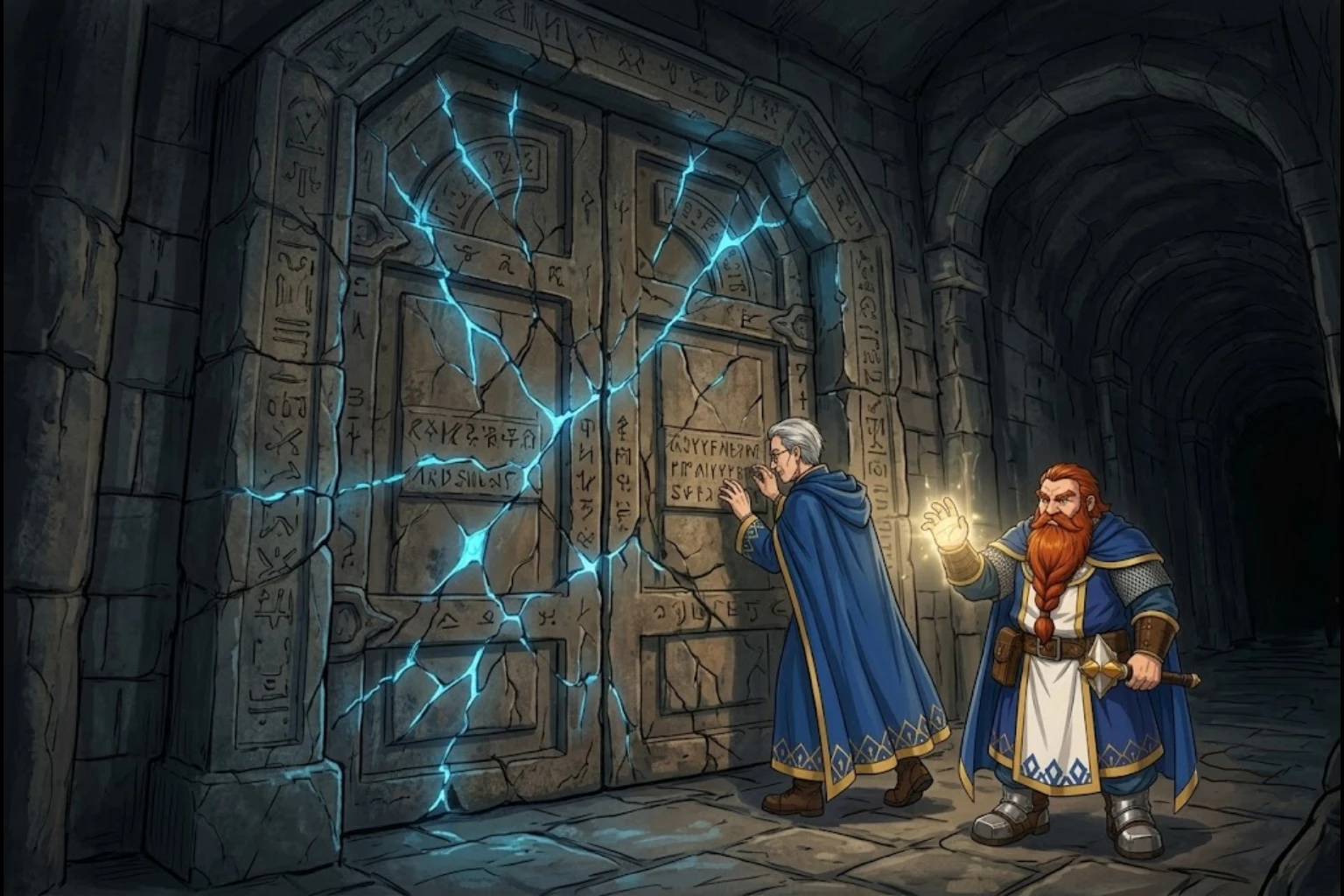
The passage continued from here — not a ramp this time, not a stairwell, but a corridor that had been sealed with a door that was no longer sealed. The door was ancient, older than the kingdom installation above it, older than the war-era modifications to the Underbreach, older than anything they had seen since the pre-kingdom binding work Dovar had felt in the antechamber on the first level. It was stone, a single slab like the north mouth but larger, and it had been inscribed not with kingdom wards but with something that predated the kingdom's entire warding tradition. The inscription was dense and complex and ran the full face of the door in a pattern that was not decorative but structural — every line connected to every other line, the whole thing a single continuous working rather than a collection of individual glyphs.
It was open. Not broken, not forced. The pivot mechanism — the single-point balance system that let a slab this size be moved by one person if you knew where the balance was — had been engaged from the inside, and the slab had been rotated forty degrees, and the corridor beyond it was dark.
The creature's residue trail went through it.
Elara stood at the threshold and looked into the dark beyond the ancient door, and she felt the quality of the space beyond it the way she had felt the chapel — not with her senses exactly, but with the part of her training that had always been about knowing what you were walking into. The space beyond the door was large. She could not see it but she knew it by the way the air moved and the way the silence had more depth than the dungeon above had managed.
Odo came to stand beside her. He looked at the door — at the inscription covering its face — and was quiet for a moment.
"That inscription," he said, to Lucian behind them. "Can you read it?"
Lucian was already reading it. He had been reading it since he was close enough to see it, his light raised, his eyes moving over the pattern with the deliberate pace of someone transcribing as they went, committing the structure to memory. "Partially," he said. "The language base is pre-kingdom, the same tradition as the binding work above, but it's — compound. Several traditions layered. I can read the outer layer. The inner layers will take time I don't have right now." He looked at Elara. "The outer layer says what the chaplain's inscription said. That this was a road built to hold something rather than to travel. That the holding was the purpose." A pause. "And that whatever is beyond this door was put here before the first settlement in this region. Before the roads. Before the kingdom, before the wars, before the version of the world that any existing record has a description of."
The dark beyond the door breathed, very slightly, in and out.
"We go in," Elara said.
Not a question. Never a question, at this point. They had come through the north mouth and the antechamber and the combat chamber and the holding pits and the flooded works and the gallery and the barracks and the trap hall and the bridge and the treasury and the chapel and the ramp and the pit-wardens, and there was a door open in front of them, and the First Party went through open doors. That was the oldest truth about them, the thing that the false ballad had gotten most wrong: they had never run from a door.
She stepped through.
The corridor on the other side was short, ten feet, and then it opened into what lay beyond, and what lay beyond was the final chamber of the Underbreach, and the final chamber was vast.
The Underbreach had not been built to hide monsters.
It had been built to keep one thing from reaching the road.
And now the final door was open, and the First Party was through it, and in the dark ahead of them something very old waited with the patience of something that had been practicing patience since before the world had a name for it.


.png)
.png)
.png)