%20(1).png)
The rear door of the captain's chamber opened onto a stairwell, and the stairwell went down.
Not a grand descent. Not the wide ceremonial stairs of a fortress built to impress visiting lords or intimidate surrendered enemies. This was a working stairwell, narrow and steep and cut directly into the limestone with the economical indifference of military construction — the kind of stairwell built by engineers who had been told to connect two levels as efficiently as possible and had done exactly that and nothing more. No railing. No finishing on the walls. The steps were uneven in a way that was not careless but simply old, worn smooth in the center by the passage of boots and claws and whatever else had moved through this dungeon during the years of the war.
The walls were close. Close enough that Brakka had to turn sideways to descend, his shield arm scraping the stone on the right side, his pack catching on the left at every third step, and he managed this with the same patient, wordless economy he brought to every space that human hands had built too small for him. He had long ago stopped being annoyed by it. Annoyance required expecting something different, and he had stopped expecting different a long time ago.
Elara went first, one hand on the wall for the uneven footing, her pendant giving off a faint warmth that was less light than the suggestion of it — enough to see the next three steps, enough to know there was floor at the bottom, not enough to announce them to anything waiting. Behind Brakka came Elanor, then Dovar, then Odo with one hand on the lute to keep it from knocking against the walls, and Lucian last, his pale gold light dimmed to almost nothing, just enough to keep himself from missing a step.
The smell reached them before the bottom did.
It came up the stairwell in layers, the way smells moved through enclosed stone — not a wave but a gradual thickening, each step down adding to it. Cold first, the cave-cold of deep underground, and then underneath that the animal smell: old and accumulated and pressed into the stone over years of occupation, the smell of living things kept in confinement. Straw. Waste. Wet fur and old blood and the specific sharp musk of creatures that had not been able to move away from their own presence. It was not the fresh smell of recent habitation. It was the ghost of habitation, layered into the rock the way woodsmoke layered into old timber, the kind of smell that outlasted the things that made it by years.
Dovar identified it two steps before anyone else named it, not because his nose was better than Elanor's but because he had more context for it — a dwarf cleric who had spent decades working dungeons knew the smell of a holding level. He said nothing. He simply readjusted his grip on his warhammer.
"Holding level," Lucian said, from the back. "The final campaign field reports mentioned it. The advance scouts noted that the Underbreach was used for more than a checkpoint — creatures captured on the forward roads were brought back here. Alive. For study, for potential tactical use, for containment until a better option presented itself." A pause, measured. "The war ended before most of that study was completed."
"So they left them," Dovar said.
"The evacuation at the end of the final campaign was not conducted in an orderly fashion."
"They left them here," Dovar said again. The repetition was not confusion. It was a dwarf making clear that he had heard the explanation and was choosing to call the thing what it was regardless.
Lucian did not argue. He was not wrong to refuse it.
The stairwell ended at an iron gate standing open in the dark. Not broken open. Not forced. The bolt had been drawn back cleanly and the gate swung inward on hinges that were stiff with age but intact, and it stood at a forty-five-degree angle, which was the angle it had settled at when someone had pushed it open and left it. Elara stopped at the gate and put her hand on the iron without going through and looked at the bolt mechanism, the hinges, the way the gate hung.
"Not the hounds," Elanor said, from beside her. She had moved up to look too. "The bolt's too high and the draw is against the hinge side. Whatever opened this understood the mechanism."
They stood with that for a moment. Then Elara stepped through.
---
The holding level opened up beyond the gate into a central corridor that ran the length of the level in both directions, and the first thing that registered was the ceiling — lower than anything above, low enough that Brakka moved with his head tipped slightly forward, not ducking exactly but aware, the particular attention of a creature calibrating continuous clearance. The walls pressed closer than the combat chamber above. The architecture was not designed for fighting in. It was designed for containing, which meant narrow passages between cells, lines of sight broken by corners, the geometry of a space that made individual movement easier than group movement and gave no one a clean angle on anything for more than twenty feet.
The cells lined both sides of the corridor. Iron-barred, floor to ceiling, six feet wide and eight feet deep, each one fitted with a locking mechanism on the outside — a heavy iron bar dropped into brackets, supplemented by a chain lock with a key mechanism. The bars on most of the cells had been forced. Not carefully. The iron was bent outward, the brackets torn from the stone, the work of something that had been in there long enough to test the limits of what was keeping it in, and had eventually found that limit and gone through it. Several of those cells were now empty. Several were not, in ways that told a story about what had been feeding in the holding level and for how long, and Elara looked at those cells exactly long enough to understand them and then moved her eyes to the corridor ahead.
"Elanor," she said.
Elanor was already reading the floor.
She moved three feet ahead of the group and crouched, not dramatically, not in any way that suggested she was performing the act of tracking — she simply went lower to improve her angle on the dust and old straw and grit that covered the corridor floor, and her eyes moved across it the way eyes moved across written text, left to right, building a sequence. The floor was not clean. Nothing about this level was clean. But in the mess of old straw and settled grit there was recent movement, the compressed and disturbed layer that fresh passage left, and she was reading its frequency and its direction and the weight that made it.
"Something has been coming through here regularly," she said. "Not just since the horn. Weeks, I'd estimate — possibly longer. The disturbance pattern is too consistent for a single event. It has been coming down from above, moving through the corridor, and returning." She stood and looked at the bent cell bars closest to her, then at the floor in front of them, then at the contents of the cell, briefly. "It's been feeding," she said.
"Systematically," Odo said. He was looking at the cells with the specific attention of someone mapping a pattern, not examining individual pieces. "Not just the nearest ones. Look at the disturbance pattern in front of each cell — it's even. It went to each one." He looked at Elara. "It knows what's in here. Or it knew."
"Then we should assume it knows what it's sent at us," Elara said, and her voice was even, the voice she used to keep the shape of a situation clear without adding weight to it that the situation didn't already have. She looked at Brakka. "Close spacing in the corridor. You can't swing freely — work with what you have."
"I know what I have," he said.
"Elanor — crossbow."
The elf had already made the swap. The recurve bow was across her back, the crossbow in her hands, its short arms and horizontal profile suited to the corridor in a way the recurve's draw length was not. She checked the bolt, checked the mechanism, and moved to the right-hand wall.
"Dovar," Elara continued. "The residue in here will be heavy — war-magic and animal both. If something bites through, don't let it sit."
"I'm aware of how bites work," Dovar said, without heat.
"Lucian—"
"I'm going to be conservative with casting," Lucian said, ahead of her, which was the pattern. "The combat chamber was stone and bounded. Down here the stone runs all the way to the lower level. Any significant magical working I do will propagate through it. The horn woke this level. I would prefer not to wake whatever is below us before we're ready to face it."
Elara nodded. "Odo."
"I'll feel out the resonance as we go," Odo said. "The corridor will amplify. I'll be careful about what I put into it."
She looked at all of them. Six people in a corridor that was tight even for four. The smell pressing in from all sides. Somewhere ahead, the bent bars of cells that had held things that were no longer in them, and somewhere behind those corners the things themselves, which had been woken by a horn that they had caused, which meant whatever came next was a consequence of the room they had just won.
This was the part of dungeon work that nobody wrote songs about. The veteran understanding that winning one thing always woke the next thing, and the question was never whether you were ready but whether you were ready enough.
"Move," she said.
---
They got thirty feet before the first sound.
Low. Rhythmic. The quick percussion of nails on stone — not one set but several, overlapping, which meant pack, which meant they were already spreading before they were visible.
"Right," Elanor said.
The cell had looked empty. The back of it was shadow and the shadow had been still when they passed it and now it was not still because what had been pressed into the back corner, low to the ground, motionless in the way that hunting things were motionless before they moved — three of them — was moving.
War-hounds. Or they had been war-hounds once. The campaign records described them as a bred variant, larger than standard hunting dogs, trained for tracking through dungeon environments and for driving captured creatures back toward handlers. What came through the bent cell bars now retained the general architecture of that description but had been changed by years of confinement and dungeon-magic and whatever they had been fed on: too lean, legs too long for the body, heads too heavy for the necks, the proportions of something that had grown in a space too small and been fed on magic that hadn't been meant for living tissue. Their eyes caught Lucian's dimmed light and gave it back wrong, not the yellow of animal eyes in the dark but the flat blue of absorbed war-magic still working in the blood.
They moved with the fractured, too-fast gait of something that had too many joints and used all of them at once, and the lead one went straight at Brakka because Brakka was the largest thing in the corridor and that was the instinct, and it hit the face of the tower shield at speed and the sound it made on impact was the sound of something running into a wall, because that was functionally what had happened.
Brakka drove the shield down and forward, pinning the hound to the stone, and it thrashed and he held it, and the other two split — this was the trained response, pack tactics still running even in corrupted animals, the lead takes the center target and the flankers go for the gaps — and the left-side one went for the gap between the shield and the wall.
He closed the gap. Two inches of lateral movement, his left side pressed to the stone, the shield face flush with it, and the hound hit both simultaneously and had nowhere to go and he got his elbow down on the back of its neck and kept pressure until it stopped fighting, which took longer than it should have because there was something wrong with the nervous system of a dungeon-magic hound that made it not recognize when it was supposed to stop.
The right-side one cleared him. It got past the shield on the corridor side — the one place in the narrow passage where he couldn't cover without creating a gap on the left — and it was low and fast and by the time it had cleared Brakka's position it was already past Elara's reach and into the middle of the column.
Dovar saw it coming. He had been watching for it, had clocked the split the moment the flankers moved and had been tracking the right-side one with his peripheral attention while the rest of him stayed ready on the corridor ahead. He brought his warhammer across in a short horizontal strike — not a full swing, no room for a full swing, just the short flat arc of a cleric who had spent forty years learning to fight in spaces that didn't accommodate his preferred technique — and it connected with the hound's skull and knocked it into the cell bars on the left side of the corridor and the bars rang like a badly struck bell.
The hound rebounded off the bars. It was fast even stunned, the wrong kind of fast, and it got its jaw around Dovar's forearm before he could pull it clear, and it bit down.
The leather vambrace took part of it. Not enough. The teeth went through and Dovar felt the wet heat of the bite and the secondary sensation behind it, the one that wasn't pain exactly but was the spreading awareness of something in the blood that didn't belong there. He got the haft of the warhammer across the hound's throat and pushed, leveraging its jaw open, and when it released he stepped back and reset.
The hound tried to lunge again. He hit it in the same place he'd hit it the first time, same angle, harder, and it went down and did not get back up in any coordinated fashion, just scrabbled at the stone with diminishing intent until it stopped.
Dovar stood with his forearm raised, looking at the bite. The wrong color was already spreading from the punctures — not fast, not the immediate blackening of a high-potency venom, but a slow gray-blue discoloration moving through the skin around the wound in the way of something working its way into the tissue rather than burning through it.
"Poison," he said, with the flat precision of a man filing a report on his own body. He set his warhammer against the wall, held the forearm up at heart height, and began the counterclaim. It was not a dramatic working. It never was with Dovar — no light, no sound, just the compressed, economical prayer of a cleric who had been performing this specific function for long enough that it lived in his hands and his lips independently of conscious direction, the divine register keeping a running account of what had been done and what was owed and what the body needed. The discoloration slowed. Then it stopped spreading. Then it began, grudgingly, to fade back toward normal. Thirty seconds, maybe forty.
He lowered his arm. The punctures still wept. He wrapped the forearm from a strip of cloth from his pack — tight, clean, the practiced bandaging of someone who treated his own injuries without drama — and picked up his warhammer.
"How bad?" Elara asked. She was watching him with the specific attention she gave to party injury, which was not soft attention. It was assessing.
"Managed," he said. "The venom's neutralized. The residue will sit in the tissue for a while — I'll feel it. It won't stop me." He met her eyes. "I'm all right. Move."
She moved.
---
The corridor bent left twenty feet ahead, and the bend was the problem. In a straight passage you could see the threat coming and position for it. Around a corner everything arrived at once, and the architecture of the holding level had been built with corners specifically because the things it held needed to be managed in segments, one section at a time, the bends preventing any one creature from seeing the full length of the corridor and understanding the whole of its confinement. That logic now worked against the party instead of for them.
Elanor went to the corner first, moving along the right-hand wall with the half-crouched, quiet advance of a scout who understood that the point of checking a corner was to not be standing directly in front of it when you did. She reached the wall at the bend and paused, listening, then lowered herself another few inches and looked around at floor level — not at chest height where the obvious threat would be but at the ground, where the movement residue would tell her what was waiting before she saw it directly.
She held up four fingers. Then moved one down to three. Then held.
Three. More hounds, or something else of comparable size. Clustered near the bend, which meant they had come to the sound of the fight and stopped, and the stopping might mean fear or might mean coordination, and the difference between those two things mattered.
She pulled back to the group.
"Three," she said, quietly. "They're holding the corner. Not charging." She looked at Odo. "That's either territorial instinct or something is directing them."
Odo had his lute out. He had been holding it since the first hound, not playing, just holding, the way a person holds a tool when they're waiting for the right moment to use it. Now he ran his fingers across the strings without sound — not playing, just feeling the instrument's readiness, the tension in the strings, the way it sat in the space. He had been listening to the corridor the whole time they'd been in it, building the acoustic picture of the space in the part of his mind that was always doing that, and he had the fundamental frequency of it now: the specific pitch at which this passage resonated, the intervals the stone walls amplified, the frequencies that would travel and the ones that would be absorbed.
"Let me go first," he said.
Brakka looked at him. Brakka's whole face was a question about whether that was a sentence that made sense.
"Not around the corner," Odo said. "I'll stay at the bend. But let me have it first."
Elara looked at him for a moment, reading whatever she read in his face, and then nodded.
He moved to the corner. He stood just back from the edge of it, positioned so he was visible to the corridor ahead but not fully exposed, and he played.
Not a battle-song. Not anything with the structure of a performance. What he put into the corridor was a pattern — a rhythmic phrase at a specific interval, built on the fundamental frequency of the passage, which meant it didn't dissipate against the walls but ran along them, following the stone, finding the creatures at the corner the way a hand finds a shape in the dark. The interval he chose was a minor second laid against the tonic — the most dissonant option available, the musical equivalent of two things that could not occupy the same space simultaneously. When he played it into a space with the right resonance, it found the gap between instinct and learned behavior in pack animals and put friction there: the impulse to act running into itself, the coordination breaking down because the signal running through the pack was suddenly wrong.
Three seconds of it. Four. Five.
Then he heard the sound from around the corner that he had been waiting for — the sound of coordinated animals losing coordination, the scrabbling readjustment of creatures that had been synchronized and were suddenly not — and he nodded at Brakka.
Brakka went around the corner at the kind of speed that was surprising in something his size and shouldn't have been, because the size was what you saw and the years of training behind the size was what you didn't. He took the first hound off the ground with the leading edge of his tower shield, just the rim, enough to redirect its momentum without the swing he didn't have room for, and it hit the wall and didn't get its legs under it. The second one was still recovering from the dissonance — a quarter-beat behind where it should have been, its lunge starting a half-second late — and he stepped into it instead of away, which was the counter-intuitive move that a hound expected a human to not make, and got his knee under its chest and his elbow down behind its head in a way that used his weight rather than a weapon and achieved the same result.
The third tried to break past him. Elanor's bolt took it at the joint between neck and shoulder, the vulnerable angle on that particular animal, and it went down in the graceless sideways tumble of something whose limbs had stopped receiving the right signals.
Six seconds. The corner was clear.
Brakka stood among the three hounds with the economy of someone who had just done a moderately difficult thing and had already moved on to assessing what was next.
"The song helps," he said to Odo, without particular emotion.
"I know," Odo said.
"I'm saying it anyway."
Odo looked at him. There was something in the ogre's face that was not quite a smile but existed in the same territory. Odo nodded once, and Brakka turned to the corridor ahead, and they moved.
---
The rest of the holding corridor was slower and quieter than the two engagements had been, the party moving in the careful rhythm that a dungeon level demanded after you'd been in a fight — not tense, not fearful, but calibrated, each member holding a few degrees more awareness than they'd been carrying at the start. Elanor checked every cell before the group advanced past it. Dovar kept his warhammer loose in his grip and ran his free hand along the right-hand wall periodically, feeling for curse-residue in the stone, cataloguing the layers of old war-magic that had soaked into the limestone over years of dungeon operation. What he found was consistent: heavy with it, old, nothing active, the magic long since decayed from any specific function into simple contamination.
"This level was running active curse-containment wards during the war," he said, to no one in particular, his hand on a stretch of wall between two empty cells. "You can feel the structure of it even now — the intention, if not the power. Whatever was held here was considered dangerous enough to layer divine suppression on top of the standard ironwork."
"The forward road reports mentioned a category of creature that they were specifically trying to keep alive," Lucian said. He was reading as he walked, which was the habit that irritated Dovar and which he had given up commenting on because commenting had never once changed it. The journal was small and the light was minimal and Lucian navigated the corridor from memory while his eyes were on the page, which was its own form of dungeon expertise. "Something they called a pit-warden. A magical construct from the pre-kingdom era, designed as a guardian for underground complexes. They had found evidence of them on the forward roads and wanted specimens for study." He closed the journal. "The reports also noted that the pit-wardens they encountered seemed to respond to something deeper in the complex. As if they were receiving direction."
The corridor went quiet in the particular way it went quiet when information arrived that nobody wanted to say out loud yet.
"Direction from where?" Elara asked.
"The reports don't say," Lucian said. "The campaign ended before the question was answered."
Ahead, the corridor widened.
---
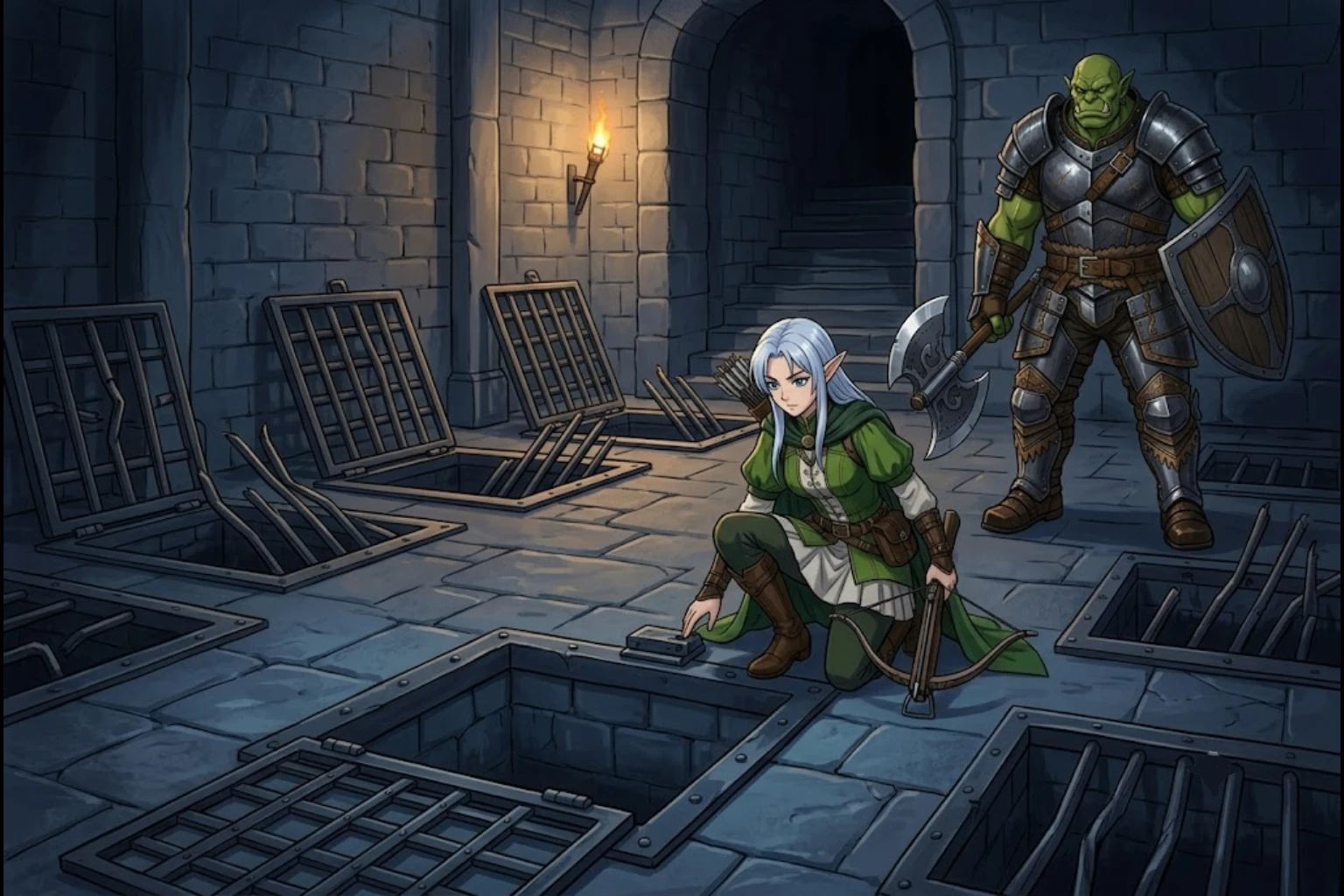
The holding pits were at the end of the level, past the last of the barred cells, in a room that opened up enough to almost feel like space after the corridor's confinement. Eight pits in two rows of four, sunk six feet into the bedrock floor, each one ten feet across and covered with iron grating fitted on heavy hinges. The grating was the kind of construction that required significant engineering — thick bars, close-spaced, the iron at least two inches in diameter, fitted into frames that had been set into the rock with lead and bolts. Not something you made in a week. Something you made when you intended the containment to hold indefinitely and wanted to be very sure about it.
A walkway ran around the perimeter of the room, a foot-wide lip of stone between the edge of the pits and the outer walls, enough to walk on if you were careful and didn't mind the view down into the pits on one side and the close stone wall on the other. Lucian brought his light up to full as they entered the room — the pits required it, the depths of them lost in shadow even with the glow.
Six of the eight grating covers had been forced upward.
The force had come from below. The evidence was in the iron itself: the bars bent upward, the hinges distorted and in two cases torn entirely from the frames, the stone around the fitted edges cracked and scarred where the frames had shifted. The lock mechanisms on the forced gratings were sheared through — not picked, not disengaged, simply destroyed, the lock bodies crushed or torn in the process of something large applying sustained upward force until the grating gave way. The covers lay thrown back against the walkway walls or tilted at angles where they'd fallen, and the scarring on the rock at the edges of the pits told the story of what had been inside them and how it had left.
The pits themselves were empty. Whatever had been in them was somewhere in the dungeon behind the party, or gone through the north mouth, or among the things in the corridor that were no longer moving.
Brakka looked into the nearest open pit and then looked up at the ceiling of the room, gauging the clearance from the pit floor to the grating height. "Big," he said.
"Bigger than a hound," Elara confirmed.
"The two that were let out of the seventh and eighth pits," Elanor said.
She was standing at the edge of the seventh pit.
She had moved to it without explaining why — had separated from the group's general examination of the room and gone directly there, which meant she had seen something from the entry point of the room that had pulled her attention before anyone else had registered the distinction. She was crouched at the edge of the grating, looking at the hinge side, and then she was looking at the lock mechanism, and then she stood and walked to the eighth pit and did the same thing, crouching, looking at the hinge and the lock and the frame, and then she leaned over and looked down at the floor of the pit below.
She stayed at the eighth pit for a long while. Longer than the examination strictly required, which meant she was confirming something she'd already seen and wanted to be certain about before she said it.
Then she stood.
"These two weren't broken out," she said.
The party looked at her.
She pointed at the sixth pit — one of the forced ones — and traced the evidence with her hand without touching it. "The forced pits: grating bent upward. Lock bodies sheared. The stone at the frame edges has impact marks from the frame shifting under load. The floor of the pit—" she gestured down — "has the marks of something large bracing itself to push. You can see where it found its footing to get the leverage." She turned to the seventh pit. "This one: the grating is open. Hinged back fully, laid flat against the walkway, neatly. The lock mechanism is disengaged." She crouched at the lock. "The key slot has been used. There's rotation wear on the inside of the barrel — recent, the metal's bright where it was turned. The lock wasn't forced. It was opened."
She moved to the eighth pit and indicated the same features. Lock disengaged, hinge intact, grating laid flat.
"Both of them," she said. "Opened from the outside. The locks turned with a key or something functioning as one. The grating hinged back deliberately." She stood fully and looked at the pit floor below through the open frame. "The floor of both pits has no bracing marks. Nothing pushed up from inside. The disturbance on the floor is from the creatures moving out and down the grating ladder — these pits had iron rungs set into the walls, you can see them. Whatever was in here didn't need to force its way out. It climbed out through an open door." She looked at Elara. "And the disturbance on the walkway around both pits is recent. Within the last day. Maybe within the last few hours."
The room was quiet.
Dovar said something in Dwarvish that required no translation.
"It released them," Elara said. Not a question.
"It released them," Elanor confirmed. "It came up to this level — recently, deliberately — opened two specific pits, and let whatever was inside them out." She paused. "And it knew which pits to open. It didn't try the forced ones — those were already empty, had been empty for weeks. It went directly to the two that still had something in them."
"It knows the dungeon," Odo said quietly. He was standing at the edge of the walkway, looking at the two open pits, and his expression was the one he got when he was listening to something that most people couldn't hear. "It knows what's in here. All of it — what's in each cell, which pits are empty, which ones aren't." He looked at Lucian. "It's been managing this place."
Lucian had been standing at the back of the room since Elanor started speaking, and he had the particular stillness of a man whose mind was running very fast behind a very controlled face. "Yes," he said. "That's exactly what it's been doing." He looked at the open pits, at the forced ones, at the room as a whole. "Consider the sequence: the binding wards on the north mouth fail. The creature comes up through the holding level to feed — not randomly, but systematically, working through the available food supply in a deliberate order. It learns the dungeon. Then we arrive. The combat chamber activates, triggers the dungeon horn. The horn is a signal — to the holding level and to below. The creature hears the horn, comes up, and opens the two remaining occupied pits. Not to feed. To release." He adjusted his spectacles. "It is using the dungeon's resources as a defensive measure. It heard us fight our way through the combat chamber and responded by deploying what it had available."
"It deployed the hounds at us," Brakka said. He was looking at the passage they had come through. "The ones that attacked in the corridor."
"I think so," Lucian said. "Whether it directed them specifically or simply released them knowing they'd respond to the intrusion, the effect is the same. It used the holding level as a weapon against us." A pause. "And the two things it released from the pits — whatever those were — they are somewhere in the dungeon now. Between us and the entrance, or between us and whatever is below."
"Between us and below," Elanor said. "The walkway disturbance runs toward the stairwell to the lower level. They went down."
Nobody said what that meant immediately. They didn't need to. Whatever had been in those pits had been deemed significant enough to warrant the engineering of a purpose-built containment pit with two-inch iron grating, which meant it was not small and it was not simple, and it had been sent downward to stand between the party and whatever was at the bottom of the Underbreach.
The party had been expected.
Elara stood at the far edge of the walkway and looked at the passage in the rear wall of the pit room, where the descent continued — a stairwell narrower than the one from the combat chamber, cut directly into the bedrock rather than finished stone, the steps irregular, the darkness below it complete. The creature's residue trail ran to it. Elanor's reading of the walkway disturbance ran to it. Two things of unknown size and capability had gone down it in the last several hours.
She felt the weight of what Lucian had said and what Elanor had found and what it meant, and she held the weight without showing it on her face, which was the job.
"Take stock," she said. "Everyone. Now, before we go further."
It was the right call and they all knew it. Dovar sat on the walkway edge and examined his forearm, unwrapping the field dressing, checking the wound. The discoloration was fully faded but the punctures were deep and the tissue around them was tender in the way of a body that had fought off a foreign substance and was still accounting for the effort. He rewrapped it carefully. The arm worked. The grip on the hammer was solid. That was what mattered.
Brakka checked his shield for damage — there was a dent in the face from the first hound's impact, a fresh one, adding to the history of dents that covered the shield's surface like a topographical record of every fight it had been part of. The dent didn't compromise the structure. He confirmed this with his thumb in the specific way he checked shield integrity, running it along the back face to feel for cracks in the metal beneath the exterior, and found none. He lowered the shield and stood.
Elanor counted her remaining bolts without taking them out of the quiver, by touch, the way someone counted money by feel. She had enough. She looked satisfied with this and said nothing.
Lucian stood in the middle of the pit room with his eyes closed and his hands at his sides, which was the posture he used when he was assessing his own reserves — the internal audit of a mage who had been conserving power and needed to know exactly how much he had to spend. He had cast one ward extension in the corridor and had dimmed his light throughout and had done nothing else. He was, by his own reckoning, nearly at full capacity. The question was what the lower level would cost him and whether full capacity would be enough.
He opened his eyes. Said nothing. That meant the audit had come out to a number he was satisfied with.
Odo checked the lute. This took him longer than any of the others took to assess their equipment, not because the lute was more complicated but because the check was different. He was not looking for structural damage. He was listening — playing three soft notes, feeling the vibration through the body of the instrument, checking that the resonance was what it should be. A lute that had been through a dungeon combat where the walls were close and the acoustics were difficult could acquire distortion in its resonance — not damage you could see, but a change in how the sound behaved that would affect every working he tried to put through it. The three notes came back clean. He nodded at no one and settled the lute across his knee.
Elara had not moved from the edge of the walkway. She was looking at the stairwell into the deep level, and she was thinking about what Lucian had said and what it meant for what was down there. An intelligence that knew this dungeon, that had been managing its resources and had now deployed those resources against them. Something that had been bound here long enough to know every occupied cell and every available weapon, and had waited with whatever patience it possessed until the binding failed and then immediately begun to prepare.
She thought about the sunburst mark she had cut into the corridor wall above. She thought about the first campaign, the advance into territory nobody had fully mapped, the particular feeling of going into a dungeon knowing that the Hero Party would eventually need whatever you found. She had believed, then, that the work was the point. That it mattered even if nobody sang about it. She still believed that.
She believed it a little harder when the work was a dungeon that had something at the bottom of it that had been planning for their arrival.
"Right," she said. "Down. Tight formation, Brakka behind me. Elanor, you're reading the lower level the moment we have floor. Lucian — when you cast, make it count. Don't spend power on anything you're not sure about."
"Understood," Lucian said.
"Dovar."
"I'm fine," Dovar said.
"I know. Tell me if you stop being fine."
"I will tell you when it becomes necessary," he said, which was not agreement but was the closest he got to it.
She looked at Brakka.
"Ready," he said.
She went to the stairwell and started down, and one by one the party followed her into the dark, and behind them the pit room settled back into the quiet of a place that had held things for a long time and was now, finally, empty.
Somewhere below, in the deep bedrock of the Underbreach, something that had been planning this since the moment its binding failed heard the sound of boots on stone above it and waited with the patience of a thing that knew, now, exactly how much time it had.


.png)
.png)
.png)