%20(1).png)
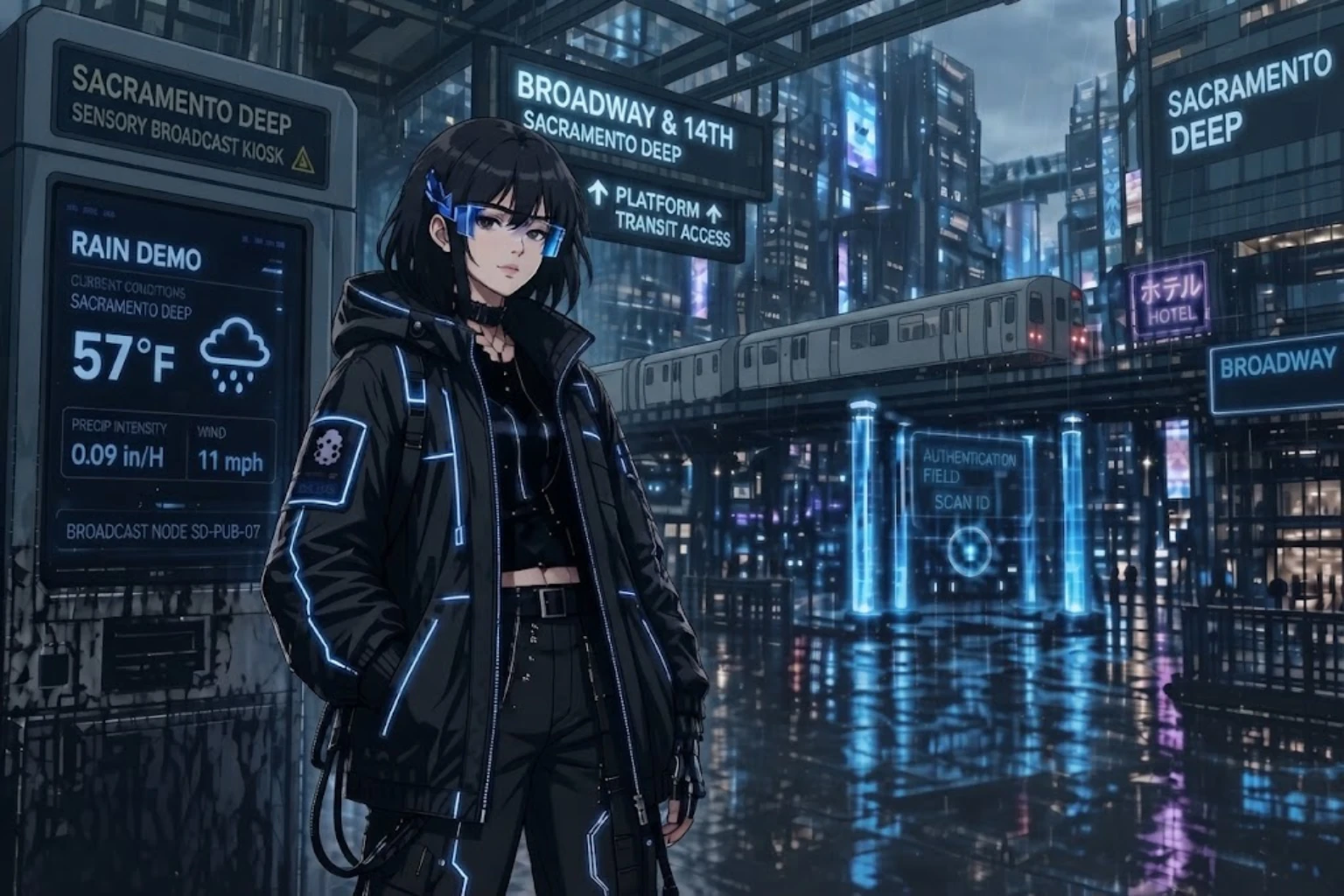
The rain tasted like someone else's Tuesday.
Mika stood under the transit overhang on Broadway and 14th, letting the borrowed sensation run its thirty-second loop through the back of her skull—cool, mineral, faintly sweet, somebody's memory of standing in an actual storm sometime before the Restriction Acts made storms into something you subscribed to. The kiosk beside her sold it for eight scrip, black-market pull off a corporate license, no royalty flowing back to whoever'd originally felt it. She wasn't buying today. She was just close enough to catch the broadcast bleed off the demo loop, the kiosk's short-range signal painting anyone standing in range whether they paid or not.
That was the whole scam. Get you wet for free, then sell you the towel.
She shut it off with a flick of her attention, the sensation gone as fast as it came. A woman beside her—thirty-something, tired-eyed, work jacket still creased from a shift somewhere—was less lucky, or more willing. She'd actually paid, credits blinking green across her wrist display, and she stood there for the full loop with her eyes half-closed, mouth slightly open, chasing something that wasn't rain at all. Might've been a memory of her own childhood, licensed back to her at a markup, filtered through whatever corporate service held the rights to nostalgia these days. Mika had seen it a thousand times. People paying to feel their own lives.
The kiosk itself was a patchwork thing, a newer sensory-broadcast unit bolted onto a public transit pole that had been standing on that corner since before the water math changed everything, its base still stenciled with a city seal nobody bothered to update. Half the infrastructure in Sacramento Deep looked like that—recent technology grafted onto bones nobody had the budget or the will to replace. Above it, an authentication field shimmered faintly blue across the entrance to the transit station, a soft curtain of light that would read her identity the moment she crossed through it, log her presence, flag her subscription status, and decide in about four hundred milliseconds whether she was allowed to be exactly who she claimed to be.
Mika checked the time laced across her lower left vision. Six minutes till she was supposed to meet Juno, and she was already there, but arriving exactly on time felt like admitting you didn't have anything better to do.
Sacramento Deep sprawled downhill from her, layered like sediment: newer glass towers on top of older concrete bones, and under those, the original city, half-flooded, half-abandoned, fully claimed by people who didn't appear in anybody's census. Overhead, freight lines hummed on their rails, cargo pods gliding past on magnetic cushions with the lazy indifference of things that had replaced human drivers forty years ago. Every fourth building wore some corporation's authentication field like a visible skin—soft blue light meaning scan here, meaning we know who you are before you finish walking through the door. A few of the older buildings still had their fields running on decommissioned protocols, technology so outdated that walking through them felt like being patted down by a ghost: thorough, useless, obligatory.
A boy, maybe twelve, was selling something out of a cracked case near the station steps—used credential chips, she guessed, the kind that let you borrow somebody else's subscription tier for an afternoon. Not illegal exactly. Just the sort of thing you didn't advertise to anyone wearing a corporate badge. He clocked her looking and flipped the case shut, reflexive, the way you'd flinch from a hot stove. She wasn't buying. She had six identities of her own right now, two of them hers, the rest rented or built out of dead accounts nobody had bothered to close, and she didn't need a twelve-year-old's inventory. But she liked that he'd noticed her noticing. Meant his instincts were good. Meant he'd probably survive long enough to get better at this than he currently was.
She used one of the rented identities—a mid-tier maintenance tech named Dee Osei who existed on paper and nowhere else—to walk into the noodle place where Juno was waiting. The authentication field at the door read Dee Osei's credentials, found them plausible, and let her through without so much as a flicker. Somewhere in a server two acquisitions removed from whoever had originally issued that identity, a system logged the visit and forgot about it by morning.
Juno had a corner booth and two bowls already going cold, because Juno never ordered when she arrived—she ordered when she sat down, so that by the time whoever she was meeting showed up, there'd be a plausible reason for two people to already be sitting together, eating, talking about nothing. It was a habit from years of not wanting to be the first flagged face in somebody's retroactive surveillance pull. The restaurant itself ran no active authentication field, which was rare enough these days that Juno favored it specifically for that reason—an old analog dive that had never updated past a card reader, its owner apparently allergic to anything that might report on his customers.
"You're early," Juno said, not looking up from the table's embedded display, where numbers were doing something Mika didn't care about.
"You're paranoid."
"I'm alive." Juno finally looked at her. Composed as always, dark hair pulled back, wearing the kind of clothes that read as nothing to any algorithm trying to profile her—no visible brand ports, no subscription tattoos, no chrome. Juno believed the most powerful thing you could be in this city was forgettable. "Client's real. Ownership claim's clean. It should be boring."
"You always say that right before it isn't."
"It's usually boring. You remember the boring ones. You just don't tell stories about them." Juno slid a data packet across the table's surface—not physical, just a light pulse that Mika's own system caught and logged. "Wren Okafor. Sixty-one years old, lives out past the levee line, still has an analog garden, if you can believe that. Grows actual things in actual dirt, no misting rig, no reclaimed-water subscription. Just whatever rain she's legally entitled to and whatever she can beg off a neighbor."
"That's either very poor or very committed."
"Little of both, I think. Her late partner's sensory archive got orphaned about eleven years back."
"Orphaned how?"
"Company called Halcyon Residential Systems held the storage contract. Cloud-memory service, mid-tier, nothing fancy—the kind of thing regular people used before the big platforms ate everybody smaller. Halcyon got bought by Aegis Domestic in '76. Aegis got broken up and sold off in pieces in '81—infrastructure went one way, consumer division went another, brand name got licensed out to somebody making appliances now, if you can believe it, they put 'Halcyon' on refrigeration units. Wren's archive was supposed to migrate to whoever inherited the consumer division. It didn't. She's been locked out ever since. Every year she files a request. Every year some dead company's ghost software tells her no."
"And she's got the original credentials."
"Original everything. Marriage contract, joint ownership license, the works. This should be a formality." Juno pushed the cold noodles toward Mika, an offering more than an order. "Kai's already in the architecture. Get in there, help him find the actual storage node, get her access restored, we get paid, everybody's happy."
Mika picked at the noodles without much interest. "What's she paying?"
"Enough that I don't ask why she waited eleven years to hire somebody instead of doing this herself."
"You didn't ask?"
"I asked. She said she didn't used to believe in paying people to do things she should be able to do herself." Juno's mouth twitched, not quite a smile. "Grief changes the math, I guess. She also said—and I'm only telling you this because I think you'll find it useful, not because I think it means anything—that every time she called Halcyon's old customer line, before it went dark, somebody different answered. Different name every time. Never the same voice twice, in eleven years of occasional calls. She thought that was strange. I told her most of these companies outsource that line to whatever call service is cheapest that quarter. High turnover. Nothing sinister."
"You believe that?"
"I believe it's the most likely explanation for a customer service line having high turnover, yes." Juno gave her a look that had ended more speculative conversations than Mika could count. "Don't turn this into something it isn't before you've even opened the first door."
"I'm not turning anything into anything. I'm eating noodles you don't want."
"Those are for you. I already ate."
Kai's apartment smelled like solder and cold coffee, which was as close as he came to a personality broadcast. Two rooms in a converted transit maintenance building, most of the space given over to a rig that would've been illegal in a corporate office—decommissioned enterprise-grade processing cores he'd bought for scrap and rebuilt, humming under a blanket he'd thrown over them less for insulation than because the blinking status lights bothered him at night. A single window looked out over a service alley where a maintenance drone was methodically clearing debris that had washed down from somewhere upslope during the last permitted rain cycle, three days ago, four minutes of scheduled precipitation that the whole district had been notified about in advance.
He didn't look up when Mika let herself in. "Door was locked."
"Door thought it was locked." She dropped into the chair across from him, the room's second and only other piece of furniture besides a mattress folded against the wall. "What've we got?"
"A mess." Kai turned one of his three floating displays toward her—not a physical screen, just light structured in the air by emitters bolted into the ceiling, the kind of tech that had been cutting-edge fifteen years ago and was now what people like Kai bought used because it did exactly what he needed without phoning home to anybody. "Halcyon Residential Systems dissolved as a legal entity in 2081. Its authentication servers should have gone dark the same year. They didn't."
"Zombie infrastructure. Happens all the time. Some sysadmin forgot to pull the plug, keeps drawing power off an account nobody's watching."
"That's what I thought too, at first." He pulled up a directory tree, ancient by the standards of anything currently marketed, nested folders inside folders, the digital equivalent of a building nobody had drawn blueprints for before adding three more floors on top. "Except forgotten systems decay in a specific way. Certificates lapse. Security patches stop coming. Eventually something breaks and nobody fixes it because nobody's watching. This isn't decaying. Look."
He expanded a branch of the tree, a security log stretching back years, entries thinning as they went further back in time but never quite stopping.
"Someone's renewed its security certificates four times since the company died. Last renewal was eight months ago."
Mika leaned in, frowning at the timestamps. Certificates didn't renew themselves. Somebody had to hold a private key, had to know the system existed, had to care enough to keep paying whatever the renewal fee was—usually pocket change, the kind of expense that vanished inside somebody's bigger budget without anyone asking why.
"Could still be automated," she said, working the alternative out loud the way she always did, testing it against the shape of the evidence. "Legacy contract, auto-renew clause, some accounting system that keeps a card on file and doesn't know how to stop billing it."
"That was my first guess. So I checked whether the renewal payments were coming from an automated billing service or a manual authorization." He pulled up a transaction trail, sparse but legible. "They're manual. Somebody has to approve each one. Auto-renew doesn't require a human signature on a payment authorization. This does."
"Could still be a low-level employee somewhere, doing it because it's on a checklist nobody's updated. I've seen dumber things survive corporate mergers."
"I know. That's still possible." Kai said it without defensiveness, the way he considered most things—weighing rather than arguing. "But let's find the node first. This is a side detail. It doesn't get us Wren's archive."
"Finally, something we agree on."
It took longer than either of them expected, and the shape of the search told its own story before the content of it did.
Kai started where any competent excavation starts: at the surface, with the most recent record, and worked backward. The current legal owner of "residential cloud archival services, western region" was a company called Ferrovue Data Partners, a name Mika had genuinely never heard of, which didn't surprise Kai at all.
"Ferrovue bought the consumer storage division from a company called Hollowbrook Systems in '85," he said, dragging a timeline into the shared display, a chain of corporate logos strung out like a genealogy chart nobody had asked for. "Hollowbrook bought it from a liquidation auction after a company called Vantable Networks collapsed in '83. Vantable inherited it from Aegis Domestic's consumer spin-off, which was itself just Aegis's leftover pieces after the good parts got sold to infrastructure buyers in '81."
"So Ferrovue owns Wren's archive now."
"Ferrovue owns the right to own it. Whether they actually have it, whether their systems can even find it inside whatever they inherited, is a different question." Kai queried Ferrovue's public-facing account lookup, the kind of thing any customer could theoretically use, and waited while a soft chime indicated the request was processing somewhere on the other end of a continent's worth of fiber.
The response came back within a few seconds, cheerful and useless.
Thank you for contacting Ferrovue Data Partners. We're unable to locate an account matching the provided credentials. If you believe this is an error, please contact your original service provider.
"Original service provider," Kai repeated flatly. "Which is Halcyon. Which doesn't exist. Which is, itself, the reason we're talking to Ferrovue in the first place."
"Beautiful. Very helpful. Ten out of ten customer service." Mika was already moving, pulling up her own angle on the problem, faster and less patient than his. "Let me try the maintenance side instead of the customer side. If Ferrovue inherited physical infrastructure along with the paperwork, somewhere there's a technician-facing system that actually knows what hardware they're running and where."
She found it inside twenty minutes—a legacy maintenance portal, originally built for Hollowbrook's field technicians, still technically live because Ferrovue had apparently never bothered decommissioning it, just left it running the way you'd leave a light on in a room you never enter. It still recognized old Hollowbrook service credentials, three companies and two owners out of date.
"This thing shouldn't still work," she muttered, half to herself, watching the login screen render in a font style that had gone out of fashion a decade earlier. "Nobody updates a system this old unless they have to. Which means nobody's had to. Which means nobody's looking at it."
She built a technician credential from scratch—not stolen, not borrowed, constructed, the way she preferred when she had the time: a plausible employee ID, a service ticket number formatted the way Hollowbrook's old tickets had been formatted, a login that claimed to be routine infrastructure verification work. The portal accepted it without hesitation. Old systems were trusting in a way new systems weren't allowed to be anymore; nobody had gone back and taught this one to be suspicious.
"I'm in," she said. "Sort of. I'm in a system that thinks it's still 2083."
Inside, the maintenance portal showed her a facilities map—data centers, storage arrays, physical hardware locations, most of them marked with statuses that hadn't been updated in years. Half the listed facilities showed as active when Kai, cross-referencing against public infrastructure records, confirmed they'd been decommissioned or repurposed since. One listed location didn't exist anymore at all; the address now belonged to a vertical farm.
"This map is a fossil," she said. "It's telling me where things were, not where things are. But—" she paused on one entry, a storage cluster tagged with a facility ID that matched something Kai had already flagged from a completely different direction, "—this one's still showing active heartbeat pings. Something out there is still answering when this ancient system checks in on it."
Kai pulled the same facility ID and cross-referenced it against current hosting registries. "That's a real, currently operating data facility. Outside Stockton. Owned by a hosting company called Deltrix Regional—mid-tier, mostly serves small business clients, nothing about them suggests they have any relationship with residential memory archives."
"So either the map's wrong, or Deltrix inherited hardware from somewhere down the chain without necessarily knowing what's sitting on it."
"That happens more than you'd think," Kai said. "Acquisitions move racks, not inventories. Somebody buys a hosting company for its floor space and cooling contracts, and whatever data was already sitting on the drives comes along as dead weight, invisible until someone goes looking for it specifically."
It took another hour of cross-checking—Kai methodically walking the ownership chain forward from Deltrix, Mika testing whether her Hollowbrook-era technician credential could get any response at all from anything Deltrix currently ran—before they had enough to be reasonably confident: Wren's archive, if it still existed, was very likely inside that Stockton facility, sitting on infrastructure that had been physically absorbed into Deltrix's hosting business without anyone at Deltrix necessarily knowing what else came with the racks.
"Reasonably confident," Mika repeated, unimpressed. "After two hours."
"Corporate archaeology," Kai said. "You don't get to skip strata."
Getting a response from the facility was its own negotiation.
Mika's first approach was direct: present Wren's actual ownership credential to whatever authentication layer Deltrix's systems exposed to the specific storage partition, on the theory that if the data really was there, the original contract's authentication logic might still be intact underneath whatever Deltrix had layered on top.
The response wasn't a rejection. It was stranger than that.
Access denied. Pending secondary authorization.
"What secondary authorization?" She read it aloud, mostly to have something to say to the room. "There's no secondary account holder. It's just Wren."
"There used to be two," Kai said, quietly, from his side of the shared workspace—not a room, just a channel they kept open between his rig and her borrowed interface, voices and light and status updates flowing back and forth like they were in the same building instead of across town. "Her partner. Dario Reyes. He's been dead nine years."
"So he's not signing off on anything."
"No. But the system doesn't know that." Kai pulled the account structure up so she could see it too, both of them looking at the same stubborn, decades-old logic tree—a joint ownership contract written in 2064, digitized sometime in the seventies, migrated across three companies since, its underlying legal logic untouched the entire time despite every relocation, every rebrand, every acquisition. "Nobody ever told it he died. Death certificates don't automatically propagate into consumer cloud contracts. There's no integration between vital records and Halcyon's legacy account system—there never was, because when this contract was written, nobody imagined the company would still theoretically exist, in software form, nine years after one of the account holders was in the ground. As far as this system's concerned, Dario Reyes is an active co-owner who hasn't approved the request."
Mika sat with that for a second. "So the system's not malicious. It's just old. It's asking a question that made sense fifteen years ago and doesn't make sense now, and nobody ever taught it the difference."
"Right."
"Fine. Let's see if it's flexible about how he approves it." She wasn't ready to accept the wall yet. She tried routing a request through Deltrix's own customer-facing account recovery flow instead of the original authentication layer, on the theory that a newer system might apply newer, more reasonable logic on top of the old contract's bones.
Deltrix's system took the request, thought about it for nine full seconds—an eternity, by the standards of anything digital—and produced an answer that told her exactly how deep the sediment went.
This account is governed by a legacy service agreement predating current Deltrix Regional account policies. Legacy agreements require original-provider verification. Please contact Halcyon Residential Systems for account modifications.
"They're routing me back to a company that's been dead for eight years," she said, half-laughing, half-furious. "Deltrix knows it's dead. It has to know—it's their own system telling me to call a corpse. But the compliance logic doesn't care. It just knows the contract says 'original provider' and refuses to make a decision that isn't its to make."
"That's most of corporate software," Kai said. "It's not built to know things. It's built to avoid being wrong in a way that gets someone sued. Deferring to a dead company is technically defensible. Making an independent judgment call isn't, even if the judgment call is obviously correct."
"So nobody at Deltrix will ever fix this, because fixing it means taking responsibility for a decision, and refusing to decide is free."
"That's the shape of it, yes."
She tried one more angle before conceding the point—attempting to use her constructed Hollowbrook maintenance credential, still technically live in that fossilized portal, to push a manual override directly against the storage partition, technician-to-hardware, bypassing the customer-facing logic entirely.
It almost worked. The system accepted the credential, accepted the override request, began processing—and then stalled on a secondary check she hadn't anticipated: the maintenance portal required a countersignature from a second registered technician, a policy presumably meant to prevent a single rogue employee from unilaterally moving customer data, written by someone at Hollowbrook years ago who never imagined the entire company disappearing and leaving exactly one technician credential still functional in an abandoned tool.
"Of course," she muttered. "Dead company logic, again. Built for a world where there'd always be a second person to check with."
"Could you forge a second credential?"
"I could. It'd take another hour, maybe two, and it's the same problem as forging Dario's sign-off, just wearing a different uniform." She sat back, arms crossed, giving the display a long look, like she was negotiating with the software itself. "Which brings us back to the actual argument."
"We forge the sign-off," Mika said again, this time without the edge, more like she was simply putting the option back on the table now that the alternatives had cost them three hours. "Dario's. Or a second technician, same difference. We know he's dead. We know he'd have zero objection to his wife getting their memories back. We build a credential that says he approves, push it through, done tonight instead of next week."
"That's fraud."
"That's access. Kai, the man is dead. He's not going to object. He's not going to be harmed. Nobody is harmed. The only thing standing between a grieving woman and her own memories is a piece of code that doesn't know its friend died. I'm not going to lose sleep over lying to a piece of code."
"It's not about losing sleep." Kai's voice stayed level, the way it always did when he actually cared about something, which made it harder to argue with than if he'd raised it. "It's about what we're actually doing when we do that. We're not picking a lock. A lock doesn't believe anything. It just resists or it doesn't. This system holds a belief—a false one, an outdated one, but a belief about the world, about who's alive and who approved what. If we forge Dario's sign-off, we're not getting past a barrier. We're making the system believe something untrue. And once you're willing to do that because the untruth is convenient and harmless this time, you've built the habit. The next system might not be quite so harmless to lie to. I don't love where doing this casually leads."
"That's a very philosophical way to describe filling out a form."
"Maybe. But every fake credential we've ever built starts as a small, harmless one." He wasn't lecturing her—Mika could tell the difference, had learned it over two years of working with him—he was thinking out loud, weighing it the same way he weighed everything else, and it happened that this time the thing he was weighing was her idea. "I'd rather find the legitimate path first. If there isn't one, or if it's genuinely impractical, we talk about the other thing."
"The client doesn't have six days of patience built into a budget. Neither does Juno."
"Then let's find out how long the legitimate path actually takes before we assume it's too slow. We've spent three hours proving the shortcuts don't work cleanly. Give me twenty minutes to see if the honest door is actually shut, or just heavy."
She threw up a hand, half surrender, half fine, prove it. "Twenty minutes. Then I start building a dead man's signature whether you like it or not."
"Understood."
Kai found the legitimate path in closer to forty minutes than twenty, and it came with its own small excavation, one he did methodically, the way he did everything, testing each layer before trusting it.
"There's a probate resolution service," he said eventually. "Used to be state-run—part of the old county recorder system, before that got privatized in the sixties. Now it's a company called Continuity Solutions. Death registries feed into it. If a death certificate gets properly routed through them against a specific contract, they issue what's called a legal supersession notice. It's a real, binding document. Old joint-ownership contracts have to honor it, because it's not just Continuity's opinion—it's backed by the original county vital records, which nobody's successfully argued around in court in about forty years."
"How not free, and how not fast?"
"Two hundred scrip processing fee. Four to six days for resolution, because Continuity has to independently verify the death certificate against county records and cross-check it against the specific contract before issuing the notice. They don't move quickly. They're not built to. They're built to be defensible if anyone ever challenges the outcome."
"So the honest way costs money and time, and the dishonest way costs nothing and takes ten minutes."
"That's usually how it works, yes."
Mika groaned, long and theatrical, mostly for effect, dropping her head back against the chair. "Juno's client is sixty-one and has waited eleven years. Six more days won't kill her. Fine. Do it the slow way. But I want it on record that I think we're solving an ethics problem nobody but you was having."
"Noted." Something in his voice suggested he didn't fully believe her, and he was probably right not to. She filed the sign-off idea away rather than discarding it—the kind of thing she'd remember next time a dead-account contract stood between somebody and something that mattered, next time the six-day version wasn't available and the stakes were higher than a wait.
While the supersession request processed in the background—a form, a fee, a queue number, the unglamorous back half of the job—Kai went back to the thing he'd set aside three hours earlier, because setting a question aside had never once meant he'd stopped turning it over.
"Talk me out of Meridian Trust," he said, mostly to himself, but Mika was still in the channel and answered anyway.
"Happily. What's the going theory?"
"There isn't one good theory. That's the problem. Let me walk through it." He pulled the shell company's registration back up, sparse as it had been the first time. "Simplest explanation: forgotten auto-renewal. Somebody set up recurring billing decades ago and it's still running because nobody canceled it. I already ruled that out—the renewals are manually authorized, not automatic."
"Second explanation?"
"Legal escrow. Sometimes when a company dissolves mid-dispute, a court or a creditor arrangement requires certain assets or records to be preserved by a neutral party until some legal question resolves. If Halcyon's dissolution involved litigation, a court order could require this." He checked, cross-referencing California and Nevada dissolution filings against Halcyon's corporate history. "There's no litigation on record. Halcyon dissolved cleanly, voluntarily, as part of Aegis's restructuring. No creditor disputes, no ongoing lawsuits, nothing requiring court-ordered preservation."
"Third."
"Accounting residue. Sometimes big companies maintain small, meaningless legal shells for years after an acquisition simply because dissolving them costs more in accounting fees than just... not. Corporate zombies kept alive by inertia rather than intention." He sat with that one longer, because it was the most boring explanation and boring explanations were usually correct. "That would explain the shell company existing. It wouldn't explain why someone's still manually renewing authentication certificates on Halcyon's dead servers specifically, rather than just letting the whole thing lapse the way accounting residue normally does. Nobody pays a renewal fee by accident, four times, over multiple years, on purpose."
"Infrastructure maintenance contract, maybe. Somebody's still paying to keep some other system running, and Halcyon's authentication server just happens to share physical hardware or dependencies with whatever that other system is. Collateral maintenance."
"That's the best one so far," Kai admitted. "It would mean nobody's protecting Halcyon's data specifically—they're protecting something else nearby, and Halcyon's ghost is just riding along for free because pulling it out would risk breaking whatever they actually care about." He turned that over for a while, testing it against what he already knew. "It would also mean there's something else in that infrastructure worth protecting badly enough to accept the risk of an unrelated, defunct authentication system staying reachable. Which isn't really less strange. It just moves the strangeness one step sideways instead of removing it."
"Compliance retention," Mika offered. "Some industries have to keep records a certain number of years by law. Maybe residential memory archives fall under some retention statute and Meridian's just the entity somebody set up to satisfy the letter of the law without spending real money on it."
"I checked that too, once I thought of it. There's no retention statute for consumer sensory archives that runs anywhere near forty years. Most personal data retention requirements top out around seven, sometimes ten for anything touching financial or medical categories. Forty years isn't compliance. Forty years is a choice somebody keeps renewing."
Mika didn't say anything for a moment, which for her was its own kind of concession.
"None of them fit clean," she said finally.
"No. Some of them fit almost. That's what bothers me more than if none of them fit at all. Almost means somebody built this to look explainable. A real accident doesn't usually look this defensible from four different angles at once."
"Maybe you're just good at finding reasons things could look suspicious. That's sort of your whole thing."
"Maybe." He didn't sound convinced of his own maybe. "I'm not saying it's important. I'm saying I can't make it stop being strange just by wanting to move on."
The confirmation chime sounded across both their displays at the same moment—Continuity Solutions, acknowledging receipt of the supersession request, case number assigned, estimated resolution four to six business days. Ordinary. Bureaucratic. Blessedly boring, after three hours of everything else.
"There," Mika said. "The actual job. Handled the honest way, like you wanted. Can we let the shell company be somebody else's problem now?"
"For six days, sure." Kai copied the Meridian Trust metadata to an isolated drive anyway, unconnected to anything, the digital equivalent of putting a strange object in a drawer instead of a museum. "After that, we'll see what it wants to be."
Six days later, Wren Okafor's supersession notice cleared. Continuity Solutions' verification came back clean, the county records matched, the old joint-ownership contract folded under the weight of a document it had no legal basis left to refuse, and somewhere in the buried architecture of a company that had stopped existing eight years before, a ghost's veto was finally, formally overwritten by a piece of paper he'd never have objected to signing.
Mika watched the access grant come through in real time, more satisfaction in it than she'd expected. There was something almost tender about it—watching a system built by people who'd never imagined anyone would still care this much, this long, finally get out of the way.
Out past the levee line, in an analog garden growing things the misting rigs weren't supposed to be able to grow anymore, Wren Okafor put on the interface Juno's courier had walked out to her personally, because some things weren't worth trusting to a data pipe, and heard her partner's voice again for the first time in eleven years—the specific cadence of him reading to her on a rainy evening they'd both apparently thought worth keeping, water sound in the background, real water, recorded before the world decided that sound needed a license. She sat with it for a long time. She didn't say anything to the courier when it ended, just nodded, the way people do when there isn't a sentence built yet for what they're feeling.
Juno got paid. She took her cut, routed the rest through four accounts before it reached Kai and Mika, standard practice, nothing that needed discussing. She didn't ask why Kai wanted a small, separate, unbilled fee logged internally as "additional archival verification" that hadn't been part of the original scope. She assumed it was a rounding error in his invoice, or professional pride, or some private itch he needed to scratch. She'd worked with him long enough to know that sometimes the smartest thing to do about Kai's curiosity was let it be his problem, and not ask questions whose answers might become her problem too.
Kai kept the Meridian Trust metadata on a drive that wasn't connected to anything, in a drawer, under the blanket that covered his humming rig, and didn't look at it again that week.
But he didn't delete it, either.
Forty years was a long time for anyone to keep paying, quietly, manually, deliberately, to protect something nobody was supposed to find. Long enough that whoever started doing it might not even be the one still doing it now. Long enough that the reason might have outlived the reasoner, the way Dario Reyes's veto had outlived Dario Reyes, still exercising authority years after the person behind it had stopped existing.
Kai didn't know what it was.
He just knew that somebody, somewhere, had built a very careful, very expensive habit of making sure nobody ever asked.


.png)
.png)
.png)