%20(1).png)
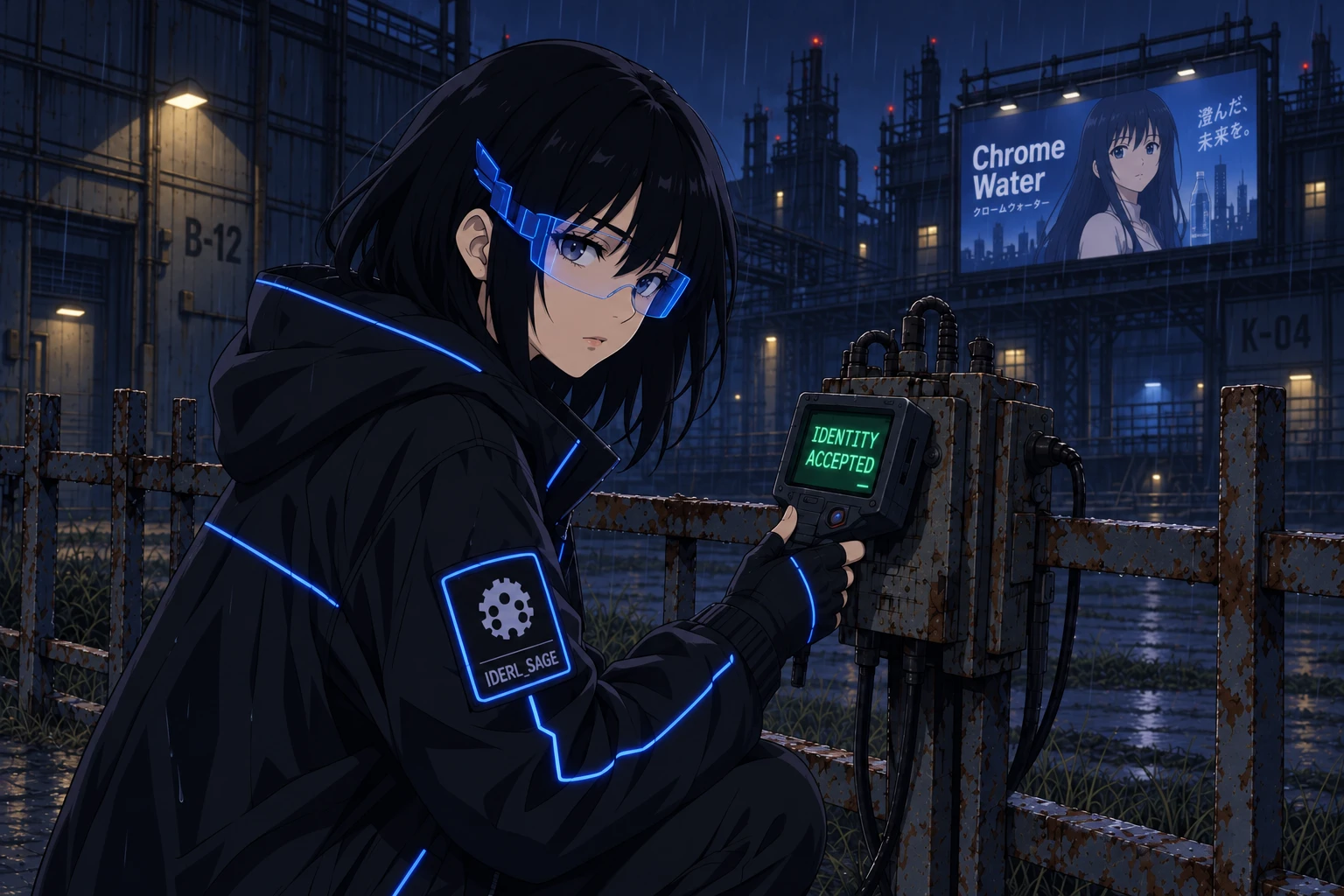
The rain in Sacramento Deep never smelled like rain.
Mika noticed it every time, the way you notice a scar you've had so long it should have stopped being interesting. The water that fell from the reclamation towers along the old rail corridor had the faint mineral sourness of a swimming pool three days overdue for treatment, and it fell in the same metered pulses it had fallen in for eleven years — four minutes on, six minutes off, city ordinance, weather as bureaucracy. She stood under the awning of a shuttered noodle stall and watched it come down in gray threads under the sodium lights and thought, not for the first time, that real rain probably didn't care what time it was.
"You're doing the thing," Reid said, from somewhere behind her shoulder.
"What thing."
"The thing where you stare at the rain like it personally disappointed you."
"It smells like a hot tub."
"Everything here smells like a hot tub." Reid didn't look up from the tablet strapped to his forearm, its screen throwing pale light across a face that gave away nothing it didn't intend to. "Facility's two blocks up. You want to walk it or you want to keep having feelings about municipal weather."
Mika snorted and pushed off the wall, and they walked.
The old Delta Freight Consolidation Yard sat on the ragged eastern edge of the Deep, in the strip of the city that had been industrial before it was corporate before it was simply forgotten, three overlapping economic eras stacked like sediment. Its warehouses had been built for a version of commerce that didn't exist anymore — physical freight, actual trucks, human forklift operators — back before autonomous barges made most surface logistics obsolete and before water rationing made most surface anything a luxury nobody wanted to maintain. Now the yard was fourteen acres of corrugated steel and cracked concrete behind a fence that had given up pretending to be a deterrent, patrolled by a security contract so old that the drone still on file hadn't flown in six years, according to Kai, according to the maintenance logs, according to three independent sources Juno had bothered to check because Juno always bothered to check.
"Routine," Juno had said, over a booth table at a noodle place two nights ago, the good kind, the kind that used actual broth instead of flavor cartridge. "Client wants a storage module out of Warehouse Nine before the salvage auction clears the lot in eleven days. Encrypted casing, palm-sized, registered to a defunct freight logistics company called Valehold Transit. Client says it's old accounting data, contractual liability stuff, doesn't want it surfacing during the property transfer. Pays flat, pays well, wants discretion. That's it. That's the whole job."
"That's never the whole job," Reid had said.
"Sometimes it actually is," Juno said. "You've just been doing this long enough that you've forgotten what boring looks like."
Kai, checking something on his own slate without appearing to be part of the conversation at all, had said, "Valehold Transit dissolved nine years ago. Absorbed into a shell portfolio, then folded again. No public officer listed."
"So the client's buying a receipt no one can trace back to who benefits," Juno said. "Which is also, historically, most of our clients."
Mika had asked why they needed four people for a warehouse with a dead drone and a rusted fence, and Juno had said this: because the client's paying for four, and because I don't like sending people into buildings I haven't fully mapped, and because Ghost was free. Which wasn't really an answer to the question, but it was Juno's version of one, and everyone at the table had accepted it the way you accept weather.
The fence, when they reached it, was exactly as sad as advertised. Mika crouched at a seam where two panels had rusted apart at their bracket, ran a scanner the size of a coin along the gap, and found a contact sensor so old its firmware predated her.
"Aw," she said, almost fondly. "It's a baby."
The scanner flickered once in her hand. A second status line appeared beneath the sensor readout.
IDENTITY ACCEPTED
Mika frowned. She hadn’t sent an identity.
Before she could open the diagnostic layer, the line disappeared. The scanner refreshed, showing only the same ancient contact sensor and its equally ancient firmware.
She ran the check again. Nothing.
Mika looked at the fence for another second, then decided the old hardware had simply coughed up something left over from a previous handshake.
"Don't get sentimental," Reid said. "Sentimental people cut themselves on rebar."
Mika pulled a spool of conductive tape from her jacket, bridged the sensor's contact points with the ease of someone tying a shoelace, and eased the panel open just enough for a body to slip through sideways. "In," she said. "For real this time, no drone, no ping, nothing home."
They moved across the open yard in the metered rain, staying inside the long shadows the warehouses threw under the sodium security lights that had, for whatever reason, never been decommissioned even though nothing else here had been maintained in a decade. Puddles collected in the buckled concrete, oily and shallow, catching red light from a billboard three blocks over that Mika could see through a gap in the buildings — some Chrome Water ad, a woman's face tilted up into simulated rain, eyes closed, the tagline scrolling beneath her in soft blue: Remember what it felt like. Underneath, smaller: Now with 40% richer sensory fidelity. First minute free with code RENEW.
"They redid that ad," Mika said. "Last month it was a beach."
"Beach one tested worse," Reid said. "Focus group probably said it felt like advertising, not memory. Rain feels more like something that happened to you personally."
"You know that how?"
"I did courier work for a marketing shop for four months when I was seventeen. Learn a lot about what makes people cry standing still in a mall."
Ghost was waiting for them at the mouth of the access alley between Warehouse Seven and Eight, having arrived early and alone, as he generally did, moving through the city in a manner that made him difficult to remember clearly even moments after you'd looked away from him. He didn't greet them. He simply fell into step, scanning the rooflines out of habit rather than expectation.
"Anything?" Reid asked him.
"Cameras on the east corner are dead housing, no glass in them. South fence has motion sensors but they're on a maintenance loop, not live monitoring — somebody forgot to decommission the contract, not the equipment." He paused. "There's a light on in Nine."
That got everyone's attention, in the quiet, unhurried way this crew paid attention to things.
"Define light on," Kai said. He'd come from the opposite direction, having taken his own route in, as he preferred, arriving with a scuffed courier satchel over one shoulder that contained enough hardware to compromise a midsize bank and looked, to any casual eye, like a man who delivered contraband noodles for a living.
"Interior. Low. Second floor, north side. Could be automated — emergency lighting on a dying battery, that kind of thing burns for years after everyone's forgotten it exists." Ghost's voice had the flat calm of a man reporting weather. "Could also be somebody's already inside."
"Squatters," Reid offered.
"Or salvage," Kai said. "Building's slated for auction. Wouldn't be the first time someone got there early to strip copper before the paperwork clears."
"Or it's nothing," Mika said. "Buildings like this, half the lights that shouldn't work still work, and half the ones that should are dead. Entropy doesn't respect our schedule."
Nobody moved to argue that they should abort over a light. They moved to argue, instead, about approach — quietly, efficiently, the way people who trust each other's judgment argue, which is to say briefly and without ego.
"We go in through the loading dock like planned," Reid said. "If somebody's in there, we'll know before they know us."
"If somebody's in there illegitimately," Kai said, "they might already know the module's valuable and might already have it."
"Then we'll find that out too," Reid said. "Standing out here speculating just burns time we don't have if there's a patrol schedule we haven't accounted for."
Ghost said nothing, which from Ghost generally meant agreement with whoever had spoken most recently and most sensibly.
Warehouse Nine's loading dock door hadn't rolled up in years, its motor long dead, but a service door beside it gave way to Mika's tools in under ninety seconds — a mechanical lock so old it barely counted as security, more a formality than a barrier, the kind of lock that existed because someone once filed a compliance report and nobody since had bothered to notice the building didn't need it anymore.
Inside smelled like standing water and rust and, underneath that, the peculiar mineral sweetness of old cardboard that had been wet and dried a hundred times. The warehouse floor stretched out into darkness, broken by irregular columns of gray light falling through skylights that had lost most of their panels to weather and time. Shelving units rose three stories in places, most of them empty, a few still holding crates whose contents had probably been catalogued into oblivion by some auction inventory system months ago. Water pooled in low spots on the concrete, rainwater finding its way through the broken roof in patient, persistent lines, dripping in a rhythm too irregular to be the city's metered schedule — real water, untaxed, unrationed, falling through a hole nobody had bothered to fix because there was nothing left here worth protecting from weather.
"Romantic," Mika muttered, aiming her light up at the black gap in the roof. "Free rain. Somebody tell the billboard."
"Focus," Reid said, but without heat.
Kai had already produced a compact slate and was cross-referencing the facility's decrepit layout against Valehold's last known filing — an inventory manifest recovered, weeks ago, from a records broker who specialized in dissolved-company paperwork nobody else wanted. "Module's registered to a secure asset cage on the second floor, northeast quadrant, near what used to be an office annex. If the layout hasn't changed structurally, that puts it about sixty meters that way, up the mezzanine stairs."
"And the light Ghost saw?"
"North side, second floor," Ghost said. "Consistent with that quadrant. Could be the same room."
They moved along the ground floor in a loose staggered line, Reid taking point because route judgment was his whole profession, Ghost trailing slightly behind and to the side where he could watch the columns and the dark spaces between them, Kai in the middle with his slate throwing faint blue light across his face, Mika bringing up the rear with a scanner sweeping for anything electronic that might notice them before they noticed it.
The mezzanine stairs were metal grate, half-rusted through in places, and Reid tested each riser with his weight shifted back before committing, out of habit rather than any specific worry — the kind of habit that had kept him alive in worse buildings than this one. Near the top, a section of railing was simply gone, sheared away sometime in the building's long slow collapse, leaving a twelve-foot drop to the concrete below with nothing between a careless person and the fall.
"Mind the gap," he said, stepping past it without ceremony.
At the top, the north side of the mezzanine opened into what had once been a row of office annexes, most of their glass partition walls shattered or missing entirely, desks and chairs still arranged in the ghost-shapes of a workday that had ended nine years ago and never resumed. And there, at the end of the row, past two collapsed partitions, a door stood slightly ajar, warm yellow light spilling from the gap.
Ghost held up a fist. Everyone stopped.
He approached alone, flat against the wall beside the doorframe, and listened for a long moment before easing his head around the frame just far enough to see. Then he straightened, and some of the tension went out of his shoulders in a way that told the others more than words would have.
"One person," he said, low. "Not a patrol. Not a trap I can see."
The room had been some kind of secure asset cage once — heavy shelving bolted to the walls, most of it empty, a rolling ladder tipped on its side in one corner, and in the middle of it all, a woman crouched over an open floor panel with a portable lamp balanced on a stack of crates beside her, throwing that warm light out into the hall. She had a compact rig of tools spread on a cloth at her knee, the organized chaos of someone who worked with her hands for a living, and she didn't look up immediately when four people appeared in her doorway, though the stillness that came into her body said she'd heard them long before they arrived.
"You're not facility security," she said, still not looking up, working a panel screw loose with a driver. "Facility security's been dead six years. I checked."
"We're not facility security," Reid agreed.
"Figured." Now she looked up, and took them in with the quick, assessing look of someone who'd learned to read a room fast because her life sometimes depended on it. Thirties, maybe, hard to say exactly under the warehouse dust and the low light — lean, sun-weathered in a way that suggested time spent outside sanctioned climate zones, a jaw scar that had healed clean, dark hair cut short and practical. Coveralls with more pockets than fabric. "You're not competing with me either, unless one of you wants a subfloor cable run nobody's touched since the Clinton administration, figuratively speaking."
"We're here for something specific," Kai said. "Second floor, northeast — this quadrant, more or less. A storage module."
The woman's eyebrows went up slightly. "Well, that's interesting, because I've been in and out of this building for nine days and there's no storage cage up here anymore. There was one. Isn't now."
The crew exchanged a look that passed between them fast enough that the woman on the floor almost certainly caught all of it.
"Explain isn't now," Reid said.
The woman sat back on her heels, wiping her hands on a rag hooked through her belt loop. "Look, I don't know what you're chasing and I don't especially care, long as it's not the copper wiring, which is mine, first-claim, I've got a salvage tag filed with the auction house and everything." She said this with the flat conviction of someone who had, in fact, filed the paperwork and would defend the claim if pressed. "But I've been stripping this building floor by floor for a week and a half. Northeast corner had a secure cage, sure — bolted shelving, keypad door, the works. I cracked it four days ago hoping for something worth reselling. It was empty. Not looted-empty. Cleaned-empty. Somebody pulled everything out of that cage a long time before the copper crews or the drone crews or anybody else got near this place."
"How long before," Kai said.
"No way to know exactly. But the dust pattern on the floor inside doesn't match the dust pattern everywhere else in this building. Everything else in here's got nine, ten years of settled grime, even indoors, even where the roof never leaked. That cage floor's practically clean underneath a thin recent layer. Somebody swept it and then it sat empty for a long while after."
"You're sure it's the same room," Reid said. Not doubting her, exactly, but the crew's habit of independently verifying anything load-bearing to the plan.
"I can show you," the salvager said, and something in her tone suggested she'd rather be doing something useful with the interruption than simply answering questions for free. "Costs you nothing. I'm not running a toll booth."
"Sable," she added, when nobody asked, standing and brushing dust off her knees. "Since we're apparently doing introductions."
Nobody offered names back immediately, which she seemed to expect and didn't push on.
The cage, three doors down, was exactly as she'd described — a steel mesh enclosure bolted into the concrete, its keypad door standing open on a busted mechanism, the interior floor swept unnaturally clean under the grime that had settled since. Kai crouched at the threshold and ran a scanner slowly across the floor, the walls, the single support post at the cage's center, his expression doing the thing it did when a problem had gotten more interesting rather than less.
"There's residue here consistent with an EM dampening field," he said, after a moment. "Old equipment, not current-gen. This wasn't just emptied. Somebody ran interference gear in this space at some point, enough to want to be sure a scan couldn't map what was in here while they worked."
"Somebody being who?" Mika asked.
"That I can't tell you from a floor."
Sable had drifted back to her own work at the cable run, giving them room without pretending not to listen, which Reid respected more than false discretion would have earned. "For what it's worth," Sable said, over her shoulder, not looking up from the panel, "I've hit maybe eleven of these old freight consolidation yards over the past two years. Half of them have a room like this somewhere in them. Cage, keypad, nothing left inside. I used to think it was just standard corporate housekeeping — pull the valuable inventory before liquidation, normal stuff. But eleven's a lot of normal. Started to feel more like a pattern than a coincidence, and I don't get paid enough to chase patterns, so I stopped thinking about it and kept stripping copper."
"You remember which yards," Kai said. Not quite a question.
"I remember enough of them. Don't imagine that's worth anything to you unless you're planning to pay for a memory, which, respectfully, I doubt." She said it without hostility, simply drawing the line where it needed to be drawn. She was not going to become a source, an ally, or a subplot; she had her own life and her own margins to protect. "I've got a job here and it isn't yours. I'll tell you what I've seen because it costs me nothing and you seem like the sort who'd remember a favor, which is worth more to me long-term than money right now. That's the whole transaction."
"Fair," Reid said, and meant it.
Kai stood, brushing dust from his knees, and looked at the empty cage for a long moment with the particular stillness of a man recalculating an entire problem from a different angle. "The manifest we bought said the module was registered here as of eleven months ago," he said. "That's recent. That's not nine-years-ago recent. Somebody moved it since then — or somebody falsified the manifest to say it was here when it never was, or somebody's manifest itself was already stale when we bought it."
"So the job's already dead," Mika said, not quite a question, testing the shape of the idea out loud.
"The job as briefed is dead," Kai said carefully. "That's not the same thing."
They regrouped in the hallway, out of easy earshot of Sable's continued work, in the gray light coming through a broken skylight two rooms down, rain sound distant and constant against the roof like static.
"Okay," Reid said. "Let's actually talk about this like adults instead of standing around a hole in the ground being surprised by it."
"There's nothing to talk about," Mika said. "Module's not here. Job was retrieve the module. We call Juno, tell her the intel was stale, she renegotiates with the client or eats the loss, we go home dry. Well — dry-ish." She glanced at the ceiling, where a slow drip had started finding its way through a gap onto the concrete a few feet away.
"That's the responsible answer," Kai said. "I want to be clear I'm not dismissing it. But I want everyone to actually look at what we found before we decide it's nothing."
"What did we find," Reid said. "A clean floor and a scanner reading."
"We found a company that's been legally dead for nine years, whose asset manifest says a specific item was in a specific location eleven months ago, in a building that's clearly had that exact location professionally and deliberately emptied using interference equipment good enough that it left signature residue years later. And a stranger who's independently telling us this same setup — cage, keypad, clean floor, nothing inside — exists in at least ten other buildings she's personally walked into." Kai said this without heat, laying it out the way he laid out any system he was trying to understand. "That's not a dead end. That's a pattern somebody spent real resources building. I don't know what it means yet. I'd like to know what it means."
"Curiosity's not the same as a job," Ghost said. It was the first thing he'd said since the room, and it carried the particular weight of a man who had learned, at some cost, the difference between wanting to know something and needing to.
"No," Kai agreed. "It isn't. I'm not proposing we chase a mystery for its own sake and eat the risk for free. I'm saying: if the module was moved rather than destroyed, there's probably a record of where. Somewhere. A transfer manifest, a shipping log, an internal memo nobody thought to scrub because nobody thought anyone would ever get this far. The client wants the module because the client doesn't want its contents surfacing. That means the client still cares about the outcome even if the object isn't sitting where they thought. If we can trace where it actually went, that's still deliverable. That's still the job, just harder and later than we planned."
"Or," Reid said, "we spend six more hours in a condemned building chasing a lead that goes nowhere, and we still walk out with nothing, except now it's four in the morning and the fence sensor logs have a longer window with our faces in them, figuratively speaking, since none of us actually showed our faces to anything, but you get what I mean. Risk goes up. Payout doesn't."
"That's the actual fork," Kai said. "I'm not going to pretend it isn't. I just don't think 'the intel was wrong so let's go home' is obviously correct just because it's the safer sentence to say out loud."
Mika had crouched down near the cage's threshold again, running her fingers along the frame of the busted keypad mechanism, not really working on it, more turning something over. "For what it's worth," she said, "and I know this isn't really my department — that interference gear Kai's talking about, the old EM stuff, that's not cheap and it's not common anymore. Most gray-market ops don't bother with active dampening, they just physically move things at night and call it done. If somebody used dampening gear on a freight liquidation cage, that's someone worried about a very specific kind of attention. Data attention. Not eyeballs. That tells me whatever was in that box wasn't accounting records for a nine-year-dead trucking company. Or if it was, it was accounting records somebody thought were dangerous enough to protect from a network scan."
"Which argues for chasing it," Kai said, "not walking."
"Or argues for the opposite," Reid said. "If it's serious enough to run interference gear over, it's serious enough that we might be stepping into something a lot bigger than a fetch job for an anonymous shell client. That's exactly the kind of situation where curiosity gets somebody hurt for a paycheck that was never going to cover the risk."
Nobody moved to end the conversation with a joke, though it would have been easy enough. This was the part of the profession that didn't get talked about much outside rooms exactly like this one — the moment where competence stopped mattering and judgment took over, where there wasn't a correct answer sitting quietly in a manual somewhere, just people who trusted each other's read on a situation and didn't automatically share it.
Ghost, who had been quiet through most of the back-and-forth, finally spoke again. "Call Juno," he said. "Not for permission. For information. She'll know things about the client we don't, and she'll have opinions about the risk math that are worth more than ours right now, because she's the one who has to answer for it afterward if it goes sideways."
That, everyone silently agreed, was probably the smartest sentence anyone had said in the last ten minutes.
Juno picked up on the second signal, her voice arriving clean and slightly amused into Reid's earpiece, as though she'd been expecting a complication precisely because the job had sounded too easy in the first place. "Let me guess," she said. "It's not where the file said."
"Cage is empty," Reid said, keeping his voice low, walking a slow loop away from the others to give the conversation room. "Cleaned out, professionally, using interference gear, sometime well before now, but the manifest we bought said it was still here eleven months ago. Local salvager independently confirms similar empty cages in a bunch of other dead freight yards. Kai thinks there might be a transfer record somewhere if we go looking. Question is whether we go looking, or whether we call this dead and come home."
There was a pause on the line, the particular quality of silence that meant Juno was actually thinking rather than performing consideration for effect.
"Client's paying for the object, not for information about the object," Juno said finally. "That's worth saying out loud, because it changes the math. If you find a transfer record but not the module itself, I can't promise the client pays out at all — they might, if it gets them meaningfully closer, but they might also decide partial information isn't worth the balance of the fee. I'd have to renegotiate after the fact, and that's not guaranteed to go well."
"So financially it might be a wash," Reid said. "Or a loss."
"Might be. Might also be more, if what you're describing is real — a shell company running interference gear across multiple decommissioned freight sites isn't small-time record-hiding, and clients who want small-time records disappeared don't usually attract that kind of protection. If there's a bigger buyer for whatever you actually dig up, that's a different conversation, later, with different money attached. I'm not promising that. I'm saying don't assume the ceiling on this job is what we agreed to Tuesday." A beat. "How exposed are you right now?"
Reid glanced back down the hallway, where dim light and rain sound and the others' quiet voices carried faintly. "Building's dead. No active security beyond one guy's flashlight-grade paranoia. We could stay another few hours without meaningfully increasing our footprint, as long as we're careful about how long we linger once it's light out."
"Then it's your call, all of you, not mine," Juno said. "I'm not going to tell four competent people whether a lead is worth chasing when I'm not the one standing in the building. But if you go forward — get something concrete. Don't come back with a theory. Theories don't pay rent."
The line went quiet. Reid walked back to the others, relayed it more or less word for word, and watched the calculus shift slightly on each face — not agreement exactly, more like the shared understanding that the decision had narrowed down to something they'd actually have to choose rather than something that could be deferred to someone else's authority.
"I'll go," Kai said. "If there's a record of where that module went, it's going to be buried in something adjacent — facility logistics network, old freight scheduling system, something local to this yard rather than out on the open net, because nobody encrypts a physical transfer log for a dead company unless they still expect someone might come looking. That means it's probably still here, on hardware, somewhere in this building or the yard office. That's a search I can actually do."
"If it's on hardware in this building," Mika said, "there's a decent chance it needs power, and power in a building this dead means either a battery system somebody forgot to kill, or —" she paused, glancing toward the ceiling, toward the sound of the rain, "— or a solar feed on the roof that nobody's bothered stripping yet, because copper crews go for wiring, not panels, panels are heavy and annoying to move."
"You think there's a working panel array up there," Reid said.
"I think it's worth five minutes to check before we assume every terminal in this place is a brick."
Ghost had already turned toward the stairwell without being asked, doing the math on entrances, exits, sightlines, the practical geometry of a decision that had just been made without anyone formally announcing it. "I'll take the roof access with Mika," he said. "Reid, cover the yard office — if there's a working terminal anywhere ground-level, it's there, and it's also the most exposed room in this compound if a patrol actually does come through."
"And me?" Kai asked, mostly rhetorically, since everyone already knew.
"You're wherever the data actually is," Reid said. "Which we won't know until one of us finds a live terminal. Stay central. Stay reachable."
It wasn't a plan built from confidence. It was a plan built from four people distributing uncertainty across the pieces of the building most likely to resolve it, each of them accepting a real chance of finding nothing, each of them accepting that the job, whatever it had become, was now genuinely theirs rather than the client's.
The yard office sat in a squat brick annex at the compound's southern edge, separate from the main warehouses, its windows boarded from the inside rather than the outside, which Reid noted with mild interest as he worked the door — someone had wanted to keep light in, once, not keep people out, which suggested either paranoia about visibility from the street or simple energy conservation from back when every watt of light leaking into the night sky was a line item somebody's accountant complained about.
Inside, the office was a single room, a desk buried under nine years of dust and pigeon droppings, a wall of dead monitors, and — Reid's light caught it before he quite registered what he was looking at — a server rack in the back corner, small, industrial, the kind of thing installed for a single dedicated purpose rather than general computing, still humming.
Still humming.
He stood very still for a moment, listening to that sound, faint and mechanical and entirely wrong for a building this dead, and felt the particular cold focus that came whenever a job's danger level quietly reclassified itself without anyone announcing it out loud.
"Kai," he said, into the comm. "Yard office. There's a live rack back here. Small, dedicated, humming like it's got somewhere to be."
"On my way," Kai said, and something in his voice had sharpened.
He arrived within ninety seconds, moving fast without looking like he was hurrying, satchel already open, a thin diagnostic cable already in hand. He crouched at the rack, ran his fingers along its casing without touching any of the actual ports yet, reading it the way a doctor might read a patient's face before touching an instrument to them.
"This isn't facility infrastructure," he said slowly. "This is a dedicated logistics terminal, isolated, probably never connected to any wider network on purpose. Somebody wanted a record kept, but wanted it kept here, physically, off the net entirely. That's not standard corporate behavior for accounting data. That's how you handle something you don't trust to exist anywhere a search crawler could ever find it."
"Can you get in without waking anything up that shouldn't wake up?" Reid asked.
"I can try. I'd rather not rush it." He glanced up at him, and there was something almost apologetic in it. "This is going to take longer than five minutes."
"Take what you need," Reid said. "I'll watch the door."
He worked in silence for the better part of twenty minutes, cross-legged on the filthy floor, cable running from his slate into a port he'd exposed by carefully prying loose a service panel, his face lit blue, his breathing slow and even in the particular way it went when he'd essentially stopped being aware of his own body. Reid watched the door, and the window gaps between boards, and listened to the rain outside settle into its metered rhythm, four minutes on, six minutes off, indifferent to everything happening beneath it.
"Got something," Kai said finally, quiet. "Transfer log. Dated fourteen months ago. Module — matches the serial in our manifest — was moved from this facility to a private secured storage contractor. Not a warehouse. A boutique data-security vault, the kind corporate legal departments use for materials they're required to retain but don't want centrally networked. Address is out past the Deep's northern edge, industrial corridor near the old rail spur."
"That's the whole job, then," Reid said. "New location, achievable, defined. We can bring that to Juno and let the client decide if they want to fund a second trip."
"That's most of the job," Kai said, and something in the way he said it made Reid look over at him properly.
"What."
He was frowning at the slate, scrolling slowly back through something, comparing two records side by side with the particular stillness of a man who had noticed a stitch out of place in an otherwise even seam. "The transfer log is clean. Straightforward. Dated, signed off, standard boilerplate authorization chain — three approvals, all from names that check out as real employees of the shell portfolio that absorbed Valehold. Nothing wrong with it on its face."
"But."
"But the manifest we originally bought — the one that told us the module was still here, eleven months ago, four months after this transfer log says it left — wasn't just outdated. It was internally consistent with a version of this facility's inventory that includes a false entry for that exact date. Someone didn't just fail to update an old file. Someone generated a plausible-looking updated file, well after the real transfer happened, specifically saying the module was still on-site. That's not decay. Records don't spontaneously grow new false entries as they age. Somebody wrote that entry on purpose, and dated it to make it look contemporaneous, and it ended up feeding into the exact chain of paperwork our client's broker eventually bought from."
Reid considered that for a moment. "Could be nothing. Could be some low-level compliance flunky covering a mistake nine years ago so a quarterly audit balanced."
"Could be," Kai agreed. "I want to be careful not to build a conspiracy out of one weird file. People fudge records for boring reasons all the time — laziness, liability, somebody's bonus depending on inventory numbers matching. This might really be that boring." He paused, and the pause went on a beat too long. "But the false entry doesn't just say the module was still here. It's built to specifically match the format and metadata of records from a records broker who specializes in exactly this kind of dissolved-company paperwork. Whoever wrote it didn't just want the module's actual location hidden from a casual audit. They wanted it hidden specifically from someone who'd eventually come looking through exactly the kind of secondhand information channel we used to find this place at all."
"That's oddly specific for boring."
"That's what's bothering me," Kai admitted. "I don't have an explanation. I just have a shape that doesn't look accidental."
They regrouped at the ground floor near the service door forty minutes later, Ghost and Mika returning from the roof with the mildly triumphant, faintly damp look of two people who had, in fact, found a working solar feed responsible for keeping a chunk of the building's dead infrastructure alive far longer than anyone would have expected — a discovery that explained the humming rack, if not yet the buried false record inside it.
"New address," Reid said, once everyone was gathered, relaying it plainly. "Private security vault, industrial corridor north end. That's a harder target than an abandoned warehouse — real security contract, probably real staff, probably not something we walk into casually tonight. That's a different job, a future job, if the client wants to fund it."
"And the weird record," Mika said, once Kai had explained it in the compact, careful way he explained anything technical, stripped of speculation he couldn't support. "What do you actually think it means?"
"I think," Kai said slowly, "that somebody with real resources and real patience made sure that anyone chasing this module through ordinary channels — brokers, dissolved-company filings, secondhand manifests — would run face-first into a dead end designed to look like an accident. That's not a company protecting boring accounting data. That's somebody protecting something they specifically expected people to go looking for eventually, and they built the misdirection years in advance."
"Which tells us what it is," Reid said. "Nothing. Which tells us it matters. Also nothing, in terms of actually knowing anything."
"Right," Kai admitted. "I don't have a next step beyond flagging it. I don't know what's actually in that module. I don't know who built the false record or why. I know somebody thought it was worth the effort, and people don't spend that kind of effort on things that don't matter to them."
Sable had drifted closer during the exchange, coiling a length of cable around her forearm with the unhurried efficiency of someone finishing a shift.
"For what it's worth," she said, "those empty cages I mentioned? I stopped assuming they were normal liquidation work after the fifth or sixth one. Too clean. Same kind of careful removal, same kind of dead paperwork afterward."
Kai looked over. "You kept notes?"
"I keep notes on buildings, not mysteries." She slung the cable over one shoulder. "Different thing."
"Would you remember the sites?"
Sable considered him for a second. "Some of them."
"That might matter later."
"Then later you can decide what remembering is worth."
She started back toward the stairwell, clearly finished with the conversation. "Right now I've got copper to strip before the auction crew shows up. Try not to fall through the mezzanine on your way out. The gap by the stairs isn't getting smaller."
They left the way they'd come, through the seam in the fence, the metered rain having eased into its off-cycle, the yard quiet under sodium light and the far red glow of the Chrome Water billboard still cycling through its rain-soaked, eyes-closed woman three blocks distant. Remember what it felt like.
"So what do we actually tell Juno," Mika asked, as they walked, hands in pockets, the fatigue of the night finally starting to settle into her shoulders.
"The truth," Reid said. "Module's moved, new location's harder, and there's a loose thread in the paperwork that doesn't add up. We did the job we could do tonight. Whether there's a second job is her conversation with the client, not ours to decide standing in a parking lot."
"And the thread," Kai said, half to himself, still scrolling back through the transfer log on his slate as they walked, "I'm keeping. Whatever else happens with the client, I want to know why somebody went to that much trouble to bury one small inconsistency inside data nobody was ever supposed to look at twice."
Ghost, walking slightly apart as always, glanced back once at the warehouse receding behind them, its broken skylights catching the last of the streetlight, and said nothing at all — which, from Ghost, was its own kind of agreement.
Above them, the rain resumed its cycle, four minutes on.


.png)
.png)
.png)