%20(1).png)
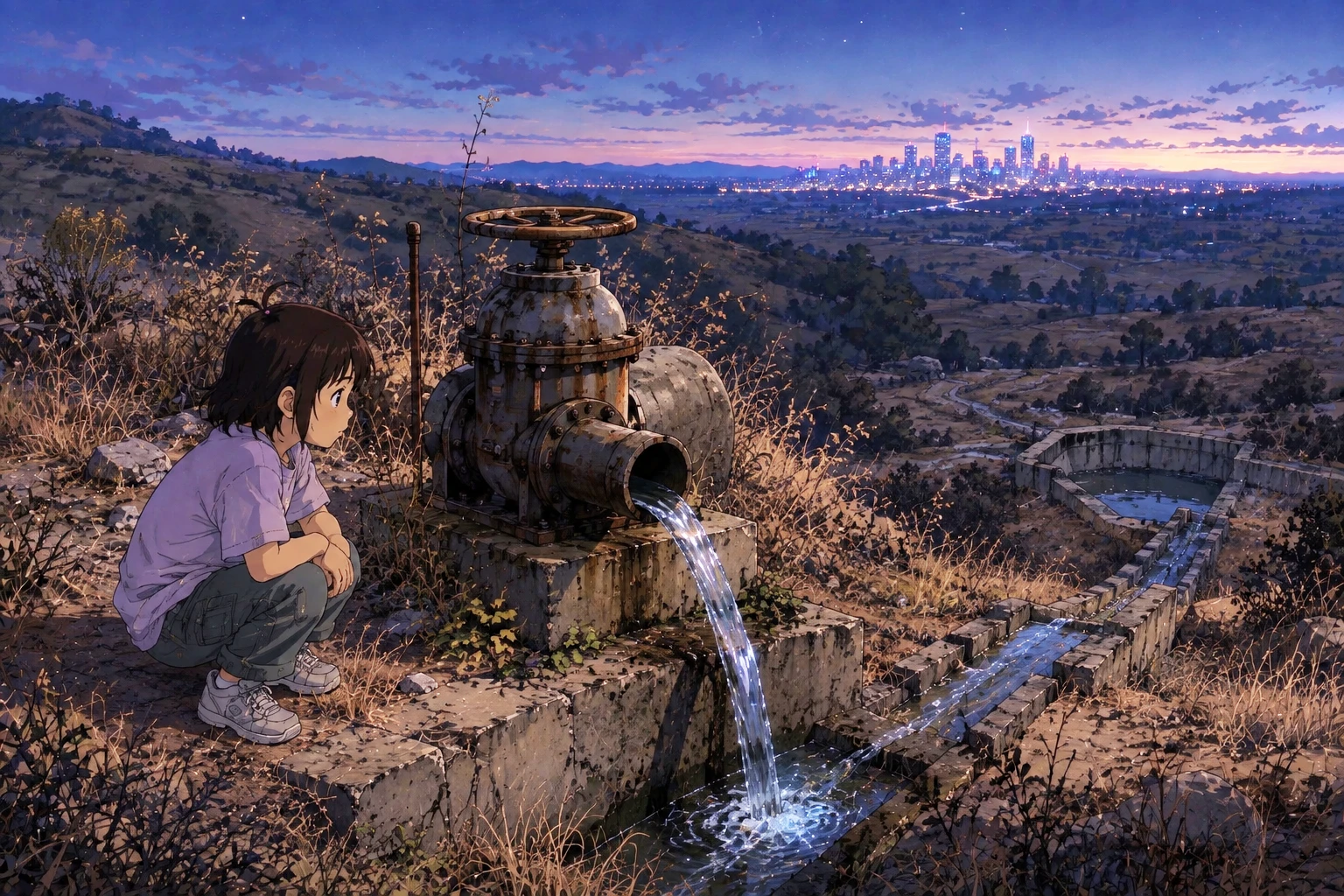
The Feather River foothills above Oroville held onto morning fog longer than anywhere Lei had ever heard described in the handful of books that made it up the grade to her family's place, and by the time it burned off the ridge behind their cabin, she was already three switchbacks down the hill with an empty jug bouncing against her hip, headed for Desmond Okafor's place because his chickens sounded wrong.
She was nine years old, small for her age the way kids raised on hard water and harder chores sometimes were, with dirt under her nails that never fully came out no matter how long she scrubbed at the wash basin, and she had heard the difference between hungry chickens and thirsty chickens since she was old enough to walk the fence line with her mother. Hungry chickens complained in short, irritated bursts. Thirsty chickens went quiet in a way that scared her more than noise ever could, a low, defeated murmuring that meant something was actually wrong instead of just inconvenient.
Desmond was seventy-something and lived alone in a patched-together house at the bottom of the old Okafor orchard, what was left of forty acres that had grown pears and walnuts three generations back, before the water math changed and the family that owned it sold off most of the land and kept only the house and a few stubborn acres nobody wanted to farm anymore. He'd had a stroke two winters ago that left his right hand slow and uncertain, and Lei's mother sent her down twice a week with eggs or bread or just company, the unspoken arrangement between two households that couldn't call anyone official for help and so simply helped each other instead.
The chickens were worse than she'd expected. Their trough sat bone dry, a crust of dried mud at the bottom where water should have been, and when she checked the tank that fed it — a battered plastic cistern Desmond had rigged years ago to catch runoff from his roof — she found it dry too, dry enough that the intake pipe had pulled a thin skin of algae loose from its walls and left it curling at the bottom like a dead leaf.
"Desmond?" she called out, jug still in hand, and got no answer from the house, which didn't necessarily mean anything — he slept heavy some mornings, and his hearing wasn't what it used to be — but the empty tank sat there being a problem regardless of whether anyone answered her.
She knew the old orchard well enough to walk it blind. She'd grown up half-feral in it, the way kids did out here, climbing the collapsed remains of an equipment shed, hunting for the good blackberries that grew wild along what used to be an irrigation ditch, and she remembered — she was almost sure she remembered — a second line running down from higher on the property, an older pipe from back when the orchard had actually been an orchard, buried mostly under blackberry roots and packed dirt, feeding into a valve housing that hadn't turned in longer than she'd been alive.
Nobody had told her the pipe was dead. She simply knew, the way kids who grew up around water infrastructure knew things, that the newer cistern Desmond depended on was fed by his roof alone, and the roof hadn't caught anything worth catching in eleven days, because it hadn't rained in eleven days, because it never rained except when the city said it could.
The old valve sat under a rotted wooden cover at the top of the property, near the tree line, where the ground went from orchard scrub to actual forest. She'd played near it a hundred times without ever really looking at it, and when she pried the cover off now — more curiosity than plan, the specific instinct of a kid who'd learned that most problems had a physical shape somewhere if you looked hard enough — she found a valve wheel crusted almost solid with rust, a metal tag half-legible beside it that might have once said something about a district or an allocation, worn down to nothing meaningful now.
She worked at the wheel with both hands and got nothing, tried again with a rock as leverage against one of the spokes, and on the third attempt felt something give, a groan of metal that hadn't moved in what felt like forever, one full rotation and then, unexpectedly, a second easier than the first.
Nothing happened for a long moment. She almost gave up on it, already turning to go back and tell Desmond she'd figure out some other way to get his birds water — carry it up herself, jug by jug, from her own family's tank, which would take most of the morning but wasn't impossible.
Then she heard it. A low knock, somewhere underground, followed by a shudder she felt more than heard, traveling through the packed dirt under her bare feet, and a few seconds after that, water. Real water, gushing weakly at first and then with more confidence out of an old outlet pipe near the base of the hill, rust-brown and then clearing, running downhill toward Desmond's dry cistern like it had never stopped in the first place.
Lei watched it for a while, more satisfied than surprised, the specific pride of a kid who'd fixed something with her own hands. She didn't think about where the water was actually coming from, because there wasn't any reason for her to. She didn't know that the pipe she'd just opened was supposed to have been sealed off from any working source since before her mother was born, or that its supply line, on paper, in whatever ancient survey map still existed somewhere in a county archive, terminated at a pump station that had been decommissioned and stripped for parts decades earlier. She didn't know that somewhere else, in a monitoring system she would never see and couldn't have named if she had, a sensor logged eleven straight minutes of pressure and flow through a line classified, in every record anyone still consulted, as permanently dead.
She filled the trough, watched the chickens crowd around it and go from that low, frightened murmur to their ordinary irritated bickering, and went to check on Desmond, who turned out to have simply slept through the whole thing and was mildly astonished, over breakfast, that his birds had water at all.
"Old pipe," Lei told him, around a mouthful of egg. "Up by the tree line. It still works."
"Shouldn't," Desmond said, not really arguing, just saying it the way old men said things about infrastructure they'd stopped expecting anything from years ago. "Nothing's fed that line since I was younger than you."
"Well, it's feeding it now," Lei said, and that was the whole of her interest in the matter. She finished her eggs, walked home before the heat got bad, and by early afternoon had mostly forgotten about it, already occupied with the more pressing business of whether her mother would let her go down to the river before dinner.
Somewhere far south of the foothills, in an unremarkable operations center run by a subcontractor whose name would have meant nothing to her even if she'd somehow heard it, an automated flag registered the anomalous flow event, checked it against a maintenance schedule that hadn't been touched in years, found no explanation, and filed it exactly the way similar anomalies had been filed for months now — as noise, as nothing, as a glitch in old hardware nobody had the budget or the will to actually go inspect.
Nobody came to check. Nobody ever did. The report simply sat in a queue, one more small inconsistency in a system built, deliberately or not, to absorb inconsistencies rather than explain them.
Kai had started thinking of his equipment in terms of hours rather than days. Not because anything had failed him yet, but because the math had changed in his head after Corovale, the same way it had changed after the trace two weeks before that — every piece of hardware now carried a countdown he tried not to think about too directly, a sense that whatever window of safe use it had was shorter than it used to be and he simply didn't know by how much.
He was working from a converted storage unit on the industrial edge of the Deep, rented under a name that existed for exactly this purpose and no other, his rig reduced to what fit in two duffel bags and a single reinforced case, when the message came in through a channel he hadn't touched in over a year.
It arrived as a burner ping, no header, no name, routed through enough dead relays that tracing it back to a point of origin would have taken longer than the message's own lifespan on the network — because these messages didn't last. They were built to expire, self-erasing after a set window whether or not anyone had read them, a practice common enough among people who valued not being found more than they valued being remembered.
Something's moving through credential-check systems that shouldn't share a vendor. Same signature showing up in three unrelated networks over the last nine days. If you've touched anything storage-adjacent recently, watch your back doors.
Kai read it twice before he pulled Mika into the channel, forwarding the message with a short note of his own: Recognize this handle?
Mika answered within two minutes, which for her, at this hour, meant she'd been awake and working rather than asleep. No handle attached to it. Could be anybody. Doesn't mean it's nothing.
Doesn't mean it's something either, Kai sent back, though he didn't fully believe that as he typed it.
He opened a private channel instead — not the burner relay, something slower and more deliberately obscured, built for exactly the kind of two-way conversation a self-erasing warning didn't usually invite. It took him almost twenty minutes of careful, patient signaling before he got a response, and when it came, it was as spare as the first message had been.
Who's asking.
Someone who might have touched the thing you're talking about, Kai sent. Not looking for a name. Looking for specifics. Where's this showing up.
The reply took a while. Long enough that Kai started to think he'd get nothing further, that whoever was on the other end had already decided the exchange wasn't worth the exposure.
Three networks. One's a regional logistics vendor, nothing you'd know. One's a mid-tier storage security contractor — commercial, not corporate campus stuff. One's smaller, private, don't know much about it. All three started flagging the same credential-construction pattern within the same nine-day window. Not the same credential. The same method. Like something learned to recognize a style instead of a specific key.
Kai sat with that for a moment, feeling the specific cold clarity of a fact sliding into a shape he didn't like.
A mid-tier storage security contractor, he sent. Would that include Corovale.
There was a longer pause this time. Didn't say that name. Didn't say it wasn't, either. I don't have their client list. I have pattern data from watching adjacent systems, that's it.
Is it automated or is somebody pushing it manually?
Started automated, far as I could tell. Getting less automated the longer it runs. Somebody's tuning it now, not just letting it run on its own logic. That's the part that made me bother sending anything at all.
How recently did the tuning start?
Six days, maybe seven. Hard to be exact from where I'm sitting.
Six or seven days put it almost exactly at Corovale. Kai didn't say that out loud, not even in the channel, because there was no version of typing it that didn't feel like handing something valuable to a stranger he couldn't verify. He asked instead, carefully, the question that actually mattered.
Are old credentials getting checked too, or just new construction patterns?
Both, near as I can tell. Whoever's doing this isn't just watching for new stuff built a certain way. They're going back through logs looking for anything that matches the style retroactively. That's not cheap, computationally. Somebody's spending real resources on this.
Kai let that settle before typing his last question, the one that mattered most for the shape of what came after this conversation.
If you see anything else, will you pass it along? Same channel, whenever you've got it. I'll do the same if I learn something that might matter to you.
The reply took almost five full minutes this time, long enough that Kai genuinely didn't expect an answer.
Maybe. Depends what it costs me to keep watching. I'm not making this my problem. I'm telling you what I already saw because leaving people blind to something like this feels worse than the small risk of saying it out loud. Don't expect more than that.
That's more than I expected already, Kai sent, and meant it.
Good luck, the reply said, and then the channel went dark, not closed exactly, just quiet, the way these arrangements always ended — no goodbye, no name, no promise of anything beyond what had already been given.
Mika had been reading the whole exchange in parallel. Somebody's tuning a system to recognize how we build things, she said, once the channel had gone still. Not what we build. How.
"That's what it sounds like," Kai said. "Style. Method. The shape of it, not the specific content." He rubbed at his eyes, the particular exhaustion of a problem that didn't have an obvious next step. "That's harder to defend against than a specific credential getting burned. You can build a new key. You can't always build a new style, not fast, not without it costing you speed and reliability you actually need on a job."
"Then we get slower and less reliable for a while," Mika said. "Or we get creative about faking a style that isn't ours." She didn't sound thrilled about either option. "Either way, I want to know if Corovale's actually one of the three networks that flagged us, or if that was just a coincidence in timing."
"I asked. They didn't confirm or deny. Just said they didn't have the client list."
"Convenient."
"Or honest," Kai said. "People like that don't usually lie by omission for fun. They just don't have everything, and they're not going to pretend they do."
Ghost's message came in later that same night, through a different channel entirely, one he kept separate from anything Kai or Mika touched, built out of a network of contacts that predated his time working with this particular crew and would likely outlast it. It was shorter than the one Kai had gotten, and considerably less technical.
Ex-cop sniffing around water stuff. Older guy. Name's Voss. Don't know whose side he's on. Heads up.
Ghost read it twice, the way he read most things that mattered, and sent back a single line.
How recent. Where.
The answer came faster this time, the sender apparently already anticipating the question.
Couple weeks, maybe less. North side, industrial edge, some old flood-control site. Word's he used to be Sac PD, thirty-some years, does private work now. Somebody I know saw him asking questions at a transit station about a missing guy. Wasn't subtle about it.
Who told you.
Somebody who owed somebody. Don't ask me to draw the line further back than that. I'm passing it along because water stuff's been getting hot lately and figured you'd want the name if you didn't already have it.
Appreciated, Ghost sent, and got no reply after that, the sender apparently having said everything they intended to say.
He brought it to Kai and Mika the next morning, in person, at a rented room two blocks from the storage unit Kai had been using, the kind of brief, deliberately unscheduled meeting the crew favored now over anything that might repeat a pattern.
"Look up an ex-cop," Ghost said, without much preamble. "Voss. See what you can find. Word is he's been asking around River Annex, or somewhere close to it. Somebody thought I should know."
"Somebody being who," Mika asked.
"Somebody who's not going to tell me more than they already did." Ghost's tone made clear that line of questioning wasn't going anywhere useful. "Point is, there's another person walking the same ground we've been walking, and I don't know if he's dangerous to us or just dangerous to whoever he's actually chasing."
Kai had his slate open within the hour, and what he found came back in fragments rather than any coherent picture — the specific frustration of searching for someone who'd spent thirty years inside systems that logged everything and had apparently spent the years since learning how to keep himself mostly out of the ones that mattered.
"Jonah Voss," Kai said, reading off what he had. "Thirty-one years with Sacramento PD, detective, retired — or pushed out, hard to tell which from public record alone, the timing lines up with a department restructuring that replaced a lot of human investigators with predictive triage software. He's been doing independent work since. Skip traces, missing persons, that kind of thing. Current footprint's thin. No active social presence, no consumer data trail worth mentioning, pays for most things in a way that doesn't generate much of a record. That's either someone who's very private by nature or someone who's learned, the hard way, not to leave much of a shadow."
"Anything connecting him to River Annex specifically," Mika asked.
"Nothing direct. But there's a missing-persons filing from about three weeks ago — a woman named Mara Ellison, reporting her brother, Adrian Ellison, an employee at a climate operations outfit called SCOC. The filing itself is nothing unusual, happens constantly, but there's a private investigator authorization attached to it dated a few days later, and the name on the authorization is Voss." Kai scrolled further, frowning slightly at what came next. "And there's a maintenance flag from a transit station up north — Green Line, North Basin — logged around the same window, an inquiry about a gate that's supposedly been offline for months. No name attached to the inquiry in the public record, but the timing fits."
"So he's real," Mika said. "Not corporate. Doesn't look like anybody's plant."
"Doesn't mean he isn't working for somebody," Ghost said, before either of them could relax into that conclusion. "Real and independent isn't the same as harmless. Man spends thirty years as a cop, then years after that doing whatever pays, could be working this because somebody hired him and he doesn't know or doesn't care who's underneath the job, same as us half the time." He said it flatly, without much heat, just the plain caution of someone who'd learned not to extend trust based on incomplete information. "We don't reach out. We don't get near him. We just know he's out there, walking some of the same ground, and we watch our own step accordingly."
Nobody argued with that. It wasn't really the kind of statement that invited argument.
The next problem announced itself the way most of the crew's problems announced themselves lately — quietly, at first, easy to mistake for something ordinary.
Mika had built a temporary relay node three days earlier, meant to route a client job through a clean, disposable path with no connection to anything she'd used before, the kind of throwaway infrastructure she now built and discarded almost weekly. She checked its status out of habit rather than concern, the way you'd check a lock you were fairly sure you'd already locked, and found something that made her sit up straight in the middle of an otherwise unremarkable afternoon.
"Kai," she said, into the shared channel. "My relay from Tuesday's getting probed."
"Probed how."
"Somebody's running connection attempts against it. Slow, spaced out, not aggressive — the kind of thing that's designed not to trip an obvious alarm. If I hadn't already been paranoid enough to check it manually, I might've missed it entirely."
Kai pulled the relay's traffic log through their shared feed, watching the pattern resolve into something he recognized with a discomfort that had become familiar over the past three weeks. "That's not random scanning," he said. "Random scanning hits everything in a range indiscriminately. This is targeted. Somebody has this specific address and is testing it carefully instead of throwing noise at a whole block of possibilities."
"How would they have the address at all? I built that thing fresh. Never reused, never connected to anything old."
"I don't know yet. Maybe they don't have the address specifically. Maybe they've built a way to recognize the shape of what you build even when the actual address is new — the same thing the message last night was warning about. Style, not content." Kai kept working the log, trying to trace the probing traffic back toward any point of origin, and came up, within a few minutes, against the same wall he'd hit before. "It's routed clean. I can't get past the first two hops without burning more time than I think we have."
"So do we abandon the relay."
"Yes," Kai said, without hesitation. "Now, not after we've watched it a while longer to be sure. If it's already found once, watching longer just tells them more about how we react, and I don't want to hand them that data for free."
Mika killed the relay within minutes, routing the job it had been supporting through an entirely different path she hadn't yet used for anything, and sat back from her terminal with the specific unsettled feeling of someone who'd just watched a door they thought was locked turn out to have already been standing open.
"That's the second thing in two days," she said. "The warning last night, and now this."
"I know," Kai said.
"You think they're connected."
"I think," Kai said slowly, "that somebody's building a profile of us. Not just watching for specific credentials or specific addresses. Watching for the way we build things. And if that's true, every piece of disposable infrastructure we make is only disposable until it isn't — until whatever's watching gets good enough at recognizing our style that a fresh address doesn't actually buy us the safety we think it does."
Neither of them had a clean answer for that. It sat between them in the silence that followed, the kind of problem that didn't resolve with a clever trick or a well-built decoy, because the thing it threatened wasn't any single piece of infrastructure — it was the entire practice of building disposable infrastructure in the first place, the foundation their whole way of working rested on.
Ghost, listening in on the channel from wherever he currently was, spoke for the first time in several minutes. "Then we change more than the infrastructure," he said. "We change the habits underneath it. Timing. Order of operations. The small stuff neither of you thinks about because it's automatic."
"That's a lot to change on short notice," Mika said.
"Everything's a lot on short notice," Ghost said. "Doesn't make it optional."
Jonah had gone back to River Annex three times in the two weeks since he'd first found the fresh lock on an old gate that should have belonged to nobody, and each time he'd learned a little more without ever getting far enough inside to learn everything.
Tonight he went in daylight, deliberately, on the theory that a man walking a public perimeter path in broad afternoon light drew less attention than the same man skulking around after dark, and that theory held up well enough that nobody so much as glanced twice at him from the vehicles passing on the access road above the levee wall.
He'd learned, over his second and third visits, that the fresh lock got checked. Not constantly, not on any schedule he'd managed to pin down exactly, but regularly enough that he'd started leaving small, nearly invisible markers near the gate each time he left — a specific arrangement of gravel at the base of the fence post, a thread of dead grass wedged into the chain link at a particular height — and each time he came back, the markers had been disturbed. Someone was coming through here, on foot or by vehicle, often enough to matter.
Today he found something more than disturbed markers. A section of the perimeter fence, forty meters east of the main gate, had a fresh gap in it, wire cut clean rather than rusted through, wide enough for a person to slip through sideways, and the ground just inside it showed tire tracks in a soft patch of dirt that hadn't been there on his last visit — narrow tread, a light utility vehicle rather than anything heavy, and recent enough that the edges of the impressions hadn't yet softened from wind or the metered rain cycles that occasionally reached this far out.
He crouched at the gap for a long moment, the way he always did with anything worth actually looking at rather than glancing past, and noticed a small logo pressed into a discarded equipment tag half-buried near the tracks — a company decal, worn but legible, three interlocking angles above a stylized character he didn't immediately recognize, and beneath it, smaller, a name: Kanzaki.
He photographed it without touching it, the same habit he'd carried through thirty-one years of careful evidence handling even though nothing about this work required that level of caution anymore, and filed the name away the way he filed most names — not yet meaningful, just present, waiting to see if it recurred somewhere else before he decided how much weight to give it.
He didn't go through the gap. Whatever was happening on the other side of that fence, walking into it alone, in daylight, with no idea what kind of response a cut fence line might trigger, struck him as exactly the sort of mistake that got careless men hurt, and Jonah hadn't survived thirty-one years of this work by being careless at the moments that mattered most.
Instead he walked the rest of the perimeter, slower now, cataloguing everything the way he had the first time — the newer lock on the main gate, the low mechanical hum he'd heard before, still present today, still running whatever it ran behind concrete he couldn't see past. Near the southern corner of the fence line, where the levee wall curved away from the road, he found a second thing worth noting: a discarded cigarette, still faintly fresh, the filter not yet fully bleached by sun, sitting in a spot with a clear sightline down the length of the access road — the specific vantage point a man might choose if he were watching for anyone approaching on foot rather than simply patrolling on a schedule.
Someone had been standing here, recently, watching the road instead of the facility. That wasn't maintenance behavior. That was security behavior, the kind you adopted when you expected a specific threat rather than generic trespassers.
He walked home a different way than he'd come, out of the same old habit that had kept him alive through cases considerably more dangerous than this one currently appeared to be, turning the name Kanzaki over in his mind the whole way, filing it next to Filter 7B and the transit record that put a man walking through a door that couldn't authenticate anyone, building a case out of fragments the way he'd built every case in thirty-one years, one small physical fact laid carefully beside the next until the shape of something real finally emerged from all of it.
The name reached the crew from an entirely different direction two days later, and it was Kai who found it first, buried in the tuning behavior of the system that had been probing Mika's relay.
He'd spent most of two days doing what he now did with everything — building sandboxed mirrors, testing carefully, refusing to let curiosity outpace caution the way it had before Corovale and before the apartment. The patience paid off in a small, specific way: a fragment of routing metadata that had leaked through one of the probing attempts, incomplete, corrupted in places, but enough to trace back to a registered private security contractor operating out of a commercial address in the Deep's northern business corridor.
Kanzaki Protective Solutions. Corporate security, physical and digital, the kind of outfit that got hired by companies who needed more than a rent-a-cop standing at a lobby desk — asset protection, executive security, the increasingly blurred category of firms that handled both a building's cameras and the people walking its halls.
"That's not automated," Kai said, once he'd confirmed it, sitting back from his terminal with the specific stillness that meant he'd found something that mattered more than he wanted it to. "That's a company. A real one, with a name and an address and a client list I can't see, but a company all the same. Whatever's been probing us, tuning itself to recognize our style, watching Mika's relay — it's coming from somewhere that employs actual people to do this kind of work."
Mika absorbed that in silence for a moment. "So it's not just some system that got smart on its own. Somebody's paying a security firm to hunt patterns like ours."
"That's what it looks like," Kai said. "I don't know who's paying them. I don't know if it's Meridian directly or somebody Meridian hired the same way Corovale's own client hired us. I don't have enough to say anything with certainty." He looked up, and there was something in his expression that hadn't quite been there before — not fear exactly, but the recognition of a problem that had just gotten a face, however partial. "What I know is that this isn't abstract anymore. There are people, real people, with a name and a business address, who are apparently being paid to find people who build systems the way we build them."
Ghost took the news the way Ghost took most news, without visible alarm, already moving toward the practical question underneath it. "Then we know a little more than we did yesterday," he said. "Doesn't change what we do next. Still means fewer patterns, more caution, less trust in anything that used to feel safe." He paused, and for a moment something almost like grim humor showed at the edge of his voice. "At least now the thing chasing us has a name. That's more than we had two weeks ago."
"A name doesn't make it smaller," Mika said.
"No," Ghost agreed. "But it makes it real in a way that's easier to plan around than a shape in the dark." He looked between the two of them, and then toward the door, the old habit of checking exits even in a room he'd already checked twice. "We keep working. We keep being careful. And we keep watching for the next thing, because there's going to be a next thing. There always is."
Ghost was the one who caught it, and he caught it in a way that didn't announce itself as anything at first — a delivery drone that passed the mouth of the alley behind Kai's storage unit twice within eleven minutes, running the same low, unhurried altitude both times, which no legitimate courier route ever did twice in the same short window unless something about the corridor itself had changed.
"We've got company," he said, into the shared channel, already moving from the doorway where he'd been standing to a position further back, out of any sightline the alley offered. "Drone. Not delivery traffic. Passed twice, same pattern, same height. Somebody's using it to hold a visual on this block."
"Confirmed or guessed," Kai asked, already pulling up whatever public traffic data existed for that corridor.
"Guessed, until it does it a third time," Ghost said. "It's about to do it a third time."
It did. Kai watched the drone's transponder ping the same rough coordinates a third time in under fifteen minutes, a pattern no commercial routing algorithm would generate on its own, and felt the particular cold drop of a theory becoming a fact faster than he wanted it to.
"That's not automated patrol behavior," he said. "That's somebody circling a location manually, or close enough to manually that it doesn't matter which."
"Then we're done here," Ghost said. "Now, not after we watch it loop a fourth time."
Mika was already moving through the storage unit's meager inventory of anything worth saving, sweeping drives into the lined bag she now carried everywhere without needing to be told twice. "Kai, cameras," she said. "Anything covering the street exit?"
"One municipal traffic camera, half-broken, mostly pointed the wrong way. I can push it further off angle for about ninety seconds before whatever's watching it notices the feed drifted." Kai was already building the spoof as he spoke, hands fast. "That's not much of a window."
"It doesn't need to be much," Ghost said. "It needs to be enough for one door."
Reid picked up on the second ring, and didn't waste time asking why before he was already moving — the specific efficiency of a man who'd learned that questions cost seconds and seconds were the only currency that mattered once a call came in sounding like this one did.
"Storage unit's blown," Ghost told him. "Drone's holding a visual pattern on the block. We need a way out that isn't the street exit, and we need it in the next few minutes."
"There's a loading corridor two buildings east," Reid said, already walking, phone against his shoulder. "Runs behind the block, feeds out near the transit spur. It's not covered by anything municipal, but it's not covered by much of anything, which cuts both ways."
"We'll take both-ways-cuts over a drone with eyes on the front door," Ghost said.
Kai's ninety-second window opened a minute later, the traffic camera's feed drifting just enough to blind the street-facing approach, and in that gap Kai, Ghost, and Mika moved fast and low out the storage unit's side access, cutting through a service gap between two buildings that Reid had scouted on some earlier job and filed away the way he filed every alternate route, useful or not, on the theory that useless information today was sometimes the only thing standing between him and a very bad night later.
They reached the loading corridor with maybe forty seconds of the window left, and it was Reid, arriving from the opposite end at a flat, unhurried jog that covered ground faster than it looked like it should, who got them the rest of the way clear — down the corridor, through a gap in a rolling gate that hadn't rolled in years, and into the anonymous, unremarkable churn of a transit spur platform three minutes before an inbound train that none of them had planned around but all of them were grateful for regardless.
"Storage unit's dead," Kai said, once they'd put two transit stops between themselves and the block, voice tight but steady. "I'm not going back for the rig I left behind. Not worth it."
"No," Ghost agreed. "It's not."
Mika's slate buzzed as the train pulled out, a burner ping routed through enough relays that whoever sent it clearly hadn't wanted to be found either.
Somebody Bobby knows says pass this along. Black panel van, no plates visible, parked two blocks off North Basin for the last hour. Not transit authority. Not delivery. Thought you'd want to know before you're anywhere near there tonight.
Mika read it twice, feeling the specific chill of two unrelated warnings arriving inside the same hour. Appreciated, she sent back. If you see it move, or see it again anywhere else, tell Bobby to pass that along too.
No promises, came the reply, and then nothing more.
She looked up at Ghost, who was watching the train car's other exit without appearing to watch anything at all. "North Basin's off the list too, then. Whatever we were planning to route through there."
"Everything's off the list until we know what's actually watching us," Ghost said. "Tonight we lost a storage unit and a route. Could've lost more."
Nobody argued with that, and nobody suggested, even quietly, that the night could have gone any other way without costing them something. It had cost them a location they'd trusted, a corridor they could no longer use, and whatever equipment Kai wasn't willing to risk retrieving — small losses, maybe, against everything else the past three weeks had already taken, but losses all the same, and the kind that added up in a ledger none of them were keeping on paper.
Outside, the city went on with its ordinary indifferent rhythm — the metered rain somewhere over the Deep, four minutes on, six minutes off, a Chrome Water billboard three blocks over cycling through its rain-soaked woman with her eyes closed, remember what it felt like — while far to the north, water continued moving through pipes that every surviving record insisted were dead.


.png)
.png)
.png)