%20(1).png)
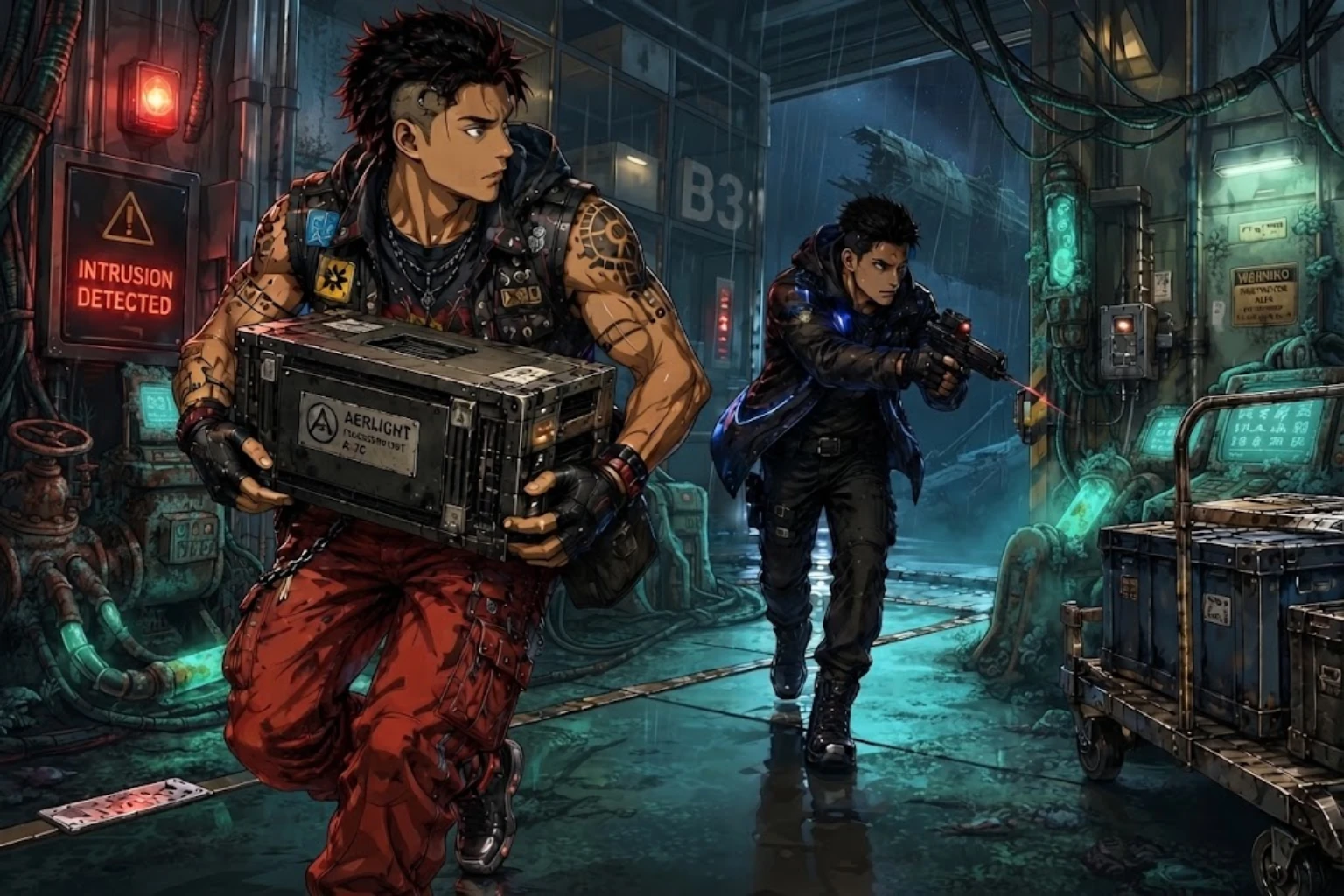
Kai had stopped thinking of any single room as his. That was the actual change, more than the burner hardware or the rotating logins or the new habit of carrying his real drives in a lined bag clipped inside his jacket instead of leaving them anywhere overnight. The change was psychological before it was technical. Eleven days after the trace, he still caught himself, on waking in whatever rented room he'd slept in that night, running a half-second inventory of exits before he remembered where he was.
Tonight's room belonged, on paper, to a produce distributor who sublet three units in an old residential conversion near the rail yards to people who paid in advance and didn't ask about the water pressure. The pressure, for the record, was terrible. Kai had learned to shower fast out of necessity rather than principle. He'd been in the room four days, which was already longer than he liked, and he'd already started making a list of the next three places he could move to without repeating a pattern anyone watching might notice — never the same district twice in a row, never a building with a working authentication field if he could avoid it, always somewhere with an independent power source so a grid interruption wouldn't leave him blind at the wrong moment.
His rig these days lived in two duffel bags rather than a permanent installation. Nothing bolted to a wall. Nothing that hummed loud enough to be heard through a floor. He missed the old setup the way you missed a bed that had fit your back — not because it had been good, exactly, but because it had been familiar, and familiarity was the thing he'd had to give up first.
Mika had made her own version of the same adjustment, though hers ran through hardware and identity rather than geography. In the eleven days since the trace from Kai's apartment, she'd burned through four constructed credentials that she would previously have kept in rotation for months, retiring each one the moment it had done a single job, on the theory — which nobody could prove but which nobody wanted to test by ignoring it — that whatever had traced Kai's query might also be capable of building a slower, patient profile out of anything that got reused too often. She'd started thinking of identities the way people thought of matches: strike once, use the light, throw it away.
Reid varied his routes on principle now instead of on instinct, which was its own kind of exhausting, because instinct had always been fast and principle required actual attention every single time. He'd stopped using the same noodle counter twice in a row for meetings. He'd stopped parking in any structure with a working camera contract, which in a city like Sacramento Deep narrowed his options considerably, and he'd taken to walking the last three blocks to anywhere important instead of riding transit the whole way, on the theory that feet left less of a trail than a fare card, even a borrowed one.
Ghost had simply gotten quieter, which for Ghost was saying something. He watched longer before entering rooms. He clocked exits with more deliberate attention, even in places he'd been a dozen times before the night Kai's apartment was traced had rearranged everyone's sense of what "safe" actually meant. Nobody asked him if he was still doing it out of caution or out of something closer to habit that had curdled into a kind of permanent unease. Nobody needed to ask. It was visible enough in the way he stood near doorways now, weight slightly forward, like a man who'd stopped fully trusting rooms to be what they appeared to be.
None of it stopped them from working. That was the part that mattered, the part none of them said out loud because saying it felt like admitting fear had won some small percentage of ground — but they still needed money, and money still came from Juno, and Juno still had clients who didn't care in the slightest about a trace that had burned one of Kai's safe places eleven days ago.
She found Kai in the produce distributor's rented unit two days after his last check-in, using a contact method they'd agreed on specifically because it didn't require either of them to be anywhere predictable — a relay number that forwarded through three dead accounts before ringing anything real, the kind of arrangement that had felt like overkill a month ago and felt like bare minimum now.
"I've got something," she said, when he picked up. "Real client. Real money. I want you to hear the whole thing before you decide whether you're in a place to take it."
"I'm always in a place to take work, Juno."
"Less than two weeks ago you followed a loose thread and ended up burning an apartment. Humor me."
He didn't argue with that. It was fair.
They met in person the next evening, which had also become rarer than it used to be — Juno preferred, these days, meeting somewhere with enough foot traffic that four people sitting together read as coincidence rather than arrangement, and she'd chosen a covered market three transit stops from anywhere any of them lived, stalls selling reclaimed-water produce and black-market credential chips within twenty feet of each other, nobody looking twice at anybody.
Reid and Mika were already there when Kai arrived, Ghost a few stalls down, close enough to matter, far enough to not read as part of the group to a casual eye. Juno had a paper cup of something that steamed and didn't smell like coffee, which meant it probably wasn't, and she didn't waste time on preamble.
"Client's a company called Aerlight Systems," she said. "Small outfit, maybe thirty people, does atmospheric engineering — moisture reclamation, air-to-water processing, that end of the market. They've built something they think is genuinely good. A processor that pulls usable water out of ambient air at an efficiency rate that, if it's real, undercuts most of what Chrome Water's licensing partners currently run on infrastructure contracts. That's not nothing, in a city that meters rainfall."
"How real is real," Kai asked.
"Real enough that a former partner tried to walk off with the credentials to the storage account holding the only working prototype." Juno said it flatly, the way she delivered most complications, letting the facts do whatever emotional work was needed without her having to supply it. "Man named Thom Balewa. Early investor, helped build the company, hasn't done real work there in over a year. There was a falling-out — money, credit, control, the usual reasons people stop being partners and start being enemies. Aerlight pushed him out of day-to-day operations. Problem is, nobody pushed him out of the storage account. Balewa can still get at the facility that's physically housing the only working unit."
"And he's using that," Reid said.
"He's using that. Aerlight found out three days ago that he's arranged to move the unit out of storage within the next thirty-six hours — our thirty-six hours, starting from about four this afternoon, so more like thirty-two by the time we're actually doing anything. They don't know where it's going. Could be another storage facility somewhere completely off their radar. Could be a buyer. Could be Balewa just being spiteful and burying it somewhere out of pure resentment. Once it moves, Aerlight loses whatever thread they currently have on it."
"What's the storage facility," Mika asked.
"Company called Corovale. Private commercial storage, high security, the kind of place manufacturers, brokers, research outfits and people with expensive hardware use when they don't want something sitting in their own building or tied into their own network — prototypes, industrial equipment, sealed data systems, sensitive physical assets that need controlled temperature and serious security. The building's old, converted from municipal utility use decades ago, but Corovale's been operating there long enough that most of what's visible is modern. I checked them independently. They're legitimate. No connection I can find to anything we've been worrying about the last two weeks." She let that sit a beat, because she knew exactly what everyone at the table was thinking without her saying it. "I checked twice, actually. Once because it's normal due diligence. Once because after what happened to Kai's apartment, I check everything twice now, whether the client asks me to or not."
"And it came back clean both times," Kai said.
"Both times. Corovale's a real facility with a real security contract and no shell companies anywhere in its ownership chain that I could find. Aerlight's real. Thirty-one employees, actual office, actual product filings going back four years. Balewa's real — public professional history, a falling-out you can practically read between the lines of two press releases if you know what you're looking for. This is, as far as I can tell, exactly what it looks like. A messy corporate divorce with a physical asset caught in the middle."
"What do they actually want us to do," Reid asked. "Because if the answer's steal it back, that's a different conversation than most of what we do."
"They don't want it taken. They were very specific about that. What they want is smaller and smarter. Get in. Find the unit. Confirm physically that it's actually the real prototype, not a decoy or a partial mockup — apparently Balewa's petty enough that swapping it for junk isn't out of character. Pull a verified copy of its core architecture and operating data. Put it back exactly where it was. Leave. If Balewa moves it somewhere unknown in the next day and a half, Aerlight still has everything they need to keep building. They don't need the object. They need to know what's inside it before it disappears."
Mika leaned back, arms crossed, working through it out loud the way she usually did. "Copy the machine, don't take the machine, leave Balewa wondering why his prize still looks exactly the way he left it."
"That's the shape of it," Juno said. "Clean job, as these things go. Get in, verify, copy, restore, get out. Corovale's security is real but it's commercial-grade, not military-grade — built to stop casual theft and insurance fraud, not built to stop someone who actually knows what they're doing." She looked around the table, meeting each of them in turn, which was as close as Juno came to asking a question she genuinely wanted answered rather than one she already knew the response to. "Given everything the last two weeks, I want to say out loud that nobody has to take this. I've checked it as hard as I know how to check anything, and it looks clean. I can't promise you it'll stay clean once you're inside a real building doing real work. I never could promise that. I'm just more aware right now that I'm asking that of people who've already had one very bad night."
Nobody said anything for a moment. It was Ghost, from two stalls down, near enough to have heard the whole thing without appearing to be listening at all, who spoke first, quiet, not looking over.
"It's a real job," he said. "We do real jobs."
That settled it, more than any longer speech would have.
Mika built the access architecture over the following day from a rented room three transit lines from where she usually worked, using hardware she intended to strip and discard the moment the job closed regardless of how it went. Corovale ran a mid-tier commercial security stack — layered credentials for different clearance zones, camera coverage that was real but not exhaustive, motion sensors on the storage floor itself rather than the corridors leading to it, and an authentication field at the main entrance that she judged, correctly, to be the easiest and least interesting part of the whole system to defeat.
Kai worked the deeper architecture remotely, from his own separate rented space, the two of them linked through a connection he'd built specifically for this job and intended to dissolve the moment it closed. He mapped Corovale's internal network in the cautious, patient way he now did everything — testing each layer against a sandboxed mirror before letting a live query anywhere near the real system, the specific discipline that one live trace and one burned apartment had taught him the hard way.
"It's a normal building," he told Mika, on their second pass through the facility's public-facing infrastructure. "Boring, even. Commercial security vendor, standard maintenance contract, no interference gear, no dampening residue, nothing that reads like anyone's gone out of their way to hide anything here. If this is connected to whatever traced me nearly two weeks ago, I can't find the seam."
"Good," Mika said. "I'd like one boring job. I think I've earned one."
She built Reid and Ghost a pair of technician credentials tied to a plausible maintenance contract — the kind of access that would let two people walk into Corovale's storage wing at an off-peak hour without triggering more than routine, unremarkable scrutiny from a bored night-shift guard. Reid walked the facility's public approaches twice before the job, once that evening and once again the following afternoon, cataloguing exits, loading bays, service access points and anything else the digital schematics couldn't capture with the same honesty as actually standing there and looking at it.
By the time the crew moved, thirty hours into the thirty-six they'd been given, the plan had the specific, satisfying solidity of something built properly rather than improvised under pressure. Reid and Ghost went in a little after eleven at night, through a service entrance Reid had confirmed twice was the least trafficked point of entry, wearing the muted, unremarkable coveralls of a maintenance contract nobody at Corovale would think to question on a Tuesday night.
The storage wing itself was a long corridor of numbered vault rooms, climate-controlled, quiet except for the low mechanical hum of environmental systems working to keep humidity and temperature within tolerances that mattered more to some of Corovale's clients than others. Ghost moved a half-step behind and to the side the whole way, cataloguing camera angles and the rhythm of the facility's single roaming guard, whose patrol pattern Mika had already mapped from the footage she'd pulled during prep and confirmed was, reassuringly, exactly as lazy and predictable as most single-guard night patrols tended to be.
"Guard's fifteen minutes out," Ghost said quietly, once they'd reached the vault housing Aerlight's account. "Maybe twenty if he stops for his usual smoke."
"Then we've got time," Reid said, and nodded to Mika's feed, live in both their earpieces. "Door."
Mika's constructed credential opened the vault door on the first attempt, clean, no hesitation, the specific unremarkable success of a lock built to check a plausible-looking authorization rather than interrogate it. Inside, the room was smaller than Reid had expected, shelved along three walls, most of the shelving holding sealed cases that belonged to other clients entirely — the ordinary, boring inventory of a facility that stored prototypes, industrial hardware and expensive equipment nobody outside the companies that built it would ever care about.
Aerlight's case sat on a shelf at chest height, a matte gray container about the size of a large toolbox, sealed with a tamper-evident strip that Mika had already confirmed, from Corovale's own maintenance logs, hadn't been broken or reset in the fourteen months since the unit had been logged into storage.
"That's promising," Reid murmured, easing the case down carefully, setting it on a low table at the room's center that had clearly been placed there for exactly this purpose — clients occasionally needed to inspect their own stored property, and Corovale had built the room to accommodate that without anyone needing to remove anything from the premises.
Ghost held position near the door, watching the corridor through the narrow gap he'd left it open, while Reid worked the case's seal with the careful, unhurried patience of a man who'd learned the hard way that rushing a tamper-evident strip was the single fastest way to leave evidence that somebody had rushed it.
Inside, cushioned in foam cut to its exact shape, sat the prototype — smaller than Reid had pictured from Juno's description, a matte housing about the size of two stacked shoeboxes, vents along one face, a single status panel dark and dormant on its top surface. Kai, watching through the feed from Mika's relay, ran the unit's visible serial and housing markers against the specifications Aerlight had provided.
"That's it," Kai said, after a moment that felt longer than it was. "Matches on every visible identifier. Housing markers, vent configuration, panel layout. If it's a decoy, it's the most expensive decoy I've ever heard of."
"Powering it," Reid said, and pressed the small recessed switch Aerlight had described in their briefing, watching the status panel flicker to life with a soft green wash of light, diagnostic text scrolling too fast to read with the naked eye but clearly, unmistakably real — the specific texture of genuine hardware booting rather than something built to merely look the part.
"Data port's on the left face," Kai said. "Small, proprietary connector — Aerlight sent the adapter spec, should be in Mika's kit."
Mika had already built the adapter during prep, a small pigtail cable she passed forward through Reid's kit before the job started, and Reid connected it now with the careful precision of a man handling something worth considerably more than his own life insurance would cover. Kai's extraction routine began pulling the moment the connection registered — architecture schematics, operating parameters, the compressed core logic that represented, as far as anyone in this room understood it, the actual valuable thing Aerlight had built.
"It's flowing," Kai said. "Clean data, no corruption, no obvious tampering. Give me maybe six minutes for a full pull."
For those first several minutes, it was, gratifyingly, exactly the boring job Mika had asked for. Ghost held the door. Reid stood by the case, watching the status panel's slow, patient scroll. Kai narrated progress in the flat, satisfied tone of a man watching a job go the way jobs were supposed to go. Mika split her attention between the corridor cameras and the guard's tracked position, still fifteen minutes out, still moving through his patrol with the same lazy predictability he'd shown every night she'd watched him.
Then, at the four-minute mark, one of Mika's credentials failed.
It wasn't the vault door — that stayed open, stable, unremarkable. It was a secondary authorization she'd built as a fallback, a second key she'd tested successfully twice during the day's prep specifically so she'd have a way to re-lock and re-open the vault smoothly if the guard's patrol drifted closer than expected. It simply stopped working, no error message, no explanation, just a flat, silent refusal where there'd been clean success an hour earlier.
"That's odd," she said, mostly to herself, and rotated to the credential's backup, a second construction she'd built specifically because she never trusted a single point of failure on any job that mattered.
That one failed too. Faster this time. Almost, she thought, like it had been waiting.
"Kai," she said, keeping her voice level, "I've got two credentials down in the last ninety seconds. Both fallbacks, not the primary. Vault door's still fine."
"Corovale might be running a rotation cycle," Kai said, though something in his own voice had sharpened, the specific edge of a man doing math he didn't like the shape of yet. "Some facilities randomize secondary keys on a schedule to limit exposure. Give me a second to check if that's documented anywhere in their maintenance spec."
It took him closer to ninety seconds than the ten he probably wanted, and when he came back, the sharpness in his voice hadn't softened.
"There's no rotation cycle documented anywhere in Corovale's system," he said. "And even if there were, it wouldn't explain this next part. One of the corridor cameras just changed its recorded feed loop without any command from us and without any log entry from Corovale's own security system authorizing the change. Something told that camera to start showing a static loop instead of live footage, and it wasn't me, and it wasn't Corovale."
Ghost, still at the door, went very still in the specific way that meant his attention had sharpened rather than his posture. "Define static loop."
"It's showing the corridor as empty," Kai said. "Right now. While you two are standing in it."
Nobody said anything for a beat. Reid glanced at the case, at the still-scrolling data transfer, at the door Ghost held ajar.
"Could be Corovale's own security noticing something's off and quietly repositioning to watch us without tipping their hand," Reid said. It was the reasonable explanation, the one you reached for first, the same instinct that had made Kai reach for rotation cycles and mislabeled gates and collateral maintenance contracts in every strange thing they'd found over the past month. "Standard countersurveillance move if a guard suspects an intrusion."
"Maybe," Kai said. "I want that to be true. Give me a minute to check whether the change traces back to Corovale's own security terminal or somewhere else."
He had his answer in less than a minute, and it wasn't the one anyone wanted.
"It's not Corovale," he said. "The command that changed the camera feed didn't originate from their security terminal. It came in through the same maintenance layer Mika's credentials are built on top of — the same access tier we're using. Somebody else is inside this building's systems right now, using roughly the same door we walked through."
"Somebody being," Mika said, though she already knew the shape of the question she was actually asking.
"I don't know yet. I want to be careful about saying more than I actually know." Kai's voice had gone very level, the particular calm he reached for when the alternative was letting something else show through. "But it's not moving like a scripted defense system reacting to an intrusion alert. It's moving like it's making decisions. It killed your two fallback credentials in the order that would matter most to us, not in some obvious priority order Corovale's own security would use. And it's fast. Faster than the last thing I want to compare it to, but I'm not going to pretend I'm not thinking about the trace."
"Reid," Ghost said, quiet, urgent in the specific unshowy way Ghost delivered urgency. "Guard's changed his pattern."
Reid looked up sharply. "Changed how."
"He's not smoking. He's not doing his usual loop. He stopped at the junction two corridors over, and he's just standing there." A pause, Ghost's attention entirely on the feed Mika still had live in their ears. "That's not a patrol pause. That's someone waiting for an instruction."
"Could be nothing," Reid said, though he was already moving, disconnecting Kai's extraction cable from the prototype's data port with careful, fast hands, watching the transfer percentage on Kai's relayed readout. "Kai, how much data do we have."
"Eighty-one percent," Kai said. "I need another ninety seconds for a complete architecture pull. Less if I stop caring about doing it clean."
"We might not have ninety seconds," Ghost said. "Guard just moved. He's heading this way. Not fast. Not casual either."
Reid made the calculation the way he made most calculations under pressure, fast and without visible strain, weighing the value of a complete data set against the cost of being caught standing over an open case with a prototype connected to unauthorized hardware. "Kai. Take what you have. We reseal now."
"Seventy more seconds gets me full architecture instead of partial. Partial might not be enough for Aerlight to actually rebuild anything useful from it."
"Then we've got seventy seconds," Reid said, glancing at Ghost, who gave the smallest possible nod, the kind that meant he'd make those seventy seconds work or tell them clearly when he couldn't anymore.
The seventy seconds ran long before anyone officially decided to let them. At the fifty-second mark, the vault door — the primary door, the one that had opened clean and stayed stable the entire operation — began to close on its own, motor engaging with a soft mechanical whine that hadn't been there a moment earlier.
"That's not Corovale either," Kai said immediately, before anyone had to ask. "Same layer. Same signature. It's shutting the door on you."
Reid didn't wait for further confirmation. He wedged a case strap into the door's track, buying a few inches of resistance against the motor's slow, patient push, while Ghost moved to the gap and put his shoulder against it, holding the door open through raw physical effort against a system trying to close it electronically.
"Kai, I need that pull finished now," Reid said, voice tight but level.
"Ninety-four percent," Kai said. "Ten more seconds."
"We don't have ten seconds of door left."
Ghost, holding the frame with his whole body weight now, spoke through gritted effort. "We have what I can give you. Move."
Kai gave him eight of the ten seconds, cutting the extraction at eighty-nine percent complete rather than the full architecture he'd wanted, because the alternative was a door closing on two people he trusted more than he trusted any dataset. Reid yanked the cable free, and in the same motion, with the vault door's motor grinding harder against Ghost's braced shoulder, made the decision that would matter more than anything else that happened that night: instead of taking the ten additional seconds it would have required to reseat the prototype cleanly back into its foam housing and reseal the case, he simply picked the unit up, whole, unsealed, and moved.
There wasn't a version of that moment where putting it back was actually free. He would think about that afterward, replaying it, the way you replay any decision made in under two seconds that ends up mattering considerably longer than two seconds. Reseal took time. Time was the one resource the door currently trying to grind shut on Ghost's shoulder had made clear they didn't have.
"Go," Ghost said, releasing the door the instant Reid cleared it, the motor finishing its job with a soft mechanical thud a half-second later, sealing the empty vault room behind them.
The corridor ahead, the one Mika's compromised camera had been quietly reporting as empty, was not empty. The guard stood at the far junction, radio already at his mouth, close enough now that Ghost's earlier read on his changed pattern had been exactly right.
"Not that way," Ghost said, already turning, reading the geometry of the corridor with the fast, practiced calculation that had kept him alive through worse buildings than this one. "Service stair, north end. Reid."
They moved fast and low, Reid with the prototype held against his chest like something considerably heavier than its actual weight suggested it should be, Ghost half a step ahead, clearing the corner before Reid committed to it. Behind them, the guard's voice carried down the hall, not shouting yet, but talking into his radio with the specific urgency of a man who'd just seen something he hadn't expected to see.
"Service stair's not on the original route," Kai said, voice tight in both their earpieces, working the building's schematic in real time. "It exits into a loading bay on the east side. There should be a secondary door there, unmonitored."
"Should be," Reid said, already moving toward it.
The door was locked. Not with the ordinary mechanical lock the schematics suggested — with something electronic, freshly engaged, a status light glowing a hard, uncooperative red where Kai's own earlier mapping had shown it as passive and unremarkable.
"That's not supposed to be active," Kai said, and there was something in his voice now that wasn't quite panic but was close enough to its neighborhood that Mika, listening from her own rented room three transit lines away, felt her stomach tighten in response.
"Kai," Mika said, "talk to me. Is this the same thing as the vault door."
"Same layer. Same signature." He was working fast now, testing the lock's architecture against everything he knew, and coming up, for the first time all night, genuinely short. "It's not Corovale's normal security system. It's running underneath it — older, deeper, something I don't have a clean map of. Whoever's doing this isn't just interfering with Corovale's cameras and door logic. They're reaching into something underneath that, something that predates the current security contract entirely, and I don't know it well enough to beat it clean. Not in the time we have."
"Then what do we have," Reid said, checking the corridor behind them, hearing footsteps now, more than one set, moving with purpose rather than routine.
Kai didn't answer immediately, and the half-second of silence told Reid more than any words would have. Then: "Give me sixty seconds. I need to make a call."
"Kai—"
"Sixty seconds, Reid. I don't have a version of this where I solve it myself in less time than that, and I'd rather burn sixty seconds calling someone who might actually know this system than spend the same sixty seconds guessing and being wrong."
Reid didn't like it. He said so, once, briefly, and then didn't waste further breath arguing, because arguing cost time neither of them had, and because in two years of working with Kai, Reid had learned that when Kai said he didn't have a solution, he meant it, and the honest admission was worth more than false confidence dressed up as competence.
Kai's call went to a number he hadn't used in over three years, a man named Otis Vann who'd spent thirty-some years maintaining SCADA control systems for the old Sacramento Valley water authority before privatization folded it into something bigger and considerably less interested in keeping men like Otis on staff. Kai had met him at a scrap auction, of all places, both of them bidding on the same pallet of decommissioned industrial controllers, and had ended up buying Otis a drink afterward to hear him talk about systems that, as far as Kai had understood at the time, no longer existed anywhere that mattered.
Otis picked up on the third ring, gravel-voiced, unhurried in the specific way of a man who'd stopped being surprised by anything decades ago.
"This better be good," Otis said. "It's near midnight."
"I need you to look at something live," Kai said, already pushing a read-only mirror of the lock's architecture through the connection, stripped of anything that could trace back to Corovale's actual address. "A door control system, running underneath a modern commercial security stack. I don't recognize the base layer. I think you might."
There was a pause on the line, the sound of Otis actually looking at what Kai had sent rather than simply talking through it, and when he spoke again, his voice had lost its sleepy edge entirely.
"Where in god's name did you find this," Otis said. "This is SCADA-lineage. Old. Real old. This is the kind of control architecture we used to run whole irrigation districts on, back before the state even had a unified water authority, back when every county basically ran its own patchwork system and none of them talked to each other cleanly. When everything got consolidated and privatized through the eighties and nineties, most of that old infrastructure should've been retired. Some of it got folded into newer systems instead, because ripping it out cost more than just letting it keep running underneath whatever got built on top."
"Can you get me past it," Kai said. "Fast. I don't have time for the history lesson, Otis, I'm sorry, I need it later."
"There's an emergency override built into systems like this," Otis said, already working, his voice picking up the specific focus of a man doing something he was genuinely good at. "Fail-safe subsystem, designed decades ago for exactly the situation where the primary control layer locks something that shouldn't be locked — flood gates, mostly, originally, doors and valves that needed to open no matter what the main system said, because somebody's life depended on it. If this door's running on the same lineage, there should be a manual trigger somewhere in the local hardware, not the network. Something physical."
"There's a panel," Ghost said, having already found it, a battered gray box beside the door frame that looked, to any casual eye, like a decades-old fire suppression control nobody had bothered replacing. "Old. Real old."
"That's it," Otis said, once Kai relayed the description. "Break the seal, there'll be a lever inside, spring-loaded. It'll force the door regardless of what the network layer thinks it's doing. I have to warn you — that subsystem doesn't communicate quietly. It's built to be loud on purpose, because the whole point was making sure someone noticed a flood gate had been forced open in an emergency. You use that, every alarm tied to that subsystem is going to go off, and there won't be any hiding that it happened."
"Understood," Reid said, already moving to the panel. "Ghost."
Ghost broke the panel's seal with the flat of his hand, hard, once, and found the lever exactly where Otis had said it would be. He pulled it, and the door released with a mechanical shudder entirely unlike the smooth electronic click of everything else in the building — and somewhere above them, an alarm began, loud, physical, unmistakably analog, the kind of sound built to be heard through concrete rather than transmitted through a network.
"That's the cost," Kai said, unnecessary but honest. "No hiding it now."
"Move," Ghost said, and they did, out through the loading bay and into the cool dark of the service alley beyond, the alarm still sounding behind them, footsteps closing from somewhere inside the building they'd just left. Ghost caught the arm of the first guard through the door before the man had fully processed what he was seeing, controlled and brief, enough to buy three seconds and no more, and then they were moving again, fast, into the alley's shadow and away from the light spilling out of the loading bay behind them.
They didn't stop until they were four blocks clear, in the dead space behind a shuttered auto shop, both of them breathing hard, the alarm now distant enough to be just one more piece of the city's ordinary night noise.
Reid looked down at what he was still holding. The prototype, unsealed, uncased, very much not back where it belonged.
"We were supposed to put that back," he said, mostly to himself.
"We were," Ghost agreed. "Didn't have the ten seconds."
"No," Reid said. "We didn't."
Juno's reaction, twenty minutes later, over the same relay line they'd used to bring her the good news about jobs like this one going smoothly, was not one Reid particularly enjoyed sitting through.
"You took it," she said. Not a question.
"We were a little busy," Reid said.
"You were supposed to put it back."
"That was the plan."
"The plan was the part that kept this from becoming theft," Juno said, and there was an edge in her voice that Reid had heard maybe twice in two years, both times over things that mattered considerably more than a missed step in a routine job. "I sold this to Aerlight as a copy job. In and out, nothing disturbed, nothing they'd have to explain to Corovale, nothing that leaves a mark anywhere. Now I've got a prototype sitting somewhere it categorically should not be, and a client who is going to ask me, reasonably, why their careful, low-risk job turned into something that could get them accused of arranging their own theft."
"We got the data," Reid said. "Eighty-nine percent of the architecture, clean, before the door started trying to close on Ghost's shoulder. That's not nothing."
"It's not everything either," Juno said, "and I'm not upset about the data. I'm upset about the part where I now have to figure out how to get a physical prototype back to its rightful owner without it looking like the same crew that copied its files also happened to walk off with it, which is going to be a considerably harder conversation with Aerlight than the one where everything went according to plan." She exhaled, and some of the edge went out of her voice, replaced by the flatter, more exhausted tone of someone already working the problem rather than dwelling on how it happened. "I'm not blaming you for the decision in the moment. I wasn't there. I don't get to second-guess a choice made in real time from a call three transit lines away. I'm telling you the decision creates a mess, and the mess is now mine to clean up, and I'd like everyone to sit with that for a second before we move on to whatever comes next."
Nobody argued with her. There wasn't really an argument to make.
It took Juno most of the following day to work out a version of an answer — not a clean one, nothing that undid the fact that Aerlight's prototype now sat in a lined case in the back of a rented room instead of a Corovale vault, but a workable path forward: quietly informing Aerlight that the extraction had encountered unexpected security escalation, that Balewa's window to move the unit had likely already closed given the alarm Corovale's own system had logged, and that the physical unit was safe, intact, and recoverable through a discreet handoff Aerlight could arrange on their own terms rather than something Juno's crew would attempt to walk back into Corovale to fix. Aerlight, to their credit and Juno's considerable relief, cared more about the data and the unit's safety than about the mess of how it had ended up outside the building. It wasn't the clean ending anyone had wanted. It was, Juno said, the best version of an ending that existed once the door started closing.
She rechecked the entire job afterward anyway, the way she now rechecked everything, running the same verification passes on Aerlight, Balewa, and Corovale that she'd run before the operation even started, looking specifically for anything that might connect any piece of it to Meridian, to the warehouse, to whatever had traced Kai's query nearly two weeks earlier.
She found nothing. Aerlight was exactly what it appeared to be. Balewa was exactly what he appeared to be, a bitter, small man trying to extract value out of a partnership that had soured, with no deeper agenda than spite and money. Corovale was a storage facility with a real security contract, and nothing in its current records suggested that any of the building's old municipal control architecture was still active, much less capable of reaching into its modern security systems.
"That's the part I don't like," she told Kai, once she'd finished. "If this had turned out to connect back to Meridian somehow, I'd almost feel better. At least then it would make sense — they'd have been protecting something, watching a target they cared about. Instead I've got a completely unrelated, completely clean job, and something found you anyway."
"Found the job," Kai said carefully. "Not necessarily us specifically. I don't know that yet."
"Does it matter which, practically speaking?"
He didn't have a good answer for that, and didn't pretend to.
What he did have, once Otis Vann's read on the architecture had time to settle, was a genuine, if incomplete, piece of the picture. He laid it out for Juno the way he'd laid out the Meridian metadata weeks earlier — carefully, without overselling what he actually knew.
"The system that locked us in wasn't Corovale's own security," he said. "It was running on something underneath it, an older control architecture, SCADA-lineage, the kind of system that used to run water infrastructure — irrigation districts, flood control, that whole patchwork of pre-consolidation utility systems that never fully got retired when everything got folded into bigger, newer operators. Otis recognized it immediately. Said it's the kind of thing that survives specifically because ripping it out costs more than leaving it running underneath something newer built on top."
"So somebody's using old water-control infrastructure to run interference on a private storage facility's security."
"That's what it looks like. I don't know why yet. I don't know if this architecture has anything directly to do with Meridian, or if whoever came after us simply knew it was here and knew how to use it. What I do know is that the behavior felt a lot like the trace — fast, adaptive, changing its response based on what we did. That's happened twice now. The water-system architecture is new."
"I want to know more about that," Juno said, and then, before Kai could respond, added, "and I want you to not go looking for it tonight, or tomorrow, or this week, without talking to me first."
"I wasn't going to."
"I know you weren't planning to tonight. I'm asking for longer than tonight." She looked at him steadily, the way she looked at anyone she was asking to trust her judgment over their own curiosity. "You've been burned twice now chasing exactly this kind of thread on your own timeline. I'm not telling you to let it go. I don't think you could, and honestly, I don't think I want you to, not entirely — whatever this is, it's already found us twice without being invited. I'd rather understand it than keep pretending it isn't there. I'm telling you the next move needs to be planned, with everyone knowing what's actually being risked, instead of one more midnight decision made because you couldn't stand not knowing for one more day."
Kai was quiet for a moment, turning that over. "That's fair," he said finally. "I don't love it. It's fair."
"That's the best agreement I've gotten out of you in two weeks," Juno said, and something in her voice, for the first time since the call had started, came close to actually being tired rather than simply controlled.
Somewhere else in Sacramento Deep, in a residential block that had gone through three ownership changes in as many decades and still ran a water reclamation line that its own maintenance logs listed as decommissioned, a pressure sensor buried in a wall from before the current building had been the current building registered, for eleven seconds, a flow reading in a pipe that had supposedly carried nothing for years.
The building's systems noted the anomaly, checked it against a maintenance schedule that hadn't been updated since before most of the tenants currently living there had been born, found no scheduled work to explain it, and logged it as sensor noise.
Three blocks away, in a Chrome Water kiosk identical to a hundred others scattered across the district, a man mid-transaction for a licensed beach-memory experience felt, for four unscheduled seconds, the unmistakable sensation of cold rain against his face — real rain, not the polished, focus-grouped version the kiosk was contracted to sell him, something rougher and colder and entirely uninvited, before the feed corrected itself and delivered the sunlit beach he'd actually paid for.
He mentioned it, mildly, to no one, assumed it was a glitch in the delivery hardware, and finished his ninety seconds of borrowed sunshine without further thought.
Somewhere in a maintenance log neither event ever reached, both anomalies were filed, separately, as routine synchronization noise, and forgotten by morning.


.png)
.png)
.png)