%20(1).png)
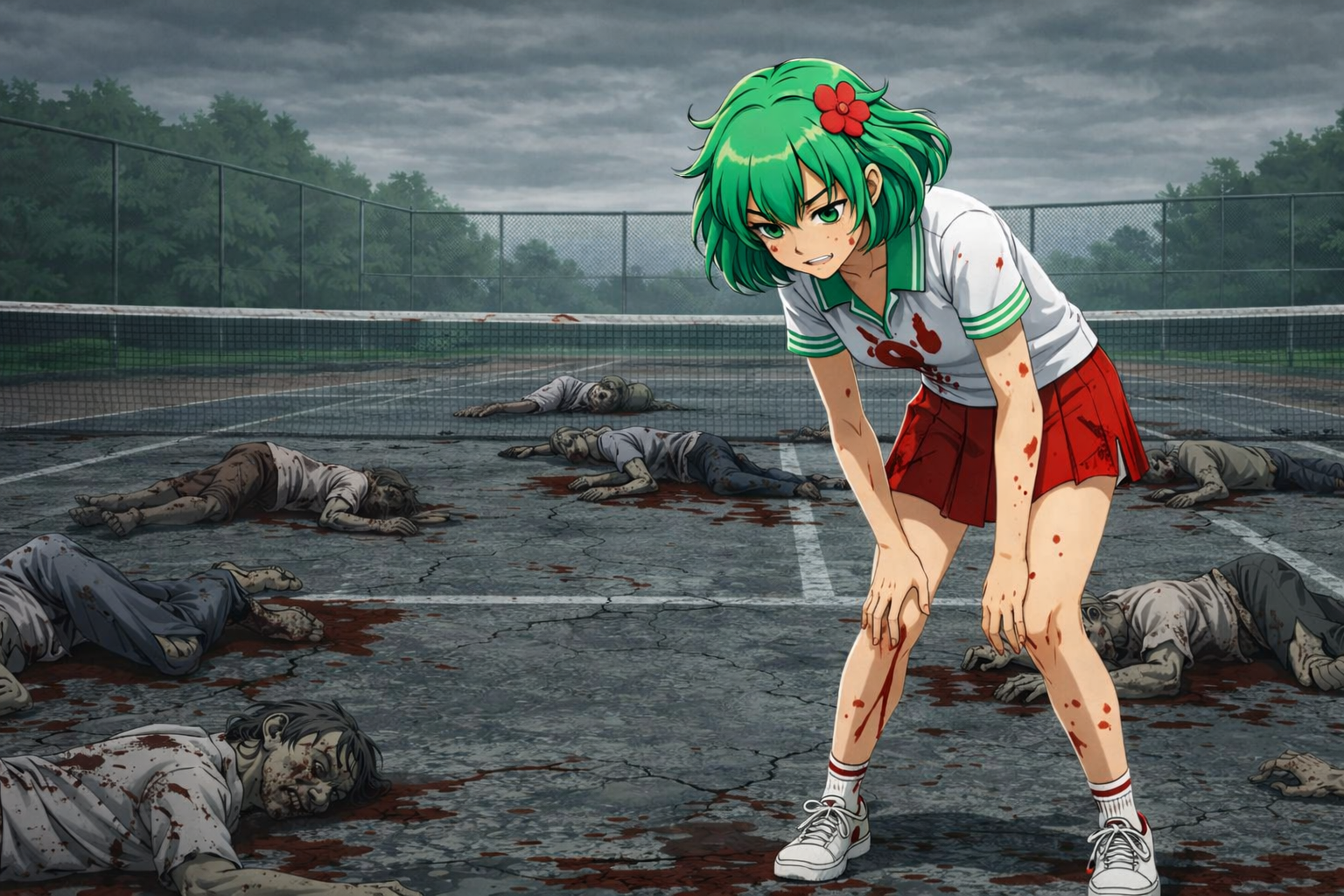
Rei Tsukino had been counting her footwork when the screaming started.
Left. Right. Pivot.
Swing through. Follow the line.
The university courts were empty except for her, chain-link fences humming softly as wind rolled across the asphalt. Clouds pressed low overhead, thick and gray, promising rain that never quite arrived. The kind of sky that made colors dull and sounds travel farther than they should.
She liked practicing alone.
It made mistakes easier to hear.
The tennis ball rose, fell. Rose again. Her shoes whispered against the court with each step, muscle memory guiding her body without conscious thought. The rhythm steadied her breathing, narrowed the world down to movement and timing and balance.
Then the scream cut through it.
Short. Sharp. Cut off too quickly.
Rei froze mid-bounce. The ball dropped uselessly at her feet and rolled toward the baseline. She didn’t move to retrieve it.
She waited.
Campuses were loud places. People screamed for all kinds of reasons — drunk laughter, stupid dares, arguments that felt urgent in the moment and embarrassing an hour later. She told herself it was nothing. Her pulse slowed a notch.
Then the second scream came.
Longer this time.
Rei walked to the fence and peered through the chain links toward the path that led from the dorms. A man stumbled into view, hands clutching his stomach. Blood soaked through his hoodie, dark and spreading in irregular shapes. He fell, scrambled to stand, and fell again.
Someone ran after him.
They didn’t stop.
They crashed into him hard enough that both went down, bodies tangling on the pavement. Rei saw the way the second figure moved — too fast, too clumsy, like balance no longer mattered.
Her throat went dry.
Rei stepped back onto the court, heart beginning to race. She grabbed her phone from the bench and tapped the screen.
No signal.
The display flickered once, then went dark.
Around her, the space felt suddenly too open. Too wide. The court that had always felt controlled now felt exposed, bordered by nothing but fences and trees that swallowed sound.
Movement exploded at the far gate.
Three — no, four people slammed into the chain-link, rattling the posts hard enough to make the metal sing. Their mouths were open, sounds pouring out that weren’t words anymore. Their movements were jerky, uncoordinated, driven by something blunt and relentless.
Rei backed toward the net, racquet rising instinctively into ready position.
She told herself it was a drill.
React. Adjust. Swing.
The first one reached her before she could think better of it.
She swung the racquet hard, aiming for the shoulder — the way she would in practice when correcting someone’s form, redirecting momentum instead of meeting it head-on. The impact jolted up her arms, shock traveling through graphite and bone.
The racquet bent.
Rei stared at it for half a second, disbelief slicing cleanly through the fear.
Her favorite racquet.
Custom grip. Perfect balance. Tuned to her swing after years of adjustments.
The thing lunged again.
Anger burned hotter than panic.
She brought the racquet down this time with both hands, striking the side of its head. There was a sound like hitting wet clay. The body collapsed, twitching against the court.
Rei didn’t stop swinging.
Another grabbed at her sleeve. She twisted free, fabric tearing at the hem of her skirt, and smashed the racquet into its jaw. The frame bent further, warped beyond repair, but it didn’t snap.
Neither did she.
Her movements stopped being deliberate and became precise instead — shorter arcs, tighter strikes, footwork adjusting automatically as she pivoted and stepped, never staying still long enough to be grabbed properly.
When it was over, four bodies lay sprawled across the court, blood streaking the white boundary lines in ugly smears. The net sagged slightly where one had fallen into it, tangled and unmoving.
Rei stood among them, chest heaving, hands shaking just enough for her to notice.
She looked down at the racquet.
Bent. Ruined.
She laughed once — sharp, breathless, almost hysterical.
“That figures,” she muttered.
The rain finally started.
It came down in thin sheets, tapping against the asphalt and darkening the court inch by inch. Rei dragged the bodies toward the edge of the court with her foot, pushing them against the fence the way groundskeepers moved debris after storms. She didn’t want to trip later.
The thought was absurd.
And practical.
More shapes moved beyond the trees.
Too many to count.
Rei wiped rain from her eyes and scanned the court. Benches. Ball cart. Maintenance shed near the far gate. Her decision came without debate.
She sprinted.
Shoes slipped slightly on the wet asphalt, but she corrected instinctively, body leaning into the run. She reached the shed and yanked the door open, grabbing anything with weight — a metal pole, a crate of old practice balls. She slammed the door shut just as something hit it from the outside.
The impact made the hinges scream.
Rei braced the pole against the handle and leaned into it, breathing hard. Her arms burned. Her legs trembled, not from fear now, but exertion.
This wasn’t a match.
There were no points. No crowd. No second set.
Just survival.
The pounding slowed.
She counted the gaps between impacts, timing them the way she’d timed serves and returns her entire life. When the rhythm faltered, she slipped out the back and circled wide, racquet still clutched in her hand.
Bent or not, it was familiar.
It fit her grip.
She trusted it.
By the time she left the courts, the lines were smeared red and the net sagged where bodies had tangled into it. Rain washed the worst of it away, but not all. Some stains set quickly, clinging stubbornly to the surface.
Rei didn’t look back.
She walked down the campus path with her broken racquet resting over her shoulder, jaw set, eyes forward. Sirens wailed somewhere in the distance, muffled and directionless.
She’d lost something important that day.
But she’d learned something, too.
Fear could be worked through.
And anger — when controlled, when shaped — could keep you alive.


.png)
.png)
.png)