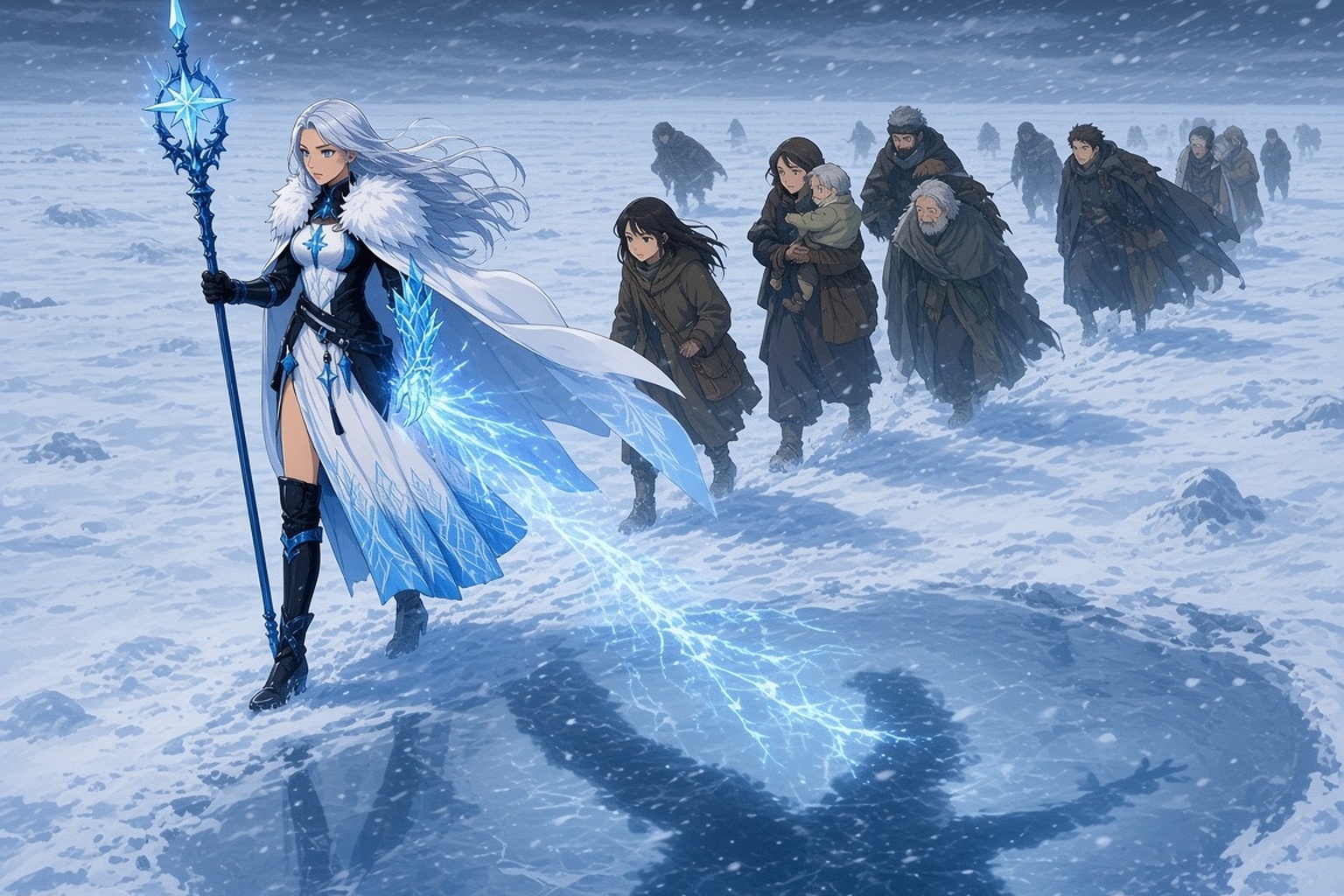
The wall rose out of the storm like something the mountain had grown instead of built.
Wren counted the refugees behind her for the hundredth time. Forty-one, if you counted the baby who hadn't cried since yesterday. She wasn't sure that was a good sign.
"That's it," said Old Dassen, beside her. "That's Aureth's house."
He said the name the way people said words they didn't quite believe in.
Wren's coat was too thin for the wind, but she kept her arms crossed over it anyway, pressing the hard shape of the ledger against her ribs. Nobody could know it was there. Not yet.
Behind her, Tamsin tugged at her sleeve.
"Is this it?" her sister asked. "Is this where we stop walking?"
"Maybe," Wren said. "If they let us in."
"And if they don't?"
Wren didn't answer that. She crouched instead, pulling Tamsin's hood further over her ears, the way their mother used to before their mother had stopped being able to do anything at all.
"Keep your hands in your sleeves," Wren said. "Like I showed you."
Nearby, the young mother — Sera, Wren had learned her name was, somewhere around the eighth day — rocked the baby against her chest, murmuring words that weren't quite a lullaby anymore, just sound to fill the space where warmth should have been.
"She hasn't fed properly in two days," Sera said, to no one, to everyone. "I don't have enough left to give her."
One of the wounded men, Bellic, sat propped against a sled with his bandaged leg stretched stiff in front of him. He'd taken an arrow outside Calder's Hollow running cover for the others, and the wound had gone an ugly color three days back that no one wanted to name aloud.
"If they turn us away," Bellic said quietly, to Wren, "leave me. Don't let the little ones slow down for me."
"No one's leaving anyone," Wren said, sharper than she meant to.
"You say that like it's a choice you get to make."
"It's the only choice I'm willing to make," Wren said, and that ended it, for now.
She stood, and looked up at the wall, and called up at it before her courage could cool.
"We need passage! We have children, we have wounded—"
A long moment. Then shapes appeared along the top of the wall, pale lanternlight catching on spear-points.
And then she stepped into view, and Wren understood immediately why no one joked about the Winter Sovereign.
Aureth Winterward didn't look like winter. She looked like the thing winter was afraid of.
Tall, still, a staff of black ice in one gloved hand, hair bound back so the wind couldn't use it against her. She didn't shout. She didn't need to. Her voice carried over the gale like it had been given permission to.
"Hollowmere is closed," Aureth said. "No one crosses while the Long Dark holds. That has been the law for longer than any of you have been alive. It will not change tonight."
"Please." Wren's voice cracked despite herself. "We've walked twelve days. We buried six of our own in the snow because we couldn't stop to dig proper graves. If you turn us back, the cold will finish what—"
"What burned your province?" Aureth said. "Tell me. All of it. I will not bargain blind."
So Wren told her.
She told her about the Ashen Writ, the company that had ridden into Calder's Hollow with sealed orders and torches. She told her how the orders hadn't been about rebellion or tax, how the garrison commander had read them aloud before he did it, like he wanted witnesses to understand it wasn't cruelty, it was policy. She told her about the ledger — the real one, not the one burned for show — that recorded names, dates, the chain of command signed in wax from a southern lord who wanted the whole province gone so no one would ask where the grain levies had actually gone.
"And where is this ledger now?" Aureth asked.
Wren hesitated. Only a breath. But Aureth's eyes caught it.
"Safe," Wren said.
"How far behind you is the Writ?"
"A day. Maybe less. They're not chasing stragglers, my lady. They're finishing the job. They want no one left to say what happened."
Something shifted in Aureth's face. Not softness. Attention.
"You understand what you're asking," Aureth said. "Hollowmere isn't locked out of spite. It isn't locked for taxes, or trade, or the convenience of a sovereign who likes her solitude. It is locked because it is dangerous in a way you have no reason to believe yet."
"I believe you," Wren said. "But I believe the men behind us more. I've seen what they do."
For a long moment, Aureth said nothing. The wind filled the silence instead, screaming off the battlements, dragging snow sideways across the lanternlight.
"How many children?" Aureth finally asked.
"Nine. One not yet walking. My sister's seven. There's a man here who took an arrow covering the rest of us and won't say how bad it's gone."
"And how many of you have crossed ice before? Any ice, frozen river, pond, anything?"
Wren didn't know why that mattered, not yet. "Some. Not this. Not Hollowmere."
Aureth's jaw tightened, the only crack in her composure.
"I make no promises tonight," she said. "Not because I don't wish to help you. Because the law exists for reasons older than your grief and mine, and I will not break it to ease my own conscience before I understand what breaking it costs."
"Who told you to care more about an old law than forty-one people freezing outside your gate?"
It came out sharper than Wren meant it. She braced for anger.
Instead Aureth looked at her — really looked, like she was filing the question away somewhere it couldn't be lost.
"You'll have shelter outside the wall tonight," Aureth said. "Fires, food, guards to watch the dark. That I can give freely. The crossing, I cannot promise. Not yet."
"And if the Writ arrives before you decide?"
"Then I will have decided," Aureth said, "one way or another."
She turned from the wall before Wren could answer, her cloak snapping once in the wind like something striking.
The gates didn't open. But smaller doors did, at the base of the wall, and lantern-bearing soldiers came out with blankets and bread and did not meet anyone's eyes, as if ashamed of the mercy they were allowed to offer and the one they weren't.
Sera finally got the baby to settle against the warmth of a borrowed fire. Bellic let the healer look at his leg and said nothing when her face didn't change fast enough to hide what she thought of it.
Wren sat beside Tamsin, pressed the ledger flatter against her ribs, and did not sleep that night.
The archive beneath the citadel smelled of cold stone and older cold beneath that.
Aureth descended alone, a lantern of captured lightning throwing blue light across shelves that had stood since before her grandmother's grandmother wore the title of Winterward.
She found the record she wanted bound in sealskin gone brittle as old bread. The First Winterward's hand, cramped and certain.
Hollowmere is not a lake. It was a wound, and I have made it a scar.
Aureth had read this before. As a girl, as a student, as the heir being shown what she would one day hold. She remembered the old castellan who'd taught her tracing the words with one finger, telling her: You will carry this. One day it will not be a story to you.
She had not understood, then, what that meant. She was beginning to.
I have frozen it to the bottom, and poured part of myself into the ice to hold the seal. What lies beneath is not dead. It is held. Cold is the chain. Stillness is the lock. It will not wake for cold and silence. It wakes for heat, for motion, for voices raised in fear or joy alike. The Long Dark is when the deep turns over and the seal thins, as a held breath thins near its end. Cross it then, and you risk waking what no wall of mine can stop a second time.
Aureth closed the book, and did not open it again for a while.
She thought of the First Winterward, whose name history had not even kept — only the title, worn like a coat passed down too many times to remember its original owner. She wondered what that woman had looked like, standing at the edge of this same lake, deciding to give part of herself to something she couldn't fully name.
Did it feel like this, she thought. Like standing at the edge of a decision that will outlive you either way.
A soldier found her an hour later, torch guttering in the archive's cold.
"The girl insists on seeing you," he said. "The young one. Wren."
"Let her in."
Wren came down the stairs like she expected to be thrown back up them. She stopped a respectful distance away, eyes flicking over the shelves, the frost-rimed ceiling, the staff leaning against the wall like it was listening.
"You're reading old books while my people freeze outside," Wren said.
"I'm reading the reason the law exists," Aureth said, "before I decide whether I'm willing to risk breaking it for your sake."
"That's a cruel way to say it."
"It's an honest way to say it. Would you rather I lied to make you feel better?"
Wren's jaw worked. She didn't answer that.
"They say you're merciless," she said instead.
"Who says that?"
"Everyone south of here. They say the Winter Sovereign let a whole village freeze once rather than open her gates a week early."
Aureth's face didn't change, but something in her eyes went very still, like ice forming over moving water.
"There was a village," she said. "Nineteen years ago. They wanted to cross Hollowmere a week before the thaw to beat a trade caravan to market. I told them no. They crossed anyway, at night, without me."
"What happened?"
"The ice held for all but six of them. Those six, I never found a single piece of." Aureth set the book down with exact care. "I did not let them die, Wren. I failed to stop them from killing themselves. There is a difference, even if the grief looks the same from outside."
"Do you think about them? Still?"
"Every Long Dark," Aureth said. "It's why I read these books every Long Dark, instead of trusting my memory of them."
Wren was quiet.
"Then why do it at all? Why risk it for us, if the cost is what you're describing?"
"I haven't decided to risk it."
"Then why read the books?"
Aureth looked at her for a long moment.
"Because I need to know exactly what I'm asking the ice to forgive," she said, "before I ask it. The First Winterward gave part of herself to make this seal. I was raised knowing that one day, I might be asked to understand what that cost her. I didn't expect to be asked tonight."
"Tell me honestly," Aureth said. "The ledger. You have it, don't you."
Wren's hand went, instinctively, to her side. She didn't deny it.
"Yes."
"Where."
"Sewn into my coat."
"Why didn't you tell me at the gate?"
"Because you're the law here. And the law in Calder's Hollow was the thing that burned us."
It should have offended her. Aureth found, instead, that it clarified something.
"The ledger is the only record of the order?" she asked.
"The only one not burned."
"Then it may be the only proof left that what happened to your home wasn't an accident, or a rumor someone can argue away in a season. You carried it anyway, knowing what it could cost if the Writ caught you with it. That tells me something about what you think is worth protecting, beyond your own lives."
"We weren't going to let them get away with it."
Aureth almost smiled. Almost.
"You're young to be carrying something like that."
"I'm old enough to know what happens if I drop it."
Aureth walked to the narrow window, where the storm threw itself uselessly against old glass. Somewhere beyond it, under snow and black water, something that had slept since before her title existed was turning in its sleep.
"If I take you across," Aureth said, not quite to Wren, "I am not just risking forty-one lives. I am risking whatever the first of my line spent herself to hold down. You understand that? It isn't a wall I'm opening. It's a wound."
"I understand you're afraid," Wren said.
"I am not—"
"You should be," Wren said. "I would be. But my little sister is out there wrapped in a blanket that isn't warm enough, and she asked me tonight if the Winter Sovereign was going to let the bad men catch us because the lake didn't like noise." Her voice cracked, just slightly, on the last words. "I didn't have an answer for her. So I need one from you."
Aureth said nothing.
"The law's here to protect people," Wren said. "Isn't it? That's what you said at the gate. Reasons older than my grief. Fine. But if the law can't bend even once, even for this—" she gestured, helplessly, at the shape of everything that had happened to her— "then who is it for, if not us?"
The words landed somewhere Aureth hadn't expected to be hit.
Who is the line for, if not us.
She had asked herself variations of that question for seventeen years as Winterward. She had never heard it asked back at her so plainly.
She turned from the window.
"Go and tell your people this," she said. "We cross tonight. Not at dawn — tonight, while the Writ is still a day behind and not an hour. I will lead, and everyone follows exactly where I step, slow, together, no one wandering wide or rushing ahead. No fire. Keep your voices low."
"What about the children? They won't be able to stay perfectly quiet the whole way, however hard they try."
"I'm not asking for silence like held breath," Aureth said. "Walking calm and close together — that the ice can forgive. It's not steady footsteps it answers to. It's suddenness. A scream instead of a startled gasp. A fall allowed to become a crash instead of catching yourself. Flame instead of frost. Teach them that much, and I'll ask no more of them than that."
"They'll keep as quiet and careful as they can. I'll make sure."
"That's all I can ask of anyone tonight," Aureth said. "I have decided which risk I can live with."
She lifted her staff from where it leaned against the frost-bright wall.
"Wake them," she said. "Tell them to leave anything that isn't essential. Weight slows feet, and slow feet stumble."
Wren hesitated at the stairs.
"Thank you," she said.
"Don't," Aureth said. "Not yet. Thank me on the far shore, if we reach it."
Hollowmere at night looked like a single held breath, white and vast and silent beneath a sky that had stopped pretending to have stars.
Aureth stood at its edge with forty-one refugees behind her and did not let any of them see her hesitate.
"From here," she said, low, "we walk as I walk. Exactly where I step. No wider. No faster."
"How far?" Dassen asked.
"Three miles by the shortest line. It will feel longer."
She planted the staff, and the ice groaned — not in protest, in greeting, as though it recognized the shape of her weight pressing through generations of her blood.
"Single file," she said. "Hands on the shoulder ahead of you if you need the dark to feel smaller. No torches. No lanterns. The moon is enough, and fire is the one thing I asked you to leave behind. Move slow. Keep close. If someone stumbles, catch them quiet if you can — don't shout it."
She looked back once at the line of frightened faces, found Wren near the front with Tamsin gripping her hand, and then she stepped out onto Hollowmere.
The ice took her weight and hardened beneath her boots, a faint blue light spreading from each footstep like something waking politely, briefly, and going back to sleep.
The line began to move.
For the first half mile, it was almost peaceful. Snow fell soft and windless in the lee of the storm Aureth had quietly bent around them, a held pocket of calm inside the greater violence of the Long Dark. Forty-one people walked across a sealed wound in careful, single file, and the only sound was boots on snow-dusted ice and breath turning to fog.
Tamsin's hand tightened in Wren's.
"I don't like it," she whispered. "It feels like the ice is listening."
"It is," Wren whispered back, before she could stop herself. Then, softer: "So we give it something small to listen to instead of something big. Count your steps instead. Quiet, in your head. One, two. Like that."
Tamsin counted. It seemed to help.
Behind them, Sera walked with the baby bundled so tight against her chest that only a small puff of breath marked where its face was, and she had stopped rocking, stopped murmuring, and simply walked with her whole body curved protectively forward, as if she could become the calm the child needed.
Then the baby started crying.
It was thin and immediate, the particular cry of a child too young to understand the word danger, and it cut across the stillness like a dropped blade.
Aureth stopped.
Beneath her boots, deep down, so deep it was more felt than heard, something shifted.
A groan traveled the ice, out and away, a sound like a door easing open somewhere very far beneath them.
"Settle her if you can," Aureth said, not raising her voice, not needing to. "Gently. Don't fight the sound, just soften it."
Sera pressed the baby to her chest and rocked, whispering, but the crying didn't stop, and panic began to climb into her voice along with it.
Wren broke the line before she'd decided to, moving back to Sera's side.
"Let me," she said, and took the child, and pressed her own cold cheek against the baby's hot one, humming instead of speaking, a wordless, breathless thread of sound too low to carry far.
It wasn't magic. It was only that the baby, exhausted past the point of fighting sleep, finally gave in to it.
The crying thinned to hiccupping breath and then to nothing.
The ice settled.
Aureth let out a breath she hadn't realized she was holding, and resumed walking. She didn't look back, but something in her shoulders had eased, fractionally, at the quiet returning.
"Closer together," she said. "Fear makes noise even when we try to keep it down. I would rather hear you breathing near me than imagining you lost in the dark behind."
They tightened the line. Wren kept the baby a while longer, handing her back to Sera only once the child was fully asleep, and after that Sera walked a half-step nearer to her, as though proximity itself were a kind of thanks.
A mile out, the wind found them again — not the storm itself, Aureth was holding that back, but its leading edge, cold enough to bite through coats and patience both. Aureth felt the strain of it immediately, a second front to hold alongside the ice, and the first thin thread of frost crept across the back of her left hand beneath her glove, small and almost unnoticeable.
Bellic stumbled.
His bad leg gave without warning, and he went down hard with a grunt of pain that he swallowed almost as fast as it escaped him, biting down on his own forearm to keep from crying out further.
The ice answered. A crack, distant but distinct, ran out from somewhere to their left, a long low note like a string plucked beneath the lake.
Everyone froze — not from any order this time, but from instinct, and that, at least, was the right kind of stillness.
"Easy," Aureth said. "Let him rise slow. No sudden moves, nothing sharp. The ice doesn't mind a fall. It minds a crash."
Bellic rose, slow, sweat beading on his forehead despite the cold, saying nothing, though his face had gone grey with the effort.
The crack did not come again.
But Aureth felt it then — not through her ears, through the staff, through the ice itself, a sensation like a vast eye opening somewhere far below and turning, slow as a continent, toward the warmth and noise above it.
She did not tell the refugees what she felt. There was no use frightening them with something they could not run from and could not fight.
She only walked faster, and asked the ice beneath her to hold a little harder, and felt the cost of that asking settle into her arm like a splinter of the cold made permanent. The frost had reached her wrist now, climbing steady as a tide line.
Wren noticed next.
She'd been watching Aureth's back the whole crossing — partly out of fear, partly because it was easier than looking at the dark on either side of the path — and so she saw, when Aureth lifted her staff to drive it down again, that the sleeve of her left arm had gone pale and strange in the moonlight, nearly translucent, as though frost had crept beneath the fabric rather than over it.
"Lady Aureth—" Wren started, low.
"Keep walking," Aureth said, without turning.
"Your arm—"
"Keep walking, Wren."
Wren kept walking. But she watched, after that, every time the moonlight caught Aureth's shoulder, and she saw that the frost had crept higher by the time they reached the second mile marker — a cairn of stones just visible above the snow, placed, Aureth had told them, by the first Winterward herself.
At the cairn, Aureth paused — not to rest, Wren understood, but because something in her had to, if only for a breath.
"We're over the deepest part now," Aureth said, quiet, mostly to herself. "It's thinnest here. Oldest wound, closest to the surface."
"Is that why it's harder?" Wren asked.
"It's harder because fear doesn't care how far we've walked, and we're all still afraid." Aureth's voice had gone tighter, each word costing something to shape evenly. "Keep them moving steady. I need to hold this a little longer than I planned to."
"How much further?" Tamsin whispered, from behind Wren.
"Not far," Wren said, with more confidence than she owned.
Behind them, far behind, barely audible over the wind, came a sound that didn't belong to the storm.
A horn.
Distant. Human. Hungry.
"They're on the shore," someone hissed. "They've found the shore—"
"They are behind us," Aureth said, loud enough to carry without shouting, calm enough to cut through the beginning of panic before it could spread. "Behind means they have not caught us. Walk steady. Do not run. Running is what breaks ice that walking won't."
It worked — mostly. Fear made the line ragged, made shoulders hunch and breath come short and fast, but no one broke into a run, and the ice held.
Barely.
Aureth could feel it now in a way she hadn't anticipated, even having read the old book, even having known what she was risking. The seal wasn't a wall. It was a tension, something stretched taut over an enormous slow patience, and every frightened heartbeat crossing above it was a hand plucking at the strings holding it closed.
She drove the staff down again, pouring more of herself into the ice with each strike, and felt the frost climb past her elbow, cold in a way that had stopped being merely cold and started being something else — something that did not ache so much as it replaced, slow and patient, the feeling that had lived there before.
"My lady." Wren again, closer now, matching her stride at the front of the line. "Your whole arm—"
"I know what my arm is doing," Aureth said. Not unkind. Just final.
"Does it hurt?"
"It is the ice remembering an old arrangement," Aureth said. "Pain isn't the word for it. Keep your eyes on the path, not on me."
They were close to the far shore now — close enough that Aureth could feel it in the quality of the ice beneath her boots, firmer, older, less recently disturbed.
And that was when the horn sounded again, much closer, and torchlight bloomed along the shore ahead of them like a wound opening in the dark.
They had not expected the Writ to be waiting on the far shore. They had expected pursuit from behind. Instead, a dozen riders had swung wide around the lake through country Aureth had not thought passable in winter, and now stood arrayed along the shoreline the refugees needed to reach, torches lit, banners hanging heavy and wet with melted snow.
At their center, mounted, unhurried, sat a man in grey-black plate with the ash-grey sigil of his company stitched stark across his chest. Three fire-mages stood just ahead of the line, flanking him — two to his left, one to his right — torches already lit at their feet though they hadn't yet raised their hands.
"Hold the line," Aureth said, quiet, to the refugees behind her. "Stay where you are. Do not come further until I tell you."
She walked forward alone onto the last stretch of ice between the refugees and the shore, staff in hand, the frost now past her elbow and climbing toward her shoulder beneath her sleeve.
"Winter Sovereign," the commander said, with a small, mocking bow from the saddle. "I confess, I did not expect you to walk them across yourself. That simplifies matters considerably."
"You're on my shore," Aureth said. "Under my sky, over my lake. State your purpose plainly, Commander, and I will decide how much patience that purpose deserves."
"My purpose is simple. Those people behind you are carrying stolen property belonging to a lawful southern authority. I'm here to recover it."
"The ledger is not stolen. It is evidence."
"Evidence of what, precisely?"
"You know precisely," Aureth said. "I've read it secondhand from the mouth of a fifteen-year-old girl who walked three provinces carrying it rather than let it burn. I imagine the original reads worse."
The commander's smile didn't move, but something behind his eyes did.
"You realize what you've done tonight," he said. "Broken your own law. For strangers. For people who lied to you about what they carried, who will vanish south the moment it's convenient and leave you holding whatever this crossing cost you. Look at your arm, Sovereign. Can you even feel your fingers?"
"My arm is my concern."
"It should be. I'm offering you a way to stop paying for it. Give me the ledger, and let these people go on alone from here. Whatever becomes of them afterward won't be yours to answer for."
"You mean let you finish what you started in Calder's Hollow, somewhere I won't have to watch."
"I mean let you walk back to your wall with both arms you came with," the commander said. "I don't think that's an unreasonable offer, all considered."
"Your fire-mages," Aureth said, "will not open that ice. My storm will see to that, and whatever's left of me after. Turn back now, and leave under my protection. I will not pursue you beyond this shore. That offer will not be repeated."
For a moment, no one moved.
Then one of the riders near the back lowered his torch, and swung down from his saddle, and dropped his sword into the snow.
"I didn't sign on for drowning children," he said, to no one in particular, and began walking away from the shore, hands raised, not looking back.
Two more followed, swinging down from the commander's left flank. Then a fourth, younger, from the right, who looked like he might be sick.
"Cowards," the commander said, without heat, as if noting weather.
"Let them go," Aureth said. "They chose the harder, better thing. That deserves more than your contempt."
The commander's hand rose.
"Mages," he said. "Open the ice."
"Here is what will happen," he added, almost gently, to Aureth, as the two mages on his left stepped forward. "My fire-mages will open the ice ahead of them. The lake will do what lakes do in winter when the ice breaks beneath forty-one tired, frightened people. And in a season or two, when the thaw brings the bodies up, the story will already be written — that the merciless north let refugees drown rather than grant them shelter. No one south of here will ever look past that story to ask what burned Calder's Hollow in the first place."
The two mages on his left loosed twin arcs of flame toward the refugees still huddled at the center of the lake. Aureth moved to meet it, placing herself directly in their path, staff raised, and the fire met a wall of hardened wind and shattered into harmless sparks that hissed out against the snow.
"I warned you," she said.
The third mage, on the commander's right, loosed his fire at a wider angle — one she couldn't block in time without abandoning the first two — and it struck the ice thirty yards from the refugees, splitting it with a crack like the world breaking in half.
Beneath the fissure, for one instant, something vast and dark pressed up against the underside of the ice, visible only as a shifting of deeper black against black, there and gone.
A woman in the refugee line screamed.
"Silence!" Aureth's voice cracked across the lake like a thunderclap, and the storm obeyed her even if the terrified refugees couldn't quite manage to, their panic a ragged, scattering noise now spreading down the line.
The ice groaned, long and deep, a sound that did not belong to weather.
Aureth felt it in her bones before she felt it in the staff — the seal, stretched thin by a night of fear and noise and now torn further by fire, beginning, for the first time in longer than her family's memory, to fail.
There was no more time to negotiate.
"Get them to shore — NOW," Aureth shouted, and whatever authority was left in her voice drove the refugees forward at a dead run, discipline abandoned, survival all that mattered now.
The two mages on the commander's left turned and fled the moment the lightning-charged air around Aureth made itself known. She let them go, attention fixed on the third.
He loosed one final strike, aimed squarely at the fissure to widen it.
Aureth called down lightning out of the boiling storm overhead, white and absolute, and it struck him mid-gesture and dropped him where he stood.
The commander himself drew a blade and spurred his horse forward onto the ice, two of his remaining soldiers following close behind on foot, eager to reach the fleeing refugees directly rather than trust fire alone.
The ice beneath the horse's hooves split entirely.
Aureth saw the moment the fissure reached the commander's position, saw the dark water surge up black and sudden, saw something beneath it that was not water move with terrible unhurried purpose toward the light and noise above.
She had no more time to choose gently.
She drove her staff into the ice with both hands — her ruined arm screaming cold all the way to the shoulder now, the translucent frost climbing past her collarbone — and called on everything the First Winterward had left her, everything her own years of discipline had built, everything her blood owed to this lake.
"Be still," she said, and it was not a request.
The storm above Hollowmere collapsed inward, all its fury drawn down through her staff and into the ice in a single, world-ending pulse of cold. The lake froze from shore to shore in an instant, a mile of black water turned white in the space of a heartbeat, the fissure sealing, the vast shifting dark pressed back down into stillness and silence where it belonged.
The commander and the two soldiers who had followed him onto the ice had no time to reach either shore.
They were frozen where they stood, a terrible tableau preserved in the new ice, and Aureth felt each of their deaths as a separate, specific weight settle onto whatever was left of her conscience.
She did not allow herself to look away from it.
The storm broke apart into ordinary snow. The refugees, sobbing, stumbling, reached the shore in a ragged mass and collapsed onto solid ground that had not asked anything of them.
Aureth remained on the ice a moment longer, staff driven deep, her left arm entirely transformed now beneath her torn sleeve, translucent and faintly, terribly moving — like something small and patient shifting beneath glass.
Then she withdrew the staff, and walked, slowly, to the shore herself, and did not let anyone see how much that walking cost her.
The refugees woke inside Aureth's citadel to warmth they hadn't trusted themselves to believe in anymore.
Wren woke last, curled on a pallet near the hearth in a long stone hall, Tamsin asleep against her side, and for a moment she thought the crossing had been a fever dream.
Then she saw her own boots, still crusted with Hollowmere's ice, drying by the fire, and she remembered all of it.
She found Aureth two hours later in a smaller chamber off the main hall, seated at a table with a healer standing over her, examining her left arm where the glove had been removed.
Wren stopped in the doorway, uninvited, and no one told her to leave.
The arm from fingertip to shoulder was pale, faintly blue-white, and translucent — not skin anymore, not quite ice either, something between the two that caught the firelight strangely and held it.
Deep inside it, almost too subtle to be sure of, something moved. Slow. Patient. Like a shape turning over in deep water.
"There's nothing I can do for this," the healer said, quiet, like she was apologizing for a death rather than describing an injury. "I've treated frostbite, I've treated curses, I've treated wounds from things that shouldn't exist. This isn't any of those. This is the ice, Aureth. You're not hurt. You've changed."
"Will it spread?" Aureth asked.
"I don't think so. I think it stopped where the debt was paid." The healer hesitated. "You'll never feel warmth in that hand again. Not fire, not sun, not another person's touch. I'm sorry."
"Don't be," Aureth said. "I knew the price before I paid it. I simply didn't know its exact shape."
The healer wrapped the arm in soft linen, and fitted a glove over the hand — plain, unremarkable, the kind anyone might wear against the cold.
"There's something else," the healer said, slower now. "Part of you went into that seal tonight. I don't think that's a one-way door. I think you'll find you're tied to it now, the way the lake is tied to you. I don't know how far you could travel from here before it pulled at you. I'd rather you didn't test it to find out."
"You'll need the glove whenever you're among people who don't know," the healer added. "It frightens them otherwise."
"It frightens me," Aureth said, with the ghost of something that wasn't quite a smile. "I don't see why it shouldn't frighten them too."
After the healer left, Aureth reached for the cup of tea at her elbow — habit more than thirst — and closed her gloved hand around it. She held it a moment too long, frowning slightly, before setting it back down untouched.
"You can't feel the cup," Wren said. It wasn't a question.
"I can feel that I'm holding something," Aureth said. "I can't feel that it's warm. It's an odd thing, to hold heat and not know it's there." She glanced toward the hearth, a few feet away, where the firelight didn't warm that side of her at all anymore. "I imagine I'll get used to it. I haven't yet."
Wren crossed the room and sat across from her without being invited.
"That's because of us," she said. "Isn't it. Because of the crossing."
"It's because of a choice I made," Aureth said. "Don't carry that weight for me, Wren. I didn't carry yours."
"I still want to understand it."
"Then understand this much: the lake is held by cold and stillness. I gave it both tonight — more of both than it's had in a generation. It took payment in the manner the First Winterward's book warned it would. A part of me, for the part of the storm I drew down. That's not your fault. That's arithmetic older than either of us."
Wren looked at the gloved hand a long moment.
"Will you be all right?" she asked.
"I don't know yet," Aureth said, honestly. "Ask me again in a year."
She gestured to a ledger of her own — not the southern one, a plain northern record book — open on the table, half-filled with names in her careful hand.
"The soldiers who turned back on the ice," she said. "I asked each of them their name before I let them go through the gate. I intend to write to their commanders, their families if they have them, and make it known they chose rightly when it would have been easier not to. Cowardice gets remembered forever. Courage like theirs is usually forgotten within a season. I'd rather it wasn't, this time."
"And the ledger? The real one? Will you go south yourself, to see it delivered?"
"No," Aureth said. "I can't leave the north for long now, not after this. I used to think that was a choice I made every year, staying close to the lake. Now I think it's a law of a different kind. The ledger leaves at first light under armed escort, with my seal on the letter beside it. A southern lord ordering a massacre is not a secret that survives contact with my name attached to its exposure, whether I carry it there myself or not."
Wren didn't argue further. But she didn't entirely let go of the weight of it either.
Before dawn, Wren woke from a half-sleep and found Aureth's pallet empty.
She found her, eventually, at the edge of Hollowmere itself — not the citadel's edge, the lake's, where the new ice met the shore in a seam still faintly glowing blue in the dark.
Aureth knelt there, alone, her gloved left hand resting flat against the ice.
Wren approached slow, careful of the quiet, the way she'd learned to be on the crossing itself.
"Can't sleep?" she asked, quiet.
"I can feel it," Aureth said, not turning. "Through the hand. Not sound, not quite thought. Something more like — weather, if weather could be patient."
"Feel what?"
"The thing beneath. It's still again. Held. But it isn't asleep the way it was before tonight. It's listening now, in a way it wasn't before the crossing." She was quiet a moment. "It's heard my name."
Wren sat down beside her on the cold shore, not touching the ice herself.
"Is that bad?"
"I don't know yet," Aureth said. "Ask me again in a year."
She almost smiled at her own echo. It didn't quite reach her eyes.
"What will you do?" Wren asked. "If it stays listening. If it doesn't go back to just... sleeping."
Aureth looked down at her altered hand, pale and faintly moving beneath the glove, pressed flat against a seal that had cost her exactly this much and would, she suspected, go on costing for as long as she held the title she'd been given.
"Then I'll be here," she said.
She finally turned to look at Wren — not the Winter Sovereign now, not quite, just a woman with one hand that would never be warm again, sitting on a frozen shore in the deepest week of winter.
"That's what holding the line means," she said.
Behind them, far off, the citadel's lights were beginning to catch the first grey edge of dawn.
Ahead of them, the lake lay white and silent and utterly still, keeping, as it always had, exactly what it was asked to keep.