%20(1).png)
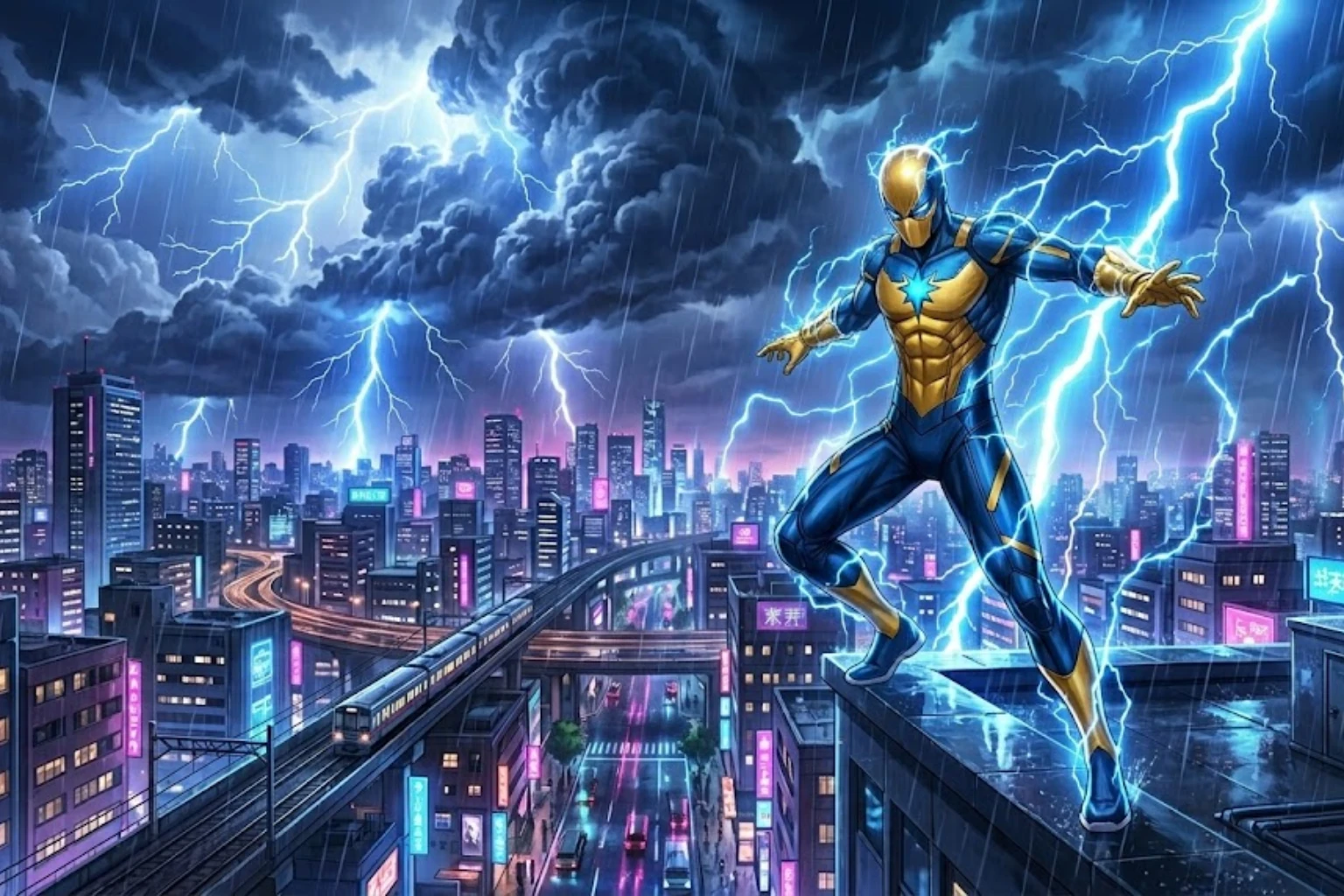
His name was Cael Takahara and he worked at a library.
This was the detail people would have found most surprising, if people had known to find anything surprising about him. The Midori Ward public library, third floor reference section, Tuesday through Saturday, nine to five. He reshelved books with the quiet efficiency of someone who had developed a genuine affection for the work — the specific order of it, the way a correctly shelved book sat flush with its neighbors, the particular silence of a space maintained specifically for thinking.
He was twenty-six years old. He had worked at the library for two years. His colleagues knew him as someone who spoke carefully and not often, who made good coffee in the break room and remembered how everyone took theirs, and who occasionally stood at the reference section window looking at the city with an expression they couldn't quite name.
Nobody at the library knew about the storm season.
Nobody at the library knew what he became when the atmospheric pressure dropped and the charged air gathered above the city and the first lightning split the sky.
That was the arrangement he preferred.
The storm had been building for eleven days.
Not a natural storm — or not entirely. Cael had known the difference for three years, since the incident that had changed the architecture of what he was, and the difference was felt rather than seen: natural storms had a quality of arrival, of weather moving in from elsewhere, pressure systems colliding. This had a different quality. This had the feeling of something summoned. Something that had been fed.
He had been watching it from the library window every afternoon for eleven days.
On the twelfth day he stopped going to the library.
His apartment was in the Higashi district, seventh floor, corner unit that faced northeast — the direction the energy was coming from. He had chosen it for this reason, which said something about the degree to which his two lives had become entangled despite his best efforts at separation.
He stood at the window in the late afternoon of the twelfth day and looked at the sky.
The clouds had been darkening for a week, moving from the grey of ordinary overcast to something deeper and more deliberate — a bruised purple-black at the center that spread outward in layers, the kind of formation that weather services categorized as severe and that he categorized as intentional. The lightning had started three days ago. Not constant — intervals, the storm charging itself, the discharge visible from his window as bright seams in the cloud cover, lasting longer each time.
It was charging toward something.
He had been trying to determine what.
He had spent eleven days running the district in the early hours — the quiet hours, three to five in the morning when the streets were empty enough that his movement was unlikely to be observed and the electrical energy was at its most ambient, conducting through the city's infrastructure with the specific quality of something being directed rather than simply occurring.
He had found the nodes.
That was what he called them — points in the city's grid where the energy was accumulating rather than dissipating, where the charge was building in the infrastructure the way pressure built in a sealed system. He had found six of them. They formed a pattern he had been mapping on paper because he didn't trust digital records for this kind of work — a hexagonal arrangement, each node at a specific point in the Midori Ward grid, the center of the hexagon coinciding exactly with the intersection of Midori-7 and the elevated rail line above it.
The intersection was a plaza. A public plaza, outdoor, with a fountain at the center and benches and the kind of open geometry that made it a natural gathering point.
On Saturday — three days from now — the plaza was scheduled to host the Midori Ward Community Festival. Estimated attendance: several thousand people.
He had done the calculation eleven times and gotten the same answer every time.
When the storm broke — and it was going to break, it had been building too long and too deliberately to do anything other than break — it was going to break at that intersection. And when it did, the six nodes were going to discharge simultaneously into the plaza's infrastructure, which was connected to the fountain, which was connected to the water table, which was connected to every wet surface in a four-block radius on a day when several thousand people would be standing on wet ground.
He had been trying to find who built the nodes.
He had found them on the ninth day — or found the evidence of them, the traces in the infrastructure, the specific technical signature of something placed by someone who understood the city's electrical grid with professional thoroughness. Not improvised. Engineered. Built over months, possibly longer, by someone who had access to the grid's schematics and the time to work carefully.
He had not found the person.
He had found, instead, the eleventh node.
Because the hexagon he had mapped was not a hexagon. It was seven points, not six, and the seventh was not in the Midori Ward grid. It was in the substation two kilometers northeast, the one that fed the entire ward's power supply, and whatever was in that substation was not a node in the same sense as the others.
It was the source.
Everything the storm was building, everything the six nodes were accumulating — it all traced back to the substation. Which meant the person who had built this had not set a trap that would trigger automatically when the storm broke. They had built a trigger that required activation. Something in the substation that, when switched, would complete the circuit and send everything the storm had been storing into the plaza at once.
Which meant someone was going to flip that switch.
On Saturday.
During the festival.
From inside the substation.
He had three days to find them and no way to do it that didn't involve being very fast and very visible, which were things he preferred not to be simultaneously.
He spent the twelfth day reviewing what he knew.
The technical signature in the nodes matched maintenance access records he had pulled — carefully, the way he did everything that required accessing systems he wasn't supposed to access, which was carefully and only when necessary. The records showed authorized maintenance visits over the past eight months, always the same credential, always off-hours.
The credential belonged to a grid technician named Ando Seiji who had worked for the city's electrical authority for seventeen years and who had, four months ago, been passed over for a promotion he had applied for twice.
That was the slow build. That was the eleven days of charging. Not a foreign entity, not an organization, not a supernatural event wearing the city's infrastructure as a mask.
A man. A specific, ordinary, unremarkable man who had learned the city's electrical grid over seventeen years and had spent eight months building something in it while carrying a grievance the size of what he believed had been taken from him.
Cael sat with this for a long time.
He thought about speed. About what speed was useful for and what it wasn't.
Speed was useful for the substation. He could be there in seconds when the time came — faster than any response, faster than anything that could be sent to stop him. When Saturday arrived and the storm broke and Ando moved to complete the circuit, he could cover two kilometers in the time it took most people to cross a room.
Speed was not useful for what needed to happen before Saturday.
What needed to happen before Saturday required something else entirely.
He found Ando on the thirteenth day.
Not at the substation — at a noodle shop three streets from the electrical authority's district office, eating alone at the counter at noon with the focused, private quality of someone who had been eating alone for long enough that they had stopped noticing it.
Cael sat two seats away.
He ordered the same thing.
He ate slowly, which required concentration — he ate the way he did most things when he wasn't in motion, which was carefully and with attention to each step, because the stillness of ordinary life required more effort than people assumed it did.
Ando was fifty-three. He had the hands of someone who had worked with physical systems for decades — capable hands, slightly scarred at the knuckles from old work. He ate with the economy of someone on a lunch break with a fixed duration.
He did not look dangerous.
This was the thing that Cael had been sitting with since the ninth day, when he had found the source node and followed the access records to a name and a face. Ando Seiji did not look dangerous. He looked like a man eating noodles alone at a counter, carrying something heavy that nobody else in the shop was aware of.
Cael understood, with the specific understanding of someone who also carried something heavy that nobody in any room was aware of, that the weight did not show from the outside.
He finished his noodles.
He paid.
He left.
On the fourteenth day, the day before the festival, he went back to the noodle shop.
Ando was there again.
This time Cael sat beside him.
"Ando-san," he said.
Ando looked at him. The look of someone assessing an unknown variable — not alarmed, not defensive, just attentive.
"I don't know you," Ando said.
"No," Cael said. "But I know what you've built in the Midori Ward grid. The seven nodes. The accumulation in the substation." He said it quietly, in the register of a conversation that was not intended to be overheard. "I've been in your work. It's very good."
Ando was very still.
"I'm not here to arrest you," Cael said. "I'm not police, I'm not the authority. I'm not anyone official." He looked at his tea. "I'm just someone who knows what the festival plaza is going to look like tomorrow afternoon if the circuit completes."
The stillness had a different quality now. Not the stillness of assessment. The other kind.
"There will be children there," Cael said. Not as an accusation. As a fact, offered plainly. "The festival has a children's area. It's in the program. By the fountain."
Ando looked at the counter.
"You know what the discharge would do to people standing on wet ground in a four-block radius," Cael said.
"I know exactly what it would do," Ando said. Very quietly.
"Then you know it wouldn't be the board who approved Takeda's promotion," Cael said. "It would be whoever happened to be standing near the fountain at the wrong moment."
A silence.
The noodle shop moved around them — the counter staff, the other customers, the ordinary noon Thursday of a place that had no idea it was adjacent to something enormous.
"Seventeen years," Ando said.
"I know," Cael said.
"I built half of what's in that grid. The routing through the Midori sector — that was my design. Six years ago. They use it every day." He stopped. "Takeda has been here four years."
"I know," Cael said.
"You don't know," Ando said. Not angry — something flatter than anger. "You're young. You haven't spent seventeen years building something and watched someone half your age get credit for the half they could see."
Cael was quiet for a moment.
"You're right," he said. "I don't know that specifically." He looked at the counter. "I know other things specifically. I know what it's like to have something in you that the world didn't ask for and doesn't understand and that you carry anyway, every day, alone." He paused. "I know what it's like to want to make something feel the size it actually is."
Ando looked at him for the first time directly.
"What are you?" he said.
"Someone who runs fast," Cael said. "That's all."
Ando looked at him for a long moment.
"You'd stop it anyway," Ando said. "Tomorrow. Whatever I decided tonight. You'd stop it."
"Yes," Cael said. "I would."
"Then why are you here."
Cael thought about this. About the answer that was tactical — because stopping it tomorrow doesn't undo what you've built and I need you to dismantle it — and about the answer that was true.
"Because stopping it tomorrow doesn't change anything for you," he said. "You'd still be Ando Seiji who spent seventeen years being overlooked and built something terrible in the grid and got stopped at the last second by someone who moves fast." He looked at his tea. "That's a worse story than the one where you walk back into the substation tonight and take it apart yourself."
The noodle shop was quiet around them.
"I could be arrested," Ando said.
"You could," Cael said. "I can't promise you won't be. The nodes are in the grid. Someone will find them when they do the next comprehensive survey." He paused. "But there's a difference between someone who built something and dismantled it and someone who built something and had to be stopped."
Ando looked at his hands.
The capable hands. The scarred knuckles. The hands that had spent seventeen years building things in a city that hadn't always noticed.
He didn't say anything.
Cael paid for both their meals.
He left.
He was at the substation at three in the morning.
Not inside — outside, on the rooftop of the building across the street, the city spread around him in its nighttime configuration, the storm overhead still charging, still building, the lightning visible in the cloud cover every few minutes.
He waited.
At three forty-seven the substation's service door opened.
Ando went in.
Cael watched the door.
The storm moved overhead. The lightning came and went. The city hummed below in the specific way of infrastructure running at night — reduced load, cooler systems, the grid breathing slowly.
At five twelve the service door opened again.
Ando came out.
He stood on the street outside the substation for a moment, looking at nothing in particular. Then he walked away, heading east, in the direction of what Cael's research had told him was a small apartment in the Higashi district that Ando had lived in alone for six years.
Cael watched him go.
He ran the check — the infrastructure sensors he had been monitoring for eleven days, the charge accumulation at the seven points, the source node in the substation. He ran them all.
The accumulation was gone. All six nodes, discharged safely into the ground over the course of two hours, the charge dispersed in manageable increments through the maintenance pathways that Ando had designed six years ago and apparently still understood better than anyone. The source node was dark.
The circuit was open.
The trap was disarmed.
He sat on the rooftop and let the rain start — real rain now, ordinary rain, the charged energy finally releasing as weather rather than discharge, the storm completing itself safely above an unsuspecting city.
He sat in it for a while.
The festival was good.
He went, which surprised him — he had not planned to go, had planned to spend Saturday in the apartment with the window closed, but found himself on the Midori-7 platform at noon and decided that was close enough to decide.
The plaza was full. The fountain was running. The children's area was exactly where the program had said it would be — near the fountain, small figures running between stalls and activity stations with the committed energy of children at festivals.
He stood at the edge of the plaza and watched.
He thought about what the plaza would have looked like at this moment if he had simply been fast. If he had waited for Saturday and moved at the right second and gotten there in time. He would have made it. He was almost certain he would have made it — a two-kilometer distance, his speed at full charge in a storm of this magnitude, the timing would have been very close but workable.
Almost certain and very close were not the same as certain and comfortably inside the margin.
He thought about the noodle shop. About Ando's hands on the counter.
He thought about the story where you built something and dismantled it yourself versus the story where you got stopped at the last second.
The fountain caught the afternoon light and scattered it across the wet plaza stones.
A child ran past him chasing something — a balloon, escaped from somewhere, drifting west on the afternoon wind. The child's father followed, laughing, not quite catching up.
Cael watched the balloon go.
He put his hands in his pockets.
He stood in the ordinary afternoon of a city that didn't know it had been in danger, among the people who were simply here because Saturday was a good day for a festival, and he felt the specific weight of what speed was for and what it wasn't for, and he held both of those things at the same time, and the afternoon continued.
The storm was gone.
The sky above Midori Ward was the clear, washed blue that only arrived after a long rain.
He stayed until the afternoon light changed.
Then he went home.


.png)
.png)
.png)