%20(1).png)
The morning of the hearing I was in the Kita district before seven.
Not because the hearing required anything from me — it didn't. Wada had what she needed, Osaki and Fukuhara had their roles, and my presence in a courtroom would have told the client's lawyers more about the shape of our group than I wanted them to know before I had to. I was in the Kita district because the Tsuda shells were there and the shells were financial infrastructure and financial infrastructure connected to people, and I'd learned early in this work that people were always more findable than the entities they built to hide behind.
I'd mapped the four registered address buildings the previous afternoon. This morning I was at the bank branch — the mid-tier commercial bank whose routing prefix had appeared on the Kosei account number in the Temmabashi financial photographs. I had a position at a bus stop across the street and a coffee going cold in my hand and the specific patience of someone who had done this kind of waiting enough times to have stopped feeling it as waiting and started feeling it as work.
The branch opened at nine. By nine-twenty the foot traffic had established its morning rhythm — the regular customers, the early errand runners, the pattern of a branch that knew its clientele and moved them through efficiently.
At nine fifty-three she came out.
I almost missed her. Not because she was trying to be invisible — she wasn't — but because she moved with the seamless naturalness of someone whose operational awareness had become so embedded in her physical presentation that it didn't look like operational awareness. It looked like a woman leaving a bank. The dark charcoal coat was well-made without announcing itself. The document envelope under her left arm was the kind of thing a hundred people carried out of a hundred buildings every morning in this city.
What gave her away was the reflection check.
She did it at the corner of the adjacent building's glass frontage — a half-second shift in her head position, too brief to register if you weren't watching for it, long enough to read the street behind her. Then again at a parked car window, a different angle, covering the blind spot the first check had left.
Two checks in one block. Not paranoia. Habit.
I left the bus stop and followed.
She went north, then east, into the older section of the Kita district where the redevelopment money hadn't reached and the buildings had the particular settled quality of structures that had been doing the same thing for fifty years and found no reason to change. I kept her a block and a half ahead, using the pedestrian flow on the busier stretches and the shop windows on the quieter ones. She checked twice more in the seven blocks she walked. The second time I was behind a parked van and she wouldn't have caught me. The fourth time I was less certain.
She went into a residential building on the third block east. Key on the ground-floor entrance. Gone.
I noted the address and stood in the mouth of the service lane opposite and let the morning settle around me.
Then I felt the tail.
The vegetable stand to my left. The man who'd been there when I'd passed going north — same position, but his orientation had changed. He'd been reading the vegetable display before. Now the display he was reading was closer to the street. Closer to where I was standing.
I filed this without changing anything about my posture or my pace and turned east at the next corner, away from my intended route, and stopped at a newspaper stand. Bought a paper. Watched the corner in the window of the car parked at the kerb.
He came around thirty-five seconds after me. Young, late twenties, the kind of unremarkable that took deliberate effort to construct. He didn't stop when I stopped. He walked through, maintaining pace, and turned north at the next junction.
Better than the grey-coat from earlier in the week. Different operative entirely.
I went south and then into the covered shopping arcade through the east entrance, moving at the pace of a man with errands, stopping twice at stalls I had no intention of buying from. At the junction of the two arcade sections I stopped at the curved security mirror and watched for forty-five seconds.
Clean.
I went out the west exit, cut north through the service lanes behind the market stalls — the lanes I knew at the inch level, that I'd walked in every weather and at every hour over nine years — and came out four blocks clear. Waited. Nothing.
It was ten forty-seven.
Both phones rang.
Not sequentially. Simultaneously. The office mobile in my left coat pocket and the burner in my right, both going at once, and I stood on the pavement in the Kita district and understood before I answered either of them what simultaneous meant.
I took the mobile first. Fukuhara.
Her voice was even in the specific way of someone who had organized their fear in advance and was drawing on that organization now. "There's a man outside my building," she said. "He was there when I came back from the hearing. I walked to the station and took the train and walked back and he wasn't on the train but he was at the corner when I turned onto my street."
"Just one?" I said.
"One visible," she said.
"How long since you saw him?"
"Six minutes. I walked past and kept going and went around the block and called you."
"Good," I said. "Don't go home. Go to the station. Take the first train that comes, direction doesn't matter. Call Sayuri from the train."
"Murphy—"
"Fukuhara. Station. Now."
I switched to the burner. The callback number was Sayuri's current clean line, which meant she'd relayed from Osaki.
"Where is he?" I said.
"His office stairwell," Sayuri said. Her voice was controlled but the control was working hard. "He called me forty minutes ago when he came down from the office and saw the lobby. One inside, one on the street."
"He's still in the stairwell?"
"Third floor. He has his phone."
"Tell him to go to the roof," I said. "Right now. Tell him to look for the building to his right — taller than his building, there should be a parapet gap. And tell him to wait there. Don't move until I call back."
"Murphy, how far are you—"
"Twenty minutes," I said. "Tell him."
I put the burner away and started moving.
Twenty minutes was what I'd said. The truth was I didn't know. The Namba district accounting firm was the better part of a half-hour from the Kita district at a normal pace and I didn't have a normal pace available. I walked fast and ran when I could do it without announcing myself — the empty stretches, the service lanes, the sections of road where I was the only pedestrian and there was no one to read my urgency as information.
While I was moving I was thinking about the choice I'd just made.
Fukuhara was mobile. She had a head start. She had Sayuri's number and the instruction to use it and she had the specific competence of someone who'd been functioning at a low level of constant vigilance for eighteen months. One visible operative at her building meant one person watching a static location she was no longer at. The threat to her was real but its geometry was manageable.
Osaki had two people and a cordon configuration. One in the lobby, one on the street — a classic two-point system designed to cover both exits from a building: the front for movement toward the street, the lobby for early warning. A subject who came down the stairs and into the lobby would be visible to the lobby operative before reaching the door, giving the street operative time to position. It was the kind of setup you used when you wanted to intercept someone rather than just observe them.
The difference between messaging someone and catching them.
I was twenty-two minutes away from Osaki.
I ran.
---
I came around the block from the north.
Not the obvious approach — the obvious approach from the Kita district was from the west, and the street operative at Osaki's building would be watching west. From the north I had a sightline to the front entrance from an angle the operative's position didn't naturally cover. I stopped at the corner and looked.
He was where Osaki had described. Dark coat, corner position, watching the building entrance and the street east. Standard placement for the outdoor operative in a two-point cordon. He was professional enough not to be on his phone or visibly restless. He was just there, which was the hardest kind of surveillance to read from a distance because there was nothing wrong about it. Just a man standing on a corner.
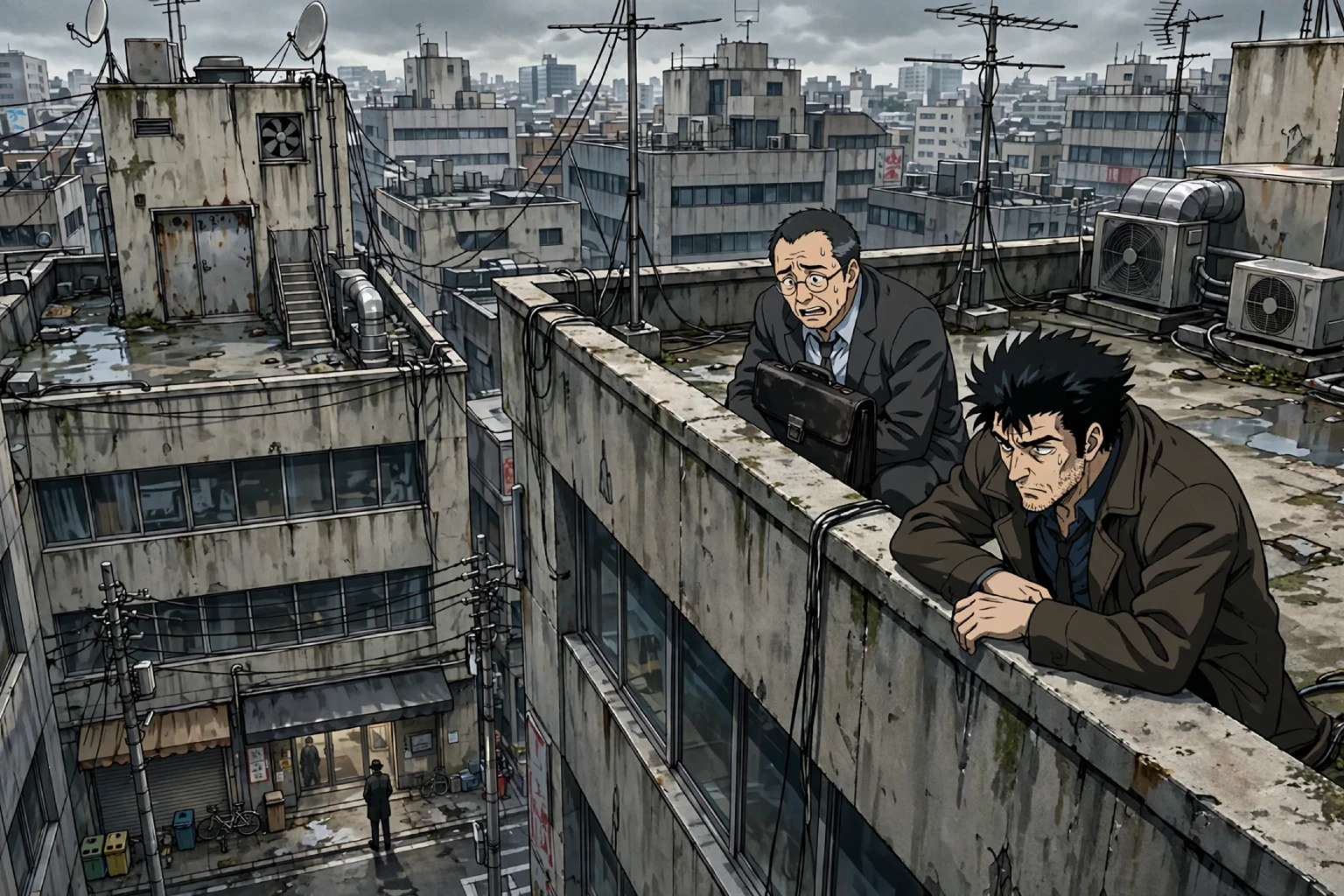
The building beside Osaki's was taller. Five stories to Osaki's three. The entrance was twenty feet from where I was standing.
I went in.
The lobby had a security guard who looked up from a phone. I said I had a delivery for a name I invented on the spot, floor four, and he looked at his directory and didn't find the name and I said it might be three and moved to the elevator before the discrepancy had time to become a conversation. The elevator took me to four. I found the stairwell and went up.
The roof access door was unlocked.
The roof was flat and functional — HVAC units, ventilation housings, the corrugated surface of an industrial rooftop that had never been meant for standing on. I went to the left-side parapet and looked across.
Osaki was there.
He was standing with his back against the parapet wall of his building's roof, coat pulled tight, briefcase on the ground beside him. The two-foot gap between the parapets was narrow but manageable — I could see him calculating it the same way I had, the specific engineering problem of crossing two feet of nothing at three stories up with a briefcase to manage.
He saw me and his face did something complicated. Not relief — the situation didn't allow relief yet. Something more provisional. A recalibration.
"The briefcase," I said, keeping my voice low. "Leave it."
He looked down at it. The briefcase was what he'd carried his work in every morning for how many years. It contained the Osaki financial analysis, the documents he'd been building for the last three days, the thing he'd spent himself on.
"I can't," he said.
We looked at each other across the gap.
"Then hold it in your right hand," I said. "Don't swing it. Keep it close to your body. Come across sideways, not face-on."
He picked up the briefcase and looked at the gap and I watched him do the thing that frightened people do when they've decided that being frightened is not the same as being stopped. He set his jaw and stepped onto the parapet ledge.
The ledge was eight inches wide.
He came across with his right side leading, left hand trailing along the parapet face for contact, briefcase held tight against his body. The two feet of air between the buildings was not a long crossing. It felt long. At the halfway point his foot found a rough patch of parapet surface and his weight shifted and for a half-second he was not in balance and I had my hand out across the gap and he took it — not a grip, just a touch, just enough — and he found the other foot and the balance came back and he was across.
He stood on the roof of the taller building and breathed.
I gave him four seconds.
"Stairwell," I said.
---
At the lobby level I told him not to look at the security guard. He didn't. We went out the front entrance and turned north and I didn't let the pace slow until we were two blocks clear and the corner operative's sightline was broken by a building.
Then Osaki stopped walking.
I stopped with him.
He was breathing in the specific way of someone who had been in a stairwell for forty minutes and crossed a rooftop gap with a briefcase and had held it together throughout and was now, two blocks from the building, beginning to feel what he'd held it together through.
"They were going to take me," he said. Not a question.
"They were going to intercept you," I said. "Which isn't the same thing."
"It felt like the same thing," he said.
I didn't argue with that.
"Fukuhara?" he said.
"Mobile," I said. "Sayuri has her." I took out the burner and called Sayuri. She answered on one ring. "Where are you?"
"Tenma district," she said. "Fukuhara is with me. We're at the place."
The place was the room above the laundry that Sayuri had identified weeks ago as a backup position — her four months of managing exposure had included identifying exactly this kind of location, a room whose connection to any of them was unguessable from the outside. I'd known about it since she'd mentioned it in passing, the way she mentioned her backup positions, in the specific offhand way of someone who had made contingency planning as automatic as locking a door.
"I'm bringing Osaki," I said. "Twenty minutes."
---
The room above the laundry was small and warm from the heat coming up through the floor from the machines below. It smelled of detergent and the particular warmth of a room that had had many different people in it over many years without quite belonging to any of them.
Fukuhara was at the table. She'd taken her coat off, which was the first time I'd seen her do that in any of our meetings, and it registered as a signal — not relaxation, but something more like arrival. She'd decided this was the place she was in for now and she was settling into it with the economy of someone who didn't waste energy on resistance to facts.
Sayuri was at the window. She didn't look at me when I came in. She was watching the internal courtyard the window faced, the small closed square of it, the grey sky above.
Osaki sat on the edge of the bed and put his briefcase on the floor and looked at his hands.
The four of us in a small room above a laundry in the Tenma district with the operation knowing three of our home addresses and having demonstrated this morning that knowing an address was not abstract information.
Nobody spoke for a moment.
"They moved on both of us at the same time," Fukuhara said. She said it the way she said most things — directly, without the social preliminary of working up to it. "Right after the hearing. They were already in position before we got back."
"They knew the hearing was today," I said. "They knew the timing and they had people at both locations before the hearing ended."
"Which means they were confident the hearing wouldn't go their way," Osaki said.
"Or they were covering themselves regardless of how it went," Sayuri said, still at the window. "If the hearing went for them they pull the operatives back and nothing happened. If it went against them the operatives are already placed."
"Either way they lose nothing by placing them," I said.
"And they gain a great deal if it went against them," Fukuhara said. "Us managing our own safety instead of building the case. Divided. Uncertain." She looked at the table. "It almost worked."
The almost was doing work in that sentence. It had almost worked. Osaki had been in a stairwell for forty minutes. Fukuhara had walked past her own building and kept going rather than go home, which meant she was now in a room above a laundry in a district she didn't know with people she'd met two weeks ago and the operation knew where her bed was.
That was almost working.
"The man who was outside my building," Fukuhara said. "Static. One person, one location. They weren't trying to intercept me — they were trying to make me know they could. A different message than Osaki's."
"Two messages at once," Sayuri said. "Two different targets, two different approaches. Someone coordinated that."
"Someone who has the resources to run simultaneous operations across two districts," I said. "And the judgment to calibrate the approach differently for each target."
I was thinking about the woman from the bank branch. The document envelope. The residential address in the Kita district. The checking habit — so embedded it had become invisible until you knew to look for it.
The checking habit of someone who'd been doing this for years.
"The woman I followed from the bank branch this morning," I said. "She's not a contractor. She's not working for the operation from outside. The way she moves, the calibration of this morning's response — she's inside this. Embedded in it."
"The client's own structure," Sayuri said.
"His own office," I said. "Someone in the oversight coordination division who manages the operational side of the records system directly. The Temmabashi visit, the court monitoring, the simultaneous deployment this morning — that's all one person's work."
"Can you find out who she is?" Fukuhara said.
"I know where she lives," I said. "And I know she works in or near the Kita district administrative cluster." I paused. "Tomorrow morning I go back to the residential address. Early. I'm there when she comes out."
"And then?" Osaki said.
"I introduce myself," I said.
The room was quiet for a moment. The laundry machines below sent their warmth up through the floor. Outside the courtyard window the grey afternoon was making no commitments about whether it was going to rain again.
"What do we do tonight?" Osaki said. He said it simply, without complaint, the flat practical question of someone who had burned the address he could go back to and needed to know what came next.
"You stay here," Sayuri said. She turned from the window. "Both of you. The room is paid through the week. There's a convenience store two blocks north. Don't go home tonight."
Fukuhara nodded. Osaki nodded.
Sayuri looked at me.
"You're going to the Kita district residential address at first light," she said.
"Six-thirty," I said.
"What do you expect to find?"
I thought about the woman from the bank branch. The document envelope. The two position checks in seven blocks. The specificity of this morning's deployment — two targets, two calibrated responses, both timed to the hearing's end.
Someone who planned for contingencies before they arrived. Someone operational in the specific sense of someone for whom operations were a professional discipline.
"Someone who's been running this side of the operation long enough to have made habits of it," I said. "And someone who's been doing it long enough to wonder whether the habits are sustainable."
"That's not what I asked," Sayuri said.
"I know," I said. "But it's what matters."
---
I left the laundry at dusk and walked back to the Shita district through the city doing its evening thing, and I thought about the morning's simultaneous calls and what they'd required of me and what they'd cost.
The choice I'd made had been the right one. Fukuhara mobile, Osaki cornered — the logic was clear. But right choices in situations like this had a specific quality: they were right in the way that meant the wrong outcome was still possible. I'd gone to Osaki and Osaki was safe in a warm room above a laundry and his briefcase was with him and he was going to be all right.
But I'd made that choice in the ten seconds between picking up the mobile and dialing the burner, and I'd made it without knowing whether Sayuri would reach Fukuhara in time, without knowing whether the cordon around Osaki was the containment kind or something harder, without knowing whether the rooftop gap was crossable or whether Osaki would freeze at the parapet edge with his briefcase in his hand and the operation's people coming up the stairs below him.
Right choices were still bets.
I went home. Checked the apartment — locks, positional details, the notepad on the kitchen table that I turned face down without reading the four words again because I'd read them enough to have them.
I set the alarm for five-thirty and went to bed.
In the morning I would go to the Kita district residential address and wait for a woman who had spent the last eleven days running an operation against me with considerable skill and I would introduce myself and see what she did with the introduction.
That was the plan.
It wasn't much of a plan. It was what I had.


.png)
.png)
.png)