%20(1).png)
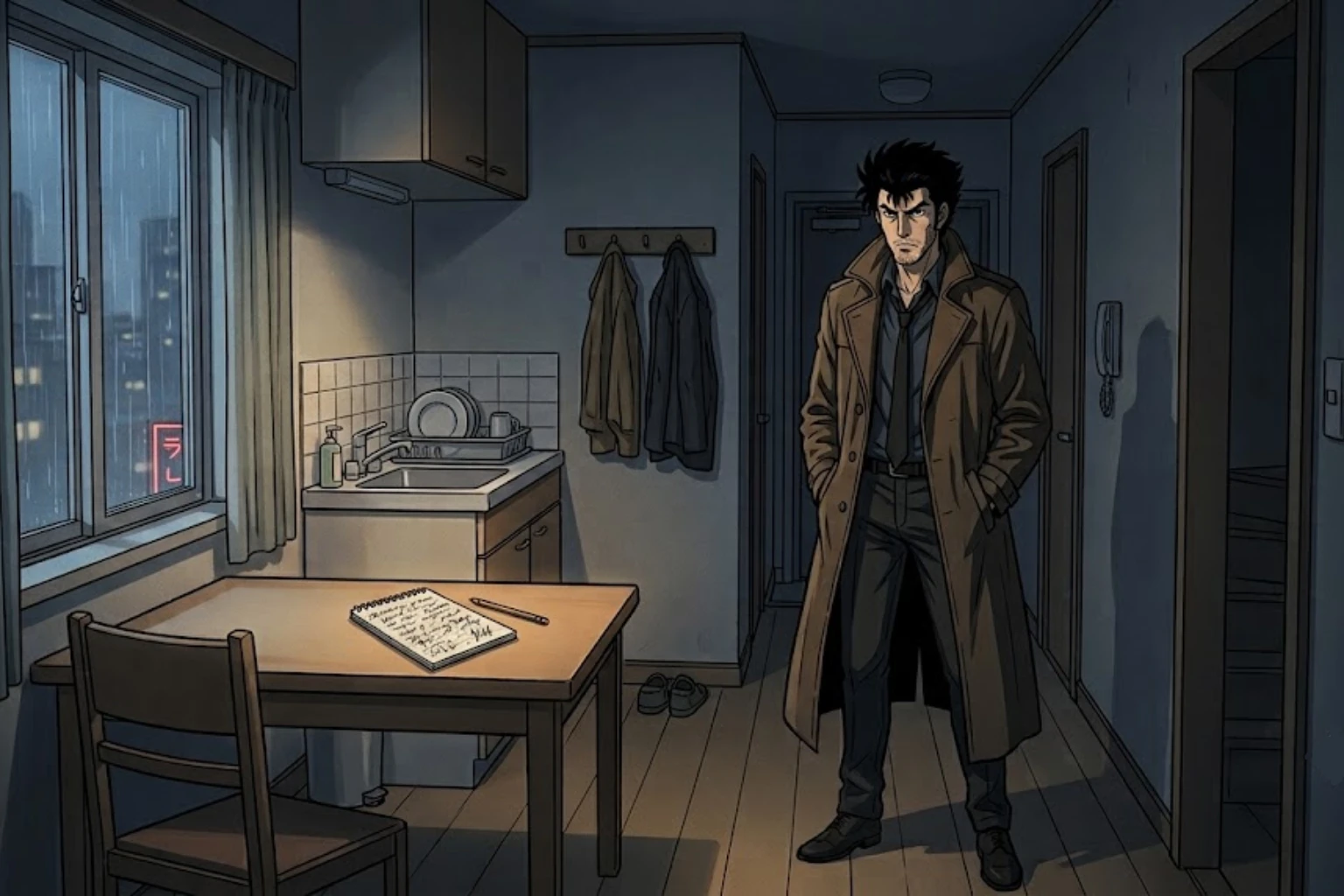
I spent the morning after Wada's meeting running the Tsuda shells.
Not registry work — I'd done the registry work. What I wanted now was physical. Six registered addresses across three districts, all commercial buildings that rented postal addresses to entities that needed an official location without needing space. I wanted to know what those buildings looked like, who used them, whether any of them showed signs of activity that a dormant shell shouldn't have.
I started in the Kita district, where four of the six addresses were clustered within three blocks of each other. The clustering was itself information — four shells with registered addresses in the same three-block radius suggested a single registered-address service handling all four, which meant a single point of contact, a single office manager who had signed the registration paperwork for all four entities.
The first building was a narrow commercial premises on Kami-Shinjo Street that housed a registered-address service on its second floor alongside a small insurance broker and a translation company. The ground floor was a convenience store. I went in, bought a can of coffee, and stood at the window looking at the building across the street while I drank it.
Nothing notable about the building. Nothing notable about the foot traffic around it. I noted the address service's name from the lobby directory — Kita Business Services — and moved to the next address.
Three of the four Kita district addresses used the same building. The fourth was two blocks east, a different provider, a building that also housed a small accounting firm and a patent agent. I stood outside it for ten minutes. Nothing notable.
What I was looking for wasn't activity at the registered addresses. I knew the shells were dormant on paper — that was the point of them. What I was looking for was the gap between the registered address and where the shells actually operated, which in the case of an active financial receiving structure meant somewhere that handled actual banking. Shells with real accounts needed someone managing those accounts, which meant either a nominee account manager or someone from the operating structure visiting a branch to conduct transactions.
The bank. The routing prefix on the Kosei account number had identified a mid-tier commercial bank, the branch in the Kita district. I'd noted the branch address from the routing information. It was four blocks from the Kami-Shinjo Street registration address.
I went to the branch.
I didn't go in. I found a position across the street — a covered bus stop with a partial sightline to the branch entrance — and I waited.
This was the work that didn't look like anything. Standing at a bus stop in the Kita district on a grey morning watching a bank branch. Forty minutes of it. Buses came and went. People passed. The branch opened at nine and by nine-thirty had the flow of a functioning small branch — a steady trickle of customers, two tellers visible through the glass, a manager's desk at the back.
At nine fifty-three a woman came out of the branch.
She was moving with the purposeful economy of someone who had done a specific thing and was now going somewhere else, not the casual exit of a customer who'd done their banking and had no particular agenda. Her coat was a dark charcoal — well-made, not expensive in a way that announced itself, the coat of someone whose professional presentation was considered without being ostentatious. She carried a document envelope under her left arm. She turned north.
I let her get half a block ahead and followed.
She moved well. Not the trained movement of a surveillance professional — not the practiced pace management and the natural-looking stops I'd seen in the grey-coat tail from earlier in the week. But she moved with the awareness of someone who operated in environments where being aware of your surroundings was a professional habit rather than a personal quirk. She checked reflections. Not constantly, not obviously — twice in the first block, at the corner of a building's glass frontage and at the window of a parked car. She was looking.
I adjusted. Dropped further back, took the opposite side of the street, let her move at the natural pace of someone who wasn't being followed while I moved at the natural pace of someone who had somewhere to be in the same general direction.
She went north four blocks, then east. The route took her into a section of the Kita district that was older than the commercial strip around the bank — narrower streets, buildings that had been here since before the redevelopment money, the kind of neighbourhood that had been passed over for improvement and had settled into its own self-sufficient character. She slowed in this section. The checking frequency increased.
I stopped at the mouth of a service lane and let her get further ahead.
She went into a building on the third block east. Not a commercial address — a residential building, older construction, the kind that had ground-floor units with their own street entrances. She used a key on the ground-floor entrance and went in.
I noted the address. Stood at the mouth of the service lane and thought about what I'd seen.
A woman coming out of the bank branch associated with the Kosei receiving account, carrying a document envelope, moving with the awareness of someone who took her operational security seriously, going to a residential address in the Kita district that was not registered as any of the Tsuda shell addresses.
A safe house, or an operational base, or just where she lived.
I didn't know who she was. I had a face and an address and the context of the bank branch. That was more than I'd had an hour ago.
I went back toward the Shita district, and I was three blocks from the bank when I felt it.
Not saw. Felt — the specific change in the texture of the street that happened when the people around you were no longer moving at the street's natural pace. A man at a vegetable stand to my left had been there when I'd passed going north. He was still there. The vegetable stand was busy enough that twenty minutes at it wasn't impossible, but the way he was positioned had changed — he'd been looking at the vegetables before, and now he was looking at a section of the stand that was closer to the street.
Closer to me.
I kept my pace. Turned east at the next corner — a direction I hadn't been planning to go, just to see what happened behind me. I walked half a block, stopped at a newspaper stand, and bought a paper.
He came around the corner thirty seconds after me. He didn't stop. He walked past at a pace that said he had somewhere to be, which was the correct response to a subject turning unexpectedly — you don't stop, you don't overcorrect, you walk through and reposition. He was good. Better than the grey-coat from earlier in the week. Different build, different age — younger, late twenties, the kind of unremarkable appearance that was itself a professional choice.
I let him go. Watched him turn north at the end of the block.
Then I went south. Not my apartment, not the office — south, into the lower Shita district, into the part of the neighbourhood I knew at the granular level of nine years of operation. The covered shopping arcade. The service lanes behind the market. The specific geography of a place I understood better than anyone following me from the outside could.
The arcade was mid-morning busy. I went in at the south entrance and moved at the pace of a person with errands, stopping twice at stalls I had no intention of buying from. At the junction of two arcade sections I stopped at the curved security mirror and looked.
Nobody from the south entrance following me in. I watched for forty-five seconds. Nothing.
I went out the east exit, doubled north through a service lane, and came out on a street parallel to the one I'd been tailing the woman on, two blocks north of where she'd entered the residential building.
The tail had been put on me before I reached the bank branch. Which meant either someone had been watching the bank branch specifically — monitoring it for anyone who spent time observing it — or the tail had been on me earlier in the morning, from the Kita district address service or from somewhere before that.
If the tail had been on me since the morning, they'd seen me at the registered address buildings. They knew I was running the Tsuda shell structure.
I stood in the service lane and thought about that.
The operation knew what I was doing because they'd read my notes. The notepad in the desk drawer — that was the office search. What was on the notepad. I wrote phone numbers there, and the occasional address, and the shorthand of active cases in the compressed notation I used when I was working fast. If they'd read the notepad, they knew I was looking at the shells.
If they'd read the notepad, they knew more than that.
I went back to the office, and I went carefully.
---
The office was clean. Positional details correct. Nobody had been in since I'd left that morning.
I stood at the desk and looked at the notepad.
Face down, the way I left it. Pen on top, the right pen in the right orientation. The notepad was face down, correct, but — I picked it up. The crease along the spine was slightly more pronounced than it had been. Someone had opened it and closed it and pressed it back down, and the pressing had deepened the spine crease by a degree that was visible if you were looking for it.
I looked at the top page.
My notation from the previous week, the compressed shorthand of the Rindo case at an early stage: the Motocho address, the two phone numbers from the desk drawer, the Harlan visit noted in abbreviation. The page below it — I turned to it — had the Tsuda shell addresses. The Kosei account routing information. Seiryu Development.
They'd read the current case notes.
They knew I had the shells. They knew I had the Kosei account details. They knew I'd connected Seiryu Development.
But the notepad had nothing about Wada, nothing about the preservation filing, nothing about the photographs from Temmabashi Street. I kept that material in my head and in the physical photographs, which were at Wada's office, not here.
So they knew what I'd built through public records and through registry searches. They didn't know about the photographs. They didn't know the full extent of what had come out of Temmabashi Street.
That was the gap. Small, but mine.
I picked up the phone and called Sayuri through the drop service.
When she called back I told her about the woman at the bank branch, the address in the Kita district, and the tail.
"They're running active surveillance on the Kosei account," she said.
"On the bank branch," I said. "Or on me generally, and the bank branch visit confirmed what they already suspected about my direction."
"The notepad," she said.
"They read the notepad in the office search. They know I have the shell structure. They don't know about the Temmabashi photographs." I paused. "The woman from the bank branch — I need to know who she is. Kita district residential address, older building. She had a key to the ground floor entrance."
"Someone connected to the client's office directly," Sayuri said slowly. "Not Akaike. Not the Motocho Street desk man. Someone from inside the client's own structure managing the operational side."
"She carried a document envelope out of the bank branch," I said. "She moved like someone who knew what she was doing. And the tail they put on me this morning was better than the previous ones."
"The operation is escalating," Sayuri said.
"Yes," I said. "Be careful tonight. If they're running active surveillance on me they may be running it on the others."
"I'll tell Fukuhara and Osaki," she said. "Murphy — where are you staying tonight?"
"The apartment," I said.
A pause. "Is that wise?"
"It's my apartment," I said. "They've already been in the office twice. If they were going to move against me directly they've had opportunity." I paused. "The message they left — what they wrote on the notepad — wasn't written the night I found it, was it?"
"What do you mean?"
"They read the notepad in the office search," I said. "But they didn't write anything on it then. They left the office clean. The message — if they were going to leave a message — they'd leave it somewhere I'd find it specifically. Somewhere more personal than the office."
Silence on the line.
"The apartment," Sayuri said.
"I haven't been back since this morning," I said. "I need to go back."
"Murphy—"
"I'll call you when I'm in," I said.
---
I went back to the apartment at seven in the evening.
Checked the street from the corner first — three minutes, watching. Nothing I could identify as wrong. The lamp post at the corner was functioning tonight, which meant the street had better light than usual, which was either good or bad depending on whether the extra light worked for me or for anyone watching.
I went in. First floor, second, third. My door.
Both locks, no sign of interference.
I went in.
The apartment was dark and I turned the light on and stood in the doorway for a moment before I crossed to the table.
The notepad.
I kept one at the apartment as well as the office — a different one, personal rather than professional, the kind I used for the thinking-out-loud notation that didn't belong in a case file. It lived in the kitchen drawer, face down, the way I kept everything.
It was face up.
I crossed to it and looked at the top page.
The page was blank. My own blank page, the paper I'd left empty. Except in the upper right corner, in handwriting that wasn't mine — small, precise, the handwriting of someone who was making a specific point about precision:
*We know about the photographs.*
Four words.
I stood at the kitchen table and looked at four words in someone else's handwriting on my personal notepad and understood what they meant.
They'd been in the apartment. They'd found the notepad in the kitchen drawer. They'd written four words and left it face up.
They knew about the Temmabashi photographs. Which meant they knew I'd been inside Temmabashi Street. Which meant either someone had seen me enter or exit the building — the courtyard, the service lane, someone positioned on Temmabashi Street itself — or they had some other means of knowing.
The camera. I'd used a small compact camera, no flash, and I'd had it in my coat. But the photographs had been developed at a shop in the Tenma district the following morning. A shop I'd used before. A shop that was in my professional routine.
Someone watching my routine would have seen me go to the developer. Would have understood what it meant when a man who didn't take holiday photographs went to a developer.
They knew I had the photographs. They didn't know what was in them — or they might not. The message said *we know about the photographs*, not *we know what you photographed*. That distinction mattered.
Or it didn't and they were just being careful about what they revealed.
I picked up the notepad and looked at the handwriting again. Small, precise, controlled. The handwriting of someone who was being deliberate about every mark they made.
A woman's handwriting, possibly. Or a man who wrote that way. There was no way to know from four words.
I put the notepad down and checked the rest of the apartment. Methodically, every room, every surface, the way you checked after a professional entry. The bathroom: the coat was on the door, the coat pocket empty — the photographs were at Wada's office, I'd left them there after the meeting that morning. Nothing in the coat had been disturbed. The bedroom: the bed was made the way I'd left it, tight, no sign of anyone having used it or searched it. Under the bed: the false floor panel I'd installed eighteen months ago, accessible only if you knew to look for it and knew how to open it, undisturbed. What was inside it was still there.
They'd come in for a specific purpose. To leave a message. They hadn't torn the apartment apart looking for the photographs because they already knew the photographs weren't here — they'd tracked them to the developer and understood they'd been developed and were now somewhere else.
Which meant the message wasn't *we found what you have*.
It was *we know how far you've gotten, and we want you to know that we know*.
I sat down at the kitchen table and looked at the notepad.
The operation's tone had changed. The office searches had been passive — information gathering, done clean, no message. The tail this morning had been active but still deniable. This was different. This was deliberate communication. They were choosing to show me that they could reach into my apartment, into my personal space, and leave their mark.
That was a threat. Not a warning, not an offer, not a negotiation. A demonstration of capability intended to produce a specific response.
The response they wanted was for me to understand that continuing was costly. That the cost was not abstract. That they knew where I lived and had been inside and would be inside again if they chose.
I thought about that for a while.
Then I picked up the phone and called Sayuri.
"Four words," I said when she answered. "On my personal notepad in the kitchen. *We know about the photographs.*"
Silence.
"They were in your apartment," she said.
"Yes."
"Murphy." The careful register. "This is different from the office searches."
"Yes," I said. "It's a message. They want me to know they can reach me personally."
"Can they?" she said.
"They already did," I said. "The question is what they do next."
"If they wanted to stop you they could have done more than leave a note," she said.
"Yes," I said. "Which means they don't want to stop me — or they don't want to stop me this way. They want me to stop myself." I paused. "Which means they're concerned about what I have. Four words on a notepad is a threat. It's also a tell. You don't threaten someone who doesn't have something you want them to stop having."
"The photographs," she said.
"The photographs are at Wada's office," I said. "They're inside a legal instrument now. Even if the operation got to me tonight, the photographs don't disappear."
"They know that," Sayuri said. "They know about Wada — the preservation filing named her as the filing lawyer."
"So the photographs are outside their reach," I said. "The message isn't about the photographs. The message is about me."
A pause. "They want you to understand that you're personally exposed," she said. "Not the case. You."
"Yes," I said.
We were both quiet for a moment.
"I need to know who the woman is," I said. "The Kita district address. If she's connected to the client's office directly — if she's the one who writes in small precise handwriting and walks out of bank branches with document envelopes — she's the operational link between the client and the records system. Finding out who she is gives us the connection the case needs."
"How do you find out?" Sayuri said.
"I go back to the Kita district address," I said. "Tomorrow. Early. Before she moves." I paused. "And I'm more careful this time about what's behind me."
"Murphy," she said. "Be careful."
"I'm always careful," I said.
"You've been careful," she said. "Tomorrow be more careful."
---
I was in the Kita district at six-fifteen the next morning, which was earlier than careful and later than paranoid and approximately the right time for what I needed.
The residential building where the woman had gone the previous morning was on a street that connected two busier roads, which meant foot traffic even at six-fifteen — the early-shift workers, the delivery people, the residents of the neighbourhood moving through the first tasks of the day. I'd found a position the previous evening, after I'd called Sayuri — not staking it out, just walking the street to understand its geometry. There was a covered entrance to a small neighbourhood shrine two buildings east of the residential building, set back from the street, partially obscured by a stone lantern and a small tree that hadn't been trimmed recently. From the shrine entrance you had a partial sightline to the residential building's ground-floor entrance.
I was at the shrine entrance at six-fifteen with a can of coffee and the patience of someone who'd been doing this kind of work long enough to have made peace with the waiting.
Before I'd arrived I'd run the counter-surveillance route I'd worked out the previous evening — forty minutes through the Kita district using the specific geography I'd mapped, the angles and reflective surfaces and the route that gave me the best read on whether anyone was behind me. Nobody. Either they weren't running morning surveillance on my movements or I'd left early enough to be ahead of it.
At six fifty-eight the ground-floor entrance opened.
She came out with a bag over her shoulder and no document envelope this morning, moving at the pace of someone on a morning schedule that didn't include a bank visit. She turned west, away from me.
I gave her the length of the block and followed.
This time I was watching for the watching. The first check she did was at the corner, looking left before she crossed — standard pedestrian behaviour, but the duration of the look was longer than traffic required. She was reading the street behind her. I was behind a parked van when she did it and she wouldn't have caught me.
She walked seven blocks west and then north, into the part of the Kita district that was closer to the administrative centre — the ward office, the prefectural satellite services, the cluster of civic and professional buildings that accumulated around local government. She went into a building on a street that had three such buildings in a row.
The building had a lobby directory visible through the glass frontage. I walked past it at the pace of someone reading the directory numbers and confirmed what I could see before I moved on: three floors, the second and third floors occupied by offices whose names I couldn't read at street pace without stopping.
I went around the block and came back on the opposite side and stopped at a vending machine with a partial view of the building entrance. Bought something. Stood there.
Nine minutes later a man came out of the building who I recognised.
Not from personal encounter. From the framed photograph that appeared in the prefectural government's annual report, which I'd looked at twice in the previous week while running background on the client — the photograph that showed the client at a civic function, surrounded by the staff of his office.
The man who came out of the building was listed in that photograph as a senior administrative director in the client's office. His name was Amano Shuji. His role, per the annual report, was oversight coordination — the specific function that connected the client's office to the subordinate agencies whose contract and property work had generated Fukuhara's billing irregularity and Osaki's compulsory purchase inquiry.
He paused on the steps of the building and checked his phone. A woman came through the lobby door behind him.
The woman from the Kita district residential building.
She said something brief to Amano. He responded without looking up from his phone. She handed him something — a small envelope, the kind that held a USB drive or a memory card. He pocketed it without looking at it and went down the steps and turned east.
She went back into the building.
I stood at the vending machine and watched Amano walk east and thought about what I'd just seen.
She wasn't running the records operation independently of the client's office. She was embedded in it. She worked in the same building as Amano Shuji, who was the oversight coordination director — the specific role that connected the client to the agencies whose work the records operation managed. She had an authorized key to the Temmabashi Street building, automated monitoring access to the court registry, and she was conducting in-person handoffs with a senior director in the client's own administrative structure on a morning when she wasn't carrying a document envelope to the bank.
The operation wasn't just connected to the client's office. It was staffed by it.
I turned away from the vending machine and walked north, and I didn't look back, and I kept moving until I was four blocks clear before I let myself think about the full weight of what that meant.
The records operation, the shell structure, the financial mechanism — none of it was an external criminal enterprise that the client had hired. It was internal. The people running it were his people. The oversight was his oversight. The institutional power that had been used to manipulate the compulsory purchase valuations and the billing irregularities wasn't power that had been corrupted from outside — it was power being used precisely as designed, by the people it had been given to, for purposes that had nothing to do with what the design had intended.
That was a different kind of problem than what I'd been working on.
And the woman who'd written four words on my kitchen notepad was one of those people.
I found a payphone and called the drop service and left a message for Sayuri: *I have a name. Amano Shuji, oversight coordination director. She works with him. Call me.*
Then I walked back toward the Shita district, through the Kita district morning, through the city that kept its texture regardless of what was happening inside it, and I thought about four words in small precise handwriting and what they'd been intended to make me do and what I was going to do instead.
They'd wanted me to understand that the cost was personal.
I understood that.
I just didn't find it persuasive.
---
Sayuri called at ten-thirty.
"Amano Shuji," she said, and her voice had the quality it had when she was recognizing something she'd been looking for. "He was the contact. When I worked for Keisen — the summary documents went to a receiving address, via the usual channel, addressed to a department in the client's office. I never knew which person received them. But the department was oversight coordination."
"Amano received the summaries," I said.
"He was the operational link," she said. "Between the records system and the client. The summaries went to Amano and Amano filtered what went up to the client and what was actioned at his level."
"And the woman is part of his structure," I said. "She runs the operational side — Temmabashi, the monitoring, the bank accounts. He manages the client relationship."
"Do you have her name?"
"Not yet," I said. "I have her face and her address and the building she works in. The building directory will give me the rest."
"Murphy," she said. "If she works in the client's office building — getting her name from the directory means going into a building that knows what you look like."
"The lobby directory is visible from the street," I said.
"You walked past it once at street pace," she said. "You said you couldn't read the office names."
She was right. I'd need to be stationary long enough to read the second and third floor listings, which meant being visible outside the building long enough to be noticed by anyone paying attention. And anyone connected to Amano's structure who was paying attention to the street outside their building was paying attention for exactly this kind of reason.
"I'll find another way in," I said.
"The annual report," she said. "The one you used to identify Amano — does it list staff below the directorial level?"
I thought about the report. "Senior staff only," I said. "Directors and above."
"Fukuhara," Sayuri said. "She worked in the contracting world. She knows how the client's office is structured — she filed reports to agencies under that office's oversight. She may know who works in Amano's division."
Fukuhara. Who had an original Rindo document and had been three steps ahead since the noodle stand.
"Get her," I said. "Tell her what I saw this morning. The woman, the building, the handoff to Amano. See if the description matches anyone she encountered during the contracting work."
"I'll call her now," Sayuri said. "Murphy — the hearing is tomorrow."
"I know," I said.
"Wada says the client's lawyers will be there. Amano may be there."
"Amano's presence at the hearing tells us something," I said. "It tells us he's managing the legal response personally, which means he's the one most exposed by what the filing contains." I paused. "If the woman is connected to Amano and she wrote the message on my notepad — she did it because Amano is worried."
"He should be," Sayuri said.
"Yes," I said. "But worried people make decisions faster than careful people, and some of those decisions are mistakes." I looked at the office wall. "Tomorrow's hearing — Wada knows what to present. The Fukuhara document, the Osaki analysis. She doesn't present the Temmabashi photographs. Not yet."
"You're holding the photographs back," Sayuri said.
"The photographs are the piece they don't know the full extent of," I said. "They know the photographs exist — the message said so. They don't know what's in them. That gap is useful for exactly as long as we maintain it." I paused. "The hearing is about preservation. Not about full disclosure. Wada argues preservation on the basis of what's in the filing. The photographs stay out of it."
"And after the hearing?"
"After the hearing," I said, "we use the photographs for the endgame." I stopped. "But first I need the woman's name."
Sayuri called back at one in the afternoon.
"Fukuhara recognized the description," she said. "A woman in Amano's division, listed as a senior coordination officer. Her name is Nishida Yuki. Fukuhara filed two reports through her office eighteen months ago — standard contracting documentation. She described her as precise, efficient, and the kind of person who read everything that crossed her desk." A pause. "She also said Nishida was the person who told her the billing irregularity had been reviewed and found to be a miscategorization."
The person who'd managed Fukuhara's exposure from inside the client's office.
The person who'd written *we know about the photographs* on my kitchen notepad in small precise handwriting.
Nishida Yuki.
I wrote the name down and looked at it.
"She's not peripheral," I said. "She's the operational center. Amano is the client link. Nishida runs everything between the client's decision to manage a risk and the records system's execution of that management." I paused. "She wrote the note herself. She went into my apartment personally."
"She wanted you to know it was personal," Sayuri said.
"She wanted me to know it was capable," I said. "The personal aspect was incidental. She went in herself because she didn't want to trust a message that important to one of the tails." I looked at the name on the notepad. "That's both a strength and a weakness."
"The weakness being that she's now personally identifiable," Sayuri said.
"Yes," I said. "She came out of cover to deliver the message. She's been operational until now — the Temmabashi visit, the bank branch, the Amano handoff. Now I have her face and her name and her address."
"Murphy," Sayuri said. "She also has yours."
I looked at the kitchen through the office window in my mind — the notepad, face up, four words in the upper right corner.
"Yes," I said. "She does."
The afternoon was moving. The hearing was tomorrow. And Nishida Yuki was in a building in the Kita district managing the operational response to what four people and a lawyer had set in motion, and she'd gone into my apartment herself to write four words that were meant to end it.
I picked up the phone and started building what I'd need for the day after the hearing.


.png)
.png)
.png)