%20(1).png)
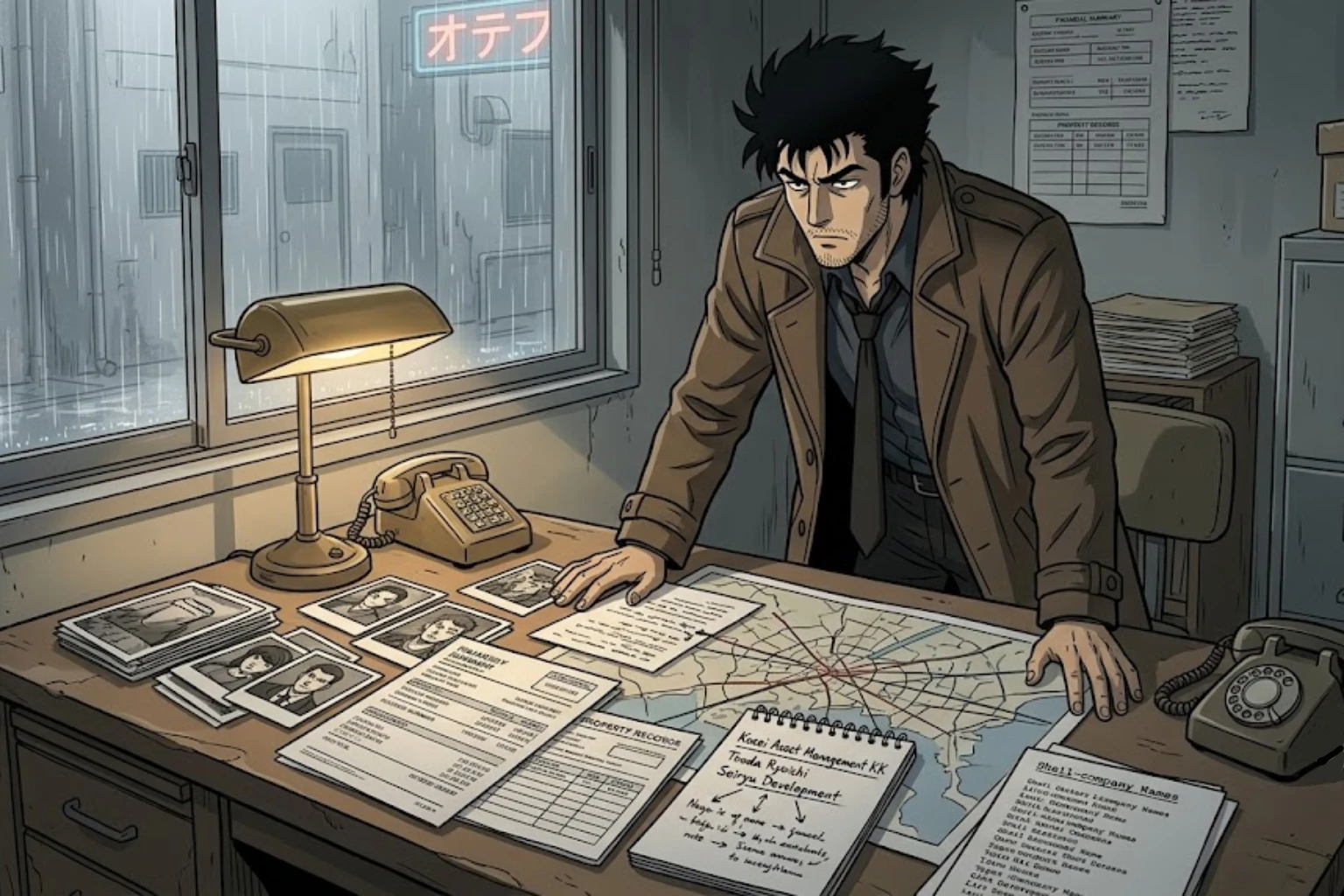
Wada Keiko's office was in the Tenma district, on the fourth floor of a building that housed the kind of small professional practices that existed at the functional end of their fields rather than the prestigious one — the lawyers and accountants and consultants who did real work for clients who needed results rather than addresses. The office was clean and spare, the bookshelves holding law reporters and procedural manuals that showed use rather than display, and Wada herself was a woman in her early fifties who had the specific quality of someone who had been filing against institutional pressure for long enough that institutional pressure no longer surprised her, which was different from it no longer concerning her.
She concerned herself with it precisely and without drama.
I arrived at eight the following morning with the developed photographs from the Temmabashi Street visit in an envelope in my coat pocket. Sayuri was already there. Osaki and Fukuhara arrived eight minutes after me. We sat around the table in Wada's meeting room — smaller than the rented space in the Namba district, the table not designed for five people, but functional — and I put the photographs on the table.
Wada looked at them in sequence, methodically, without speaking. The financial summary documents first. The index page showing the CLO entries and the three RMV notations. The locked cabinet with the wax seal symbol. The flat storage section labels.
She set the last photograph down and looked at me.
"You were inside the Temmabashi Street location yesterday afternoon," she said.
"Yes," I said.
"While the preservation application was pending."
"Yes."
She looked at the photographs again. Not with disapproval — with the assessing attention of someone determining what she could use and how. "The application named Temmabashi Street as an associated address. Once filed, the application creates a legal context that — in theory — obligates any party with knowledge of the filing to preserve the named materials." She paused. "In practice, a filing that hasn't been served yet creates no enforceable obligation. The party served is the Rindo entity at its registered address. Temmabashi Street is associated, but service hadn't been completed when this—" she indicated the RMV photograph— "occurred."
"So the removal isn't contempt," Osaki said.
"Not technically," Wada said. "Not yet. The question is whether the removal occurred after service was completed at the primary address." She looked at me. "You said someone came into the building while you were inside. What time?"
"Approximately four o'clock," I said. "Service was attempted at the Motocho Street address — what time?"
"The process server logged first attempt at four-seventeen," Wada said. "Nobody answered. He left notice of service and the application documents under the door. That constitutes valid service under the civil procedure rules."
"So the removal happened before four-seventeen," I said.
"Before service was completed," Wada confirmed. "Which means the obligation to preserve wasn't yet enforceable when the files were removed." She was quiet for a moment. "However." She picked up the photograph of the index with the RMV notations. "The preservation application is now served. Any further removal or destruction of materials at either address, from this point, constitutes contempt. And the fact that removal occurred in the window between filing and service—" She set the photograph down. "That's not contempt. But it's evidence of knowledge. Someone knew the filing was coming and moved to remove specific materials before service was completed."
"The leak," Sayuri said. Not loud. Just placing it.
Wada looked at her. "The application was filed at the court registry. Court filings are not public until served, but they exist in the registry system from the moment of filing. Someone with access to that system — or someone with a contact who has access — could have known the filing existed within minutes of it going in."
The room was quiet.
"The client's influence in the court system," Fukuhara said. She said it without inflection, as a statement of a thing that was now confirmed rather than inferred.
"It's a reasonable inference," Wada said. "I won't put it more strongly than that without more evidence. But the timing is what it is." She looked at the table. "What I can do is file a contempt motion on the basis of the post-service window — any further removal or destruction of materials. I can also file a supplementary application documenting the pre-service removal and asking the court to draw an adverse inference from it." She paused. "What I cannot predict is how quickly the court will move. Emergency applications in this court system move at the speed the system permits, and the speed the system permits is not always the speed the situation requires."
"The judge," I said.
Wada looked at me. "The application has been assigned. I know the judge. He is not corrupt — I want to be clear about that. But he is cautious, and cautious judges in cases with institutional complexity tend to move carefully, which means slowly." She folded her hands on the table. "I have filed a motion requesting expedited consideration. Whether that motion is granted depends on the judge's assessment of urgency."
"Three files were removed from a locked cabinet at a location named in a preservation application," Osaki said. "Within hours of the filing."
"Yes," Wada said. "That is the urgency I have represented to the court. Whether the court agrees that it constitutes sufficient urgency for expedited consideration—" She left the sentence where it was, which was the honest place to leave it.
We sat with it for a moment.
"The financial photographs," Fukuhara said. She was looking at the summary documents in the spread of photographs on the table. "The receiving account. The same account across multiple transactions, multiple years. What do we know about it?"
"The account number and the entity name associated with it," I said. "Both documented in the photographs. The entity name is one I don't recognize — it's not in any public registry I've checked."
"A shell," Osaki said. "Probably registered offshore or through a nominee structure. The funds move into the shell and from there—" He shook his head. "That's the step that requires a forensic accountant or regulatory access to trace. Standard registry searches won't get you there."
"But the account number is a starting point," Fukuhara said. She looked at me. "A domestic account number has a routing structure that identifies the bank and the branch. Even without knowing the account holder, knowing the bank gets you to someone who could file a regulatory inquiry."
"A regulatory inquiry takes time," Sayuri said.
"Everything takes time," Fukuhara said. "The question is whether the time a regulatory inquiry takes is shorter than the time we have." She looked at Wada. "If the court grants expedited consideration and a judge signs the preservation order — how long before the operation is effectively frozen?"
"The moment the order is signed," Wada said. "A signed preservation order creates an immediate legal obligation. Violation is contempt with enforcement consequences." She paused. "But the order only covers what's named in the application. The Rindo entity at its registered addresses. If the operation has moved material to a third location not named in the application—"
"The material is outside the order's reach," I said.
"Yes," Wada said.
The three RMV files. Removed to somewhere not named in the application, somewhere the preservation order — when it came — wouldn't cover.
I looked at the photographs on the table. The index with its three RMV notations. The locked cabinet with the wax seal symbol.
"The receiving account," I said. "Give me the day. I'll see what I can find without regulatory access."
---
I went back to the office.
The financial photographs were in the envelope. I spread the relevant ones on the desk — the summary documents showing the account number and entity name — and looked at them in the morning light from the alley window.
The account number had the structure Fukuhara had described: a routing prefix identifying the bank and branch, followed by the account identifier. The routing prefix was a domestic bank, one of the mid-tier commercial institutions with branches throughout the city. Not one of the major banks, not a boutique private bank — a mid-tier commercial institution with enough volume in its operations that individual accounts didn't receive particular scrutiny.
The entity name associated with the account appeared in three of the summary documents. Not a personal name — a corporate name, in the format of a registered entity: KOSEI ASSET MANAGEMENT KK. The KK designation meant it was registered as a kabushiki kaisha, a standard Japanese corporation. Which meant it existed in the commerce office registry, the same registry where Rindo and Keisen had existed before their dissolutions.
I picked up the phone and called Eto Fumiko.
She answered on the second ring.
"Murphy," she said, in the tone she used when she already knew this was going to cost her something.
"One more," I said. "Commerce office registry. Kosei Asset Management KK."
A pause. "Registration lookup?"
"Full registration. Directors, registered address, filing history."
"That's public counter accessible," she said, which meant she was telling me I could get it without burning a favor.
"I'm not near the public counter," I said. "And I need it in the next hour."
Another pause. "What am I getting for this?"
I thought about what I had and what she'd find useful. "The Imamura situation," I said. "Last time you wanted a current address. I gave you what I had from eight months ago. I can get you a current verification."
"How current?"
"Within the week," I said. "I'll make a call this afternoon."
She considered this. "Kosei Asset Management KK," she said. "Give me twenty minutes."
She called back in seventeen.
"Registered four years ago," she said. "Director of record is listed as Tsuda Ryoichi. Registered address is in the Kita district — a commercial building on Kami-Shinjo Street." A pause. "Filing history is thin. Annual returns filed on time, no amendments, no associated entities listed." Another pause. "Murphy, this entity has had no reported revenue and no reported expenses in any of its four annual filings."
"A shell," I said.
"An active shell," she said. "It's been maintained — the filings are current, the registration is in good standing. Someone has been paying to keep it alive." She paused. "The director of record, Tsuda Ryoichi — I ran the name against other registrations while I had the screen up. He's listed as a director on six other entities. All of them have the same filing profile. Thin history, no reported activity, maintained registration."
Six shells. All maintained. All with the same director of record.
"What's Tsuda's listed address?" I said.
She gave me an address in the Kita district, near the Kosei registration address.
"Thank you, Eto," I said.
"The Imamura verification," she said.
"This afternoon," I said, and hung up.
I looked at what I'd written.
Kosei Asset Management KK. Tsuda Ryoichi, director of record, also director of six other entities with the same shell profile. A Kita district address for both the entity and the director. Four years of maintained registration with no reported activity.
The receiving account was registered to an entity that existed specifically to receive and hold funds without reporting them. A shell with a director who ran six other shells, all maintained, all dormant on paper. This was the infrastructure of systematic financial misdirection — not improvised, not ad hoc, but built deliberately, the kind of structure you built when you needed to receive significant funds across multiple transactions over multiple years and needed the receiving mechanism to be clean and permanent and invisible.
Someone had put this together carefully.
Not someone who had stumbled into financial crime. Someone who understood how to construct a receiving structure that would survive routine scrutiny.
I wrote down the Kita district address for Tsuda Ryoichi and looked at it.
Then I picked up the phone and called Sayuri through the drop service.
Her callback came eleven minutes later, from a number I didn't recognize — another clean line, another burned burner.
"Kosei Asset Management KK," I said. "It's the entity name on the receiving account. Registered four years ago. Director of record is Tsuda Ryoichi — he's also director of six other shells, all the same profile. Kita district address."
Silence on the line.
"Tsuda Ryoichi," she said slowly.
"You know the name."
"Not from the Rindo operation," she said. "From — before. From a professional context, before I worked for Keisen." She was quiet, working something out. "He was a reference. On a contract I worked on early in my career — a documentation project for a property development company. His name appeared as an associated director on one of the entities in the development structure."
"A property development company," I said.
"In the Higashi ward," she said. "Four, maybe five years ago."
The Higashi ward. The same district as Fukuhara's billing irregularity. The same district as several of the compulsory acquisition transactions in the Temmabashi Street flat storage.
"Sayuri," I said. "The property development project. Do you remember the development company's name?"
A pause while she reached back through four or five years of professional memory. "Seiryu Development," she said. "I remember it because the kanji was unusual — it meant something like blue-green dragon. I thought it was an odd name for a development company."
"Seiryu Development," I said. I wrote it down. "Was it registered?"
"It would have to have been," she said. "I did documentation work for it — contracts, filing preparation. It was a registered entity."
"Was Tsuda associated with Seiryu directly or through one of his shells?"
"Through a shell," she said. "The shell was listed as a minority investor in the development structure. I didn't pay much attention to it at the time — minority investors in development projects were common, the structure was standard, I was doing documentation work not due diligence." She paused. "Murphy, if Seiryu Development was involved in the Higashi ward property transactions—"
"Then the compulsory acquisitions in the Temmabashi flat storage might connect directly to Seiryu," I said. "The below-market valuations, the misdirected funds — if a development company was acquiring the land after the compulsory purchases, the below-market valuations would have made those acquisitions cheaper."
"And the funds that represented the difference between market value and the actual payment—"
"Went to Kosei or one of the other shells," I said. "Which were associated with Tsuda, who was associated with Seiryu, which was the ultimate beneficiary of the underpriced land."
The line was quiet.
"That's the mechanism," Sayuri said. "Not just fund misdirection. A systematic land acquisition program using public compulsory purchase powers to acquire land below market value and redirect the difference to entities connected to the ultimate beneficiary."
"And the client's office had oversight of the agencies that managed the compulsory purchases," I said.
"The oversight is the key," she said. "Without the oversight, the valuations couldn't be manipulated. The oversight is what made the whole mechanism possible."
I looked at what I'd written on the desk. Kosei Asset Management KK. Tsuda Ryoichi. Seiryu Development. The Higashi ward. The client's oversight chain. The compulsory acquisitions. The receiving account.
It was a complete picture of a financial crime that had been running for years, using public institutional power to benefit private interests, documented in the files of a records operation that had been built specifically to manage the exposure risk created by the people who'd noticed it.
"The Temmabashi financial documents," I said. "The photographs I took. Combined with Sayuri's professional memory of Seiryu Development and Tsuda's association — that's a corroborated connection between the receiving account and the land acquisition program."
"It's not court-ready evidence on its own," Sayuri said. "My memory of a project I worked on four years ago isn't documentation."
"No," I said. "But it tells us where to look for documentation that is court-ready. Seiryu Development's registration. The development project's filing history. The property records in the Higashi ward showing what happened to the compulsorily acquired land." I paused. "Those are all public records."
"Osaki," Sayuri said. "He's an accountant. He knows how to read property and corporate filings."
"Can you get him this afternoon?"
"I'll call him now," she said. "Murphy — Wada called an hour ago. The court has received the expedited consideration motion. The judge has scheduled a hearing for the day after tomorrow."
"Two days," I said.
"Two days," she confirmed. "Wada says it's faster than she expected, which she attributes to the RMV notation evidence. Even a cautious judge can see the urgency of documented removal during a preservation window." She paused. "The client's lawyers will be there. We'll see them for the first time."
"Two days," I said again. I was thinking about the Temmabashi visitor. The eight minutes. The three files marked removed. Two days before a hearing where the opposition would show their face.
"What are you thinking?" Sayuri said.
"I'm thinking about the person who came into Temmabashi Street while I was there," I said. "They knew the filing was coming. They knew which cabinet to go to. They moved in an eight-minute window and they knew exactly what they were there for." I paused. "That's not someone who received a phone call from a contact at the court registry and made a decision on the fly. That's someone who had a protocol for this specific situation. Someone who had thought about what to remove if a preservation filing came in."
"The operation has a contingency plan," Sayuri said.
"The operation has someone running it who thinks in contingencies," I said. "Someone operational. Not administrative, not the Motocho Street desk man who manages the system. Someone who makes decisions about exposure management and executes them personally."
"Akaike," Sayuri said. "The Rindo director of record."
"Possibly," I said. "Or someone above Akaike. Someone who connects the records operation to the client directly."
The line was quiet for a moment.
"The hearing in two days," Sayuri said. "The client's lawyers. If the operation has someone operational who connects to the client directly — that person may be at the hearing."
"Or may be managing things from behind the lawyers," I said. "Either way, two days gives us time to build what we have before we're in a room with the opposition."
"Osaki this afternoon," she said. "Seiryu Development and the Higashi ward property records."
"Yes," I said. "And the Kosei registration and Tsuda's other shells. If the shell structure connects back to the client through Seiryu, that connection needs to be documented before the hearing."
"I'll get Osaki," she said. "Call me at four."
---
The afternoon was the kind of work that didn't look like much from the outside — telephone calls, registry checks, the patient assembly of public information into a shape that meant something. Osaki was at Wada's office by one-thirty, working through the Seiryu Development filing history and the Higashi ward property records with the focused efficiency of an accountant in his element, the kind of work that required knowing which registers to check and in which order and how to read the results in combination rather than in isolation.
I spent the afternoon on the Tsuda shells.
Six entities, all with Tsuda Ryoichi as director of record. I pulled the registration details on each one through the commerce office public counter — I went in person this time, no favors burned, just the public access that anyone could use if they knew what to ask for and how to read what they got. The six shells had the same profile Eto had described for Kosei: thin filing history, no reported activity, maintained registration. They were registered across a four-year period, which matched the operational timeline of the Rindo records system.
Each shell had a registered address. Six different addresses, spread across three districts — Kita, Higashi, and one in the Namba district. None of the addresses were residential. All were commercial buildings, the kind that rented registered addresses to entities that needed a postal address without needing physical space.
I looked at the six addresses and thought about the network they implied. A director of record managing six shells, all dormant on paper, all maintained. A receiving account at one of the shells. Five others in the same structure.
Five other receiving accounts, potentially.
If the Higashi ward compulsory acquisitions were one stream of funds, there might be other streams. Other districts, other mechanisms, other transactions that had generated files in the Rindo system on the people who'd noticed them. The Temmabashi flat storage had drawers labeled with multiple district names — not just Higashi, not just Shita. Multiple districts over multiple years.
I wrote down the six shell addresses and the registration dates and went to find a payphone.
Osaki picked up at Wada's office on the second ring.
"Murphy," he said.
"The Seiryu Development project," I said. "The Higashi ward. What are you finding?"
"Seiryu Development was registered five years ago," he said. "Director of record is a man named Kato Hiroshi — not Tsuda, different name. But Seiryu's shareholder registry lists a minority investor — Kosei Asset Management KK, twelve percent stake." A pause. "The development project acquired seven parcels of land in the Higashi ward over a three-year period. All seven were subject to compulsory purchase orders issued by the Higashi ward municipal office. All seven were valued at between thirty and forty percent below comparable market transactions in the same period."
"And after Seiryu acquired the land?"
"Six of the seven parcels were sold within eighteen months of acquisition," he said. "The sale prices were market rate. In some cases above market — the Higashi ward had appreciated significantly during that period." He paused. "The difference between the compulsory purchase price and the eventual sale price, across all seven parcels, is approximately eight hundred million yen."
The number sat in the silence for a moment.
"Eight hundred million," I said.
"Over three years," he said. "Across seven transactions." He was quiet. "Murphy, the compulsory purchase valuations were prepared by the Higashi ward municipal office's property assessment division. I found the assessment records in the public property register. Each of the seven assessments was signed by the same assessor."
"One person signed all seven undervaluations," I said.
"The same assessor for all seven parcels, across three years," he said. "The probability that one assessor would handle all seven compulsory purchases in the same district across three years is not impossible — assessors have geographic specializations — but the consistency of the undervaluation across all seven, all by the same magnitude, all during the same period—" He stopped. "That's not randomness."
"That assessor has a file," I said. "In the Rindo system."
"Almost certainly," he said.
"And the assessor's cooperation would have been — arranged," I said. "Through the client's oversight of the municipal assessment function."
"That's the inference," he said. "I can't document the arrangement itself. But the pattern in the public records is documentable."
"Document it," I said. "Everything you've found. The seven parcels, the assessment records, the valuations, the sale prices, the Kosei stake in Seiryu. Write it up the way you'd write a financial analysis. Wada needs it before the hearing."
"I'll have it by tonight," he said.
I put the phone down and stood at the payphone for a moment.
Eight hundred million yen. Seven parcels. One assessor. A shell structure receiving the difference. A records operation managing the exposure risk.
And somewhere in the locked cabinet with the wax seal symbol, three files that had been removed before the preservation order could cover them, marked RMV in the index of a filing system that used CLO to designate people who had stopped being findable.
I walked back to the office.
---
Sayuri called at four.
"Osaki is still working," she said. "He'll have the analysis by tonight. Wada says it'll be the strongest piece of corroborating documentation we have."
"The Tsuda shells," I said. "Six of them, plus Kosei. All maintained. The registration dates span the same four-year period as the Rindo operation."
"You think the other shells are receiving accounts for other revenue streams," she said.
"I think the Higashi ward land program was one of several," I said. "The Temmabashi flat storage had drawers labeled with multiple district names. If the same mechanism ran in other districts — other compulsory acquisitions, other below-market valuations, other shells receiving the difference — the scale is significantly larger than eight hundred million yen."
She was quiet for a moment. "The hearing in two days," she said. "We're going to be in a room with the client's lawyers. They're going to know what we have — or as much of it as Wada's application has disclosed."
"They'll know about the preservation application," I said. "They'll know about the Rindo entity and the two addresses. They won't know about the photographs from Temmabashi Street, because Wada hasn't disclosed those in the application. They won't know about the Seiryu connection or the Tsuda shells — those came from public records, not from the application."
"So we know more than they think we know," she said.
"For now," I said. "The hearing will change that. Whatever Wada presents, they'll see."
"Then we need to decide what Wada presents," Sayuri said. "What we disclose at the hearing and what we hold back."
"That's a conversation for tomorrow," I said. "With Wada and all four of us."
"Tomorrow morning," she said. "Wada's office. Eight o'clock."
"I'll be there," I said.
She paused. "Murphy. The receiving account thread — the Seiryu connection, the eight hundred million, the shell structure. This is bigger than four people and a lawyer."
"Yes," I said.
"At some point this needs to be in front of someone with the institutional authority to act on it. Not just preserved. Acted on."
"I know," I said.
"Do you know who that is?"
I looked at the wall above the desk. The question I'd been turning over since the meeting in the rented room in the Namba district, since the full picture had assembled itself across the week. The prefecture insider option — the one none of them could solve because they couldn't identify who in the prefectural system was genuinely independent of the client's influence.
"I have an idea," I said. "Someone I haven't thought of because I've been thinking inside the system. The client's influence runs through the prefectural institutions. But prefectural institutions aren't the only institutions with authority here."
She waited.
"The national audit authority," I said. "The Board of Audit. They have jurisdiction over the use of public funds and they report directly to the national legislature — not through the prefecture, not through any administrative chain the client can reach into." I paused. "They're slow and they're bureaucratic and getting a case in front of them requires specific documented grounds. But the Osaki analysis — seven compulsory acquisitions, one assessor, thirty to forty percent undervaluation across all seven, a shell structure receiving the proceeds — that's exactly the category of documented irregularity they're constituted to receive."
Silence on the line.
"You've been thinking about this," she said.
"Since the meeting room," I said. "The prefecture insider option kept failing because the client's influence runs too deep in the prefectural structure. But his influence doesn't run to the national level. He's not significant enough at the national level to have reach into the Board of Audit."
"Filing with the Board of Audit," she said slowly. "That's a long process."
"It is," I said. "It doesn't move fast. But a preservation order from the local court combined with a Board of Audit referral — the court order stops the immediate damage while the audit process builds the formal case. They're complementary mechanisms."
"The hearing in two days gives us the court order," she said. "If the judge signs it."
"If the judge signs it," I said. "And if the contempt motion on the pre-service removal has any teeth."
"And if the client's lawyers don't find a way to delay."
"Yes," I said. "All of those ifs."
She was quiet for a moment. "It's the best path we have," she said.
"It's the path that doesn't require us to trust anyone we can't verify," I said. "The Board of Audit is slower than a journalist and less dramatic than a lawyer, but it's also the mechanism the client has the least leverage over."
"I'll talk to Wada tonight," she said. "Get her assessment of the Board of Audit referral as a parallel track."
"Good," I said. "And Sayuri — Fukuhara's original document. The three-page summary with the Rindo seal. Has Wada seen the original?"
"Yes," she said. "She authenticated it last night. She says the chain of custody is clean — Fukuhara received it from a former colleague who received it in a misfiled crate. Documented, traceable, no connection to Murphy or to me."
"That document is the cleanest piece of evidence we have," I said. "Everything else — the packet, the photographs — has a provenance question. That document came out of the system through an uncontrolled channel. No one handed it to us. It found its way out on its own."
"I know," Sayuri said. "Wada said the same thing."
"Make sure she leads with it at the hearing," I said.
We ended the call.
I sat at the desk and looked at what the day had produced. The Tsuda shell structure. The Seiryu Development connection. Eight hundred million yen across seven transactions in the Higashi ward alone. An assessor whose cooperation had been — arranged. And five more shells in the same structure, suggesting the Higashi ward program was one of several.
On the other side of the ledger: a judge moving cautiously, the client's lawyers appearing in two days, and someone who had walked into Temmabashi Street at four in the afternoon and removed three files in eight minutes with the efficiency of someone who had prepared for exactly this contingency.
Someone who was still unidentified. Someone who knew what was in the locked cabinet and what to take and had a key to take it.
I put the Tsuda shell notes in the filing cabinet and locked it. Put my coat on.
The office was as it should be. Positional details correct. The alley window showing the ordinary alley.
I went to the door and stopped.
The thing that had been sitting at the edge of my thinking since the Temmabashi Street visit — the thing I hadn't said to Sayuri because it wasn't fully formed yet — clarified itself in the moment before I turned the key.
The person in Temmabashi Street had arrived after me. They had entered using a code — a code that meant they had authorized access to the building. They had gone directly to the flat storage section, then to the locked cabinet. They had worked in eight minutes and left.
They hadn't found me.
Not because I'd hidden well, though I had. But because they hadn't looked. A person entering a location they believed to be secure, to retrieve specific materials, didn't search the premises. They did their task and left.
Which meant they hadn't known I was there. Which meant the visit wasn't a response to my presence — it was already planned before I arrived.
Which meant the contingency protocol I'd inferred — the plan to remove specific files if a preservation filing came in — had been triggered not by my presence but by the filing itself.
The filing had gone in at three-thirty-two. The visitor had arrived at approximately four o'clock. Twenty-eight minutes between the filing and the response.
Twenty-eight minutes from a court registry filing to someone with a key arriving at a secondary location to remove specific files.
That was not the response time of someone who had received a phone call from a contact at the court registry. That was faster than a phone call, a decision, a transit across the city.
Unless the person had been close. Unless they had been notified the moment the filing appeared in the registry system — not by a human contact but by some kind of automated monitoring.
The operation had automated monitoring on the court registry system.
Which meant the operation had technical access to court systems that was not a casual connection. That was the kind of access that required resources, relationships, or expertise that elevated the operation's sophistication well beyond what a document custody firm — even a fraudulent one — would normally possess.
I stood in the office doorway with that for a moment.
Then I turned the key and went out, and the door locked behind me, and the office settled into its evening quiet, and I walked back toward the apartment thinking about what kind of organization built automated monitoring into a municipal court's filing registry and what that meant for the two days before the hearing.
The rain had come back overnight, and the city was wet again, and the Shita district was doing its evening thing, and somewhere in the Kita district a man named Tsuda Ryoichi was the nominal director of six dormant shells, and in a location I didn't know three files had arrived that used to be marked CLO in a system that used CLO for people who had stopped being findable.
Tomorrow, Wada's office. The Board of Audit referral. The hearing strategy.
And the question, sitting alongside all of it: who was the person with the key.
I didn't have an answer yet.
But I knew now that finding one was not optional.


.png)
.png)
.png)