%20(1).png)
Osaki didn't call.
By nine in the morning it was clear he wasn't going to, and by nine-thirty Sayuri and I had agreed on the phone that waiting for a call that wasn't coming was not a productive use of the time we had. The operation was in damage-control mode. The S-section files had been moved. The man at the Motocho Street desk had described an accelerated closure process requiring forty-eight hours notice. Every day we waited was a day the operation used to reduce what was accessible.
"We go to him," I said.
"He might not open the door," Sayuri said.
"He might not," I agreed. "But he hasn't called, which means he's sitting with the decision and not resolving it, and sitting with an unresolved decision when the situation around you is moving is how people end up acted upon instead of acting." I paused. "He needs to see it's real. The phone is abstract. Two people at his door is real."
Sayuri was quiet for a moment. "All right," she said. "I'll meet you at the Namba district station. One hour."
---
The accounting firm where Osaki worked occupied the third floor of a building that was modest in the way of businesses that had been in the same location for a long time and had stopped thinking about their presentation. The building directory in the lobby listed six tenants. We didn't go up.
We waited across the street, under the awning of a closed insurance office, and at ten forty-five Osaki came out through the front entrance with his coat on and his bag over his shoulder, moving with the deliberate, checking pace I'd observed two days earlier. He turned left.
We crossed the street and fell into step behind him, and Sayuri said his name.
He stopped.
He turned, and for a moment he looked at both of us with the expression of someone whose preparation for this moment had not included it happening on a public street with two people he recognized and one he didn't. Then the expression settled into something more considered.
"You said you'd call," he said to Sayuri.
"You didn't answer," she said. Not an accusation. Just the fact.
He looked at me. "Murphy," he said. The name Sayuri had given him.
"Yes," I said.
He looked at the street around us — left, right, the building entrance behind him. The checking habit, automatic now. Then he looked at Sayuri.
"Where?" he said.
"Somewhere private," she said. "Your choice."
He thought for a moment. Then he said: "There's a place two blocks from here. A room I rent by the hour for client meetings. Accountants do that sometimes, when we need a neutral space." He paused. "Nobody knows I use it for that."
"Lead the way," I said.
---
The room was exactly what he'd described — a rented meeting space in a building that offered them by the hour, neutral and anonymous, a table and four chairs and a whiteboard nobody had used recently. Osaki took the chair at the far end of the table with his back to the wall. Sayuri took the chair to his left. I took the one across from him.
He put his bag on the table and looked at us and said: "I've been sitting with this since last night."
"I know," Sayuri said.
"I wanted to say no," he said. "I've been telling myself to say no for two years. To leave it alone. To accept that the inquiry was gone and the people who erased it had enough reach that fighting them was not a fight I could survive." He looked at his hands. "Then you told me what the file said. What my inquiry actually looked like before they changed it. And I understood that saying no doesn't make me safe. The file is still active. I'm still in the system. Saying no just means I'm in the system and I'm not doing anything about it."
"That's correct," I said.
He looked at me. "She said you work outside official channels. That you're not going to take this to the police."
"Not as the primary move," I said. "The police in this city are not a reliable mechanism for a case involving someone with the client's institutional standing. That may change — if the right framework is established first, if there's enough corroborated evidence in the right hands, police involvement becomes possible and maybe necessary. But not as the first step."
"Then what is the first step?"
I told him the full picture the way I'd told Fukuhara — the operation's structure, the client's name, the scale, the three missing people, the financial evidence that might exist in the secondary location. He listened without interrupting, which was the way of someone who had been preparing to receive information rather than waiting to respond to it.
When I finished he was quiet for a moment.
"The billing irregularity," he said. "The woman — Fukuhara — she reported a misdirection of public funds and they opened a file on her."
"Yes," I said.
"My inquiry was about a property transaction," he said. "A compulsory purchase order in the Shita district. The valuation was significantly below market and the difference went — I couldn't prove where it went. But the pattern was consistent with funds being directed to a private account connected to the agency's oversight structure." He paused. "The same oversight structure the client's office manages."
Sayuri looked at him. "You were investigating the same financial mechanism from a different transaction."
"A different transaction in a different district," he said. "Same mechanism. Same oversight chain." He looked at the table. "If Fukuhara's billing irregularity and my property transaction are part of the same pattern, there would be other transactions. Other districts. Other people who noticed and asked questions and had files opened on them."
"Fifteen hundred files," I said. "Minimum. Not all of them for the same reason — the operation compiled files on anyone who came into proximity with information the client needed to manage. But a significant portion of them may be people who noticed the same kind of irregularity in different contexts."
Osaki looked at the wall for a moment. "Fifteen hundred," he said quietly.
"Yes."
He looked back at me. "What do you need from me?"
---
I went to get Fukuhara.
She'd given me the logistics company address and told me to come in person if there was news. I went east on foot while Sayuri stayed with Osaki, and at eleven-forty I walked into the logistics company's front office and asked for her by name and said I was there on a personal matter, which was true in the way that the most important things were usually true — not the way you'd put it on a form, but the way you'd say it to someone who needed to understand why it mattered.
She came out from the back of the office two minutes later with her coat and her bag, said something brief to a colleague, and walked out with me without explanation.
On the street she said: "Osaki."
"He's in," I said. "He's at a rented meeting room in the Namba district. We should go now."
She nodded and we went.
---
The four of us at the table.
Sayuri, who had been inside the operation for two years and had carried the packet for four months. Osaki, who had filed a legitimate inquiry two years ago and had been living in the contracted perimeter of his own life since it was erased. Fukuhara, who had an original document with a Rindo seal in a location that wasn't her home address and who had been three steps ahead since before I'd introduced myself. And me, who had been in this for eight days and had a searched office and two confirmed surveillance operatives as the visible portion of what I was dealing with.
Four people with different pieces and different stakes and the same general problem.
I put what I had on the table — not the packet, not the physical documents, but the picture. Everything I'd built over eight days, organized in the order it had come to me and then reorganized into the order that made the most sense for people who were hearing it together for the first time as a complete account.
The operation. The client. The mechanism — files used not just for surveillance but as active management tools, closures that preceded rather than recorded the disappearance of subjects. The Motocho Street location and what it held. The S-section cleared in response to the external situation. The secondary location on Temmabashi Street in the Higashi ward, holding higher-sensitivity files, potentially including the financial documentation of the irregularities that Osaki and Fukuhara had separately identified.
Then the options.
"The journalist route," I said. "Independent, publication-backed, enough institutional standing to publish against pressure. The packet gives them the documentation. The problem is time — weeks of independent verification while the operation continues its damage-control process. And the missing people have weeks of exposure during that period."
"The lawyer route," Sayuri said. "Emergency relief — an injunction requiring the operation to preserve its records and halt certain activities. The problem is petitioner standing. The people with the most direct standing are Osaki and Fukuhara, and a two-person filing against a client with the institutional resources we're describing is not a fight that survives long in the courts without additional support."
"The prefecture insider," I said. "Someone with the authority to open an official inquiry, independent enough from the client's sphere of influence to be insulated from the pressure he can apply. The problem is identifying who that person is, because his influence runs through the institutions, and finding someone genuinely clean requires intelligence we don't currently have."
The room was quiet for a moment.
Fukuhara spoke first. She'd been listening to the options with the focused attention of someone running calculations in parallel with the presentation.
"None of those alone is sufficient," she said. "The journalist needs time we don't have. The lawyer needs standing we don't fully have. The insider requires intelligence we don't have." She looked around the table. "But the problem with the financial evidence — if it exists in the Temmabashi Street location — is that it changes all three options. Financial documentation of systematic fund misdirection across multiple transactions and multiple districts is not the same category of evidence as surveillance files on individuals. It's the crime itself, documented by the people who were covering it up."
"It makes the journalist's verification faster," Osaki said. He'd been quiet while I laid out the picture, processing, and now he was engaging with the specific shape of the problem the way an accountant engaged with a discrepancy — methodically, following the numbers to where they led. "Financial records are verifiable against public data. Property valuations, contract awards, fund disbursements — those exist in public registers. If the Temmabashi files contain the internal documentation of the misdirection, a journalist with those documents and access to the public registers could verify the pattern in days, not weeks."
"It gives the lawyer's filing more weight," Fukuhara said. "Two individuals with documented irregularity reports, an original authenticated document from inside the system, and financial evidence of the underlying crime — that's a different filing than two individuals with copies."
"And it gives the prefecture insider something to act on that he can't be pressured to ignore," Sayuri said. "Evidence of financial crime in public contracts is a different category from surveillance of private individuals. It triggers different reporting obligations, different investigative authorities."
"All three options become stronger if we have the Temmabashi material," I said.
"Which means the question is whether we go after it," Fukuhara said. "And what that costs."
She looked at me when she said it. Not because she was asking me to make the decision — because she understood that going after the Temmabashi material was my part of the problem. She and Osaki and Sayuri couldn't walk into a locked building in a district they didn't operate in and read a filing system without triggering the exact kind of attention that would end everything before it started. What I could do — what nine years of operating in the margins of this city had built — was go into a place that wasn't expecting me and come out with what was there.
"The operation is in damage-control mode," I said. "The Motocho Street desk man described an accelerated closure process. The S-section files were moved. Temmabashi is the location they're moving material to, which means right now it has more material than it usually does and more people paying attention to it than it usually does." I paused. "Going in while they're actively managing the space is a different risk than Motocho Street was."
"But the material won't be there indefinitely," Osaki said. "If the operation is in a closure process — if they're moving files and shutting down in response to the external situation — the window for accessing Temmabashi is not unlimited."
"No," I said. "It isn't."
The four of us sat with that for a moment.
"We split it," Fukuhara said. "Not sequentially. Simultaneously. You go into Temmabashi. While you're doing that, we start the filing process — not the full legal action, not yet, but the preservation filing. An emergency application to the courts to require the preservation of records held by a named entity, based on the evidence we already have. The packet, my original document, the authentication records." She looked at Sayuri. "Can we get a lawyer today?"
Sayuri looked at her. "I know someone," she said. "She's independent. She knows what institutional pressure looks like and she knows how to file against it. I've been holding her name for three months waiting for the right moment."
"Today is the right moment," Fukuhara said.
"Murphy goes to Temmabashi," Osaki said. He was looking at the table, running something in his head. "While he's there, we're with the lawyer. The preservation filing creates a legal instrument that — if it goes through before the operation can respond — makes it significantly harder for them to destroy or relocate the Temmabashi material." He looked at me. "The timing matters. If the filing goes in first, it establishes the legal obligation to preserve before you access the location. If you go in first and something goes wrong—"
"The filing still protects the material you already have," I said. "The packet, Fukuhara's document. That doesn't go away."
"But it doesn't protect you," he said.
I looked at him. He said it the way he said everything — quietly, precisely, as someone stating a material fact that needed to be on the table.
"The risk to me is the same regardless of the filing order," I said. "The filing doesn't change what happens if I'm found inside Temmabashi Street."
"No," he said. "It doesn't." He was quiet for a moment. "I want to say that I understand what you're taking on. I want to say it directly, because I think it's important to say." He looked at me steadily. "Thank you."
The room was quiet.
"Don't thank me until it works," I said.
---
We spent an hour working out the details.
Sayuri would call her lawyer contact the moment we left the meeting room — an initial call to establish the situation and determine whether an emergency preservation filing was viable today. If it was viable, Osaki and Fukuhara would go with her to the lawyer's office with the packet and Fukuhara's original document. The filing, if it went in, would name the Rindo Document Custody entity and its associated addresses — Motocho Street and Temmabashi Street — and require the preservation of all records held at those locations pending a formal inquiry.
I would go to Temmabashi Street.
Not immediately. Not until Sayuri had confirmed the lawyer was viable and the filing was in motion. The sequencing mattered — not for my protection, but because the filing in motion created a context for what I found. If the Temmabashi material confirmed the financial evidence Fukuhara had described, that evidence needed to arrive in a legal context that could receive it, not as material obtained by a grey-market operator working alone.
"There's one more thing," Fukuhara said, before we ended the meeting.
We looked at her.
"The three missing people," she said. "Sekine, and the other two. If the Temmabashi material contains financial evidence across multiple transactions, it may also contain documentation of what happened to the people who knew about those transactions." She paused. "I want to know if that's in there. Not just the financial records. What happened to them."
The room was quiet.
"I'll look," I said.
She nodded once, and that was the end of the meeting.
---
Sayuri called at two-fifteen.
"The lawyer is viable," she said. "Her name is Wada Keiko. She's independent — she runs a small practice in the Tenma district, civil and administrative law, she's filed against public agencies before and she knows how to insulate a filing from institutional pressure. She's read the summary I gave her and she says the preservation application is supportable." A pause. "She wants the original documents. Fukuhara and Osaki are with me now. We're going to her office."
"The filing," I said. "How long?"
"Wada says she can have the application drafted in two hours. Filing it is another hour — she has a contact at the court registry who can expedite an emergency application. If everything goes smoothly, the filing goes in before close of business today."
Before close of business. Four hours, maybe five.
"I'll go in this afternoon," I said. "After the filing is confirmed."
"Murphy." Her voice shifted — not to alarm, but to the register she used when she was saying something she'd thought about and wanted to say precisely. "The operation is going to know the filing exists the moment it's served. The service goes to the registered addresses — Motocho Street, and whatever address is associated with the Rindo registration. They'll have notice within an hour of the filing going in."
"I'll be in before the filing goes in," I said. "And out before they know to respond."
A pause. "That's a narrow window."
"Yes," I said. "It is."
She was quiet for a moment. "Call me when you're out," she said.
"I will," I said.
I put the phone down and looked at the office. The desk, the filing cabinet, the alley window. The positional details all correct.
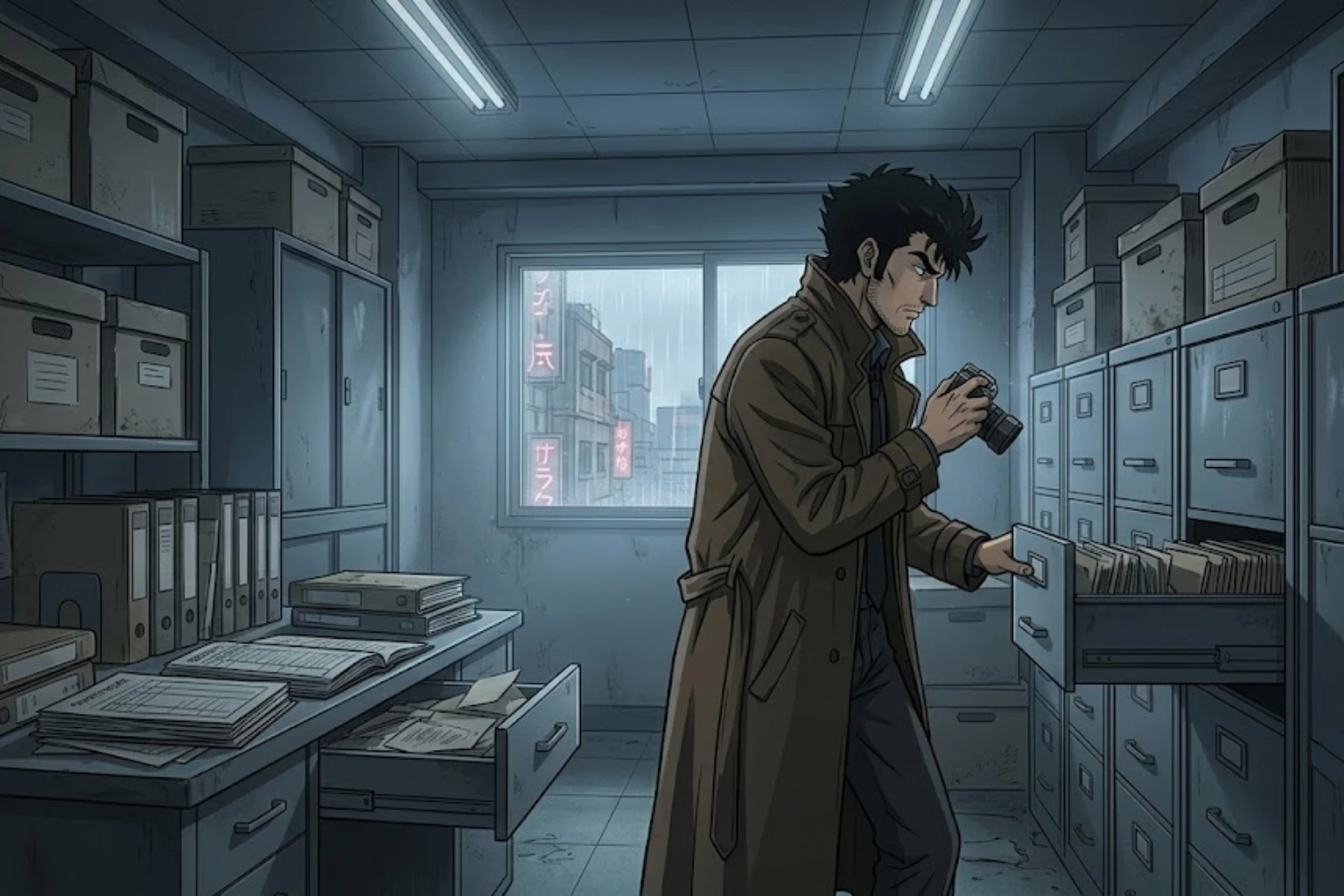
I opened the desk drawer and took out the small camera I'd used at Motocho Street. Checked the film. Full. Good.
I put it in my coat pocket and put the coat on and stood in the office for a moment.
Nine days since Kuroame. A searched office, two confirmed tails, a name from the civic register, four people in a rented meeting room deciding what to do about a records operation that had been running behind two corporate fronts for the better part of a decade. A lawyer in the Tenma district drafting a preservation filing. An emergency application going to the court registry before close of business.
And Temmabashi Street, in the Higashi ward, holding what the operation considered its most sensitive material.
I locked the office and went out.
---
The Higashi ward was forty minutes by foot from my office, through the district line and into the part of the city that had a different texture from the Shita — newer construction in places, the influence of the redevelopment money that had moved through here a decade ago and had improved some things and displaced others. Temmabashi Street was in the older section, the part that hadn't been redeveloped, the part that had the character of a street that had been doing the same thing for a long time and saw no reason to change.
The building was a four-story commercial structure, narrower than the Motocho Street building, the ground floor occupied by a small import business — stationery and office supplies, ironically enough, the window display showing boxes of paper and printer consumables. The upper floors were offices, the directory in the lobby listing three tenants, none of them with names that meant anything. The fourth floor was unlisted.
I stood across the street for twenty minutes.
The building had more foot traffic than Motocho Street — the import business on the ground floor was active, a delivery van parked at the curb, two people moving boxes through the front entrance. The upper floors were quieter, the windows on the second and third floors showing the ordinary activity of offices in the middle of the afternoon. The fourth floor windows — two visible from my position — were dark. Frosted glass, like the Motocho Street office had been, but darker. Heavier glass, or treated.
No way to tell from here whether the darkness meant empty or occupied and careful.
I noted the building's side access — a narrow passage between the import business and the adjacent building, leading to what was probably a service entrance at the rear. The passage was ungated. I watched it for five minutes. Nobody used it.
At three-forty, my phone rang from the payphone two streets over that Sayuri had the number for.
I went to it and picked up.
"The filing is in," Sayuri said. "Wada filed at three-thirty-two. The court registry acknowledged receipt. The preservation order is now a pending legal instrument — it won't have full force until a judge signs it, but the filing itself creates the obligation for any party served with notice to preserve the relevant records." A pause. "Service goes out this afternoon."
"How long before the operation receives notice?"
"Wada estimates one to two hours for service to be attempted at the Motocho Street address," she said. "Temmabashi Street is listed as an associated address in the filing, so service will be attempted there as well — but she says associated addresses are served after the primary, sometimes with a delay of several hours."
One to two hours from three-thirty-two. Call it five o'clock, conservatively, before the Motocho Street address received notice. Temmabashi Street later than that.
"I'm going in now," I said.
"Murphy." One word, the register she used when she was saying something she meant and didn't want to dress up.
"I'll call when I'm out," I said.
I hung up and went to the building.
---
The service passage ran along the left side of the building to a rear courtyard shared by three buildings on the block. The service entrance to the target building was a steel door, newer than the one at Motocho Street, with a better lock. I stood at it for a moment assessing the lock, then took out the tools and worked it.
Two minutes. Longer than Motocho Street. The lock was a step up from commercial standard.
The door opened inward.
Inside: a service corridor, similar to Motocho Street, but better maintained. Cleaner. A single overhead fluorescent, lit, which meant either the building had automatic lighting in the service areas or someone was here. I stood in the doorway and listened.
Nothing.
I went in.
The stairwell was at the far end of the service corridor, and I went up. Second floor, third floor, fourth floor. The stairwell door on the fourth floor was different from the floors below — heavier, with a keypad lock rather than a keyed handle.
I looked at the keypad.
A keypad was harder than a conventional lock and faster to defeat than it seemed if you knew what to look for. These particular units — the model was a common commercial installation, widely used in office buildings throughout the city — had a design flaw in the wear pattern. The keys used most frequently showed it in the surface finish, the oil from fingers creating a visible difference in the pad's texture over time. In low light you couldn't see it. In the indirect fluorescent light of the stairwell, tilted at the right angle, you could.
I tilted my head.
Four keys with visible wear. The model used a four-digit code with no positional memory — the same four digits regardless of order, entered correctly, opened the door. Four digits meant twenty-four possible combinations at most, and the wear pattern suggested a sequence that started with the upper-left key, which meant—
I tried it in three attempts.
The lock released.
---
The fourth floor was one open space, larger than either of the Motocho Street half-floors because this building didn't have the partition — just the full floor, unobstructed, the frosted windows on the street side blocking the view in and the view out.
The cabinet system was here.
Larger than Motocho Street. More cabinets, more drawers, the same alphanumeric coding system but running to different letter prefixes — the ranges that weren't in the Motocho Street primary location. And along the back wall, in a section cordoned off by a low barrier that was more symbolic than functional, a different type of storage: not the small-drawer system of the personnel files but a series of deep drawers, wider, the kind that held flat document storage rather than folded files.
I went to the flat storage first.
The drawers were labeled differently from the personnel file system — not alphanumeric codes but project designations. Names of streets. Names of districts. One drawer labeled TENMABASHI-SHITA CORRIDOR. One labeled HIGASHI RESIDENTIAL BLOCK 7. One labeled SHITA DISTRICT COMPULSORY ACQUISITION 2019-2021.
I pulled the last one.
Inside: a stack of documents, flat, the cream stock paper of the Rindo system but larger format, some of them folded to fit the drawer. I took the top document out and unfolded it.
A financial summary. A property transaction, the same type Osaki had described — a compulsory purchase order, a below-market valuation, the difference detailed in a column that tracked the movement of funds from the public account through two intermediate accounts to a final destination. The final destination was a private account, the account number listed, associated with an entity name I didn't recognize but that appeared in two more documents when I kept reading.
The same entity name. Different transactions, different districts, different years — but the same receiving account, the same entity, the pattern Fukuhara and Osaki had each glimpsed from one angle and here it was from the inside looking out.
I put the top documents back and took the camera from my pocket.
I photographed systematically — not everything, there wasn't time for everything, but the summary documents, the ones that showed the mechanism rather than the individual transaction details. The pattern was more important than any single instance. The pattern, documented across multiple transactions across multiple years, was what made the financial evidence what Fukuhara had said it was: the crime itself, documented by the people who had been covering it up.
Twenty minutes of careful, quiet photography.
Then I went to the personnel file section.
The ranges here were the higher-sensitivity files Sayuri had described — the subjects with more direct exposure to the client's activities. The S-section was here, the drawers full rather than empty, the Sekine files restored from whatever temporary relocation the Motocho Street closure had prompted. I photographed the summary documents from three of the S-section files — not reading them fully, not in the time I had, just capturing them for what they contained.
Then I looked for the specific thing Fukuhara had asked me to look for.
The three missing people. Sekine and the other two.
Their files would be in the system — closed files, CLO designation, the same notation I'd seen on the Motocho Street list. I went to the file index that was mounted on the side of the first cabinet — a master reference, a ledger of codes and their current status, the document that let whoever managed the system navigate to a specific file without going through the entire cabinet system.
I found the CLO entries.
Twelve, as the Motocho Street list had shown. But here, in the index, there was more information than the abbreviated list had given — next to each CLO code, a location reference. Not all of the CLO files were in the cabinet system. Six of the twelve had location references that pointed to a different drawer designation, one I hadn't seen in the cabinet labels.
I looked for the designation.
There was a cabinet along the right wall that I'd passed without examining — a single unit, three deep drawers, no alphanumeric label. Instead, a symbol. The same compressed character from the wax seal.
The lock on this cabinet was different from the drawer system. A keyed lock, the key not in evidence.
I looked at it for a moment. Then I took the camera and photographed the cabinet's exterior, the lock, the symbol, the location reference from the index. Evidence of existence was evidence of existence, even when the contents were inaccessible.
Then I heard the door at the bottom of the stairwell.
Not the service entrance — the front stairwell, the one accessible from the lobby. The sound of a door opening and footsteps on the stairs, moving at the pace of someone who was going somewhere specific without urgency. One person, from the sound.
I put the camera in my coat pocket and moved to the back of the room, behind the last row of personnel file cabinets, into the narrow service passage that ran along the rear wall. The same geometry as Motocho Street.
The keypad on the fourth-floor door sounded — someone entering the code from the outside, someone who knew the code, the lock releasing and the door opening.
I stood in the service passage and did not move.
The person who came in moved directly to the flat storage section. I could hear them by the sound of the deep drawers being opened — one drawer, then another, the sound of documents being handled. Not reading, not spending time on each document — moving through them with the efficiency of someone looking for something specific or conducting a check rather than a review.
Three minutes of that.
Then the drawer closed.
Then footsteps moving toward the cabinet with the symbol.
A key in the lock. The drawer opening.
More handling sounds — documents, but handled differently from the flat storage. Carefully. Each one briefly examined before being replaced or removed, the sound suggesting a sorting process rather than a retrieval.
Five minutes.
The locked drawer closed. The key turned.
Footsteps moving toward the exit.
The keypad sounded from the inside. The door opened and closed.
Footsteps descending the stairwell.
I waited until the stairwell sounds were gone and then waited two more minutes in the service passage, counting the seconds, before I came out.
The flat storage section looked undisturbed. The locked cabinet looked undisturbed. Nothing was visibly changed from before the person had come in.
But someone had been here, had gone directly to the flat storage and then to the locked cabinet, had spent eight minutes doing something, and had left.
I went to the flat storage section and opened the SHITA DISTRICT COMPULSORY ACQUISITION drawer.
The top documents were in a different order from how I'd left them. I'd put them back in the sequence I'd found them — I was careful about that, always — and now the top document was a different one. Not dramatically different. Just moved.
Someone had been through these documents after me and had taken something or replaced something, and they'd done it quickly and without appearing to disturb the system.
Which meant either they'd been in here before and knew the system well enough to move through it without leaving obvious traces, or they'd come in specifically knowing what they were looking for and had found it.
I went to the filing index and looked at the CLO entries again.
The six entries with the alternative location reference — pointing to the locked cabinet — were different from how I'd read them ten minutes ago. Or not different. The same codes, the same CLO designation. But where three of them had previously shown the alternative location reference, now they showed a different notation.
A notation I hadn't seen before in the system.
Three letters: RMV.
Removed.
Three of the six locked-cabinet CLO files had just been marked removed.
I stood in front of the index and looked at the three RMV notations and thought about the eight minutes the person had spent at the locked cabinet and what removing three files meant in a system where CLO designations corresponded to people who had stopped being findable.
I photographed the index.
Then I put the camera in my coat, went to the service passage door, and went down the stairs and through the service corridor and out the service entrance into the rear courtyard.
The courtyard was empty. The sky above it was the grey of late afternoon turning toward evening. I relocked the service entrance, went through the side passage, and came out onto Temmabashi Street.
The street was ordinary. The import business on the ground floor had its lights on. A man walked past pushing a hand cart with boxes on it, not looking at me.
I walked north, away from the building, and kept walking until I was three blocks clear and the texture of the street had returned to the normal texture of a street that wasn't holding anything specific about me.
Then I found a payphone.
Sayuri picked up on the first ring.
"I'm out," I said.
She let out a breath. "What did you find?"
"The financial evidence," I said. "Multiple transactions, multiple districts, multiple years, all running to the same receiving account. I photographed the summary documents — the pattern is documented from inside the system." I paused. "And something else."
"The missing people," she said.
"Someone came in while I was there," I said. "Eight minutes after I'd photographed the flat storage. They went to the flat storage section and then to a locked cabinet that holds the CLO files — the closed files, the ones corresponding to the people who stopped being findable. When they left, three of those files had been marked RMV. Removed."
Silence on the line.
"Someone took three files from the locked cabinet," I said. "While the preservation filing is pending and before service has been completed."
"They knew," Sayuri said. "They knew the filing was coming."
"They knew something was coming," I said. "Whether they knew about the filing specifically or whether this is the accelerated closure process the Motocho Street man described — either way, someone was in that building this afternoon removing files."
The payphone's receiver was cold in my hand. The street around me was doing the six o'clock version of itself, the shift from afternoon to evening, the city changing registers.
"Wada needs to know about the RMV notation," Sayuri said. "If the filing is pending and files are being removed from a location named in the application, that's contempt of the court process. She may be able to file an emergency motion—"
"Call her now," I said. "Tell her what happened. The notation, the timing, the three files. She'll know what to do with it."
"Murphy." The careful register again. "The three files. Sekine and the other two."
"I don't know," I said. "The index showed RMV but not the file contents. I photographed the index — the notation is documented. Whether the files themselves contain what we hope they contain—" I stopped. "That depends on what was in the locked cabinet and where those files are going."
She was quiet for a moment.
"Then we find out," she said. "We find out what was in them and where they went. That's the next thing."
"Yes," I said. "That's the next thing."
I put the receiver down and stood at the payphone for a moment, looking at the street, at the ordinary six o'clock city doing what cities did regardless of what any individual in them was doing.
Three files marked removed.
The locked cabinet with the symbol from the wax seal.
Someone who had known to come to Temmabashi Street this afternoon and had known exactly which drawer to open and had done what they'd come to do in eight minutes and left.
The next thing was finding out where those files went.
But the preservation filing was in. The financial evidence was photographed. Fukuhara's original document was with the lawyer. The packet was in the hands of people who could use it. Four people had sat in a rented meeting room in the Namba district and had decided together what came next, and what came next was now in motion.
It wasn't finished.
But it had started — really started, in the way that things started when they stopped being preparation and became action.
I turned up my collar and walked back toward the Shita district, through the Higashi ward evening, through the ordinary city that didn't know and didn't care and kept running anyway, and in my coat pocket the camera held what I'd found and what I'd found was enough to build on.
The rest was the next thing.
There was always a next thing.
That was the job.


.png)
.png)
.png)