%20(1).png)
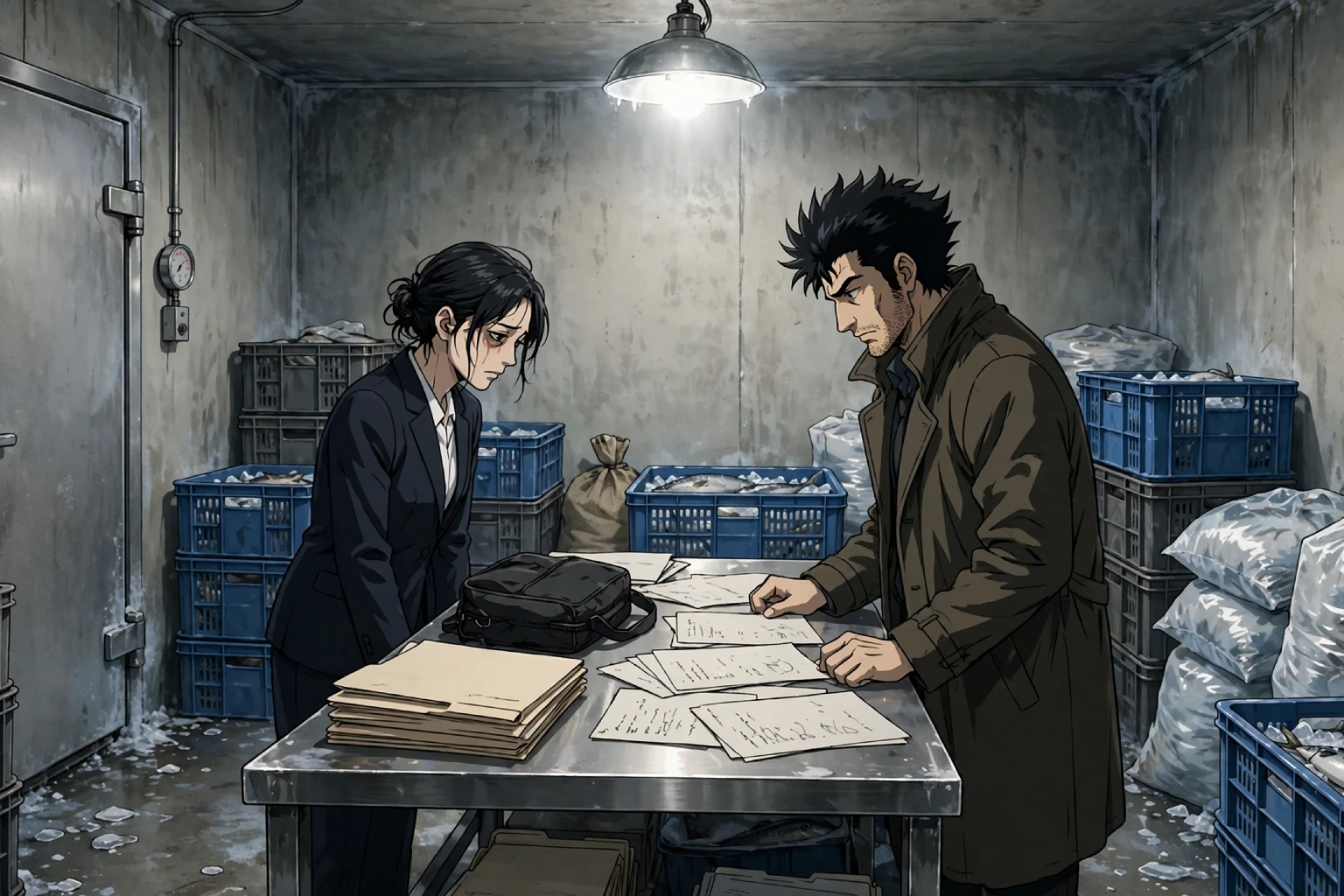
I was at Horie Street at six thirty-five.
Twenty minutes early. The market was already at full operational volume — the vendors running at the pace of people for whom this hour was not early but mid-morning, the smell of salt water and ice and fish that had come out of the sea in the dark and been on a truck before dawn and were now arranged in careful rows under fluorescent lights that made everything look a little realer than it needed to. I went to Asa's stall and said the words and she looked at me the way she'd looked at me every time I'd been here and tilted her head at the back room without expression.
The cold storage room. The stainless steel table. The crates of ice against one wall and the single overhead bulb and no windows. I stood at the far end and waited.
At six fifty-eight I heard the fish market's noise change the way it changed when someone who didn't belong there walked through it — a brief adjustment in the ambient sound, the slight recalibration of a working space around a visitor. Then the door opened.
Nishida came in and closed the door behind her.
She looked different from the previous two mornings. Not worse — different. The professional blankness was gone, or not gone but thinner, and what was under it was more complicated than I'd expected. She'd slept, or tried to, and the evidence of a night spent making a decision was in the specific set of her face — the slight tightness around the eyes that wasn't tiredness so much as the aftermath of sustained internal argument.
She put a bag on the table between us.
I didn't reach for it.
"Before I take that," I said, "I need to understand what's in it. Not in general. Specifically."
She looked at me. "I told you. The file copies and the statement."
"The file copies," I said. "Walk me through them. What exactly is in the Sekine file. What the other two files contain. What CLO means in each case and what the operational record shows around the closure date."
She looked at the bag. Something moved across her face — not reluctance, something more like the specific pain of someone who has been going over the same material in their head all night and is now being asked to say it out loud to another person for the first time.
She told me.
Sekine Taro's file ran for eight months and contained compiled activity records from the monitoring phase — his published pieces, his contacts at the ward office, the specific questions he'd been asking. The CLO notation appeared three days after his second piece ran. The piece about the family in the Higashi ward. The file entries stopped eleven days after the closure.
"Eleven days," I said.
"That was when the monitoring was discontinued," she said. "After the CLO notation the monitoring continued for eleven days as standard practice and then stopped."
"Because the file subject had stopped being an active risk," I said.
"Yes," she said.
"And the record shows nothing about what made him stop being an active risk," I said.
"The record shows the closure notation and the end of monitoring entries," she said. "Nothing else."
"But you know what CLO means in practice," I said. "Not the official definition. The operational meaning."
She looked at the table. "The operational meaning," she said, "is that the subject has been managed." She stopped. "I don't know how. I want to be clear about that. I genuinely don't know what Amano arranges. The records operation was my function. What happened to subjects after their files were closed—"
"Wasn't your function," I said.
"No," she said.
"But you understood what the operational meaning was," I said.
The silence was long.
"Yes," she said. "I understood."
I looked at the bag. "The statement," I said. "Does it say that? Does it say you understood what CLO meant in practice, or does it describe your official function and leave the inference to the reader?"
She looked at me and for the first time I saw something in her face that might have been anger — not at me, at the question, which was asking her to go further than she'd gone in the eight pages she'd spent the night writing.
"It says both," she said. "It says what my function was and it says that over time I came to understand the operational meaning of the closure notation and what that meaning implied about the subjects of those files."
"Good," I said.
I reached across the table and picked up the bag and opened it.
The file copies were three folded sets of cream stock paper — the same weight as the Temmabashi files, the same format. I unfolded the top set and read the first page.
Sekine Taro. Date of birth. The monitoring entries beginning two months before his first piece ran — they'd been watching him before he published, which meant someone had flagged him during the research phase. The entry sequence through both published pieces. And then the CLO notation in the same compressed notation format as the index photograph I'd taken.
I read three pages of it.
I put it back and picked up the statement.
Eight pages, handwritten, her signature at the bottom of each page. The handwriting was the same small precise handwriting as the four words on my kitchen notepad. I read it from the beginning.
She had written it as a complete account — not a summary, not a defensive positioning document, but the specific detailed account of someone who had decided that partial cooperation was worse than full cooperation and had committed to the full version. The instruction chain. The specific conversations with Amano. The timing of her own involvement. The functions she'd performed. The moment she'd understood what the closure notation meant and how that understanding had settled into the background of her work and how she'd continued working with it there.
The Sekine piece. She'd mentioned reading it twice in the statement — once in the context of opening his file, and once in a separate paragraph near the end that wasn't strictly necessary to the account but that she'd written anyway, the kind of paragraph that exists because the person writing it needed to put it somewhere.
I read the statement through to the end.
"You wrote this last night," I said.
"Yes," she said.
"Did anyone see you writing it?"
"No," she said.
"Does Amano know you're here this morning?"
The pause was a fraction too long.
"He knows I've been approached," she said. "He knows about the street conversation. He doesn't know about the letter or this meeting."
"How confident are you about that?"
She looked at me steadily. "Not certain," she said. "He has his own resources. If he's had me watched since yesterday—"
"Has anything felt different since yesterday? In the building, the way your colleagues interact with you, anything?"
She thought. "No," she said. "But I'm not certain."
This was the version of uncertain I'd been afraid of — not the uncertainty of someone who didn't know their own situation, but the uncertainty of someone who knew it well enough to know its limits.
"If Amano suspects you've made contact with me again," I said, "how much time do we have before he acts on it?"
"Hours," she said. "Not days."
I closed the statement and put it back in the bag and closed the bag.
"Then we move today," I said. "The package goes to Hata Emi this morning. Not this afternoon. This morning."
Something shifted in her face. "That fast," she said.
"That fast," I said. "If Amano suspects and moves before the story is in Hata's hands, the story doesn't run. Once it's in Hata's hands the only way to stop it is to stop Hata, and stopping Hata is a different kind of problem than stopping me or you."
She looked at the bag on the table. The specific look of someone looking at the thing they've put on the table and understanding that it's already gone — that the putting-down was the decision and the taking-back was no longer really available.
"The Sekine piece," she said. "The second one."
I waited.
"I read it before I opened his file," she said. "Not after. Before. I read it and then I opened his file." She looked at the table, not at me. "I've thought about that order a great deal."
"I know," I said.
"Do you?" she said. It was the first time anything like an edge had come into her voice.
"I know it matters to you," I said. "I know it's part of why you're here."
She looked at me and the edge was still there and behind the edge was something that had been compressed for a very long time under the professional blankness and the operational precision and the four years of doing her job.
"Part of it," she said. "Yes."
I picked up the bag.
"Go to work," I said. "Same as every day. Don't contact Amano unless he contacts you first. If he contacts you, respond normally. If he asks you to come to his office, go. Don't deviate from your normal pattern." I paused. "The story takes time to verify and time to run. Between now and when it runs the most dangerous thing you can do is act like something has changed."
"Something has changed," she said.
"Yes," I said. "Act like it hasn't."
She looked at me one more time with the assessing attention that had been her most consistent expression across every encounter we'd had. And this time, underneath the assessment, I could see what it was assessing for — not information, not a threat profile, but something more basic. Whether the decision she'd made in a cold storage room at six fifty-eight in the morning was one she was going to be able to live with.
I didn't know the answer to that. Neither did she yet.
She went out the door. The fish market's noise came in briefly and then the door closed and she was gone.
---
I waited five minutes in the cold storage room. Long enough for Nishida to be clear of the market, long enough for anyone watching the entrance to have lost interest in the woman who'd come in and come back out. Then I went through Asa's stall and out into the Horie Street morning without looking at Asa or saying anything, because Asa's gift was her lack of curiosity and I wasn't going to waste it.
I walked from the Tenma district to the Chuo district with the bag under my arm and the morning building around me.
Hata Emi's satellite office was on the fourth floor of a building two streets from the weekly's main editorial offices. The window faced a parking structure. The room was small and bare in the way of rooms used for work rather than presentation — a desk, a filing cabinet, a wall of shelving with binders that showed use. Hata was at the desk when I arrived and she looked at me the way she'd looked at everything, which was directly and without the social softening that made direct attention seem less direct.
"Sit," she said.
I sat.
"The material," she said. "Before you give it to me I want to understand its provenance. All of it."
I told her. The packet from Sayuri, the Motocho Street entry, the Temmabashi Street entry and what I'd found there, the Osaki financial analysis through public records, Fukuhara's original document from a misfiled transfer, and Nishida — who she was, what her role had been, how the statement had come to exist.
Hata listened without interrupting. When I finished she picked up a pen and wrote something I couldn't read from across the desk.
"The financial evidence," she said. "The compulsory purchase analysis. You said it's independently verifiable through public records."
"Property registers, planning records, the Seiryu Development filing history," I said. "The valuations, the timing, the transfer of proceeds to the Kosei shell."
"I'll need a week to verify that independently," she said. "Maybe slightly less. I have a researcher who knows the property register."
"Fine," I said.
"The statement," she said. "A signed statement from a named government official is the strongest piece of this. But a government official who is currently employed by the subject of the story presents a corroboration problem — the story's primary witness has an obvious interest in her account."
"She signed a statement that incriminates herself," I said. "Her account of her own role is not the account of someone minimizing their exposure."
"I understand that," Hata said. "I need to speak to her directly. Before publication. Not to soften the account — to corroborate it. The things she says she did, the things she says she observed. I need her on record with me independently of the written statement."
"You can reach her through the same channel that connected you to me," I said. "She's agreed to stand behind the statement."
Hata looked at me. "Has she."
"Yes," I said.
"A week ago she was running an operational response against you," Hata said. "This morning she handed you a signed statement in a fish market. That's a significant change in position. I need to understand what moved her."
"The statement explains it," I said. "Read the statement."
She opened the bag and took out the statement and read it. She read it the way she read everything — fully, without skimming, the specific attention of someone who processed text as her primary professional medium. She read it twice.
"The Sekine passage," she said. "Near the end."
"Yes," I said.
"She read the piece and then opened the file," she said.
"Yes," I said.
Hata set the statement down. She picked up the pen and wrote something else.
"The three missing people," she said. "Sekine and the other two. The statement describes what CLO meant operationally. It doesn't say what happened to them."
"She doesn't know," I said. "She documented that she doesn't know."
"I know she documented it," Hata said. "I'm asking whether you believe her."
"Yes," I said.
"On what basis?"
"On the basis that if she knew and wanted to protect the information she would have omitted the operational definition of CLO rather than providing it," I said. "The statement is more damaging to the operation than it needs to be for her protection. She wrote what she wrote because it's true, not because it serves her."
Hata looked at me steadily.
"The missing-person connection," she said. "The story I can verify and publish is the financial story — the compulsory purchase mechanism, the shell structure, the oversight function that enabled it. That story is verifiable and publishable and damaging." She paused. "The implication that people who raised questions about the mechanism subsequently stopped being findable — that's a different kind of story. I can report the facts of the disappearances. I can report what their files contained. I can report what CLO meant in the operational context of the records system." She set the pen down. "What I cannot do is state as fact that the client or his office was responsible for what happened to those people. The evidence doesn't establish that."
"No," I said. "It doesn't."
"The readers will draw the inference," she said.
"Yes," I said. "They will."
"And you understand that the client will sue for defamation based on that inference."
"I understand that," I said.
"And you understand that I've been sued before and published anyway," she said.
"That's why I came to you," I said.
She looked at the bag, the statement beside it, the file copies I hadn't opened in front of her.
"One week," she said. "For the financial verification. In that week I make contact with Nishida independently and verify the statement. At the end of the week, if the verification holds, the story runs." She paused. "The client will know the story is coming before it publishes. His lawyers will contact our editors. Our editors will inform me. I will inform them that the story meets our editorial standards and is running." She looked at me. "It will run."
"I know," I said.
"One more thing," she said. "Sekine Taro. His sister has been asking questions for two years. If this story runs, his name is in it. His disappearance is in it. The connection between his second piece and the opening of his file is in it." She paused. "I need to speak to her before the story runs. Not to get permission — to prepare her. She deserves to be prepared."
I looked at Hata.
"Sayuri Shiranami can make that connection," I said. "She already knows the sister."
"Good," she said. She picked up the bag and put it in the filing cabinet and locked it. The finality of the lock was specific and irreversible-sounding. "Go home, Murphy. Let me do my work."
---
I walked back from the Chuo district to the Shita district. Forty minutes. The morning had become the kind of morning the city occasionally produced when it had been raining for a long time — dry air, a pale flatness to the light, the streets looking slightly unlike themselves without the wet surface that had been there for so long it had started to seem structural.
I went to the office.
The positional details were correct. Nobody had been in.
I sat at the desk and did not open the Yabata file. I sat at the desk and looked at the wall and let the morning settle.
At eleven-fifteen Sayuri called.
"Hata reached out," she said. "The channel worked. They have a meeting set for this afternoon."
"Good," I said.
"Murphy." She was quiet for a moment. "Nishida's statement. The Sekine passage."
"Yes," I said.
"She read the piece before she opened the file," Sayuri said. "She knew what it was about and she opened his file anyway."
"Yes," I said.
"She's been carrying that for a year and a half," Sayuri said.
"Yes," I said.
"And now the piece is going to run," she said. "In a national weekly. With her statement attached to it. The family in the Higashi ward — the house that was taken for the road that was never built — their story is going into the public record because her guilt about opening his file finally became heavier than her reasons for keeping it closed."
I didn't say anything.
"That's a strange thing," Sayuri said. It wasn't a criticism. It was a woman who had spent four months running from an operation that a different kind of guilt was going to end, observing the specific strangeness of it.
"Yes," I said. "It is."
She was quiet for a moment.
"Sekine's sister," she said. "Hata is going to contact me about her."
"I know," I said. "I gave her your name."
"Good," she said. Another pause. "What she's going to get isn't what she's been waiting for. She's been waiting for her brother. She's going to get the truth about what happened to the story he was working on." A pause. "That's not nothing."
"No," I said. "It's not."
We held the line for a moment without talking.
"Murphy," she said.
"Yes."
"The story runs in a week," she said.
"Yes," I said.
"And then?"
"And then the record exists," I said. "The operation is damaged. The mechanism is in print. The client manages the fallout with the resources he has, which are considerable, and the city doesn't change overnight." I paused. "But the record exists. And a record is harder to make disappear than a file is."
She was quiet for a long time.
"Thank you," she said. "For taking the packet at Kuroame."
"You thanked me already," I said.
"I know," she said. "I'm thanking you again."
I put the phone down.
Outside the alley window the ordinary alley was doing its ordinary thing. I pulled the Yabata file out of the drawer and looked at the follow-up question the creditor had sent three weeks ago. The second address. The thread I'd been meaning to pull.
I picked up the phone and started making calls.
By four-thirty I had what the creditor needed and the case was done and I filed the report and locked the office and walked home.
At the apartment I went to the kitchen and picked up the notepad and looked at the four words one more time.
*We know about the photographs.*
Nishida's handwriting. The same small precise hand that had signed eight pages of statement in a cold storage room at six fifty-eight in the morning because reading a piece about a family in the Higashi ward and then opening the subject's file had been the thing she'd been carrying for a year and a half and the weight had finally exceeded the reasons to keep carrying it.
I tore the page off the pad. Folded it twice. Stood at the kitchen window looking at Mitsuse Street in the early evening and the city doing what cities did, which was continue.
The story would run.
The silence would end.
Sekine Taro's name would be in print in a national weekly and the family whose house was taken for a road that was never built would be in print and the instruction chain from the client through Amano through Nishida would be in print and the eight hundred million yen across seven Higashi ward transactions would be in print and the shells and the receiving accounts and the oversight function that had made all of it possible would be in print.
The client had resources and lawyers and institutional standing and he'd use all of them. The city didn't change overnight. The operation was damaged but power didn't disappear because a story ran.
But the record existed. The record was harder than the silence had been. The silence had been maintained for four years by a system of files and closures and people who read pieces and opened files and kept working. The record would be maintained by print and the specific permanence of a story that had been verified and published and entered into the public account.
That was what Sayuri had come to Kuroame for.
That was what the packet had been carrying all along.
I put the folded page in my coat pocket — not because I needed it, but because it was part of the account of what had happened and how, and the account mattered even when no one was keeping records of it. Especially then.
The city was the city. The Shita district was itself. Whatever came through the door next was going to come through the door and I was going to be there when it did.
That was the job.
It had always been the job.


.png)
.png)
.png)