%20(1).png)
She was there before I was.
That was the first thing wrong about the morning.
I came around from the service lane entrance at six twenty-two — eight minutes before I'd told myself I'd arrive, because arriving early was the habit and the habit was why I was still working. I came to the corner where the service lane met the residential street and stopped in the shadow of the lane entrance and looked.
The street was doing its six-twenty version of itself. The first light coming over the rooftops, thin and gray. A woman in a delivery apron pushing a cart of bundled newspapers. A man in a building manager's uniform unlocking something. The ordinary machinery of a city morning.
Nishida was at the east corner.
Not outside her building — twenty meters east, at the corner, standing with her back to a wall. The wall position was not casual. The specific geometry of it — the corner, the wall, the angle that gave sightlines north and east — was the position of someone who was not waiting but placed.
And the two men.
One on the near side of the street, between me and her, sitting on a low wall outside a closed shop with the posture of someone who'd been there long enough to have settled into stillness. One on the far side, further east, standing at the entrance to a building with a newspaper he wasn't reading.
I stood in the service lane entrance and looked at the geometry.
Three visible. The woman from the bank branch — Nishida, I was now certain — at the far point. Two men bracketing the approach between the lane entrance and her position. If I walked out of the lane and onto the street I would be in the middle before I'd covered ten meters. The man on the near side would be on me before the man on the far side needed to move.
Three visible.
Which meant a fourth somewhere I couldn't see, covering the exit route I'd come in on.
I backed up through the service lane without changing pace and came out on the parallel street and turned south. I got six steps before I heard the footsteps.
They were good — the footsteps had the specific cadence of someone maintaining exactly the right following distance, close enough to stay in contact, far enough not to trigger the instinct that proximity triggered. In an open street with traffic and pedestrian noise I might not have caught them. The parallel street at six twenty-three was quiet enough that I caught them.
I didn't speed up. Speeding up was information — it said you'd heard them and knew what they were. Instead I made a gradual left, the natural drift of someone who'd just decided to take a slightly different route, and went into a covered passage between two commercial buildings.
The passage was four feet wide and ran through the interior of the block. Overhead fluorescent, the industrial kind that had been running all night and would run all day without anyone noticing. The far end showed the grey-light rectangle of the east street.
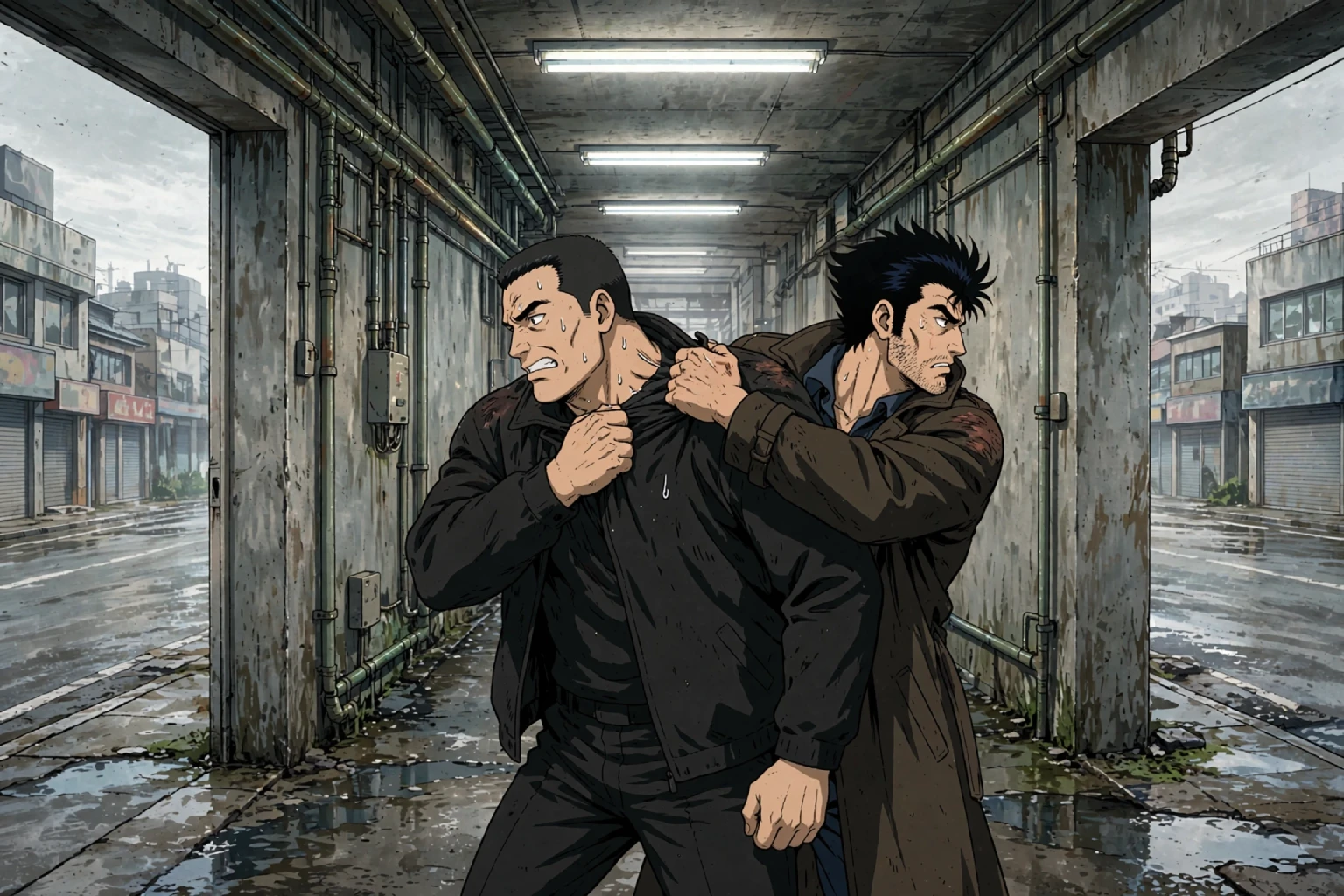
I was halfway through when he came in behind me.
I turned.
He was broad — not as tall as Brakka would have been, nothing like that, but the kind of broad that came from years of deliberate construction rather than accident. He moved through the passage without rushing, which was the move of someone who understood that rushing was what you did when you were uncertain and he wasn't uncertain.
"Murphy," he said.
Just the name. The way people said it when it wasn't an introduction.
He came forward and I moved left and the wall was closer than I'd calculated and the edge of my shoulder caught it and he used that half-second of contact to close the distance. His first move was a grab at my right arm — not a punch, a grab, the move of someone whose instruction was to control rather than hurt — and I got my left elbow back into the center of him before he could finish the grip.
It connected with something solid. He grunted and the grip loosened and I turned out of it and got two steps of distance but two steps in a four-foot passage is not distance, it's geometry, and he came again faster this time because I'd made him recalibrate.
His second move was better. He anticipated the left and went right and he got the arm, the wrist, and he was bigger and the leverage was his. He drove me toward the wall and I let myself go with the drive rather than against it, using his momentum, and got my back against the wall and my feet planted and pushed hard off the wall surface into him.
We went together into the opposite wall, his grip still on my wrist, my free hand getting purchase on the back of his collar. I was smaller than him and it mattered but it mattered less than position and I had position briefly — wall at my back and feet planted and the leverage of the push. I got my arm up across his throat from behind, not tight, not a choke, just the bar of the forearm that said this is where we are now and you know what it means.
He stopped moving.
We stood there in the narrow passage. Overhead the fluorescent hummed. Outside both ends of the passage the morning continued its morning.
He was breathing carefully. Not the careful breathing of fear — the careful breathing of someone assessing whether continuing cost more than stopping.
He stopped.
I held the position for a count of five, which was long enough to be certain and short enough not to be theatrical. Then I stepped back and he turned and we looked at each other.
My shoulder was saying things I didn't want to deal with yet. The wall had found the same joint the parapet had found two days ago on the rooftop — different impact, same complaint, the cumulative cost of using your body as a primary tool in a line of work that didn't come with insurance.
He looked at me with the flat professional assessment of someone filing information rather than experiencing anger.
"Tell Nishida I'll be in touch," I said.
He didn't say anything. He was taking the inventory of himself, the quiet post-incident accounting. Nothing broken. I was fairly certain nothing was broken on either side, which meant the instruction had been what I'd suspected — control, not damage, and whatever Nishida wanted from an intercepted Murphy, it wasn't his medical record.
They wanted the photographs. That's what four positions on a residential street at six in the morning communicated. Not a message, not intimidation. A search. They wanted to get me somewhere controllable and go through my coat and my pockets and find out where the Temmabashi photographs were and what exactly they showed.
The photographs were at Wada's office. They hadn't found them in the apartment or the office because I didn't keep important things in the obvious places. But they'd read enough of my notepad to know the photographs existed and they'd tracked me to the developer and they'd put the intelligence together and now they wanted the photographs themselves.
Because the photographs showed things that a signed statement alone couldn't show. The photographs were the physical evidence from inside the room, and physical evidence from inside the room was the kind of evidence you couldn't dismiss as fabricated or motivated.
The man in the passage hadn't found the photographs because the photographs weren't on me. He'd found a grey-market investigator who knew how to use a wall.
I went out the east end of the passage and walked south and didn't look back.
---
The shoulder was functional. I established this in the first three blocks by rotating it through its range at a pace that attracted no attention and found that functional was the accurate word — not good, not comfortable, functional. The joint would work. It would work while reminding me it was working, which was the version of injury that didn't stop you but didn't let you forget.
I found a coffee stand that was open and sat at the counter and put my coat on the stool beside me and took the inventory of the morning.
Four positions. Nishida at the east corner, two men bracketing the approach, one on the parallel street covering the exit. They'd mapped my approach routes — the service lane from the north, the parallel street return. They'd been in the Kita district before I arrived, which meant either they'd been watching for me since yesterday's conversation or they'd anticipated I'd come back and had prepared the geometry in advance.
The geometry told me something. Four people deployed at six in the morning on a residential street in the Kita district was not the deployment of an operation that was confident. It was the deployment of an operation that was frightened enough to commit significant resources to a problem that a confident operation would have handled differently.
A confident operation didn't send four people to intercept one grey-market investigator looking for photographs. A confident operation managed the situation at a level below that. Made calls, applied pressure through channels, waited for the investigator to make a mistake.
Four people at six in the morning meant the channels weren't working. The pressure hadn't produced the result they needed. And the photographs were loose somewhere in the city and they didn't know exactly where and that uncertainty was costing them more than four people's morning.
This was not a confident operation.
But it was still a dangerous one, which was the combination that got people hurt — frightened people with resources made decisions faster than careful people and some of those decisions were wrong and some of those wrong decisions caused damage before anyone could correct them.
I needed to reach Nishida before Amano made another decision.
The problem was reaching Nishida. She'd gone to Amano with the conversation from yesterday's street — that was clear from the morning's deployment. Amano had given her the four positions and the instruction to intercept. She was inside that structure now, actively engaged in the operation's response. A direct approach in the Kita district would give them another four-position opportunity, except next time they'd know I'd spotted the street geometry and they'd adjust.
I couldn't approach her physically. I couldn't call her — I didn't have a number and calling the oversight coordination division to ask for a specific extension was not a call I could make in any form that didn't announce itself.
But she had to eat lunch somewhere. She worked in a building in the Kita district and buildings in the Kita district had people in them who ate lunch and those people had regular lunch locations because that was what office workers did — they found the places within reasonable walking distance that suited them and they went to those places with the reliability of habit.
I knew what she looked like. I knew roughly where she worked. I knew she checked reflections and would clock a familiar face if she saw one.
Which meant I couldn't be the one in the coffee shop.
I paid for the coffee and walked to a payphone and called Sayuri.
She answered on the second ring.
"I need you in the Kita district at noon," I said. "Watching lunch places near the administrative cluster. I'll describe her. If she comes in anywhere you're watching, you leave an envelope on the table when you leave."
Silence.
"An envelope with what in it?" Sayuri said.
"A letter," I said. "I'm going to write it now. Two paragraphs. No signature."
"And if she doesn't come to any of the places I'm watching?"
"Then she brings her lunch from home," I said. "Which tells me something too."
"Murphy," Sayuri said. "If she goes to Amano with the letter—"
"She might," I said. "If she does, the letter tells Amano that I understand his operation is frightened and that his solution this morning didn't solve the problem. Which is information he already has, just confirmed." I paused. "But she'll read it before she decides what to do with it. That's what I'm counting on."
"What are you counting on her to understand from it?"
I thought about the morning. The four positions. The passage. The man with the careful breathing.
"That four people at six in the morning is what a frightened operation looks like," I said. "And that she's smart enough to know the difference."
I wrote the letter at the office. Two paragraphs, exactly. The first described what four positions at six in the morning communicated about operational confidence — not as an accusation, as an observation, the kind of observation that one professional made to another when they wanted the other to understand that the display had been read correctly. The second paragraph said the offer I'd made on the street was still available and had a time limit that was shortening.
I sealed it. Put her name on the envelope in plain handwriting. Walked to the Tenma district laundry and gave it to Sayuri with the physical description — the coat, the movement pattern, the reflection check — and two candidate coffee shops in the Kita district administrative cluster that I'd identified as the kind of places that suited people who ate alone and watched the room.
Then I went back to the office and waited.
---
The afternoon was the longest kind. The kind where the work you can do has been done and what remains is other people's actions and you can't move them and you can't hurry them and you sit at your desk and look at the case notes you've already read and wait.
I pulled the Yabata file out of the drawer and looked at it. The follow-up question the creditor had sent, the second address, the thread I'd been meaning to pull since before Kuroame. I looked at it for ten minutes and put it back. I couldn't do careful work on a skip-trace while waiting to find out whether a senior government official had received a two-paragraph letter in a coffee shop.
At two-forty-five Sayuri called.
"She came in," she said. "The second place — the one with the counter facing the window. I was at the back table. She sat at the counter and ate alone and read something on her phone."
"Did she see you?"
"No," she said. "She checked the room when she came in. I had my back to her and the angle was wrong for the mirror above the bar. She didn't make me."
"The envelope."
"I left it on the table when I settled up," she said. "I didn't look back."
I sat with that.
"She's either reading it now or it's in her bag," I said. "Or she picked it up and put it in a bin on the way out without reading it, but she's too careful for that."
"What happens if she goes to Amano tonight?" Sayuri said.
"Then Amano knows everything I wrote in the letter," I said. "Which isn't anything he doesn't already know. The value of the letter isn't information — it's the private conversation. Something she reads alone before she decides anything."
"You're asking her to think separately from Amano," Sayuri said.
"I'm asking her to think," I said. "Separately from Amano is what that looks like."
Sayuri was quiet for a moment. "How long do you give her?"
"She'll call by morning," I said. "Or she won't call."
I held the uncertainty through the afternoon and into the evening and the evening turned into the specific quiet of a city night that hadn't yet decided what it was going to do, and I sat in the office longer than I needed to and finally locked up and went home.
The notepad was on the kitchen table. I turned it over and looked at the four words one more time.
*We know about the photographs.*
Smart. That was the thing I kept coming back to. The message had been smart — not threatening in the blunt way of a threat, but precise in the way that said: we have read your situation correctly and we want you to know we have. That kind of precision came from someone who understood that the right message was more effective than the loud one.
A person who thought that way was a person who, given the right information and the right private moment, would make the calculation that their own exposure had shifted past the point where the operation's logic protected them.
I hoped I was right about that.
I'd been hoping I was right about a lot of things since Kuroame.
The phone rang at eleven forty-seven.
Number I didn't recognize — a burner, clean. I picked up.
"The letter," she said.
Her voice was different from the street. On the street it had been controlled with the specific blankness of professional presentation. Now it was controlled with something that cost more — the control of someone managing real internal weather.
"Yes," I said.
"You said the offer is still available." She paused. "I need to understand what that means specifically. Not in the abstract. Specifically."
I told her. The statement, the files, the journalist. Not a court, not a filing, not an institutional channel they had reach into. A story. Print. The specific irreversibility of publication.
"Hata Emi," I said. "National weekly. Independent editorial structure. She's published against institutional pressure before and she'll publish again."
Silence on the line.
"The files," she said. "If I give you the files — I'm describing material that came out of a government office. My government office. I'm describing what I did in that office. I'm—" She stopped.
"Yes," I said. "You are."
The silence this time was longer. Long enough that I could hear the city behind her voice on the line — not quite ambient noise, just the specific absence of interior quiet, the sound of someone who was not at home where they could think without the city in the background.
"I need until morning," she said.
"Horie Street market," I said. "Six fifty-five. The fish stall in the middle of the left side. Tell the woman behind the counter you're there about the standing order."
Silence.
"I don't know if I'll be there," she said.
"I know," I said.
The line went dead.
I set the phone down and sat in the kitchen with the notepad face-up in front of me and four words in precise handwriting and did not sleep for a very long time.


.png)
.png)
.png)