%20(1).png)
The stories were not warnings because they were exaggerated. They were warnings because they were incomplete.
Sergeant Hask Orven had been at Veth's Hollow eleven years earlier, when he was young enough to still believe that surviving a battle meant he understood it. He had run from that field with four other men out of the forty he had marched in with, and he had spent the eleven years since trying, with limited success, to explain to people who had not been there that the difference between Thur'Zakk and every other terror a soldier might face in his life was not a difference of degree.
It was a difference of kind.
He had tried to explain it to Lord-Marshal Cassian Thorne three days ago, standing in the high command tent of Aldwick Keep with the fortress's senior officers arranged around the map table like men already certain of their victory, and he had watched his own words fail to land the way water fails to land on stone that has decided, in advance, not to absorb it.
"You ran," Thorne had said, not unkindly, but with the particular patience men extend toward subordinates whose fear they have decided to forgive rather than credit. "Eleven years ago, as a green recruit in a battle your own account describes as chaos and collapse. I do not doubt what you saw frightened you. I doubt whether what frightened you was as large as memory has since made it."
"My lord, I am telling you—"
"You are telling me a story that has had eleven years to grow in the telling," Thorne had said. "Every survivor's account does. I do not say this to shame you, Sergeant. I say it because Aldwick Keep has walls forty feet high, a gate reinforced with iron bands that took two years to forge, and a kill-zone in the approach that has been refined by three generations of siege engineers specifically to break any force that reaches it, however large." He had gestured at the map, at the careful, confident lines marking the approach, the murder-holes, the angled walls that gave defenders interlocking fields of fire from three directions at once. "Thur'Zakk is a man. A large man, by every account, and a dangerous one, and I do not dismiss the army he commands. But he is not a force of nature that walks through stone, and I will not let eleven-year-old fear dictate the defense of this keep."
Hask had stopped arguing, because he understood, the way men understand things they have learned at the worst possible cost, that some warnings could not be carried into another person's certainty by force of words alone. Some warnings only worked if the person hearing them had already, somewhere in their own bones, felt the thing being warned about.
Thorne had not been at Veth's Hollow. Thorne had inherited his command, his confidence, and his walls from a father who had built Aldwick Keep specifically to be the kind of fortress that made conquest unprofitable, and he had never once, in twenty years of competent administration, faced anything that tested whether unprofitable and impossible were actually the same word.
He was about to learn the difference.
—
Thur'Zakk's column came up the eastern approach three days later, in numbers that matched, almost exactly, what Aldwick's scouts had reported and Thorne's siege engineers had planned for. This, Hask understood, watching from the wall with the particular dread of a man who had seen this exact confidence before, was itself part of the problem. Thorne's defense had been built to break an army of a certain size, moving in certain patterns, and the army currently filling the valley below moved exactly as predicted, which gave Thorne's officers a rising, mistaken confidence that the entire engagement would unfold exactly as planned.
Hask watched Thur'Zakk's command tent go up at the edge of bowshot, in plain sight, with no concealment and no apparent concern for the fact that it sat well within range of Aldwick's strongest engines.
"He doesn't even hide his position," one of the younger soldiers beside Hask said, with the particular relief of a man finding evidence for what he wanted to believe. "Arrogance. Or stupidity."
"Neither," Hask said.
"Then what?"
Hask did not answer immediately, because the honest answer — that a man does not hide his position when he has already calculated, correctly, that nothing behind these walls is capable of reaching him before he reaches them — was not an answer the younger soldier was prepared to hear, and Hask had learned, eleven years ago, exactly how much good it did to offer such answers before they could be believed.
"Watch the column," he said instead. "Not the tent. The column."
The younger soldier watched. Hask watched too, with the particular attention of a man checking a memory against present reality, hoping, in some small, exhausted corner of himself, that the memory had after all been larger than the truth.
The column moved the way Thur'Zakk's forces always moved, in his experience — without the loose, shifting disorder of armies whose discipline depended on fear of punishment, and without the brittle, performed precision of armies whose discipline depended on display. They moved the way water moves down a slope it has traveled many times before: economically, certainly, with no wasted motion and no hesitation, soldiers who had marched together long enough that coordination had stopped requiring conscious thought.
At the center of the column, mounted on nothing — walking, the way he always walked, because Hask had heard, eleven years ago, that no horse had ever been bred that could carry that particular weight for a full campaign without breaking beneath it — Thur'Zakk moved at the unhurried pace of a man who had never once in his existence needed to hurry toward a fight he had already decided to win.
Hask felt his hands go cold on the stone of the parapet, the way they had gone cold eleven years earlier, in the moment before the world at Veth's Hollow had stopped behaving the way a battlefield was supposed to behave.
—
Lord-Marshal Thorne addressed his senior officers from the gatehouse that evening, with the particular energy of a commander who believed, correctly by every measure his training had given him, that he held every advantage the engagement offered.
"Their numbers match our projections within five percent," he said, indicating the map, the careful annotations his staff had spent three days refining. "Our walls exceed anything their siege equipment, by all reconnaissance, is capable of breaching within any reasonable timeframe. Our kill-zone has been tested against forces of comparable size in three previous engagements and has never failed to break an attacking force's cohesion before they reach the gate itself." He looked around the room, at officers who had, by and large, spent their careers in Aldwick's specific, well-funded confidence. "Thur'Zakk's reputation is built on campaigns against forces that did not have these advantages. Open-field engagements. Undermanned garrisons. Terrain that favored mobility over fortification." He set his hand flat on the map, over the careful lines of the kill-zone. "He has never, in any account I have been able to verify, broken a fortress built specifically to break him. I do not intend for Aldwick Keep to be remembered as an exception born of insufficient preparation. We have prepared. The preparation will hold."
Hask, standing at the back of the room because his rank did not entitle him to speak unprompted in this company, said nothing.
He thought of the gate at Veth's Hollow, which had not been a gate at all, but a hastily fortified river crossing that forty green soldiers had been told, with the same confidence Thorne now carried, would hold against anything that came down the valley road.
He thought of the moment the holding line had stopped being a line.
He said nothing, because eleven years had taught him that nothing he said would be heard until it had already, again, become true.
—
The assault began at dawn, the way sieges traditionally began, with Thur'Zakk's forces advancing on the kill-zone in the disciplined, layered formation that Aldwick's defenders had specifically prepared to break. The first volleys from the wall found their marks with the precision three generations of siege engineering had purchased — shields raised, formations absorbing the losses with the grim, practiced endurance of soldiers who understood that the approach to any fortified position cost blood by design, and that the cost was the price of arriving close enough to do the actual work of breaking it.
For the better part of an hour, the engagement unfolded almost exactly as Thorne's projections had predicted.
Hask, stationed on the gatehouse wall with a clear line down into the kill-zone, watched the advancing formation absorb losses, reorganize, advance again, in the methodical rhythm of an army that had done this many times before and understood the rhythm completely. He watched Thorne's officers exchange the particular look of men whose preparation was being vindicated in real time, the look of professionals watching their calculations hold against reality.
He watched, at the edge of the formation, near the rear where a commander's position traditionally remained until the breach was achieved, Thur'Zakk begin, finally, to walk forward.
Not charging. Not rushing the wall with the reckless momentum a younger or lesser warlord might have spent on impatience. He walked the way he had walked up the valley road three days earlier — at the unhurried pace of something that understood, completely, that hurry was a thing other people needed and he did not.
"He's entering the kill-zone," someone said, with the particular sharpening of voice that came from a soldier recognizing an opportunity rather than a danger. "Sir, he's exposed himself to the full angle—"
"Concentrate everything on his position," Thorne ordered, and Hask heard, in the order, the genuine confidence of a commander who believed, completely and not unreasonably by every rule his training had taught him, that he had just been handed the engagement's decisive moment on a platter no enemy commander should have offered.
Every engine on the southern wall redirected. Every archer capable of the angle loosed everything they carried.
Hask watched the volley find him — watched arrows that should have ended the engagement on contact strike a man who did not so much as break stride, watched a ballista bolt that should have gone through plate and bone alike glance from something that was either armor or simply the man himself in a way Hask's mind, even after eleven years of trying to prepare for this exact moment, refused to fully process.
Thur'Zakk did not slow.
—
What happened in the kill-zone over the following minutes was, Hask understood even as he watched it, the thing he had spent eleven years failing to make Thorne believe, arriving now in a form that no amount of disbelief would be able to survive contact with.
Thur'Zakk did not fight the kill-zone's design. He simply moved through it at a pace that the design had never accounted for, because the design assumed an attacking force could be slowed, channeled, ground down by the accumulating cost of distance and exposure — assumptions that held true for every army that had ever tested them and failed, entirely, against a single man who treated the distance as an inconvenience rather than an obstacle.
He reached the wall's forward defensive line — a shield wall of Aldwick's finest infantry, drilled for exactly this contingency, trained specifically to absorb and hold against a breakthrough at the gate's approach — and did not go around it, or attempt the careful, tactical dismantling a clever commander might have favored.
He went through it.
Hask watched the shield wall, twelve men deep and trained to hold against cavalry charges and siege rams alike, buckle at the point of contact the way a door buckles against something that has stopped treating it as a door. He watched men who had trained their entire careers for exactly this moment discover, in the space of seconds, that their training had prepared them for an opponent whose strength existed on the same scale as their own, and that the actual scale of what they faced had simply never been accurately described to them by anyone who had not personally watched it.
The shield wall did not break through tactics. It broke through force, the specific, undeniable force of something that did not require an opening because it was capable of making one.
"Reform!" Thorne's voice, from the gatehouse, carrying the first genuine edge of alarm Hask had heard from him in three days of unshaken confidence. "Reform the line, hold the—"
There was no line left to reform.
—
Hask had told the younger soldier, three days earlier, to watch the column rather than the tent. He understood now, watching from the gatehouse wall as Thur'Zakk reached the gate itself, that he should have told Thorne the same thing about the entire engagement: that nothing about Thur'Zakk's army — its size, its formation, its conventional and unremarkable approach to a fortified position — had ever been the actual variable that mattered.
The gate of Aldwick Keep had been built over two years, reinforced with iron bands forged by smiths who had no equal in the region, designed by engineers who had studied every siege in the last century to ensure that whatever else might fail in a prolonged engagement, the gate itself would not. It represented, in the keep's own internal mythology, the physical proof of Aldwick's specific philosophy: that sufficient preparation, sufficient engineering, sufficient careful, patient investment in defense could neutralize any threat that arrived in conventional form.
Thur'Zakk stood before it for a moment that Hask would spend years afterward trying to accurately describe to people who had not seen it, a moment that held none of the drama a storyteller might have invented for it and all of the dread that no invented drama could have matched. He simply looked at the gate the way a man looks at an obstacle he has already, mentally, finished dealing with.
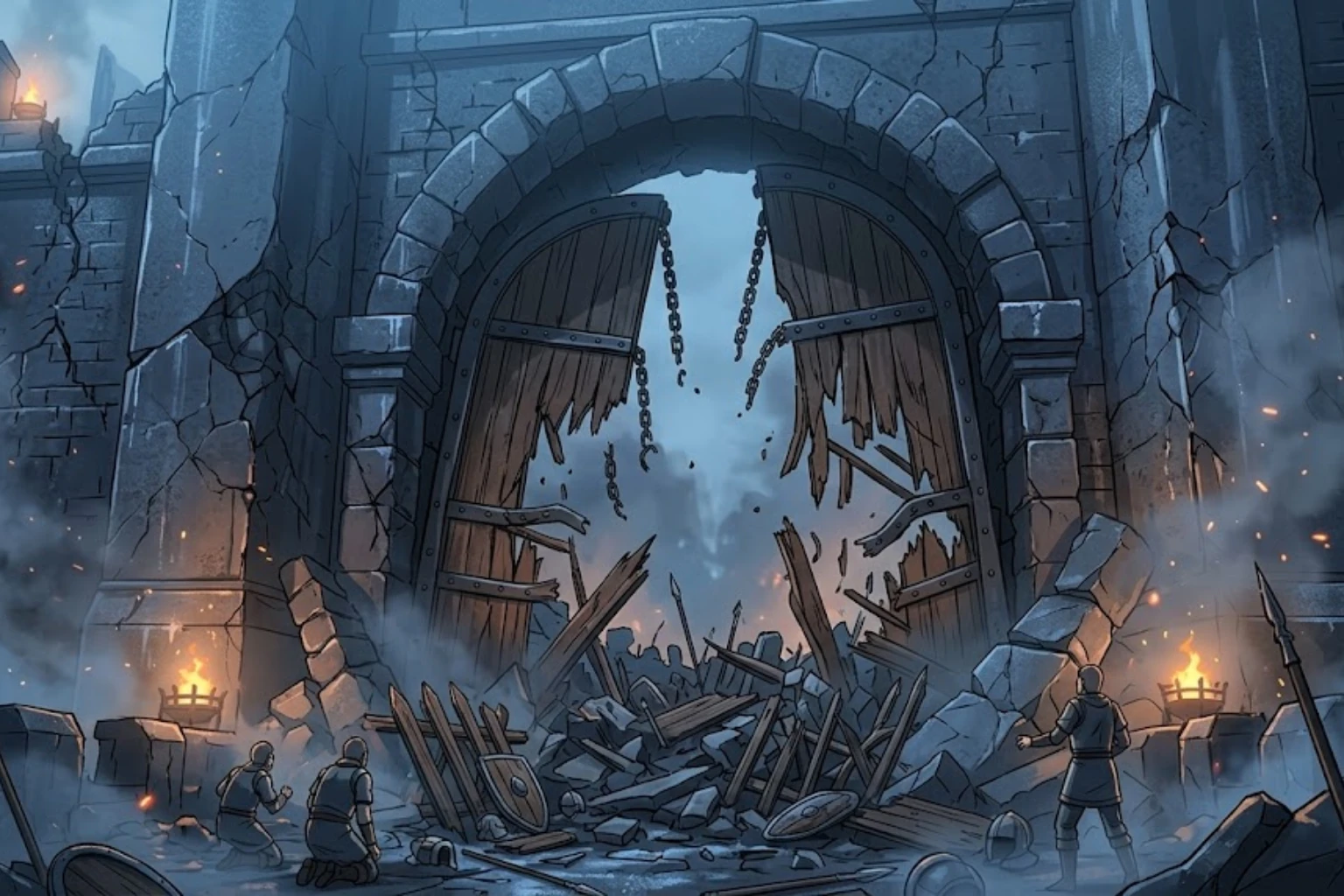
Then he put his hands against it, and the iron bands that had taken two years to forge gave way with a sound Hask had never heard a piece of metal make before and never wanted to hear again — not a clean break, but a long, tortured groan of material failing all at once under a weight it had simply never been designed to survive, because no one who designed it had imagined a force capable of applying that weight directly, by hand, without siege engine or battering ram or any of the conventional mechanisms that gates were built to resist.
The gate of Aldwick Keep, forged to outlast a century of conventional siege warfare, came apart in Thur'Zakk's hands in considerably less time than it had taken Thorne to deliver his confident address to his officers the evening before.
—
What happened after the gate fell was not, by any honest accounting, a battle.
Hask had seen battles. He had survived one, eleven years ago, that had cost him thirty-five of the forty men he marched in with, and even that chaotic, terrible collapse had still possessed the basic structure of a battle — two forces testing each other, advantage shifting, outcome genuinely uncertain until the moment it resolved. What happened at Aldwick Keep, in the minutes after the gate gave way, was something closer to weather arriving at a place that had built itself to withstand a storm of a different, lesser kind, and discovering, too late, the actual scale of what it now faced.
Thorne's officers, to their genuine credit, did not break and run in the first moment. They held, briefly, with the particular discipline of men who had trained their entire lives for exactly this kind of crisis and were not, whatever else might be said of their preparation, cowards.
It did not matter. Hask watched the same thing happen to Aldwick's finest defenders that had happened, eleven years earlier, to a river crossing manned by green recruits who had never trained for anything at all: the realization, arriving in real time across the faces of men who had believed, until this exact moment, that competence and discipline and sufficient preparation were variables that mattered against this particular opponent.
They did not matter. That was the thing Hask had never successfully explained to anyone who had not seen it, and the thing he watched, now, finally land in the faces of men who had needed eleven years and a broken gate to learn it the way he had learned it: that Thur'Zakk's reputation was not built on cleverness or tactics or the kind of advantage that better preparation could neutralize. It was built on a simple, terrible fact that no amount of walls or engineering or careful generational investment in defense could fully account for, because the fact itself predated every fortress built to resist it.
He was simply, physically, beyond what war as they understood it had ever required them to prepare for.
—
Lord-Marshal Thorne met him in the keep's inner courtyard, because retreat had stopped being a meaningful option the moment the outer gate fell, and because whatever else could be said about Thorne's misjudgment of the engagement's opening hours, he was not, in the end, a man who ran from the consequences of his own command.
Hask, positioned on the inner wall with a clear view down into the courtyard, watched the confrontation with the specific, exhausted clarity of a man watching history repeat a lesson he had already, personally, paid for once.
"You came expecting a fortress," Thorne said, and his voice held, even now, even with the outer gate broken behind him and his finest infantry scattered or fallen in the courtyard's approach, a measure of the composure that had made him, in every other respect, a genuinely competent commander. "I built one specifically to withstand you."
"You built one to withstand an army," Thur'Zakk said, and his voice, Hask noted even from the distance of the wall, carried none of the exertion the broken gate should have demanded of anyone, human or otherwise. "Your engineers studied a century of sieges and prepared, with genuine skill, for every contingency those sieges suggested." He looked at the courtyard, the fallen, the broken gate behind him. "I do not say this to diminish the effort. It was real preparation, against a real category of threat. You simply prepared for the wrong category."
"And what category," Thorne said, "would have served?"
Thur'Zakk considered the question with what Hask recognized, even in the wreckage of the moment, as genuine and unhurried thought — the same quality of attention Hask had heard described, in the stories that Thorne had dismissed as exaggeration, as the thing that made Thur'Zakk something other than simply the largest and strongest man on any given field.
"None," he said finally. "That is the thing your sergeant tried to tell you, three days ago, and that you were not yet capable of hearing." He looked toward the wall, toward Hask specifically, in a way that told Hask, with a small, cold certainty, that nothing about his presence on that wall eleven years ago or three days ago had gone unnoticed. "There is no fortress built by men that accounts for an opponent who has already survived more than the men building it have lived to remember. Your walls assumed a ceiling on what could arrive at your gate. I have spent longer than your keep has existed discovering, repeatedly, that ceilings built by people who have not seen what I have seen are not actually ceilings. They are simply the limit of what their imagination, however skilled, was capable of preparing for."
Thorne stood very still in the broken courtyard, surrounded by the wreckage of a defense built across two years and three generations of careful investment, and Hask watched him understand, finally and completely, the thing eleven years of survivor's testimony had failed to teach him in advance.
"Yield," Thorne said. Not a question. The plain acknowledgment of a commander who understood, now, exactly what continuing would cost, and exactly how little it would purchase.
"Yes," Thur'Zakk said. "That is the correct decision, and I would have respected you regardless of when you arrived at it. But understand what I am asking you to carry forward from today, because it matters more than the keep itself." He looked at Thorne directly. "Your sergeant was not exaggerating eleven years ago. He was describing something true and finding that truth insufficient to the task of being believed, because some things cannot be carried into another person's certainty by words alone." He paused. "Tell the story accurately, this time, to whoever commands after you. Not to frighten them unnecessarily. To ensure that the next commander who hears it does not require a broken gate to understand what the words were actually describing."
—
Aldwick Keep surrendered before midday, its garrison intact in number though not in confidence, its gate beyond any repair that would restore what it had represented rather than merely what it had physically been.
Hask Orven stood, afterward, in the wreckage of the outer gate, looking at the torn iron bands that had taken two years to forge and considerably less than two minutes to fail, and felt something that was not quite vindication and not quite grief, but held elements of both — the particular, complicated relief of a man who had spent eleven years being disbelieved and had finally, at terrible cost to people who were not himself, been proven entirely and exactly correct.
A young soldier — the same one who had stood beside him on the wall three days earlier, who had called Thur'Zakk's open position arrogance or stupidity and found, in the hours since, considerably more respect for the question than he had previously held — approached him at the gate's ruin.
"You were there," the soldier said. "Eleven years ago. At the place you mentioned."
"Veth's Hollow," Hask said. "Yes."
"Why didn't anyone believe you?"
Hask looked at the broken iron, the torn gate, the courtyard beyond it where Aldwick's garrison was even now beginning the long, humbled work of accepting terms they had been certain, three days earlier, they would never need to consider.
"Because the stories sound impossible," he said, "until the day they don't. And on that day, it is always too late to have believed them sooner." He looked north, toward the column already beginning its orderly process of securing the keep, Thur'Zakk visible at its center, walking at the same unhurried pace he had carried up the valley road three days before, as though breaking the most fortified gate in the region had cost him nothing more than the walking itself had. "The stories were never exaggerated. That was the mistake every commander before Thorne made, and the mistake Thorne made despite every warning available to him." He paused, watching the war-king's column move through the broken gate and into the keep's interior with the same patient, economical discipline it had carried through three days of approach. "They were incomplete. No word anyone has ever found has been large enough to carry the whole of what that man actually is. We simply keep trying anyway, because the alternative — saying nothing, and letting the next fortress learn it the way Aldwick just did — costs more than the inadequate words ever could."
The young soldier said nothing for a long moment, watching the column, the broken gate, the particular, settling quiet of a keep that had just learned, completely and at last, the actual shape of what it had spent two years preparing to resist.
"I believe you now," he said finally.
"I know," Hask said. "Everyone always does. Eventually." He turned from the gate's wreckage, toward the long work of whatever came next for a keep that no longer belonged to the lord who had built it. "The trouble has never been whether people come to believe it. The trouble is how much it costs them, every single time, to arrive there."


.png)
.png)
.png)