%20(1).png)
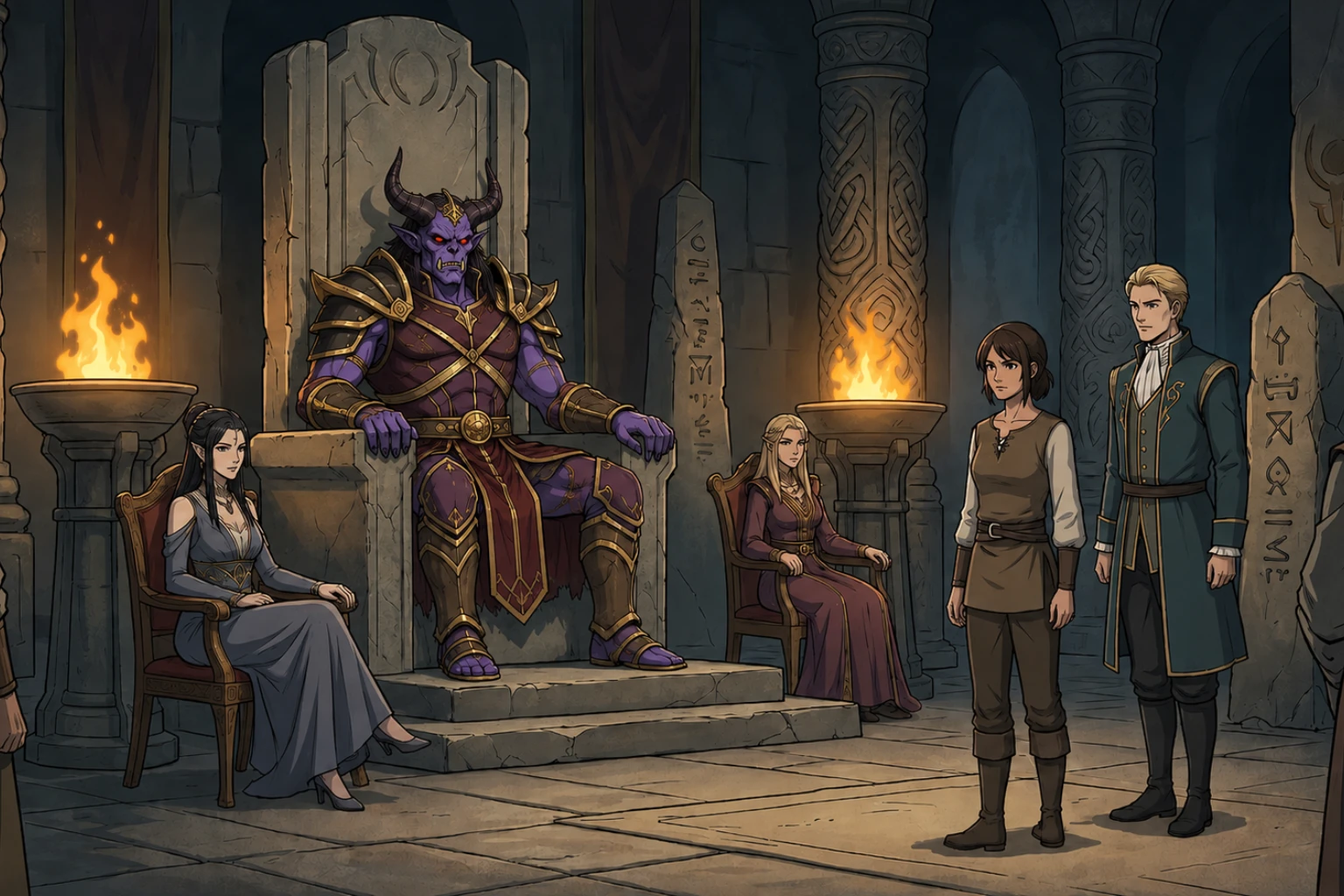
The holding of Ferris Vale had no proper ruler for three years before anyone thought to call that a crisis.
It had a ruler in every practical sense. When the river plague took Lord Edrin Vale and both his named heirs within the span of a single brutal month, the holding's steward — a woman named Maren Ashe, born in the lower terraces to a family of glassmakers, with no blood claim to anything and no expectation that she would ever need one — had simply continued doing the work that needed doing, because the alternative was watching the granaries mismanage themselves into a famine on top of a plague. She organized the quarantine wards. She redistributed the dead lords' stores before hoarding could take root. She held the harvest together with the unglamorous, unceasing attention of someone who understood that a holding does not run on ceremony, and by the time the plague had burned itself out, the people of Ferris Vale had stopped asking who their lord was, because they already knew who had kept them alive.
Three years later, a man named Cassian Vale arrived from the southern branch of the family with a sealed lineage record, a small honor guard, and a complete certainty that the throne was his.
He was not wrong, by the old paper of it. The Vale line ran through him, properly, traceably, with none of the ambiguity that usually gave heralds work. He was also, within a week of his arrival, the kind of lord who had the granary stewards beaten for an inventory discrepancy that turned out to be a clerical error, who referred to the lower terraces as the convenient parts of the holding rather than by their names, and who had said, within earshot of enough witnesses that the saying of it traveled, that the woman currently running his inheritance into the ground would learn her place once the formalities were settled.
The formalities, as it happened, were not so easily settled.
Ferris Vale's elders — old enough to remember when the holding's law had still answered to clan custom rather than the newer charters the Conclave preferred — pointed out, with the particular stubbornness of people defending something they were not entirely sure they understood, that succession in the old Ashenveil reckoning required recognition, not merely blood. That the rite existed for a reason. That a ruler installed by paper alone, without the standing-witness and the binding words, had never been considered properly seated in the years before the charters had smoothed all of that away into something simpler and, in their private opinion, lesser.
Cassian Vale's lawyers called this superstition. Maren Ashe's supporters called it the only law that mattered. And because Ferris Vale sat near enough to the northern reaches that both sides knew exactly whose judgment would settle it beyond all argument, both factions sent riders north within the same week, each one certain that the old war-king would rule in their favor once he understood the truth of things.
Thur'Zakk read both messages. Then he went.
—
He met them on the holding's own boundary stone, because it seemed correct to him that a dispute about old recognition should be settled on the kind of ground recognition had always been settled on, and because Vethara had pointed out, in her flat distant way, that making people come to him changed the shape of what they were willing to say, and he did not want the shape changed this time. He wanted to see them as they actually were, in the place they actually ruled.
Cassian Vale arrived with his honor guard arranged for display rather than protection, his lineage record carried by a clerk in a polished case, and an expression that suggested he had already rehearsed his gratitude for the inevitable verdict. He looked at Thur'Zakk the way men of his particular confidence looked at things too large to argue with directly — assessing not whether the thing could be moved, but which angle of flattery might move it on his behalf.
Maren Ashe arrived with two glassmakers and a granary steward, none of them armed, all of them looking considerably more frightened of the war-king than they did of the man contesting her right to keep doing the work she had already been doing for three years.
"You are the steward," Thur'Zakk said to her.
"I was the steward," she said. "Before the plague, I mean. After — I don't know what I am. The people call me lady. Lord Vale's lawyers call me a usurper. I have not had the leisure to decide which of those is more accurate."
"And you," he said to Cassian, "are the blood of the Vale line."
"The rightful lord," Cassian said, "by every law your own people wrote." He said it with the particular emphasis of a man who believed he had found the one argument that could not be countered, and Thur'Zakk noted, the way he noted such things, that the man had clearly prepared this line with some care and had not prepared anything else nearly as carefully.
"Tell me," Thur'Zakk said, "about the recognition rite. As you understand it."
Cassian's lawyer began to speak. Thur'Zakk did not look at the lawyer.
"As you understand it," he said again, to Cassian directly.
Cassian recovered. "The standing-witness. The binding words spoken before the clan elders, confirming the blood claim before the holding." He gestured, slightly impatient, at the sealed record his clerk carried. "It is a formality my line has always observed. I am prepared to observe it now, the moment the holding's elders are gathered to witness it."
"You understand it," Thur'Zakk said, "as a confirmation. Something performed after the claim already exists, to make the claim official."
"Is that not what it is?"
Thur'Zakk turned to Maren Ashe.
"And you," he said. "What do you believe it is?"
She was quiet for a moment, the particular quiet of someone choosing not to perform an answer she had prepared for flattery's sake. "I don't know the old rite," she said. "I never expected to need it. I kept the granaries open during the plague because people were going to starve if I didn't, and I didn't think about whether that made me a lord. I only thought about whether it made people alive." She looked at him directly, with none of Cassian's rehearsed gratitude. "If your law says the dead should have starved because no one with the proper blood was left standing to feed them, then I don't understand your law, and I am not sure I want to."
Vethara, in the deep shadow beside the boundary stone, made a sound that was almost amusement.
Cassian's lawyer began, again, to object to the framing. Thur'Zakk raised one hand, and the lawyer discovered, the way most people discovered, that there was a particular quality to that small gesture that ended arguments more thoroughly than any verbal command could have.
"I was there," Thur'Zakk said, "when the rite began."
The boundary stone was quiet. Even the wind seemed, for a moment, to be listening, though that was almost certainly only the particular stillness that settled over people once they remembered exactly how old the man in front of them actually was.
"It was not, in the beginning, a confirmation of blood," he said. "It became that, later, when clans grew larger and inheritance grew more complicated and ceremony became a convenient way to settle disputes that might otherwise have been settled with knives." He looked at the stone beneath his feet, worn smooth by centuries of negotiations he had and had not personally witnessed. "But the rite's oldest form — the form I knew, the form my own clan practiced before blood-right calcified into the only thing anyone remembered — required something else entirely. The standing-witness was not a ceremony performed at the claimant. It was a testimony given by the people. The elders did not confirm a bloodline. They testified, before the clan, that they had watched this person, and that what they had watched was a person fit to be trusted with what the clan needed kept."
He looked at Cassian.
"Blood made a person eligible to be considered," he said. "It never made a person recognized. Recognition was never something done to a claimant by ceremony. It was something a people did, slowly, by watching — and the binding words were only ever a public naming of a thing that had already happened, in the years before anyone thought to write it down."
Cassian's composure had not entirely held. "That is not the rite as it has been practiced for generations."
"No," Thur'Zakk agreed. "It is the rite as it began. What it became afterward was simpler, because simpler is easier to administer, and administration has a way of eating the things it claims to preserve." He paused. "You are eligible, Cassian Vale. Your blood is not in question and was never going to be." His voice did not change, level and geological as it had always been, but something in it settled, the way a verdict settles rather than merely being spoken. "But you have been in this holding for nine days. In nine days, the only testimony your people have given of you is fear, and the only watching they have done is of a man who had granary stewards beaten over an error in arithmetic. That is not nothing. It is, in fact, exactly the kind of watching the old rite was built to account for. They have watched you. They have testified, in the only way available to them — by what they say about you when you are not present to hear it."
Cassian opened his mouth. Closed it.
Thur'Zakk turned to Maren Ashe.
"And you," he said, "have been watched for three years. By people who had every reason to resent a glassmaker's daughter telling lords' stewards how to ration grain, and who instead, by every account I gathered before I rode south, speak of you the way people speak of something they have decided, slowly and without ceremony, to trust completely." He paused. "You did not perform the binding words. You did not need to. The binding words were only ever meant to say out loud what a people had already decided in the long, unglamorous accumulation of being kept alive, season after season, by someone who did the work without asking for the credit." He looked at her steadily. "You have been recognized, Maren Ashe. You were recognized the first winter you held this holding together, by every measure the rite was built to take. The ceremony simply never caught up to what had already happened."
The boundary stone held its silence a moment longer.
"This is not the law," Cassian said, and his voice had lost the rehearsed confidence it had carried into the meeting, replaced by something thinner, closer to genuine alarm. "The charters—"
"The charters," Thur'Zakk said, "are the Conclave's business, and the Conclave is welcome to govern itself by them. But you did not come to me citing the charters. You came to me citing the old law, because the old law was the one that flattered your claim on paper." He looked at Cassian without anger, which was, Vethara had once told him, often more unsettling to people than anger would have been. "You cannot invoke a law for its name and then object when its substance is returned to you in full."
He let that settle.
"Here is what I will tell the elders of Ferris Vale," he said. "That Maren Ashe is recognized, by the oldest and truest form of the rite this holding's people ever practiced, and that the ceremony, when it is performed, will simply be the naming of a thing already true rather than the deciding of a thing still contested." He turned, finally, fully to Cassian. "And I will tell them that Cassian Vale remains, if he chooses, blood of the Vale line and welcome within this holding on whatever terms its lady is willing to extend him — which is a mercy, and which he should understand as exactly that, and not as a defeat to be quietly resented until it can be reversed."
Cassian said nothing. His lawyer said nothing. The silence had, by then, the particular quality of an argument that both sides understood had already ended.
"There is one more thing," Thur'Zakk said, and Cassian, despite everything, looked up, because some old instinct in men like him still expected that a war-king's one more thing might yet be the lever that turned a verdict back in their favor.
"If you remain in this holding," Thur'Zakk said, "you will be watched. As everyone is watched, under the oldest form of the law you tried to use against a woman who has already passed that test three winters running. If, in time, the people of Ferris Vale come to trust you as they have come to trust her — that, too, is a form of recognition no ceremony can manufacture and no paper can forge." He paused. "It is available to you. It has simply not yet been earned."
He turned from the boundary stone. Maren Ashe stood very still, her granary steward beside her with an expression that suggested he had not, until this exact moment, fully believed any of this would end in their favor.
"Lady Ashe," Thur'Zakk said, and watched her absorb the title the way people absorbed things that had been true for a long time before anyone said them aloud. "Govern as you have governed. It is, by every account I could gather, more than adequate."
He walked back toward the column waiting beyond the boundary stone, and Vethara fell into step beside him in the failing light, the way she always did, the way she had now for longer than either of them entirely cared to count.
"You changed the rite," she said. Not an accusation. A notation.
"I returned it," he said. "To what it was before it was simplified into something easier to write down and harder to actually practice." He walked for a while in silence, the cold air settling around the column as the boundary stone receded behind them. "Blood is easy to verify. That is its only virtue. Watching takes years, and trust besides, and most administrations eventually decide that easy is worth more than true." He paused. "I am not most administrations."
"Cassian will resent this for the rest of his life."
"Probably," Thur'Zakk agreed. "Resentment is not, by itself, evidence that a judgment was wrong." He looked north, toward the long road and the colder country beyond it. "He was given a path back into trust. Whether he walks it is no longer my concern. I have done the only thing I came to do, which was to say clearly what the old law actually required, rather than what was convenient for whoever cited it loudest."
Vethara was quiet for a while, in the particular way that meant she was turning something over with the patience only she possessed.
"Three years," she said finally, "of being watched, before anyone thought to call it recognition."
"Yes."
"That is a long time to wait for a word to catch up to what was already true."
Thur'Zakk thought of a pasture above a winter camp, and a girl with the same quality of attention he had carried his whole life, and a shadow beneath a scrub tree that had watched for thirteen years before either of them had thought to call it anything at all.
"Yes," he said again, quieter this time. "It often is."
The column moved on into the gathering dark, and behind them, Ferris Vale's elders began, without further argument, the long-overdue work of saying out loud what their people had already known for three winters running.


.png)
.png)
.png)