%20(1).png)
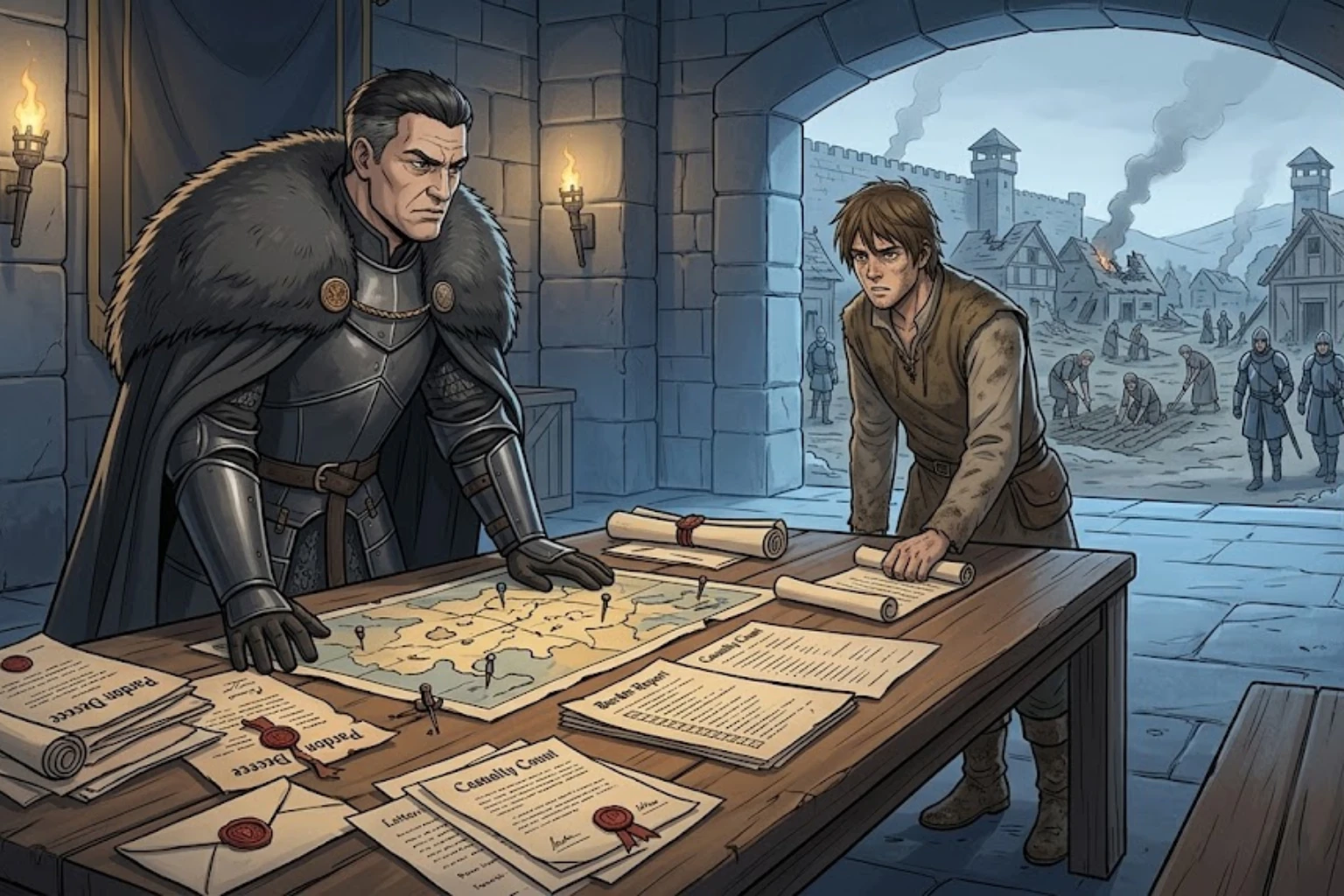
The holding of Cael's Reach had never been important enough to matter, which was, for most of its history, the closest thing to safety a small place could ask for. It sat at the edge of the Conclave's eastern administration, too poor in resources to attract ambition and too far from any contested border to attract armies, and its people had built a quiet, unremarkable life around fishing the cold straits and tending the thin highland pastures that were the only farmland the rocky coast allowed.
It became important, finally, for the worst possible reason: a man named Commander Tessen Brael decided it was useful.
Brael held a Conclave military commission for coastal defense, a commission that had, over eleven years of quiet erosion, expanded well past its original boundaries the way commissions do when no one is paying close enough attention to notice the drift. He requisitioned Cael's Reach's fishing fleet for what he called defensive patrol duty, leaving the holding without the boats it needed to feed itself through the winter. When the holding's elders petitioned for the fleet's return, he requisitioned grain stores instead, calling it a wartime necessity against a threat from the northern straits that several independent observers had quietly begun to suspect did not entirely exist in the form he described it.
When a young fisherman named Orin Cael — no relation to the holding's name beyond the coincidence two centuries of small-place history sometimes produced — organized a formal complaint to the regional magistrate, Brael's soldiers burned the man's boat in the harbor as an example, and three of Orin's neighbors who had signed the complaint alongside him were detained for what Brael's official report called interference with active defensive operations.
The magistrate, reviewing the matter, found grounds to act against Brael.
Brael's lawyers found the Tessen Pardon.
—
Thur'Zakk remembered the day the pardon was granted with the particular clarity he reserved for moments he had argued against and lost.
It had been eighteen years earlier, in a different season of a different conflict, when a young officer named Tessen Brael — barely more than a boy then, in the war-king's accounting of such things — had disobeyed a direct order during the campaign against the river raiders, abandoning his assigned position to pull six wounded soldiers out of a collapsing trench under fire that should, by every reasonable calculation, have killed him. The disobedience had nearly cost the engagement. The six lives he saved had been real, specific, irreplaceable lives, and the old ruler of that province — Lady Serai Doman, young herself then, newly seated and still finding the shape of her own authority — had been moved nearly to tears by the soldier's account when it was given to her, and had granted him, on the spot, a formal pardon for the disobedience and a standing clemency that would, in her words, ensure that a man capable of such courage under fire would never again be punished for choosing mercy over orders.
Thur'Zakk had stood in that same room.
"The mercy is correct," he had told her, afterward, when the room had emptied of everyone but the two of them. "What he did deserves recognition, not punishment. I do not argue that."
"Then we agree."
"We agree on the act," he had said. "I am asking you to narrow the pardon to the act. As written, it does not forgive what he did that day. It forgives, indefinitely, whatever he might claim was done in service of mercy, for as long as he lives, to be invoked at his own description of his own motives." He had looked at her with the particular weight he reserved for warnings he expected to be ignored. "A young man who saves six lives today is not the same man who will hold this pardon in his hand twenty years from now. People change. Power changes them faster than most things do. The pardon, as written, does not bind itself to the man you are forgiving. It binds itself to whatever he becomes."
Lady Doman had been twenty-six, generous, and certain — the particular certainty of someone who has just witnessed an act of genuine courage and wants, with her whole heart, to ensure that courage is never punished again.
"You are asking me to be less merciful," she had said, "to guard against a future that has not happened yet."
"I am asking you to be precisely as merciful as the act deserves," he had said, "and no more open-ended than that. Mercy that has no edges is not larger mercy. It is simply mercy that has stopped being aimed at anything in particular."
She had not narrowed the pardon. She had been moved, and young, and certain that her own generosity could not become a weapon in someone else's hands, and Thur'Zakk had watched her sign the broader version with the specific, helpless clarity of a man who understood exactly what he was watching and could not make it stop without overriding a sovereign authority he had no standing to override over a single document neither of them yet knew would matter.
He had not forgotten it. He did not forget things of that particular weight.
Eighteen years later, Lady Serai Doman was sixty-four years old, still ruling the same eastern province with the same fierce, generous heart she had carried at twenty-six, and entirely unwilling to believe that the gentle, terrified young officer she remembered had grown into the man currently burning fishing boats in a harbor three days' ride from her court.
—
The envoy who came north to Thur'Zakk's column was not sent by Lady Doman, and that fact, more than anything else in the message that announced her arrival, told him most of what he needed to know before she had said a single word.
Her name was Issa Doman, the Lady's grandniece and ward, raised in Doman's own household since the death of Issa's parents in a border skirmish when she was seven, close enough to the old ruler that the court referred to her, half-affectionately, as the second heart of the house. She arrived without an honor guard befitting her station, having ridden, by the evidence of the road-dust on her, considerably faster and with considerably less ceremony than her position would normally allow.
"My great-aunt does not know I am here," she said, before Thur'Zakk had finished assessing her, which told him a second important thing.
"Sit," he said.
She sat. Vethara, in the shadow at the edge of the tent, watched the girl with the particular attention she reserved for people carrying weights heavier than their years had prepared them for.
"Tell me about Cael's Reach," Thur'Zakk said.
Issa Doman told him. Not the magistrate's careful report, which she had read and which she described, with visible contempt for its careful, administrative softening, as a document written by people who had decided in advance how much truth the situation could be allowed to contain. She told him about Orin Cael's burned boat. About the three neighbors still held, eleven days now, on charges that grew vaguer the longer anyone examined them. About the holding's winter stores, requisitioned twice in eighteen months under the banner of a northern threat that the regional garrison's own scouts had stopped reporting any evidence of nearly a year ago.
"And the pardon," Thur'Zakk said.
"The pardon," she said, and something in her voice changed — not anger exactly, but the particular flatness of someone delivering a fact they had turned over so many times privately that saying it aloud had stopped costing what it once had. "He has invoked it four times in three years. Each time for something worse than the time before. The magistrate who tried to act against him for the boat-burning was overruled the moment Brael's lawyers cited the clemency by name. My great-aunt's own seal, on her own signature, undoing every attempt anyone makes to hold him accountable for anything." She looked at Thur'Zakk directly. "She does not see it. I have tried to show her. I have brought her the reports myself, and she reads them, and she says — every time — that the man who saved those six soldiers could not have become this, that there must be some other explanation, that Brael has enemies who exaggerate his conduct for their own reasons." She paused, and the flatness cracked slightly, revealing something rawer beneath it. "I love her. I need you to understand that before anything else I say. I am not here because I have stopped loving her. I am here because loving her and watching her be wrong are, it turns out, things a person can do at the same time, and I have run out of other ways to make her see what is actually happening."
"You came to me," Thur'Zakk said, "rather than confronting her again yourself."
"I came to you," she said, "because I am twenty-three years old and she is the only family I have left, and the last four times I tried to tell her the truth, she heard a frightened girl who didn't understand military necessity, and I do not know how to make her hear anything else from me." She held his gaze, and he noted, the way he noted such things, the particular courage required to say the next part plainly. "You were there. When she signed it. I read the old court records — they still exist, in the deep archive, if you know where to look, and I went and I looked. You argued against the breadth of it. You told her exactly what it could become." She paused. "I am not asking you to fix Cael's Reach for me, though I would be grateful if you did. I am asking you to help me find a way to make her actually hear what I have not been able to make her hear alone."
Thur'Zakk was quiet for a long moment.
"The pardon," he said finally, "is the more immediate matter. Cael's Reach cannot wait for your great-aunt to reckon with eighteen years of avoided truth. People are detained now. A holding is starving now, under requisitions justified by a threat that does not exist." He looked at her. "I will deal with the pardon directly, and with Commander Brael, in whatever way the situation requires. That much does not need her permission, and has not, since the day she signed a document broad enough to outlive her own ability to control what it became."
"And after?"
"After," he said, "is yours to carry, if you are willing to carry it. I will not do that part for you. Not because I am unwilling, but because some truths only land when they come from someone who has earned the right to say them by loving the person enough to risk the relationship in the saying." He paused. "I can stand beside you when you say it, if standing beside you would help. I cannot say it instead of you and expect it to do what it needs to do."
Issa Doman absorbed this with the particular stillness of someone receiving exactly the answer they had feared and hoped for in equal measure.
"Then I will carry it," she said.
—
Thur'Zakk rode to Cael's Reach himself, with a small column and Vethara beside him, and arrived three days before Commander Brael expected anyone with the standing to challenge him would think to come.
He found the holding in the particular state of quiet, grinding endurance that small places adopt when they have been failed by every structure meant to protect them and have not yet given up only because giving up was not, practically, an available option. The harbor held the burned wreck of Orin Cael's boat, still moored at its blackened post because no one had been given leave to clear it, a daily reminder displayed with what Thur'Zakk recognized, immediately, as deliberate cruelty rather than mere neglect.
Commander Brael received him in the holding's requisitioned hall with the particular confidence of a man who had successfully weathered every challenge to his conduct for three years running and saw no reason to expect this one would be different.
He was not, Thur'Zakk noted, an obviously cruel man to look at. That was, in its own way, the most instructive thing about him. He had the bearing of someone who had once been brave in a way that mattered, and had built, on top of that old bravery, eighteen years of slow accommodation to his own unaccountability, the way a man's posture slowly accommodates a permanent injury until he no longer notices he is favoring it.
"War-King," Brael said, with a small, correct bow that held just enough performed deference to suggest he did not believe any was actually owed. "I confess I did not expect this particular visit."
"You are aware," Thur'Zakk said, "of why I have come."
"I am aware that small holdings generate complaints when defensive necessity requires sacrifice they are not accustomed to bearing." Brael's voice held the particular smoothness of a man who had given this explanation enough times that it had stopped requiring effort. "I regret the hardship. I do not regret the necessity. The northern straits remain a genuine threat, and—"
"Your own garrison's scouts," Thur'Zakk said, "stopped reporting evidence of that threat eleven months ago. I have read their reports. I imagine you have as well, since you are the one they report to."
Brael's smoothness did not crack, exactly, but it thinned.
"Threats are not always visible in advance," he said.
"No," Thur'Zakk agreed. "But a threat invisible for eleven months, invoked specifically each time it becomes convenient to requisition something this holding cannot afford to lose, begins to resemble something other than a threat." He let that settle. "Tell me about the boat-burning."
"An object lesson," Brael said, with the first flicker of something that was not quite defensiveness — closer to genuine conviction, which was, Thur'Zakk thought, in some ways worse. "Interference with active operations cannot be tolerated, regardless of the sympathy the interfering party might generate. I made a difficult decision under difficult circumstances. I have made many such decisions across eleven years of command. They are not always comfortable to witness from outside the responsibility of command itself."
"And the clemency you invoked when the magistrate moved against you for it."
"Lady Doman granted that clemency in full understanding of what it was," Brael said, and here, for the first time, something genuinely defensive entered his voice. "I did not coerce it. I did not deceive her. She gave it freely, in gratitude for service that nearly cost me my life, and I am within my rights to invoke a pardon that bears her own seal."
"You are within the letter of it," Thur'Zakk said. "I was in the room when she signed it. I want you to understand that I am not disputing whether the document permits what you have done with it. I am telling you, directly, that the document was wrong to permit it, that I said so at the time, and that the gap between what a young ruler's generosity intended and what an aging commander's convenience has made of it is precisely the gap I came here to close."
Brael's hand, Thur'Zakk noted, had gone very still on the table between them.
"You cannot revoke a sovereign's pardon," Brael said.
"No," Thur'Zakk agreed. "I cannot, and I have no intention of trying. What was granted to the young officer who pulled six men from a collapsing trench remains granted, in full, exactly as it should. That act earned exactly what it received." He held Brael's gaze without anger, which was, as it had been with Cassian Vale, considerably more unsettling than anger would have been. "But a pardon for an act does not become a pardon for a person, regardless of how many years pass between the act and whatever the person later becomes. What you have built since — the boats requisitioned under threats your own scouts no longer believe in, the boat burned as an object lesson, the neighbors detained on charges that grow vaguer with scrutiny — none of that was contained within what the trench earned you. You have spent eighteen years invoking a debt that was already paid in full on the day it was incurred."
"Lady Doman's seal—"
"Lady Doman's seal," Thur'Zakk said, "forgave a disobedience that saved six lives. It did not forgive whatever you might later decide, in your own description of your own motives, constituted mercy. I told her, at the time, that the document did not bind itself to the man she was forgiving — that it bound itself to whatever he became. You are the proof of the warning, Commander. I take no satisfaction in that. I would have preferred to be wrong."
The hall was very quiet.
"What happens now," Brael said, and his voice had lost, finally and completely, the smoothness it had carried into the room.
"The pardon, as it applies to anything beyond the act it was granted for, ends today," Thur'Zakk said. "I will tell Lady Doman myself that this is what should always have been written, and she will understand, because she is not a foolish woman, only a generous one who was never shown the cost of generosity without edges until the cost had already accumulated past the point of easy correction. The clemency for the trench stands. Everything invoked beyond it — every requisition, every detention, every object lesson burned in a harbor to frighten people who had every right to complain about losing the boats that fed them — falls under the regional magistrate's authority, unobstructed, starting the moment I leave this hall." He paused. "Orin Cael's neighbors will be released today. The boats, what remains of them, will be returned. The grain requisitioned under a threat that no longer exists will be accounted for and restored or compensated, in full, by whatever means your command currently possesses."
"And if I refuse."
"Then you will discover," Thur'Zakk said, with the particular quiet that Vethara, beside him, had once told him was more frightening to most people than any volume could have been, "that a commission granted by the Conclave answers, eventually, to consequences considerably less patient than the ones you have spent eighteen years successfully avoiding. I would prefer you simply comply. It is, by a wide margin, the less costly path remaining to you."
Brael did not refuse.
—
Orin Cael's neighbors were released that afternoon. Thur'Zakk stood in the harbor as it happened, beside the blackened wreck of the boat that had started the holding's particular reckoning, and watched three frightened, exhausted people walk free into a square that had not, until that morning, expected to see them walk free at all.
He did not stay to watch the longer work of restoration — the boats rebuilt, the grain accounted for, the slow unwinding of three years' accumulated harm. That work belonged to the magistrate now, unobstructed, and to the holding's own considerable capacity for quiet endurance, which had, after all, carried it this far already.
Issa Doman had ridden south to Cael's Reach behind him, watching the entire confrontation from the back of the hall with an expression Thur'Zakk recognized, because he had worn something like it himself, more than once, watching a wrong finally corrected too late to undo what it had already cost.
"Now," she said, as they stood together at the harbor's edge, "I have to tell her."
"Yes."
"What do I say?"
Thur'Zakk considered the question with the particular care he gave to questions that mattered more than their length suggested.
"Tell her the truth in the order it actually happened," he said. "Not the order that makes it easiest to hear. She granted a mercy that was real and good and deserved. She wrote it without edges because she trusted, completely, that the man she was forgiving would never become someone capable of abusing that trust. He did, slowly, the way most people who abuse trust do — not in one dramatic betrayal, but in eighteen years of small accommodations that each, individually, felt almost reasonable." He looked at the harbor, the rebuilding already beginning in small, determined motions along the dock. "Tell her that loving someone and protecting them from consequence are not always the same act, and that she has spent eighteen years confusing the two, the way generous people often do, because the alternative — believing the frightened, brave young man she remembers could become this — was unbearable to hold."
"Will she forgive me? For making her hold it?"
"I don't know," Thur'Zakk said honestly. "I have been wrong about such things before. I have believed in people who did not survive what was done to them by the truth they were finally asked to carry." He paused, and something in his voice settled into the particular weight Vethara recognized, beside him, as the closest thing to tenderness he allowed himself in front of strangers. "But I have also watched people who loved each other enough to survive much harder truths than this one. You did not come north because you stopped loving her. You came because you loved her enough to risk the part of the relationship that depended on her never having to know." He looked at the young woman beside him, twenty-three years old and carrying a weight that should, by any fair accounting, have belonged to someone considerably older. "That is not nothing. Whatever she does with the truth, the love that made you carry it to her was never in question."
Issa Doman was quiet for a long moment, watching the harbor, the slow, patient work of a small place putting itself back together.
"Will you come with me?" she said. "When I tell her?"
"If you want me to stand beside you," Thur'Zakk said, "I will stand beside you. But the words have to be yours. I told you that at the start, and it remains true now." He looked north, toward the long road back to the province that had waited eighteen years for a debt it had not known it was accumulating. "Mercy without edges feels, in the moment it is given, like the largest possible kindness. It is only later, when the debt has had time to grow in the dark, unattended, that anyone discovers what it actually cost." He paused. "Your great-aunt gave a kindness that was real. She simply never learned, until today, that kindness still requires tending, the way anything alive requires tending, or it grows into something its giver never intended and would not recognize if she met it now."
Behind them, the harbor continued its quiet work. Ahead of them, the long road north waited, and at the end of it, an old woman who had spent eighteen years loving a memory instead of reckoning with what that memory had become.
Vethara fell into step beside them as they turned toward the column, the way she always did, the way she had now for longer than the world had words to properly measure.
"You did not enjoy that," she said quietly, to Thur'Zakk alone, as they walked.
"No," he agreed. "I rarely do." He looked back, once, at the harbor receding behind them, the small holding already beginning the long work of becoming, again, the quiet, unremarkable place it had been before anyone decided it was useful. "Lady Doman's mercy was never the failure. The failure was leaving it unattended for eighteen years, the way a field left untended does not stay empty — it simply grows whatever takes root in it, wanted or not, while no one is watching closely enough to notice the difference." He paused. "I told her that, eighteen years ago. I will tell her again, if she will hear it from me a second time. But the telling will mean more, this time, coming from someone who loved her enough to carry it across three days of hard road rather than someone who merely watched, from the room next door, and warned her in advance."
The column moved north, into the gathering evening, carrying a young woman toward the hardest conversation of her life, and an old war-king who had watched, more times than he cared to count, how long a debt could wait in the dark before finally, inevitably, coming due.


.png)
.png)
.png)