%20(1).png)
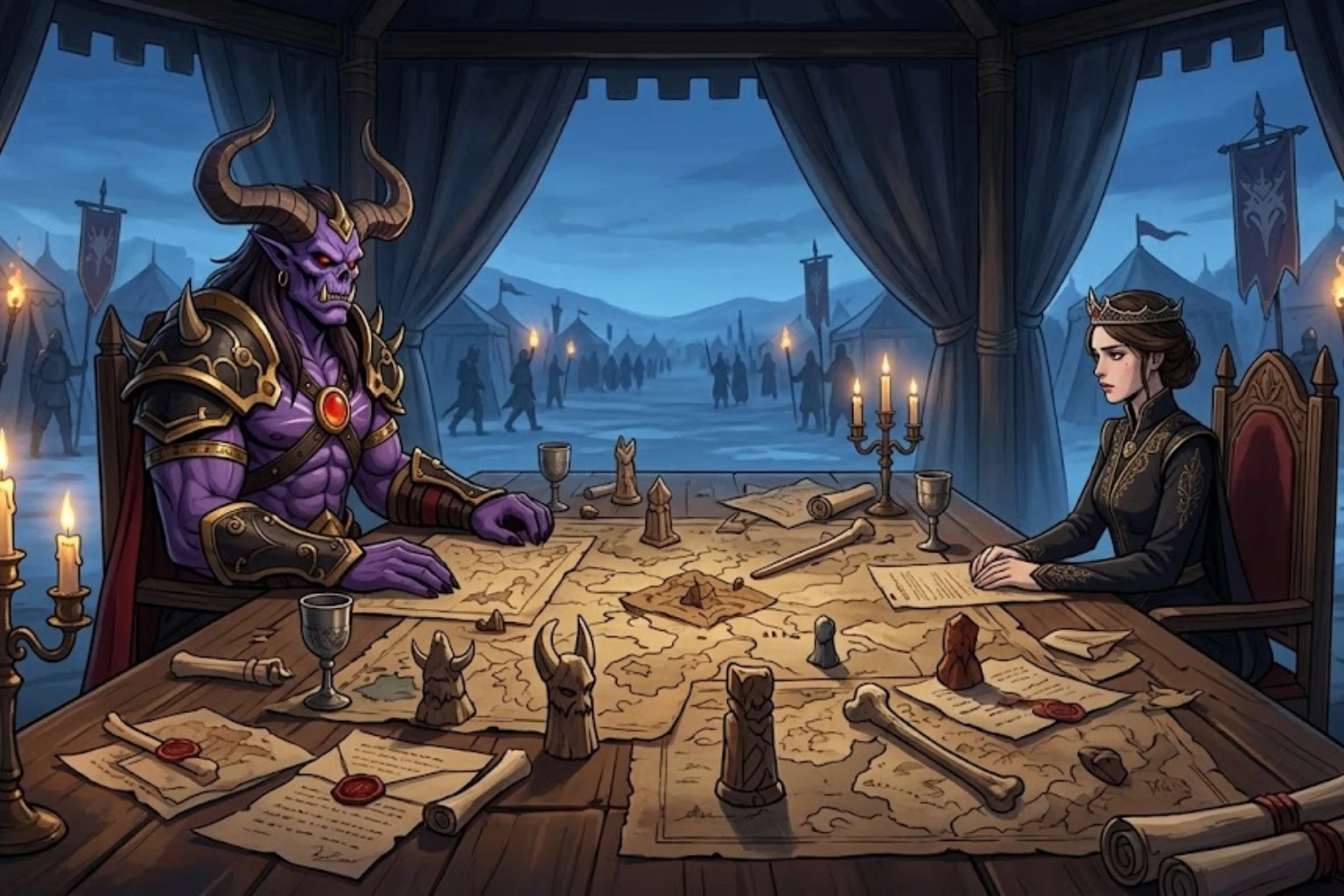
The war had been running for eleven years before Queen Avelis Sorn inherited it.
Her father had started it over a trade dispute that had since been resolved, rendered irrelevant by the deaths of the men who had originally disagreed, and replaced by a much older and more intractable kind of conflict — the kind that begins as a reason and continues as a habit. The eastern coalition had its grievances. The Sorn crown had its pride. Eleven years of border skirmishes, burned harvests, and the slow bleeding of both treasuries had produced nothing except a generation of soldiers who had never known peacetime and an aristocracy on both sides that had constructed so many layers of justification around the war's continuation that they could no longer locate the original argument beneath them.
Avelis Sorn had been eighteen when her father died.
She was twenty-two now, which meant she had been queen for four years and at war for all of them, and she had spent those four years learning, with increasing desperation, that the men who advised her had a collective investment in the war's continuation that no military reality was going to dislodge. Her generals had built their careers on it. Her treasury ministers had built financing structures around it. Her court had organized its entire political ecosystem around the alliances and enmities the war had produced.
She had tried diplomacy. The eastern coalition's leadership had sent back terms so insulting they appeared to have been designed specifically to be rejected, which, she had eventually understood, they had been — because the eastern coalition's leadership had the same problem she did, mirrored exactly, a court that had grown around the war like a tree growing around a fence post and could no longer be separated from it without killing the tree.
She had tried a different approach.
She had sent a letter north.
Thur'Zakk read the letter twice.
It was short. That was the first thing. He had received communications from monarchs that ran to forty pages of elaborate justification and careful positioning and the political equivalent of a man backing slowly toward a door he needed to reach. This letter was one page, written in a direct hand, and it said:
I have inherited a war I did not start, cannot finish, and cannot afford to continue. My advisors have interests I cannot align with my kingdom's survival. I am told you have no interest in my kingdom's politics and significant interest in stability in the northern reaches. I would like to discuss whether those interests overlap. I am aware this letter may be ignored, may be used against me politically, or may result in an army on my border. I am sending it anyway because the alternatives have not worked and I am running out of time.
— Avelis Sorn, Queen of the Delvane Western Reach
P.S. I have read the Ashenveil covenants. I understand what they require. I will not waste your time with offers I cannot honor.
He set the letter down.
He looked at it for a while.
"She wrote it herself," Vethara said, from the shadows at the back of the room. Her voice, when she chose to use it, was like something heard from the far side of a very deep place — present, recognizable as language, carrying an quality of distance that had nothing to do with volume.
"Yes," Thur'Zakk said.
"The postscript."
"Yes."
"You're going to go."
He picked the letter up again and looked at it. Outside, his camp went about its quiet business in the late afternoon light, soldiers moving between tents, the sound of metal being maintained, someone somewhere speaking in a low voice about supply line logistics with the focused calm of a person who understood that logistics was the actual architecture of war and everything else was decoration.
"She's twenty-two," he said.
"You were younger than that during the second great war," Vethara said. "When you made your first covenant."
"I was not a queen of anything. I was a clan commander with forty soldiers and a very clear sense of what I was willing to die for." He set the letter down again. "She rules a kingdom. Courts are different from clans. The pressures are—"
"You're looking for reasons not to go."
He was quiet.
"Because she's young," Vethara said. "And you have watched young rulers before."
The room was very still. Through the tent wall, diffused afternoon light.
"I have watched them be adequate," Thur'Zakk said finally. "I have watched them be extraordinary. I have watched them begin with extraordinary clarity and be ground, slowly, into something administrative and careful by the people around them." He paused. "I have watched that happen to good people. People who deserved better than what their position did to them." His voice carried something that was not quite bitterness — something older and more weathered, the residue of bitterness that has been processed and accepted but not forgotten. "It is difficult to watch."
"Then go before she's ground down," Vethara said. "While she's still the person who wrote that letter."
Thur'Zakk looked at the postscript one more time.
I will not waste your time with offers I cannot honor.
He sent a reply north. Then he began preparing for a journey rather than a campaign, which required different arrangements and a different quality of attention, and he gave both the attention they required because he had learned, across a very long life, that the distinction between a journey and a campaign was sometimes the most important distinction there was, and that getting it wrong in either direction cost things that could not be recovered.
They met in a border town called Ashfen, which had the quality of most border towns — built for transit rather than permanence, its architecture the architectural equivalent of a shrug, structures designed to shelter people passing through rather than to house people staying. The inn Avelis Sorn had chosen was its largest building, which was not saying much.
She had come with four guards and an advisor.
Thur'Zakk noted this when he arrived. Four guards and one advisor was either extraordinary confidence or extraordinary naivety, and he had learned to distinguish between the two by looking at the guards rather than the ruler. Naïve rulers brought guards who were decorative. Confident rulers brought guards who were watching everything with the quiet competence of people who had assessed every exit before their charge walked through the door.
These guards were watching everything.
He filed that away.
Avelis Sorn was standing rather than sitting when he entered the room, which was also noted. She was young — he had known she was young but knowing and seeing were different — with the particular quality of stillness that people develop when they are frightened and have decided not to show it, which is different from the stillness of someone who is not frightened. She wore her crown because she had understood that this meeting required it, that she could not walk into a room with Thur'Zakk as a private person and expect to negotiate as a queen. It sat on her head with the slightly effortful straightness of someone who had not yet fully made peace with what it meant.
He stood in the doorway for a moment. He was aware of what he looked like in doorways. He had been aware of it for a long time and had made a considered decision, early on, to simply exist as what he was and allow people to do what they needed to do with the first moment of seeing him. Some people needed a moment to remember how to breathe. There was no shame in that and performing a diminishment of himself to ease it served no one.
Avelis Sorn looked at him for three full seconds — he counted, as he always did, because three seconds was the threshold, the point at which the first shock of physical reality began to resolve into assessment — and then she said, clearly: "Thank you for coming."
Not welcome or please be seated or any of the formulations that filled the space while a person recovered their composure. Thank you for coming. Direct. Acknowledging that he had made a choice, that the choice had cost something, that she was aware of the exchange.
He came into the room. He sat — or rather, lowered himself into the chair that had been placed across from hers, which was somewhat undersized for him but that was the nature of furniture in a world not built to his dimensions, and he had long since stopped finding it notable. His two accompanying soldiers positioned themselves at the door and became furniture themselves, as his soldiers did.
Vethara he had left outside. This conversation did not require her, and her presence tended to complicate rooms in ways that were sometimes useful and sometimes not, and he had assessed that this was a not.
"Your letter," he said, "was honest."
"I didn't see the point in being otherwise." She sat. Her back was straight in the way that backs are straight when someone is maintaining it rather than when it comes naturally, but the maintenance was invisible to anyone who wasn't looking for it. "You would have known."
"Yes."
"Then there was no strategic advantage in being anything except direct." She looked at him steadily. "I need to end a war. I cannot end it from inside the political structure that's maintaining it. I need — I need someone outside that structure. Someone my court cannot pressure, cannot negotiate around, cannot—" She stopped. Chose her words more carefully. "Someone who changes the mathematics."
"You want me to threaten someone," Thur'Zakk said.
"I want you to be present," she said. "There is a difference."
He looked at her.
She held the look. Not without effort — he could see the effort, the thin line of it, the conscious choice to not look away. But she held it.
"Tell me," he said, "about the war."
She told him about the war.
Not the diplomatic version, not the court version, not the version her advisors had constructed that explained every Sorn decision as measured and justified and the eastern coalition as intractable aggressors. She told him the version she had assembled herself, from the original records, from her father's private correspondence, from eleven years of watching the machine run and trying to understand what the machine was actually for.
It had started, she said, over navigation rights on a shared river. A Sorn merchant consortium had been undercutting eastern trade by using a river route that passed through disputed territory and paying the local toll-keepers less than the agreed rate. The eastern coalition had complained to her father formally, through proper channels, twice. Her father had dismissed both complaints because the consortium's leading family had political connections to the Sorn court that made their interests effectively his interests. The eastern coalition had then retaliated by blocking a different route, which had cost the same consortium significant money, which had translated, through those political connections, into her father deciding this was a matter of sovereign dignity.
"He started a war," Thur'Zakk said, "to protect a merchant family from the consequences of their own violations."
"Yes," Avelis said. "And now eleven years have passed and the merchant family in question has been absorbed by a larger consortium and no one in my court is directly protecting their interests anymore, but the war continues because—"
"Because it has become its own reason," he said.
"Yes."
He was quiet for a moment. Outside, Ashfen conducted its border-town business in the street — carts, voices, the sound of a transaction being negotiated in the local commercial dialect that mixed three different linguistic roots into something functional if not elegant.
"The eastern coalition's leadership," he said. "Tell me about them."
She told him. Two primary figures: a duke named Errath Vohl who had inherited command of the eastern forces from his father and who was, by her assessment, not a cruel man but a deeply entrenched one — someone who had organized his entire identity around the war's prosecution and would find its end existentially threatening. And behind Vohl, less visible, a council of trade advisors who had built significant financial infrastructure around the war's continuation and whose interests were, if anything, more durable than Vohl's because they were less personal and therefore less susceptible to anything as variable as human feeling.
"Your own court," Thur'Zakk said.
She was quiet for a moment. This was the harder inventory.
"General Caed," she said finally. "He is not corrupt. He is — he is a good soldier who has spent eleven years becoming excellent at this particular war and who has nothing prepared for what comes after it. His fear is not malicious. It is just—"
"Real," Thur'Zakk said.
"Real," she agreed. "And my treasury minister, Foss, who has issued bonds against future war revenues that would be extremely complicated to unwind, and who has not told me the full extent of this, but I have found enough to know the extent is significant." She paused. "And three members of my advisory council who have family connections to eastern coalition noble houses and who have been very carefully ensuring that no negotiation succeeds, which they do not do openly because they are not stupid, but they do it consistently, and I have watched it long enough to be certain."
"You have named your own court's saboteurs to me," Thur'Zakk said. "With specificity."
"You asked about the war," she said. "Those people are the war, at this point. The fighting is almost incidental."
He looked at her for a moment. That same notation he had made about Vassell — filed, relevant — but different in character. Vassell had been a competent man who had done his research. This was something else. This was someone who had looked clearly at a situation that implicated people she depended on, in a position where clear looking was actively dangerous, and looked anyway.
"What do you want from me," he said. Not what are your terms — he had heard her terms, in the letter and in this room. He meant something more specific. Something underneath the politics.
She seemed to understand the distinction. She was quiet for a moment in a way that was not hesitation but thought.
"I want someone to stand beside me," she said, "who cannot be moved." She looked at him steadily. "I am twenty-two years old and I have been queen for four years and every room I walk into is full of people calculating how to use me. My generals. My treasury minister. My advisory council. The eastern coalition's leadership. Even the people who are loyal to me — genuinely loyal — are always also calculating." She paused. "I need to walk into a room with Errath Vohl and his council and my own court in it and have them all understand that the calculation has changed. That there is a variable in the room they cannot account for and cannot remove." She met his amber eyes without looking away. "I am not asking you to fight for me. I am asking you to stand there."
Thur'Zakk was quiet for a long time.
Through the wall, Ashfen's street commerce continued. A child somewhere laughed at something. A cart wheel needed grease and was protesting the fact in a long descending squeal.
"You understand," he said, "what it means when I stand somewhere. What it implies. What history it carries."
"Yes."
"You understand that my presence will be read as alliance. That there are people who will use that reading against you — who will say you have bargained with darkness, invited an old evil, compromised your legitimacy."
"I have thought about that," she said. "At length."
"And?"
"And my legitimacy is currently protecting a war that has killed more people than I can name and emptied a treasury that was funding schools and road maintenance and grain storage for bad harvest years." She said it without heat, without performance — the flat delivery of someone who has already done the moral arithmetic and arrived at an answer they can live with. "I would rather have complicated legitimacy and a kingdom than clean legitimacy and a ruin."
Outside, Vethara waited in whatever way Vethara waited — patient, dark, remembering things.
"I will not be instructed," Thur'Zakk said. "I will stand where I judge it useful to stand and speak when I judge it useful to speak. I will not perform menace on request, and I will not be deployed as a weapon against anyone who has not earned that response by their own actions." He looked at her. "If the people in that room behave as you describe — if Vohl is entrenched but not wicked, if your general is frightened but not corrupt — then they will be treated accordingly. My presence is not a threat. It is a fact. What they do with the fact is their choice."
She nodded. Slowly. The nod of someone filing away every word precisely as spoken.
"There is one more thing," he said.
She waited.
"The three members of your advisory council. The ones with eastern connections who have been sabotaging negotiations." His voice had not changed. Level, geological. "When this is finished — however it finishes — they will be removed from your council. Not imprisoned, not punished beyond that, unless evidence of direct material harm emerges that requires a tribunal. But removed. With explanation. Publicly."
She had clearly expected this. "Yes."
"And you will tell your treasury minister Foss that the bonds are going to need to be unwound, and that you have known about them for longer than he thinks, and that you expect full disclosure within thirty days." A pause. "Not because I require it. Because your kingdom requires it, and you know it, and having someone beside you who is not calculating may make it easier to do the thing you already know needs doing."
Avelis Sorn looked at him for a long moment.
"You read the letter very carefully," she said.
"I read everything carefully," he said. "It is one of the few habits I have maintained consistently across a very long life."
Something shifted in her expression — not quite a smile, something more complicated than that, the expression of someone who has been carrying a weight alone for long enough that the presence of another load-bearing point produces feelings that are not entirely comfortable because the relief contains, embedded in it, the full measure of how long the carrying has been going on.
"When?" she said.
"Three days," he said. "I need to send word to my column. Arrangements need to be made." He stood, and the room reorganized itself around his standing as it had reorganized itself around his sitting, adjusting to the physical fact of him with the unconscious compliance of spaces that were not built for what they were currently containing. "And you need to send word to Vohl. Neutral ground. Tell him — tell him that new factors have entered the situation and that a final negotiation is warranted. Don't tell him what the factors are."
"He'll assume the worst," she said.
"Good," Thur'Zakk said. "Let him spend three days assuming. People who have spent three days afraid of what might be in a room are more honest when they discover what is actually in the room than people who arrive with their positions already fully constructed."
He moved toward the door. His two soldiers came away from the wall.
"Thur'Zakk," Avelis said.
He paused.
She seemed to consider her words for a moment. Then: "Why? Not the politics of it. Not the stability of the northern reaches." She looked at him with the directness that was, he was beginning to understand, simply how she was built — not performance, not strategy, just the default mode of someone who had decided that clarity was less expensive than its alternatives. "Why did you come?"
He was quiet for long enough that the quality of the silence became its own kind of answer — the silence of someone considering whether to say a true thing, and deciding.
"You said you were running out of time," he said. "In the letter." He looked at the door rather than at her. "I have watched a great many people run out of time. For causes that deserved better. For kingdoms that were worth more than what happened to them." A pause. "The letter suggested you might be worth more than what was happening to you. I came to see if that was accurate."
He went out.
Avelis Sorn stood in the undersized room in the border town inn for a moment after the door closed, her crown on her head and her back still straight from maintenance rather than ease, and breathed.
Four guards and one advisor looked at her and waited.
"Send word to Vohl," she said. "Neutral ground. Three days."
The negotiation took two days.
On the first day, Thur'Zakk stood at the back of the room and said nothing.
He did not need to say anything. He stood with the stillness of old stone and the patience of very deep water and let every person in the room do their own mathematics. He watched Errath Vohl — a heavy man in his fifties with the bearing of someone who had been important for long enough that importance had become load-bearing to his posture — look at him, look away, look back, recalculate, look away again. He watched the eastern coalition's trade council whisper among themselves and reach the collective conclusion that their financial infrastructure was worth considerably less than they had believed an hour ago. He watched General Caed sit very still with the expression of a man who had just understood that the room had changed shape around him.
He watched Avelis Sorn sit at the head of the table and negotiate.
She was good. Better than good — she was precise in the way that people are precise when they have done the work, when they know the file as well as the person presenting it and better than the person opposing it, when they have war-gamed every position and arrived with nowhere left to be pushed. She offered what she could afford to offer. She held what needed to be held. When Vohl's council tried to introduce a clause that would have re-established the original river navigation dispute as an ongoing arbitration matter — quietly, inserted into the third annex, the kind of thing designed to be unnoticed until it became a foundation for the next eleven years — she caught it, named it, and removed it with a calm specificity that left no room for the pretense that it had been accidental.
Thur'Zakk noted that.
On the second day, Vohl asked to speak with him privately.
This happened in a side room, just the two of them, which was itself a statement — Vohl's council had wanted to be present and Vohl had refused them, which told Thur'Zakk several things simultaneously about what Errath Vohl actually was underneath the entrenchment.
"You're here for her," Vohl said. Not accusatory. Assessing.
"I am here," Thur'Zakk said, "because the situation warranted it."
"She's young."
"Yes."
"She doesn't—" Vohl stopped. Reformulated in a way that suggested the original sentence had contained something he didn't want to have said. "The war has momentum. Eleven years of momentum. Stopping it is not—"
"Ending things that have built momentum," Thur'Zakk said, "is precisely as difficult as it appears and must be done anyway." He looked at Vohl. "You know this war should end."
Vohl was quiet.
"You have known it for some time," Thur'Zakk said. "The reasons it hasn't ended are not primarily military and are not primarily yours. They are structural. The structures around you have found the war useful and have arranged themselves to perpetuate it." He paused. "You are not a wicked man, Errath Vohl. You are a man who has been wicked by accumulation — by ten thousand small choices not to push against structures that should have been pushed against." He said it the way he said most things: without heat, without judgment in the performative sense, the flat delivery of someone describing a condition rather than condemning a person. "That is recoverable. But only if the pushing begins."
Vohl looked at him for a long time.
"If I sign," he said, "my council will—"
"Your council's objections," Thur'Zakk said, "are their problem. Not yours. You did not appoint them to govern you." He paused. "Sign what is worth signing. Hold what genuinely needs holding. Let the rest go."
The silence stretched.
"You've done this before," Vohl said. Not a question.
"Many times," Thur'Zakk said. "The specifics change. The structure does not." He stood, which meant the meeting was ending. "I will tell you one thing more. The queen across that table is better at this than anyone in that room has yet understood. Including you. She will be difficult to work with from a position of opposition, and she will be — I believe — considerably more than useful from a position of honest engagement." He looked at the door. "You have the opportunity to be the person who helped end this rather than the person who prolonged it. That distinction has a way of mattering, eventually. To you, if no one else."
He went back to the main room.
That afternoon, Errath Vohl signed.
The treaty required two months to be ratified through both courts. It was not Thur'Zakk's business to manage those two months and he did not attempt to — he returned to his column and his maps and the ongoing administration of a domain that was not a kingdom and not a camp but something between, something old enough to have preceded the current vocabulary for such things.
Vethara walked beside him on the road north.
"Well?" she said, in her deep-distance voice.
"The trade council will try to insert complications during ratification," he said. "She will catch them. The three advisory council members will be removed within the month — she had already decided, she was waiting for the right moment." He thought about the postscript. I will not waste your time with offers I cannot honor. "The treasury situation will take longer. Foss is more frightened than dishonest and frightened men move slowly." A pause. "She will manage it."
"You sound certain."
"I am not certain," he said. "I am — reasonably confident. Which is different." He walked for a while in silence, the road north stretching ahead between frost-edged fields. "She will make mistakes. She is twenty-two and she is learning and learning requires mistakes. Some of what she believes about governance will turn out to be wrong in ways she cannot currently see." He paused. "Most people in her position stop being able to learn at some point. The position closes around them. They start protecting what they know instead of questioning it."
"And her?"
He thought about the inn room. The four guards watching every exit. The crown worn with effortful straightness that was not yet ease. The directness that was not strategy but architecture — built into her, the way some things are built into people before the position gets to them.
"I don't know," he said honestly. "I have been wrong before. I have believed in people who did not survive what was done to them by the thing they were trying to do." He paused. "But I am less wrong than I used to be. I have had considerable practice." He looked at the road ahead. "She sent a letter. She came to Ashfen with four guards and a clear understanding of her own situation and no language in the room that she had not earned by knowing what she was talking about." He paused. "I have sat across from a great many rulers. Most of them were performing a version of the thing she was actually being."
Vethara was quiet beside him in the way she was quiet — fully, comprehensively, with the quality of depth that reminded him, always, of what she was and what she remembered.
"You liked her," Vethara said.
"I respected her," he said. "Which is more durable and more useful and considerably harder to earn." He paused. "She may, eventually, earn the other thing as well. There is time."
The road ran north between the frost-edged fields and the cold sky and the trees that had been standing long enough to have their own kind of patience, and Thur'Zakk walked it with the unhurried steadiness of something that had walked a great many roads and understood that the walking was itself the work, and that arriving was merely a pause before the next road began.
Behind him, to the south, a young queen sat at a table covered in ratification documents and worked through them with the careful, clause-by-clause attention of someone who had learned, recently and at considerable cost, that the details were where the long games were played.
She had set her crown aside while she worked.
That, if he had known it, would have satisfied him more than the treaty.
The war ended. Formally, on the forty-third day of ratification, with both courts' seals on the document and a ceremony that the official histories would later describe as dignified and the participants would privately describe as tense in the specific way that rooms are tense when several people in them know that the wrong word at the wrong moment could still unravel eleven years of careful architecture.
Avelis Sorn removed three members of her advisory council within three weeks of returning from Ashfen. She gave the public explanation she had promised: clearly, with specificity, without the softening language that would have let the removal be reinterpreted as something less than what it was.
The treasury situation took fourteen months to fully resolve. Foss cooperated, eventually, and was retained in a reduced capacity that he found humiliating and which Avelis decided was proportionate.
Errath Vohl retired from active military command within a year of the signing. He spent the remaining decade of his life writing a history of the eastern coalition that was, by all accounts, more honest than anyone had expected it to be.
Thur'Zakk sent no communication after the ratification.
Seven years later, during a conflict on the Delvane coast that threatened to spread into the northern reaches, Avelis Sorn sent a letter north.
It was, again, one page.
He read it carefully.
He sent a reply the same day.


.png)
.png)
.png)