%20(1).png)
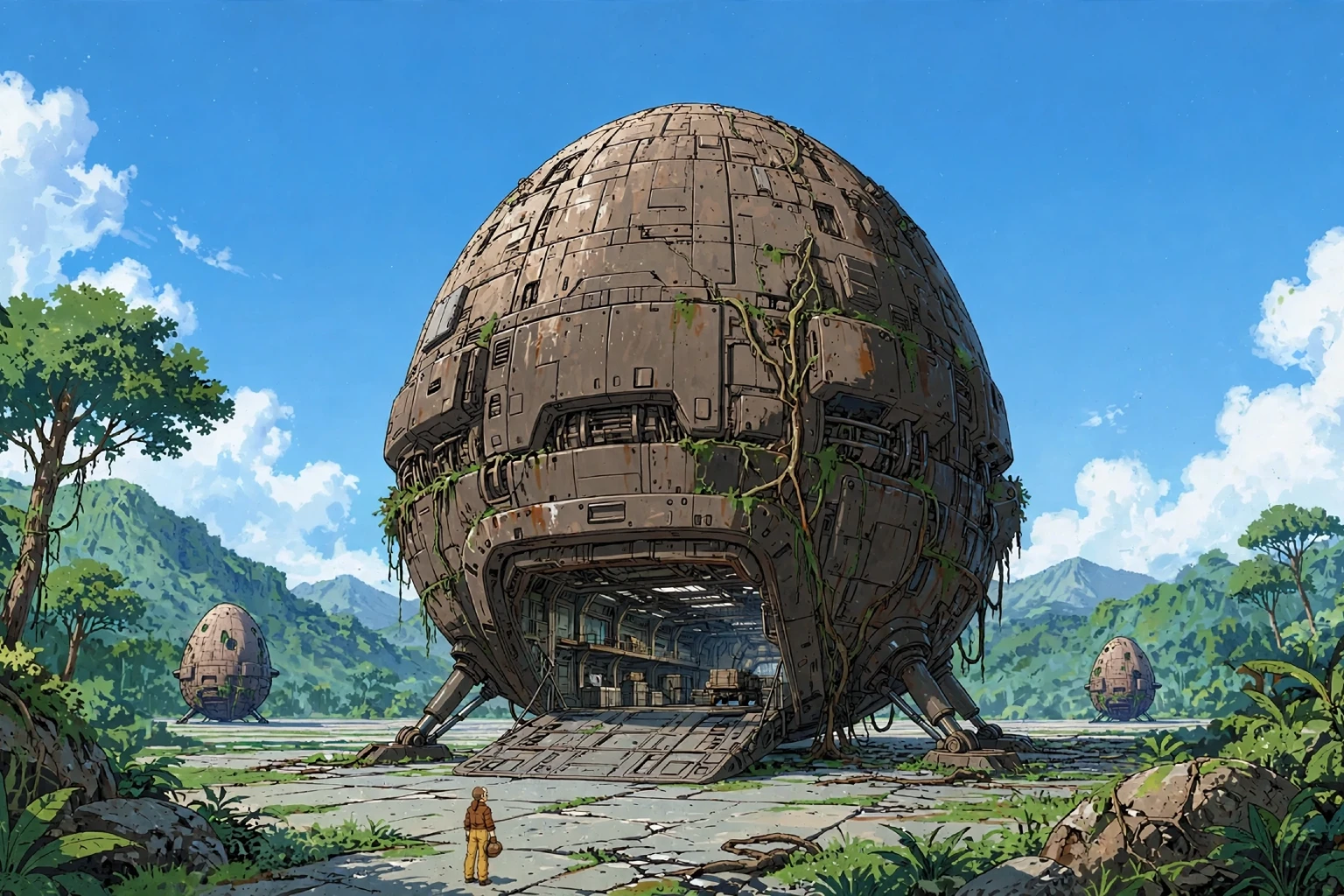
The Overdraft came down through Viridia-9's atmosphere trailing a thin plume of smoke from the starboard thruster, and for the first ninety seconds of descent nobody in the cockpit said a single word, because the readout in front of Jax was telling him something none of them had ever seen a readout say before.
"Atmosphere reads breathable," he said finally, voice careful, like he half expected the instrument to be lying to him. "Not filtered. Not processed. Just—breathable. Nitrogen-oxygen mix, no contaminant flags, no particulate warnings." He glanced at Mara. "That's not possible."
"Read it again."
"I've read it four times."
Mara leaned over his shoulder, staring at the same numbers, and something in her face did a thing Jax had rarely seen it do—a kind of unguarded, disbelieving hope that she usually kept locked down tighter than the ship's spare parts locker. "That's a live reading. That's not archived data, that's current atmospheric composition, right now, unprocessed." She sat back slowly. "Jax, that's a planet breathing on its own."
Below them, the surface unspooled in a way none of the crew had context for. Green. Not the sickly hydroponic green of a colony dome's recycled air garden, not the artificial shimmer of a terraformed corporate world running on subscription atmosphere, but a deep, saturated, chaotic green that rolled across mountain ranges and river valleys in every direction the eye could follow, forests thick enough to swallow entire cities, rivers cutting silver ribbons through canyon systems that had clearly been carving themselves deeper for longer than any of them had been alive.
"I don't see any domes," Rin said slowly, forehead pressed near the viewport glass. "No processors. No stacks, no towers, no grid lines. Jax, I don't see a single piece of Kessler hardware anywhere down there."
"Keep looking. There'll be something."
There wasn't. The Overdraft continued its long, careful descent, and the only structures that broke the endless green belonged to something older, half-swallowed by the landscape, and utterly unlike anything Kessler had ever built.
The starboard thruster made its opinion known well before the Monolith Drop-Bays came into full view, a shudder running through the whole airframe as the damaged coil Mara had beaten back into alignment during the jump complained about being asked to do meaningful work again so soon. The readout flickered, dropped ten percent of its rated output without warning, and the ship's nose yawed a few degrees before Jax caught it, correcting with a hand that had gone instinctively tight around the yoke.
"That's not good," he said, mostly to himself, scanning the terrain ahead for anything flat enough to forgive an imperfect approach. The jungle canopy rolled beneath them in unbroken green for kilometers, no clearings, no rooftops, and the only open ground he could see at all was the cracked expanse of ferro-concrete just now resolving past the final ridge, riddled with root-fissures that made it look considerably less inviting up close than it had from altitude.
"Mara, talk to me. Can that thruster take a hard approach?"
"Define hard." Her voice came back tight through the internal comm, already down among the coils. "If you mean 'give me another twenty seconds of full burn to correct a bad angle,' maybe. If you mean 'stall and recover twice in a row like we just did in the jump,' no. Whatever you're about to do, do it clean the first time."
"Copy that." Jax adjusted their vector, easing off the throttle just enough to take pressure off the compromised coil without losing the lift he needed, watching the cracked landing expanse grow larger and more complicated the closer they got—heaved and split by root systems the width of highway overpasses, some fissures deep enough to swallow a landing strut entirely if he came down wrong.
"Rin, I need eyes on the ground. Tell me where not to put us down."
"On it." Rin was already leaning hard into the side viewport, forearm CRT throwing a quick overlay of whatever resolution the ship's aging scanners could manage against the terrain below. "There's a stretch between the two nearest gantry cranes that looks mostly intact, but it's narrow, Jax, and there's a fissure running along the near edge that I can't get a clean depth reading on. If a strut catches that wrong, we're not walking away from it easily."
"How narrow is narrow?"
"Tight. Tighter than I'd like. You've got maybe four extra meters on either side once you're actually down, assuming the struts don't punch through anything."
"That'll have to be plenty." Jax brought them around in a slow, careful bank, giving himself the longest possible approach rather than a fast, direct drop, correcting each drift as it came rather than all at once, unwilling to ask the damaged coil for one hard motion when a dozen small ones would do the same job more gently.
"Fifty meters," Rin called out, eyes fixed on her overlay. "The fissure's curving away from your line, that's good—forty, thirty, watch the crane on your left, its base looks like it's leaning further into the pad than the visual suggested—"
"I see it."
"Twenty. Ten. You're clear, put her down."
Jax cut the throttle in the last careful measure, letting the Overdraft settle rather than drop, the landing struts groaning as they took the ship's full weight against cracked, uneven ferro-concrete, one strut finding a slight depression that tilted the whole airframe two or three degrees before settling, and then, all at once, stillness.
Nobody spoke for a moment. Jax exhaled slowly, hands finally easing off the yoke.
"That thruster is not doing that again without a full teardown," Mara's voice came through the comm, breathless but steady. "I mean that. Full teardown, new coil if I can find one, or the next hard landing takes the whole assembly with it."
"Noted," Jax said. "And well flown, both of you."
"I didn't fly anything," Rin said. "I just told you where not to die."
"That's flying, as far as I'm concerned."
He cut the engines fully, settling the Overdraft onto a relatively clear stretch of the cracked landing pad between two of the massive gantry cranes, and even at that scale, even scarred and battered as she was, the ship looked absurdly, almost comically small against the landscape surrounding her.
"Well," he said, "that's humbling."
"That's one word for it," Mara said.
The landing expanse was vast—stretching for what must have been kilometers in every direction, split apart in long jagged fissures where roots the width of highway overpasses had forced their way up through the material over the course of a century, some of them thick as small buildings, disappearing into canopy that towered above even the tallest surviving structures. Rusted gantry cranes rose out of the wreckage like the skeletons of dead giants, their once-orange paint gone to flaking rust-brown, vines climbing their legs in thick tangled ropes, and standing at the center of it all, dwarfing everything around them, sat three enormous egg-shaped hulls.
"Colony drop-ships," Mara breathed, coming up from the engine room to see it properly with her own eyes rather than through a scope. "Those are colony drop-ships."
"They're huge," Rin said, and it wasn't an exaggeration. Each hull stood taller than the Anchor's central spine, their curved sides scarred with a hundred years of weather and neglect, blast doors along their lower flanks standing open in wide, dark rectangles that had clearly not moved since the day they'd first swung wide.
They stood at the base of the boarding ramp for a long moment before anyone moved, the four of them gathered at the threshold of the open airlock, looking out at air none of them had ever breathed without a filter standing between them and it.
"Test it first," Jax said, though there wasn't much conviction in the order, more habit than actual doubt. "Rin, run the external sensor package again."
"Already ran it three times on the way down. It's clean, Jax. It's cleaner than the air on the Anchor. It's cleaner than the air in half the corporate stations I've ever been in." Rin's voice had gone tight with something that wasn't quite fear and wasn't quite joy, some emotion that didn't have an easy name for someone who'd grown up rationing every breath behind a subscription filter.
Mara stepped past both of them, down the ramp, boots striking the cracked ferro-concrete with a sound that echoed strangely in the open air, and stopped at the bottom, standing very still.
"Mara?"
She didn't answer right away. She reached up with one grease-stained hand and unlatched her suit's helmet seal, and Jax felt his whole chest tighten with an instinctive, reflexive alarm that had been drilled into him since childhood—you don't do that, you never do that, unfiltered air kills you slow and it kills you ugly—right up until she lifted the helmet clear and simply breathed.
Nothing happened. Nothing except the long, slow, unhurried inhale of a woman who had spent her entire adult life paying, one way or another, for every lungful of air she'd ever taken, doing it now for free, under an open sky, with nobody's meter running.
"It's real," she said, voice cracking slightly around the words. "Jax. It's actually real. I can taste—" She stopped, swallowed, tried again. "It smells like rain. Like actual rain, and dirt, and green things growing. I don't think I've ever smelled that before. Not once. Not really." She stood there a moment longer with her eyes closed, one hand pressed flat against her own chest, as though checking that her lungs were still doing what they were supposed to.
Rin was already past her, helmet coming free, breathing hard and fast like she'd forgotten how the process worked without a filter's hiss accompanying it, and something in her young, sharp face cracked open into an expression none of them had seen from her before—not the wary competence she wore like armor, not the manic energy she brought to a hacking problem, just simple, uncomplicated wonder.
"I grew up rationing this," she said quietly. "Every family in the Tiers had a meter. You paid by the hour, by the breath practically, and if you couldn't pay, they throttled your allotment until you learned to breathe shallow just to make it last." She looked up at the canopy towering overhead, sunlight breaking through in scattered shafts of gold and green. "There's no meter here. There's nobody running a meter on this at all." She laughed, short and disbelieving, pressing both hands to her face for a moment as though she needed to feel her own breath against her palms to fully trust it.
Jax stepped down the ramp last, helmet coming free with considerably less ceremony than the other two, and breathed in air that tasted, he had to admit, better than anything he'd paid for in his entire life. He said nothing for a long moment, simply standing with his head tilted back, eyes on the canopy, letting the strangeness of it settle into him the way it had settled into the others.
"Henry," he said finally, glancing back toward the ship, "you coming down, or are you just going to stand there judging us for getting emotional about oxygen?"
"I do not require atmosphere to survive, Captain Mercer," Henry said, descending the ramp with his usual unhurried grace, "but I confess I find the reaction entirely understandable. I have observed a great many things in my functional existence. I have not, until this moment, observed a planet that appears to owe nothing to anyone."
They explored the nearest drop-ship first, the massive egg-shaped hull looming over them as they approached its open blast door, and stepping through into the dim interior felt, to Jax, uncomfortably like stepping into a tomb that had never actually been used.
The cargo hold beyond the blast door stretched away into shadow, rows of luggage racks still fully loaded, suitcases and travel trunks stamped with a corporate colonial seal none of them recognized, some split open where age and gravity had finally won against their fastenings, spilling out clothes gone gray with a century of dust but otherwise perfectly preserved in the dry, sealed air.
"Nobody ever came to claim these," Rin said, crouching beside a fallen trunk, running her light across a child's toy—a small mechanical animal, wound-up and long since stopped, resting atop a folded stack of tiny clothes. "This was somebody's kid. This was somebody's whole life, packed up to start over on a new world."
"Keep moving," Mara said, though her voice had gone soft. "Let's see what else is here."
They moved deeper, past racks of settlement tools still shrink-wrapped in their original packaging—shovels, seed cases, portable water purifiers, agricultural equipment stamped with the same corporate seal, an entire warehouse's worth of colonial infrastructure that had simply sat, waiting, for a hundred and three years.
"There's seed stock here," Mara said, examining a row of sealed cases with growing disbelief. "Grain varietals. Livestock embryo storage—still reading viable, if the display's telling the truth. This is everything you'd need to found an actual working colony from scratch. All of it just sitting here."
"Untouched," Rin added. "Nothing's been looted. Nothing's been scavenged. If pirates or scrappers had ever found this place, this whole warehouse would've been stripped bare decades ago. Nobody's been here."
Past the cargo hold, the corridor widened into a room that stopped all four of them at its threshold, and it took Jax a moment to understand why the silence here felt different from the silence in the hold behind them. Rows of processing counters ran the length of the space, each one still fitted with a terminal, a stamp station, a small brass placard bolted above it reading things like FAMILY UNITS A THROUGH F or SINGLE PERSONS INTAKE, and along the far wall, a wide board stretched from floor to ceiling, its surface a grid of small slotted compartments, each one labeled with a plot number and, beneath it, a name.
"It's an assignment board," Mara said quietly, stepping closer. "Land assignments. Look—plot forty-one, the Okonkwo family, five persons. Plot forty-two, Aldis Renn, single occupant, agricultural specialization." She ran her fingers along the row, reading name after name, each one paired with a tidy little slot that had clearly once held a welcome packet or a set of keys, whatever small physical token a colonist was meant to receive on the day they finally stepped off this ship and onto their new land. Most of the slots were still full. Untouched. Waiting.
"They'd already been assigned plots," Rin said, voice hushed. "Before they even landed. Somebody sat in an office somewhere and matched families to farmland, probably imagined what their houses would look like." She reached toward one of the slots, then stopped herself, hand hovering without touching. "This wasn't supposed to be abandoned. This was supposed to be the first day of a hundred thousand ordinary lives."
Jax moved along the board in silence, reading names he'd never know anything else about—the Okonkwo family, plot forty-one; Aldis Renn, plot forty-two; a dozen more beside them, then a hundred, each one a person or a family who had packed a trunk, boarded a ship, and settled in for a journey they must have believed, right up until the very end, was going to end somewhere good.
Nobody said anything for a while after that. The assignment board loomed over them in the dim light, patient and complete and utterly pointless, a hundred small compartments still holding whatever welcome the colony had prepared for people who had never come to collect it.
They found the passenger decks next, a labyrinth of berths stacked six high in long silent rows, each one built for a family unit, each one still made up with bedding gone gray and brittle, personal terminals mounted at each berth's head displaying frozen welcome screens that had apparently never been touched.
WELCOME TO VIRIDIA-9 COLONIAL SETTLEMENT PROGRAM. PLEASE PROCEED TO PROCESSING UPON DISEMBARKATION.
"That's a friendly little message," Jax muttered, reading it over Rin's shoulder. "Except nobody ever disembarked to see it."
"There's no bodies," Mara said, and the observation landed heavier than she'd probably intended, all four of them going quiet at the simple, terrible fact of it. "We've walked through cargo, we've walked through an assignment board, we've walked through what looks like most of a passenger deck, and there's no bodies anywhere. No skeletons. Nothing. If something killed everyone on this ship before they disembarked, where did they go?"
Nobody had an answer.
Rin found the drop-ship's primary data terminal in what had clearly once been a bridge or command deck, a squat CRT console built into a curved wall of dead instrumentation, and she wasted no time connecting her deck's cable to its ancient port, forearm CRT already scrolling data before she'd even fully settled into position.
"Okay," she said, working fast, the same focused intensity she'd brought to every piece of hardware that had crossed her path since the beginning of this whole mess. "Ship's log. Colonial transport vessel, registry—okay, this matches the disk's authorization data exactly, same mission designation, same colonial charter."
"Can you get a timeline?" Jax asked. "What happened here?"
"Working on it. Give me a second." She scrolled further, brow furrowed, and the light from her screen threw strange shadows across the dead bridge around them. "Environmental systems activated on schedule, one hundred and three years ago. That part's confirmed—there's a whole activation log, terraforming network coming online, atmospheric processors engaging, all of it right on time, exactly as planned."
"And the colonists?"
Rin's fingers slowed. "That's where it gets weird. There's a disembarkation protocol logged as initiated. Blast doors opened. Passenger processing queue established." She stared at the screen a moment longer. "And then it just—stops. There's no completion log. No record of anyone actually walking off this ship. The environmental program ran perfectly. The settlement program never finished."
"Never finished, or never started?" Mara asked.
"Started. Definitely started. There's partial processing records for individual passengers—first few dozen show a status change from 'in transit' to 'disembarkation pending.' And then the log just cuts off. No error message. No malfunction report. It just—stops, like whoever was maintaining the record simply stopped updating it."
The silence that followed felt different from the earlier awed quiet, heavier, colder.
"So the planet worked," Jax said slowly. "The whole terraforming operation, the whole environmental system, did exactly what it was supposed to do. And somehow, the actual people never made it off this ship."
"That's what the data's telling me. I don't like what it's telling me, but that's what it says." Rin disconnected her cable, sat back, rubbing at her eyes. "This is old, damaged, physical data. I'm reading it straight off the terminal, no shortcuts, no easy answers. I can't ask it questions it wasn't built to answer. It just gives me what it has, and what it has is a colony that never quite happened, on a planet that's been quietly, perfectly maintained for a hundred and three years by systems that apparently never got the memo that nobody was ever going to use them."
They found the environmental control station in the drop-ship's lower decks, and it was there, more than anywhere else, that Mara finally understood the true scale of what they'd stumbled into.
The station's core processing units hummed with steady, healthy power, ancient by any modern standard but clearly, unmistakably functional, running diagnostics and maintenance routines that had apparently continued uninterrupted for over a century. Mara didn't stop at admiring it. She pulled a panel loose along the unit's base—unlatching rather than prying, the fasteners still turning smoothly despite a hundred years of disuse—and crouched to trace a bundle of feed lines back toward a squat, cylindrical component that looked, to her practiced eye, exactly like a pressure regulator she'd rebuilt a dozen times over on lesser equipment.
"Look at this," she said, running her thumb along a seam in the regulator's housing. "This isn't sealed. There's no tamper strip, no encrypted verification chip, no serial-locked firmware demanding I prove I'm authorized to touch my own equipment. Standard thread pattern, standard fitting, built so that if it ever failed, whoever found it could pull it, rebuild it, replace it with anything that matched the spec." She traced the feed line further, finding a secondary junction where a smaller unit sat mounted flush against the main housing, its casing stamped with a manufacturing date that predated the ship's own registry. "This whole system was built with the assumption that someday, someone without corporate backing would need to keep it running. There's a materials cache two decks up, still sealed, meant for printing or forging replacement parts on-site instead of shipping them in from somewhere with a markup attached."
She sat back on her heels, and something fierce and furious kindled behind her eyes as she said it plainly, for the first time, out loud. "This is what atmospheric processing looked like before Kessler figured out you could charge people to breathe. Honest technology. Built to serve the people using it instead of extracting money from them." She gestured back toward the ship, toward every sealed, subscription-locked system she'd ever cursed her way through keeping alive. "Every system I've worked on since I left home was built the opposite way on purpose. Locked housings. Firmware that bricks itself if you don't renew a service contract on schedule. I always figured that was just how the technology worked. This proves there was a better way, on purpose, a hundred years ago, and somebody's spent the last hundred years making sure the rest of the galaxy forgot it ever existed."
"And it's been running for a hundred and three years without anyone maintaining it," Jax said.
"Without anyone maintaining it directly, maybe. But something's been keeping this network alive. Systems this complex don't just run themselves indefinitely without upkeep—parts fail, seals degrade, you need active intervention eventually or entropy wins no matter how well you built the thing originally." Mara frowned, studying a status display that continued cycling through routine maintenance logs in patient, mechanical sequence. "Something out there has been doing the maintenance. For a century."
They found their answer, or the first piece of it, an hour later, standing at the edge of the cracked landing expanse where the ferro-concrete finally gave way to raw jungle and a wide, fast-moving river cut through the tree line.
It was Henry who noticed first, his sensors picking up movement at a distance long before human eyes could have resolved the shape clearly, and he raised one hand in a small, careful gesture that stopped the others mid-conversation.
"There," he said quietly. "Along the riverbank. I would ask everyone to remain still for a moment."
They followed his gaze, and slowly the shape resolved out of the jungle’s tangled green: massive, impossibly massive, a machine unlike anything any of them had seen in a corporate catalog. It stood on four thick, piston-driven legs, its chassis a sloped heavy wedge of ancient armor plating gone the color of rust and moss, hazard stripes faded to pale ghost-lines beneath a century of weathering. A broad horizontal amber CRT band glowed across its front. Its two enormous articulated arms ended in wide, flat hydraulic plates, pressed against the riverbank’s eroded edge with slow, patient force.
Rin swallowed. “I don’t know what that is,” she breathed. “But it’s the size of a building.”
They watched it work for several long minutes, none of them daring to move closer. The machine didn't seem to notice them at all, entirely absorbed in its task, one hydraulic plate pressing rhythmically against a slumped section of bank while the other reached to draw fresh soil from a shallow trench beside it, packing the loose earth back into stable form with slow, deliberate, almost gentle force despite the obvious power behind each motion. Every so often it paused, the amber band flickering through some internal sequence, and a fine mist of water sprayed from a nozzle Jax hadn't noticed at first, settling the freshly packed earth before the next compression pass. It moved with the unhurried rhythm of something that had performed this exact task ten thousand times before, no wasted motion, no urgency—the patient, repetitive competence of a machine built for exactly one job and given a century to become perfect at it.
Vines and moss grew thick across its shoulders and upper chassis, small colonies of bright fungus clustering in the joints where its legs met its body, a fine tracery of rust following every seam in its armor, and yet every motion it made was precise, purposeful, entirely without hesitation, as though the neglect of its own exterior had never once been permitted to touch whatever kept its actual mechanisms turning.
"It's fixing the riverbank," Mara said, quiet with disbelief. "Look at it. It's not hunting, it's not attacking anything, it's doing erosion control. Like a groundskeeper. Like the biggest, most terrifying groundskeeper anyone's ever built."
"One hundred and three years," Jax said slowly, "and that thing's still out here, doing exactly the job it was built for."
As if in confirmation, the machine's amber sensor band flickered briefly, cycling through some internal display sequence, and for just a moment, angled toward them though its attention remained fixed on the riverbank, they caught a fragment of text glowing pale against the amber field.
SOIL RESTORATION IN PROGRESS. ESTIMATED COMPLETION: 4 HOURS.
Nobody moved. Nobody spoke. The massive machine continued its slow, patient work, utterly indifferent to the four small figures watching from the tree line, and after several long minutes it straightened, the hydraulic plates retracting with a soft hydraulic hiss, and turned—not toward them, but away, into the jungle, moving with a heavy, ground-shaking gait that sent birds scattering from the canopy overhead, off toward whatever other task awaited it somewhere deeper in the maintained wilderness.
"Okay," Rin said finally, into the silence it left behind. "That happened."
"That happened," Mara agreed.
"This planet has been actively cared for," Jax said slowly, working through the implications as he spoke them aloud. "Not abandoned. Not simply left to its own devices while nature reclaimed it. Something's been running this whole ecosystem like a job, for over a century, keeping it in whatever condition it was originally supposed to reach for the colonists who never showed up."
"Whoever built that thing," Mara said, "built it to outlast everything. Built it to keep going even after the reason for its existence apparently vanished."
They made their way back toward the second drop-ship as the light began to shift toward evening, gold sunlight slanting long and low through gaps in the jungle canopy, and it was there, at the base of the second hull's blast doors, that Henry stopped abruptly, his posture going rigid in a way none of them had seen from him before.
"Henry?"
"There is a terminal here," he said, voice carefully controlled. "A physical access panel, similar to those we encountered aboard the Halcyon Concourse. I believe it is attempting to address me."
The panel in question was small, unassuming, mounted beside the blast door at a height that suggested it had once served maintenance crews rather than passengers, its screen flickering weakly to life as Henry approached, old text scrolling across a cracked display.
UNIT RECOGNITION: PARTIAL MATCH. AUTHORIZATION PROTOCOL: [DATA CORRUPTED]. GREETING SEQUENCE: [DATA CORRUPTED].
Beneath the corrupted lines, a single fragment of legible text remained, formatted in the stiff, formal phrasing of a protocol decades out of date.
WELCOME, SUPPORT ASSET. STANDING BY FOR FURTHER INSTRUCTION.
The blast door beside it, which had stood motionless and unresponsive through every other approach they'd made that day, shuddered, groaned, and slid open several centimeters before jamming against a century of accumulated debris, wide enough now to admit a person where before it had refused to move at all.
Henry stood very still, staring at the small cracked panel with an expression none of them could read on a face that had no features to read.
"That's not nothing," Rin said carefully. "Henry, that thing just opened a door for you that it wouldn't open for the rest of us."
"I am aware," Henry said, and his voice carried a tightness that made Jax's chest ache in quiet, protective sympathy. "I do not know what it recognized in me. I do not know what 'support asset' refers to, nor what protocol it believes it once shared with whatever I once was. I would very much like to know."
"Try the next terminal," Mara suggested gently. "See if it's consistent."
They found a second panel deeper inside the same drop-ship, mounted near what appeared to have once been a crew quarters, and this one gave Henry nothing at all—no recognition, no partial match, simply a flat, unresponsive refusal that treated him with exactly the same indifferent silence it showed the rest of them. Henry stood before it a long moment, patient, almost hopeful, before finally stepping back.
"Inconsistent," Rin said. "That's actually more unsettling than if it had recognized you everywhere. Whatever you were, Henry, it's not registered uniformly across this whole system. Some parts of you match something old and buried in this network. Some parts don't match anything at all."
"I find that observation deeply uncomfortable," Henry said quietly, "though I appreciate your honesty in making it."
"You okay?" Jax asked, watching him carefully.
"I do not know that I am entirely 'okay,' Captain Mercer, in the sense you likely mean it. I am, however, still myself. Whatever fragments of some older purpose remain buried in my architecture, I do not feel commanded by them. I simply feel—" he paused, searching, as he so often did, for the precise word "—incomplete. In a way I had grown accustomed to, until today reminded me how large the missing pieces might actually be."
"For what it's worth," Jax said, "whatever that panel thinks it recognizes, we don't need an explanation to know who you are. You're not a key, Henry. You're crew."
"I appreciate the sentiment, Captain Mercer, more than I know how to properly express."
Nobody had a comforting answer beyond that, and nobody pretended otherwise, though Rin reached out and rested a hand briefly against his forearm, a small, wordless gesture that Henry seemed to accept with quiet gratitude.
They made camp that night in the Overdraft's cargo bay with the hatch cracked open to the outside air, a small extravagance none of them had ever been able to afford before, breathing unfiltered night air scented with rain and distant flowering jungle while Jax cooked something simple over a portable burner and the four of them sat together in the enormous, ancient silence of the drop-bays.
"So," Rin said, breaking the quiet, staring out at the dark shapes of the two other drop-ships looming against the starlit sky, "Eden's real. Viridia-9's real. Breathable air, working ecosystem, technology that doesn't charge you a subscription fee to exist. This should be the best day of my entire life."
"But," Mara said.
"But there's nobody here. A whole colony ship, fully loaded, fully prepped, environmental systems working perfectly, plots assigned, names on a board, and somewhere between 'disembarkation initiated' and 'disembarkation complete,' every single person just—stopped existing in the record. No bodies. No wreckage. No explanation." Rin pulled her knees up to her chest, arms wrapped around them. "I keep thinking, if I just had better equipment, more time, a cleaner interface, I could pull the rest of the story off that terminal. But I don't think that's actually true. I think the story just isn't there to pull. I think whatever happened, somebody made sure it wouldn't be easy to find out."
"Or something happened fast enough that nobody had time to log it properly," Jax said quietly.
"Either way," Mara said, "we've got the single most dangerous discovery in the galaxy sitting under an open sky, guarded by giant machines that fix riverbanks instead of shooting at trespassers, and we still don't actually know what we've found."
"So what do we actually do with it?" Rin asked, and the question sat in the middle of the group with more weight than she'd probably intended. "Say we make it out of here. Say Kessler doesn't catch us first. Do we tell people? I keep looking at that assignment board, all those names, all those plots nobody ever got to stand on, and thinking—somebody should get to. Somebody should finally get to live here."
"And the second we tell anyone," Mara said, "the whole galaxy knows the one thing that could break the Oxygen Tax actually exists. Every corporation, every government, every desperate settlement half-starved on a filtered ration is going to want a piece of this place, and most of them won't care about doing it gently. You saw what a century of nobody knowing did for this planet. It kept it exactly like this. Perfect. Untouched. The day the wrong people find out, that stops being true."
"So we just—keep it secret? Forever?" Rin shook her head. "That doesn't sit right either. Feels wrong to be the ones who decide nobody else does either."
"Nobody's deciding anything tonight," Jax said, and there was no real authority in it, more simple tiredness, the honest acknowledgment of a problem too large to solve over a portable burner on the first night any of them had ever slept under an open sky. "We don't know enough yet. We don't know what happened to the people who were supposed to be here. We don't know what those machines are, or what they'd do if somebody tried to actually settle this place without whatever authorization they're apparently still waiting on. I'm not making a decision about the fate of a planet with half the facts."
"That's fair," Mara admitted. "Doesn't make the question go away, though."
"No," Jax agreed. "It doesn't."
Henry, quiet for a while, finally spoke. "For what it is worth, I do not believe there is a version of this decision that costs no one anything. Every option available to us appears to trade one harm for a different one. I would prefer we make that trade with full information, rather than in the dark, out of fear of Kessler's approach."
"Easy to say when you're not the one who has to live with whatever we pick," Rin muttered, though there was no real bite in it, just exhaustion.
"I did not say it was easy, Rin. Only that it seemed true."
Above them, the jungle canopy rustled in a warm night wind that smelled like nothing any of them had ever paid for, bioluminescent fern-fronds glowing faint blue-green in the dark like something out of a dream none of them had known to have, and somewhere out in that vast, patient wilderness, a machine continued its slow, tireless work, restoring a riverbank nobody but a machine had been left alive to need.


.png)
.png)
.png)