"Thirty-five thousand," the woman at the folding table said.
Mai Arakawa didn't lower the sleeve. She couldn't. The silk was heavy in her hands, heavier than silk had any right to be, and the red of it was so deep it looked wet.
"Thirty-five thousand yen? There's gold couching on this. It's hand-embroidered. Hana, tell her."
Hana was already bent over the paulownia box, photographing the faded ink label on the lid. "It's an uchikake. Taisho, probably. Look at the padded hem. Nobody pads a hem like that anymore." She glanced up. "You know this belongs in a museum, right?"
The woman, whose company polo bore a plastic tag reading SASAKI – YOKOHAMA IHIN SEIRI, shrugged. "The granddaughter set the price. She told us, and I'm quoting, 'I don't care what you get for it. Just make sure it leaves the house.'" She lowered her voice. "She wouldn't come into this room."
Junko Okada crossed from the far side of the house clearance in her cream cardigan, two lacquer trays under one arm, reading glasses pushed up into her silver hair. She looked at the kimono, and something in her face went soft and greedy at once.
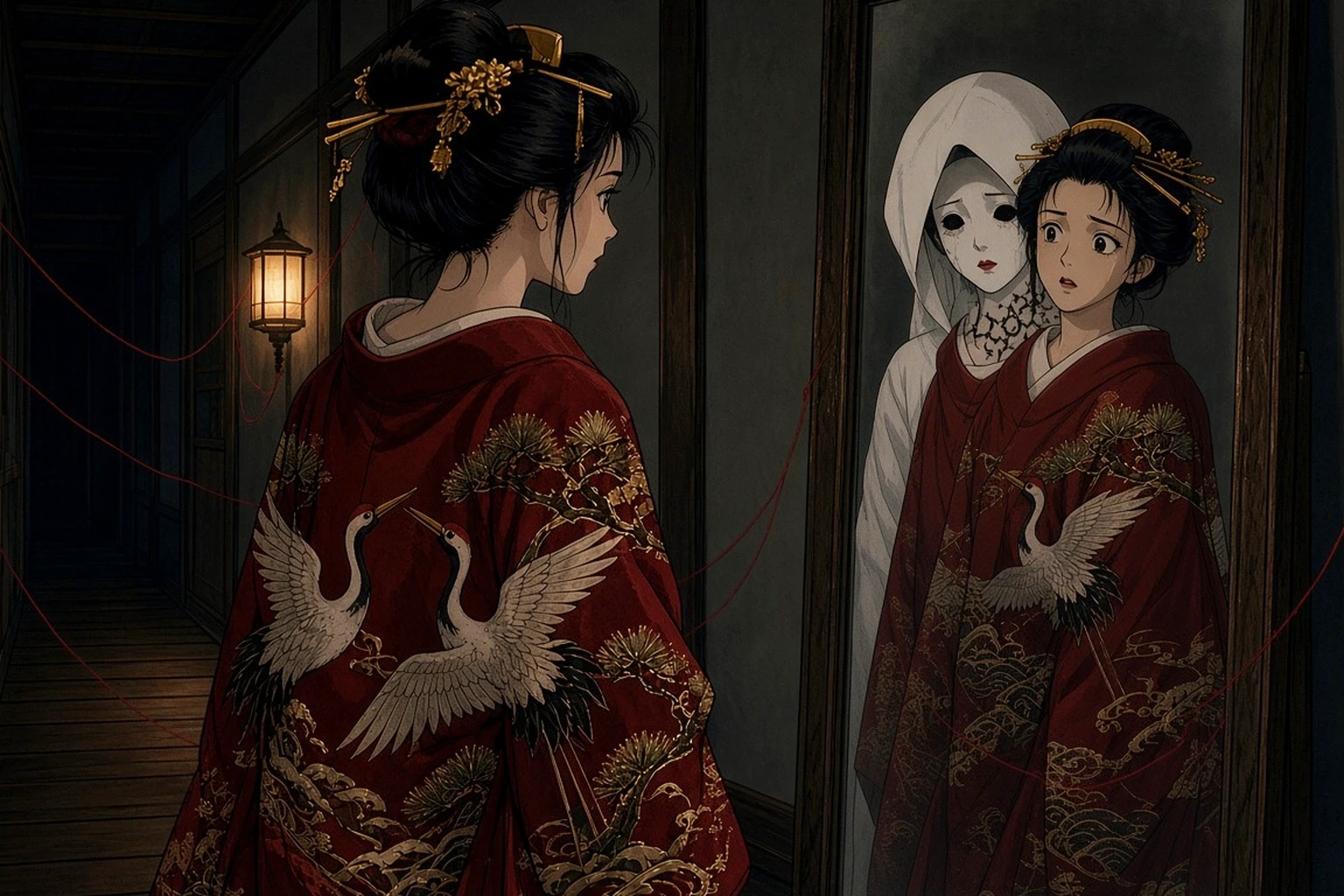
Two cranes faced each other across the back of the robe, worked in gold and white over a twisted pine and a field of stylized waves. Their necks bent toward each other. Their beaks nearly touched.
"Cranes mate for life," Junko said. "You'll wear this for the reception, Mai-san. After the change."
"Okada-san, it's a hundred years old—"
"It survived a hundred years. It can survive one evening." She took four ten-thousand-yen notes from her purse and laid them on the table. "Keep the change. Tell the granddaughter it went to a bride."
Sasaki looked at the money, and then, oddly, at Mai. "Sure," she said. "I'll tell her."
Under Mai's thumb, something shifted: a single thread inside the weave, sliding, the way a vein moves under the skin of an old woman's hand.
She let go.
"Did you feel that?"
"Feel what?" said Hana.
Mai wiped her palm on her jeans. "Static."
Hana dressed her in the upstairs guest room of the Okada house in Yamate. Mai lived there now, until the apartment renovation in Kannai was finished, because Junko had insisted with such warmth that refusing would have felt like a slap. First the white underrobe, then a borrowed obi, then the uchikake over everything, falling from her shoulders to the floor.
"It's heavy," Mai said.
"Four kilos of silk." Hana stepped back, and her mouth twisted. "You look like you belong in it. It's kind of annoying."
She went to the top of the stairs. "Naoki! Brace yourself."
Mai turned to the full-length mirror at the end of the hall. The red deepened in the lamplight. The cranes were on her back, so she twisted to look over her shoulder, and that was when she saw the woman.
She stood directly behind Mai, close enough that her chin should have rested on Mai's shoulder. Her face was painted white, the old way, a smooth mask of oshiroi down to the collar. Her lips were a small red bud. Her hair was dressed high under a white silk hood, a tsunokakushi, the bride's headdress. She wore the same kimono. The same red, the same cranes.
Her eyes were wrong. The whites were full of red, burst vessels, as though she had been crying blood from the inside.
She smiled.
"It suits the bride," she said.
Her Japanese was stiff and formal, the cadence of a century ago, like a voice off an old shellac record.
Mai spun around. The hallway was empty.
"There was someone—" she said, and the kimono tightened.
It happened all at once, as if a fist had grabbed the fabric at her back and twisted. The silk hauled across her shoulders and the padded collar crushed into her throat. She clawed at it. It didn't give. It pulled harder, slow and steady, the way you pull a knot you mean to keep.
"Hana—"
"Hold still—what are you doing—"
Sparks crawled in at the edges of Mai's vision. Her breath went thin, then whistling, then nothing.
Feet pounded on the stairs. Naoki's hands were at the collar, prying it outward, and for a horrible second the silk resisted him. Mai felt it pull back like a living thing. Then it went slack and slid off her and pooled on the carpet in a red heap.
Mai knelt on the floor in the white underrobe, dragging in air. When she touched her neck, her fingers came away spotted with blood where the collar's edge had bitten in.
Daiki leaned on the banister behind his brother. "Okay," he said. "So that's a no on the entrance."
"Daiki. Downstairs."
Naoki crouched beside her. He was looking at her the way he looked at the restaurants' quarterly numbers, as though he could make her come out right if he was patient enough. "You've been on four hours of sleep for a month. My mother calls you twice a day. I'd be seeing things too."
"I didn't see it choke me, Naoki. I felt it."
Hana was crouched by the kimono. She didn't touch it. She held her phone beside the embroidery, showing the photo she had taken at the clearance in Zushi.
In the photograph, the two cranes faced each other, beaks almost touching.
On the floor, the first crane's neck had straightened. It was looking up and away, toward the edge of the robe, as if listening for something.
"That's the lighting," Naoki said, too fast.
"Naoki," said Hana. "That's thread."
Mai folded the kimono into its box, put the box on the closet shelf, and shut the door. Naoki watched her do it.
At 3:12 she woke, and it was on the reading chair in the corner.
It wasn't folded. It was draped as though someone were wearing it, shoulders square, sleeves hanging to either side, the padded hem pooled at the chair's feet.
And there was someone in it.
The white face rose out of the collar slowly, like something surfacing through red water. The hood. The painted mouth. The bloody eyes, which found Mai in the dark and held her there.
"Did they give you the sake yet?" the woman asked.
Mai couldn't move.
"The third cup," the woman said. "The third cup is the one that matters."
Her head tilted. It kept tilting, past where a neck should stop, until her cheek lay on her own shoulder, and it stayed there.
"Who are you?" Mai whispered.
The red mouth barely moved. "Saeki Kiyo. Then Ishiguro Kiyo. For four hours."
Naoki shifted in his sleep. Mai's eyes flicked to him and back, and the chair held only the kimono.
She shook him awake and he fumbled the lamp on. The robe hung empty over the chair. The closet door was still shut.
"Did you take that out?" he said.
"You watched me put it away."
He stared at the closet door for a long time. "Garage," he said finally. "It goes in the garage."
In the morning Hana, who had slept in the guest room and looked as though she hadn't, set her phone on the kitchen counter in front of Junko. She had photographed the robe in the garage every hour since midnight.
"Seven a.m.," Hana said. "Look in the pine."
There was a third crane, small and stitched in gray thread, half hidden among the needles. It was looking down at the other two.
"It wasn't there at six."
"You missed it." Junko pushed the phone back across the counter. "We have a wedding in four days, a florist threatening to quit, and a dead walk-in freezer at Motomachi. Mai wears the kimono or she doesn't. But no one says a word about this to the Nakamuras or anyone from the board. Understood?"
Daiki was eating toast at the counter. "For the record, I believe you," he told Mai. "I went in for my golf bag this morning and I swear the sleeve moved." He pointed his butter knife at her. "Wear it Saturday anyway. Mom'll be impossible if you don't."
Two days before the wedding, Mai drove the kimono down to a shikkai workshop in Kamakura. Mitsuko Arai was a brisk woman who went over the robe with a loupe for forty minutes and pronounced it sound, extraordinary, and "criminal for thirty-five thousand yen."
She didn't see the third crane, though she looked right at it.
She did stop once, with her fingertips flat at the center of the back, right between the two cranes.
"There's something in the lining," she said. "Stiff. About the size of a postage stamp. Could be a card stiffener. People sewed in shrine talismans sometimes." She pressed it gently. "I could open the seam and—"
Every lamp over her workbench went out.
In the dark, Mai heard a sound like dry grass rubbing together, the sound of silk sliding against silk. When the lights stuttered back on, Arai had snatched her hand away and was holding it against her chest. Across the pads of her fingertips ran a neat row of red pinpricks, as though she had pressed them onto a needle cushion.
She looked at the robe for a long moment.
"Let's leave it," she said. "Whatever it is, it's been there a hundred years."
On Saturday evening, in the bridal dressing room of the bayside hotel by Yamashita Park, Hana lifted the real obi out of the box: a long, stiff band of gold-and-white brocade patterned with interlocking rings.
"Nobody would blame you," Hana said. "Stay in the dress for the second half."
"She said it suits the bride," Mai said. "Not 'it suits you.' Like there's only ever been one bride, and it's whoever's wearing it." She held her arms out from her sides. "I want to know who she is."
"That's a reason to set it on fire."
"Arms up," said Mai.
Hana sighed and tied the obi.
The banquet hall was hung with gold screens and white peonies. When Mai came back through the doors in the red uchikake for the oironaoshi, the room went quiet, then broke into applause. Naoki did, in fact, cry. The robe was heavy but warm, and it moved with her as though it had been cut for her.
They broke open the sake cask with wooden mallets, the room shouted yosh!, and Junko took the microphone.
"When Naoki first brought Mai-san home, she washed every dish without being asked and reorganized my spice drawer." Laughter rippled through the room. "And I thought: this one understands what a family is. A family is a business. Everyone contributes. Everyone looks after what the family has built." She raised her square cedar cup. "Mai-san is exactly what this family needed. Kanpai."
Mai drank. The sake was cold and clean. Guests kept coming up to pour, so she drank again.
The third cup was bitter, a chalky bitterness at the back of her throat like a crushed pill, and the room tilted slowly to the left.
She was kneeling on tatami, in lamplight that smelled of oil and incense and something sour. Her face was stiff under its paint. Across from her sat a young man in a black crested kimono, with very clean fingernails. He was not looking at her. He was looking past her, at someone behind her.
He will not look at me, she thought, and the thought was not in her own voice.
A woman's hand settled on her shoulder. It was old, and it wore a jade ring.
"Mai. Nē-chan."
Hana's face was close to hers, and the hotel chandeliers were back.
"You went gray," Hana whispered. "Restroom. Now."
Once they were locked inside the wide multipurpose restroom down the corridor, Mai said, "The third cup was bitter. I saw her wedding. I was in it, there was a man who wouldn't—"
The obi tightened.
Mai folded in half. The brocade cinched inward as though someone stood behind her hauling on both ends. Her ribs creaked. All the air went out of her in one hard push and did not come back.
"I didn't tie it this tight—" Hana clawed at the knot. "I swear I didn't—"
"You tied it well, little sister."
Kiyo stood in the corner beside the sink. She wasn't in a mirror this time. She was as solid as the porcelain, and the fluorescent light lay flat and cold on her white face. The paint on her neck had cracked and flaked away, and pressed into the skin beneath it was a pattern of interlocking rings, gold and white, the brocade of an obi printed in bruises.
She was looking at Hana.
"Did you fix my collar, imōto?" she said. "Did you make me pretty for the beam?"
Hana's back slammed against the door. "I'm not—I don't—"
The obi wrenched tighter. Something in Mai's side gave with a small wet pop. She forced words out with no air behind them.
"Kiyo. She's my sister. Not yours."
Kiyo's red eyes came slowly around to Mai.
"Your sister," she said. "Who ties your obi."
The brocade let go. Mai dropped to the tile, coughing, a hot spike of pain in her ribs.
The corner by the sink was empty.
"Her eyes," Hana whispered. "Mai, her eyes were full of blood."
"Petechiae." Mai pressed a hand to her own throat. She had studied forensic toxicology at pharmacy school, and right now she wished she hadn't. "Burst capillaries. You get them from strangulation. Somebody strangled her with her obi."
Kaori Endō met them in a fourth-floor office at Yokohama City University that smelled of radiator dust and old paper. Sasaki had given Mai her number. Kaori had brought her grandmother's diaries to Dr. Ayumi Kuroda nine days earlier, after years of being too afraid to.
Kaori was about forty, thin, with a clinic ID on a lanyard. She took the chair farthest from Mai's tote bag.
"It's in there, isn't it," she said.
Mai had left the kimono in the Yamate garage under a dust sheet. At a red light near Sakuragichō, she had found it folded in her tote on the passenger seat.
"Yes," she said.
Kaori got through it fast, the way you rip off tape. Her grandmother had been Fumiko Ishiguro, then Fumiko Endō after she married into a Zushi family; her parents were Tadashi Ishiguro and Shizu, born Saeki. "Grandma tried to burn it in 1978. Kerosene, in the garden in Zushi. It sat in the fire like a stone and came out without a scorch mark. After that she kept it in the closet, and every March third she took it out and sat with it all day." She slid a brown studio portrait across the desk: a man in round spectacles, a girl of about fourteen with her hand on the back of a chair, and a young woman seated in the chair. Someone had cut the seated woman's face out with a blade, a neat oval. "That was in the box."
Kuroda-sensei was sixty, with cropped gray hair and enormous tortoiseshell glasses, and she didn't waste words.
"Yokohama Bōeki Shinpō, March 1923." She translated from a photocopy of the old vertical print. "On the night of the third, the eldest daughter of the Saeki silk house, wed that same day to Ishiguro Tadashi, was found dead by her own hand in the family storehouse, hanged with her obi. Letters indicate a clandestine association with a man of low station." She set it down. "The Ishiguros had an old samurai name and no money. A silk house with American export contracts would have saved them. Six months later the Kantō earthquake burned Yokohama for two days. If there was ever a police file, it's ash."
She opened a cloth-bound notebook at a yellow tab.
"Shizu, March fifth. Father burned Nē-san's photographs in the garden and made me watch. I said she never went anywhere, she had no lover. He struck me. February 1924: Father says I am to marry Ishiguro Tadashi in the spring. April: Mother Ishiguro brought Nē-san's uchikake. She said it would be wasteful to have another made. She said, You are the same size as your sister."
Hana had her hand over her mouth.
"One more." Kuroda's voice stayed perfectly flat, which made it worse. "Two weeks after my wedding I heard Kōji and Tadashi drinking behind the storehouse wall. Tadashi said, The other one fought harder than I expected. Kōji laughed. He said, You did not have to hold her hands, brother. I had to hold her hands. Mother had the obi." She turned a page. "Earlier she mentions that the house physician kept Calmotin for Mother Ishiguro's nerves."
"Bromovalerylurea," Mai said. "A sedative. It's bitter."
The tote bag fell over.
Nobody had touched it. It tipped onto the carpet and red silk poured out of it, yard after yard, far more than the bag could have held.
"No," said Kaori, standing up. "No, no, no—"
Fine red threads lifted off the silk like hair in static. They ran up the leg of the desk and across the blotter, straight into the oval hole in the photograph, and there they knotted and wove, fast as a loom. In three seconds there was a face in the hole: white thread for the skin, a red-thread mouth, and two tight black knots for eyes.
Then the threads lunged out of the photograph and caught Hana by the wrists.
They yanked her forward onto the desk and crossed her wrists over each other, the way you'd hold someone's hands to keep them from reaching their throat. A single strand whipped around her neck and drew tight. Hana made a sound like a hinge.
Kuroda grabbed for scissors. Kaori was screaming.
Mai did the only thing she could think of. She snatched the uchikake off the floor and threw it over her own shoulders.
Every thread went slack. They dropped from Hana and slithered back across the desk into the hem, and the robe settled onto Mai, heavy and warm, as though all it had wanted was to be worn.
The hole in the photograph was empty again, showing only the desk underneath.
There was a red line around Hana's throat, thin as a paper cut, beaded with blood.
Kaori was already gone. They heard her running down the stairwell.
In the car, Hana didn't start the engine.
"Why does she keep calling me that? Imōto."
Mai didn't answer.
"I have to tell you something." Hana's hands were tight on the wheel. "Daiki got drunk at the engagement dinner. He said the restaurants were underwater. He said, Don't worry, your sister's going to fix everything. And before you met Naoki, I went out with him. Twice. Okada-san set it up. It was nothing, we had nothing to say to each other—"
"And you didn't tell me."
"You were happy, Nē-chan."
Mai looked at the bead of blood on her sister's neck. From inside the collar, so close to her ear that she felt breath on it, breath that wasn't warm, came a whisper.
Watch her.
"Drive," Mai said.
At three in the morning she woke to the sound of paper.
Light spilled down the hall from Junko's study, and the sound came again, a fast dry riffling, like someone tearing through files.
Every desk drawer had been pulled out and dumped. Papers covered the floor. The uchikake sat upright in Junko's leather chair, shoulders square, hollow at the collar. Its sleeves lay on the desk, and they were moving, sweeping across the blotter and shoving pages aside, while a fold of the hem hooked a folder out of the bottom drawer like a crooked finger.
When Mai stepped into the doorway, every sleeve went still.
Then one cuff pushed a single page across the desk toward her.
It was on the letterhead of a private lender in Kannai. Okada Shōji KK – Balloon Payment Due: ¥480,000,000. Four hundred and eighty million yen, due in sixty-one days, and Junko had signed a personal guarantee secured against the Yamate house and land.
This house.
The cuff pushed another page. Junko printed everything, and this was an email from Keiko Morimoto, dated the spring before last.
Junko-san—I asked around about the Arakawa girls. Their father passed two years ago. Both daughters hold shares in the family asset trust, paid out outright at marriage or thirty-five. The elder is Mai, pharmacist, single. The younger is in grad school. Shall I arrange a dinner?
Under it, in Junko's fountain pen: Hana first—younger, Naoki will like her. Mai as backup.
Mai had met Naoki at Hana's birthday party. He'd come with a friend, he said.
The hem dropped a folder at her feet. It was labeled NAOKI – PERSONAL, and it held the notarized matrimonial property agreement she had signed and stamped with her jitsuin in the car on the way to the final hotel walkthrough, with Naoki holding out the red ink pad while he looked out the window. A sticky note marked one clause.
Article 7, Clause 3. Any funds advanced by either spouse to any corporate entity in which the other spouse's family holds an ownership interest shall be deemed an irrevocable gift to such entity.
The note was in Junko's handwriting: Takeda-sensei will object to 7(3) if he sees it. Have Mai seal it before filing.
So if Mai gave them four hundred and eighty million yen, she could never get it back. Not as a loan, and not in a divorce.
Something slid along the hallway floorboards behind her. The tail of a sleeve came around the door frame, dragging Daiki's iPad from the den, unlocked, his LINE messages open.
Daiki: bro u have to take her out again mom is gonna kill u Naoki: No spark with Hana. Her sister's at the party next week. I'll talk to her Daiki: lol musical chairs
Then, from three weeks ago:
Daiki: has she said anything about the bailout Naoki: After the wedding. After the trust pays out. She sealed the contract without reading it. She trusts me Daiki: and if she says no? Naoki: She won't Daiki: theres always little sister 😂 Naoki: Don't
When Mai looked up, the chair was empty.
A long red trail of hem was sliding out the door and up the stairs.
She ran.
Junko's bedroom door stood open. Junko lay asleep on her back, and the uchikake lay over her like a second quilt, its sleeves spread wide across the bed and the cranes turned up toward her face. Kiyo knelt at the pillow. She was drawing a single red thread across Junko's lips, slowly, back and forth, the way a seamstress tests the lie of a seam before she pierces it. Junko's mouth puckered in her sleep where the thread pressed.
Kiyo looked up at Mai and said nothing at all.
"Not like this," Mai whispered.
Kiyo smiled. The thread slid away.
Junko woke up screaming under four kilos of red silk, and the whole house came running.
Daiki went out to the garage the next evening to grab the cooler for Hakone. Mai heard the crash from the kitchen.
The uchikake hung from the rafters, nearly four meters up, its sleeves dangling. The stepladder lay on its side by the shelving. Daiki was backed against the workbench with a tackle box spilled across his feet.
Kiyo stepped down out of the robe as though it were a doorway.
Her feet didn't touch the floor. The sleeves came down after her, long, far too long, unrolling like ropes. They caught Daiki's wrists and wrenched his arms behind his back and crossed them there. His shoulders popped. He screamed.
Kiyo leaned close to his face. Her neck cracked as her head tipped.
"Now you know what it feels like," she said, dropping the old-fashioned accent entirely, her Japanese flat and modern and right in his ear. "Brother."
"Kiyo!" Mai seized the hem in both fists and pulled.
The sleeves let go. Daiki hit the concrete. When Mai looked up, the rafters were bare, and the robe lay folded across her arms as neatly as if it had come out of the box.
At dinner Daiki pushed up his cuffs without a word. Red welts ringed both wrists, and printed across them, faint but clear, were gold-white interlocking rings.
"Daiki." Junko's voice was careful. "Did you do that to yourself?"
"Are you serious?"
"She thinks you're Kōji," Mai said. "The brother who held her hands while his mother strangled her." She put her water glass down. "It's roles, not people. A family with debts marries a merchant's daughter for her money. The mother arranges it. The brother jokes about it. She knows exactly what she's looking at." She turned to Junko. "Hana first. Mai as backup. In your handwriting. Four hundred and eighty million, due in sixty days. Article 7, Clause 3." Then to Naoki: "She trusts me."
Naoki's face crumpled. "It started as Mother's idea, but it stopped being—I love you—"
"You told Daiki don't. You didn't tell him never. And you didn't tell me."
Junko stood up. She was trembling, but her voice came out perfectly controlled.
"My mother married my father because his family had a dry-cleaning shop in Tsurumi and hers had nothing. Nothing, after the firebombing. They had forty years, and they loved each other. Love comes after. It grows out of shared work. That's what a family is." She flattened both hands on the table. "I am not ashamed of looking out for my sons, and I won't be lectured by a woman who talks to a dead girl in my garage."
"Okāsama," said a voice from the doorway, "you sound exactly like her."
Kiyo stood framed in the kitchen doorway. Behind her, the kitchen counter was crowded with little square cedar sake cups, dozens of them, more than the house had ever owned, every one filled to the brim.
"Mother Ishiguro told me the same thing while she fixed my hood. Love comes after. That evening she measured the powder into the third cup with a little silver spoon." Kiyo's ruined eyes moved over the rows of cups. "You forgot the powder, okāsama. How will you know which cup is hers?"
Junko made a sound that wasn't a word, and fainted. Daiki caught her, barely, and they went down together against the cabinets.
When Mai looked back, the cups were gone. The kitchen smelled of sake, sweet and sour and very strong.
After that, the kimono went wherever Mai went. She wore it. When she tried to take it off, the obi tightened, so she stopped trying. It didn't hurt anymore. It only held her.
The embroidery kept changing. The third crane came down out of the pine. Now three cranes stood on one side of the robe, a large one, an old one, and a young one, and on the other side stood the first crane, alone, its neck twisted backward. Tiny white hands appeared between the pine needles. A girl in a plain kimono crouched behind the trunk with her hands over her ears.
"That's Shizu," Hana said on the phone. "Hiding. Nē-chan, I'm coming over."
"Don't. She doesn't like you." Mai heard how calm she sounded and couldn't make herself care. "Right now, neither do I."
Hana hung up.
On the ninth night, Mai came down for water at one in the morning and heard voices through the study door.
"Dr. Ōta, from Father's Rotary," Junko was saying. "He'll come to the house. He's discreet. She hasn't taken that robe off in four days. The hospital pharmacy called me. She stands in hallways whispering in that stiff, century-old cadence. That's a psychotic break."
"We all saw the dead woman, Mom," said Daiki.
"We saw something." Junko's voice was level. "A few weeks somewhere quiet. Once the Family Court appoints a guardian, her husband manages her affairs. That's not a scheme, Daiki, that's the law."
"Seriously, Mom? That's dark even for me."
"I'm not doing that to her," said Naoki.
"You're doing it for her. You saw your brother's wrists. Do you want to wait until it's somebody's throat?"
A long silence.
"Call Dr. Ōta," Naoki said.
In the dark hallway, cold fingers slid into Mai's hand and closed around it.
"First," Kiyo breathed, "they make you a lunatic. Then they make you a ghost."
The scream woke her at 3:40.
She was in a T-shirt. For the first time in days, the kimono was off her; Naoki must have gotten the obi loose while she slept, or it had let him. The bed beside her was empty.
The sound came from Daiki's room. It was a choking, animal noise, then a heavy thud, then a rhythmic knocking like a heel drumming on wood.
Mai went down the hall and put her hand on the knob.
She didn't turn it.
On the other side of the door, the choking went wet, a rasp like air being forced through a straw. She heard silk sliding against silk, very loud.
She thought about Kōji laughing behind a storehouse wall. I had to hold her hands. She thought about theres always little sister 😂.
She thought: I could just go back to bed.
Ten seconds. Twenty.
A door banged open. Naoki came pounding out of the guest room, shoved past her, and threw Daiki's door wide.
The uchikake lay on the floor. The obi was wound around Daiki's throat three times, the brocade biting deep into the skin, and its free end had looped over the top of the closet door and was hauling upward, slow and steady, like a rope on a pulley. Daiki was on his knees with his heels drumming. Threads from the fallen robe had snaked across the floorboards and wrapped his wrists, binding his hands to the obi, so that he could claw at it but never loosen it. His face was purple.
Kiyo stood over him with her head tilted, watching him the way a child watches an insect.
"Mai!" Naoki heaved on the obi. It didn't give. "Help me!"
"Kiyo," Mai said. "Not yet."
Kiyo looked at her for a long moment, and then she smiled.
The obi went slack. Daiki collapsed, retching. The threads slithered back into the silk, and Kiyo was gone.
Naoki cradled his brother. Daiki's throat was a ring of bloody interlocking rings. Then Naoki looked up at Mai.
"I heard your door a full minute before I came out," he said. "You told her not yet."
"I meant no."
From somewhere very close, in the hiss of the thread, Kiyo spoke, almost tenderly.
You were not frightened, bride. You were deciding.
Junko announced a family dinner. "Just us, and Hana-san. We'll talk about everything like adults. Whatever you decide, Mai-san, we'll respect it."
Mai messaged her sister on LINE. If I don't call you by 8:30, come anyway. Side door.
The unread indicator flipped to Read, then nothing for a long minute. Are you going to hurt someone?
Mai typed I don't know, then deleted it. Just come.
Junko had made sukiyaki and set the table with the good dishes, the Arita plates from the house clearance. Mai sat at the foot of the table in the red uchikake, its sleeves pooled on the floor. Daiki wore a turtleneck and wouldn't look at her. Hana's place was empty. "Traffic on the Shuto," said Junko.
She poured hōjicha for everyone, and Mai's last, from a separate pot.
"We want to start by apologizing," Junko said. "Drink your tea, Mai. You look exhausted."
Kiyo stood behind Junko's chair with her hands folded inside her sleeves. Nobody else saw her.
"In the tea," Kiyo said.
Mai lifted the cup and took one small sip. Under the roasted barley lay a sharp, metallic bitterness. Zolpidem—Myslee. She knew it from pharmacy school, and from the strength of it, Junko had crushed at least two ten-milligram tablets. Mai brought the cup up again, and as she tipped it, she let the tea run down the inside of her wrist and into her sleeve. The red silk drank it without a stain. She set the empty cup down.
"Thank you, Okaasan."
Junko's smile flickered.
Mai let her eyelids grow heavy. The one sip was real: the dining-room lights grew faint halos and her tongue went thick. The rest she acted. She let her head droop.
"She's going," Daiki whispered.
"Okay." Junko pushed back her chair and opened the sideboard drawer. She took out a pair of heavy fabric shears. "Dr. Ōta's here at nine. We cut it off her before he comes, bag it, and put it in the trunk of the car. Naoki, her arms. Daiki, her shoulders."
"Mom, I don't—"
"Hold her arms, Naoki."
Clean, warm hands pulled Mai's wrists together and held them. Another pair pressed her shoulders down into the chair. Junko's hand found the knot of the obi at the small of her back.
For an instant there was tatami under her, and lamp oil, and a young man's soft laugh at her shoulders, and a hand with a jade ring at her waist.
Mai lifted her head.
Naoki was holding her wrists, and he was looking at the wall.
"Look at me," Mai said.
He didn't.
The shears bit into the obi, and the kimono woke up.
The shears closed on the obi as if on steel. Junko grunted and squeezed with both hands, and the blades shrieked. Then the obi flung itself off Mai's waist in a single living coil, four meters of gold-white brocade whipping through the air.
It went for Daiki first. It looped his throat three times before he could get his hands up, and then its free end flew over the wrought-iron railing of the gallery above the dining room and pulled.
Daiki's feet left the floor.
Naoki let go of Mai and lunged for his brother's legs. Junko stabbed upward at the obi with the shears. Red threads shot from Mai's sleeves and wrapped Junko's wrist, and wrenched it down and around. The blades raked across the back of the robe, ripping a slit between the cranes, and then drove point-first into Junko's own palm. She shrieked and the shears clattered to the floor.
The uchikake came off Mai's shoulders. It didn't fall. It stood, empty, its sleeves spread wide, and every thread in it crawled like a disturbed nest. The cranes were gone. Gold figures had taken their place, a man, a woman, and another man, with a small white figure on her knees between them, and they were holding a cord.
Kiyo rose out of the collar.
This was the bride as they had found her in the storehouse. The paint was sliding off her face in flakes. Her eyes were nearly black with blood. Her mouth hung open and swollen, the tongue dark, and her head lolled at a terrible angle on a throat that was a ruin of brocade-printed bruises.
"OKĀSAMA."
Threads poured out of the sleeves, hundreds of them, red and gold and fine as hair. They bound Junko's wrists and shoulders, and when she opened her mouth to scream, they went into it. They went in and came back out through her lips and went in again. They were sewing. They ran stitches through the soft pink skin of her lips, over and under, over and under, quick and neat as a seamstress at a wedding.
"You told them I had a lover," Kiyo said, in a voice like a whole house burning. "You told them with this mouth."
Daiki had stopped kicking. His face above the obi was black.
The obi dropped him. He hit the table, slid off among the broken Arita plates and the spilled broth, and didn't move. The brocade came snaking across the floor, wrapped once around Naoki's throat, and pushed its free end into Mai's hands.
Naoki was on his knees in front of her, and for the first time, his eyes were on hers.
"Pull," said Kiyo, close at Mai's ear, her breath sour with sake and powder. "He held your hands and he would not look at you. He would have stood at the door while they carried you to the car."
"I know," Mai said.
Her fists tightened. Naoki's face darkened. He didn't fight. He only looked at her.
The side door banged open.
"Mai!" Hana stopped dead in the dining room doorway with her car keys still in her hand. She saw Daiki on the floor, and Junko with her mouth stitched shut and blood running down her chin, and her sister holding the cord.
Then she saw Kiyo, and Kiyo saw her.
The obi went slack in Mai's hands.
"Imōto," said Kiyo.
The threads lifted from Junko and came sliding across the floor toward Hana's feet.
Mai got up. The single sip of zolpidem dragged at her legs, and she stumbled and caught a chair back and kept going, and she put herself between the threads and her sister.
"Move, bride."
"No."
"Every sister is Shizu." The voice cracked like a beam giving way. "They tie your obi and then they put on your clothes. They grow old in your house and they never, never say your name."
"You're right," Mai said. "She should have screamed it in the street. She didn't. She was a coward. No."
Something small and pale lay on the floor among the spilled broth, where it had fallen out of the slit the shears had torn in the back of the robe. It was a postage-stamp-sized thing, stiff. Mitsuko Arai's fingertips had bled over it.
Mai went down on her knees and picked it up.
It was an oval of brown photographic card, cut out with a blade. Inside it was a young woman's face: a wide forehead, strong dark brows, a long straight nose, and a mouth that wasn't quite smiling but was considering it, as though someone just off camera had said something clever and she was deciding whether to laugh.
"Kiyo," Mai said, and held it up. "Shizu didn't throw your face away. She sewed it into your kimono. Right between the cranes. She married him with your face against her spine."
Everything stopped. The threads hung in the air. Hana pressed a hand over her mouth.
"It is not enough," Kiyo whispered.
"No. It's not nearly enough."
Kiyo held out a thin white hand. It was trembling. Mai laid the little face in it.
Then Kiyo wept. They weren't tears of blood this time. They were clear, ordinary tears, and they cut clean tracks through the cracked paint until the face underneath showed through, the strong brows and the mouth that was considering laughing.
"The sister lives," Kiyo said.
Then her gaze moved to Naoki, who was still kneeling in the brocade.
Mai looked at him for a long time, at the clean hands that had held her wrists. She wound the obi once around her fist.
"If I kill him, they disappear," she said. "The lender takes the house, and in a month no one remembers the Okadas. That's what they did to you, Kiyo. They made you disappear." She pulled, gently, and Naoki's chin came up. "I want them to remember. I'll buy their debt from the lender in Kannai. I'll be the bank. He'll stamp whatever paper I put in front of him without reading it, and he'll say thank you."
Kiyo laughed, short and startled and delighted, the laugh of a clever girl in a silk warehouse watching a buyer realize he's been outmaneuvered.
"A merchant's answer."
"I'm a merchant's daughter," Mai said. "So take your thread back. All of it. Out of her mouth. If forensics finds silk in her lips, they'll take you away and burn you, and this time they'll find a way."
Kiyo turned toward Junko and crooked one finger. The stitches pulled out of Junko's lips one by one, slow and wet, and slid back across the floor into the hem. What they left behind were two neat rows of punctures, bleeding.
The obi slid off Naoki's throat and lay on the floor, only cloth.
"I will stay," Kiyo said. "In the cloth. With you."
"I know."
The last thing Mai saw before the drug finally pulled her under was the red silk settling over her like a blanket, warm as a palm, heavy as an embrace.
"Toxicology found zolpidem," said Assistant Inspector Matsuda, holding her police notebook open. "Not a lot."
Mai sat on an examination bed at Minato Red Cross with a blanket around her shoulders. It was four in the morning.
"My mother-in-law put it in my tea. It tasted bitter, so I only had a sip. I'm a pharmacist." She let a careful silence pass. "She'd arranged for a psychiatrist to examine me for guardianship. Dr. Ōta. You can check."
"And your brother-in-law."
"Gambling debts. He'd been drinking. Naoki found him with a sash around his neck last week; that's why he wore the turtleneck. Tonight he used the obi from my wedding kimono. Okaasan tried to cut him down with the shears." Mai's voice caught, very slightly and very convincingly. "She fell into the broken plates."
"There are punctures all along her lips," Matsuda said. "Two even rows. The ER doctor says they look like stitch holes."
Mai met her eyes. "Or a fork, Inspector. The table went over. I was on the floor, drugged by her."
"Severed tendons in her right hand. From the shears. She can't write, and so far she can't speak."
"She was hysterical," Mai said. "She'd just watched her son die."
Matsuda held the look for a long moment, then closed her notebook. "We'll ask you to come to the Yamate station for a formal statement once you're discharged."
In the dark window at the end of the corridor, behind Mai's reflection, a tall young woman stood with her hands folded inside her red sleeves.
"You lied very well," said Kiyo.
"I learned from the best," Mai said. "The Ishiguros."
A year later, on the third of March, Hana got engaged to Satoshi Fujii, a mild, funny, slightly bald structural engineer whose family owned a chain of auto-body shops in Saitama. Nobody had arranged it. Mai had already asked Takeda-sensei to find out how many shops.
Junko lived in the hanare behind the Yamate house now, with a full-time caregiver. Her lips were laced with pale scars, and she could make sounds but not words. The doctors called it a conversion disorder. When Mai visited on Sundays, she tasted Junko's tea in front of her before handing it over. Junko never drank it.
Mai had bought the Okada note at a steep discount from the Kannai lender, who wanted to be done with the family, and she had restructured it so the restaurants would be paying her for eleven years. Naoki managed the Motomachi flagship. Every morning he handed Mai her coffee, then took it back, drank a sip, waited, and gave it to her again. He wore a scarf even indoors. He looked at her when she came into a room and when she left it, and he never looked away first.
Kuroda-sensei's article had run in January. Shizu's diaries were in the Yokohama Archives of History now. In February the Kanagawa Shimbun had printed the family portrait with the oval restored to it, and the caption read: Saeki Kiyo (1901–1923). She did not take her own life.
At Hana's apartment in Jiyūgaoka, Mai made the tea herself. Hana talked about Satoshi's mother, who was sweet, and a little intense, and had asked twice what Hana planned to do with her trust payout.
"She's just curious," Hana said. "She's old-fashioned. She means well."
"I'm sure she does," said Mai.
The ring was small and old, a single sapphire that had belonged to Satoshi's grandmother. Hana kept turning it on her finger as though she didn't trust it to stay.
Mai set a paulownia box on the low table. It still had the Yokohama Ihin Seiri sticker on it: ¥35,000.
"Nē-chan. No."
Mai lifted the lid. The cranes were gone. Now two brides in white hoods walked side by side across the gold waves, one tall and one a little shorter, their sleeves overlapping. The slit in the back had been mended invisibly.
"Listen to me," Mai said. "She'll never touch you. She only hurt me before she knew me, and she knows you now. You're mine. The bride is the one thing she guards." She smoothed the silk. "It isn't you she'll be watching. It's Satoshi's mother, and anyone who ever reaches for your inheritance. If they're decent, you'll have a beautiful wedding. If they're not, they'll learn what the Okadas learned. Either way, nobody does to you what they did to me."
"Is that her talking," Hana whispered, "or you?"
"Me," said Mai.
She held the uchikake up by the shoulders, the way Hana had held it for her a year ago.
"Arms up."
Hana hesitated. Then she turned and raised her arms.
There was a mirror on the closet door. Over her sister's head, Mai saw Hana in the red silk, pale, eyes closed. She saw her own hands on Hana's shoulders. And behind herself, close enough that her chin should have rested on Mai's shoulder, she saw a tall young woman with long black hair, smiling a small, satisfied, red-mouthed smile.
It took her a moment to see what was wrong with the reflection. She and Kiyo were smiling exactly the same smile.
"It suits the bride," said Kiyo.
"It always does," Mai said, in the stiff, century-old cadence that wasn't hers.
Under her palms, the threads began to move.