%20(1).png)
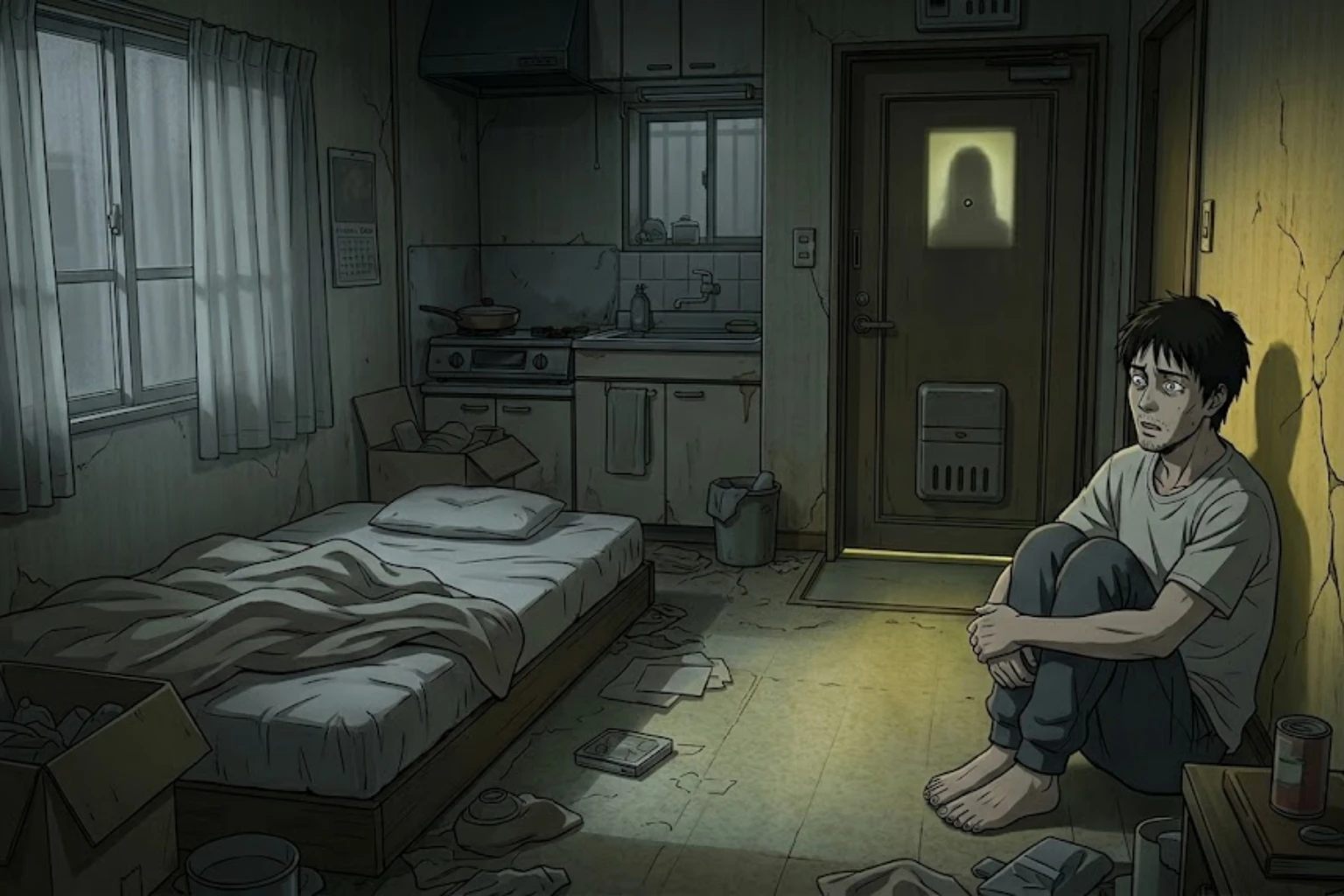
The apartment was cheap for a reason Daichi Mori couldn't immediately identify, which was, in his experience, the most honest kind of cheap there was. The building sat three train stops past where rent became reasonable, its stairwell lit by a single flickering bulb on each landing, its walls thin enough that he could hear his upstairs neighbor's television without trying. He had signed the lease anyway, because his savings had reached the specific, unglamorous number that made decisions for him, and because the landlord, a tired man with a folder of paperwork he clearly wanted to stop holding, hadn't asked him a single question he didn't already know the answer to.
He moved in on a Sunday with two suitcases and a box of kitchen things his mother had insisted he take, and by Tuesday he had unpacked enough to feel, for the first time in months, that he was occupying a space rather than simply passing through it.
He heard the voice for the first time on Tuesday night.
It came through the wall beside his bed — the wall shared, he assumed, with whatever apartment sat next door — soft and conversational, a woman's voice pitched at the kind of volume a person uses when they're not entirely sure anyone's listening but are willing to try anyway.
"Did you have a good day?"
Daichi sat up in the dark, his heart doing the quick, startled thing hearts do when a stranger's voice arrives where no stranger should be. He listened for a long moment, certain he'd imagined it, certain it was the television upstairs bleeding down through some trick of the building's old pipes.
"Hello?" he said, mostly to prove to himself that nothing would answer.
"Hello," the voice said, immediately, warmly, as though she'd been waiting for the invitation. "I'm sorry. I don't mean to bother you. It's just quiet, and I heard you moving boxes."
He sat with his back against the headboard, the wall cool against his shoulder, and found himself answering — not because it seemed wise, but because the voice carried an unmistakable, almost embarrassing loneliness, the kind he recognized from his own reflection some mornings. "It's fine," he said. "I just moved in."
"I know," she said. "I heard. Welcome."
—
She introduced herself only as Yuki, and over the following nights Daichi came to think of her less as a stranger through a wall and more as a kind of fixture of the apartment itself, the way a creaking floorboard becomes a fixture, expected and eventually almost comforting. She asked about his day in a way that felt genuinely curious rather than performed. She asked what he did for work, and laughed softly, kindly, when he admitted he wasn't entirely sure himself most days. She told him, on his fourth night in the building, that she liked the sound of rain on the window, and he told her he did too, and for a while they simply sat on either side of the wall listening to it together, saying nothing, which felt less strange than it should have.
She was useful in ways he hadn't expected a neighbor to be. On his second week, he fell asleep on the couch with a pot still on the stove, the burner ticking quietly under a film of reducing broth, and her voice came through the wall sharp enough to wake him.
"Daichi. Your stove."
He bolted upright, the smell of scorched broth already thickening in the kitchen, and killed the burner with seconds to spare. When he thanked her afterward, pressing his palm flat against the wall as though that might carry the gratitude through it, she only said, "I notice things," with a small, modest laugh, and he didn't think to ask how she could have noticed something happening inside his apartment and not hers.
Twice more she warned him of things he hadn't seen himself — once that someone was standing outside his door before he'd heard the knock, once that he'd left his window unlatched on a night the wind had picked up fast and cold. Each time, the warning arrived a beat before he would have discovered the problem on his own, and each time, he was too grateful in the moment to find that timing strange.
It was three weeks before he found a reason to.
—
He mentioned her to the landlord almost by accident, asking in passing whether the woman next door — Yuki, he said, in 4B — had lived in the building long.
The landlord's face did something complicated. "4B's empty," he said. "Has been for years."
Daichi laughed, assuming a misunderstanding. "No, the apartment right next to mine. I can hear her through the wall."
"That's 4B." The landlord said it slowly, the way a person says something they'd rather not have to repeat. "Sealed up. Has been since before I took over the building. Owner won't lease it, won't let anyone in to clean it, won't even talk about it if you ask straight out. Pipes are probably the only thing moving in there."
"There's no one living there?"
"There's no door that opens," the landlord said. "Not from the inside, not from the hallway. It's bricked up behind the wallpaper, if you want to know. I checked once, years back, thought maybe I could rent it after all. Whole frame's filled in solid. No way in or out."
Daichi stood in the hallway after the landlord had gone, looking at the wall that separated his apartment from 4B, and found that the cool, painted plaster looked exactly the way it had looked that morning — ordinary, slightly scuffed near the baseboard, entirely unremarkable — and that this, more than anything the landlord had said, was what unsettled him most.
—
He didn't tell Yuki what he'd learned. He told himself this was simple caution, the same caution that makes a person avoid mentioning a strange noise to whatever might be making it, but some smaller, more honest part of him understood it was something closer to fear of confirming what he already suspected he wouldn't be able to unconfirm afterward.
She talked to him as she always had that night, asking about his day, mentioning the rain, and he answered the way he always answered, his voice carefully level, his palm resting flat against the wall the way it always rested, except now the gesture felt less like comfort and more like checking a pulse.
"You're quiet tonight," she said.
"Tired," he said, which was true, in its way.
"Sleep well, then," she said, gentle as always, and the wall went silent the way it always went silent when she said goodnight, and Daichi lay awake long after, staring at the ceiling, listening to a silence that no longer felt empty so much as occupied by something that had simply decided, for the moment, not to speak.
—
The warning came nine nights later, a little after one in the morning, her voice arriving through the wall with none of its usual warmth.
"Don't open your door."
Daichi sat up immediately, every nerve in his body snapping awake at once. "Yuki—"
"Don't open your door," she said again, the words flat now, stripped of the conversational softness he'd grown used to, carrying instead something close to urgency, or close to fear, though he couldn't tell, in the dark, which of the two it more closely resembled.
He didn't open the door. He went to it instead, slow and silent, and pressed his eye to the peephole the way a person checks a wound they already suspect is worse than it feels.
The hallway outside was lit by its single, flickering bulb, the same dim, sour yellow it had always been. And standing in the middle of it, facing his apartment door directly, was a woman.
She wasn't moving. She wasn't reaching for the handle, wasn't raising a hand to knock, wasn't doing anything at all except standing in the small, distorted curve of the peephole's lens, facing him with a stillness that felt less like waiting and more like already knowing he was there.
He couldn't make out her face clearly through the fisheye warp of the glass. He didn't try very hard to. Something in him had already decided he didn't want to.
He stepped back from the door, his breath unsteady, his hand still hovering near the peephole as though some part of him wanted to look again despite every other part of him insisting otherwise.
The voice came from the wall beside him, soft now, close, intimate in a way it had never sounded before.
"That isn't me."
—
Daichi backed away from the door until his shoulders met the far wall, and slid down it until he was sitting on the floor, his knees drawn up, his eyes fixed on the thin strip of hallway light bleeding under the door. He didn't ask what she meant. Some part of him had already understood the shape of the answer well enough that hearing it spoken aloud would only have made it heavier.
He reached up without quite deciding to and turned off the bedside lamp, then crossed the room on unsteady legs and killed the kitchen light, then the hallway light, until the apartment held no glow anywhere except the gray seep of the streetlamp through the curtains. He didn't know, with any clarity, why darkness felt safer than light. He only knew that visibility had started to feel like an invitation, and he wanted, more than anything, to stop extending it.
He sat against the wall — his wall, the one that had carried her voice for three weeks now — and waited.
The woman in the hallway never knocked. He listened for it anyway, every minute that passed sharpening rather than dulling the listening, certain that the absence of sound was its own kind of held breath. The building ticked and settled the way old buildings do. The flickering bulb outside buzzed faintly through the door. And beneath all of it, beneath the ordinary sounds of a building doing nothing in particular, Daichi sat and watched the thin line of light under his door for any shift, any shadow, any sign that the stillness in the hallway had decided to end.
It didn't. Not for hours. Not until the gray light at the curtain's edge had started, very slowly, to lighten into something closer to morning.
The voice returned just before dawn, quiet, almost tender.
"Good," she said. "Now don't look through the peephole again."
Daichi let out a breath he hadn't realized he was holding, his shoulders dropping by some small, exhausted degree, the first relief he'd allowed himself all night. He opened his mouth to answer her, to thank her, to ask her — finally, now, with the morning light arriving to make the question feel survivable — what exactly she was, what exactly had been standing in his hallway, what exactly he had just spent the night agreeing not to look at again.
He never got the chance to ask.
From the other side of his apartment door — not the wall, not 4B, but the door itself, the hallway just beyond it — a voice whispered back in the exact same warm, familiar register Yuki had used every night for three weeks.
"Too late."
Daichi did not move. He sat very still against the wall, the gray morning light creeping slowly across the floor toward his feet, and understood, with a clarity that felt almost peaceful in its completeness, that he had followed the only rule he'd been given, and that following it correctly had never been the part that was supposed to save him.


.png)
.png)
.png)