%20(1).png)
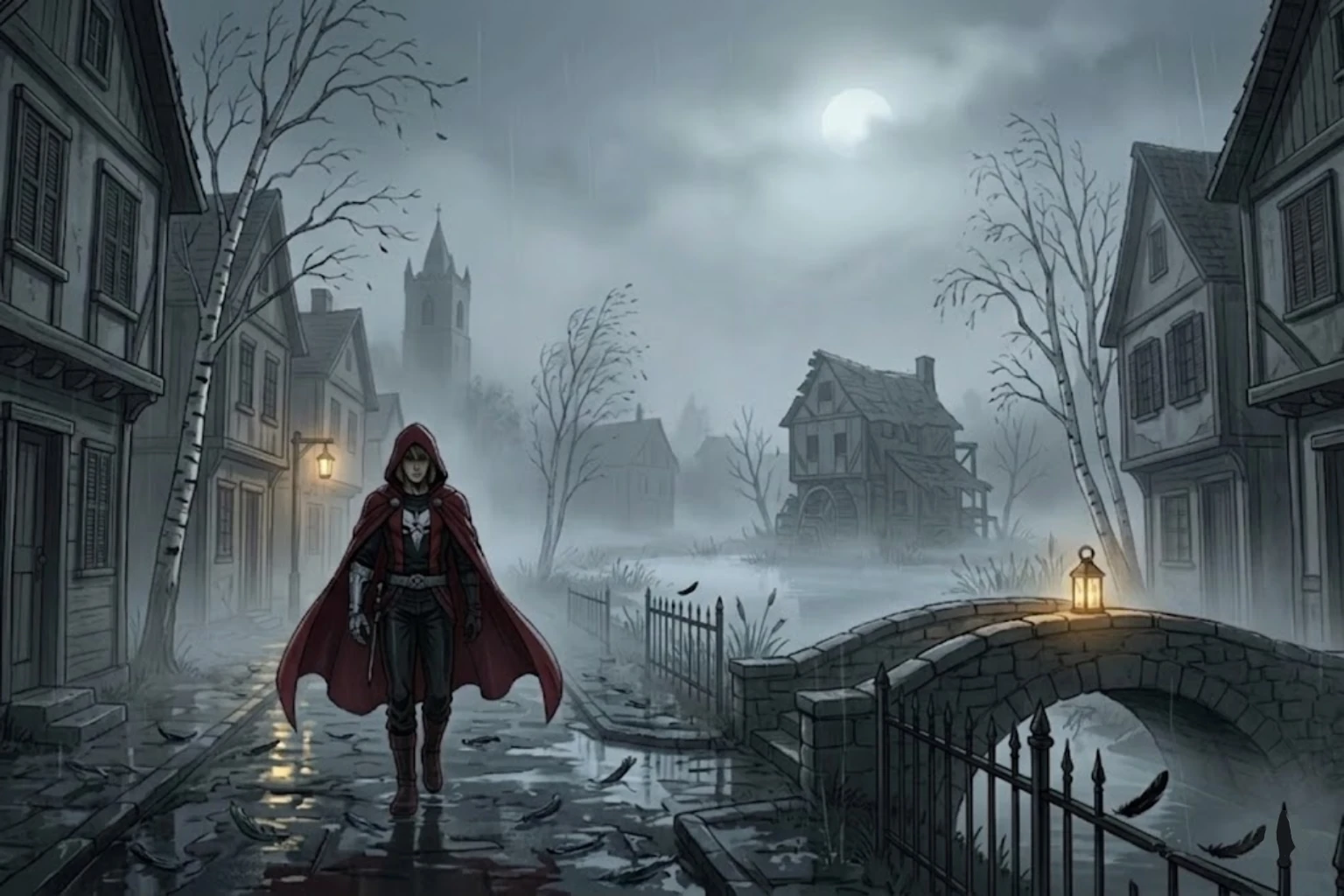
The ferry did not appear on any map Kaito had consulted.
It was there regardless — a flat, dark vessel barely wide enough for two horses, poled by a ferryman who had not spoken since Kaito had boarded at the eastern bank. The river itself had no name that locals used openly. They called it the crossing and left it at that, which told Kaito more than any name would have.
The fog came in from the west.
By the time the far bank materialized from the grey, the village behind him had already disappeared. There was only water, the soft knock of the pole against the hull, and the ferryman's breath misting in the cold air.
Kaito pulled his hood lower and watched the opposite shore take shape.
A dock. A lantern on a post, burning low. A road of black mud leading upward through birch trees stripped bare by late autumn. Somewhere beyond the tree line, a church bell rang once — not on the hour, not twice, not at all predictably. Just once, as if to acknowledge his arrival.
The ferryman stopped the vessel without a word.
Kaito stepped off, set two coins on the railing without looking back, and walked toward the light.
The village was called Voss.
He had been told this by the man who had hired him — a merchant from the lowland city of Ardenveck who smelled of pipe smoke and nervous sweat and who had slid a folded envelope across a tavern table three weeks prior without making eye contact.
Children, the letter inside had said. Three. Gone in the span of one month. No bodies. No tracks past the mill. The village council has made no formal request because there is no authority left in Voss that functions. I am asking on behalf of a family I owe a debt to. Find what is taking them. Stop it if you can. Leave if you cannot.
Below the instructions, a figure. A reasonable one. Enough to matter.
At the bottom, a single line added in different ink, as if written later:
The villagers will not speak to you freely. They are afraid of something they have already decided not to name.
That last detail had been what convinced him to take the contract.
People afraid of a thing they refused to name were always the most dangerous kind of afraid.
The inn was called The Amber Post and it smelled of old wood, tallow candles, and something beneath both — damp stone, Kaito thought, or old water. The kind of smell that came from a building that had flooded once and never fully dried.
The woman behind the counter was perhaps sixty, with a face that had long since made peace with suspicion as a permanent expression. She looked at Kaito the way people looked at weather — not afraid, exactly, but aware that it did not care about her.
Her eyes moved to his silver arm. Then to the symbol on his chest. Then back to his face.
She said nothing about any of it.
"A room," Kaito said. "Three nights, possibly more."
"Coin upfront," she said.
He paid it.
She set a key on the counter and kept her hand on it a half-second longer than necessary before releasing it. A small thing. He filed it away.
"The mill," he said, before she could withdraw entirely. "Is it still operating?"
A pause. Not the pause of someone who didn't know. The other kind.
"Closed for the season," she said.
"Since when?"
"Since it closed."
She turned and disappeared through a low door behind the counter, and the room settled back into its silence as if she had never been there at all.
Kaito took his key, took his bag, and climbed the stairs.
Through the single window of his room, Voss was barely visible beneath the fog — a handful of rooftops, a crooked fence line, one more lantern burning somewhere near the far end of the main road. The church tower rose above the rest, pale against the dark sky.
The bell did not ring again.
But he had the distinct impression it was considering it.
He found the first mark the following morning.
Scratched into the doorframe of the mill — low, near the ground, as if made by someone crouching or something smaller than a man. A symbol he did not immediately recognize: a circle with a single horizontal line bisecting it, and beneath the line, three small vertical cuts.
He crouched and studied it for a long time.
Behind him, the river moved sluggishly through the fog. The mill wheel had stopped turning. Rust had crept up its paddles. The water around the wheel's base was dark and perfectly still.
No tracks past the mill, the letter had said.
He looked at the symbol again.
Then he looked at the stillness of the water.
Something about it was wrong in a way he couldn't immediately articulate — not the color, not the smell. The behavior of it. Water near a mill wheel, even a stopped one, still moved. Current pushed through. Debris drifted.
This water did not move at all.
He picked up a stone and dropped it in.
The ripples lasted exactly two seconds. Then the surface sealed itself flat again, as if the stone had never touched it.
Kaito stood up slowly.
He looked upstream, where the river bent out of sight behind a wall of birch and grey fog.
Then he walked back toward the village.
He had questions. Whether anyone would answer them was a different matter entirely.
He saw her that evening.
Or rather — he saw the evidence of her.
He had been crossing the narrow bridge at the north end of the village when he noticed two black feathers caught in the iron railing, held there by the wind's pressure rather than any attachment. Long feathers. The kind that did not belong to any bird that wintered in this region.
He stopped.
Looked north along the road. Nothing visible beyond the fog.
Looked south toward the village. An old man closing his shutters. A dog that had stopped walking and was staring at the same northern road with its ears flat.
Kaito picked up one of the feathers. Turned it once between his fingers. Set it back exactly where he had found it.
She had already been here. Had already seen whatever there was to see — or had come to see him, which was a different thing and not necessarily better.
Either way, she was gone now.
He stood on the bridge another moment, the fog pressing in from the river below, the cold working through his coat at the shoulders.
The village council has made no formal request.
Somebody had, though.
Somebody had sent for him specifically.
And somebody else — it now appeared — had arrived before him and chosen not to stay.
He filed that away as well, in the place he kept things that had not yet decided what they meant.
Then he walked back toward the inn, and the fog closed behind him, and Voss grew quiet again in the particular way of places that had learned silence as a form of survival.
He did not sleep well.
Not from fear — he had slept in worse places under worse circumstances and had learned long ago that fear spent on anticipation was fear wasted. It was the silence that kept him near the surface of sleep rather than under it. Voss at night was too quiet. Not the quiet of a peaceful village, but the quiet of one that had agreed, collectively and without discussion, to make as little sound as possible after dark.
No dogs. No wind in the eaves. No distant conversation from the taproom below.
Just the occasional settling of the building's old bones, and once, near what he estimated was the third hour of the night, the sound of footsteps in the road outside — slow, unhurried, moving from north to south along the main road and then stopping beneath his window for a duration he counted to eleven before they resumed and faded.
He did not go to the window.
He lay still and listened until the silence returned, and then he closed his eyes and waited for morning with the patience of a man who had learned that some things revealed themselves better in daylight.
The priest was the first person in Voss who looked directly at him.
Not at the arm. Not at the symbol. At his face — which was, in its own way, more unsettling than the usual avoidance.
He was an old man, built narrow and dry like something preserved rather than aged, with white hair and the hands of someone who had spent decades doing physical work before shifting to work of a different kind. He was sweeping the steps of the church when Kaito approached, and he stopped sweeping and watched him come up the path with an expression of neither welcome nor hostility. Simple recognition.
"I wondered when you would come here," the priest said.
"Most people start with the inn," Kaito said. "I started with the mill."
"And what did the mill tell you?"
"That the water doesn't behave."
The priest looked at the broom in his hands as if he had forgotten he was holding it. He set it against the stone railing and said, "Come inside. The cold is worse than it seems."
The church was small and very old, older than the village around it by the look of the stonework. The nave held perhaps forty people at capacity. The windows were narrow and the light through them was thin and grey. Candles had been lit along the side aisle — too many for an empty church on an ordinary morning, the kind of quantity that suggested they were burning for a reason.
Three of them, Kaito noticed, had been placed before a small alcove in the eastern wall. The alcove held no saint's figure. Just a shallow stone bowl filled with water that did not reflect the candlelight correctly.
He looked at the bowl for a moment, then at the priest.
"How long," Kaito said.
The priest sat down in the front pew without ceremony. "The first child in late summer. The second in the month after. The third—" He paused. "Seventeen days ago."
"All from the same family?"
"No. Three different families. Two boys, one girl. Ages between six and ten." He folded his hands in his lap. "No connection between the families beyond the village itself. No prior incidents. No warnings anyone acknowledged in time."
In time. An interesting phrasing.
"There were warnings," Kaito said.
The priest looked at the candles. "There are always warnings. People simply decide what a warning is only after the thing it warned about has already happened."
"What did they ignore?"
A long pause. The old man had the quality of someone organizing what he was willing to say alongside what he knew, and choosing the border between them carefully.
"The mill pond," he finally said. "Three weeks before the first child vanished, the miller's wife reported that the water in the pond had changed. Not in color. Not in smell. She said it had become — attentive."
Kaito said nothing.
"She was not a superstitious woman," the priest continued. "That is what makes it significant. She was practical, literal, not given to poetry. Attentive was the word she chose. She said it felt as though the water was watching the bank."
"What happened to the miller's wife?"
"She left. Took her children and went to her sister in Ardenveck. The miller stayed." A pause. "He is still here. He does not go near the pond."
Kaito looked again at the stone bowl in the alcove. At the water that didn't reflect correctly.
"What is that?" he said.
The priest was quiet for a moment that stretched just past comfortable.
"Something old," he said. "Older than this church, which was built on older foundations than the village council knows about or would want to know about. The bowl was here when the first stone was laid. We were instructed — my predecessors were instructed — to keep water in it. Not pond water. Not river water. Rain water only, collected in a specific vessel during specific conditions." He looked at his hands. "I have maintained that practice. I do not fully understand why. But in forty years of serving this parish I have learned that there are instructions one follows not because one understands them, but because one notices that the periods when they were not followed tended to end badly."
Kaito stood there in the thin grey light of the church and let the silence settle for a moment.
"The symbol on the mill door," he said. "Circle, bisected. Three marks below."
The priest's hands tightened slightly in his lap.
"You know it," Kaito said.
"I have seen it before."
"Where?"
"In the older sections of this church. Carved into the foundation stones. Covered, most of them, when the floor was relaid two centuries ago." He met Kaito's eyes. "And in the record books of my predecessors. Mentioned but never explained. Drawn in the margins in the manner of something that needed to be documented but could not be spoken plainly."
"What do your predecessors' records say about it?"
The priest stood slowly, with the careful effort of old joints. He moved to the alcove and stood before the bowl of rain water and looked into it with an expression Kaito could not fully read — something between duty and dread, the look of a man standing at a post he had not chosen but had held too long to abandon now.
"They call it the mark of the patient thing," the priest said quietly. "They do not name the thing itself. They only note that when the mark appears, it means the thing has been waiting long enough that it has decided to stop waiting."
The candles threw soft light across the stone bowl.
The water in it sat perfectly still.
Outside, the fog pressed against the narrow windows, and Voss made no sound at all.
The miller was a broad man gone to grey, living alone in a house that had the feeling of somewhere a person slept rather than lived — surfaces cleared not from tidiness but from the systematic removal of anything that required care. No fire in the hearth despite the cold. Bread on the table that had not been touched. The curtains on the mill side of the house drawn and, Kaito noticed, weighted at the bottom with something heavy so they could not shift.
He answered the door on the third knock and looked at Kaito with the eyes of a man operating well past the point where fear had any useful function remaining.
"I have nothing to tell you," the miller said.
"You don't know what I'm going to ask."
"Everyone who comes to this door wants to know about the pond. I have nothing to tell anyone about the pond. I don't go there. I don't look at it. I don't discuss it." His jaw worked briefly. "I stay in this house and I wait for spring and then I am leaving."
"Where will you go?"
"Anywhere."
Kaito studied the man's face for a moment. The specific quality of his fear — not the fear of someone who had seen something, but the fear of someone who had almost seen something and had made the choice not to, and now lived with the permanent weight of that decision.
"Your wife said the water became attentive," Kaito said.
Something moved through the miller's expression. Not surprise. The opposite of surprise.
"She should not have said that to anyone."
"She said it to the priest. The priest said it to me. I am trying to find three children."
A long silence. The weighted curtains did not move.
"I heard it," the miller said at last, very quietly. "At night. From the pond. Not every night. Certain nights — still nights, when there was no wind." He stopped.
"What did you hear?"
The miller looked past Kaito at the empty road behind him, at the fog sitting over everything, at the village that had grown so practiced at its silence.
"Breathing," he said. "Patient. Regular. From under the water." He looked back at Kaito. "Not the breathing of something that had come up from below. The breathing of something that had always been there and had simply decided, after a very long time, to let itself be heard."
He stepped back from the door.
"That's all I have," he said. "That is everything I know. I would ask you not to come back."
He closed the door.
Kaito stood in the road for a moment, the cold working steadily at his face, the fog folding itself around the rooflines of Voss.
From somewhere near the north end of the village — near the bridge — a single crow called once and went silent.
He turned up his collar and walked toward the mill pond.
It was time to stop approaching the edges of this and look directly at the center of it.
The pond was behind the mill, separated from the river by a narrow earthen bank that looked like it had been built up deliberately over many years — reinforced, Kaito noted, with stones placed too regularly to be natural. Someone had maintained that bank. Someone had considered it important that the pond and the river not connect.
He stood at the edge and looked at it.
It was perhaps thirty feet across. Roughly circular. The fog sat over it differently than it sat over the rest of the village — thicker, lower, almost surface-level, so that the water itself was barely visible beneath the white. The birch trees surrounding it on three sides had shed every leaf but stood completely still, no movement in the branches despite the cold air that had been shifting all morning.
Everything around the pond was still.
Not the stillness of winter. The other kind.
Kaito crouched at the bank and looked at the water directly.
It looked back.
That was not a metaphor. There was a quality to the surface — a subtle, oriented quality — that he had encountered perhaps twice before in his life, in places where something old had been present long enough that the environment around it had begun to participate in its attention. The water was not moving. The water was not merely still. The water was directed.
He picked up a stone. Held it.
Then he set it back down.
Dropping stones told him what he already knew. He needed to think about what he didn't know yet.
Three children. No tracks past the mill. The mark appearing on the door — not scratched by a child, not worn by weather, but deliberate and recent, the edges of the cuts still pale against the dark wood. The patient thing. The breathing at night.
He thought about the priest's words.
When the mark appears, it means the thing has been waiting long enough that it has decided to stop waiting.
He thought about the stone bowl. Rain water only, collected under specific conditions. Maintained for forty years by a priest who didn't fully understand why, only that the periods when it was not maintained had ended badly.
He thought about the earthen bank between the pond and the river.
He stood up and walked around the pond slowly, keeping three feet from the edge, watching the ground rather than the water. The fog made it slow work. He went methodically, the way he had been taught a long time ago in circumstances he no longer chose to think about at length — sector by sector, nothing assumed, everything observed.
He found the second mark on the north side.
Same symbol. But larger. And not on a door or a wall — scratched into the earthen bank itself, at water level, in a place that would be submerged when the water was higher and was only visible now because the pond's level had dropped.
He crouched and studied it.
The pond level had dropped.
He looked again at the bank, at the waterline stain on the earth above the current surface, and understood that the pond had been slowly draining. Not from the bank breaking — the bank was intact. From somewhere below.
From somewhere that led, he now suspected, not out but down.
He stood.
He walked back to the mill door and looked at the first mark again, at the circle and the bisecting line and the three small cuts below it.
Three marks. Three children.
Not a warning about what had already happened.
A record of what had been taken.


.png)
.png)
.png)