%20(1).png)
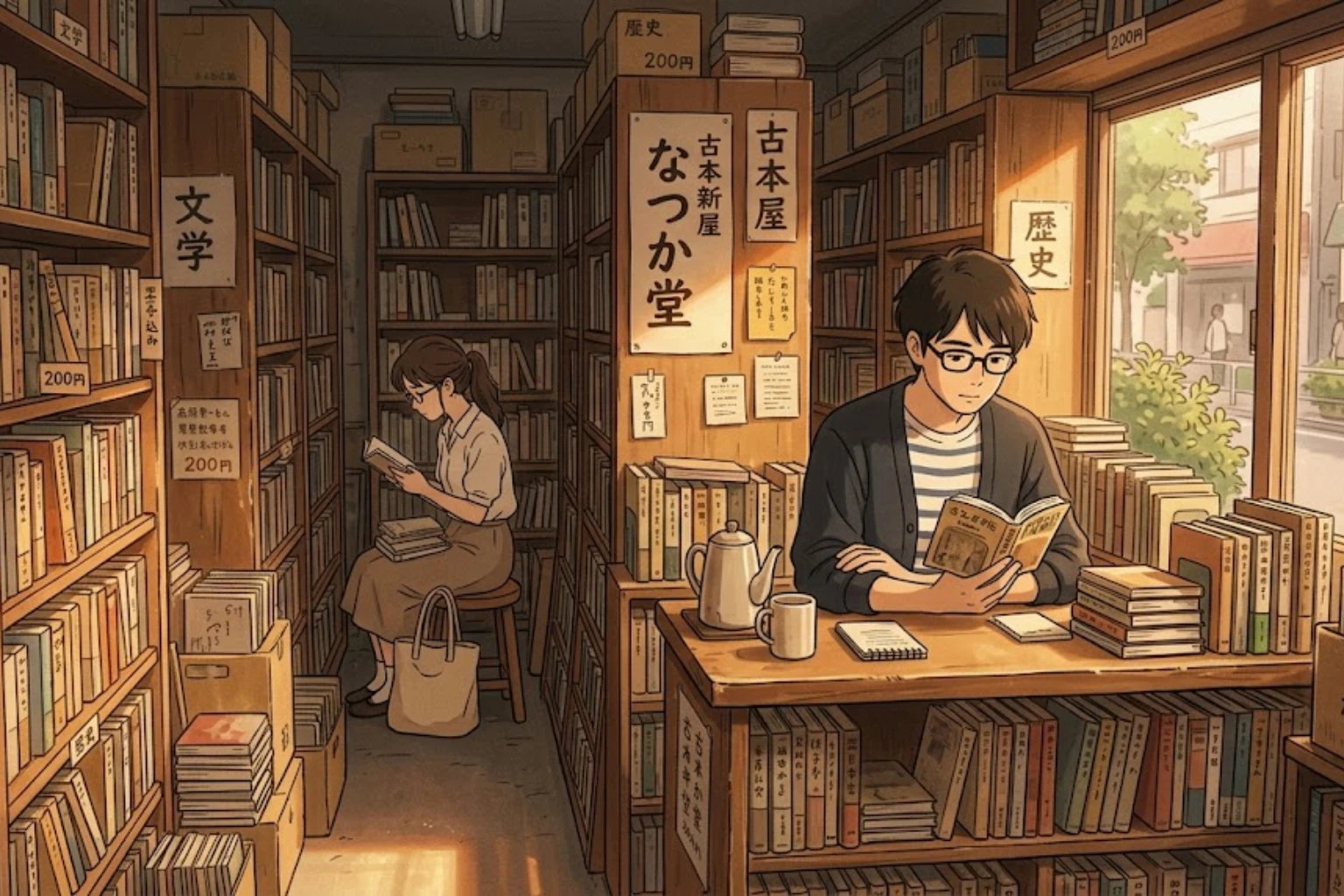
The shop had been his grandmother's for thirty years before it became, on paper at least, his.
Natsu was twenty-two when the ownership transferred, official stamps and all, in a lawyer's office that smelled nothing like the shop itself. He had a half-finished literature degree, no retail experience worth mentioning, and a general sense that taking over Kotobuki Books was less a decision than a thing that happened to him, the way weather happens to you. His grandmother had run the place since before he was born. When she died, someone had to keep the lights on, and it turned out that someone was him.
He did not tell people this part. What he told them, when they asked why someone his age was running a used bookstore in a neighborhood better known for ramen shops and dry cleaners, was simpler: it was my grandmother's. As if that explained everything. It explained some of it.
It did not explain how to price a water-stained travel memoir from 1974, or what to do when the register jammed on humid days, or how a person was supposed to feel spending every Saturday in a room that still smelled, faintly and permanently, of his grandmother's hand lotion. That smell had soaked into the shelves over three decades and showed no sign of leaving. Natsu had stopped noticing it around the third month, which he chose to interpret as adjustment rather than forgetting.
She had left things behind, the way people who spend thirty years in one room always do. A ledger with her handwriting, cramped and slanting left, recording prices in a system Natsu had needed two weeks to decode. Handwritten labels on some of the older shelves — POETRY (JAPANESE), POETRY (OTHER), a distinction he'd never quite understood the logic of but had preserved anyway, because changing it felt like erasing something. A cardboard box of bookmarks she'd apparently collected from customers over the years, useless and sentimental, that he kept behind the counter and used without thinking about it until he was three pages into a book and noticed the bookmark had someone else's handwriting on it.
Sometimes he found her notes in books that hadn't sold yet. A margin comment. A date. Once, in a copy of an Enchi Fumiko novel, a receipt from a grocery store folded into quarters, the ink so faded he couldn't read what she'd bought, only that she'd bought it on a Tuesday in June, eleven years before he was born.
He kept all of it. Not out of any grand sentiment — mostly because he hadn't decided yet what he was allowed to throw away.
By spring, eight months in, he had learned enough to stop feeling like a fraud most of the time. There were pricing guides online. There was Ogawa-san, a retired bookseller from two streets over who had taken an interest in Natsu's survival that fell somewhere between mentorship and supervision, and who showed up periodically to tell him, with the confidence of a man who had never once doubted himself, that he was undercharging for things.
"This," Ogawa-san said one Tuesday afternoon, holding up a slim hardcover with a cracked spine, "is worth four times what you have on it."
"It's damaged," Natsu said.
"It's a first printing."
"How can you tell?"
Ogawa-san looked at him the way a man looks at a nephew who has disappointed him in a way that is not quite worth getting angry about.
"You look at the colophon page," he said. "You always look at the colophon page."
Natsu wrote it down. He had a notebook now — his grandmother's old ledger had run out of pages sometime in the nineties, and he'd started a new one, and it was filling steadily with things Ogawa-san had told him, things he'd learned from forums, things he was slowly assembling into something like competence.
He had regulars, too, by then. Not many — the shop was small, and the neighborhood wasn't really a bookstore neighborhood, but there was a university two stations away, and university students needed cheap paperbacks the way anyone needed anything. A handful of them came in reliably. An old man named Tachibana who bought exactly one mystery novel every second Wednesday and never seemed to run out of ones he hadn't read. A mother who brought her son in on Sunday mornings and let him pick anything under five hundred yen. Natsu had started thinking of these people, privately, as his — a possessive he knew was slightly absurd to apply to strangers, but which felt true regardless.
The girl with the tote bag first appeared on a Saturday in April, though at the time he had no reason to notice her particularly.
She had been looking for the post office.
This was the entire truth of it, unglamorous as it was. Fumiko had a map open on her phone showing a route that made sense right up until the street split into two narrower streets that the map did not seem to know about, and her phone, with what she felt was almost personal malice, chose that exact moment to lose signal.
She stood at the fork for a moment. Left looked marginally more promising. She had no actual evidence for this. She went left anyway.
The post office was not on the left. What was on the left, roughly forty meters down, was a narrow shopfront with a wooden sign reading KOTOBUKI BOOKS and a window display that had clearly not been curated by anyone with strong opinions about window displays — books stacked more or less by size, a few faded paper flowers, a handwritten sign about a sale that had probably ended weeks ago.
She almost walked past it. Then she saw the spine of the book propped in the front corner of the window and stopped walking entirely.
It was a novel she had been looking for since October. She had checked three secondhand shops near campus and one enormous chain store downtown and had more or less concluded it was out of print everywhere that mattered, at least everywhere she could reasonably get to.
It was three hundred and twenty yen, according to the pencil mark on the inside cover, in a shop she had found by accident, on a street she had come to by mistake, looking for a post office that turned out to be somewhere else entirely.
She went inside.
The shop was narrower than it looked from outside and deeper than she expected, shelves running back further than the front window suggested, the air smelling of paper and something floral she couldn't place. A young man was behind the counter, maybe early twenties, sorting through a stack of books with the mild distraction of someone doing three things in his head at once.
He looked up when the bell over the door rang.
"Welcome," he said, and went back to the stack.
She found the novel in the window easily enough, then bought it at the counter with the correct change, because she'd counted it out already on the walk in, hoping.
He wrapped it in a small square of brown paper without her asking. She noticed that — the wrapping, unprompted, precise — and thought it was a nice touch, the kind of thing that suggested someone paying more attention than the job strictly required.
"Thank you," he said, handing it over.
"Thanks," she said.
She found the post office two streets further on, on the way back, in almost the opposite direction the map had originally suggested. She mailed her package and thought about the bookstore twice more that day, for no reason she examined closely.
She came back the following Saturday.
She told herself it was because the shop had a good selection, which was true, though it did not entirely explain why she had specifically chosen a Saturday, or why she'd left slightly earlier than necessary to get there before the light through the front window shifted from direct to something softer, though she had no way of knowing that detail yet.
The shop was quiet. The same young man was behind the counter, this time reading something with the kind of stillness that suggested he'd forgotten anyone might come in. She browsed for nearly an hour — poetry first, because she'd noticed the section on her way in the first time and it had looked reasonably curated, then fiction, then a back corner where the paperbacks had gone the specific yellow of decades-old paper.
She read standing up. She always had — it was a habit from childhood, from her mother's shop back in Niigata, where sitting down with a book you hadn't paid for yet had felt, to her ten-year-old self, like some kind of minor theft. She held books in both hands, weight shifted onto one hip, and read three or four pages before deciding.
She decided against everything that day. She left without buying anything, half-expecting some flicker of annoyance from the counter.
There wasn't one. The young man looked up when the bell rang on her way out, said nothing beyond a small nod, and went back to his book.
She came back the Saturday after that.
By the third visit, Natsu had started paying actual attention rather than simply registering her presence, which was a different thing entirely.
He recognized the tote bag first — heavy canvas, a faded print of some train line map on the side, the strap worn pale where it crossed her shoulder. He recognized the timing next: she came in reliably late morning, just after ten thirty, which was when the light through the front window shifted from the harsh angle of direct sun to something more diffuse, filtered through the building across the street.
She went to poetry, then fiction, then the back corner. Always in that order. She read standing, which most people didn't — most people grabbed a chair from the small reading nook near the register, or crouched on the floor if they were committed, or simply flipped through standing for thirty seconds before deciding. She stood and read for twenty minutes at a stretch, weight on one hip, entirely still except for the small motion of her eyes moving down the page.
On her fourth visit, he noticed her shift her weight for the third time in ten minutes and thought, with the practical part of his brain that had learned to think about customer comfort, that the back corner didn't have anywhere to sit.
He didn't think much of it at the time. He just moved a stool back there, an old wooden one from the stockroom, tucked it against the shelf where the light was decent, and went back to the counter.
She noticed it on her next visit. He watched her notice it — the small pause, the glance toward the counter, and then she sat down on it and kept reading, and neither of them said anything about it, which felt, to Natsu, like the correct way to handle it.
It was on her fifth visit that he actually spoke to her, beyond the transactional minimum required to complete a sale.
She was in the back corner, on the stool, holding a novel she had picked up twice already that afternoon and put back down twice, an oscillation Natsu had noticed without meaning to. It was good — he knew it was good, he'd read it himself — but he understood the specific hesitation of not wanting to commit to a book yet.
He came down the aisle with a different one in his hand.
"This one's better," he said.
She looked up, mildly startled, as though she'd forgotten the shop had other people in it.
"Better than what?"
"Than that." He nodded at the book in her hands. "Same author. That one's the one everybody starts with. This is the one people actually remember."
She looked at the book he was holding out — thinner, a plainer cover, no obvious marketing behind it.
"Why does everyone start with the other one, then?"
"Because it won a prize," he said. "Prizes don't always pick the right book."
She took it from him, turned it over, read the back copy. Then, without any particular ceremony, opened to the first page and started reading it standing in the aisle.
He didn't wait around to watch. He went back to the counter, because staring at someone while they decided whether to like a book felt like the wrong kind of pressure.
A few minutes later she came up to the register with both books.
"I'm buying this one," she said, indicating the one he'd handed her. "Not the other one yet. I want to see if you're right."
"Fair," he said.
She paid. He wrapped it.
"Have you read everything in this shop?" she asked, watching his hands work the paper.
"Most of it," he said. "Some of the older stock I'm still working through." He handed her the wrapped book. "My grandmother read everything. I'm catching up."
Something in the way he said it — not sad, exactly, just matter-of-fact, the tone of someone describing an ongoing project — made her look at him a beat longer than the exchange required.
"Was it hers? The shop?"
"Thirty years," he said. "Mine for about eight months now."
"That's not very long."
"No," he said. "It isn't."
She didn't ask anything further, which he appreciated, because he didn't have a tidy answer prepared for the question underneath the question — whether he'd chosen this or simply failed to choose anything else in time to stop it from happening.
"I'll let you know if you were right," she said instead, holding up the book.
"Take your time," he said. "It's not a race."
She left. He noticed, again, that he was noticing things about her, and filed that observation away without doing much with it.
She came back and told him he was right.
This became, over the following weeks, a kind of pattern — not a formal one, nothing either of them would have described as such if asked, but a rhythm all the same. She came on Saturdays. She browsed. Eventually she came to the counter, sometimes with a book, sometimes without, and they talked for a while before she left.
The talking expanded slowly, the way these things do, starting from books and widening outward.
"You're a student?" he asked one Saturday, apropos of the university sticker on the corner of her tote bag.
"Urban planning," she said. "Two stations over."
"What made you pick that?"
She considered the question with more seriousness than he'd expected for something so casual.
"I grew up in a town where things didn't change much," she said. "Then I came here and everything changes constantly. I wanted to understand why. Whether it's better or worse, or just different."
"Which is it?"
"I haven't decided," she said. "Ask me again in three years."
"I might not remember to."
"Then I'll remind you."
He liked that — the assumption, casual and unexamined, that they'd still be having conversations in three years. He didn't say so. He just made a note of it, the way he'd started making notes of things she said.
Another Saturday, she asked him about the degree he hadn't finished — she'd noticed a university textbook shelved, oddly, among the fiction, and asked if it was his.
"Comparative literature," he said. "I was two years in when my grandmother got sick."
"Are you going back?"
"I don't know," he said. "Some days yes. Some days the shop feels like the whole thing, and finishing the degree feels like admitting the shop isn't enough."
"Is it enough?"
He thought about that one for a while, longer than the question probably warranted.
"Some days," he said finally. "Ask me again in three years."
She laughed — a short, real sound, not performed — and he felt unreasonably pleased with himself for causing it.
Tokyo came up often, mostly because she complained about it, mildly and without real venom, the way you complain about something you've decided to tolerate.
"It's loud," she said. "Not the traffic. The pace. Everyone's always moving toward something."
"Where are you from?"
"Niigata. My mother has a shop there too, actually. Not books — she collects things. First editions, mostly. Woodblock prints sometimes."
"A collector."
"An obsessive," Fumiko said, "but yes."
"Is that where you get it? Reading standing up, deciding whether to buy something for twenty minutes."
"I get the standing-up thing from her shop," she said. "You weren't allowed to sit unless you'd already paid. I still can't shake it."
"That's a strange rule."
"She had strange rules about a lot of things."
He filed this away too — the mother, the shop, the collecting — the way he'd started filing most things she told him, without any clear plan for what he'd do with the information later.
The tea started as practicality and became something else without either of them marking the transition.
The shop got cold in the mornings, especially in the back near the old paperbacks, and Natsu had an electric kettle behind the counter that heated water faster than the space heater ever managed. He'd made tea for himself most mornings since he took over — his grandmother's habit, apparently, judging by the tin of loose leaves that had been behind the counter longer than he had.
Sometime in May, without deciding to, he started making two cups.
He didn't announce it. He just set one down near the register when Fumiko came up to browse the shelf there, and she took it without comment the first time, and the second time, and by the third time it had become simply a thing that happened on Saturdays, unremarked upon by either of them.
"You don't have to do this," she said once, holding the cup with both hands.
"I'm already making it," he said. "It's not extra effort."
"It's a little extra effort."
"Negligible," he said, and she let it go, though she smiled slightly into the cup in a way he noticed and didn't mention.
It was in June that she found the first mispriced book, and it happened almost by accident.
She was in the back corner, on the stool, working through a stack of older paperbacks that had been re-shelved after a delivery, when she pulled out a slim hardcover with a faded blue jacket and stopped.
"Natsu-san," she called. "Come here a second."
He came, wiping his hands on his apron out of habit though there was nothing on them.
"This," she said, holding up the book, "is priced way too low."
He looked at the sticker. Two hundred yen, in his grandmother's handwriting, faded but legible.
"It's old," he said. "That's usually why things are cheap."
"It's old and rare," Fumiko said. "This is worth at least four times what's on it. Maybe more, depending on the printing."
"How do you know that?"
"My mother collects them," she said, as though this were self-evident. "I grew up around price guides. I used to help her catalogue things on weekends."
He took the book from her, turned it over, checked the colophon page the way Ogawa-san had drilled into him.
"First printing," he said slowly.
"Yes."
"How did you know just from looking at it?"
"The typeface on the cover changed after the second printing. It's a small thing. Most people wouldn't notice."
He looked at her, then at the book, then back at her.
"Are there others?" he asked. "Priced wrong, I mean."
She looked past him at the shelves, running a quick mental survey.
"Probably," she said. "Do you want to find out?"
They spent the next two Saturdays going through the shop's older stock, section by section, with Fumiko identifying anything she thought was undervalued and Natsu writing it down in the notebook he kept behind the counter.
It was, against his expectations, one of the more enjoyable things he'd done since taking over the shop.
"This one," Fumiko said, holding up a battered paperback with a torn corner, "worth almost nothing. Don't get excited."
"I wasn't excited."
"You had a face."
"I don't have a face."
"You have a very specific face when you think something might be valuable," she said. "It's this one." She attempted an expression — eyebrows slightly raised, mouth pressed into a line of restrained hope — that was, mortifyingly, exactly what he did.
"I don't look like that."
"You look exactly like that."
He decided not to argue further, mostly because arguing further would require making the face again, which felt like conceding the point.
Later that same afternoon, she pulled a copy of a Dazai collection from the shelf, opened the front cover, and went still.
"What?" he said.
She held it up. Tucked into the inside cover was a small square of paper, folded twice, his grandmother's handwriting on it — a note about the previous owner, apparently, someone who'd traded it in decades earlier, along with a comment about the weather that day.
Natsu took it carefully. Read it twice.
"She used to write little things like that," he said. "In half the older stock. I keep finding them."
"Do you keep them?"
"I don't know where else they'd go," he said, and put the note back exactly where it had been, and reshelved the book without pricing it.
"You're not going to sell that one?"
"Not yet," he said. "Maybe not for a while."
She didn't push. She just nodded, and moved on to the next shelf, and he appreciated that she understood the difference between a book that was stock and a book that was something else.
Toward the end of the second Saturday, she caught him trying to quietly write a new price sticker for a book she hadn't even flagged.
"What are you doing?"
"Fixing a price."
"I didn't say that one was wrong."
"I noticed it myself," he said, a little too quickly.
She raised an eyebrow. "Did you check the colophon page?"
"...I was about to."
"Natsu-san."
"I was going to check it."
"You were guessing."
"I was estimating."
She took the book from him, checked the page in question, and handed it back without a word — the price he'd written was, in fact, correct, more or less by accident, and she looked entirely unimpressed by his good luck.
"Beginner's confidence," she said.
"I'll take it."
Between the two of them they found eleven items total, and Fumiko wrote out the list in a neat, compressed hand — title, current price, corrected estimate, and a short note on why. He read through it at the counter while she waited, sipping tea that had long since gone lukewarm because neither of them had thought to refill the kettle.
"Thank you," he said, when he finished. "Genuinely."
"It's your shop," she said. "You should know what's in it."
"I've been here eight months."
"Your grandmother was here thirty years."
"I'm still catching up," he said, which had become something close to a refrain between them by then, and she smiled like she recognized it as one.
Ogawa-san came in on a Tuesday afternoon in August, while Fumiko was not there, though the evidence of her was.
He noticed the small shelf behind the counter first — the one that had accumulated, over the summer, without either Natsu or Fumiko formally naming it. Seven books, arranged with slightly more care than the rest of the stock.
"Who's that for?" Ogawa-san asked.
"A regular," Natsu said.
Ogawa-san looked at the shelf a beat longer than the answer required.
"A regular," he repeated.
"She comes in on Saturdays. She's a student. Urban planning."
"Mm."
"She's the one who found the mispriced first editions. Her mother collects them."
"Very useful," Ogawa-san said, in a tone that suggested he was filing this information somewhere Natsu couldn't see. He picked up one of the seven books, glanced at the cover, put it back exactly where it had been. "You've fixed the pricing, then."
"Mostly."
"Good." He said nothing further about the shelf. He wandered toward the travel section instead, the way he always did, and spent twenty minutes deciding against a guidebook to Kyushu that he had, by Natsu's count, decided against at least three times before.
On his way out, he paused at the counter again.
"She has good taste," he said. "The girl. If she found the ones I would have found."
"I'll tell her you said so."
"Don't," Ogawa-san said. "It'll go to her head." And he left, the bell over the door ringing once behind him, having said, in his own way, everything he intended to say.
The shelf behind the counter grew slowly through the summer.
It started with one book — the recommendation that had begun everything, the one he'd said was better than the famous one. Then a second, a poetry collection he thought she'd like based on something she'd said in passing about her mother's taste. Then a third, and by August there were seven, arranged with a care he told himself was purely practical.
She noticed the shelf's existence around book number four.
"What's this?" she asked, tilting her head at it.
"Books," he said.
"I can see that. Why are they behind the counter and not on the shelves where they belong?"
"They're not shelved yet."
"It's been three weeks."
"I've been busy."
She picked one up, turned it over. "This is a book you specifically pulled aside for someone. It has your grandmother's old note-taking energy."
"It's just stock."
"It's organized stock. There's a system here. I can tell there's a system."
"There's no system."
"Natsu-san."
"They're books I thought you might like," he admitted finally. "That's the whole system."
She looked at the shelf again, then at him, and something in her expression softened without becoming anything he could easily name.
"Okay," she said simply, and took two of the seven home that day, and didn't tease him about it further, though she did glance at the shelf every Saturday after that, checking, he suspected, whether it had grown.
It usually had.
By late summer the rhythm between them had settled into something neither of them discussed but both, in their own ways, relied on.
She stayed longer now — two hours, sometimes three, migrating between the back corner and the counter and occasionally, when the shop was slow, sitting on a second stool Natsu had found in the stockroom and placed near the register without much comment.
She'd started knowing where things were well enough that she occasionally helped other customers find sections when Natsu was in the back.
"Poetry's against the far wall," he heard her tell a nervous-looking high schooler one Saturday. "Second shelf from the bottom has the anthologies, if that's what you need for class."
"Are you the owner?" the kid asked.
"No," Fumiko said. "I just come here a lot."
Natsu, listening from the stockroom doorway, found that he liked the sound of that more than he examined too closely.
He'd started making two teas automatically by then, without the small pause of decision that used to precede it. He found himself glancing toward the door around ten twenty some mornings, before she was due, a habit he hadn't noticed forming until Ogawa-san mentioned, unprompted, that he seemed to check the clock a lot on Saturdays.
"I check the clock every day," Natsu said.
"Not like that," Ogawa-san said, and left it there, which was somehow worse than if he'd said more.
The last Saturday of August, she came in to find a book sitting on the counter with a small folded note tucked inside the front cover.
Found this in a box from an estate sale last week, the note read, in his usual quick hand. Thought of you immediately. Not for sale — just read it if you want.
She read it standing at the counter first, then again in the back corner, on the stool that had become, without either of them declaring it so, hers.
The shop moved around her while she read — a mother and her son came in and left with two paperbacks under five hundred yen each; Tachibana appeared, bought his mystery novel, exchanged a few words with Natsu about the heat, and left; the light through the front window shifted from harsh to soft the way it did every day around ten thirty, though today it seemed, to Fumiko at least, to take its time about it.
She finished the book a little after one o'clock.
She brought it back to the counter, where Natsu was refilling the kettle for what would be their second round of tea that day.
"Well?" he said.
"It's the best thing I've read this year," she said.
He nodded — not surprised, exactly, but satisfied in the specific way of someone whose instincts had been confirmed.
She set the book down on the counter between them.
"I'd like to buy it," she said.
"I told you, it's not—"
"I know what you told me." She kept her eyes on him. "I'd like to buy it anyway. Put a price on it."
"Fumiko."
"Put a price on it, Natsu-san."
He looked at the book. He looked at her. He picked up the small pad he used for handwritten receipts and wrote a number on the corner slip, then tore it off and slid it across the counter.
She looked down at it.
One yen.
She didn't laugh, didn't comment, didn't do anything except open her tote bag, find her coin purse, and set exactly one yen on the counter with the careful seriousness of someone completing an entirely legitimate transaction.
He rang it up. The register made its small mechanical sound. He wrote out a proper receipt — date, item, one yen, his own signature at the bottom, the same as he'd give for a hundred-thousand-yen first edition — and handed it to her.
She folded the receipt in half and tucked it into the book, and put the book in her tote bag, next to the seven others that had, over the summer, migrated home with her one at a time.
There was a moment, brief and unremarkable to anyone who might have walked in on it, where neither of them said anything at all. The kettle finished boiling behind the counter. Somewhere outside a delivery truck idled. The light came through the window at its late-August angle, warm and unhurried, and settled over the counter between them like something that had always belonged there.
"Same time next Saturday?" she said.
"The shop opens at ten," he said.
"I know when the shop opens."
"Then yes," he said. "Same time next Saturday."
She turned toward the door, tote bag over one shoulder, and had almost reached it when she stopped.
"Natsu-san."
He looked up.
"You're still undercharging for the Mishima in the back left corner."
She was gone before he could answer, the bell over the door ringing once behind her, the sound settling into the quiet of the shop the way it always did.
Natsu stood at the counter for a moment. Then he smiled — small, involuntary, the kind that arrived before he'd decided to have it — and went to find the Mishima.


.png)
.png)
.png)