%20(1).png)
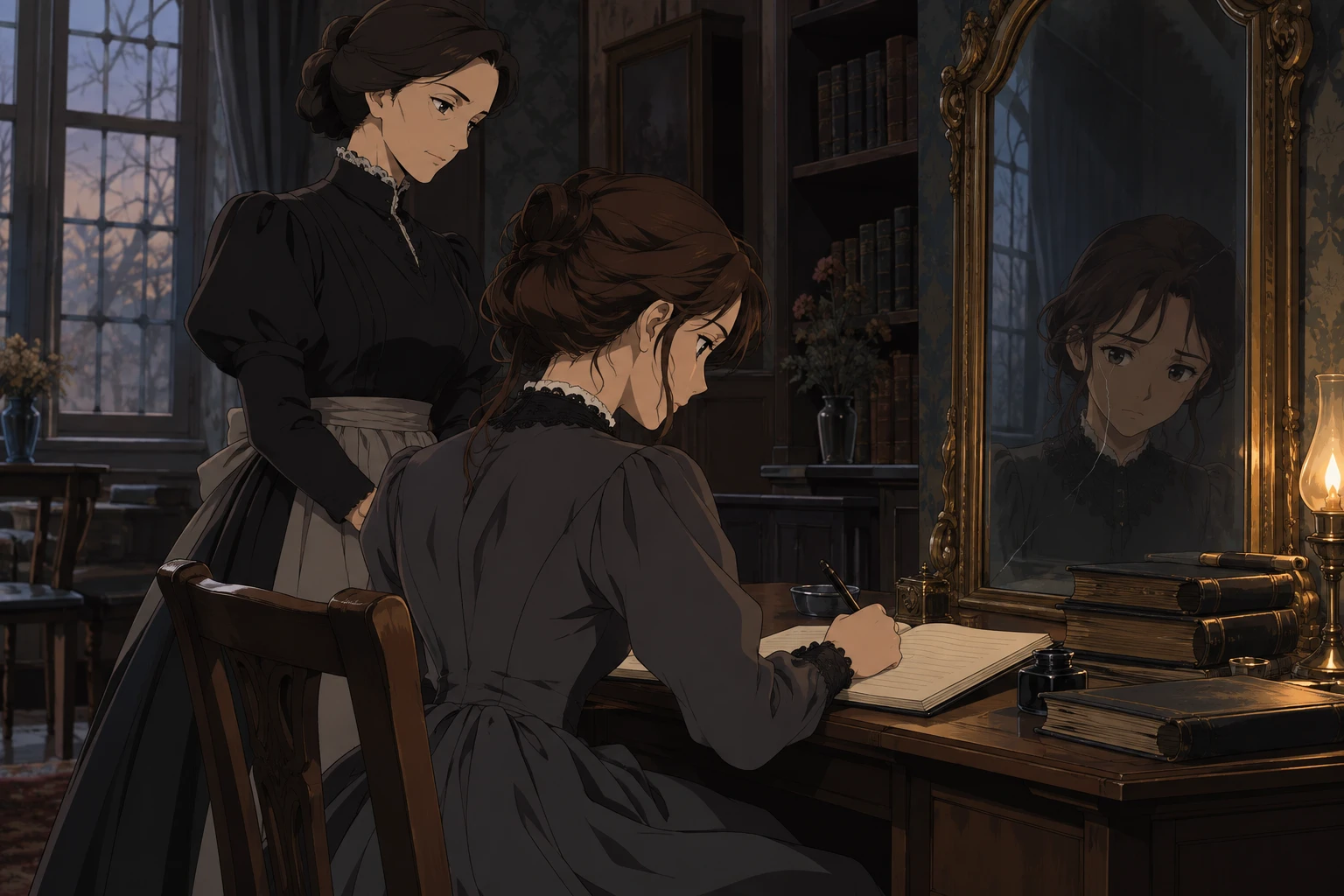
The carriage left Wren Ashby at the end of a long gravel drive flanked by yews so old and so carefully clipped that they had long since stopped looking like trees at all, and stood instead like a row of patient black sentries watching her walk the last quarter mile to the house alone, her single trunk bumping against her shins.
Aldermoor Hall rose at the end of the drive the way a held breath rises in the chest, grey stone and dark windows, ivy grown thick enough over one wing that it seemed to be holding the stonework together rather than merely decorating it. A woman stood waiting on the steps before Wren had come close enough to properly see her face, as though she had been standing there since the letter confirming Wren's arrival had first been sent, and had simply not thought it worth sitting down in the meantime.
"Miss Ashby." The woman's voice carried the particular, practiced warmth of someone who had said a great many names in that same gentle tone and never once mixed one up with another. "I am Mrs. Quill. I manage the house, and I'll be seeing to your instruction while you're with us. You've had a long journey. Come in out of the wind."
"Thank you." Wren set her trunk down at the foot of the steps, uncertain whether she was meant to carry it further herself. "The letter said Mr. Aldermoor was in need of a companion for his household. I confess I don't entirely understand what that will involve."
"You'll understand soon enough," Mrs. Quill said, already turning toward the door, "and in the meantime, there's no sense standing in the cold working yourself into a worry over it."
It was not, Wren would think later, an answer at all, though at the time it had seemed only the ordinary brisk evasion of a woman with a great deal to see to and little patience for questions that could wait.
Her room, when she was shown to it, occupied the end of a long corridor on the second floor, its single window looking out over a dark stretch of ornamental lake that caught what little evening light remained and held it, flat and still, like something waiting. The furniture was good, old, and slightly too fine for a companion's chamber, and against the far wall stood a wardrobe of dark polished wood that Mrs. Quill opened without asking whether Wren wished to see inside it.
"These will want a little taking in," Mrs. Quill said, drawing out a dress of deep grey wool, its cuffs trimmed in a narrow band of black lace gone soft and slightly yellowed with age. "But the fit should be close enough to begin with. We'll have the rest adjusted by the week's end."
"They're not new," Wren said, before she had quite decided whether it was polite to say so.
"Very little in this house is new, Miss Ashby." Mrs. Quill held the dress up against her, assessing, her eyes moving over Wren's shoulders and waist with the brisk, impersonal thoroughness of a tailor rather than a housekeeper. "You'll find we don't believe in waste here. A good dress outlives its first wearer a dozen times over, if it's cared for properly."
Wren said nothing to that, though something in the phrase settled into her without quite announcing itself as unease, the way a single cold draft might pass through a warm room without anyone troubling to find its source.
She met Mr. Aldermoor at supper, in a dining room large enough to seat twenty and laid for three, the long table's unused length stretching away into candlelit shadow on either side of her. He was older than she had expected, though not so old as the house's atmosphere had led her to imagine, a tall, grey-haired man with the careful, contained bearing of someone who had spent a very long time practicing stillness, and he watched her take her seat with an attention that felt, from the first moment, a shade too close and a shade too long.
"Miss Ashby." His voice was low, unhurried, pleasant in a way that did not entirely reach his eyes. "Thank you for coming so far on such short notice. I hope the journey wasn't too wearying."
"Not at all, sir. I'm grateful for the position."
"We'll see that you have no cause to regret accepting it." He studied her for a moment longer than the pleasantry required, something moving behind his expression that she could not name, and then turned his attention to his soup with the air of a man setting down something carefully so as not to spill it. "Mrs. Quill will see to your instruction. I trust you'll find her thorough."
"Instruction in what, if I may ask, sir?"
"In the ways of this house," Mr. Aldermoor said. "It has its own customs. You'll find they suit you better than you expect."
It was, again, not quite an answer, and Wren found herself, over the following days, collecting these near-answers the way a child collects smooth stones from a beach without yet understanding why one stone feels more worth keeping than another.
The lessons began the next morning, in a small sitting room off the library that Mrs. Quill called the schoolroom, though there was no schoolbook in sight, only a writing desk, a looking glass taller than Wren herself, and a shelf of ledgers bound in matching dark leather.
"Sit straight in the chair," Mrs. Quill said, settling into the one opposite with her own spine perfectly vertical, as though demonstrating a posture she had demonstrated a great many times before. "Hands folded, just so. Now. When you speak to Mr. Aldermoor, you'll address him directly, not down at your hands. He finds it discourteous to be spoken to by the crown of someone's head."
"I didn't mean to be discourteous."
"I know you didn't. That's precisely why I'm telling you now, before it becomes a habit worth correcting more firmly." Mrs. Quill's smile did not reach any further than her mouth. "You have a pleasant voice, Miss Ashby, when you're not rushing it. Slower, please. Let the end of the sentence land before you reach for the next one."
Wren tried again, slower, and watched something in Mrs. Quill's face ease very slightly, the way a craftsman's face eases at a joint that has finally been coaxed to fit.
"Better," Mrs. Quill said. "Much better."
The lessons continued daily after that, in small, specific increments that felt, individually, almost too trivial to object to. The particular way to hold a teacup, two fingers through the handle rather than one, the cup never lifted higher than the collarbone. The precise angle at which to tilt her chin when listening to someone speak, attentive without appearing eager. A set of phrases Mrs. Quill corrected her toward again and again, not generic etiquette so much as oddly specific turns of speech — I had not considered it in that light in place of I hadn't thought of that, I find I am rather fond of in place of I like — until Wren began to notice herself reaching for the practiced phrase before the natural one even finished forming in her mind.
"Why this particular way of speaking?" she asked, perhaps a fortnight in, during a lesson on handwriting that had her copying out, letter by letter, a passage from a worn leather notebook Mrs. Quill kept locked in the desk drawer between sessions. "It seems a great deal of trouble for ordinary conversation."
"Because ordinary conversation is not what's wanted here," Mrs. Quill said, watching the pen move across the page with an attention Wren found increasingly difficult to ignore. "Copy the loop on your g again, please. Smaller. Like so." She reached over and guided Wren's hand briefly, correcting the shape with two fingers pressed light and precise against her knuckles, and withdrew again before Wren could properly object to the familiarity of it.
"Whose handwriting is this?" Wren asked, looking down at the passage she'd been copying, a description of a garden in early spring, the hand elegant and old-fashioned, full of small, particular flourishes she had been made to practice until her own hand had begun, faintly, to resemble it.
"A former pupil's," Mrs. Quill said, closing the notebook and returning it to its drawer before Wren could read further. "You needn't trouble yourself over whose. Your concern is only the shape of the letters."
It was the first time the phrase former pupil had been spoken aloud in Wren's hearing, and she turned it over for days afterward, the way one turns over a coin found in an unexpected pocket, trying to recall whether she had always had it or whether someone else had put it there.
It was around this time that she began to take her afternoon tea, at Mrs. Quill's instruction, in the small morning room where Mr. Aldermoor liked to sit with his correspondence, and it was there, on an otherwise unremarkable afternoon, that she first understood how closely she was being watched outside the schoolroom as well as within it.
She had laughed — genuinely, without thinking, at some small absurdity in a letter she was reading from her one remaining correspondent, a cousin in Dorset whose spelling had never improved past the age of ten — and when she looked up, Mr. Aldermoor had set down his pen entirely and was watching her with an expression so naked in its longing that she felt, for a moment, as though she had intruded on something private of his rather than the reverse.
"Forgive me," he said, recovering himself, though not quickly. "You laughed just then exactly—" He stopped. "It's nothing. An old man's fancy. Do go on with your letter."
"Exactly like whom, sir?"
"I didn't say like anyone." His voice had gone carefully even, the way Mrs. Quill's did when a lesson required particular correcting. "Tell me what your cousin writes that's so amusing."
She told him, haltingly, aware the moment had gone strange around the edges, and he listened with a stillness so complete that she found herself speaking faster, the way one does under an attention too steady to be borne at an ordinary pace. When she finished he did not laugh himself, only nodded, slowly, as if filing the story away somewhere he meant to return to it later.
"Read me the passage again," he said. "The precise words, if you can recall them."
"Sir?"
"Only the way you told it. I should like to hear it again." He smiled, and it was a kind smile, an old man's smile, and it did nothing at all to loosen the small cold knot that had formed beneath Wren's ribs. "Humor me."
She read it again, as near to her first telling as she could manage, and watched his eyes close briefly at some point in the middle of it, not from boredom, she understood even then, but from something nearer to pain, and when he opened them again he thanked her with a courtesy so formal it felt like a door being shut gently but very firmly between them.
"You've a generous laugh, Miss Ashby," he said, rising to excuse himself. "It's a rare thing in this house. I hope you won't let it go quiet on my account."
He left before she could answer, and she sat a long while afterward with her cousin's letter forgotten in her lap, turning over the strange certainty that she had, without knowing how, given him something he had wanted very badly, and that he had taken it from her as carefully and as completely as Mrs. Quill took the shape of her letters, her vowels, her folded hands.
She found the first portrait by accident, three weeks into her residence, taking a wrong turn in a corridor she had not yet learned properly, in a disused wing where the dust lay thick enough on the floor runners to show, plainly, that no one had walked there in a very long while. The portrait hung between two shuttered windows, its gilt frame gone dull with neglect, and the girl within it wore the same grey wool dress, the same narrow black lace at the cuffs, that hung now in Wren's own wardrobe.
She was not Wren. The resemblance was close enough to unsettle and far enough to reassure, a different set to the eyes, a fuller mouth, hair a shade darker. But she sat in the same high-backed chair Wren had sat in for her very first lesson, hands folded in precisely the manner Mrs. Quill had spent a fortnight teaching Wren to fold her own, and there was no name plaque beneath the frame, only a small brass tab gone green with age, entirely blank.
"Who is she," Wren asked that evening, carefully, over supper, watching Mr. Aldermoor's face rather than her own plate.
Something crossed his expression too quickly to properly name, there and gone, the way a fish breaks the surface of still water and is under again before the ripple has finished spreading.
"Which portrait do you mean," he said, mild, reaching for his wine.
"In the west corridor. A girl in a grey dress, seated by a window. There was no name beneath it."
"There are a great many portraits in this house, Miss Ashby, collected across a great many years. I confess I couldn't tell you the sitter of every one." He said it smoothly, without hesitation, and yet she noticed, as she had noticed several times now without being able to say precisely why it troubled her, that he did not ask which window, or offer to have the portrait properly labeled, or show any of the mild curiosity a man generally shows about his own family's walls.
Mrs. Quill, seated at the table's far end, said nothing at all, though Wren felt her attention settle, briefly and precisely, the way a hand settles on a shoulder it means to steady rather than comfort.
The second portrait she found deliberately, a week later, having returned to the west corridor on a pretext of needing air that nobody troubled to question, since nobody in that part of the house seemed to trouble much over anything Wren did so long as she returned in time for her lessons. This one hung three doors further along, in a small disused parlor whose furniture had been draped in dust sheets, and the girl in it was fairer than either Wren or the first portrait's sitter, younger, perhaps no more than fifteen, seated in the same chair, wearing a dress Wren now recognized by its particular cut even before she registered the familiar lace. This frame, too, carried only a blank brass tab where a name ought to have been.
She counted the dust sheets in that room on her way out, an old habit of hers from counting things that frightened her, and found there were more shapes beneath them than furniture alone could easily account for.
The ledgers in the schoolroom, she had assumed from the first, held household accounts, the ordinary tedious record of linens and coal and wages that every great house kept somewhere. It was curiosity rather than suspicion that made her open one, late one evening when Mrs. Quill had been called away to deal with some matter in the kitchens and had, for once, left the desk drawer unlocked.
The first page bore a date some six years past, and a name she did not recognize — Clara M. — followed by a column of measurements, waist and wrist and the length from shoulder to elbow, precise to the quarter inch. Beneath the measurements, a second column recorded lessons, dates and brief notations in Mrs. Quill's own hand: Posture improved. Speech still too quick. Handwriting shows promise but resists the loop. The entries continued for several months, growing steadily more approving, and then, on a page some four months in, stopped entirely, mid-column, the remainder of the page left blank.
She turned forward. The next ledger began again, a new name — Susannah B., a date some two years after Clara M.'s final entry — and the same columns, the same careful, approving notations building toward something Wren could not yet name, and the same abrupt silence partway through, a blank page where continuation should have been.
She found four such names before she heard Mrs. Quill's footsteps returning down the corridor, and closed the ledger with hands that were not quite steady, and did not trust herself to speak for the remainder of that evening's lesson, though if Mrs. Quill noticed her distraction, she gave no sign of it at all.
It was Agness, the oldest of the house's few remaining maids, who first said anything to her that might have been called a warning, though even that came sideways, offered almost against the old woman's own better judgment, in the kitchen passage late one night when Wren had come down for water and found her sitting alone by the banked fire, unable to sleep.
"You're a sweet girl," Agness said, without preamble, watching Wren fill her cup at the pump. "Sweeter than most of them were, I think, though it's been a long while and memory plays tricks."
"Most of whom?" Wren kept her voice as light as she could manage.
Agness's hands, folded in her lap, tightened very slightly. "I've said more than I ought already. Mrs. Quill wouldn't thank me for it."
"Please. I only want to understand what's expected of me here. Nobody will tell me plainly."
"Because plainly isn't how it's done in this house," Agness said, "and hasn't been, not in all my years in service here, and I've seen longer years in this house than I care to count some nights." She looked up then, and there was real fear in the old woman's face, not for herself, Wren thought, but for her, a fear with no clear object yet attached to it. "Be careful what you let them teach you, child. Be careful how much of yourself you let slip away while you're learning to be someone else's notion of pleasant."
"Whose notion?"
But Agness had already risen, murmuring something about the hour, and would say nothing further on the matter that night or any night after, though she took to pressing Wren's hand, briefly and wordlessly, whenever they passed each other in the halls, a small, furtive gesture that felt less like affection than like someone marking a grave while there was still time to mark it properly.
The changes in herself, when she finally let herself notice them properly, had been happening slowly enough that she could not afterward say exactly when they had begun. She caught herself, more than once, reaching for I find I am rather fond of before her own plainer words arrived, and found the substitution had stopped feeling like a lesson and started feeling, disturbingly, like simple habit. Her handwriting, when she wrote letters she never sent to a sister she had not seen in years, had taken on a loop in the g that was not her own and would not, however she tried, revert back to what it had been before.
And there was the mirror.
It stood in the schoolroom, tall and old, its silvering gone faintly cloudy at the edges, and Wren had taken, without quite deciding to, to avoiding it during her lessons, finding some excuse to keep her eyes on Mrs. Quill or on her own folded hands instead. It was only by accident, catching her reflection at an angle she hadn't prepared for, that she saw it the first time: a single fine line across her cheekbone, pale and hairline, like a crack in old china, visible only when the candlelight caught it just so.
She touched the spot and found no wound there, no roughness, only smooth skin exactly as it should have been, and told herself, with as much conviction as she could manage, that it had been a trick of the glass's imperfect silvering and nothing more.
Mrs. Quill saw it too, the very next morning, and said nothing about it directly, only reached for the small box of face powder she kept in the schoolroom desk and applied it, with brisk, practiced fingers, to the exact spot on Wren's cheek before the lesson began, as though it were the most ordinary thing in the world to powder a line that did not, by any honest accounting, actually exist.
"There," Mrs. Quill said, stepping back to assess her work. "Much better. You've a touch of dryness there, is all. The air in this house can be unkind to young skin."
"It didn't feel dry," Wren said.
"No," Mrs. Quill agreed, in a tone that closed the subject as firmly as a door being shut, "I don't imagine it did."
She found the locked door at the end of the attic stair nearly two months into her stay, on an evening she had gone up ostensibly to search for a shawl she did not need, in truth simply to be somewhere Mrs. Quill's careful corrections could not follow her for an hour. The door was iron-banded, old, set into a wall that smelled, even through the wood, of something faintly sweet and faintly wrong, like flowers left too long in standing water, and it was locked with a mechanism far sturdier than anything else in that quiet, neglected part of the house.
She did not have a key. She told herself, descending the attic stair again with her unneeded shawl, that she had no intention of finding one, and knew, even as she told herself this, that it was not entirely true.
The key, when she found it three days later, hung on a ring in Mrs. Quill's own room, among a dozen others, while its owner was occupied belowstairs with some crisis involving the kitchen chimney, and Wren took it with hands that shook rather more than she liked, and told herself the whole way back up the attic stair that she would simply look, and nothing more, and would put everything back exactly as she had found it before anyone noticed she had gone anywhere at all.
The room beyond the door was not, as she had half expected, empty, nor was it the ordinary attic storage of trunks and broken furniture that the rest of the house's upper floors held in abundance. It was dry, and still, and lit by a single high window whose grime let through just enough grey evening light to see by, and arranged along both walls, seated in a row of identical high-backed chairs, were the girls.
She understood, for one long, suspended moment, almost nothing of what she was looking at, and then she understood entirely too much.
They sat in the grey wool dresses, the same narrow black lace at every cuff, hands folded in precisely the posture Mrs. Quill had spent two months teaching her own hands to hold, and their faces, where the light caught them, showed the same fine, hairline cracking she had seen once on her own cheek and told herself was a trick of the glass. On some of them the cracks ran deep and wide, whole sections of cheek and brow given over entirely to something that was not porcelain and was not skin either, something in between the two that had simply stopped deciding which it meant to be. Their mouths, every one of them, had been drawn closed with careful black stitches, small and even, the kind of neat, patient needlework Mrs. Quill had praised in Wren's own sewing only the week before.
A small brass tag hung from the arm of each chair, and where the portraits downstairs had offered nothing, these offered everything at once: Clara M. Did not hold past the fourth month. Susannah B. Too much of herself remained in the voice. Margaret T. The hands would not forget their own hand. Further down the row, names grown older and the ink gone browner with age, the notations shorter, more weary, as though whoever recorded them had tired, over the years, of finding new ways to describe the same failure.
The last chair in the row, nearest the window, sat empty.
Wren did not remember, afterward, deciding to scream, only the sound of it filling the small dry room and dying immediately against walls that seemed built for exactly that purpose, to take a sound and give nothing back. She did not remember crossing the room to the last empty chair, only standing before it, her own reflection caught faintly in the clouded window glass behind it, one fine hairline crack visible along her cheekbone in the grey evening light, plain now, unmistakable, no trick of any candle to blame it on.
"You weren't meant to find this yet."
Mrs. Quill stood in the doorway, the key ring still in her other hand, her face holding none of the alarm Wren felt radiating from her own chest, only a tired, weary sort of resignation, as though a long-expected letter had finally arrived.
"What is this," Wren said, and did not recognize her own voice, thinned and strange, already reaching, she realized with a fresh wave of horror, for the careful, practiced cadence of a lesson rather than the plain fear she meant to speak with. "What have you done to them. What are you doing to me."
"We are not doing anything to you that wasn't done, in its proper time, to every one of them," Mrs. Quill said, stepping into the room, her eyes moving across the seated row with something that was not quite grief and was not quite pride either. "And nothing that was not done to someone before all of them, a very long time ago now, someone this house lost and has never once stopped trying to call back."
"Evelyn," Wren said, the name arriving in her mouth from some lesson she did not remember being given, a name copied so many times in another girl's hand that it had worn a groove into her own memory without her ever being told whose it was.
Mrs. Quill's expression did something complicated at the sound of it, grief and relief tangled together past separating. "She drowned in that lake you look out upon every evening, child, longer ago than you would credit, and her father has never forgiven the water for taking her, nor forgiven himself for whatever he believes he failed to do in time to stop it. He has spent every year since trying to bring enough of her back into this house that the rooms would stop feeling empty. We have never quite managed it. Something in each of you resists, in the end. Your own hand. Your own voice. Something that will not fully let go of itself no matter how patiently we teach it to."
"Then let me go," Wren said. "Let me leave before whatever happened to them happens to me."
"I don't believe that choice is entirely mine to give you anymore," Mrs. Quill said, not unkindly, nodding toward the clouded window glass, where Wren's own reflection stood with its single hairline crack catching what remained of the evening light. "It rarely is, by the time a girl finds her way up here on her own feet instead of being brought."
Wren ran. She would not, afterward, be able to give a clean account of the stairs she took or the halls she crossed, only the dry, sweet-wrong smell of the locked room falling away behind her, and the sound of her own breath, and beneath it, faint and persistent, the specific horror of noticing that even her panic had a practiced cadence to it now, a rhythm Mrs. Quill's lessons had worn into her without her ever consenting to the lesson.
She found Mr. Aldermoor in the long dining room, standing at the head of the table as though he had been waiting there the entire evening for precisely this, and something in his face, when he looked at her, was so raw and so plainly grieving that for one terrible moment she almost forgave him everything before she remembered the row of seated, stitched, and cracking girls she had just left behind her.
"I only wanted her home again," he said, before she could speak at all, his voice breaking in a way that made him sound, suddenly, considerably older than he had at any meal they'd shared before this one. "I only wanted the house to stop being so empty."
"There were six of them up there." Wren's voice shook, and she let it, no longer caring whether the shaking was proper or improper, lesson or no lesson. "Six, that I counted, in stitches and chairs, with their faces coming apart like old plates. Six girls who came into this house exactly as I did, trusting the letter and the carriage and your very good manners, and not one of them walked back out again. Did you grieve for every one of them the way you're grieving now, sir? Did you stand in this very room and tell each of them how sorry you were, before or after?"
"After," he said, so quietly she nearly didn't hear it. "Always after. I have never once had the courage to say it before, when saying it might have meant something."
"Then say it means nothing now, because it doesn't. You knew what this would do to me from the moment I stepped out of that carriage. You watched me across this very table and you knew."
"I told myself it would be different this time," he said, and there was no defense in it, only a terrible, exhausted honesty, a man setting down a weight he had carried so long he no longer remembered how to stand without it. "I have told myself that every single time, Miss Ashby. I told myself it with Clara, and with Susannah, and with every name in that room upstairs, and I have never yet been wrong in hoping and never yet been right in believing it would hold. I promise myself, each time, that I will stop before it comes to this. I have never kept that promise. I don't expect you to find any comfort in my telling you so, but I find I cannot make it better by lying to you now, of all moments."
"You let Mrs. Quill stitch their mouths shut."
"I did not watch it done," he said, and had the grace, at least, to look as though the admission cost him something. "That is not the defense you deserve, and I offer it only because it is the truth I have. I have never been able to watch any part of it done. I only wait, afterward, to see whether this will be the time it finally holds."
"It will never hold," Wren said. "Not because the girl isn't good enough, or doesn't practice her letters well enough, or doesn't laugh the way you remember her laughing. It will never hold because we are not her. We never were her. We are only ourselves, being unmade a little at a time so that you don't have to go on missing someone you've already lost." She was crying now, she realized distantly, though her voice had not lost the strange, borrowed evenness Mrs. Quill's lessons had pressed into it, grief and training occupying her at once in a way that frightened her nearly as much as the attic had. "I won't be the seventh name in that ledger, sir. I would rather take my chances on the drive in the dark than spend one more night under this roof learning to disappear."
He did not try to stop her. He stood very still at the head of the long table, and something in his face, watching her, looked almost like relief, as though some small part of him had been waiting a very long time for a girl to say exactly that and mean it enough to leave.
Agness was waiting by the servants' door when Wren reached it, already holding a shawl that was not Wren's own and a small parcel of bread wrapped in cloth, as though she had known, the moment she heard footsteps running where footsteps did not run in that house, precisely what they meant and precisely what would be needed.
“I've watched this door before,” Agness said, working the lock with fingers far steadier than Wren's own had been on the attic stair. “Watched it, and never once opened it in time. I'll not make that mistake again, whatever it costs me after.” She pressed the parcel into Wren's hands, and then, briefly, pressed her own hand against Wren's cheek, light as a blessing. "Go on, child. Don't look back at the windows. Whatever's lit up there, it isn't anything you owe an answer to anymore."
She left that same night, out through the servants' door Agness unlocked for her, and walked the long drive between the patient black yews with no lantern and no clear sense of where the nearest village lay, only the certainty that she could not spend one more hour beneath that roof. She did not look back at the house until she had nearly reached the gate, and when she did, despite everything Agness had told her, she told herself the single lit window she saw, high up near the roofline, was only Mrs. Quill's own chamber, nothing more sinister than an old woman unable to sleep.
She found the road eventually, and a farmer's cart some hours after that, and told the farmer only that she had left a position that had not suited her, which was true enough in its way, and he asked no further questions, which she was grateful for more than she could properly say.
It was weeks later, in a boarding house two counties distant, settled at last into a position as an ordinary companion to an ordinary elderly woman who asked nothing of her but conversation and company, that Wren caught her own reflection one evening in a window gone dark with early winter dusk, and saw, for just a moment before she steadied the lamp and the glass brightened back into ordinary reflection, the faintest hairline shadow along her cheekbone, there and then gone, so quick she could almost, almost convince herself she had imagined it.
She did not write to anyone about Aldermoor Hall. She told herself this was because no one would believe her, which was likely true, and did not examine too closely the quieter, colder reason beneath it: that somewhere in the back of a desk drawer in a locked schoolroom two counties distant, a new ledger had very probably already been opened, a fresh name entered at its head in Mrs. Quill's careful hand, the first column of measurements already begun, and that the house, whatever else might be said of it, had never once in all its long account shown the slightest difficulty finding a girl willing to walk up that gravel drive alone.


.png)
.png)
.png)