%20(1).png)
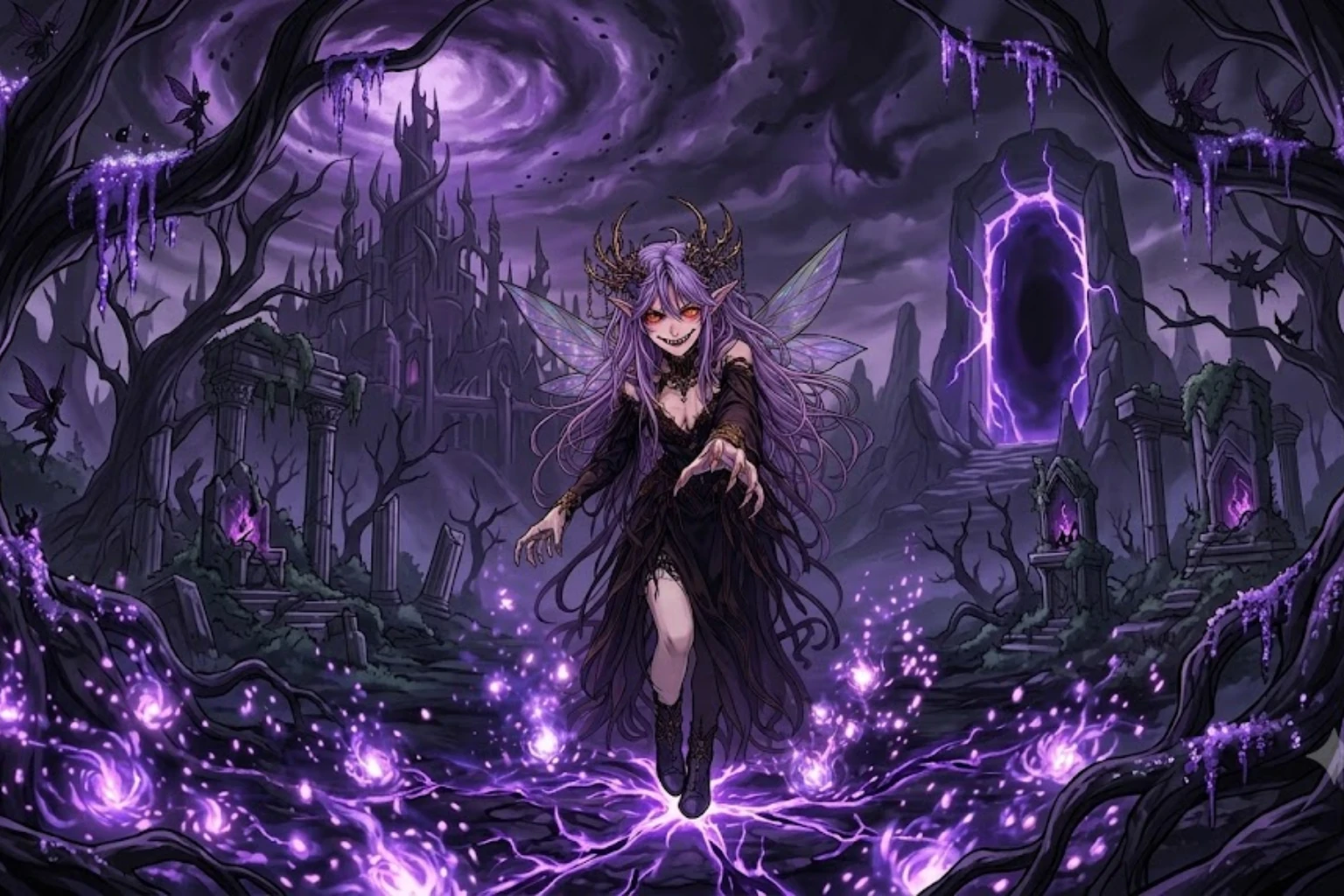
She had opened gates for a long time. She did not remember the first one, only that there had been many since, and that the shape of the thing never changed. Someone came into the forest carrying a wanting large enough to see, and she waited, and if the wanting was real enough to survive her waiting, the gate came. She did not make the wanting. She had never made the wanting. She only saw it, the way anyone might see a lit window in a dark street, and she opened what the wanting had already built.
She felt this one a long way off.
Sae had not planned to enter the forest. She had planned, as she planned most weeknights, to walk the road along its edge until her legs were tired enough to make the apartment feel smaller than her thoughts, and then to go home and sit with the television on and not really watch it. She had done this for three years. The forest had always been there, dark and close and slightly wrong in the way that certain woods are wrong even to people who don't believe in anything, and she had never gone in.
Eleven years ago she had painted every day.
She had been good at it in the unglamorous, undeniable way that some people are good at things before anyone tells them they're allowed to be. She had gone to school for it. She had a degree with her name on it and a portfolio she still owned, technically, in a flat black case at the back of her closet, though she could not remember the last time she had opened it. She thought it might have been when she moved into this apartment. She thought it might have been before that.
She had not decided to stop painting. That was the version of the story she told people, when people asked, which was rare now because most of the people in her life did not know she had ever done it. "I used to paint," she'd say, if it came up, in the mildly amused tone of someone describing a phase, a hobby from a former self. "Not anymore. Life got busy." This was true and also not true, the way a lot of the sentences she used to explain herself were true and not true at the same time.
What had actually happened was slower than a decision. She had graduated and needed money and taken a design job at an architecture firm because it used some of the same visual instincts and paid rent. The job had been supposed to be temporary. She had been supposed to paint on weekends, in the evenings, in the pockets of time that everyone always assumed would exist and that never quite did. The weekends filled with other things. The evenings got shorter. She had told herself, for the first year or two, that the wanting was still there and would come back to her in a rush the moment she had space for it.
Then one day she noticed she had stopped saying that to herself.
She still had brushes. They were in the bottom drawer of her dresser, wrapped in a dish towel that had once been decorative and was now just a rag that held brushes, and she had not opened that drawer in longer than she could accurately guess. She had paint tubes somewhere too, dried at the caps, probably unusable now, cracked like the mud at the edge of a pond in late summer. She had one painting on her apartment wall — a small one, unfinished at the edges in the way she used to like, a study of light on water that she had made in her last year of school.
People who came over sometimes asked about it. "Did you make that?" they'd say, and she'd say yes, and they'd say it was beautiful, and she would feel something complicated and quick move through her chest and then be gone by the time she answered.
An old classmate had messaged her on some professional network two years ago. Congratulations, she'd written, on the promotion, I saw it on your page — are you still painting at all? Sae had looked at that message for a long time before typing back: Not really, work keeps me pretty busy these days! How are things with you? She had not been lying. She had also known, typing it, that the exclamation point was doing a lot of work.
Her life was not bad. This mattered to her, when she thought about any of this at all, which she tried not to do often. She had a job she was competent at and did not hate. She had an apartment with good light and a couch she liked and a handful of friends she saw with enough regularity to call it a life. She was not miserable. She wanted to be clear with herself about that, whenever the thought of the unopened drawer surfaced. Nothing had gone wrong.
She had simply put something down eleven years ago and had not, in eleven years, picked it back up, and some nights, walking this road, she felt the specific weight of that the way you feel a stone in a shoe you've stopped noticing until you stop walking.
Tonight she did not stop walking. Tonight she kept walking, and at some point that she could not later identify, the road was behind her and the trees were around her and she did not know how she had gotten there.
The light in the forest was wrong in a way she found herself cataloguing rather than fearing. It had a faint violet cast, like the hour after sunset stretched out and left standing. The trees were old, some of them twisted into shapes that looked almost deliberate, as though something had bent them slowly over centuries the way a person shapes a bonsai. Twice she thought she saw movement at the edge of her vision — something small, quick, gone before she turned her head — and both times she told herself it was a bird, or a trick of the strange light, because the alternative required believing something she was not ready to believe.
The path did not feel like a trap. That surprised her. It felt, if anything, like a suggestion — a soft insistence, the kind a current makes on a swimmer who isn't fighting it. She followed it because it was there and because, she admitted to herself, she did not particularly want to turn around.
She came to the clearing without quite noticing the trees had thinned.
An easel stood in the center of it, and even from twenty feet away she recognized the model — the specific lean, one leg shorter than the others, the same wooden frame she'd used in university and had sold, with almost everything else, when she moved for the job at twenty-six. She had told herself at the time that she wasn't going to need it.
She stopped at the edge of the clearing and did not go closer.
"That's not possible," she said, out loud, to no one, because there was no one, and hearing her own voice in the quiet felt like a useful thing to do.
"It's not impossible either," said something that was not no one.
Sae turned fast enough that her shoulder bag swung and hit her hip.
The fae was smaller than she expected — not childlike, exactly, but compact, folded in on herself in the manner of something built for a different scale of world. Her wings were dark and mostly still. Her expression was not unfriendly, but it wasn't warm either. It had the quality of an expression on someone who has seen a great many things and has decided, a long time ago, not to be surprised by any of them.
"Did you put that there?" Sae asked. "The easel."
"I arranged it," the fae said. "I didn't put anything there that wasn't already yours to find."
"That's not an answer."
"It's the true one."
Sae looked at the easel again, and the small table beside it, on which sat a scatter of paint tubes that she was, from this distance, already fairly sure she would recognize.
"Why me?" she said.
"You've been carrying something into this forest for three years," the fae said. "Tonight you finally brought it far enough in that I could see the whole shape of it."
"I don't know what that means."
"You do. You're choosing not to, which is different."
Sae felt a flash of irritation, quick and disproportionate, the kind that comes from being told something true by someone with no right to know it. "Do you do this to everyone who walks in here?"
"I don't do anything to anyone," the fae said. "I open something, if there's something worth opening. Most people who come into this forest are carrying small wants. Wants they'd be relieved to have taken from them and disappointed to actually get. Those don't interest me. Yours is not small."
"You don't know what mine is."
The fae tilted her head very slightly, an economy of motion that somehow conveyed enormous skepticism.
"Fine," Sae said. "What is it, then?"
"I'm not going to tell you," the fae said. "You already know it. If I say it out loud you'll spend the next ten minutes arguing with me about whether it's true instead of finding out for yourself, and that would be a waste of both our evenings."
Sae almost laughed. It surprised her — a small, sharp exhale, more reflex than amusement. "You're very literal for a fairy."
"I'm not a fairy. I'm not sure what your word for what I am would be. Literal is accurate, though. I find most of what humans say about me is decorated well past the point of usefulness."
Sae walked a few steps closer to the easel, close enough now to see the brushes lying beside the paints, and her stomach did something small and unwelcome — a lurch of recognition, the kind you feel seeing an old lover's handwriting.
"These are my colors," she said.
"They're colors you used to prefer. I understand there's a difference, to you."
"How do you know what I used to prefer?"
"I told you. I see the shape of the wanting. Yours has paint in it. It has had paint in it for eleven years."
Sae's jaw tightened. "You're trying to get me to do something."
"I'm not trying to get you to do anything," the fae said, and for the first time there was something like an edge in her voice, not anger exactly but a correction, precise and unhurried. "I don't persuade. I don't need to. If I have to talk someone into wanting a thing, the wanting isn't theirs, and the gate won't come for it. I only opened what's already yours. Whether you use it is entirely your business."
"What happens if I paint?"
"I don't know," the fae said. "I've never painted anything in my life."
"That's not what I meant."
"I know what you meant. I'm telling you I still don't know. I don't get to see what's on the other side of the doing. Only that the doing wants to happen."
Sae looked at the brush closest to her — a flat, half-inch, the bristles slightly worn on one edge in a way that looked exactly like her own worn brushes had looked, years ago, from how she used to drag them.
"And if I leave," she said, "right now, without touching any of it?"
"Then you leave," the fae said, simply. "The easel goes when you go. Nothing follows you out. No curse, no debt, no second chance I owe you later. You'll walk back to the road and go home and none of this will have cost you anything you didn't already choose to spend."
"That easy."
"I didn't say it was easy. I said it wasn't complicated. Those aren't the same thing."
Sae stood there a moment longer with her arms crossed, feeling the old argument rise in her the way it always did — the practical voice, the one that had gotten her through eleven years of not doing this, telling her that this was absurd, that she was a grown woman standing in an enchanted forest arguing with a small strange creature about paint, that she had somewhere to be tomorrow morning at nine.
She uncrossed her arms.
She picked up the brush.
It felt wrong in her hand at first — too light, or her hand too unused to the weight, she wasn't sure which. She turned it over once, twice, the way you turn over an object you used to know well and have half forgotten the geometry of. She dipped it into a color without deciding to. It was a blue she had mixed herself once, years ago, a blue she remembered wanting and never quite getting right until she had, and finding it there, already mixed, sitting in a tube with no label, made her throat tighten in a way she did not examine.
She put the brush to the canvas and made a mark.
It was a bad mark. Too hesitant, too thin, the kind of mark a student makes when they're afraid of the canvas rather than working with it. She frowned at it.
"That was terrible," she said.
"I wouldn't know," the fae said, from somewhere near the edge of the clearing. "It looked like paint touching cloth to me."
"It was terrible. I used to be better than that."
"Then be better than that."
Sae shot her a look, but there was no malice in the fae's voice, only the same flat, patient practicality she'd had the whole conversation, and Sae found, absurdly, that it settled something in her more than sympathy would have.
She made another mark. Better. A third, correcting the angle of the second. Her hand remembered things her mind had stopped consciously tracking years ago — the particular pressure that made a line taper instead of stop dead, the way to load a brush so the color didn't run thin two strokes in. She got frustrated once, badly, when a shadow she was trying to build kept coming out flat and grey instead of the specific violet-black she wanted, and she nearly put the brush down.
"You're allowed to be bad at something you haven't done in eleven years," the fae said.
"I know that."
"You're acting like you don't."
Sae exhaled through her nose, mixed the color again, added a touch more red than felt intuitive, and this time it came out right — not perfect, but right, the exact temperature of dark she'd been chasing. Something in her chest loosened.
"Do you always talk this much," she asked, without looking away from the canvas, "or is it just me?"
"It's rarely anyone. Most people don't ask questions. They see the gate and they go."
"That seems sad."
"It isn't sad or not sad. It's just what most people do with a chance they've already made up their mind about."
Sae kept painting. She lost track, at some point, of the conversation and of the fae's presence and of the specific ache in her shoulders that came from holding her arm up for longer than she had in over a decade. This was the part she had forgotten most completely — not the skill, which had apparently been waiting in her hands the whole time like a language she hadn't spoken but hadn't lost, but the disappearing. The way an hour could go by and feel like ten minutes, or twenty minutes could feel like an hour, because the part of her mind that tracked time in the ordinary way had been handed off to some other part of her that didn't care.
She did not know how long she painted. When she finally stepped back her arms were shaking slightly and the light in the clearing had changed — not brighter, not the color she'd have expected from morning, but different, more directed, as though something had turned its attention toward the space.
She looked at what she'd made.
It was not finished. She knew immediately that it would take days, weeks, more sessions than the one she'd just had, if it were the kind of painting that got to have more sessions. But even unfinished, even rough at the edges in the places where her hand had still been finding its old confidence, it was good.
It was better than good.
She stood there with the brush still loose in her hand and felt something she recognized, distantly, as grief.
"I was better than I let myself believe," she said. It came out quiet. She wasn't entirely saying it to the fae.
"Most people are," the fae said. "Not all. But most of the ones who stop are stopping something that was actually working."
"That's a horrible thing to tell someone."
"You'd rather I lied?"
"I'd rather it not be true."
"I don't have any control over whether it's true. Only over whether I say it."
Sae set the brush down on the little table, carefully, the way she used to, bristles up, and looked at the painting for a long moment without speaking. Eleven years. She thought of the black portfolio case at the back of her closet. She thought of all the paintings that had not existed because she had decided, at twenty-six, that good and exceptional were different categories and she had not been sure which one she was, and had chosen, instead of finding out, to simply not ask the question again.
She became aware, gradually, of a light building at the far end of the clearing.
It came the way dawn comes if you're watching for it too closely — not a sudden thing, but a thing you realize has already been happening for longer than you noticed. Violet, at first, low and slow, and then a shape within it, an outline of a doorway, and then, past the outline, light of a completely different quality: pale, directional, north-facing, the specific gold-white light of a working studio in the middle of an afternoon.
Sae stared at it.
"That's it," she said. "That's the gate. That's what people talk about."
"That's what people talk about, yes. Not always accurately, but that's what it is."
"What's through it?"
"I don't know."
"You have to know. You're the one opening it."
"I open the door. I don't decorate the room on the other side. I've never crossed one of these. I couldn't tell you what's actually there any more than I could tell you what your dreams look like from the inside."
Sae walked closer to it, drawn despite herself, the painting still standing on the easel behind her.
"That light," she said. "That's studio light. That's the light I used to look for on purpose, when I was choosing an apartment, before I stopped needing to choose apartments with that in mind."
"I wouldn't know what it looks like to you. I only know it's there because it's part of what you wanted enough to build a gate out of."
"So I built this."
"You built the wanting. I only noticed it was strong enough to open."
Sae turned to look at her. "That's a very convenient way to avoid responsibility for any of this."
"It's not avoidance. It's accuracy. If I told you I built this for you, out of nothing, you'd believe your wanting came from outside yourself. It didn't. It's been in you the whole time. I didn't put it there. I'm not going to pretend I did, even if it would sound kinder."
"Is it permanent? If I go through."
"I don't know."
"Can I come back?"
"I don't know that either."
"You don't know a lot for something standing right next to the door."
"I know what the door is. I don't know where it leads, or whether it's kind to you once you're through it, or whether you'll find what you're imagining or something else entirely. I've watched a great many people cross gates like this one. Some of them found the life they wanted. Some of them found something harder than the life they'd left, and stayed anyway, because it was at least a true thing instead of a comfortable lie. A few turned around and came back through, and I let them, because that was still theirs to do."
"And some people don't cross at all."
"Some don't. Not because they were wrong to want it. Because in the end they decided the life they already had, imperfect as it was, was theirs, and they weren't willing to trade the certainty of it for something they couldn't see the shape of. That's not failure. People act like it is. It isn't."
Sae looked back at the painting on the easel — at the wet blue-black shadow she'd finally gotten right, at the years of unmade work she could feel sitting behind it like water behind a dam that had just, for the first time in over a decade, been allowed to crack.
"If I go through," she said, "and it's terrible. If it's worse than what I have now."
"Then it will be worse, and it will be yours, the way the choice was yours."
"You're not going to promise me it'll be good."
"No."
"Not even a little."
"Not even a little. I don't lie to make crossings easier. If I did, the whole arrangement would stop meaning anything. You'd be walking through a story I told you instead of a door you chose."
Sae laughed, once, short and disbelieving. "You're a strange thing to talk to."
"I've been told that by everyone who's ever talked to me long enough to say anything at all."
Sae was quiet for a while. She thought about the job — not with hatred, she didn't hate it, that was the complicated part, it had never asked to be hated, it had simply been what she'd chosen instead of this for eleven years running. She thought about her apartment, the good light, the couch, the small painting on the wall that people admired without knowing what it had cost her, in the years since, not to make another one.
She thought about the friends who knew her only as someone competent at architecture, who would be confused, maybe hurt, if she disappeared from the life they knew her in. She thought about the fact that nothing in her present life was actually bad, and how strange it was that this did not make the choice any easier, and how it perhaps should have and didn't.
"If I walk away from this," she said slowly, "right now. Go back to the road. Am I going to spend the rest of my life wondering?"
"I can't answer that. I don't know what you'll do with the wondering, if there is any. Some people put it down. Some don't."
"That's not helpful."
"I'm not required to be helpful. I'm required to be honest, and only because that's the only way any of this works."
Sae picked up the painting from the easel. It was awkward in her hands, still slightly wet at the edges, and she held it carefully the way you hold something you've only just learned again how to make.
She walked toward the gate.
At the threshold, she stopped, the way she somehow knew she would stop, the light on the other side falling warm across her hands and the wet paint and not at all across the dark clearing behind her.
She turned back.
"Thank you," she said, and then immediately looked faintly annoyed at herself for saying it. "I don't know why I said that. You didn't do anything, by your own account."
"You're welcome anyway," the fae said. "People say it. I've never minded."
"Will I see you again?"
"Probably not. This is not usually a thing that repeats."
Sae nodded slowly, as if this confirmed something she'd already suspected, and looked once more at the gate — at the studio light, at the door that was and wasn't a door, at eleven years compressed into the width of a threshold.
"Okay," she said, mostly to herself.
She stepped through.
The gate held the light a moment longer, the violet drawing back into itself slowly, the way a held breath releases, and then it closed, not violently, simply completing, the way a door completes a room by shutting it.
The clearing was empty.
The fae stood at its edge for a while, looking at the place where the light had been. She thought, briefly and without particular ceremony, of the painting under the woman's arm — the shadow she'd fought to get right, the years sitting behind it like water behind a dam. She had not made that possible. She had only noticed it was already true.
She let the easel go. It did not shatter or vanish dramatically; it simply stopped being necessary, the way a held note stops when the breath runs out, and the clearing was only a clearing again, dead leaves and old trees and the ordinary dark of a forest at night.
She turned and moved back among the trees, the faint violet of her own presence trailing after her like something remembered rather than seen.
Somewhere beyond a gate that no longer existed on this side, a woman stood in an unfamiliar room with north-facing light and a wet painting in her hands, and whatever she found there — whatever it cost her, whatever it gave her — was no longer any business of the forest's.
The fae walked deeper into the trees, and waited, the way she always waited, for the next one to arrive already carrying what they wanted.


.png)
.png)
.png)