%20(1).png)
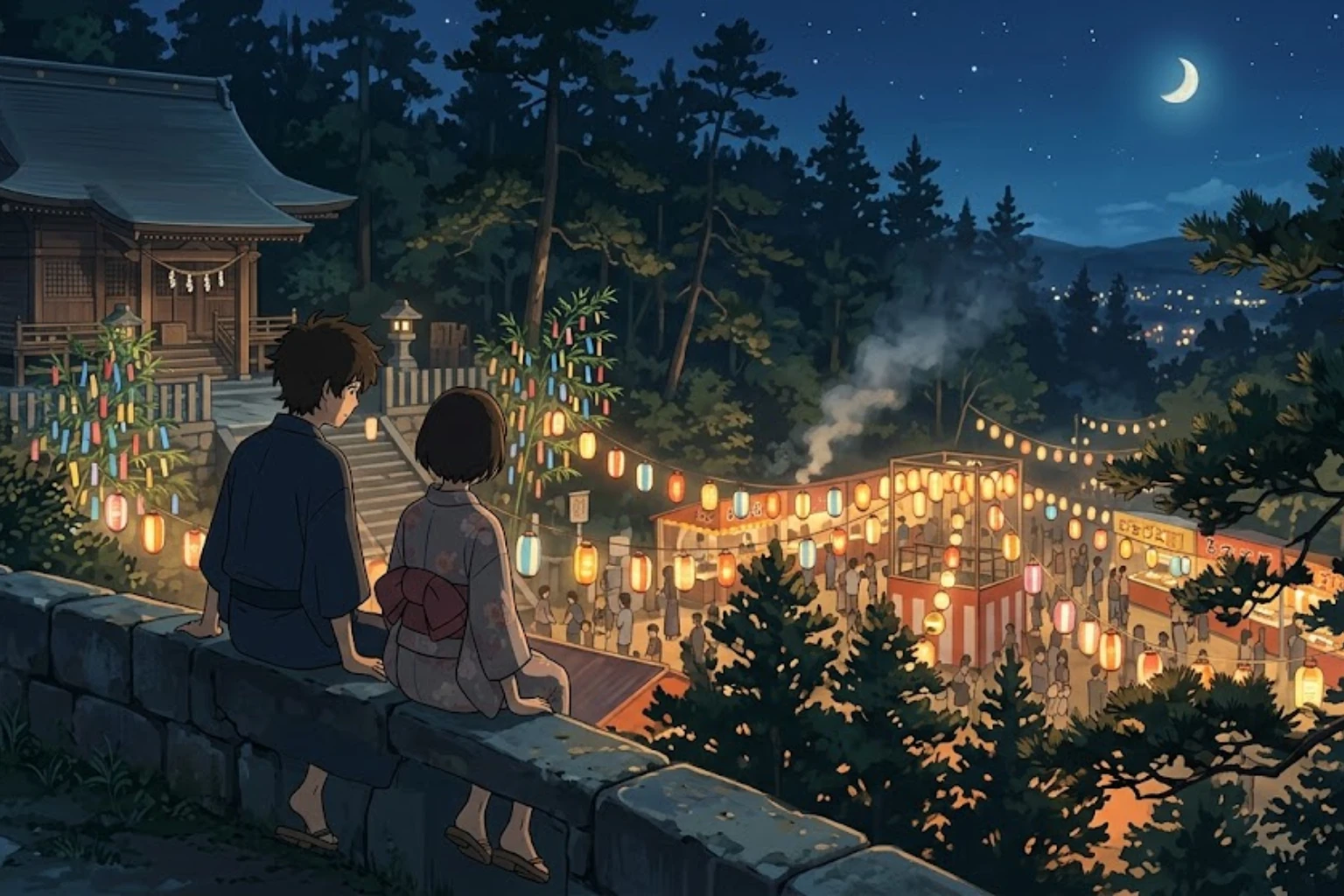
The last night of the Tanabata festival smelled like incense and fried food and the particular sweetness of shaved ice melting faster than anyone could eat it. Paper lanterns strung between the shrine's old pines swayed gently in the warm evening air, and somewhere below the hill a vendor was calling out prices for grilled corn in the same singsong voice he used every year, the same voice Kenji and Akari had been hearing since they were small enough that their parents still held their hands crossing the shrine steps.
Kenji had a streak of blue syrup on his wrist that he hadn't noticed yet. Akari's yukata sat slightly askew at the collar, because she had dressed in a hurry that afternoon and her mother hadn't been home yet to fix it properly, and neither of them minded any of this, because they were thirteen and this was simply what the last night of the festival looked like every year — sticky hands, crooked collars, the whole town gathered on one hillside pretending, for a few hours, that summer might last forever.
They had been coming to this festival together since they were six, which meant there were entire routines neither of them had ever discussed out loud but both understood completely. They always ate their shaved ice on the low stone wall behind the main shrine rather than at the food stalls, because the wall had a view of the lantern trees that the crowded paths below didn't. They always played the ring toss exactly once, regardless of whether they won, because Kenji had once won three years running and Akari had declared it bad luck to stop while he was ahead, and neither of them had tested the theory since. They always stayed for the second round of drumming, because the first round was for tourists and small children, and the second round — later, louder, when the drummers had properly warmed up — was for people who actually knew the festival.
There was a particular stall near the shrine steps that sold roasted chestnuts every year, run by the same old man with the same faded blue apron, and every year Kenji bought a small paper cone of them even though he complained, every single time, that they were too expensive for what you got. There was a spot along the main path where, when they were nine, Akari had tripped over an uneven stone and scraped both knees badly enough to need bandages from the first-aid tent, and they had walked past that exact stone every year since, and every year one of them pointed it out to the other without fail, a small shared ritual of remembering. This was what six years of the same festival built between two people — not grand moments, mostly, just a thick accumulation of small, specific, unremarkable things that belonged only to them.
Tonight they sat on the wall with their feet dangling over the old stone, the festival noise washing up from the trees like a warm tide, and for a while neither of them said much of anything, which was its own kind of comfortable.
"My dad got the transfer," Kenji said eventually.
He said it the way you say something you've been carrying around for several days and have finally run out of room for — not dramatically, just set down, like putting a heavy bag on the ground because your arm had gotten tired of holding it.
Akari looked at her shaved ice, the blue syrup already pooling at the bottom of the paper cup. "When?" she said.
"We move in September."
September was six weeks away. The festival was right now, tonight, syrup and lanterns and drums. The distance between those two facts felt enormous, and neither of them had quite the right words for it yet, being thirteen and largely unequipped for the specific grief of losing something that had never needed defending before, because it had simply always been there.
"Where?" Akari asked.
"Sendai."
She nodded slowly. She didn't know much about Sendai except that it was far — not impossibly far, not another country, but far enough that you couldn't reach it on a bicycle, which had been, up until this exact moment, the primary unit of distance in both their lives.
Below them, through the trees, the festival lights shifted and the drums started up again for the evening's second round, and the smell of grilled corn drifted up the hill on the same warm air that moved the lanterns. Kenji picked at the hem of his own yukata sleeve, not quite looking at her.
"We could write letters," he said.
"We could," Akari said.
They both understood, with the honest and slightly grim pessimism that children develop after watching adults make promises they don't always keep, that they probably wouldn't write letters. Not because they didn't mean it in the moment. Letters needed stamps and addresses and the sustained, simultaneous intention of two people in two different places both remembering to try on the same afternoon, and that kind of thing had a way of quietly falling apart even when nobody wanted it to.
The lanterns swayed again in a brief gust that smelled like incense and someone's grilling skewers.
"Meet here again," Akari said. "Next year. Same festival. Same wall."
Kenji looked at her.
"Same time," she said. "After the second round of drumming starts. Right here."
It could have sounded childish, and somehow it didn't, because she said it with the quiet, deliberate seriousness of someone making an actual promise rather than offering a comforting thing to say, and Kenji — who had known her long enough to always be able to tell the difference — understood exactly which one this was.
"Okay," he said.
"Promise."
"I promise."
She held out her hand, not for a handshake but palm up, the way they'd settled small disputes and sealed small agreements since they were eight years old — whose turn it was to pick the game, who owed who a favor, whether a particular claim about a teacher or a movie or a rumor going around school was actually true. He pressed his palm briefly against hers, once, and they both turned back to watch the lights through the trees, and that was that. The drums played on into the summer dark, and neither of them said anything else, because there wasn't really anything else that needed saying.
The year moved the way years do when you're thirteen and then fourteen — faster than expected in some stretches, unbearably slow in others, full of things that feel enormous while they're happening and considerably smaller once you're far enough past them to look back.
Kenji's family moved to Sendai in September, exactly as planned, in a whirlwind of boxes and his mother's increasingly precise labeling system and his father's apologetic cheerfulness about the whole thing. The apartment was smaller than their old house and smelled unfamiliar in a way that took weeks to stop noticing, and his room faced a street he didn't recognize the sounds of yet — different trains, a different rhythm of delivery trucks in the early morning, none of it wrong exactly, just not yet his.
He started at a new school where nobody knew his name, his habits, or the fact that he'd once won the ring toss three years running, and for the first two months he ate lunch alone by a window that looked out over a city he hadn't chosen and hadn't yet learned to want. It was a specific, quiet kind of loneliness, the sort that doesn't announce itself dramatically so much as sit there every day at the same hour, waiting. He got good, that autumn, at looking like someone who preferred eating alone, a small performance he kept up mostly for his own benefit.
It got better slowly, the way most things do. A boy in his class named Sota started talking to him because they were assigned to the same cleaning duty rotation and there wasn't much to do during it except talk, and it turned out Sota had opinions about basically everything, which made conversation easy in a way Kenji was grateful for even when he didn't say so. A few other names and faces accumulated after that — not a dramatic turning point, just the ordinary gradual accretion of a life, the way loneliness has its own gravity that eventually pulls people together if you let it keep working on you long enough. By spring he had somewhere to sit at lunch without having to think about it in advance, a group of friends who knew which vending machine on the third floor sometimes gave out two cans for the price of one, and a walk home from school that had stopped feeling foreign and started feeling like his.
He thought about Akari sometimes — more than sometimes, if he was honest with himself, though he mostly wasn't in the habit of being that honest with himself about it. He thought about the wall behind the shrine, the blue syrup on his wrist he hadn't noticed until she pointed it out and he'd looked at his own arm with the betrayed expression of someone who'd trusted his own hands more than that. He thought about the way she'd held her palm up like the promise was a serious, adult sort of thing, because to her, it plainly was.
He had her number. He'd texted twice in October — one message about a weird food he'd tried, one asking how her art club was going, because she'd mentioned once, before he left, that she might join — and she'd replied both times, short and friendly, and then the thread had simply gone quiet the way threads do. Not from any particular ending. Just from the accumulation of ordinary days passing without either of them quite finding the right moment to pick it back up.
He did not forget the promise. If anything, it became one of the fixed points he oriented the whole unfamiliar year around — a date on a calendar that existed independently of how lonely or how settled Sendai made him feel on any given week.
Akari's year was different in the particular way a year is different for the person who stays behind rather than the one who leaves.
The town looked exactly the same. The school looked exactly the same. Most of her friends were exactly where they'd always been, except that Kenji wasn't, which left a specific, oddly shaped absence stitched into the ordinary geography of her days — the walk to school that used to pass his house and now just passed a house, the seat beside her in class that had been his for three years running and now belonged to a girl named Chiho, who was perfectly nice and entirely beside the point.
She grew a few centimeters over the year, which she noticed mostly because her school uniform stopped fitting quite right. She cut her hair short in November, on a whim, in a way that surprised her mother and that she privately liked more than she expected to. She joined the art club in the spring — something she'd always meant to do and never quite gotten around to, the kind of thing that kept sliding one more year down the list until, this year, with a very specific Kenji-shaped space suddenly free in her schedule and her thinking, she finally just went and signed the form. It turned out she was good at it, genuinely good, in a way that surprised her and surprised absolutely nobody who'd ever actually looked at her old notebook margins, which had been quietly filling up with small careful sketches for years without her ever calling it anything.
The art club met twice a week in a classroom that smelled permanently of pencil shavings and the particular mineral tang of watercolor water left too long in its jar, and Akari found she looked forward to those afternoons more than almost anything else in her week. There was something steadying about it — the quiet concentration of a room full of people all looking closely at something, the teacher's soft footsteps circling behind them, the specific satisfaction of a line finally landing where you'd meant it to. It didn't erase the Kenji-shaped absence in her days so much as give her somewhere useful to put her attention instead of constantly circling it.
She thought about the promise with a regularity she didn't examine too closely, because examining it felt uncomfortably close to admitting something she hadn't decided yet whether she was ready to admit. She had his number the entire year. She never used it to start anything herself, because every time she got as far as opening the message thread and typing something out, it came back sounding either too casual to mean anything or too heavy to send without warning, and she could never quite find the space in between.
Mei and Tomoko, her two closest friends from art club, became the backbone of her year in a way she was quietly grateful for — loud, funny, endlessly opinionated about which snacks from the corner store were superior, the kind of company that made ordinary Tuesday afternoons feel like something worth looking forward to. She didn't tell them about the promise. It wasn't a secret exactly. It just felt like something that belonged only to her and Kenji and the wall behind the shrine, and saying it out loud to anyone else might have made it smaller somehow, or turned it into the kind of story people asked follow-up questions about.
The festival came around again in July, arriving the way it always did, gradually and then suddenly, banners going up along the shopping street one week and the whole town smelling like grilled skewers the next.
She went with Mei and Tomoko on the final night, same as she had every year with Kenji, except this year it was a different configuration entirely, three girls instead of two kids, and it was good — genuinely good, loud and funny in exactly the way a festival with those two was always going to be. They ate everything within reach. They played the ring toss, and Mei won a small stuffed tanuki that she named on the spot and carried proudly for the rest of the night, holding it up to compare its expression to various festival-goers they passed.
Akari was aware of the promise the entire evening in the specific way you're aware of something you've decided not to think about too directly, a low hum underneath everything else, present without being examined. She hadn't let herself consider too concretely whether Kenji would actually be there, because thinking about it in either direction — hope or its absence — required more preparation than she'd been able to manage in advance.
When the second round of drumming started, louder and looser than the first, the way it always was, she told Mei and Tomoko she needed to find the bathroom and would catch up with them at the food stalls.
She walked up the path behind the shrine instead, alone, her sandals loud on the gravel in a way they never seemed to be during the day, the festival noise falling away behind her a little more with every step.
He was already there.
She hadn't let herself know, one way or the other, whether he would be, but there he was, sitting on the low stone wall in the same spot, looking out at the festival lights through the gaps in the trees. He was taller now, noticeably, and his hair had grown out and fallen differently, and he was wearing a plain dark yukata she didn't recognize — new, bought in Sendai, from an entire life she hadn't been there to see any part of.
He heard her sandals on the gravel and turned.
For a moment neither of them said anything.
A whole year sat in that pause — a year of separate days and separate small changes, versions of themselves the other one hadn't witnessed happening, stacked up between them on the old stone wall like something that would need to be accounted for before either of them could move past it.
"You came," Akari said finally.
"I said I would," Kenji said, and something in the plainness of it made the year between them feel, briefly, a little smaller.
She sat down beside him on the wall, leaving a few inches of space that hadn't seemed to exist last summer, or maybe had and she simply hadn't noticed it back then. The festival continued below them through the trees, and the drums kept the same rhythm they'd always kept.
"How's Sendai?" she asked.
"Good," he said. "Different." He considered it a moment longer. "I have friends there now. It took a while, though."
"I figured it would."
"How's here?"
"Same," Akari said. "Mostly." She glanced down at her hands. "I joined the art club."
"You were always good at drawing."
"I know. I just never actually joined before."
"Why not?"
She thought about it honestly. "I think I kept telling myself I'd do it next year. And then this year I just — did."
He was quiet for a moment, considering that. Somewhere below them, someone won something at one of the game stalls, and a small ripple of applause carried up through the trees.
"I thought about texting you a lot," Kenji admitted. "I just never knew what to say that wasn't either too much or too nothing."
"Same," Akari said.
"That's a problem."
"It is."
They sat with that admission for a moment, the specific comfortable honesty of two people who had known each other long enough that pretending wasn't really available to them as an option anymore, even if they'd wanted it.
She looked at him properly then — at the profile she'd known since they were six, changed now in the particular ways a year does to a fourteen-year-old's face, the angles sharpening slightly, the last softness of being a little kid quietly receding. Still recognizably him, underneath all of it. Still the same person who had once eaten blue shaved ice on this exact wall without noticing it on his own wrist until she pointed it out, and looked down at his arm with the betrayed expression of someone who'd trusted himself more than that.
"You're different," she said. Not an accusation. Just an observation, offered plainly, the way she offered most things.
"So are you," he said. "Your hair."
"I cut it in November."
"It's good."
"Thanks."
The drums kept playing below them. A child somewhere down the hill shrieked with delight at something and was immediately shushed by an embarrassed adult. The incense smell was exactly the same as it had been every year of both their lives, one of those smells that would probably locate her instantly in this exact place for the rest of her life, no matter where she happened to be standing when she caught a trace of it.
"It's strange being back," Kenji said, after a while. "Everything looks the same, but I feel different inside it. Like I'm the wrong size for a space I used to fit into perfectly."
Akari understood this completely, and was a little surprised he'd managed to put it into words so precisely, because it was a sharper observation than she'd expected from him, and also exactly, uncomfortably right.
"That happens when you leave and come back," she said. "My cousin said almost the same thing after her first year at university. She said home stops being the place you are, and starts being the place you're from."
"That's kind of sad."
"She didn't say it sadly, though. She just said it like a fact."
He turned that over for a moment. "I don't think I want here to just be the place I'm from."
"Then come back more," Akari said, simply, without dressing it up into more than it was.
He looked over at her. "Is that an invitation?"
"It's an observation," she said. "About how geography works."
He almost smiled — the almost-smile that had always been his tell, the small quarter-second of visible resistance right before an actual smile arrived, as if some part of him needed to check first whether smiling was allowed.
"Next year," he said. "Same wall."
She looked out at the festival lights scattered through the trees, thinking about it properly for the first time all evening. A year from now she'd be fifteen. He'd be fifteen too. They'd both be further along in the long, slow process of becoming whoever they were eventually going to turn into, further from the two kids who'd sat on this same wall last summer and made a promise mostly because neither of them had known what else to do with how they felt.
Things would have changed again by then. Of course they would. That seemed, at this point, like the one reliable thing about any of it.
"Same wall," she said. "Same time."
"Promise."
"Promise."
She didn't hold her palm out this time, and neither did he. They were fourteen now, and some gestures belonged specifically to the younger versions of themselves, the ones who'd needed a physical thing to press their palms against in order to make an agreement feel real. Doing it again now would have felt a little like putting on clothes they'd already outgrown — not wrong, exactly, just no longer quite theirs.
Instead they just sat there a while longer, side by side on the old stone wall, the festival moving steadily below them and the lanterns swaying gently in the warm night air. Two people who had kept a promise they hadn't technically been obligated to keep, and were now finding out, a little awkwardly and a little tentatively, what existed on the other side of having kept it.
"Mei won a tanuki," Akari said eventually, because the silence had gone on long enough that it needed something ordinary dropped into it. "She named it before we even left the stall."
"What'd she name it?"
"Osamu. I don't know why. She just looked at it and decided."
Kenji laughed, a short surprised sound that made her glad she'd said it. "That's a very serious name for a stuffed tanuki."
"She takes these things seriously."
"Clearly."
They talked for a while after that about smaller things — Mei and Tomoko, the boy named Sota from his cleaning duty rotation, a teacher Akari still had that Kenji remembered being terrified of in the fifth grade, the specific corn vendor down the hill whose prices had gone up twice since last summer, which felt, to both of them, like a genuinely alarming development. It wasn't the same as before. It wasn't supposed to be. It was something quieter and more deliberate, built out of a year of separate distance and the simple, repeated choice to show up anyway, twice now, at the same wall, after the same second round of drumming.
It didn't have a clean name yet, whatever it was becoming. Neither of them tried to give it one.
They stayed until the second round of drumming finished, the rhythm building through its final stretch and then tapering into the looser, wandering music that always followed, signaling the festival's slow descent toward its end for the year. The lanterns kept swaying. The incense smell drifted up from somewhere below, mixed now with the smell of the last of the evening's grilled corn.
Eventually Kenji stood and offered her a hand up off the wall, an ordinary gesture that neither of them made anything more of than it was, and they walked back down the hill together toward the lights and the noise and the last of a summer that was still going, for a little while longer yet, before everything shifted forward again into whatever came next.


.png)
.png)
.png)