%20(1).png)
Nobody joined Ryohei on the floor.
He sat beside the gap where Koji's station had been for a long time, long enough that the room's attention gradually moved past him, the way attention always eventually moves past a wound that isn't actively bleeding anymore. People returned to the small, necessary business of being alive — checking a bandage, drinking water in slow, deliberate sips, lying down without expecting to sleep. Nobody told him to move. Nobody came to sit beside him either.
Mio watched him for a while from across the room, the same unreadable look she'd worn since the barrier dropped, and eventually rose and crossed the distance anyway, settling onto the floor near enough that their shoulders nearly touched.
She didn't say anything comforting. She didn't say anything at all, at first. She just sat there, present, the way Sachiko had been present for a while before her own energy ran out, except Mio didn't get up when the silence stretched past the point where most people would have found an excuse to leave.
"You don't have to sit here," Ryohei said, eventually, not looking at her.
"I know," Mio said.
That was all either of them said for a long time, and something in the plainness of it — no reassurance offered, no argument made about whether he deserved company — settled something in Ryohei's chest that hours of the room's careful distance had left raw.
Across the space, Kaori remained upright against the wall near the door, the same posture she always chose, watching the room the way she'd watched it every night since the first one. Her eyes found Ryohei more than once, and each time, something in her expression stayed carefully unreadable, unwilling yet to land on either forgiveness or blame.
Junpei sat with Naoko, quiet, the water packet she could no longer manage on her own already opened and returned to her hand without ceremony. Neither of them looked toward Ryohei directly, though Junpei's earlier words — *he asked for it, he thought it was good* — still seemed to hang somewhere in the room's air, unresolved, neither retracted nor repeated.
The buzzer came without warning, the way every unwelcome thing in this place arrived.
---
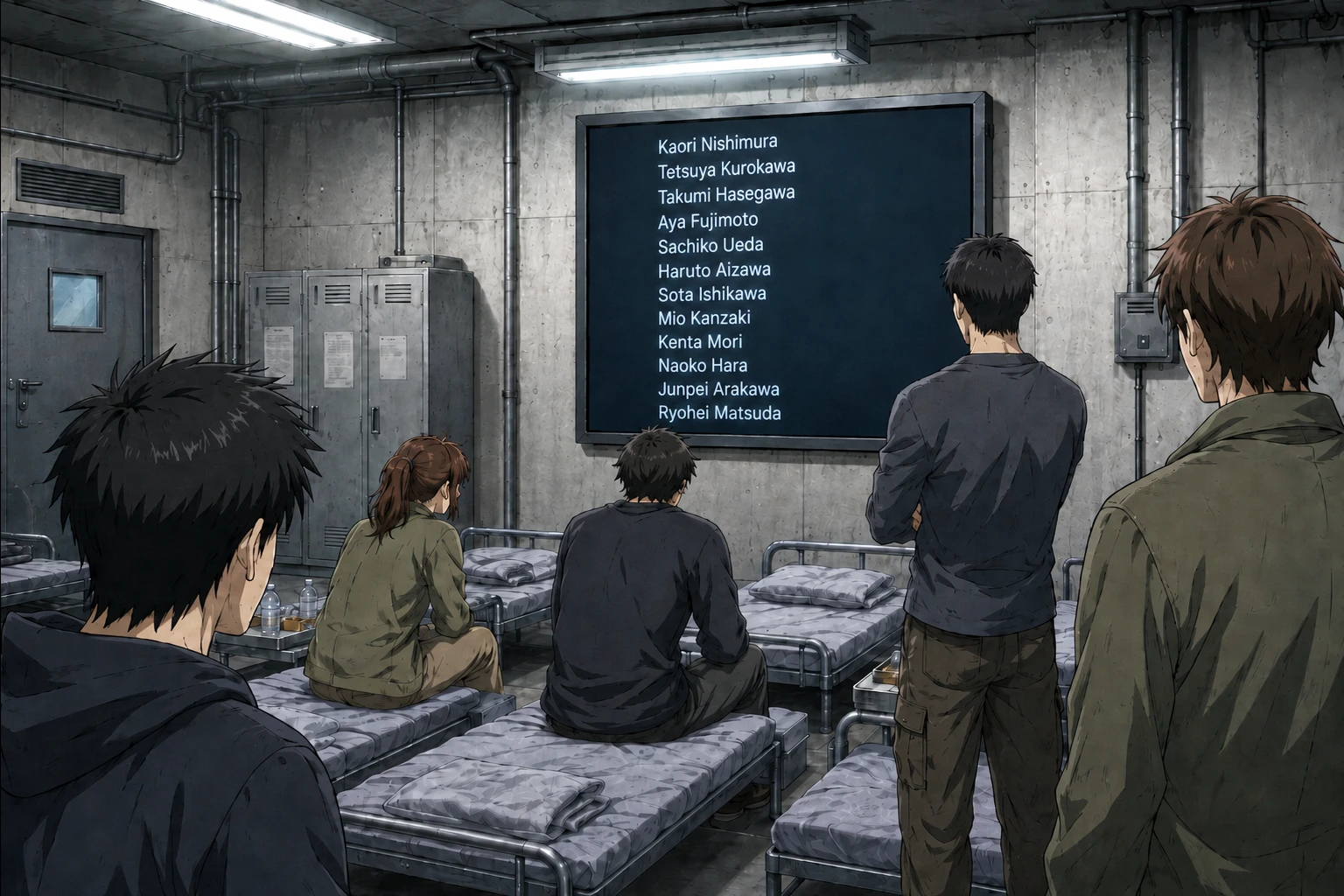
It wasn't the alarm. It carried none of the flat, punishing urgency of a game beginning — a shorter tone, almost polite by comparison, and the main screen at the end of the room lit not with an instruction but with a list.
**CURRENT STANDING.**
Twelve names appeared beneath it, arranged top to bottom, with no criteria offered and no explanation for what determined the order.
1. Kaori Nishimura
2. Tetsuya Kurokawa
3. Takumi Hasegawa
4. Aya Fujimoto
5. Sachiko Ueda
6. Haruto Aizawa
7. Sota Ishikawa
8. Mio Kanzaki
9. Kenta Mori
10. Naoko Hara
11. Junpei Arakawa
12. Ryohei Matsuda
For a moment, nobody spoke. Then, almost simultaneously, half the room was on its feet, moving toward the screen, reading the names again as though a second look might rearrange them into something with an obvious logic behind it.
"What is this," Kenta said, voice climbing. "What's it based on?"
"Nothing's explained," Tetsuya said, already studying his own position with the same close attention he gave everything. "No criteria. No formula. Just an order."
"Maybe it's performance," Sota offered. "Across all four games. Some kind of running score."
"Then why am I above Aya," Sachiko said, quiet, more confused than proud. "I haven't done anything remarkable. I've helped people. I haven't won anything."
"Maybe that's exactly what it's counting," Aya said, and something guarded crossed her face. "Maybe it's not measuring competence. Maybe it's measuring who people like."
"Or fear," Kaori said, flat, from her place at the top of the list. "Maybe it's measuring who the room is most afraid of."
"That doesn't explain why I'm at the bottom," Ryohei said. His voice came out rougher than he meant it to. "I won the last game outright. If this were built on results, I should be near the top, not last."
Nobody had a comfortable answer for that, and the room's attention drifted, inevitably, uncomfortably, toward him.
"Maybe it's not about the win," Junpei said, not quite meeting his eyes. "Maybe it's about what came after."
Nobody argued with that either, though nobody agreed with it out loud, and the silence that followed carried the particular weight of a room deciding, individually and without discussion, how much of Junpei's theory each person privately believed.
"What about the middle," Naoko said, quiet enough that it took a moment for anyone to register she'd spoken at all. She rarely offered theories unprompted, and something in the fact that she'd chosen to now made a few heads turn. "Look at who's in the middle instead of the ends. I'm not near the top or the bottom. Neither is Kenta. What would explain the middle if the ends are explained by strength or fear or being liked?"
"Maybe the middle's just noise," Sota said. "Maybe there's no theory for it because nothing sorted it. Only the extremes got sorted on purpose, and the rest of us just landed wherever there was room."
"That's almost worse," Kenta said. "I'd rather believe there's a reason I'm ninth than believe I'm ninth because nobody bothered to have an opinion about me."
A short, surprised laugh went around part of the room at that — not much of one, but real, the first sound in an hour that hadn't been fear or argument — and Kenta looked almost as startled by it as anyone else.
"I keep looking at Haruto," Tetsuya said, studying the list again. "Sixth. Above Sota, above Mio, above you, Kenta. He hasn't won anything outright. He hasn't commanded anyone. If this measures competence the way I first assumed, I don't see the calculation that puts him there."
"Maybe it's not measuring what any of us did," Haruto said, uncomfortable at being singled out. "Maybe it's measuring what people would say about us if they were asked. That's not the same as competence. I don't think I've been especially competent. I think people don't currently have a reason to resent me."
"That's an answer that keeps you safely in the middle no matter what anyone says next," Aya said, not unkindly, just precisely. "Convenient, being the person nobody currently has a reason to resent."
"I didn't build the list, Aya."
"I know. I'm just telling you how it reads from where I'm standing." She didn't say anything else about her own position — fourth, comfortably high, a fact she hadn't mentioned once since the screen lit — and the omission was, in its own way, as loud as anything she might have said out loud.
Sachiko, still turning her own placement over, shook her head slowly. "I keep coming back to the same thing. I haven't been strategic about any of this. I've just tried to help whoever needed helping in front of me. If that's worth fifth place, I don't know what to do with that information except worry it'll change how I do it."
"Don't let it," Takumi said, the first thing he'd offered to the conversation. "Whatever the list is measuring, it isn't asking you to keep measuring yourself by it."
It was, for a moment, the calmest thing anyone had said since the buzzer sounded, and it held the room's attention just long enough for the quiet to threaten settling into something like peace.
Then Kenta, still watching the list, said the thing that pulled the room back toward where it had been trying not to look. "Ryohei's last," he said, quieter now, not cruel, just naming the fact out loud. "Out of all of us. After what happened to Koji."
---
The argument about Koji resumed almost immediately, as though the ranking had simply reopened a wound that had only briefly scabbed over.
"You keep saying he thought it was good," Mio said to Junpei, sharper than her usual register. "You said it right after it happened, and you're circling back to it now like repeating it makes it truer. None of us knew. That includes you. You'd have shouted the same thing if you'd believed it might help you."
"I didn't shout anything," Junpei said.
"You didn't shout because you were too afraid to believe it might be good," Mio said. "That's not restraint. That's just a different flavor of the same fear everyone else in that room was working from."
"That's not fair," Kaori said, though her voice lacked its usual certainty. "Some of us stayed quiet because we understood, faster than the rest of the room, that silence might be the safer bet."
"You didn't understand that," Aya said. "Nobody understood anything in ten seconds. You guessed, the same as everyone. You're just telling the story now like your guess was wisdom instead of luck."
Kaori's jaw tightened, and for once she didn't have a ready reply.
"He still said Koji's name," Sota said, quietly, from where he sat near the edge of the group. "I don't think Ryohei's a bad person for it. I just don't think saying that out loud makes it stop being true."
"Nobody's arguing it isn't true," Haruto said. "The question is what we're supposed to do with the truth once we have it. Blame him forever? Pretend it didn't happen? Neither one changes what the countdown was built to force."
"I don't think anyone wants to pretend it didn't happen," Sachiko said. "I think people just don't know yet how much distance feels fair, and how much feels cruel, and everyone's guessing differently."
"Can I actually say something," Ryohei said, and something in his voice made the room go still in a way the last several minutes of theorizing hadn't. He'd been quiet through all of it, and the sudden break in that quiet landed harder for how long it had been held. "You're all talking about me like I'm not sitting right here. Like this is a puzzle you're solving instead of a thing I did."
"Nobody meant it that way," Sachiko said, gently.
"Maybe not. It still feels that way." He looked around at them, and for the first time since the countdown, something closer to anger surfaced under the guilt he'd been carrying all evening. "You want to know what I should have done? Tell me. Actually tell me. Because I've been sitting here for hours trying to work it out and I don't have an answer, and everyone arguing about whose fault it was doesn't seem to have one either — you're just taking turns deciding how angry to be at me instead."
"Nobody's required to hand you an answer," Kaori said, though her voice had lost its earlier edge.
"I know that. I'm not asking anyone to let me off easy. I'm asking because I actually don't know. Should I have stayed silent and let the system pick? Would that have been better, or would it have just meant somebody else's name instead of nobody choosing anything? Should I have refused to play at all once I understood what was happening? There wasn't time to refuse. There wasn't time to do anything except the thing I did, and I keep turning it over and I can't find the version where it comes out differently unless I already know, ahead of time, something none of us knew."
Nobody answered right away. The silence wasn't the same as agreement, but it wasn't accusation either — just a room absorbing the fact that the person they'd spent an hour discussing had opinions of his own about it, and hadn't yet been asked for them.
"I don't think there was a better version," Mio said, finally, quiet but certain. "I've turned it over too. I can't find one either."
"That doesn't make it feel like less of a thing I did," Ryohei said, some of the anger draining out of his voice, leaving something flatter and more tired behind it. "I keep waiting for someone to tell me it wasn't my fault and have it actually help. It doesn't. Knowing it wasn't really a choice doesn't change that Koji's gone and I'm the reason the game has his name instead of someone else's."
That landed closer to honest than anything else said in the last several minutes, and the argument thinned there, unresolved, the way it always seemed to thin lately — not agreement, just exhaustion outpacing conviction, and this time, for the first time, Ryohei's own voice had been part of what wore it down.
Ryohei listened to most of it without joining, the ranking screen still glowing behind everyone's shoulders, his own name sitting, silent and unmoved, at the very bottom of the list.
---
The room thinned out again once the argument had exhausted itself, people drifting back to their own cots, their own small tasks, and Mio stayed where she'd settled hours earlier, close enough to Ryohei that neither of them had to raise their voice to be heard.
"You didn't have to say any of that," she said, after a while. "Back there. You could have just kept letting them argue over you."
"I know." He picked at a loose thread on his sleeve, not looking at her. "I don't know why I didn't. I think I just got tired of being the thing everyone was discussing instead of the person they were talking to."
"For what it's worth, I don't think it made anyone like you less."
"You don't know that."
"No," she admitted. "I don't." She was quiet for a moment, watching the room's slow, uneven settling. "You know people are going to notice you and I keep sitting together. Kaori already has. She hasn't said anything, but I've seen her watching."
"Does that bother you?"
"It should, probably. I keep waiting for it to." She considered the question honestly, the way she seemed to consider most things. "I think I've spent so much of my life being careful about who I let people see me close to that some part of me is just tired of doing the math. You needed someone to sit here. I was already sitting near enough to do it. I didn't weigh it out beforehand."
"That's not nothing, in a room like this."
"Maybe not. I'm not doing it to be brave, if that's what you're thinking. I don't feel brave. I just don't like watching someone get left alone with something none of us actually understand better than he does." She glanced at him, something almost wry in it. "Don't make it into more than that."
"I won't," he said, though something in his face suggested he already had, a little, and was choosing not to argue about it.
---
Dinner arrived without ceremony, the same anonymous delivery that had brought every meal since the first night — trays sliding into place through a low panel near the wall, one at a time, in a slow enough sequence that the room had time to watch each one arrive rather than simply receive them all at once.
Rice. A portion of grilled fish. A small dish of pickled vegetables. Water. Identical, tray after tray, down the row, the same careful equal portions Mio had once quietly confirmed with her own eyes days ago. People collected their meals with the flat, unremarkable motion of a routine already worn smooth by repetition, nobody expecting anything different from what the last three days had already taught them to expect.
Ryohei's tray was different.
It carried the same base meal as everyone else's, but beside it sat a small dessert — a neat, glossy square of something that looked, absurdly, like it belonged to an entirely different life: a delicate confection, clearly crafted rather than mass-produced, sitting on its own small plate as though it had wandered in from a world where any of this made sense.
It took a moment for anyone to notice. Ryohei saw it before he understood what he was looking at, and by the time he'd registered the shape of it against the familiar plainness of the rest of the tray, Kenta, two cots down, had already glanced over, done a small double-take, and gone still.
"Is that—" Kenta didn't finish the sentence. He didn't need to.
One by one, other heads turned. Sota looked, looked away, looked again. Aya's eyes moved from the dessert to Ryohei's face and stayed there a beat too long to be casual. Kaori didn't say anything at all, but her attention settled on the small glossy square with the same close, assessing focus she gave everything, filing it away as information rather than as an event.
Nobody needed the screen to explain it. A short line of text appeared anyway, brief and clinical.
**WINNER'S REWARD — GAME FOUR.**
For a moment, nobody said anything. Then several heads turned, at once, toward Ryohei's tray, and the attention felt, to him, considerably worse than the silence that had followed the ranking reveal.
"That's not fair," Kenta said, though there was no real anger in it, only the flat, tired observation of a man too exhausted to dress the words up as anything else. "The rest of us get the same plain thing every meal and he gets—" He gestured, vaguely, at the small glossy square. "That."
"I didn't ask for it," Ryohei said.
"I know you didn't."
Ryohei looked at the dessert for a long moment, then picked up the small plate and held it out toward Kenta first, since he was closest, since he'd been the one to say something out loud.
Kenta shook his head without quite meeting his eyes. "Not from me. Feels like taking something I didn't earn either."
He tried Sota next, more out of proximity than any real hope. Sota glanced at it, then back at his own tray, and said only, "I don't need it," in the flat, closed-off tone he used for most things he didn't want to examine further.
"Sachiko," he tried, softer, when he reached her. "You've been giving your own food away since the first night. Take it."
"Not this one," Sachiko said, gently enough that it didn't sound like rejection, though it plainly was. "It's not really about the food."
He offered it once more, toward Junpei this time, who only looked at it the way a man looks at something he suspects might be a test, and said nothing at all, which was its own kind of refusal.
Nobody moved. Nobody's hand came out for it. He held the small plate out to the room in general one final time.
"Someone take it," he said. "I don't want it."
The silence answered for him. Eventually he set the small plate back down beside his tray, untouched, and ate the rest of his meal without looking at it again.
Mio, sitting near enough to have watched the whole exchange, reached over at one point and lifted a small piece of fish from her own tray, setting it deliberately on his tray without comment, an uneven, unglamorous trade that wasn't really about hunger either. He looked at her, surprised, and she only shrugged, as if to say the gesture required no explanation and she wasn't going to offer one.
---
The screen changed again once the trays had been cleared, the same short, polite tone preceding it.
**CURRENT STANDING — UPDATED.**
The list reassembled itself, mostly unchanged, except for one small, unmistakable shift near the bottom.
11. Ryohei Matsuda
12. Junpei Arakawa
"He moved up," Kenta said, disbelieving. "He got a dessert nobody else got and now he's moved up a spot. That's not a coincidence."
"We don't know that," Haruto said, though his voice carried less conviction than the sentence needed.
"We don't know anything about how this thing works," Kaori said. "That's exactly the problem."
"Maybe it's not the dessert," Sota said. "Maybe it's that he spoke up earlier. Said something true instead of just sitting there taking it. If the board's measuring anything like honesty, that would track."
"Or maybe it's simpler than any of that," Tetsuya said. "Maybe it's just time. Maybe distance from the event itself is worth something on this board, and the longer he sits with what happened without doing anything else wrong, the more the number recovers."
"That's a comforting theory if you're the one who did something wrong recently," Aya said, not quite looking at Kaori when she said it, though the implication landed anyway.
"I'm not building theories to comfort myself," Kaori said.
"I didn't say you were. I said the theory happens to comfort whoever needs it to."
Junpei said nothing, staring at his own name, now sitting at the very bottom of the list where Ryohei's had been an hour earlier, and something in his face suggested he understood, immediately and completely, exactly how uncomfortable that particular seat was going to feel. "Maybe it just means someone has to be last," he said finally, quiet, not quite bitter, just tired. "Maybe it doesn't mean anything about me at all. Maybe it just moves."
"That's possible too," Sachiko said gently. "We don't actually know it's stable. We're all assuming it means something permanent because that's easier to argue about than admitting we might just be watching noise."
The room's attention lingered on the board longer than it had the first time, several people running the same private calculation — what had changed, what hadn't, whether there was a pattern buried in it worth chasing or whether the whole exercise was exactly the kind of trap several of them had already learned, the hard way, to expect from this place.
Later, once the room had mostly settled back into its uneasy quiet, the screen changed a third time, briefly, almost as an afterthought.
**CURRENT STANDING — UPDATED.**
7. Mio Kanzaki
She'd risen a full position, and this time there was no dessert, no visible reward attached to explain it, nothing at all except the bare fact of movement.
"You didn't do anything," Aya said, watching her with an expression that wasn't quite accusation. "You sat with him. That's the only thing that changed since the last update."
"I didn't sit with him to move up a list," Mio said, sharp enough that several people looked over.
"I didn't say you did," Aya said. "I'm saying the list doesn't seem to care why you did it. Only that you did."
Nobody had an answer for that, and the room's attention drifted, slowly, unmistakably, back toward Ryohei — not with the same wary distance as before, but with something new and considerably less comfortable: calculation.
---
It didn't take long for the calculation to become visible in how people moved.
Kenta, who twenty minutes earlier had refused Ryohei's dessert with barely concealed resentment, found an excuse, not long after Mio's rise appeared on the board, to sit a little closer to Ryohei's cot than he had all evening, asking how he was holding up with a solicitousness that hadn't been there before.
"You don't have to do that," Ryohei said, watching him with tired, knowing eyes.
"Do what," Kenta said, too quickly.
"Whatever you're doing right now."
Kenta didn't have a ready answer, and after a moment he found somewhere else to be, though not before glancing once more, involuntarily, at the ranking still glowing on the wall.
He wasn't the only one. Junpei, still smarting from his own drop to last place, found himself, not entirely by accident, offering Ryohei a spare corner of blanket later that evening — a small, practical kindness that would have looked unremarkable on any other night, and looked, on this one, exactly like what it partly was. Even Aya, who rarely bothered disguising her own calculations, spent a few minutes near Ryohei's cot making the kind of light, easy conversation she usually reserved for people who might still be useful to her, before catching herself, visibly, and letting the conversation lapse rather than push it further.
Sota, by contrast, seemed entirely unmoved by the board's implications, continuing to keep his own careful distance from most of the room regardless of anyone's position on a list he'd already dismissed, out loud, as "noise dressed up as data." Takumi treated the whole development the way he treated most things — noted, filed away, unacted upon, his own behavior toward Ryohei unchanged whether the numbers moved or not. Kaori, despite occupying the top position herself, spent a long stretch of the evening watching the board with an expression of active suspicion, as though its very existence offended some principle she hadn't yet found the words for.
Naoko said nothing about any of it, though when Junpei, visibly rattled by his new position at the bottom, asked her quietly whether she thought the ranking meant anything real, she considered the question for a long moment before answering.
"I think it means whatever we decide to let it mean," she said. "That might be worse than if it meant something specific. At least then we'd know what we were reacting to."
Sachiko continued treating Ryohei exactly as she had before the board appeared — steady, unhurried, offering him water and small practical kindnesses without any visible awareness that her own position on the list had shifted at all. When Kenta, later, asked her outright whether she was being kind to Ryohei on purpose because of the rankings, she looked at him with something close to genuine confusion.
"I'm being kind to him because he's sitting alone and I don't think that's good for anyone," she said. "I hadn't thought about the list at all."
Mio, for her part, didn't change anything about how she treated him either, though she noticed, with a quiet unease she didn't share with anyone, the way a few of the room's smaller kindnesses toward Ryohei now arrived with an edge of performance underneath them that hadn't been there an hour before.
---
Ryohei noticed it too. It was almost worse than the isolation had been.
Being avoided, at least, had felt honest — a room reacting, however painfully, to something real that had actually happened. This felt like something else entirely: attention arriving not because anyone had forgiven him, or even decided he deserved company, but because a number on a wall had quietly suggested that proximity to him might be worth something.
He sat with his own tray long empty beside him, the small untouched dessert plate still resting where he'd set it down, and watched the room reorganize itself around a logic none of them understood and all of them, to varying degrees, had already begun obeying anyway.
"You could take advantage of it," Mio said, quietly, sitting beside him again as the room's evening noise settled into something closer to silence. "People being kind for the wrong reasons is still people being kind. You don't have to examine everyone's motives before you let yourself feel less alone."
"Doesn't feel like less alone," Ryohei said. "Feels like being alone with an audience."
"That's not nothing either. An hour ago nobody wanted to be near you at all. Now half the room's finding excuses. I understand why the second one feels worse in some ways. It still isn't the same as the first."
"How am I supposed to tell the difference, though? Kenta sits down, asks how I'm doing — is that because he actually cares, or because he saw a number move? I don't think he knows himself. I don't think most of them do."
"Maybe you're not supposed to be able to tell. Maybe that's the actual point of building something like this — not to reward kindness, but to make it impossible to trust when you see it." She was quiet for a moment, turning something over. "I've spent most of my life being the useful version of myself for whoever needed something from me. Foster families, coworkers, customers. I got good at reading exactly what a room wanted and becoming that, because it kept me safe, or at least it kept me somewhere. I don't know how to tell you the difference between real and strategic either. I've mostly stopped expecting to be able to."
"That's a sad way to go through people."
"Maybe. It's also just true." She looked at him directly for the first time in a while. "I'll tell you what I do know. I sat down next to you before there was a board. Before there was a dessert. Before any of it. That part wasn't strategy. Whatever anyone decides to believe about tonight, that part happened first, and I know it happened first because I was the one who did it."
Ryohei didn't answer right away. When he did, his voice had lost most of its earlier edge. "I believe that part."
"Good. Hold onto that part, then, and let the rest of it be whatever it turns out to be. You can't audit every kindness in this place down to its motive. You'll go through the next four games alone if you try, and being alone hasn't exactly been serving anyone well so far."
"You sound like you're speaking from experience."
"I am," she said, simply, and didn't elaborate further, and he didn't ask her to.
She didn't have a clean answer for the rest of it, and didn't pretend to. She just stayed where she was, the way she had all evening, and eventually that, more than anything the ranking board had done, was the thing that made the room feel survivable again.
The screen held its current standing, silent now, twelve names arranged in an order none of them could explain and all of them had already, in one way or another, begun to live inside. No announcement followed it. No countdown began. The room settled, slowly and unevenly, into whatever passed for rest in a place that had already taught them not to trust the quiet completely.
Twelve remained, ranked in an order that meant nothing and, increasingly, meant everything, and nobody yet knew which of those two things would matter more once the next alarm finally came.


.png)
.png)
.png)