%20(1).png)
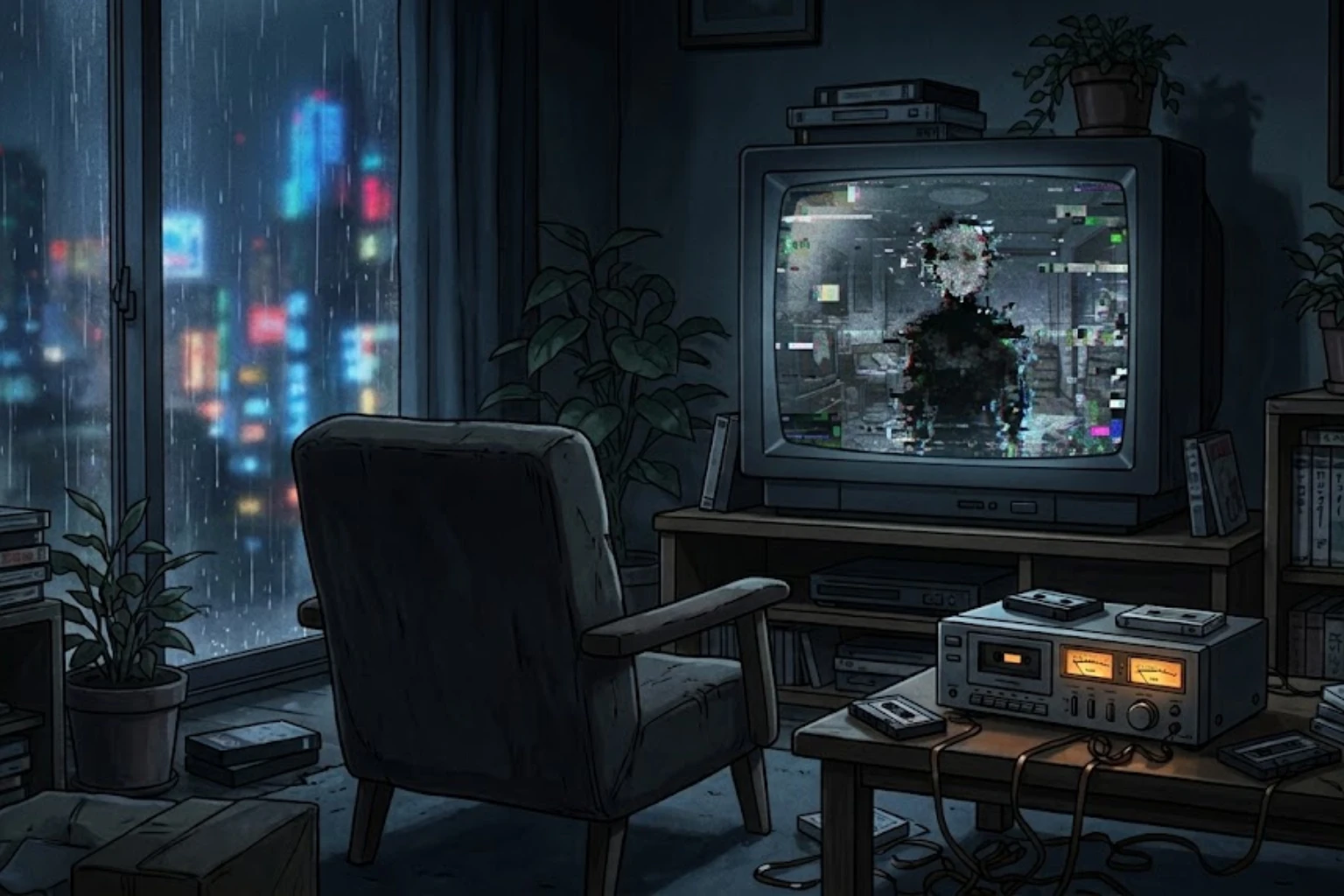
Yuta found the tape on a Tuesday.
This was not remarkable in itself — he spent most of his free hours at the weekend markets that set up in the covered arcade near his apartment, the ones with the tables of old media nobody had the right equipment to play anymore. Cassettes, reel-to-reel spools, eight-tracks, VHS tapes in cases with hand-labeled spines. He bought them for the covers mostly, for the handwriting on the labels, for the specific melancholy of objects that had been someone's favorite thing and were now selling for fifty yen in a plastic bin.
The tape had no label.
Black cassette, standard size, the shell slightly yellowed at the edges in the way of things that had spent years in a warm place. No writing anywhere on it. The seller — an old man who dealt primarily in vinyl and tolerated the cassettes as a commercial necessity — shrugged when Yuta held it up. Two hundred yen if you want it. Don't know where it came from.
He bought it.
He had a player. Of course he had a player — he had three, in varying states of functionality, because once you started buying cassettes you inevitably started buying the equipment to play them and the equipment was always broken and fixing it became its own project, which was the kind of project Yuta was good at. Contained. Finite. Something that stayed where you put it.
He played the tape that evening.
The first side was forty minutes of ambient sound.
Not music — not the kind with structure or intention. Just sound. A room, by the quality of it — the particular acoustic of an enclosed space, the slight reverb of walls and ceiling. Occasional distant sounds that might have been traffic or weather or something else entirely. A low, continuous hum that sat at the edge of perception, felt more than heard.
It should have been boring.
It wasn't.
There was something about the quality of it — the specific warmth of analog tape, the gentle hiss of the medium itself beneath the recorded sound — that was deeply, immediately comfortable in a way Yuta couldn't account for. He listened to the whole forty minutes without moving from his chair, which was unusual. He was not a person who sat still easily. He had not sat still like that since — he tried to remember. Couldn't.
He flipped the tape.
The second side was the same.
He listened to that too.
He went to bed at two in the morning feeling, for the first time in longer than he could place, like something had been set down. A weight he had been carrying at such a constant level that he had stopped noticing it, briefly and inexplicably relieved.
He slept without dreaming, which was also unusual.
His friend Nao called him Thursday.
This was their rhythm — Nao called Thursdays because she worked long shifts Tuesday and Wednesday and had energy again by Thursday, and Yuta answered because Nao was one of the few people whose calls he answered consistently and because Thursday was the day he was most likely to have run out of reasons not to talk to anyone.
"You sound better," she said, about ten minutes in.
"Do I."
"You sound like yourself. The actual version, not the—" she paused "—the version that's been operating at about sixty percent for the last year."
"I've been sleeping better," he said.
"What changed?"
He told her about the tape. She made the sound she made when she was reserving judgment — not dismissive, just withholding commitment until she had more information.
"Ambient tape," she said.
"Yeah."
"And it helps you sleep."
"And other things. I just — when it's playing, I feel like—" He stopped. This was the kind of thing that was difficult to explain without sounding like something was wrong with him. "It's quiet in a way that feels right. Like the right kind of quiet."
"That's good," Nao said, carefully.
"It's just a tape," Yuta said.
"I know," she said.
She didn't say anything else about it.
By the second week he was playing it every evening.
This was not a decision he had made so much as a pattern that had established itself — he came home, made food, played the tape, sat in the chair by the window. The window faced the street below and he watched it sometimes, the ordinary movement of the neighborhood, and sometimes he didn't watch anything at all and just let the sound of the tape fill the room.
He started sleeping eight hours. Then nine. He woke up feeling, for the first time in a year, like sleep had actually done what sleep was supposed to do.
He ate more. He went for a walk on Saturday morning that turned into two hours and he came back with color in his face that his neighbor, an older woman named Tanaka-san who occasionally left food outside his door, commented on approvingly.
The tape was helping.
He didn't question this because the alternative — having no explanation for the first good weeks he'd had since his father died — was worse than the slightly strange explanation of a cassette from a market bin.
He saw the silhouette on a Friday evening at the end of the second week.
He was sitting in his chair with the tape playing and he was looking at the old CRT television in the corner — unplugged, had been unplugged since he moved in, too heavy to move and too old to use, kept because getting rid of it required more effort than leaving it — and in the dark glass of the screen, in the reflection of the room, he saw something that wasn't in the room.
A figure.
Standing perfectly still in the reflected room, in the space between the reflected window and the reflected bookshelf. Upright. Human in outline. But wrong — not wrong in the way of a real person standing there, wrong in a different and more specific way that took him a moment to identify.
Flat.
The figure was flat. Two-dimensional. It had the quality of something drawn rather than present — clean lines, no texture, no depth. Like a character from an old animation standing inside a photograph of a real room.
He looked at the actual space between the window and the bookshelf.
Nothing.
He looked back at the reflection.
The figure was still there. Standing. Not moving. Facing away from him.
He sat with this for a long time.
The tape played.
Eventually he decided he was tired and the room was playing tricks and he went to bed.
He slept nine hours.
In the morning he looked at the television screen in the daylight and the reflection showed only the room, which contained only the things the room contained, and he let it go.
Nao called the following Thursday.
Something had changed in Yuta's voice that she registered without being able to immediately name. Not worse than before — he was still sleeping, still eating, still reporting the improved quality of his days. But there was something — a quality of distraction, maybe, or of divided attention, the way someone sounded when part of their mind was somewhere else while they were talking to you.
"Are you still playing the tape?" she said.
"Every evening," he said. "I tried not playing it for a night. I didn't sleep well."
"So you need it to sleep now."
"Need is a strong word."
"You just said you tried not playing it and didn't sleep."
A pause. "It's a routine," he said. "Routines help."
She let it go. She shouldn't have let it go. She would think about that later.
"Come for dinner Sunday," she said. "I'll make the thing with the mushrooms."
"Sure," he said. "Sunday."
He didn't come Sunday.
He texted at the time they had agreed: Sorry, not feeling well. Next time.
She looked at the message for a long time.
Yuta did not cancel things. He was the least likely person she knew to cancel things — he treated commitments with the seriousness of someone who had been let down by enough broken commitments to understand what they cost. In eight years of friendship he had cancelled on her twice, both times with a reason she had been able to verify.
She texted back: Are you okay?
He replied: Fine. Just tired. The tape helps.
She put her phone down and sat with the feeling that had no name yet — not alarm exactly, not worry exactly, something adjacent to both, occupying the space where a clearly nameable feeling hadn't arrived yet.
She went to his apartment the following Wednesday.
He answered the door in the manner of someone interrupted rather than someone who had been waiting, which was how he had always answered the door, so that was fine. He looked — thin, maybe. Or not thin exactly but reduced somehow, like something had been turned down. The color that Tanaka-san had commented on was less present.
"You look tired," she said.
"I've been having trouble sleeping again," he said.
"I thought the tape was helping."
"It was." He stepped back to let her in. "It still does. But I need more of it. I've been playing it through the night."
She looked around the apartment.
The curtains were drawn against the afternoon light. Several surfaces that had previously held books and objects now held nothing — cleared, she thought, or rather consolidated, things pushed to the edges of rooms. The CRT television in the corner — she had always found it oppressive, that old dead screen — had been moved from the corner to a more central position, angled slightly toward the chair by the window.
The chair had been moved too. Closer to the television.
"Yuta," she said.
"It's fine," he said. "I'm fine. I've just been — listening a lot. There's something in the recording I keep almost hearing. I'm trying to—" He stopped.
"Almost hearing," she said.
"There are sounds in it," he said. "Underneath the ambient. Not always. Not consistently. But sometimes — there's something that sounds like—" He stopped again.
"Like what?" she said.
He looked at the television. "Like my dad," he said. "Not his voice. Not words. Just — the way he used to clear his throat in the mornings. A specific sound. It's in the recording sometimes."
She looked at the television.
At the dark glass of its screen.
At the chair positioned in front of it.
"Can I hear it?" she said.
He put the tape in the player. Pressed play.
The sound filled the room — the ambient hiss, the low hum, the quality of a recorded space. She listened for the things he described and heard nothing, which she noted and did not say.
She looked at his face while he listened.
He was looking at the television screen.
His expression was the one she had been trying to name on the phone — not the distracted quality she had heard, but its visual equivalent. Present but divided. Here but oriented toward something else, something in the dark glass of the screen, something she looked at and saw only the reflection of the room.
"What are you looking at?" she said.
He blinked. Looked at her. The divided quality briefly resolved.
"Nothing," he said. "Just thinking."
She came back Friday.
And Saturday.
On Saturday she brought food — the thing with the mushrooms, packed in containers — and he ate it with the mechanical appreciation of someone going through the motions of eating rather than actually hungry, and she watched him and catalogued what she saw because cataloguing was how she managed things she didn't understand yet.
Sleep: disrupted again despite the tape, or because of the tape, or in a complicated relationship with the tape she couldn't parse. Appetite: diminished. Conversation: present but effortful, like a connection with interference. Eyes: returning to the television screen at intervals he wasn't tracking consciously. The chair: moved again, she was almost certain — closer than it had been Wednesday.
His hands, when she looked at them: normal. Completely normal.
She would think about that later too. The way you looked at someone's hands first when you were worried, as if hands were the last thing to change.
"You should get rid of the tape," she said.
He looked at her with the expression of someone who had heard a sentence and was processing it slowly.
"It's helping me," he said.
"It's not helping you," she said. "You're not sleeping. You're not eating. You cancelled Sunday—"
"I was tired—"
"You don't cancel things," she said. "You don't. In eight years you've cancelled on me twice and both times something serious was happening." She looked at the tape player on the table. "Something is happening."
He was quiet for a moment.
"I know it sounds strange," he said. "I know what it looks like. But when I play the tape—" He paused, and in the pause she saw something move through his expression — not distress, which she could have worked with, but something gentler and worse. "When I play it, I feel like he's still here. Just in the next room. Just about to—" He stopped. "I know he's not. I know that. But for a little while it feels like—"
He didn't finish.
She looked at her hands.
She thought about grief and what it did and what it made people willing to do and how a thing that offered relief from grief didn't have to be good to be wanted.
"I know," she said. "I know why you're playing it."
"Then you understand."
"I understand why," she said. "That's not the same as it being okay."
She took the tape on Sunday.
Not by asking — she had tried asking and he had declined with the quiet, immovable certainty of someone who had stopped being fully reachable. She took it while he was in the kitchen, slipped it from the player and into her bag with the specific guilt of doing something you were certain was right and still felt like theft.
She was at the door when he came back from the kitchen.
He looked at the empty player.
He looked at her bag.
His expression did something she had not seen on his face before — not anger, not hurt, something more fundamental than either. The expression of someone who had just had something removed that had been functioning as a load-bearing wall.
"Nao," he said.
"I'll give it back," she said. "I just want to — I want to listen to it. Look at it. I'll give it back."
"Give it back now," he said.
His voice was level. That was the worst part. Not raised, not frantic — level, in the way of someone exerting considerable effort to remain level.
"Sunday," she said. "I'll come back Sunday."
She left before he could say anything else.
She listened to the tape that night.
Forty minutes of ambient sound — a room, traffic, the low hum. She heard what he heard: a comfortable sound, a warm sound, the sound of somewhere safe and enclosed and undisturbed. She heard, or thought she heard, in the second half of the first side, something that might have been a voice and might have been the natural degradation of old magnetic tape and was almost certainly not the specific sound of any person she had ever known.
Almost certainly.
She did not sleep well.
In the morning she looked at the tape in the daylight and turned it over in her hands and looked at the old yellowed shell of it and thought about what Yuta had said. When I play it, I feel like he's still here.
She looked up from the tape.
Her laptop was open on the desk. The screen was dark — sleep mode, the screen black and reflective. In the reflection of the room she saw her desk and her window and her books and the lamp and herself, sitting with the tape in her hands.
And behind her reflection, standing very still in the reflected room, a figure.
Flat. Clean-lined. Two-dimensional against the three-dimensional reflection around it.
She turned around.
Nothing behind her.
She looked back at the screen.
The figure was still there. Standing. Facing away from her.
She looked at it for a long time.
Then she closed the laptop.
She put the tape in a ziplock bag and put the ziplock bag in a drawer and closed the drawer and sat on her bed with her hands in her lap and breathed.
She thought about Yuta looking at the television screen. The chair moving closer day by day. The way he had looked at the empty tape player.
She thought about the figure in her laptop screen and what it had felt like to see it — not frightening, which was what she would have expected. Familiar. Like something half-remembered, the feeling of almost recognizing a face.
She understood now why he kept playing the tape.
She also understood, with the cold clarity of someone who had just been shown the mechanism of a trap, exactly what it was.
She went to his apartment Monday morning.
She had her key — he had given her a key two years ago for emergencies, which she had never used because there had never been an emergency, and which she used now.
The apartment was quiet.
The curtains were drawn. The tape player was on the table, empty. The chair was directly in front of the television now — close enough to touch the screen if you leaned forward.
"Yuta," she said.
No answer.
She checked the bedroom. The bathroom. The kitchen.
Empty.
She came back to the main room and stood in the middle of it and looked at the chair in front of the television and at the television screen and at the reflection in the screen of the room behind her, which showed her standing there alone.
On the floor beside the chair: a cassette tape, unspooled. The magnetic tape pulled out in long tangles, looped and knotted, dragged across the floor in a radius of several feet as if something had been unwound at great speed. In the center of the tangle, the shell of the cassette, cracked.
She crouched beside it.
The tape was the tape she had taken. She recognized the yellowed shell, now split. The magnetic ribbon spread across the floor was dark and dull in the closed-curtain light, and she reached out toward it and then stopped.
She looked at the television screen.
The reflection showed the room behind her — the bookshelf, the window curtains, the lamp.
Empty.
Just the room.
Just her.
She sat on the floor beside the unspooled tape and took out her phone and looked at the last message he had sent her.
Fine. Just tired. The tape helps.
Sunday. Three days ago.
She called his number.
From somewhere in the apartment — not the bedroom, not the kitchen, somewhere in the walls or behind them or inside the specific architecture of the silence — she heard his phone ring once. Then stop.
She sat on the floor for a long time.
Outside, the neighborhood went about its Monday morning — the sounds of ordinary life, traffic and voices and the distant bell of the convenience store two streets over, all of it arriving through the drawn curtains as if through water, as if from a long way away.
She looked at the unspooled tape.
She looked at the television screen.
In the dark glass, the room was empty except for her.
Just her.
For now.


.png)
.png)
.png)