%20(1).png)
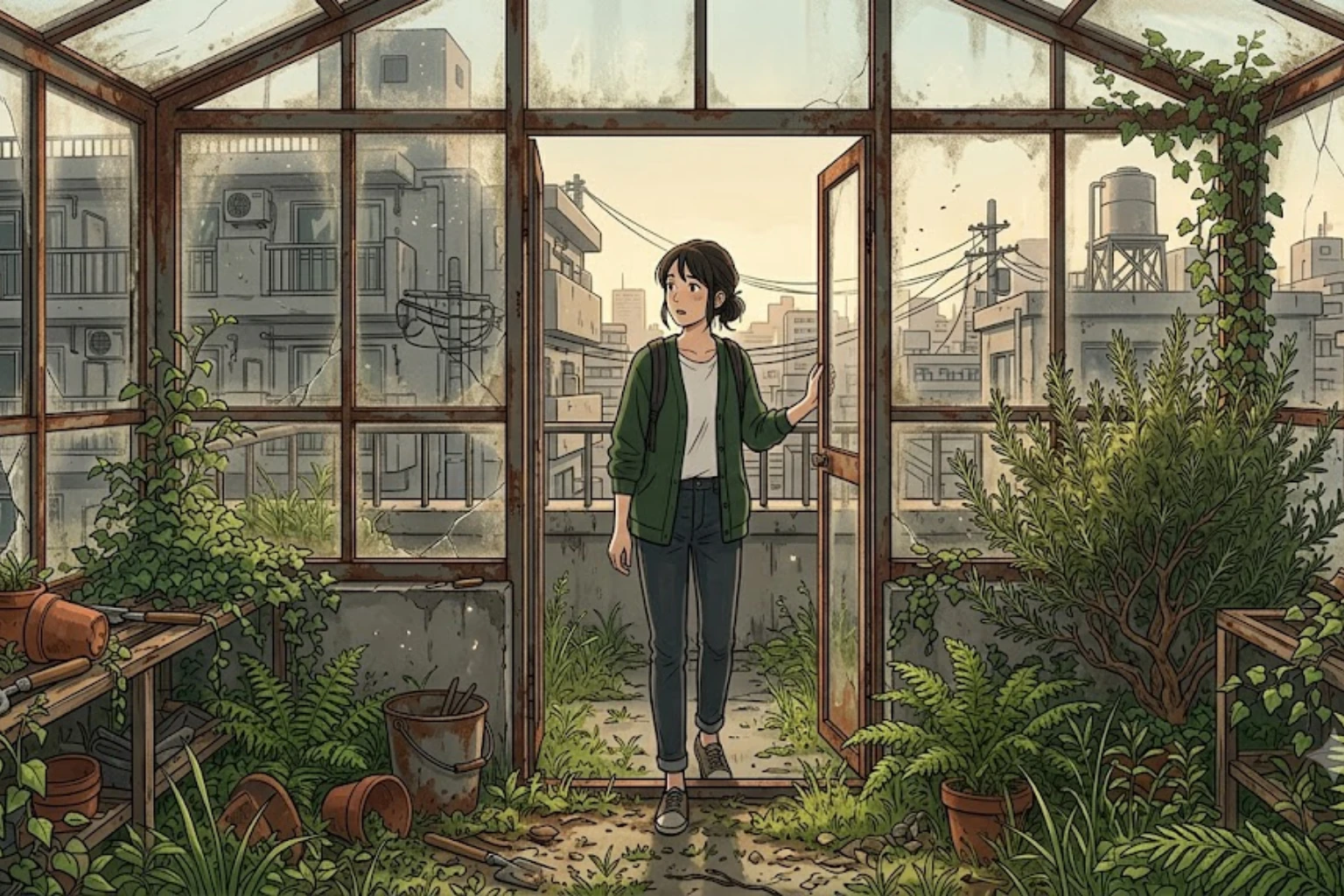
The apartment building was called Sakuragi Heights, though no one who lived there had ever seen a cherry tree anywhere near it, and the "Heights" felt like a small joke given that it was only six stories tall, hemmed in on three sides by taller buildings that blocked most of the sun by early afternoon. Yuki Nakamura had chosen it because it was cheap and close enough to the train station that she could walk to work in eighteen minutes if she didn't stop to look at anything along the way, which she rarely did anymore.
She moved in on a gray Tuesday in early April, carrying boxes up the narrow stairwell because the elevator had an "OUT OF SERVICE" sign that looked as though it had been printed sometime during the previous decade and simply never removed. The building smelled of old tatami and someone's cooking, a thin current of miso and fried garlic drifting down from an upper floor. The walls in the stairwell were the color of weak tea, water-stained near the ceiling, and the handrail wobbled slightly under her palm.
She didn't mind any of it. She had lived in nicer places before, with her ex-boyfriend, in an apartment that had underfloor heating and a view of a park, and none of that had mattered in the end. This place, with its crooked mailboxes and its silence, felt more honest somehow. It did not pretend to be more than it was.
On her third day, restless and unwilling to unpack the last box of books, she wandered up to the roof to see what was there. She had noticed the door to the stairwell continuing past the sixth floor, half-hidden behind a stack of collapsed cardboard someone had left to be recycled and then forgotten. The door was propped open with a brick, rust bleeding down its hinges, and beyond it the stairs narrowed and turned once before opening onto the roof itself, flat and gray and scattered with pigeon droppings, ringed by a low concrete parapet.
And there, in the far corner, half-swallowed by the haze of the city beyond, was the greenhouse.
It was small, perhaps four meters by six, its frame a skeleton of black-painted iron gone rusty at the joints, its glass panels furred with years of grime so thick that the afternoon light came through the color of weak tea. Several panes near the base had cracked or shattered altogether, and through the gaps she could see green things pushing insistently against the glass from the inside — vines, weeds, something with broad dark leaves that had clearly decided, in the absence of anyone to stop it, that the greenhouse belonged to it now.
She walked closer, her sneakers crunching over a scatter of gravel and dead leaves, and pressed her palm briefly against one grimy pane. It was warm. Whatever else was wrong with the place, the glass still held heat, still did the one thing greenhouses were built to do.
The door — a narrow iron-framed thing set into the side — was chained shut with a padlock gone orange with rust.
She went downstairs to find the superintendent.
---
Sato-san had lived in the building longer than anyone, in a ground-floor unit that also functioned as an office, its door propped open during the day so that the residents could bring him complaints he had no intention of addressing quickly. He was somewhere in his sixties, thick through the shoulders, with the sort of face that had settled permanently into an expression of mild disapproval, as though the entire building was a personal affront he had learned to live with.
"The greenhouse," he said, when she asked, not looking up from the newspaper spread across his desk. "That old thing. Why do you want to know about that."
"I was curious. It's locked."
"It's locked because there's nothing up there worth looking at." He turned a page. "Some tenant built it, years back. Before my time, even. Grew tomatoes, herbs, whatever. Then he moved out, or died, I don't remember which, and nobody else wanted the trouble. It's been locked up ten years, maybe more."
"Could I have the key?"
Now he did look up, with an expression that suggested she had asked something faintly absurd. "What for?"
"I'd like to clean it. Maybe grow something."
"It's full of weeds and broken glass. You'll cut yourself."
"I'll be careful."
He studied her for a long moment, the way one might study a stray cat that had wandered in and sat down without asking permission, uncertain whether it intended to stay. Then he sighed, opened a drawer stuffed with keys on tangled rings, none of them labeled in any system she could discern, and began sorting through them with irritated efficiency.
"If you break your neck up there," he said, "it's not my responsibility. I'll tell you that now, so there's no confusion later."
"Understood."
"And the building isn't paying for supplies. Whatever you do up there, you do on your own money."
"I understand."
He found the key at last — a small brass thing gone dull, indistinguishable to look at from a dozen others — and dropped it into her palm without ceremony. "Don't come complaining to me if something falls on you."
"I won't."
He grunted, which she took to be the closest thing to permission she was going to get, and returned to his newspaper as though she had already left the room.
---
The lock resisted for a long moment before it finally gave, the mechanism grinding with a sound like something waking after a long sleep, and the chain slid free with a clatter that seemed very loud against the quiet of the empty roof. The door itself stuck when she pushed it, swollen with old moisture, and she had to put her shoulder into it before it scraped open with a groan.
The smell that came out to meet her was thick and green — damp earth, rot, something sweetly rank underneath, the smell of a small enclosed world that had gone on living without anyone's permission. Inside, the greenhouse was a tangle. Whatever had once been neat rows of shelving had collapsed under the weight of things growing over and through them, vines thick as her wrist twisting up the iron struts, weeds standing waist-high in what had once probably been planting beds, a few terra cotta pots shattered on the concrete floor where roots had cracked through them entirely. Somewhere beneath all of it, she could make out the ghost of the greenhouse's original purpose: a long wooden workbench along one wall, buried under dead leaves and dust; a row of hooks that had once held tools, most of them empty now except for a single trowel rusted into uselessness; a watering can on its side, its spout broken off.
She stood in the doorway for a while, just looking, feeling something in her chest loosen slightly, the way it did sometimes when she came across a piece of music she hadn't heard in years and found she still remembered every note.
It was a wreck. It would take weeks, at least, to make it into anything at all.
She wanted, suddenly and completely, to do exactly that.
---
She started the following Saturday, in old clothes and rubber gloves, with a folding shovel and a roll of heavy-duty trash bags bought from the convenience store near the station. The weeds came out reluctantly, their roots gone deep and stubborn into the beds, and by midmorning her back ached and her palms were sore even through the gloves, and she had filled four bags with green matter that she dragged, one at a time, down six flights of stairs to the dumpster behind the building because the elevator still wasn't working.
On her third trip down, she passed an old woman on the third-floor landing, watering a single potted azalea that sat outside her door — the only green thing Yuki had seen anywhere in the building besides the greenhouse itself. The woman watched her struggle past with the trash bag slung over one shoulder, dirt smeared across her forearm, and said nothing, though her eyes followed Yuki all the way down the stairs.
By late afternoon Yuki had cleared perhaps a third of the weeds and uncovered, to her surprise, a few things that had survived beneath all that opportunistic growth—a rosemary bush gone woody and half-wild but still fragrant when she crushed a leaf between her fingers, a cluster of mint that had colonized an entire corner bed and refused, even now, to die, and something she didn’t recognize at first: a young volunteer tomato plant growing near one of the broken lower panes. A bird might have carried the seed there, or it might have been lying dormant in the old soil. Its thin stem had fallen against the remains of a broken stake, but several new leaves had already opened toward the light.
She left it alone. She left the rosemary and the mint too, cutting back what needed cutting, and spent the rest of the daylight scraping dead leaves and dirt from the workbench, exposing wood gone gray and soft in patches but still solid enough underneath.
She was almost finished when she heard the door creak behind her.
A man stood in the doorway, perhaps in his thirties, wearing a rumpled shirt that suggested he had slept in his clothes, holding a mug of coffee that had clearly gone cold some time ago. He had the particular pallor of someone who spent most of his hours in front of a screen and very few of them outdoors.
"I heard someone up here," he said. "I live on five. Ito." He gestured vaguely with the mug, as though this explained something.
"Nakamura," she said. "I just moved in. Third floor."
He looked past her into the greenhouse, at the cleared patch of earth, the trash bags stacked by the door, the young tomato plant still leaning against the broken stake. "This has been locked forever. I didn't even know you could get up here."
"The super gave me the key."
"Huh." He seemed to turn this over for a moment, unconvinced by his own curiosity, and then, apparently deciding it wasn't his business, added, "Well. Good luck," and disappeared back down the stairwell without further comment.
She didn't expect to see him again. But three days later, coming home from work, she found a folded piece of paper wedged into her mailbox slot with no name on it, only a URL for a hardware delivery site and a note in small, careful handwriting: *They sell replacement glass panes here, cut to size if you give them measurements. Cheaper than the shop near the station.*
She didn't know how he'd found her mailbox, or why he'd bothered, but she measured the broken panes that weekend and placed the order anyway.
---
The glass arrived two weeks later, wrapped in cardboard and foam, six panes in total, and she carried them up one at a time, terrified of dropping them on the stairs. Replacing them turned out to be more complicated than she'd anticipated — the old glazing compound had gone brittle and had to be chipped away with a flathead screwdriver before the new panes would seat properly, and by the time she'd finished the first one her fingers were nicked in two places and her patience had worn thin.
She was crouched by the third broken pane, swearing quietly to herself, when a voice behind her said, "You're doing that wrong."
She turned to find an old man watching her from the doorway, wiry and sun-browned despite the general grayness of the building, wearing a cardigan despite the warm afternoon. She hadn't seen him before, though something about his stance — feet planted, arms crossed, the air of someone accustomed to being listened to — suggested he'd been watching for some time before announcing himself.
"You have to bed the glass in compound on both sides," he said, "or it'll rattle loose again in a year. And you're leaving it too tight against the frame. Glass needs room to move or it cracks in the cold."
"I don't really know what I'm doing," she admitted.
"Obviously." But he said it without malice, already crossing the room to crouch beside her with a creak of knees that made him wince. "I'm Tanaka. Fourth floor. I used to keep a garden, before my knees went." He picked up the tube of glazing compound she'd bought, turned it over, read the label with visible skepticism. "This is fine. Give it here."
He showed her — how to lay a bead of compound along the frame first, how to press the pane into it gently and evenly rather than forcing one side down before the other, how to trim the excess with the flat of the screwdriver so it wouldn't catch dirt later. His hands, despite their age, were steady and sure in a way hers weren't, moving with the unhurried confidence of long practice.
"You had a garden," she said, watching him work. "Here, in the city?"
"On the ground, before this building went up around it. Small thing. Tomatoes, cucumbers, a persimmon tree that never fruited properly, no matter what I did to it." He didn't look up from the glass. "Whoever built this place, up here — I always wondered about that. Somebody wanted a garden badly enough to build one on a roof six stories up. That's not a small thing to want."
"Do you know who it was?"
"No idea. Before my time here too, I think. Or maybe I knew and forgot. I forget things now." He said this without self-pity, simply as a fact, the way one might mention the weather. He finished trimming the compound and sat back on his heels, surveying the pane with a critical eye. "There. That'll hold."
"Thank you."
"You'll need more compound before you're done with the rest. And don't buy the cheap kind next time — it dries out and cracks." He got to his feet slowly, one hand braced against the workbench, and looked around the greenhouse with an expression she couldn't quite read — something between nostalgia and calculation, as though he were mentally re-planting all of it. "There's a tomato plant in the corner that's trying very hard to survive. You should stake it properly instead of leaving it on that broken thing."
"I didn't want to disturb it."
"You won't kill it by helping it," he said, and something in the way he said it made her think he wasn't only talking about the tomato plant.
---
Word of the greenhouse spread the way things spread in a building where people otherwise kept to themselves — not through any announcement, but through the accumulation of small sightings. Someone saw Yuki carrying bags of soil up the stairwell and mentioned it to a neighbor while waiting for laundry. Someone else noticed the light in the greenhouse's grimy windows glowing faintly in the evening, where before there had only been darkness. Sato-san, questioned by a tenant about the noise on the roof, said only, "The girl on three got the key," with the particular flatness of a man who considered the matter closed and uninteresting, which somehow made it more interesting to everyone who heard it.
By the time all six panes were replaced and the glass had received its first real washing — a task that took Yuki two full afternoons, working from a stepladder with a bucket of soapy water and a squeegee, rinsing away a decade of grime pane by pane until the light coming through went from tea-colored to something closer to actual daylight — three or four residents had made the climb up to see for themselves, always with some pretext, never quite admitting outright that they'd come out of curiosity.
The washing of the glass was, in its way, the most satisfying part of all. She would soap a pane, let it sit, then drag the squeegee down in a single practiced stroke, and the grime would come away in a gray curtain, and suddenly the light coming through would leap several shades brighter, and the whole greenhouse would seem, for a moment, to inhale. Standing inside afterward, looking up through clean glass at the hazy white sky and the power lines crossing overhead and the water tower on the neighboring building's roof, she felt something settle in her chest that she hadn't managed to name yet, but that felt something like relief.
A woman from the fourth floor — not Tanaka's neighbor but across the hall from him, a woman named Kimura who worked irregular hours at a hospital and kept mostly to herself — appeared one evening while Yuki was repotting the rosemary into a larger container, and stood at the doorway for a while without speaking, arms crossed against the evening chill.
"I used to garden," she said eventually, in the tone of someone testing whether the sentence would be received well. "Before I moved here. My mother had a garden and I helped her."
"You're welcome to help now, if you want."
Kimura looked at the rosemary, at the bag of potting soil slumped open on the floor, at the row of empty pots Yuki had scavenged from a recycling pile two streets over. "I don't know if I have time. My shifts are strange."
"That's fine. Whenever you're free."
She didn't come that evening, but three days later Yuki found her on the roof after her own shift had ended, sitting cross-legged beside the mint bed with her sleeves rolled up, carefully separating a tangle of roots with her fingers, and she looked up when Yuki arrived with an expression that was almost defensive, as though she expected to be told she was doing it wrong.
"The mint had gotten into the rosemary's soil," she said. "I'm giving it its own pot. Mint does that, if you let it — takes over everything around it."
"That's fine. Thank you."
"I used to hate this," Kimura said, not looking up, working a root free with careful patience. "Gardening. My mother made me do it every weekend and I resented it. Now I don't know. It's different when nobody's making you."
---
By early summer the greenhouse had a shape again, though not the shape it must have once had. The wooden workbench had been sanded and oiled by Tanaka, who appeared one Sunday with his own tools and spent three hours restoring it without being asked, muttering the whole time about the poor quality of the original construction even as his hands moved over the wood with evident affection. The shattered pots had been cleared away and replaced with a mismatched collection gathered from recycling piles, garage sales, and in one case a broken rice cooker that Ito had suggested, half-joking, might make a decent planter, and which now held a thriving basil plant that nobody had expected to survive the experiment.
Ito himself had become a fixture, though he never gardened much — he preferred to sit on an overturned crate near the door with his laptop, working on whatever it was he worked on, occasionally glancing up to watch the others without offering to help, until one afternoon Tanaka handed him a trowel without asking and said, "Make yourself useful," and Ito, looking faintly startled, had taken it and spent the next hour turning soil with the mildly bewildered expression of a man discovering a new skill he hadn't sought out.
"I don't know anything about plants," he said, more than once, as though this might excuse him from further participation.
"Nobody does at first," Tanaka said. "You learn or you kill them. Either way you learn something."
The old woman from the third floor — her name was Endo, Yuki learned eventually, though it took weeks before she offered it — brought up her azalea one afternoon in early June, carrying the pot with both arms as though it were something fragile and precious, and set it carefully in a corner where the light fell at an angle she seemed to have already calculated in advance.
"It needs more sun than it gets outside my door," she said, by way of explanation, though no one had asked. "I've kept it fifteen years. It was my husband's, before."
Nobody asked further, and she offered nothing further, and the azalea simply took its place among the other plants, one more small life added to the collection, its story understood to be its own business.
There were disagreements, of course — small ones, the kind that arise naturally when several people with different opinions are suddenly sharing a single confined space and a shared set of decisions. Tanaka wanted the tomato plant cut back hard, insisting that its unchecked summer growth would keep it from producing properly; Kimura thought it should be left alone, arguing that it had found its own way to grow before any of them noticed it. They argued about it for the better part of an evening, Tanaka growing progressively more exasperated, Kimura growing progressively more stubborn, until Yuki, tired of refereeing, suggested they simply cut back half of it and leave the other half as a test.
"That's not how horticulture works," Tanaka said.
"It's how compromise works," Kimura said, and that, apparently, was that. The half that was cut back grew back thicker and more productive by August; the half left alone continued sprawling in every direction, producing fewer but larger fruit. Tanaka claimed victory. Kimura claimed the larger fruit proved her point. Neither of them ever quite let the argument go, though it had become, by then, more a running joke between them than a real dispute.
There was another disagreement, sharper and more serious, when Ito proposed installing a small speaker system so they could listen to music while they worked, and Endo objected strongly, saying the greenhouse was one of the only quiet places left in the building and she didn't want it filled with noise. Ito, stung, pointed out that nobody was forcing her to listen. Endo said that was exactly the problem with young people, that they thought not being forced to listen was the same as not hearing it anyway. The argument went nowhere for several days, conducted mostly through pointed silences and Sato-san being asked, absurdly, to mediate, which he refused to do, saying only that he wasn't paid enough to referee squabbles about music.
It resolved itself eventually and without any grand reconciliation: Ito began bringing a small pair of earbuds instead, and Endo, a few weeks later, without comment, began humming to herself while she worked, some old song Yuki didn't recognize, and nobody said anything about that either. It seemed, somehow, a fair trade.
---
Sato-san himself remained aloof for most of the summer, though not entirely absent. He came up once in June, ostensibly to check whether the roof drainage was being blocked by all the pots and soil bags accumulating in the corners, and stayed longer than the inspection required, standing with his arms crossed near the doorway, watching Kimura repot a struggling fern with visible skepticism.
"You're overwatering it," he said.
"I know what I'm doing."
"The leaves are yellow. That's overwatering."
"It's a different kind of yellow."
He grunted, unconvinced, but didn't argue further, and before he left he paused at the tomato plant — the half Kimura had refused to let anyone touch — and studied its sprawl for a long moment.
"My wife used to grow tomatoes," he said, to no one in particular, and then, before anyone could respond, added, "The drainage looks fine. Don't let it clog," and left without further explanation, leaving the others to exchange glances over the unexpected mention of a wife none of them had known existed.
He came back more often after that, always with some pretext — checking the drainage, checking the wiring for the single bare bulb someone had rigged up for evening work, checking that the door still locked properly — and stayed longer each time, until by midsummer his visits had stopped requiring any pretext at all, and he simply appeared some evenings after his office hours ended, sat on the overturned crate that had become unofficially his, and watched the others work with an expression that had softened, almost imperceptibly, from disapproval into something closer to reluctant fondness.
"You're all wasting your time," he said once, watching Ito struggle to build a trellis for a climbing bean plant out of scavenged bamboo stakes and garden twine. "That'll fall over in the first strong wind."
"Then I'll fix it," Ito said, not looking up.
"You'll fix it badly."
"Probably."
Sato-san watched him for a while longer, then got up without a word, disappeared down the stairwell, and returned twenty minutes later with a coil of proper wire and a pair of pliers from some drawer in his office, and spent the next half hour rebuilding the trellis himself, muttering the entire time about incompetence, while Ito held the stakes steady and said nothing except, at the end, "Thank you," to which Sato-san only grunted.
---
By July the greenhouse had filled in enough that it no longer looked like a ruin being reclaimed but like an actual garden, dense with green in a way that made the surrounding city — the concrete towers, the tangled power lines, the perpetual gray haze that hung over everything most afternoons — seem, from inside, briefly beside the point. The two sides of the tomato plant—one pruned and one left wild—had both begun fruiting, small green globes swelling and slowly reddening among the leaves. The basil in its rice-cooker planter had grown thick enough to need cutting back weekly, and Kimura had started leaving small bundles of it outside doors around the building, no note attached, so that people began finding sprigs of basil on their doorsteps and understanding, without being told, where they'd come from.
Yuki had planted cucumbers along one wall, trained up a trellis of her own design, and a scatter of flowers in pots that Endo had helped her choose — nothing elaborate, just marigolds and some small purple things whose name she kept forgetting, chosen mostly because Endo said they'd survive the greenhouse's uneven watering schedule, which depended entirely on whoever happened to be up there on a given evening remembering to check the soil.
The evening watering had become, without anyone deciding it should, a kind of loose ritual. People drifted up after dinner, singly or in twos, carrying whatever needed to be watered or checked or harvested, and stayed for anywhere from ten minutes to two hours depending on the day, the conversation flowing easily or not at all, sometimes several people working in companionable silence, sometimes an argument breaking out over nothing in particular and dissolving just as quickly.
Tanaka had begun bringing a small folding chair, complaining that his knees couldn't manage crouching for long anymore, and would sit near the tomatoes offering unsolicited advice to whoever happened to be nearby, which everyone had learned to accept as simply part of the greenhouse's atmosphere, like the smell of turned earth or the hum of the city beyond the glass.
"You're pruning too much," he told Yuki one evening, watching her thin out a cucumber vine.
"You told me to prune more last week."
"That was last week. Things change." He shifted in his chair, wincing slightly. "How's the young man's trellis holding up?"
"Better than expected. Sato-san rebuilt half of it."
"I heard." Tanaka's mouth twitched, something that might have been amusement. "He'll deny caring about any of this if you ask him directly. Best not to ask him directly."
"I wasn't planning to."
"Good instinct." He watched her work for a while longer in silence, and then, apparently apropos of nothing, said, "My wife died six years ago. Before that, we had the garden together, downstairs, before this building went up. After she died I didn't garden anymore. Didn't see the point of tending something if there wasn't someone to show it to at the end of the day." He said this evenly, without drama, the way Endo had spoken of her husband, the way Sato-san had mentioned his wife's tomatoes — as a fact laid down and then left alone, not offered for sympathy, simply offered because it was true and the moment had made room for it.
"There's someone to show it to now," Yuki said, after a moment, not quite sure if it was the right thing to say.
Tanaka considered this, looking around the greenhouse — at Kimura crouched by the basil, at Ito's laptop glowing on the crate beside his half-finished trellis repairs, at Endo humming to herself while she deadheaded the marigolds, at the whole small crowded green world they had built out of a decade of neglect and a handful of Saturday afternoons.
"So there is," he said.
---
The first real harvest came in early August — a Sunday afternoon so hot that the greenhouse's interior had turned humid and close despite the vents Yuki had propped open, the tomatoes hanging heavy and red among the leaves, the cucumbers grown long enough that several had gone slightly bitter from being left too long unpicked. There was, by unspoken agreement, no formal announcement of the harvest; it simply happened, over the course of the afternoon, as people arrived to check on things and found ripe fruit demanding to be picked.
Kimura arrived first, off an early shift, and began filling a shopping bag with tomatoes before anyone else appeared. Ito came next, laptop notably absent for once, and helped her sort the ripe from the not-quite-ripe, arguing briefly about which shade of red counted as ready. Tanaka arrived with his folding chair and immediately began directing the harvest from his seat with the confidence of a man who considered himself, by this point, the greenhouse's senior authority on all matters of readiness and ripeness, an authority nobody had granted him but which nobody contested either.
Endo brought up a knife and a cutting board, unprompted, and began slicing the ripest tomatoes into thin rounds right there on the workbench, sprinkling them with salt from a small paper packet she'd apparently brought for exactly this purpose, and handed the slices around without ceremony, and they stood there, all five of them, eating tomato slices with their fingers in the thick green heat of the greenhouse, the city humming faintly beyond the glass, and nobody said anything particularly memorable, and it did not need to be memorable, because it was simply pleasant, the tomatoes warm from the sun and startlingly sweet, sweeter than anything from a store, and the basil smell thick in the air, and somebody's radio — Ito's, from his phone, played quietly enough that Endo didn't object — running through some old song none of them could name.
Sato-san arrived toward the end of the afternoon, ostensibly to check something about the roof access door, and accepted a tomato slice when Endo held one out to him without comment, ate it standing near the doorway with his arms crossed, and said, after a while, "Not bad," which from him amounted to something close to a rave review.
"You should grow something," Kimura told him. "You keep coming up here anyway."
"I don't have time for that."
"You have time to come check the drainage every other day."
He didn't answer this directly, which everyone by now understood to be his way of conceding a point without admitting it. But the following week, a small terra cotta pot appeared on the workbench, unlabeled, containing what turned out, over the following months, to be a shiso plant, and nobody asked him about it, and he never claimed it outright, but it was understood, in the way things came to be understood in the greenhouse, that it was his.
---
The building itself had not changed. The elevator remained out of service through the summer and into the autumn, the stairwell walls stayed the color of weak tea, and Sakuragi Heights continued to look, from the street, like exactly what it was — an aging, unremarkable building crowded between taller and newer ones, easy to walk past without noticing. But something in it had shifted in a way that was hard to point to directly, evident mostly in small things: neighbors who had once passed each other in the stairwell without speaking now nodded, sometimes stopped to mention that the tomatoes were coming in well, or that someone should really fix that dripping tap on the fourth floor before winter. Baskets of extra vegetables began appearing outside doors during the height of the season, cucumbers too abundant for anyone to use alone, zucchini nobody quite remembered planting but which had apparently seeded itself from a compost pile Tanaka had started behind the workbench. A resident on the second floor Yuki had never spoken to left a note on her door once, thanking her for the basil, adding that she hadn't cooked with fresh herbs since she was a child and had forgotten how much difference it made.
The greenhouse did not become crowded, exactly — it remained a small space, and not everyone in the building came up, and some residents never showed any interest at all, which nobody seemed to mind or take personally. But those who did come formed, over the months, something that functioned like a loose and understated kind of family, bound not by any deep confession of feeling but by the accumulated weight of small shared tasks: a trellis rebuilt together, a disagreement about watering resolved through compromise, tomato slices passed around on a hot afternoon, a shiso plant nobody claimed and everyone understood.
In September, the light through the clean glass began to slant lower and thinner as the season turned, and the marigolds went past their peak, and Tanaka declared, from his folding chair, that it was time to think about what would go in for autumn — daikon, maybe, or the leafy greens that didn't mind a chill. Kimura argued for spinach. Ito, who had by then planted and mostly failed to grow a single successful thing all summer beside the bean trellis, said he didn't care what they planted as long as somebody explained clearly what he was supposed to do with it, and Endo told him, not unkindly, that he'd manage, the same as everyone else had managed, by trying and occasionally failing and mostly, in the end, learning.
Yuki stood near the doorway one evening in late September, watching the four of them argue amiably over seed packets spread across the workbench, the last of the summer's tomato vines still hanging heavy against the far wall, the city beyond the glass fading slowly into a haze of orange streetlight and distant traffic sound, and she thought, without any particular drama attached to the thought, that she had not expected to find this here — not the greenhouse itself, which she had found by accident on an idle afternoon, but this, the gathering of it, the way a locked and forgotten room could, with enough patience and enough hands, become something a whole building quietly depended on without ever quite admitting as much out loud.
"You're not planting anything," Tanaka said, noticing her standing there. "Everyone else is arguing about seeds and you're just watching."
"I'm thinking."
"About what?"
She considered this for a moment, watching the light move across the glass, the shapes of the plants dark against it, the small crowded life of the place going on around her in its unhurried, ordinary way.
"Nothing important," she said. "Just this."
He seemed to accept that as a sufficient answer, the way he accepted most things by now — with a small grunt, a shift of his weight in the folding chair, and a return to the argument at hand, which had moved on, in his brief absence, from spinach to the relative merits of daikon varieties, a debate that would, she suspected, continue for some time yet, long after the light outside had gone fully dark and someone finally remembered to switch on the bare bulb hanging from its wire above the workbench, casting its small warm circle of light out over the seed packets and the soil-stained hands and the tangle of green things settling in, however briefly, for the turning of another season.

.png)
.png)
.png)
.png)