%20(1).png)
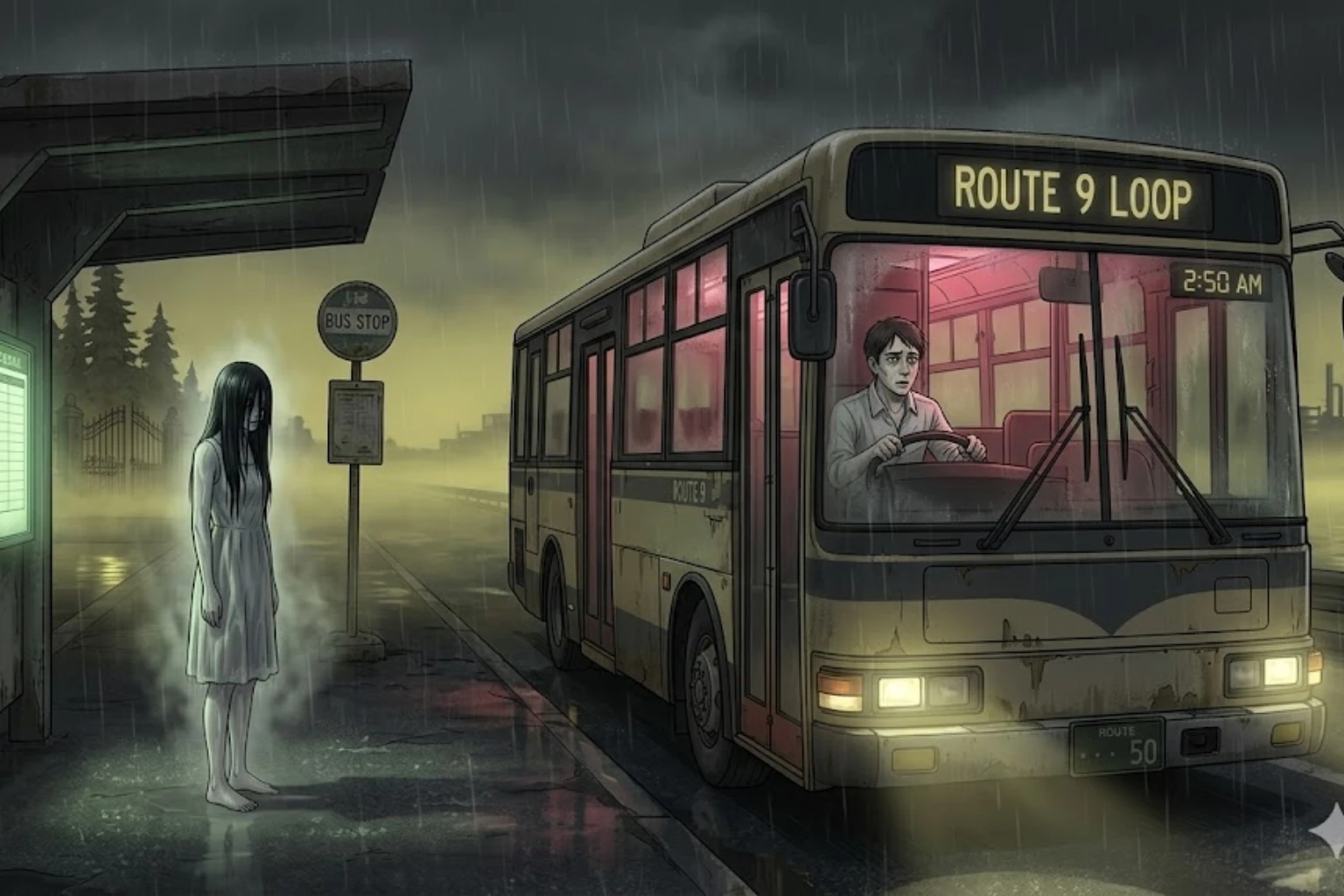
The rain over Sector 9 did not fall so much as it dissolved into the air, creating a dense, gray twilight that hung over the concrete overpasses and the rusted girders of the old canal line long after midnight. It was the kind of cold, oily mist that coated the windshield of Bus 44 in a stubborn film, forcing the heavy, rubber-bladed wipers to maintain a rhythmic, scraping groan that had been the background track to Kenji’s life for the last seven years. He sat in the high-backed, cracked vinyl driver’s seat, his knuckles stiff inside his fingerless woolen gloves, his eyes tracking the dull white beams of his headlights as they struggled to cut through the yellow fog rising from the drainage ditches. The clock on the dashboard, a simple green digital display that flickered whenever the alternator surged, read 2:14 A.M.
This was the dead hour. The modern metropolis, with its towering neon monoliths and automated high-altitude transit grids, felt miles away, buried behind layers of industrial smog and forgotten municipal zoning. Down here, on the lower loop, the city’s infrastructure bled into something older and more decayed. The route was a loop of empty storage depots, dark scrap yards, and old stone houses that had long since been abandoned to the damp air of the river valley. Most nights, Kenji drove the 2:00 A.M. shift entirely alone, the heavy diesel engine rattling the loose aluminum panels of the cabin in a way that kept him from nodding off. He preferred the silence. It was predictable. It had a beginning and an end, and it didn't ask anything of him other than to keep the heavy vehicle between the faded white lines of the asphalt.
But tonight, as the bus rumbled toward the concrete alcove of the Mid-District Transit Station, the air inside the cabin began to turn. It wasn't a gradual shift in temperature; it was a sudden, sharp drop that made the breath catch in his throat, freezing into a thick plume of gray vapor before it even left his lips. The internal heater, which had been blowing a steady, smelling stream of hot dust and engine oil, sputtered and began to rattle violently, its plastic vents frosting over with a sudden glaze of ice.
Kenji slowed the bus, his boots pressing down on the heavy brake pedal until the air brakes let out a long, shuddering hiss that echoed off the empty concrete platform. Through the wet glass of the front door, he saw her.
She was standing perfectly still beneath the single, flickering halogen bulb of the transit shelter. She didn't have an umbrella, nor did she wear a coat to shield herself from the freezing mist. She wore a simple, light-colored summer dress that was completely plastered to her thin frame, the fabric so saturated with water that it appeared almost translucent under the orange glare of the streetlamp. Long, black hair fell forward in heavy, tangled clumps over her shoulders, entirely obscuring her face, though the sheer weight of the water dripping from the strands made them look like solid iron wires. She didn't move as the bus came to a halt. She didn't look up to check the route number or the destination sign. She simply waited until the pneumatic lever was thrown.
With a heavy grunt of unpowered hydraulics, the folding doors creaked open.
A wave of air followed her inside—not the clean, crisp smell of rainwater, but the thick, suffocating stench of stagnant river mud, dead reeds, and old iron that had spent decades rusting at the bottom of a canal. The woman stepped onto the ribbed rubber floor mat of the entryway. Her bare feet were blue-white, the skin puckered and wrinkled as if it had been submerged for days, yet as she stepped into the interior light of the bus, she left no wet footprints behind. The water poured from her hem in a continuous, heavy stream, but the moment the drops touched the rubber floor, they seemed to vanish, leaving the textured surface completely dry.
"Miss, you need to scan your pass," Kenji said, his voice flat, hardened by years of dealing with late-night drifters and the strange, silent eccentrics who inhabited the fringes of the night shift.
The woman didn't pause. She didn't look toward the plastic token box or the digital scanner mounted beside the dashboard. She glided past his seat with a slow, mechanical gait, her arms hanging limply at her sides like dead weights. As she passed, the cold that radiated off her dress was so intense that Kenji’s fingers locked up around the steering wheel, a sharp, localized frostbite prickling against his skin through the gaps in his gloves. He watched her through the long rearview mirror as she moved down the narrow aisle, her head tilted slightly downward, her hair swaying with the heavy vibration of the idling engine. She walked all the way to the very back of the vehicle, choosing the exact center seat of the long rear bench—the place where the heat from the floor vents usually kept the mechanics warm during winter maintenance.
Kenji reached for the door lever, his hand trembling slightly from the residual chill. He had seen her before. For three months, she had boarded at exactly 2:15 A.M. at this very stop. In the beginning, he had tried to follow the regulations. He had stood up from his seat, flashlight in hand, determined to make her pay the fare or leave the vehicle. But each time he stepped within three rows of her, the air grew so heavy that his lungs refused to expand, the smell of river silt filling his throat until he was forced to retreat, coughing and gasping for oxygen. The other drivers at the depot had warned him during the shift changes. They didn't speak of her often, but when they did, it was always in low, hurried whispers over paper cups of bitter coffee. Leave her be, the old-timers said. Don't look her in the eye through the mirror, and don't try to find out where she goes. She’s part of the route now.
He slammed the lever forward, the doors sealing shut with a dull thud that cut off the sound of the rain outside. The bus lurched forward, its massive diesel engine groaning as it climbed the slick incline of the lower avenue, leaving the transit station behind in the gray fog.
For the next twenty minutes, the silence inside the bus was absolute, broken only by the steady, metronomic thump-thump of the wipers and the heavy sloshing of water inside the wheel wells. Kenji kept his eyes locked on the road ahead, focusing on the yellow lines that marked the boundary between the pavement and the deep, concrete-lined drainage canals that ran parallel to the highway. Yet, even without looking at the mirror, he could feel her presence. It was a physical pressure—a weight at the back of his neck that grew heavier with every mile they traveled toward the edge of the district. The frost on the dashboard console had spread, covering the digital speedometer in a delicate web of white crystals that made the numbers difficult to read. The thermometer now registered six degrees below freezing inside the cabin, despite the heater core running at full capacity.
The road began to twist, rising into the narrow, dark corridors of the Northern Terrace. Here, the modern city ended completely. The high-density residential blocks gave way to ancient, overgrown cedar groves and long stretches of rusted chain-link fence that marked the boundaries of old industrial estates.
A sharp, high-pitched ding shattered the silence.
The red 'Stop Requested' indicator on the dashboard flared to life, its plastic housing glowing with a dull, crimson light that cast long shadows across the steering column. Kenji checked his navigation screen. The next stop on the automated schedule was the West Shinonome Cemetery—a century-old burial ground that occupied nearly three miles of the valley slope, its granite markers and iron tombs hidden behind a wall of black pine trees. No one had used this stop since the transit authority had cut the daytime service three years ago. The concrete signpost was covered in thick ivy, its reflective paint peeling away from the metal backing like old skin.
Kenji pulled the bus into the gravel turnout, the heavy tires crunching through the wet stone before coming to a halt directly before the rusted iron gates of the cemetery. The rain here seemed louder, drumming against the aluminum roof of the bus with a frantic, metallic intensity that sounded like hundreds of tiny fingers tapping against the metal.
"Shinonome Cemetery," Kenji announced, his voice cracking slightly from the cold.
Through the rearview mirror, he saw the woman rise from the back bench. She moved down the aisle with that same slow, swaying rhythm, her dress dragging along the floor mats without making a sound. As she neared the central exit doors, she stopped. For the first time in three months of driving this loop, her head began to tilt backward, the long, wet strands of hair parting slightly in the middle to reveal the skin beneath.
Kenji’s breath caught in his throat. His fingers froze on the door lever.
The face in the mirror was not human. The skin was a translucent, bruised shade of slate-blue, the flesh around the jawline swollen and soft as if it had been softened by long exposure to a deep current. But it was her eyes that made his heart stutter. There were no eyes—only two dark, perfectly circular hollows that seemed to stretch back into the interior of her skull, filled with a thick, unmoving black liquid that reflected the red glare of the dashboard light like stagnant water. Her mouth parted slightly, a small trickle of gray river silt escaping from her lower lip and dripping down onto the front of her dress.
She didn't speak. She didn't look directly at him, but the hollow spaces of her face remained fixed on his reflection for three long seconds before the pneumatic valve released, and she stepped down into the dark, gravelly mud of the cemetery entrance.
The moment her bare feet touched the ground outside, Kenji slammed the door lever shut. He didn't wait for the doors to align properly; he threw the transmission into low gear and slammed his boot onto the accelerator. The heavy rear tires spun violently in the loose gravel, throwing showers of mud against the iron gates of the cemetery as the bus roared back onto the empty highway, its engine screaming in protest as he forced it down the winding descent toward the valley floor.
He was breathing hard now, his chest rising and falling in sharp, shallow gasps that left thick clouds of frost on the steering wheel. He wanted to look back. He wanted to check the mirror to ensure the back rows were empty, but the unwritten law of the depot held his head straight. Don't look back after the cemetery. He focused every ounce of his remaining concentration on the road ahead, watching the white lines appear and disappear beneath his headlights like a series of pale ribbons.
The highway descended rapidly into the lowest tier of the district—a low-lying basin where the city’s major drainage canals converged before emptying into the bay. The fog here was different from the mist on the hills; it was a thick, yellow-green smog that smelled of old oil, industrial detergents, and the sour rot of river bottom vegetation. It rose from the concrete channels in heavy, rolling banks that clung to the asphalt, reducing his visibility to less than fifteen feet. Kenji was forced to drop his speed, the bus rolling forward at a cautious crawl as the high beams bounced off the wall of vapor, creating a blinding glare that made his eyes water.
He checked the dashboard clock. It was 2:50 A.M.
The route was nearly finished. In ten minutes, he would reach the southern terminal depot, park the vehicle in Bay 4, and sign over his log to the morning supervisor. He could already feel the warmth of the convenience store down the street from his apartment—the small, brightly lit sanctuary where he would buy a can of sweet black coffee and sit by the window until the sun came up. He just needed to cross the old iron bridge that spanned the main canal junction.
The bus rumbled onto the metal grating of the bridge, the tires making a high-pitched, vibrating hum that echoed through the empty chassis. As the vehicle cleared the far side of the structure, the yellow fog parted slightly, revealing the concrete shape of a solitary transit shelter sitting at the intersection of Route 9 and the canal service road. It was an old industrial stop, long since bypassed by the main transit lines, its glass panels shattered into a web of white cracks that had been patched over with gray duct tape.
Kenji’s foot struck the brake pedal before his mind could fully process what his eyes were seeing.
Standing beneath the concrete roof of the shelter, illuminated by the dull green light of the automated schedule box, was a figure. She was drenched. Her light-colored summer dress was soaked through, clinging to her skin in heavy, wet folds that dripped water onto the cracked asphalt around her bare feet. Her long, black hair hung forward in dense, tangled clumps that completely hid her face.
"No," Kenji whispered, the word dying in his throat as a cold dread settled deep in his stomach. "No, that's impossible. That's not possible."
He checked the navigation screen. The cemetery was over four miles behind him, separated by a steep ridge and two major highway exchanges. There were no paths through the cedar groves that a person could walk in ten minutes, and no vehicles had passed him on the single-lane road since midnight. Yet there she stood, the exact same water dripping from her hem, the exact same shape to her shoulders.
He resolved to keep driving. His foot moved toward the accelerator, his mind screaming at him to blow past the stop, to leave the concrete shelter and the fog behind him and never look back. But before his boot could press down on the pedal, the diesel engine let out a sharp, metallic cough. The heavy vehicle shuddered violently, the floorboards vibrating as the RPMs dropped to zero. The digital dashboard console flickered twice, the green numbers turning into a chaotic jumble of alien characters before the entire electrical system died, plunging the front cabin into absolute darkness.
The bus coasted forward on its own momentum, the heavy iron brakes groaning as the vehicle came to a soft, dead stop directly in front of the concrete shelter.
Kenji did not touch the door control. He sat frozen, his hands locked onto the steering wheel with such force that the vinyl cover groaned under the pressure. But the pneumatic system didn't wait for his input. With a long, agonizing screech of metal against rubber, the front doors slid back, opening the cabin to the yellow mist of the canal road.
The smell hit him first. It was five times stronger than before—a thick, wet stench of river silt, industrial chemicals, and the unmistakable rot of stagnant water that had been trapped beneath concrete for decades. The cold followed, moving through the open entryway like a physical hand that wrapped around his throat, stopping his breath before it could reach his lungs.
The woman stepped onto the bus for the second time.
She left no tracks as she moved past the driver’s console, but the wet squelch of her bare feet against the ribbed rubber was loud in the dead silence of the unpowered cabin. She did not stop at the token box. She did not look at him. She glided down the aisle with that same slow, mechanical sway, her white dress brushing against the edges of the seats until she reached the very back row, taking her place in the exact center of the vinyl bench.
The moment she sat down, the dashboard console flared back to life. It wasn't the standard green glow of the transit system; the lights were a deep, sickly red that cast long, distorted shadows across the glass windows of the cabin. The digital log screen reset itself, the standard route numbers vanishing, replaced by a single line of solid text that burned into the LCD panel:
ROUTE 9 — LOOP EXTENDED
The diesel engine roared back to life with a sudden, deafening thud that shook the window glass in its frames, though Kenji had not turned the ignition key. The pneumatic doors snapped shut with the sharp force of a steel trap closing, the rubber seals meeting with a loud hiss that seemed to cut off the rest of the world entirely.
Kenji tried to lift his feet. He tried to reach for the emergency brake release, but his body was no longer entirely under his control. A strange, heavy current was flowing out of the steering column—a numbing, icy vibration that traveled up his arms and into his shoulders, locking his joints into place. His hands turned the wheel on their own, his right boot pressing down on the accelerator as the heavy bus lurched away from the shelter, its tires screaming as it turned off Route 9 and onto the old, unpaved service road that followed the edge of the industrial canal.
The fog outside turned from yellow to a deep, featureless black. The streetlights were gone now, replaced by the dark water of the channel that ran just inches from the edge of the gravel road. Through the side windows, the city seemed to be changing, the concrete warehouses dissolving into towering columns of wet mud and compacted reeds that stretched up into a sky that had no stars.
Kenji forced his head to turn, his eyes moving slowly toward the long rearview mirror above his head.
The woman was no longer looking down. Her head was completely raised, her neck tilted back at an unnatural angle that allowed her to stare directly at the back of his head through the glass reflection. The two dark, hollow sockets where her eyes should have been were weeping a thick, black fluid that ran down her cheeks in steady streams, soaking the front of her white dress until the cloth turned the color of the river bottom.
In the reflection, Kenji could see that the water pooling around her seat was no longer vanishing. It was spreading down the center aisle of the bus—a dark, viscous wave of canal water filled with dead leaves, small bits of rusted iron, and tiny, writhing shapes that moved through the silt like blind insects. The liquid crept forward, row by row, rising over the metal legs of the vinyl seats until it reached the edge of the driver's platform.
"Why?" Kenji managed to whisper, the word leaving his lips as a thick, frozen cloud of gray mist that clung to the inside of his visor. "The shift is almost over. I just need to return the vehicle."
A sound answered him from the back row—not a voice, but the deep, resonant grinding of river stones being dragged across a concrete floor by a heavy current. It filled the entire cabin, vibrating through the metal walls of the bus until the steering wheel itself felt wet and soft beneath his gloves.
"The log is incomplete," the sound murmured inside his mind, its frequency matching the low, rhythmic idle of the engine. "The loop requires a driver who stays."
The bus came to a final, shuddering halt at the very end of the service road, where the concrete pier jutted out into the widest part of the drainage basin. The engine died instantly, the red dashboard lights fading until the only illumination came from the dark, phosphorescent glow of the black liquid that had now completely covered the floor of the cabin.
The front doors slid open with a final, breathless sigh.
The woman rose from her seat and walked forward, her bare feet splashing softly through the black water that filled the aisle. She stopped directly beside the driver's console, her blue-tinted hand reaching out to touch the worn leather of the steering wheel just inches from Kenji’s fingers. The skin of her arm was cold—so cold that the air around it turned to frost, small white flakes falling onto the metal dashboard like snow.
She turned her hollow gaze toward his face, the black liquid from her cheeks dripping onto the collar of his uniform jacket.
"Your route has been cleared," the voice ground out through the silence. "Step down."
Kenji looked down at his hands. The woolen fabric of his gloves had rotted away, revealing skin that was already turning the same translucent, slate-blue shade as the woman’s arm. The silver hairs on his wrists were damp, covered in a thin layer of gray river silt that smelled of old iron and dead reeds. He could no longer feel the cold; the numbing vibration had settled deep within his chest, slowing his heart until its beat matched the slow, dripping rhythm of the water hitting the floor mats.
He stood up from the vinyl seat, his joints creaking like old timber. He didn't look at the dashboard console or the digital log that still burned with that single green line of text. He stepped out through the open doors of Bus 44, his bare feet sinking into the soft, wet mud of the pier as he walked down into the black water of the canal, his white breath disappearing into the yellow fog that hung over the river valley.
When the morning shift supervisor arrived at the West Shinonome turnout at five o'clock the next morning, he found the vehicle parked perfectly within the gravel circle, its engine cold and its batteries entirely dead. The driver’s side window was rolled down halfway, letting in the damp morning air, and the high-backed vinyl seat was soaked through with a heavy, dark silt that smelled of old river bottoms and dead vegetation. Kenji’s transit log was still sitting on the console, its paper pages damp and stuck together by the mist.
The company records were updated by noon, the old name scrubbed from the active roster and replaced by a temporary schedule code. But the loop remained. And every night, when the clock on the depot wall reaches 2:15 A.M., the new drivers on Route 9 look out at the yellow fog rising from the canal, their fingers tightening on the wheel as the air inside the cabin begins to turn to ice. They know the unwritten rule now. They don't check the rearview mirror after the cemetery stop, and they never ask why the passenger who gets off twice is still waiting at the next shelter down the line.


.png)
.png)
.png)