%20(1).png)
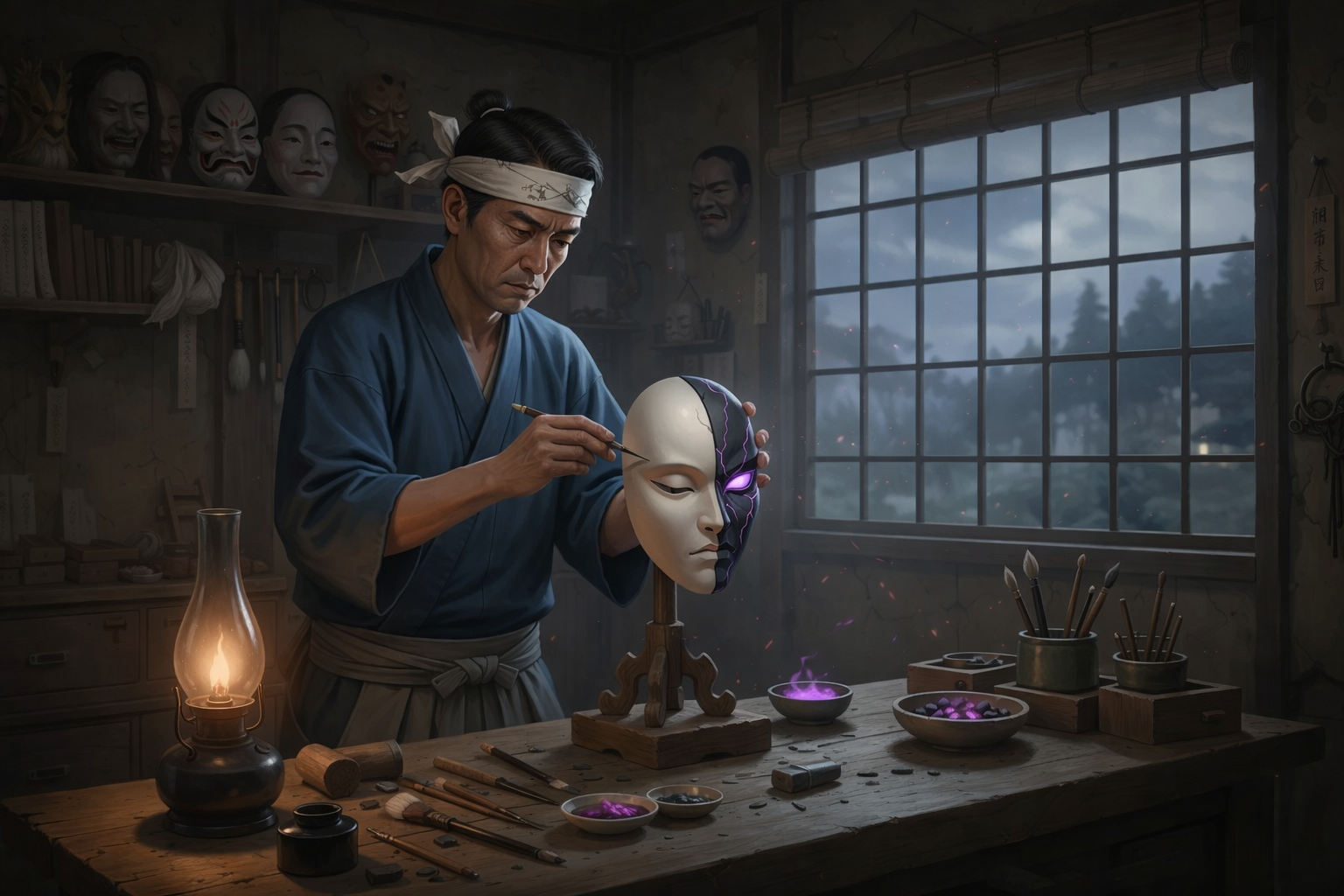
The workshop was small, but orderly, shaped over years rather than design. Nothing in it was new, and nothing was out of place. Tools rested where they were always left, worn smooth by repetition. The shelves along the back wall held finished pieces—masks of varying expression, each one carefully carved and painted, each one complete in a way that no longer satisfied him.
The man worked alone.
He had done so for years, long enough that the rhythm of it no longer felt like a choice. Morning began before the light reached the paper window. The room was always quiet at that hour, the world beyond it distant and unnecessary. He would prepare his tools, inspect the work from the day before, and begin again without urgency. There was no need to hurry. His work had never required it.
Once, long ago, the mornings had been different.
There had been another set of footsteps in the room. Another pair of hands that moved more quickly, less carefully. Questions had been asked then—about balance, about proportion, about why certain lines were left softer than others. He had answered them without hesitation, certain of his reasoning.
“Too much detail draws attention,” he had said once, guiding a younger hand away from a sharper cut. “A mask should allow the wearer to become something else. Not force it.”
The lesson had been accepted at the time.
Whether it had been understood, he could not say.
Those mornings had passed.
The second set of footsteps no longer came. The questions had stopped. The work remained.
Those who came to him now knew only the quiet version of the workshop.
He was not the only artisan in the region, but he was known for consistency. His masks were balanced, precise, and without excess. They did not exaggerate emotion. They suggested it. That restraint had earned him steady work over the years—performers, minor officials, and household patrons who preferred something understated. Nothing he made demanded attention.
He preferred it that way.
Or at least, he had come to believe that he did.
Once, a traveling performer had stood in the workshop, turning one of his finished masks over in his hands. The man had laughed—not unkindly, but with a kind of surprise.
“It doesn’t tell me what to feel,” the performer had said. “Most masks do.”
The artisan had taken it back, studying it briefly before setting it aside.
“It is not meant to,” he had replied.
The performer had nodded, though it was clear he did not fully understand.
After the man had left, the mask had remained where it was placed. The artisan had looked at it once more before returning to his work.
He had not altered it.
He had not reconsidered the comment.
There had been many such moments over the years.
Each one had passed without weight.
Or so he believed.
The mask before him now was not like the others.
It rested upright on a simple wooden stand, held at eye level as though it were meant to be regarded rather than worn. From a distance, it appeared like any other he had made—smooth, measured, carefully proportioned. But up close, the difference was clear.
One side was complete.
The surface was pale and even, the lines of the face calm and restrained. The eye was closed in a neutral expression, neither sorrowful nor content. It was the kind of face that could belong to anyone, or no one at all.
The other side was something else.
Not unfinished—the carving had been completed with the same care as the rest—but altered in surface. Fine fractures traced their way across it, subtle but undeniable. They did not break the structure of the wood. They followed it, as though guided by something beneath the surface rather than imposed upon it.
He had noticed them early.
On the second day of carving, when the form was still rough, a small split had appeared near the edge of the cheek. It was not unusual. Wood behaved this way sometimes. In most cases, he would have adjusted for it, reshaped the surface, or begun again.
He had stopped.
The tool had remained in his hand. He had turned the piece slightly, examining the line where the split had formed. It was shallow. Correctable.
He had known what to do.
The blade could remove it. A different angle could hide it. A new piece could replace it entirely.
He had waited.
Not long. Just long enough for the certainty to soften.
Then he had set the tool down.
It had not felt like a mistake.
It had not felt like a decision.
It had felt like continuation.
Now, as he worked, the brush moved steadily across the surface, following those same lines. Where the wood had shifted, he did not resist it. He refined it, bringing it into clarity rather than erasing it.
The room remained still.
Outside, the faint sounds of the village moved through their usual patterns—distant voices, the creak of a cart, the brief call of someone passing by. None of it entered the workshop fully. It existed at the edge of hearing, easily ignored.
The work continued.
Day after day, the mask returned to his hands.
At first, the changes were visible. The surface evened. The tones settled. The contrast between the two halves became more deliberate.
Later, the changes became smaller.
A line softened by the width of a brush hair.
A tone adjusted so slightly that it could not be named.
A surface polished not because it required it, but because he had not yet chosen to stop.
Time passed without measure.
Meals were taken without thought. Sleep came when the work allowed it. The rest of the workshop remained untouched.
Other commissions waited.
He saw them when he entered. He saw them when he left. He did not approach them.
When patrons came, he met them outside.
“You have not forgotten my order?” one asked.
“No,” he replied.
“You will complete it soon?”
“Yes.”
The man nodded, satisfied, and left without question.
None were invited inside.
It did not concern them.
A light sound came from the doorway.
He did not turn immediately. It was familiar—the soft shift of the door, followed by the quiet pause of someone waiting to be acknowledged. After a moment, he set the brush aside and turned.
His daughter stood just inside the threshold.
She had come without speaking, as she often did, watching before interrupting. Her hands were folded loosely in front of her, her attention fixed not on him, but on the mask.
“You’re working on that one again,” she said.
“Yes.”
He stepped back slightly, giving her a clearer view. She moved closer, careful not to touch anything.
“It looks different,” she said.
He waited.
“This side is like the others.”
Her finger hovered near the smooth half.
“But this one…” She hesitated. “It feels like it’s looking at me.”
He glanced at the mask, then back at her.
“It has only one open eye,” he said. “That is all.”
She nodded, though her expression did not change.
“Will someone wear it?” she asked.
“Perhaps.”
She remained a moment longer.
“You used to finish them faster.”
He did not answer.
She looked at him, as though expecting one.
“You used to let me watch longer,” she added quietly.
The words settled between them.
He did not respond.
After a moment, she stepped back.
“It’s not finished,” she said.
“No,” he replied.
She left as she had entered—without sound, without ceremony.
He remained still long after she had gone.
There had been a time when her presence had not required acknowledgment. When she would sit near the doorway and speak freely, asking questions he answered without impatience.
That time had passed.
He could not say when.
He turned back to the mask.
It had not changed.
The same lines. The same division.
Only the way he looked at it had shifted, though he could not say how.
He reached for the brush again.
The days continued.
Morning. Work. Evening.
The pattern held.
At times, he stepped back and regarded the mask from a distance.
It did not resemble anything he had been asked to create.
It did not resemble anything he had created before.
Yet each time he returned to it, the work continued as though it had already been decided.
The air shifted as the days passed. Mornings grew cooler. The light sharper. The workshop felt different, though nothing within it had changed.
At last, there was nothing left to adjust.
The mask was finished.
He cleaned his tools methodically, placing each one back in its proper place, then returned to the table and lifted the mask from its stand. It was lighter than it appeared, balanced in his hands. He turned it once, then again, examining it without searching for flaws.
There were none he wished to correct.
He wiped away the faint traces of pigment along the edge, where the two halves met. The line remained visible, but clean.
He held it at eye level.
The open eye faced him.
It did not change. It did not move.
He lowered it slowly.
For a moment, he hesitated.
Not long enough to act.
Only long enough to notice.
He set it back on the stand.
He remained there longer than he intended.
The mask rested where he had placed it, unchanged.
For a moment, he considered covering it—setting it aside, as he had done with other finished pieces. There were cloths nearby. A shelf with space enough to hold it.
He did not move.
The thought passed.
A shadow crossed the doorway.
He turned.
A man stood just outside, unfamiliar, dressed in the manner of someone accustomed to being received without delay.
“I was told you had completed a piece,” the man said.
“It is finished.”
The man entered, his gaze moving immediately to the table. He approached without hesitation, stopping just short of the mask.
For a moment, he said nothing.
Then, quietly, “This is the one?”
“Yes.”
The man studied it longer than most would have. His expression did not change, but his attention did not waver. He circled the table once, then returned to face it directly.
“It is… unusual,” he said.
The artisan did not respond.
“It was not made for performance.”
“No.”
The man considered that, then nodded once.
“It will be taken.”
There was no negotiation.
The artisan inclined his head slightly.
The man turned and left.
The workshop was quiet again.
He returned to the table and looked at the mask one last time. In the dimming light, the two halves appeared balanced, neither drawing more attention than the other.
He studied it for a moment.
Then, almost without thinking, he nodded.
“It is complete,” he said.
The words settled into the room.
He did not question them.
The mask remained where it was, waiting to be moved.


.png)
.png)
.png)