%20(1).png)
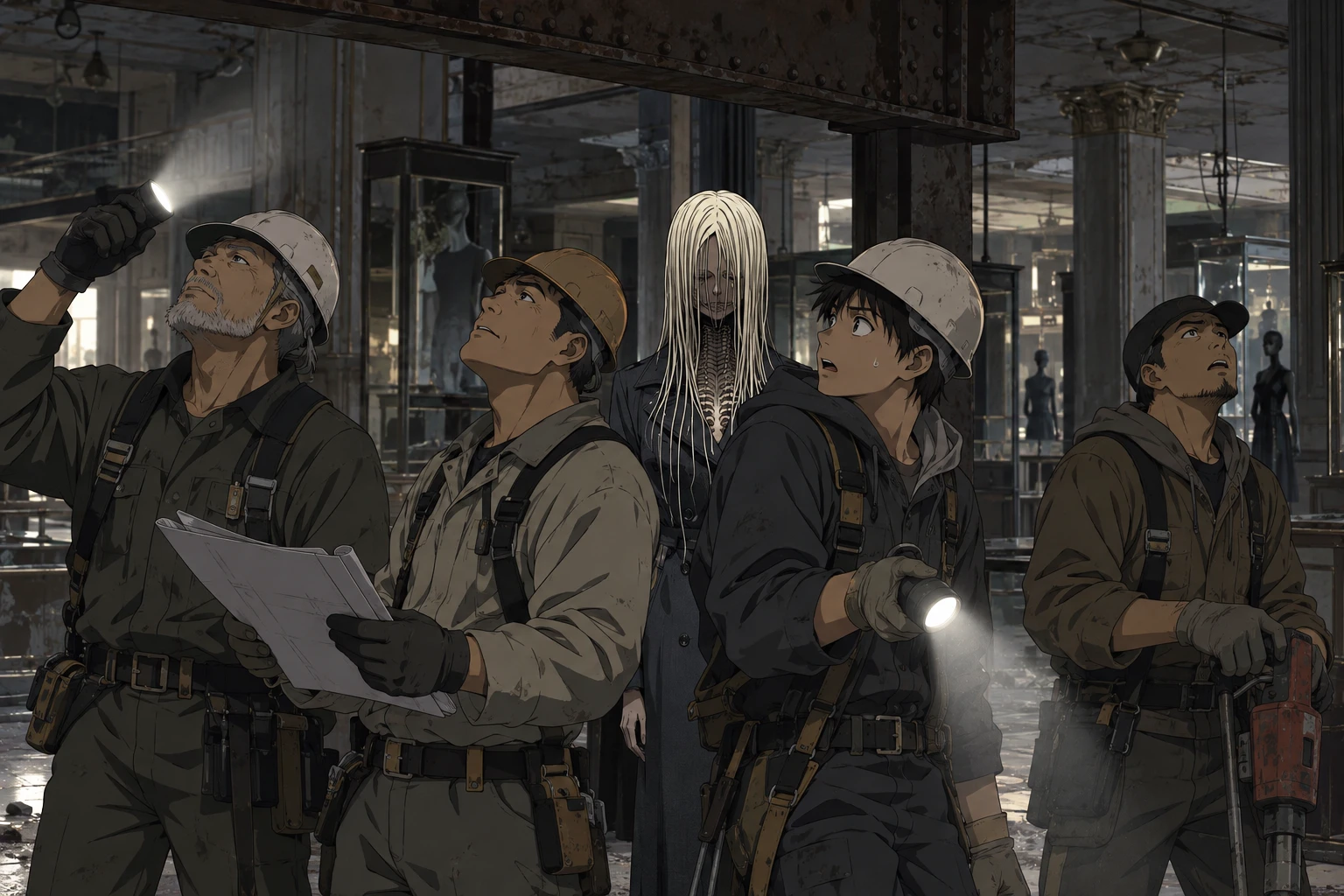
The old Garrity & Sons department store took up most of the block on Fulton, seven stories of limestone and dead neon, and the demolition crew's van looked small parked against it in the gray morning light. Tom Reyes had worked building teardowns for twenty-two years and he still felt it every time, walking into something that size with the permits in his jacket pocket and a flashlight in his hand. Like walking into the open mouth of something.
"Anybody check if the elevators still run?" asked Danny Cho, nineteen years old and already regretting his coffee choices. He had a travel mug in one hand and a clipboard in the other, neither of which he seemed to know what to do with.
"They don't run," said Marcus Webb. He was fifty-three, built like a fire hydrant, and had been doing this work since before Danny was born. "Power's been cut to this building for six years. We talked about this in the briefing."
"I'm just saying, be nice if they did."
"Be nice if a lot of things." Marcus shouldered his bag and looked up at the facade. Half the windows were boarded, half were just dark, holding six years of dust like something preserved. "Come on. Let's see what we're working with."
Inside, the store smelled like a wet basement and old carpet glue. The main floor stretched out in front of them, cosmetics counters still standing in rows like headstones, glass cases fogged with dust, a dead escalator rising up into darkness on the far wall. Somewhere above them, pigeons were shifting in the rafters, the only sound besides their own footsteps.
"Jesus," Danny said. "This is like a museum nobody wants to visit."
"Focus," Marcus said. "Beam's this way."
They walked the length of the floor to where a massive iron support column rose up through the center of the building, visible on every level through a kind of central atrium that had probably once held some grand staircase or a Christmas tree the size of a house. Tom tilted his head back and let the flashlight beam climb up into the dark.
"That's your primary load-bearer," Marcus said, more to Danny and the other young one, Walt, than to Tom, who already knew. "Runs clean up through all seven floors. You take that down right, whole building folds in on itself like a cardboard box."
"And if we take it down wrong?" Walt asked. He was twenty-four, skinny, had a habit of chewing the inside of his cheek when he was thinking. He'd been with the crew eight months and still asked more questions than the other three combined.
"Then it falls on the street instead of in on itself, and somebody from the city has a very bad day," Tom said. "Which is why we're here to look first and blow second."
"Charges probably go here, here, and up around the fourth floor where the structure necks down," Marcus said, pointing. "But we need eyes on every floor before anybody signs off on placement. Danny, you're writing all this down?"
"Writing it down," Danny said, not writing it down.
Walt had drifted a half step to the side, looking up with the others, his neck craned back at the same angle as the rest of them, and that was when he felt it. The sense, sudden and complete, that someone was standing very close to his left ear. Not near him. Beside him, the way Danny was beside him, the way you'd stand next to someone in an elevator.
He turned his head, just his head, still mostly looking up out of habit.
She was there.
Inches away. Close enough that if either of them had taken a breath too deep, their faces would have touched. Pale, the kind of pale that had no pink in it, no warmth, skin like something kept out of the sun for longer than skin should be kept out of the sun. Hair so light it was almost white, hanging straight down past her shoulders, past where he could see, because he could not see past her collar, could not see a body at all, only a face and hair and the dark wool of something at her throat. Her expression was not a scream and not a smile. It was closer to nothing. Close enough to study him. Her eyes were on his.
The instant his eyes met hers, she was not there.
Walt made a sound that wasn't a word. He stumbled back two full steps and hit a glass display case hard enough to make it shudder, and the sound cracked out across the dead floor like a gunshot.
"Whoa — hey — " Danny grabbed his arm. "What, what is it —"
"There was — " Walt's hand was up near his own face like he was trying to push something away that was no longer there. "Somebody was right there. Right there."
Marcus and Tom had both turned. The floor around them was empty, the way it had been empty the whole time, aisles of dead counters stretching off in every direction, nobody in any of them.
"Where?" Tom said.
"Right there, man, I swear to God, somebody was standing right next to my face —"
"Nobody's here, Walt." Marcus said it flatly, not unkindly, the way you'd tell a kid there was no monster in the closet. "It's the four of us."
"I'm telling you —"
"You probably caught Danny's reflection in one of these cases," Tom offered. "This glass does weird things. Catches people from across the room, makes it look like they're right on top of you."
"It wasn't Danny." Walt's voice had an edge in it now, something close to anger, which was its own kind of fear. "It wasn't any of you. It was a woman. Blonde hair, like — long, all the way down, and her face was right there, inches away, and then she wasn't there anymore."
Danny had gone a little pale himself, caught between wanting to laugh and not quite managing it. "Okay, that's — that's a very specific hallucination for a Tuesday morning."
"I didn't hallucinate it."
"Nobody's saying you're lying," Marcus said. "Buildings like this, they do things to your head. Bad light, dust in the air, your eyes play tricks."
"My eyes don't play that kind of trick."
Tom crouched slightly and ran a finger along the edge of the display case Walt had stumbled into, looking at the dust that came away gray on his fingertip. "It's fine," he said. "Just old glass. Dust settles weird in a building like this, catches light funny." He straightened again without further comment, though he glanced once, briefly, toward the dark aisles further back.
"See, that's not making me feel better," Danny said.
"It's not supposed to make you feel better, it's supposed to be a fact about dust," Tom said.
Walt was still breathing hard, looking around the floor, at the rows of counters, the dead escalator, the dark hanging shapes further back that might have been clothing racks still holding stock, draped now in sheeting and shadow. "I want better light in here," he said. "I mean it. This floor's basically black past thirty feet. I want the work lights up before we go any further."
"We were going to get the lights eventually anyway," Marcus said, checking his watch more out of habit than need, since there was nothing to be on time for. "Fine. You two —" he nodded at Danny and Walt — "go get them out of the truck, bring them up, we'll start rigging them on this floor so we've got something better than flashlights. Tom and I will keep mapping the beam placement up through the atrium."
"You want me to go by myself with him after he just saw a ghost?" Danny said, not quite joking.
"He didn't see a ghost," Tom said. "He saw bad lighting and a long night's worth of coffee catching up to him. Go get the lights, both of you. It's broad daylight outside. You'll be fine."
Walt didn't look reassured. But he went.
The truck was parked around the side, near the loading dock, which meant cutting back through the store to a service corridor on the east side rather than going out the front. Danny carried the clipboard he still hadn't written anything on; Walt carried nothing, his hands jammed in his jacket pockets, his eyes doing a slow continuous sweep of every shadow they passed.
"You really saw somebody," Danny said. It wasn't quite a question.
"I really saw somebody."
"Like — a person person? Or like a person-shaped thing?"
"I don't know, man, it was two seconds. A face. Hair. She was right on top of me, like — like the way you'd stand next to somebody waiting for a bus. That close."
"That's so much worse than if she'd been far away."
"Thank you, yes, I'm aware."
They passed through what had once been the women's shoe department, rows of low shelving still holding a scattering of boxes, most collapsed with age, a few still intact enough to read the faded logos. A dressmaker's mannequin stood near the end of the row with no head, just a wire armature where the neck should be, and Danny gave it a wide berth without quite admitting to himself why.
"Could be the store's got a reputation," Danny said. "You ever hear anything? Before the city sent us in?"
"Like what?"
"Like — I don't know, old department stores like this, big ones, they've been around since like the twenties. Somebody's bound to have died in a building like this. Heart attack in the stockroom, elevator accident, who knows. Maybe an employee."
"You're saying she worked here."
"I'm saying maybe. Maybe she was like — head of ladies' coats for thirty years and then she died of natural causes in 1974 and she's just been here since, folding sweaters nobody's going to buy."
"That's a very specific backstory for a thing I saw for two seconds."
"I'm working with what I've got." Danny glanced sideways at him. "Or maybe she was a customer. You ever think about that? Maybe she loved this store so much she just — stuck around. My grandmother used to talk about some department store in Queens like it was a religious experience. Maybe this lady's like that but extremely dead."
"Can we not do the jokes right now."
"I'm coping, Walt, this is what coping looks like for me."
They came out into the service corridor, narrower, lower ceilinged, lined with doors that had once led to offices and now mostly stood ajar on rooms full of collapsed shelving and old filing cabinets. There was a long mirror bolted to the wall near what had probably been a fitting room annex, speckled black with age, and both of them caught their own reflections in it as they passed — Danny first, then Walt a half step behind.
Danny looked back at the mirror, not sure why, some old habit of checking yourself in a reflective surface, and for just a fraction of a second he thought he saw something pass behind Walt in the glass. Not a face. Just a suggestion of pale color, there and gone, like a held breath of light.
"You good?" Walt said, because Danny had stopped walking.
"Yeah." Danny made himself keep moving. "Yeah, fine. Mirror's just — this building's got a lot of mirrors."
"It's a department store. They sell clothes. People need to see if clothes fit."
"I'm aware of how department stores work, Walt."
They reached the loading dock door and the daylight coming through the grimy dock windows felt like something to hold onto. The truck was where they'd left it, and getting the work lights out — two heavy tripod units and a coil of cable thick as a garden hose — took both of them several trips, muscling the gear back in through the dock door and setting it down just inside, ready to carry back toward the main floor.
It was on the second trip, cable coiled over his shoulder, that Walt felt it.
Cold.
Not the ordinary cold of an unheated building in late autumn. A specific cold, a point of cold, pressed right up against the back of his neck like someone had opened a freezer door an inch from his skin. His breath caught. Every hair on his arms stood up at once.
He did not turn around.
He wanted to. God, he wanted to, some animal part of his brain was screaming at him to spin and see what was behind him, confirm it, know it, because not knowing was its own kind of agony. But another part of him, older and quieter, was telling him that if he turned around and there was nothing there, he would feel insane, and if he turned around and there was something there, close enough to breathe cold on his neck, he did not know what he would do with that information, how he would carry it, how he would keep walking afterward.
"Danny," he said. His voice came out smaller than he wanted it to.
Danny was a few steps ahead, didn't look back. "Yeah?"
"Is there — can you just — look behind me. Don't ask why. Just look."
Something in his tone made Danny actually stop and turn, clipboard and cable bag still in hand, and look past Walt down the dim corridor behind him.
"Nothing's there, man."
The cold was still there. Walt could feel it, a physical pressure against his skin, as real as the cable weight on his own shoulder.
"You sure?"
"It's an empty hallway, Walt, I'm looking right at it."
Walt finally turned, fast, cable swinging with him, and the corridor behind him was exactly as Danny said. Empty. Dim. A closed door twenty feet back, dust undisturbed on the floor in front of it.
But the cold had been real. He knew that the way he knew his own name. It had faded now, bleeding back into the ordinary chill of the building, but for ten or fifteen seconds it had been an entirely different kind of cold, sourced, directional, close.
"I don't like this place," Walt said.
"Nobody likes this place. That's why they're knocking it down." Danny said it like a joke, but his eyes were moving over the corridor behind Walt a beat too long before he turned back around.
They had one more stand to carry and the last coil of cable, and they went back out to the truck for it together, neither of them willing to say out loud that they didn't want to split up even for the length of the dock, and when they came back in through the dock door, arms full, Walt stopped short in the corridor.
"Danny."
"What."
"Didn't we already bring that one in?" He nodded toward the first light stand, sitting exactly where they'd left it, just inside the door. "That's the first load. We went back out for the second."
"Yeah, so?"
"So how far did we carry it. Did we carry it further than this?"
Danny looked at it, then at the corridor stretching away toward the main floor, trying to remember, and found that he genuinely couldn't — the walk back from the dock door blurred strangely in his memory, shorter than it should have felt, or longer, he couldn't tell which. "I don't know, man. We're carrying heavy stuff, who's keeping track."
"I'm keeping track," Walt said. "I always keep track. And I don't remember covering that much ground."
"Okay, well, we're both standing right here, so let's just keep moving and stop making it weirder than it already is."
They picked the gear back up. Walt went first this time, into the dark run of the corridor, the mirror a dull smear of gray ahead of them, and Danny followed a few steps behind, cable looped heavy over his shoulder, his flashlight beam bouncing with every step.
"Hey, Walt, slow down, I'm not as fast as you with this stuff —"
He looked up from the cable and Walt was no longer in front of him.
The corridor ran straight for thirty feet to the next turn, no doors standing open on either side that Danny could see, the mirror still hanging dark and silent on the wall, and there was simply no one in it. No Walt. No sound of him up ahead, no footsteps receding, nothing.
"Walt?"
Danny set the cable down, because carrying it suddenly felt absurd, felt like the wrong thing to be doing with his hands. "Walt, this isn't funny, man."
He went forward to the turn in the corridor and looked both ways. One direction led back toward the dock, the gray daylight still visible at the far end. The other led deeper into the building, toward a stairwell door standing a few inches ajar, darkness beyond it.
"Walt, I swear to God."
He checked the dock first, some hopeful part of him expecting to find Walt standing there laughing at him, but the dock was empty, the truck sitting outside exactly as before, nothing disturbed.
He went back to the stairwell door and pushed it open. Concrete steps, a dead emergency light fixture on the landing, the kind of close, swallowing dark that made his flashlight beam feel thin and useless.
"Walt? You go up here?"
Nothing answered. Somewhere above him, very faint, he thought he heard a single footstep on the stairs, light, unhurried, and then nothing else.
He didn't go up. Some instinct held him at the bottom of the stairwell, flashlight trembling slightly in his hand, and after a long moment he backed out and let the door swing most of the way shut behind him.
"Okay," he said, to no one, his voice sounding strange and small in the corridor. "Okay. Not funny. Not funny at all."
He fumbled the radio off his belt. "Walt, you there? Walt, come in." Static answered, the ordinary hiss of an empty channel, and no voice underneath it. He tried again, got the same nothing, and started back down the corridor toward the main floor, meaning to get Tom and Marcus, because four people searching was better than one, because he did not want to be the only person left in this part of the building.
He didn't make it as far as the main floor.
The corridor bent again before it opened up, past a run of old office doors, and as Danny passed the long mirror near the fitting room annex he caught his own reflection moving beside him, pale under the flashlight, alone in the glass — and then, for just a moment, not alone. A second shape, behind his reflected shoulder, hair the color of old paper, there in the mirror and nowhere in the actual corridor when he spun to look.
"Walt?" His voice cracked on it. "Is that you doing that? Walt, I will actually hit you, come out."
Nothing came out.
He kept moving, faster now, cable and light stand abandoned behind him somewhere in the dark, his only thought to reach the main floor, reach Tom, reach Marcus, reach anyone — and the corridor seemed, in the particular way corridors do when a person is frightened and hurrying, to go on considerably longer than it had on the way in, doors sliding past that he didn't remember passing before, the mirror appearing a second time, or perhaps a different mirror entirely, he could no longer be sure.
The last clear thing Danny was aware of was the cold settling against the back of his neck, patient and absolute, and the sound of his own breathing, and then the sound of his own breathing was the only sound left in the corridor at all.
Back near the iron column, Tom checked his watch for the third time in ten minutes. "They're taking their sweet time with those lights."
"Probably Danny's fault," Marcus said, writing a measurement onto the clipboard he'd commandeered since Danny clearly wasn't using it. "Kid gets distracted by his own shoelaces."
"Could be Walt's still shook up. Maybe they're sitting in the truck having a moment."
"Could be." Marcus didn't sound convinced. He clicked his flashlight off, then back on, an old habit, checking the batteries without meaning to. "Give them a few more minutes."
A few more minutes became fifteen, became twenty, the two of them filling the time with the actual work, measurements and notes and a long, low discussion about whether the fourth floor's structural necking would make for a cleaner collapse than the third, until Tom finally said what they'd both been not quite saying.
"That's a long time to get two light stands."
Marcus pulled the radio off his belt. "Danny. Walt. Either of you copy." He waited. Nothing came back but static. "Danny, you there, buddy?"
Still nothing.
"Dead zone," Tom offered, though it came out less certain than he meant it to. "Lot of steel in a building like this."
"We were getting signal fine ten minutes ago."
"Signal in a building like this can change floor to floor, hallway to hallway, you know that as well as I do."
"I know it," Marcus said. "I also know those two have been gone the better part of forty minutes for a job that should've taken fifteen." He clipped the radio back onto his belt. "Come on. Let's go find them before I start inventing reasons to be annoyed instead of worried."
They went the way Danny and Walt had gone, through the shoe department with its headless mannequin, into the service corridor beyond, flashlights sweeping the dark doorways on either side.
"Danny! Walt!" Tom's voice carried flat and hard down the corridor.
No answer came back, but near the fitting room mirror they found the light stand and the coil of cable, abandoned on the floor exactly where Danny had set them down.
Marcus crouched over the gear, studying it without touching it at first, the way you'd study something at an accident scene. "They wouldn't just leave this lying here."
"No," Tom agreed. "They wouldn't."
"Danny!" Marcus's voice this time, louder, with an edge that hadn't been there a moment ago. "This isn't funny, you two, we've got work to do."
The corridor held its silence, the particular textured silence of an old building settling its weight, and somewhere far off a pigeon shifted in the rafters and went still again.
They checked the loading dock first, found the truck undisturbed outside, found nothing of either young man inside the bay, and came back through the corridor toward the stairwell door that stood a few inches ajar, exactly as Danny had left it.
"You think they went up?" Tom asked.
"I think I don't like any of this," Marcus said, but he pushed the door open anyway, flashlight beam climbing the concrete steps into the dark. "Danny! Walt! You up there?"
Nothing answered but a single faint creak, far above, that might have been a footstep and might have been the building doing what old buildings did.
They went up together, Tom in front, Marcus a step behind, their flashlight beams crossing and overlapping against the stairwell walls, and it was on the second landing that Marcus stopped.
"You hear that?"
"Hear what," Tom said.
"Thought I heard somebody breathing. Close. Right behind me."
Tom turned his light fully on Marcus's face. Marcus looked, for the first time since Tom had known him, genuinely rattled, his jaw tight, his eyes not quite meeting Tom's.
"There's nobody behind you, Marcus. I'm looking right at the spot."
"I know what I heard."
They kept climbing, calling names into the stairwell that no longer echoed back to them the way stairwells should, and came out onto the second floor into what had been menswear, suit racks and a rotating tie display gone dark with dust, three-way mirrors standing in alcoves along the far wall.
"Danny! Walt!"
Tom's flashlight passed over the central mirror panel, and for a half second his own reflection seemed to hold a beat too long in the glass, lagging very slightly behind his actual movement, before catching up to itself. He didn't mention it. He kept the light moving.
They found no one on the second floor. The third floor held the same dust-sheeted furniture and the long dinner table set for no one that Danny would have recognized if he'd been there to see it, and the dust on the floor lay smooth and undisturbed except for their own tracks, no sign that either young man had come this way at all.
"They didn't come up here," Marcus said, echoing a thought that had already occurred to both of them. "Dust isn't touched."
"Then where did they go."
Neither of them had an answer for that. They went back down through the stairwell, through the service corridor, out across the main sales floor calling names that no longer felt like they meant anything, until Marcus finally stopped near the base of the dead escalator and stood very still.
"Marcus."
"Give me a second."
"What is it."
Marcus didn't answer right away. When he did, his voice had dropped low, careful, like a man trying not to disturb something sleeping nearby. "Something's standing behind me, Tom. I can feel it. Cold, right on the back of my neck."
Tom's flashlight came up instinctively, pointed at the empty air behind Marcus's shoulder, and found nothing there at all — no shape, no shadow out of place, only the dead escalator and the dark aisles beyond it.
"There's nothing there, Marcus. I'm looking right at it."
"I didn't ask if there was something there. I asked you to believe me that I can feel it."
Tom lowered the light slowly. Something in Marcus's face — the stillness of it, the careful, controlled fear — made him understand, all at once and completely, that Walt had not been imagining anything that morning, that none of this had been bad lighting or a long night's coffee, and that understanding arrived with no comfort in it at all.
"Don't turn around," Tom said.
Marcus's jaw tightened. "I wasn't planning to."
They stood like that for a long moment, Tom's light fixed on the empty space behind Marcus, Marcus himself rigid and unmoving, and then, as suddenly as it had come, the cold seemed to pass, and Marcus let out a breath he'd clearly been holding.
"It's gone," he said. "I think it's gone."
"You want to keep looking or you want to get out of this building."
"I want to find Danny and Walt," Marcus said, though his voice had lost its earlier certainty. "Then I want to get out of this building."
They tried the loading dock again, methodically this time, checking behind the truck, inside the cab, along the dark edge of the bay where an old freight elevator gate stood folded shut on its track. Marcus pulled the gate open; behind it was only the shaft itself, the car long gone, a black vertical throat dropping into the foundations and rising up through all seven floors above.
"They wouldn't climb down there," Marcus said.
"No," Tom agreed. "They wouldn't."
He let the gate screech shut again, and it was in the quiet after that screech faded that Tom became aware the dock held only the two of them, and that it had, for some unclear stretch of time, held only the two of them, though he could not have said with any certainty when that had become true.
"Marcus," he said. "Marcus, where'd you go."
He said it before he'd fully registered that Marcus was no longer beside him, the way you sometimes say a thing a half second before your mind catches up to the fact of it. The loading dock was empty. The truck sat visible through the open roll-door, exactly as before. The freight elevator gate hung shut and still on its track.
"Marcus!"
Nothing answered. Tom's own voice came back to him flat and small, swallowed by the concrete and the corrugated metal and the gray morning light leaking weakly through the bay's grimy windows.
He tried the radio. "Marcus, you there? Marcus, come in." Static hissed back at him, patient, endless, no voice underneath it at all.
Tom stood in the loading bay a long time after that, alone, before he admitted to himself that he was alone, that there had been a man named Marcus Webb standing beside him only a short time ago and that the bay now held only himself, the truck visible through the open roll-door, the freight elevator gate shut and still.
He did not call out again. He had done enough calling out for one morning, and some tired, frightened part of him had begun to suspect that calling out only confirmed to whatever was in this building where he stood, how alone he had become.
He went back into the service corridor instead, flashlight held low and steady despite what his hand wanted to do, and made his way back toward the main floor, because the alternative was staying in the loading bay with the freight elevator and its black open throat, and that felt, for reasons he could not entirely articulate, like the worse choice.
The mirror near the fitting room annex was still there, speckled and dark, and Tom made himself look at it as he passed, made himself study his own reflection the way you'd force yourself to touch a hot stove just to know the shape of the pain. His reflection looked back at him, tired, gray-faced, alone in the glass exactly as he was alone in the hallway.
He kept walking.
The main sales floor, when he reached it, felt larger than it had that morning, the dead escalator and the half-assembled work lights and the long rows of counters all sitting in the gray daylight that leaked weakly through the boarded windows, and Tom stood at the edge of it for a long moment, listening.
"Marcus," he said, not loudly. "Danny. Walt."
Nothing answered, which he had expected, and somehow the confirmation of it — the simple, flat fact of being the only living thing on this floor — settled into him with less panic than he would have guessed. He had spent twenty-two years walking into buildings that other people were afraid of, buildings that groaned and shifted and occasionally dropped a piece of ceiling on a man who wasn't paying attention, and some old, practiced part of him reached for the familiar grooves of that experience even now, telling him: assess, move carefully, don't run, don't panic, panic is what kills you in old buildings, not ghosts.
He started toward the atrium, toward the iron column rising up through the heart of the building, because it was the one fixed point he had, the one piece of this place he understood completely, and because some instinct told him that if he was going to find any of them, he would find them there, near the structure's spine.
He was perhaps thirty feet from the column when he became aware that his own footsteps were being followed by a second, slightly offset set of footsteps, a half beat behind his own, as though someone were matching his pace a step or two back.
He stopped.
The second footstep did not.
It came once more, close, closer than it should have been able to get in the half second since he'd stopped moving, and then it, too, went silent.
Tom did not turn around immediately. He stood very still, flashlight beam fixed on the iron column ahead of him, and felt the air behind him change the way a room changes when a door opens somewhere in a house at night — not a sound exactly, but a pressure, an absence of the stillness that had been there a moment before.
"Walt," he said, very quietly, though he did not believe it was Walt, had not believed it for some time. "Marcus."
Nothing answered.
The cold came then, settling against the back of his neck exactly as Marcus had described it, exactly as Walt had described it before that, a small precise point of cold like an open freezer door held an inch from his skin, and Tom Reyes, fifty-eight years old, twenty-two years in this business, stood in the center of a dead department store and found that his entire body had gone rigid, that some old animal wiring beneath all his training and experience was screaming at him not to move, not to breathe, not to give away that he had noticed.
He thought of the three-way mirror on the second floor. He thought of what it would mean to turn his head and catch a glimpse of pale hair and a pale face in his peripheral vision, inches away, and he understood, with a clarity that felt almost peaceful, that he did not want to know. That not knowing, impossible as it was to sustain, was the only thing standing between himself and whatever came after knowing.
The cold did not move. It did not intensify. It simply held, patient, close, breathing — if it was breathing — in a rhythm that did not match his own ragged breath at all.
Tom closed his eyes.
When he opened them again, he could not have said how much time had passed. The flashlight was still in his hand, still on, its beam pooled on the floor at his feet rather than pointed anywhere useful, and the cold was gone from the back of his neck, and the building around him held the same vast gray silence it always had, the escalator and the counters and the iron column all exactly where they had been.
He was alone. He had been alone, he understood now, for some time.
"Marcus," he said, to no one, because there was no one left to call to, and his own voice sounded strange to him in the dead air, smaller than it should have, swallowed by the ceiling seven stories above where the pigeons shifted and settled and said nothing at all.
He stood a while longer near the base of the column, flashlight beam tracking slowly up along the iron, up through the atrium opening into the dark of the second floor, the third, the furniture floor beyond with its dust-sheeted sofas and its dinner table set for no one, the floors above that he had not yet reached and now understood, with a tired and complete certainty, that he was not going to reach either.
At some point he stopped calling names. At some point he stopped moving entirely, simply stood with his back to the iron column, flashlight dimming slightly as its batteries thinned, and waited, the way a man waits in a doctor's office for a diagnosis he has already privately accepted, for whatever was going to happen next.
The building did not hurry. It never had.
As a morning jogger passed an empty work truck near the old department store, his eyes drifted up toward the third-story windows.
For a moment, behind the grime and gray morning light, he thought he saw someone standing there. A pale shape, long pale hair, still, watching the street below.
He kept running.


.png)
.png)
.png)