%20(1).png)
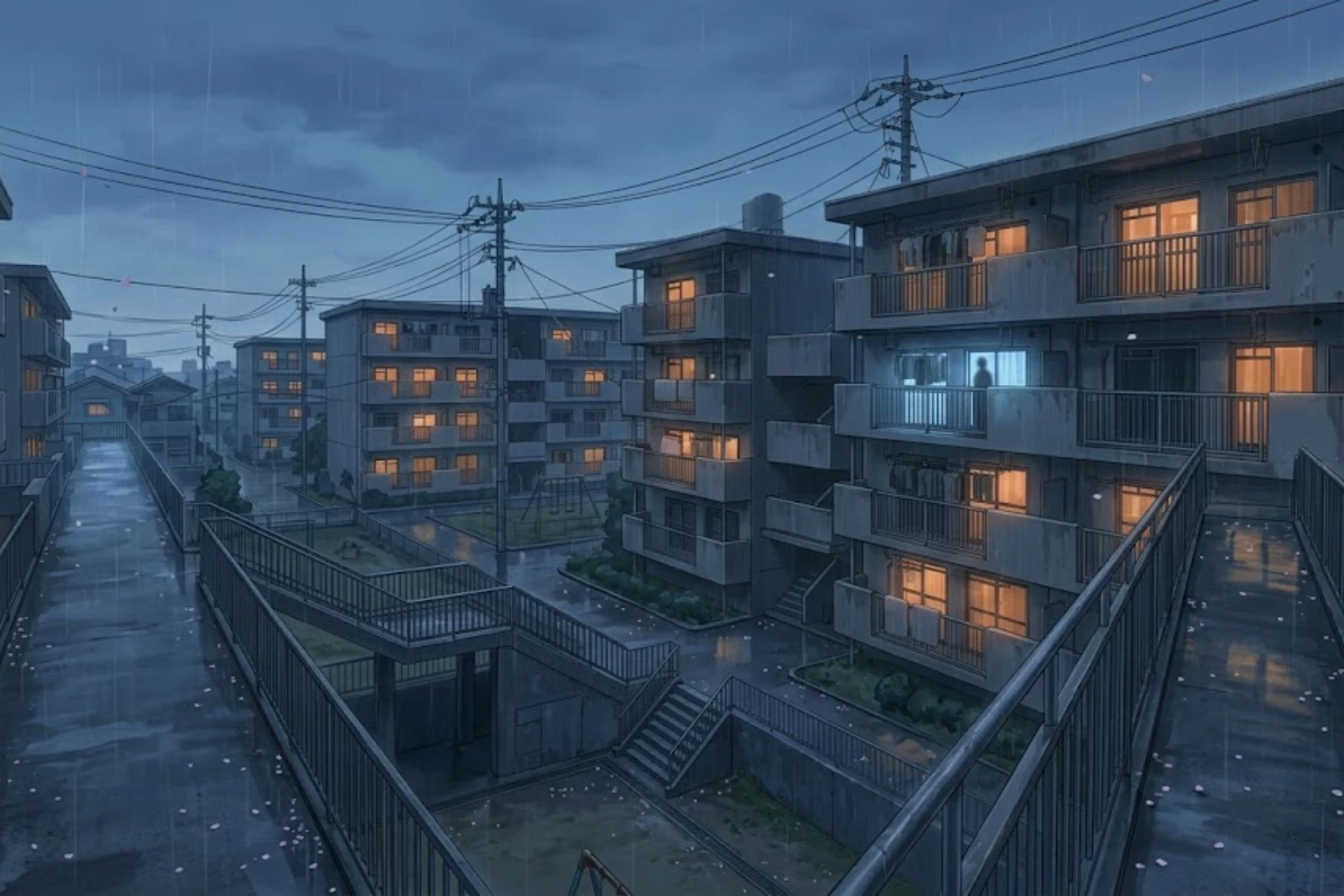
Sachiko met the Mori family on the day they moved in.
She lived across the hall in 4B and had lived there for eleven years, long enough to have seen six families come and go from 4A and to have developed the mild, uninvested interest in new neighbors that came from having done this many times. She brought a small plant — she always brought a small plant, it was a finite gesture that communicated welcome without implying ongoing obligation — and knocked on a Sunday afternoon in early April.
The mother, Rie, answered the door with the expression of someone in the middle of too many things simultaneously. Late thirties, capable-looking, the kind of tired that came from moving and from doing it alone and from the particular effort of maintaining forward momentum when several other things were pulling sideways.
Two children behind her: a boy of about fourteen whose name turned out to be Sota, and a girl of perhaps ten named Ami. Both in the process of carrying boxes to rooms in the back.
"Thank you," Rie said, taking the plant with genuine warmth. "That's very kind. We're still—" she gestured at the apartment behind her, which had the organized chaos of a move in progress.
"Of course," Sachiko said. "I just wanted to say welcome. I'm 4B, just across."
"Sachiko-san," Rie said, reading the card on the plant. "Thank you. Truly."
They exchanged numbers the way neighbors did — with the understanding that it was a formality that occasionally became useful — and Sachiko went back to her apartment and thought no more about the Mori family for several weeks.
The first time she noticed something was in May.
She had run into Rie in the elevator — a Tuesday evening, both of them returning from work at the same time — and they had done the elevator conversation, which was brief and pleasant, and when the doors opened on the fourth floor they had walked together down the hallway to their respective doors.
Rie had paused at her door. Keys out, bag on her shoulder, the ordinary posture of someone about to go inside.
And then she had stepped slightly to the side.
Not far. Maybe eight inches. A small sideways shift, the kind of unconscious adjustment you made when someone was walking behind you and you were giving them room to pass.
There was nobody behind them.
Sachiko had looked. The hallway was empty. Just the two of them and the pale overhead light and the numbered doors.
Rie had not appeared to notice the movement. She had unlocked her door and gone inside and called something back to the children in the cheerful way of parents arriving home, and the door closed, and Sachiko stood in the hallway for a moment looking at the space where Rie had moved aside for nothing.
She thought: the bag was heavy. She shifted her weight.
She went inside.
June was warm and the building's shared laundry room was in the basement and Sachiko was there on a Saturday morning when Ami came in with a basket.
Ten years old, with her mother's capable quality expressed in miniature, and the self-sufficiency of a child who had learned to manage things. She sorted laundry with the practiced efficiency of someone who had been doing this for a while, and Sachiko folded and they talked in the comfortable way of people sharing a task — about school, about the neighborhood, about the bakery two streets over that Sachiko recommended and Ami filed away with the seriousness of someone who took food recommendations seriously.
"Do you like the apartment?" Sachiko said.
"It's okay," Ami said. "It's smaller than our old one."
"The fourth floor ones always are," Sachiko said. "The third floor has the bigger units."
"Mama says it's fine for the four of us," Ami said.
Sachiko looked at her.
"Four?" she said.
Ami looked up. Something moved across her face — not confusion exactly, more like the expression of someone who had said something and wasn't immediately sure why.
"Three," she said. "Sorry. Three of us."
She went back to sorting laundry.
Sachiko watched her for a moment. The girl's expression had settled back to its ordinary configuration, unbothered, moving on.
A slip, Sachiko thought. She was thinking of the old apartment. A different number.
She folded her towels and went upstairs.
She had dinner with the Moris in July.
Rie had invited her — genuinely, not out of obligation, in the way of someone who had identified a neighbor worth knowing and acted on it. Sachiko brought wine. The apartment was settled now, the move-chaos replaced by the organized life of a family that had found its arrangement.
It was a good evening. Rie was interesting and direct. Sota was a teenager in the way of teenagers, present but conserving energy, contributing when the conversation touched something he cared about and otherwise occupied with his phone at a level his mother periodically commented on and he periodically adjusted. Ami was fully present throughout, the way some children were — seated at the table, eating, watching the adults with the focused attention of someone gathering information.
The table was set for four.
Sachiko noticed this when she sat down — four place settings, four glasses, four sets of chopsticks laid out with the unconscious thoroughness of someone who had done it automatically. One setting had no plate of food in front of it, which Rie noticed partway through the meal and looked at for a moment with a slightly puzzled expression before collecting it without comment.
"Sorry," Rie said. "I miscounted."
"Easy to do," Sachiko said.
The conversation moved on.
But Sachiko had seen the expression on Rie's face in the moment before she collected the plate — the puzzlement, yes, but underneath it something else. Not the expression of someone who had simply miscounted. The expression of someone who had set the plate there deliberately and then couldn't remember why.
August. The hallway.
She was coming home late from a work dinner — ten thirty, the building quiet — and as she turned the corner to the fourth floor corridor she saw Sota.
He was standing outside the door of 4A in the hallway, back against the wall, arms folded, the posture of someone waiting. His phone was in his pocket. He wasn't doing anything except standing there.
"Sota-kun," she said.
He looked up. The expression on his face resolved from somewhere else into the ordinary present.
"Sachiko-san," he said. "Hi."
"Are you locked out?"
"No," he said. He held up his keys. "Just — getting some air."
She looked at him. Fourteen years old, standing in a corridor at ten thirty at night because he was getting air.
"Is everything okay?" she said.
"Yeah," he said. "It's fine. I just needed—" He stopped. Looked at the door of the apartment. "It gets a little crowded in there sometimes."
She looked at the door.
"Crowded," she said.
"It's a smaller apartment," he said. "Than we're used to."
"Of course," she said.
She went to her door and unlocked it and went inside and stood in her own hallway and thought about what he had said. A little crowded. Three people in an apartment that was smaller than they were used to but not small — she had seen the layout, two bedrooms, a reasonable living space.
Not crowded.
She started paying attention.
Not obsessively — she was a practical woman, she had a full life, she was not the kind of person who invented problems. But she paid attention, in the peripheral way of someone who had noticed a pattern and was watching to see if it continued.
It continued.
September: she passed Rie in the corridor and watched her walk to her door and pause before opening it, head tilted slightly, the posture of someone listening for something on the other side. Not the cautious listening of someone worried about safety — a different quality. The expectant listening of someone who knew what they were going to hear and was waiting for it. The pause lasted perhaps three seconds and then Rie opened the door normally and went inside.
October: she ran into Ami in the elevator and the girl was talking. Not on a phone — no phone visible, no earbuds. Speaking quietly toward the corner of the elevator as the floors passed, finishing a sentence that Sachiko caught the end of — something about school, about a test, the ordinary content of a child's day — and then stopping when she saw Sachiko and smiling and saying hello with the perfect normalcy of a ten-year-old in an elevator.
November: she was returning a book she had borrowed from Rie and knocked and Sota answered and she heard, clearly, from somewhere in the apartment behind him — the living room, by the direction — Rie's voice saying something, a complete sentence, followed by a pause of the length that followed a complete sentence when someone was waiting for a response.
Then another pause.
Then Rie saying something else, in the tone of someone receiving an answer.
"Is your mom on the phone?" Sachiko said.
Sota looked back at the apartment. "I don't think so," he said.
She came for dinner again in December.
The table was set for four again. This time nobody collected the extra setting. It sat there throughout the meal, empty, with the unremarkable quality of something that had always been there and therefore required no explanation.
Sachiko watched the family.
They were — fine, was the word she kept returning to, and it kept failing to feel complete. Rie was engaged and warm. Sota had loosened up over the months, was more present, contributed to the conversation with the dry humor of a teenager who had decided the adults were worth talking to. Ami was Ami — attentive, serious, funny in the sideways way of children who had their own logic.
They were fine.
And over dinner she saw it seven times.
Sota pausing mid-sentence and glancing toward the kitchen, where nobody was, before continuing.
Rie saying we were thinking and then stopping and saying I was thinking without explaining the correction.
Ami reaching across the table for the soy sauce and shifting her arm slightly to move around something that wasn't there.
Rie laughing at something and turning to share it with — nobody, the empty place setting, before turning back.
Sota moving his chair an inch to the left when he sat down, the way you moved to give someone room.
Rie asking does anyone want more and waiting one beat longer than three people required before getting up.
Ami, at the end of the meal, collecting the plates and then looking at the empty setting for a moment with a small frown that cleared before anyone noticed it.
Seven times.
Sachiko noticed all seven and said nothing and ate her dinner and talked about the neighborhood and the bakery and the new year coming.
She heard them arguing in January through the wall.
Not the words — the walls were thick enough for that — but the rhythm of it, the shape of a serious conversation that had become a disagreement. It went on for perhaps twenty minutes and then went quiet.
She saw Rie in the elevator the next morning.
Rie looked tired in a new way — not the move-tired of April or the working-parent-tired of the months since. The tired of someone who had spent the night thinking about something unresolvable.
"Are you alright?" Sachiko said.
Rie looked at her. Considered.
"Sota thinks it's a woman," she said. "Our age. Lived there before us." She paused. "Ami thinks it's a child. She said that last week and I don't know why she thinks that. Sota said that made no sense." She looked at the elevator doors. "I told them they were both imagining things."
"And what do you think?" Sachiko said carefully.
Rie was quiet for a long moment.
"I think," she said, "that there are three of us in that apartment." She said it with the deliberate flatness of someone saying something they had decided to say plainly rather than not say. "And I think whatever it is, it isn't—" She stopped. "It isn't bad. I don't feel afraid. I just feel—"
"Crowded," Sachiko said.
Rie looked at her.
"Yes," she said. "Exactly that."
The elevator opened on the ground floor and they went their separate ways and Sachiko walked to the station in the January cold thinking about the table set for four and Ami talking to the corner of the elevator and Sota standing in the corridor saying it gets a little crowded sometimes.
February. She knocked on 4A on a Sunday with no particular reason — she had made too much soup, she said, which was true and also convenient.
Rie let her in and she stood in the living room while Rie went to get a container for the soup.
The apartment was Sunday-quiet. Sota's door was closed. Ami's door was open a crack, music audible.
Sachiko stood in the living room.
She looked at the couch. At the chairs. At the arrangement of things — the books on the shelf, the cups on the low table, the shoes by the door.
Four pairs of shoes.
She counted again.
Rie's shoes. Sota's shoes. Ami's smaller ones. And a fourth pair — adult, medium-sized, nondescript, positioned with the same casual belonging as the other three. She looked at them for a long time.
Rie came back with the container.
Sachiko looked at the shoes and then at Rie and Rie followed her gaze to the shoes and looked at them and the expression that moved through her face was the one Sachiko had been trying to name since May — the one that wasn't quite confusion and wasn't quite recognition, the one that lived in the space between knowing and not knowing and had stopped finding that space uncomfortable.
"Thank you for the soup," Rie said.
"Of course," Sachiko said.
She went back to her apartment and sat at her kitchen table and looked at the wall that separated her apartment from 4A.
She thought about the shoes.
She thought about whether to say something — to Rie, about the shoes, about all of it, about the pattern she had been watching for ten months. She ran the conversation in her mind. I've noticed that your family seems to be— No. There's something about the apartment that— No. I think you should consider—
What would she say they should consider.
Moving, maybe. Except she had no reason to give them that wouldn't sound like the specific kind of thing a neighbor said when they had been watching you too closely for too long.
She thought about whether what she had observed was harmful.
She thought about the fourth pair of shoes, positioned exactly like the other three. Belonging. Unremarkable.
She thought about the family she had been watching for ten months — Rie, capable and warm. Sota, becoming himself. Ami, serious and funny and ten years old. All of them fine, by the measures she had available. Functioning. Living their lives, going to school and work and the bakery two streets over, having dinner and arguments and Sunday mornings.
All of them, also, quietly and completely and without apparent distress, making room.
She sat at her table for a long time.
In April it would be a year since they had moved in.
She did not know what to do with what she knew, and she thought perhaps that was the truest thing about the situation — that there was nothing to do, because nothing was happening, because a family was living in an apartment and setting four places at a table and moving aside in hallways for reasons none of them could fully explain, and they were fine, and the fourth pair of shoes was by the door, and the wall between her apartment and theirs was thick enough to muffle words but not rhythm, and she was sitting here on a Sunday in February listening to the quiet of a building where six people were going about their lives.
Six.
She looked at the wall.
She got up and made tea and did not think about what she had just thought, and the afternoon went on, and the building was quiet, and next door the Mori family moved through their Sunday in the careful, practiced way of people who had learned, without knowing they had learned it, to share their space.


.png)
.png)
.png)