%20(1).png)
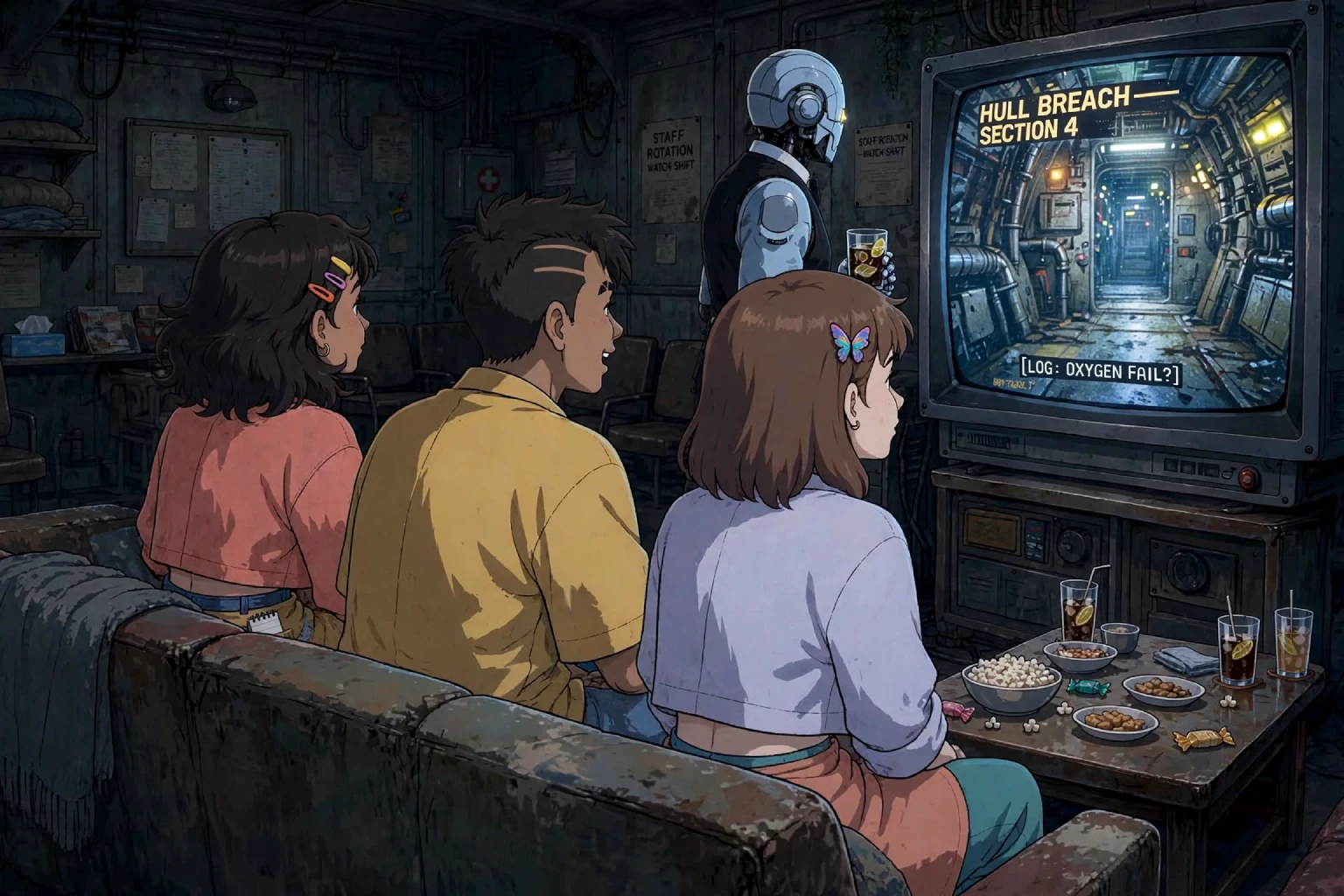
It was Dani's idea, which surprised absolutely nobody, since most of the ideas that turned an ordinary quiet night into something else started with Dani and ended with everyone else being talked into it before they'd fully agreed to anything.
“We should do something tomorrow night,” she said, wiping down the last of the counter while Nari stacked chairs behind her. “Dinner should be quiet enough afterward that we can actually get almost everybody in the same room for once.”
"It happens every few months," Sena said, from the register.
"It happens rarely enough that we should do something with it. Movie night. Common room. All of us, actual chairs, actual snacks, not just whoever happens to wander through on their break."
"We do movie nights."
"We do movie nights where four people show up and two of them fall asleep before the halfway mark. I mean a real one. Everybody there on purpose." Dani straightened up, energized by the idea in the specific way she got energized by most ideas, right up until the moment they became somebody else's problem to execute. "Tomorrow. Common room. I'll tell Chef and Sol. You tell Stirling. Somebody tell Ivo."
"I can hear you," Ivo said, from the far end of the counter, where he'd been restocking napkin dispensers. "I'm right here."
"Then you've been told," Dani said, entirely unbothered, and that was, more or less, how the whole thing got decided, which was to say it wasn't really decided so much as declared, and everyone simply arranged their evening around it the way they generally arranged things around Dani's declarations.
The following evening, once the last of the dinner rush had cleared and Nari had promised to keep an eye on the counter for the handful of late stragglers who might still wander in, most of the staff drifted, in ones and twos, toward the common room at the far end of the station's older section — the room that had been an observation lounge once, back before anyone currently working the restaurant had been born, and was now mostly just the place things happened when the restaurant itself wasn't the right shape for them. Tomas had already gotten there first, on the grounds that the light panels needed convincing before anyone else showed up to sit under them.
"It's doing the thing again," he announced, to nobody in particular, tapping the panel above the media terminal with the flat of his hand. The lights flickered, steadied, flickered again, and then, after a final, more forceful tap, settled into an even glow across the room. "There. That's the relay. Every few months it forgets how to behave."
"You'd think a station this size could afford a new relay," Sena said, coming in behind him with a stack of cushions borrowed from the restaurant's back room.
"You'd think. I've put in the request four times. I'll put it in a fifth time next month, and it'll get exactly as far as the last four requests, which is nowhere." Tomas gave the panel one more affectionate tap, like he was thanking it for its cooperation. "Anyway. Lights work. Terminal's up. Somebody just needs to actually pick something."
That, as it turned out, was going to be the hard part.
The media terminal itself was an old, boxy thing bolted into the corner, hooked up to a storage drive that had been filling up for years with whatever films and shows passing traders had swapped for fuel credits or a good meal, a haphazard archive with no organizing principle beyond whatever anyone had felt like adding at the time. Some of it was recent. A lot of it wasn't. All of it was, in Tomas's professional opinion, "roughly forty percent likely to actually play," a statistic he offered with the weary authority of someone who'd spent more evenings than he'd like fighting with corrupted files and mismatched formats.
Dani got there not long after, arms full of blankets she'd apparently decided the room required, and set about arranging the chairs into something resembling a proper viewing configuration, which mostly meant dragging two of the better armchairs into the front row and relegating the folding chairs to the back with visible disdain.
"Somebody's going to complain about the folding chairs," Ivo said, arriving with a box of snacks under one arm.
"Somebody can sit in the good chairs if they get here early enough. That's just fairness."
"That's just you wanting the good chair."
"Those are not mutually exclusive," Dani said, already claiming one of the armchairs by draping a blanket over it, a gesture with all the legal weight of nothing at all but which she clearly intended to treat as binding.
Sol came in with Chef a few minutes later, the two of them carrying between them a tray of something warm and savory that had, from the smell of it, started life as a restaurant order and been quietly repurposed once the kitchen closed for the night — small fried things, a bowl of something with cheese, a plate Sol set down with the brisk efficiency of someone who considered snacks a logistical problem rather than an occasion for enthusiasm.
"You didn't have to cook," Sena said.
"Wasn't cooking. Was using up what was already going to go bad by tomorrow," Sol said, which Sena recognized, by now, as Sol's standard explanation for any act of unrequested kindness, offered in a tone that discouraged further comment.
Chef set down a second plate beside it without saying much of anything, which was, from Chef, a perfectly normal contribution to the evening, and took one of the folding chairs near the back without complaint, on the grounds, he said when Dani gestured at the empty armchair, that he could see the screen fine from anywhere in a room this size and didn't need cushioning to prove it.
Stirling arrived last, carrying a tray of drinks he had clearly spent considerably more thought on than the occasion strictly required, glasses of something he'd mixed specifically for the evening rather than simply carrying over from the bar.
"I have prepared beverages appropriate to a communal viewing," he announced, setting the tray down on the nearest table with evident satisfaction. "Nothing so involved as to distract from the film, but suited to the mood of the evening nonetheless."
"You made cocktails for movie night."
"I made appropriate refreshments for movie night," Stirling corrected. "There is a difference, though I concede it is a subtle one."
"There's no difference, Stirling. That's a cocktail."
"It is a modest, contextually sensitive beverage," Stirling said, entirely unmoved, and took up a position near the terminal with the air of someone who considered himself, by virtue of having arrived with drinks, at least partially responsible for whatever happened next, which turned out to be an accurate assessment of how the rest of the evening would go.
With everyone more or less assembled, Dani clapped her hands together with the particular energy of someone about to enjoy herself considerably more than the task warranted. "Okay. Movie. What are we thinking?"
"I vote for something with an actual story," Nari said, poking her head in from the doorway — the restaurant was quiet enough that she could slip away for twenty minutes, provided she checked back periodically for any late arrivals, and clearly intended to make the most of her window before duty called her back. "Not one of those old adventure serials where everybody just runs around a cave for two hours."
"The cave one is a classic," Ivo said.
"The cave one is forty minutes of somebody's flashlight beam bouncing off rock walls."
"That's called atmosphere."
"That's called a lighting budget," Nari said, and Ivo, unable to argue with this assessment on its merits, subsided with the mild grace of someone who'd lost this particular round before but fully intended to bring it up again later.
Dani was already scrolling through the terminal's messy file list, narrating options as she went with the enthusiasm of someone trying to sell the room on each one before anybody had a chance to object. "Okay, we've got — ooh, we've got that one with the desert chase, the one with the really long car sequence—"
"Vetoed," Sol said, without looking up from the snack tray.
"You haven't even seen it."
"I've seen enough car chase movies to know what happens in the ones with a really long car sequence. Cars go fast, something explodes, everybody cheers. I don't need two hours of that."
"That's reductive."
"It's accurate," Sol said, unbothered, and Dani, muttering something about philistines, scrolled onward.
"What about the one with the singing competition? The one everybody was talking about a while back."
"Absolutely not," Chef said, from the back row, with more immediate conviction than he'd shown about anything else all evening.
"You don't even know which one I mean."
"I know it has singing in it. That's the entire relevant information," Chef said. "I don't need two hours of people bursting into song about their feelings. If people have feelings, they can say them like regular people. Singing about it is a stall tactic."
"That's a very specific and aggressive opinion for something you claim not to care about."
"I have opinions. I just don't have many of them," Chef said, which Sena had learned, over the years, to recognize as roughly as close as Chef ever came to admitting he cared about something, and the singing movie was accordingly struck from consideration without further debate.
"Okay," Dani said, undeterred, scrolling further. "What about the space one? The really long one, with the ships, the one everybody says is a classic."
"Which classic space one? There's about six of those on the drive, all mislabeled," Tomas said, leaning over her shoulder to squint at the screen. "Half of them are actually the same three movies with different file names, because whoever traded them clearly didn't believe in consistent labeling."
"The one with the good poster. You know the one."
"That doesn't narrow it down even slightly, Dani."
"It's got the ship on the cover, with the — the sort of dramatic lighting—"
"They all have dramatic lighting on the cover. That's what space movie covers are," Nari said, drifting further into the room now that she'd apparently decided her twenty minutes could stretch a little longer than promised. "You're describing the entire genre."
"Fine. I'll find it myself," Dani said, and commandeered the terminal outright, scrolling with the increasingly focused intensity of someone determined to prove a point nobody had actually challenged.
While she searched, the argument branched out in several directions at once, the way these things always did once more than three people got involved. Ivo lobbied, without much hope of success, for an old comedy he'd apparently watched a dozen times as a kid, which Nari dismissed on the grounds that anything Ivo had watched a dozen times as a kid was probably aimed at people considerably younger than the room's average age, a charge Ivo protested with more heat than the accusation strictly warranted.
"It's not a kids' movie. It's just — accessible."
"It's got a talking animal in it, Ivo."
"One talking animal. That doesn't automatically make it a kids' movie."
"It's the main character."
"I still don't think that's disqualifying," Ivo said, with the stubbornness of someone defending a position he knew, deep down, was probably lost, and Nari, grinning, let the argument drop rather than press an advantage she clearly already had, because there was something almost fond in the way she kept teasing him about it rather than simply overruling him outright.
Sena, meanwhile, had taken up a spot on one of the folding chairs near Chef, mostly content to let the argument run its course without inserting herself into it too heavily, offering the occasional practical observation whenever the debate threatened to spiral entirely out of anyone's control.
"Whatever we pick," she said, at one point, "let's make sure it's actually under two hours. We all still have work in the morning."
"This from the woman who let the theater troupe rehearse in here until nearly midnight," Tomas said.
"That was a special occasion. This is a Tuesday."
"Every night's a special occasion if you frame it right," Dani said, from the terminal, without looking up, which Sena chose not to dignify with a response.
Stirling, for his part, had been quietly working his way through the file list from the other side of the terminal, offering suggestions with a formality that made even the most ordinary title sound like a significant cultural event.
"I would propose," he said, "the historical drama. The one concerning the shipping dispute and the trial that followed. I understand it to be considered a work of some depth."
"That sounds like homework," Dani said.
"It is widely regarded as an important film."
"It sounds like homework with better lighting."
"I do not believe those qualities are mutually exclusive," Stirling said, echoing, without apparently noticing it, the exact defense he'd offered earlier about his drinks, which made Sena, catching the parallel, laugh out loud for the first time that evening.
"What?" Stirling asked, mildly affronted. "What have I said that is amusing?"
"Nothing. You're being very consistent tonight, that's all."
"I consider consistency a virtue," Stirling said, apparently satisfied by this explanation, and returned his attention to the file list without further comment, though he did, a moment later, quietly move his historical drama suggestion further down his own personal list of preferences, as if conceding, privately, that the room's appetite for homework-with-better-lighting was probably limited.
The argument went on like that for a while, drifting through genres and half-remembered titles, snacks getting steadily depleted, drinks getting refilled, the room's energy loose and unhurried in the specific way an evening got when nobody was actually in a rush to solve the problem they were nominally trying to solve. Nari's twenty minutes at the counter turned into closer to forty before she finally excused herself to go check on things properly, promising to be back before anyone actually picked something, a promise met with general skepticism given how the last half hour had gone.
"You say that like we're close," Ivo said.
"I have faith in you all," Nari said, already halfway out the door, and left the argument to continue without her, which it did, with undiminished enthusiasm and no closer to resolution than it had been forty minutes earlier.
Dani, having failed to locate her mystery space movie under any of its several possible names, finally gave up the terminal to Sol, who approached the problem with considerably less romantic attachment to any particular option and considerably more interest in simply narrowing the field.
"How about we do this properly," Sol said, scrolling with brisk efficiency. "Everybody names one thing. We try to load all of them. Whatever actually plays without falling apart, we watch that one. Saves us another hour of arguing about movies that might not even work on this terminal anyway."
"That's actually reasonable," Sena said.
"I have my moments," Sol said, and the room, mildly surprised to find itself suddenly organized, went along with it, each person offering up their pick in turn while Sol queued them for testing — Dani's mystery space epic, once she'd finally tracked it down by process of elimination; Nari's returning vote for the story-driven drama she'd mentioned earlier, texted in from the counter when Ivo went to ask her; Ivo's talking-animal comedy, offered with the resigned expectation of being outvoted again.
Chef's single, terse contribution, an old detective picture with no singing whatsoever, which he specified twice just to be sure; Stirling's historical drama, offered once more despite his earlier private demotion of it; and Tomas's own pick, a survival drama about a stranded engineering crew that he swore, with the enthusiasm of a man defending a genuinely underappreciated favorite, was better than anyone gave it credit for.
"That's six movies," Sol observed. "This drive's not going to make this easy."
It didn't. Dani's space epic loaded for nearly a full minute before freezing entirely on a badly compressed frame of somebody's face mid-shout, which Tomas diagnosed, after a few seconds of tapping at the terminal, as a corrupted file that had probably been corrupted since whoever originally traded it for the archive.
"That's the one you spent twenty minutes finding," Ivo said.
"I noticed, thank you," Dani said, with the particular betrayal of someone let down by a project she'd invested real effort in, and watched, arms crossed, as Sol moved on to the next title.
Nari's drama fared no better, stalling almost immediately on a loading screen that simply refused to progress no matter how many times Tomas cycled the terminal's power, and Chef's detective picture turned out to be missing its second half entirely, cutting off mid-scene in a way that made the whole file essentially useless even if the first half had played fine.
"Somebody traded us half a movie," Chef said, with the flat disapproval of a man who considered this a personal insult.
"Somebody traded us half a lot of things, apparently," Sol said, unbothered, and kept working through the list.
Ivo's comedy actually loaded, to general surprise, but stuttered so badly every few seconds that watching more than five minutes of it felt like a form of low-grade punishment, a verdict Nari, back from the counter just in time to catch this development, delivered with entirely too much satisfaction for someone who'd already had her own pick eliminated moments earlier.
"See," she said. "Kids' movie. Cursed by the universe itself."
"That's not what cursed means," Ivo said, "and also that's not fair, since your movie didn't even make it past the loading screen."
"At least mine failed with dignity. Yours is actively suffering."
Stirling's historical drama made it further than most, playing cleanly through what turned out to be nearly ten minutes of dense legal exposition before the room, almost as one, silently agreed without a word being spoken that this was probably not the evening for it, an agreement Stirling accepted with visible, if slightly wounded, grace.
"I understand," he said. "It is, I will concede, rather a lot of shipping regulation to absorb before the plot properly begins."
"It's not that it's bad," Sena said, gently. "It's just a lot, for a Tuesday."
"I accept the distinction," Stirling said, and did not argue further, though he did, notably, leave the file paused rather than closed, as if reserving the option to revisit it on some more suitably serious future evening.
That left Tomas's survival drama, which loaded cleanly, ran for a full two minutes without incident, and then abruptly cut to black with an error message none of them had ever seen before, one that Tomas stared at for a long moment with the expression of a man personally wounded by a piece of station hardware.
"That's never happened before."
"You're sure?"
"I've watched this one probably eight times. Never once done that." He tried restarting it. The same error appeared, patient and unmoved. "I think the file's just finally given up. It's old. We've been running it off the same corrupted stretch of drive for years, probably. It was bound to happen eventually."
"So that's everybody's pick eliminated," Dani said, with the particular flatness of someone watching an entire evening's planning collapse in real time. "We spent an hour arguing over six movies, and none of them actually work."
"Technically true," Sol said, still scrolling. "Though there's still stuff on here nobody actually suggested. We just tried the ones people wanted. There's a whole rest of the drive."
"None of it's going to work either. Look at the track record tonight."
"Won't know until we try," Sol said, with the stubborn practicality of someone who'd rather test one more option than sit around debating the hopelessness of the situation, and scrolled to the bottom of the file list, past the recognizable titles into the stretch of poorly labeled, half-forgotten files nobody had bothered with in years — filenames that were mostly just strings of letters and numbers, the detritus of trades made so long ago nobody remembered what half of it even was.
"There's no way any of that plays if the good stuff didn't," Tomas said.
"Some of the old stuff's actually more stable," Tomas himself admitted, a beat later, reconsidering. "Older compression. Less likely to be corrupted the same way. Worth a shot, honestly."
Sol selected one at random, mostly, she admitted, because its filename was slightly less cryptic than the others around it, something that at least resembled an actual title rather than a jumble of characters. Nobody in the room recognized it. Nobody had proposed it, argued for it, or expressed any opinion about it whatsoever, on the grounds that nobody had known it existed until roughly four seconds earlier.
It loaded. It played. The picture was a little soft around the edges and the sound came in slightly out of sync for the first minute, but it ran, steadily, without error, without freezing, without any of the ominous behavior that had doomed every previous attempt that evening.
"Well," Dani said, after a long moment of watching the opening credits roll over a shot of some very dated-looking spaceport, "I guess this is what we're watching."
"Nobody picked this," Ivo said.
"Nobody picked any of the ones that worked. That's sort of the theme of tonight," Nari said, settling into the chair beside him with a fresh drink, and the room, having exhausted every other option available to it, more or less accepted the situation and settled in properly, the argument finally, mercifully, over.
The movie itself turned out to be some kind of low-budget salvage adventure, decades old by the look of its effects, following a scrappy crew of freight haulers who stumbled onto a derelict ship full of complications considerably beyond their pay grade. The dialogue was stilted in the specific, charming way of old low-budget productions, the special effects were unconvincing even by the generous standards of the era, and the lead actor delivered every single line, regardless of the emotional stakes involved, with exactly the same flat, mildly startled expression.
"He's shocked that the ship's on fire," Dani observed, twenty minutes in. "He was equally shocked five minutes ago that there was cargo in the cargo hold."
"Maybe he's just an expressive minimalist," Ivo said.
"Maybe he only had one facial expression and the studio didn't have the budget to fix it."
"That's the same theory, phrased less generously."
"It's the more accurate phrasing," Dani said, and took another handful of snacks, apparently having transitioned, somewhere in the last few minutes, from disappointed that her own pick had failed to fully invested in the accidental substitute, a transition Sena noted with quiet amusement but did not comment on.
Chef, against all earlier evidence of his preferences, turned out to find the movie's earnest, low-budget sincerity more or less to his taste, offering the occasional dry observation about the crew's clearly nonexistent safety procedures that got a laugh out of Sol every time, the two of them settled comfortably at the back of the room with the ease of people who'd worked side by side long enough that companionable silence and the occasional muttered joke suited them just as well as actual conversation.
"That valve's been leaking for the entire movie," Chef said, at one point, nodding toward the screen. "Nobody's fixed it. Nobody's even mentioned it. It's just leaking."
"Probably budget didn't cover a competent engineer character," Sol said.
"Or they just didn't think about it."
"Same thing, in the end," Sol said, and they went back to watching without further comment, the leaking valve apparently destined to remain unaddressed for the rest of the film's run time.
Stirling, meanwhile, watched with the intense, formal focus of a man determined to take the material seriously regardless of its evident shortcomings, occasionally offering an observation about the crew's decision-making that treated the film's low-budget plotting with the same gravity he'd have given the historical drama.
"That was an unwise choice," he said, when the crew opted to explore the derelict's lower decks without any apparent safety protocol whatsoever. "I would not have proceeded without a proper survey first."
"It's not real, Stirling."
"I understand that it is not real. I am simply observing that the characters are behaving with insufficient caution, which strikes me as worth remarking upon regardless of the fictional nature of the circumstances," Stirling said, entirely serious, and the room, by now well used to this particular quality of Stirling's, let the observation stand without further argument, because arguing usually only encouraged him.
Ivo, half-slouched in one of the folding chairs with Nari beside him, found himself laughing more than he'd expected to at a movie he hadn't chosen, hadn't heard of, and had spent the last hour assuming would be some kind of consolation prize compared to whatever anybody had actually wanted to watch. There was something almost freeing about it, he thought, watching a movie nobody had staked any real pride on, nobody defending it or getting precious about whether it lived up to expectations, everybody free to just enjoy it or mock it in equal measure without anybody's feelings being on the line.
"This is somehow better than if we'd picked it on purpose," he said, mostly to Nari, though loud enough that a few others caught it too.
"Because nobody's precious about it," Nari said, as if she'd been thinking the exact same thing. "If this were Dani's pick, she'd be defending every plot hole like it was a personal insult to question it."
"I would not," Dani said, without turning around.
"You absolutely would."
"I would defend it reasonably," Dani amended, which settled the matter roughly as well as anything settled with Dani, and the movie went on, the crew of the derelict ship stumbling from one poorly explained crisis to the next while the room around them grew steadily looser, snacks disappearing, drinks refilled once more by Stirling with the same quiet ceremony he'd brought to the first round, chairs shifting as people traded seats or stretched out or, in Sena's case, ended up sharing a single folding chair's worth of space with Tomas after the room's actual seating arrangement had degraded into something considerably less orderly than Dani's original vision.
Nari drifted out once more, briefly, to check the restaurant, and came back a few minutes later reporting that everything was still quiet. Two late travelers had stopped in after the kitchen closed, so she had let them know when breakfast service started and pointed them in the right direction for the morning.
By the time the movie reached its climax — a confrontation between the crew and whatever malfunctioning system had been menacing the derelict ship, resolved through a solution so mechanically implausible that Tomas actually groaned out loud — the room had settled into the particular loose, comfortable quiet of a group that had stopped watching for quality and started watching purely for the pleasure of being in the same room together while something played in front of them.
"That's not how power conduits work," Tomas said, watching the resolution unfold with visible professional offense. "That's not how any of that works."
"It's a movie from decades ago about people who don't exist," Sol said.
"I know it's not real. I'm still allowed to be bothered by the physics."
"You're allowed. It won't change anything," Sol said, not unkindly, and Tomas subsided, muttering something about conduit safety standards that nobody bothered to follow up on.
The credits rolled a little after that, over another shot of the dated spaceport, accompanied by a swelling orchestral score that clearly believed it had just witnessed something considerably more significant than what had actually happened onscreen, and the room, by unspoken consensus, let it run through to the very end rather than cutting it off early, nobody quite ready yet to break the particular comfortable stillness the evening had settled into.
"Well," Dani said, once the screen had finally gone dark, "that was terrible."
"It was pretty terrible," Ivo agreed.
"I loved it," Dani said, with no apparent contradiction registering between those two statements. "We should watch the sequel, if there is one."
"There's no way there's a sequel to that," Nari said.
"There's always a sequel to something like that. Somewhere on this drive, probably mislabeled as something completely unrelated."
"That sounds like a project for next time," Sena said, standing and starting to gather the empty snack plates, the general signal that the evening, whatever shape it had taken, was drawing toward its natural end.
"Next time we should actually agree on something beforehand," Tomas said, helping stack chairs back against the wall.
"We tried that tonight. Look how it went."
"We tried arguing about it beforehand. That's different from agreeing," Tomas said. "Maybe next time we just skip straight to Sol's method. Saves an hour."
"Where's the fun in that," Dani said, already halfway to folding up her claimed blanket, though without any real conviction behind the objection, since even she seemed to recognize, looking back on the evening, that the hour of arguing had been at least as enjoyable as the movie that eventually resulted from it.
Chef and Sol left first, carrying the empty trays back toward the kitchen with the unhurried efficiency of two people who'd close out most nights together regardless of what had come before, Stirling not far behind them with his own tray of empty glasses, still discussing, quietly, with anyone who'd listen, the relative merits of a proper follow-up viewing of the historical drama on some future, more suitably serious evening.
Ivo helped Sena stack the remaining chairs, the two of them working through the room in comfortable, unhurried quiet, the light panels holding steady now that Tomas had gotten them settled for the night.
"Good evening," Ivo said, mostly to himself, though Sena caught it anyway.
"Good evening," she agreed. "Even if nobody actually picked the movie."
"Maybe that's why it worked," Ivo said, not quite sure himself what he meant by it, and didn't push the thought any further, content instead to finish stacking the last of the chairs and follow the others back out of the old observation lounge, the lights dimming behind them section by section as Tomas cycled the panels down for the night, the room settling back into its ordinary quiet until whatever the station's next occasion for it turned out to be.


.png)
.png)
.png)