%20(1).png)
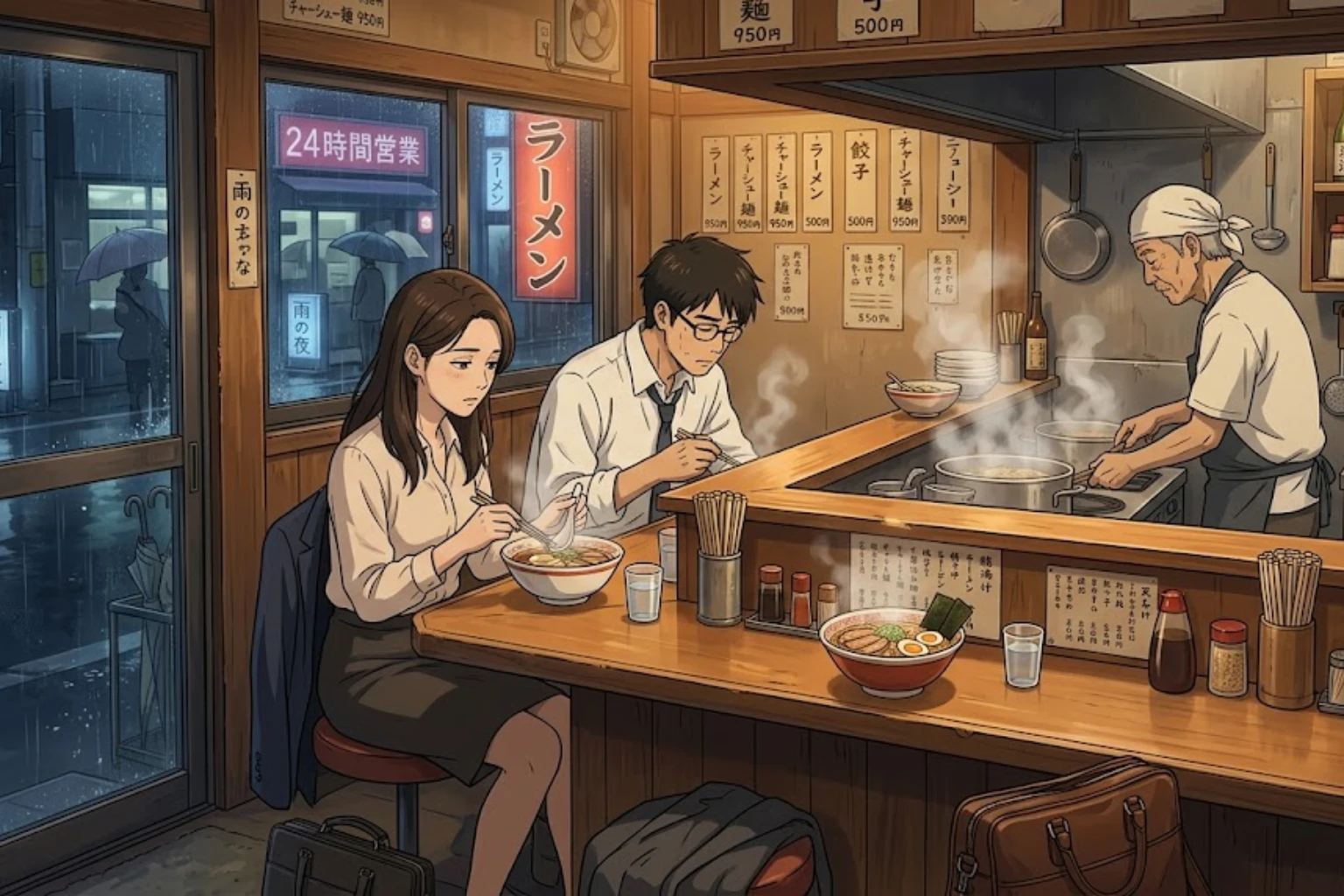
The sign said OPEN in red neon, and Yoshi had been looking at it from across the street for almost a minute before he made himself move.
It was twelve forty in the morning. The last train had left Shibuya station four minutes before he reached the platform, which was long enough to watch the doors close from the top of the stairs and short enough to make the whole thing feel personally insulting. He had considered a taxi for about ten seconds before remembering what a taxi across the city cost at this hour, and had started walking instead, mostly to think.
He was hungry. That was the part that decided things.
The rest of the street had already closed for the night — shutters down, a convenience store glowing at the far corner, a vending machine humming to itself outside a shuttered pachinko parlor. The ramen shop was the only thing on the block still lit, and the smell reached him before he'd even crossed the street, pork bone broth and something faintly sweet underneath it, the kind of smell that made arguing with yourself pointless.
He pushed open the door.
The shop was small — six stools at a single counter, no tables, the kind of place built for people eating alone or people who didn't mind sitting close to strangers. The counter itself was dark wood, worn pale at the edges where hands and elbows had rested on it for probably thirty years. Behind it, the kitchen was open to view: two gas burners, a large pot at a steady simmer, steam rising into the low light.
The man working the counter looked to be somewhere past sixty, moving with the unhurried economy of someone who had made the same broth in the same pot for more nights than he could easily count. He glanced up when Yoshi came in, nodded once, and went back to what he was doing. No greeting, no small talk. It seemed like the correct amount of attention for a customer at quarter to one in the morning.
One other seat was occupied.
A woman sat three stools down, closer to the far wall, wearing a blazer that had clearly started the day pressed and was no longer particularly interested in being pressed. Her hair had come slightly loose from whatever it had been pinned with. Both hands were wrapped around a glass of water like she was warming them on it, though the shop wasn't cold. Her phone sat face-down on the counter beside her, untouched.
Yoshi took the seat two down from her — close enough to be normal, far enough to not seem like he was making a decision about it.
The counter man set a glass of water in front of him and placed a short laminated menu beside it without a word.
"Tonkotsu," Yoshi said. "Regular noodles."
The man nodded and disappeared toward the burners.
For a while there was just the sound of the broth working, and somewhere outside, very faint, a delivery truck idling before it pulled away. Yoshi drank his water and let his shoulders come down from wherever they'd been sitting since the meeting that had made him miss his train in the first place.
"Missed the last train?" the woman said.
She wasn't looking at him. She was looking somewhere past the counter, at the middle distance, the way people do when they're talking mostly to fill a silence rather than to start a conversation with someone specific.
"By about four minutes," Yoshi said.
"I missed mine by one."
"That's worse."
"Significantly worse," she said. "I watched it pull away. Stood right there on the platform and watched the whole thing."
"I didn't even make it to the platform."
"Then you have it easier," she said. "You get to imagine it happened cleanly. I have to live with having personally witnessed my own failure."
There was something dry in the way she said it — not bitter, just tired in a way that had curdled slightly into humor. Yoshi found himself almost smiling.
"There's something to be said for not watching," he said.
"There is," she agreed. "I'd recommend it. Ten out of ten. Don't watch your train leave."
The counter man set a bowl down in front of her — she must have ordered before Yoshi arrived — and she thanked him quietly and picked up her chopsticks, and for a minute neither of them said anything else. It wasn't an awkward silence. It was the kind two strangers can share in a small warm room at an hour when nobody expects anything from anyone.
Yoshi's bowl came a few minutes later. He ate for a while, letting the broth do what pork-bone broth at one in the morning is supposed to do, which is make you forget, briefly, about whatever bad decision brought you here.
"Do you do this a lot?" she said, eventually.
"Miss my train?"
"End up somewhere you didn't plan to be. At this hour."
He thought about it honestly instead of giving the easy answer. "Not usually, no. Tonight was more a series of small failures stacking up. A work thing ran long, and then I made two or three decisions that each seemed fine on their own."
"That's very generous phrasing for what happened to you."
"I'm an engineer. We like generous phrasing for structural problems."
That got something out of her — not quite a laugh, but the ghost of one, visible at the corner of her mouth before she suppressed it and went back to her noodles.
"Mine was one big failure," she said. "Which might actually be cleaner. Less to explain."
"What was it?"
She glanced at him sideways, like she was deciding how much a stranger at a ramen counter deserved to know.
"Work," she said. "Work-adjacent. The kind of thing that's technically after work but is still, somehow, entirely work."
"Those are the worst kind."
"They really are." She turned her water glass a quarter turn on the counter, a small habitual motion. "There was an event tonight. Client-facing, semi-mandatory, the sort where everyone stands around with a drink they're not really drinking and says the same three sentences to twelve different people."
"I know that event," Yoshi said. "I was at a version of it earlier tonight."
"Did anyone say 'just one more thing' to you forty minutes before it actually ended?"
"Twice. Same man. Different 'one more thing' each time."
"That's the exact event," she said. "Except mine had table wine that had clearly been purchased based on price rather than quality, and a senior director who would not leave first, so nobody else could leave either."
"Why does it work that way?"
"I have never understood it," she said. "Somebody senior has to leave, and everyone stands there pretending to enjoy themselves until it happens, like it's a hostage situation with better lighting."
Yoshi laughed — a short, real laugh, more surprised out of him than offered. The counter man, refilling something at the burner, glanced over briefly, the way you do when a room's temperature shifts even slightly, then went back to his pot without comment.
"So you left the event," Yoshi said, "and missed your train by one minute."
"I left the event and went back to my desk to fix one thing before I went home, and the one thing took longer than one thing usually takes, and then I ran, and I watched the train leave the platform. In that order."
"What was the one thing?"
She hesitated — not evasive, just weighing it. "It's going to sound like I'm bringing my work into a ramen shop."
"You're allowed. It's one in the morning. Nobody's grading you on topic choice."
That earned the almost-smile again, a little more of it this time.
"I work in urban development," she said. "Planning side, mostly preservation-related. There's a block of residential buildings — older ones, prewar in a couple of cases — that a developer wants to buy out and demolish. I've been trying to get a preservation case approved for four months."
"And tonight?"
"Tonight the committee pushed the decision back again. Third time." She said it evenly, like she'd practiced saying it evenly. "So I went to the mandatory drink-you're-not-drinking event, and smiled at the right people, and then went back to fix a report nobody's going to read tonight anyway, and missed my train by one minute doing it."
"That's a lot for one evening."
"It's a fairly normal evening, honestly. That's the depressing part."
The counter man appeared without being summoned and topped off her water again. He didn't say anything. It seemed to be his primary form of participation in other people's conversations — refilling things at the right moment and letting the talking happen around him.
"What kind of buildings?" Yoshi asked.
She looked at him properly this time, assessing.
"You don't have to ask," she said. "I know it's not exactly bar conversation."
"I asked because I wanted to know," he said. "Not to be polite."
"Is there a difference?"
"There's a difference," he said. "Politeness is nodding along. This is actual curiosity. I promise I'll stop you if I get bored."
She studied him for a second, like she was recalibrating something, then set her chopsticks down.
"A block near the river," she said. "Mostly two-story residential buildings, wood and plaster mostly, some brick reinforcement added later. Built between the wars, repaired after, still standing. About thirty households, a lot of them elderly, several who've been there since they were children."
"And the developer wants the land, not the buildings."
"The developer wants a fourteen-story mixed-use building where the block currently is," she said. "Which, financially, makes complete sense. It's a good location. I understand exactly why they want it."
"But."
"But the buildings aren't unsalvageable," she said. "That's my actual argument, if I ever get to make it properly. They're old, they're not glamorous, but they're not falling down. Structurally, most of them are fine. It's a fixable situation being treated like an unfixable one."
Yoshi picked up his chopsticks again, considering. "What do you do, exactly, when you say you're trying to get it approved?"
"Build a case," she said. "Historical significance, community impact, engineering feasibility for retrofit versus demolition, comparable precedents in other wards. Put it in front of a committee. Wait for the committee to decide it's easier to not decide."
"That sounds exhausting."
"It's extremely exhausting," she said, with real feeling. "It's four months of exhausting, with tonight as the most recent installment."
"What do you actually do?" she said, turning it back on him. "You said work thing too. What kind?"
"Structural engineering," Yoshi said. "Mostly renovation. Older residential buildings, some commercial. I go into buildings that look like they should be condemned and figure out whether they actually are, or whether they just look that way."
She went very still for a second, chopsticks halfway to her bowl.
"That's — " she started, then stopped, like she was deciding whether to say it. "That's almost too neat."
"The work?"
"The coincidence," she said. "I spend four months trying to convince a room full of people that old buildings can be saved, and then I miss my train, and end up at a ramen counter next to a structural engineer who renovates old buildings for a living."
"It's not a coincidence," Yoshi said. "It's a ramen shop at one in the morning. Statistically, everyone in here is in the middle of something."
She laughed at that — a real one, sudden, unguarded, the kind of laugh that arrives before a person decides whether to allow it. The counter man glanced over again, this time with something almost like approval, and returned to skimming his broth without a word.
"Fair," she said, still smiling. "Fine. Not fate. Statistics."
"Much less romantic, but more accurate."
"I'll take accurate at one in the morning." She picked her chopsticks back up. "So what does that actually mean, day to day? Going into a building and deciding whether it looks worse than it is."
"It means a lot of crawling around under floors with a flashlight," Yoshi said. "People assume that if plaster is cracked and the stairs creak, the whole building is compromised. Sometimes that's true. A lot of the time the frame is fine and the problems are cosmetic, or they're isolated — one bad beam, one section of foundation that settled unevenly. You fix that specifically instead of tearing down the whole thing."
"And sometimes it's the opposite," she said. "Looks fine, isn't."
"Sometimes," he agreed. "New paint on rotten wood is its own kind of problem. You learn not to trust surfaces either way."
"That's basically my entire job in one sentence," she said. "Don't trust surfaces either way."
"I could put that on a business card."
"You'd need a very understanding printer."
The broth on the burner behind the counter had been reduced slightly, and the counter man added water to it without looking up, an economy of motion that suggested he'd done it at exactly this point in the night for years.
"Can I ask something," Shizuka said, "and you can tell me if it's rude."
"Go ahead."
"Why renovation? You could presumably do new construction. Bigger projects, probably better money."
Yoshi took a moment before answering, turning his cup slightly.
"Probably better money," he agreed. "When I started, I actually wanted the new-construction track. Bigger sites, taller buildings, your name eventually on something people photograph."
"What changed?"
"I did a renovation project in my first year almost by accident — nobody senior wanted it, so it went to the new guy," he said. "A three-story apartment building, maybe sixty years old, in bad enough shape that the firm's first recommendation was to condemn it."
"And it wasn't?"
"The frame was solid," he said. "Some of the joinery was better than anything you'd see in a new building at that price point. The problems were fixable — bad plumbing runs, one compromised support that had been patched wrong decades earlier. Six weeks of work and the building was fine for another thirty years, easily."
"That's satisfying."
"It was," he said. "But that's not actually the part that changed my mind."
"What was?"
"There was a woman living on the second floor," he said. "Eighty-something. She'd been in that apartment for over fifty years. During the assessment, she kept coming out to ask if we were going to make her move. I kept telling her probably not, and she kept not quite believing me, because two other buildings on her street had already gone that way."
Shizuka was watching him now without eating, chopsticks resting against the side of her bowl.
"When we finished," Yoshi said, "and she didn't have to move, she brought us tea every day for a week. I remember thinking, new construction doesn't have that. Nobody brings you tea for building something from scratch. You're just — filling an empty lot."
"So you switched."
"Not immediately. It took a while to admit it to myself. Twenty-five-year-old me had a very clear list of what mattered, and it was mostly about impressive projects and moving fast and having my name on things. That woman's tea wasn't on the list."
"What's on the list now?"
He thought about that honestly instead of reaching for something clever. "I'm still working it out, if I'm being accurate. But it's less about the size of the project and more about whether the people in the building get to stay in it. That's become the actual measure, somewhere along the way."
Shizuka didn't say anything immediately. She picked her chopsticks back up, then set them down again.
"That's very close to my entire argument to the committee," she said. "Just phrased with fewer PowerPoint slides."
"You could try it without the slides sometime."
"They'd fire me for unprofessional conduct."
"Worth it, possibly."
"Debatable," she said, but she was smiling again.
The counter man refilled Yoshi's water without being asked, and set a small pot of tea between them — not quite for one, not quite for two, positioned in the ambiguous middle distance that suggested it could be shared or not, whichever they preferred. Neither of them commented on it. Yoshi poured for both of them anyway.
"What's on your list?" he asked. "Since we're doing this."
She considered it with the same seriousness she'd given his question, turning her cup slowly instead of answering right away.
"I want the block still standing in twenty years," she said finally. "I want the people who live there now to still be living there. That's — honestly, that's most of the list right now."
"That's a good list."
"It's a short list."
"Short lists are more honest," he said. "Long lists usually mean you haven't figured out which parts you actually care about yet."
"Is that from experience?"
"Entirely from experience. My twenty-five-year-old list had eleven items on it. I can only actually explain about four of them now."
"What happened to the other seven?"
"Some of them I got," he said. "Turned out to matter less than I thought once I had them. Some of them I just quietly stopped wanting, and didn't notice until later."
"That's a strange thing to realize."
"It is," he said. "Nobody warns you that wanting things has an expiration date sometimes."
She was quiet for a moment, turning her teacup the way she'd turned her water glass earlier — a habit, apparently, something to do with her hands while she thought.
"Where's Sapporo," she said suddenly, "on the list of things you don't miss? You said you're from there, earlier. Or — did you say that? I feel like you said that."
"I didn't, but yes, Sapporo. And it's not that I don't miss it. Different relationship. I miss specific things about it in a very seasonal way."
"Such as?"
"Snow that actually behaves like snow," he said. "Tokyo snow is an insult. It shows up, makes everyone panic, and disappears by lunch. In Sapporo it commits. You respect it."
"I have never once heard someone speak fondly about snow with that much conviction."
"You've never lived through a Sapporo winter."
"I've lived through a Kyoto summer," she said. "I feel that's a fair trade in suffering."
"Kyoto summer is bad?"
"Kyoto summer is a war crime," she said, entirely deadpan. "The humidity sits on the whole basin and doesn't leave from June to September. You walk two blocks and you need a new shirt."
"Tokyo's not much better in August."
"Tokyo at least has the decency to have air conditioning everywhere. Kyoto has beautiful old buildings with terrible ventilation and a strong cultural attachment to suffering quietly through it."
"Is that where the preservation instinct comes from?" Yoshi asked. "Growing up around all that?"
She thought about it, actually thought, instead of giving a quick answer. "Maybe partly. I grew up two streets from a temple that was older than most countries, and nobody thought that was remarkable, it was just where you bought vegetables. You don't notice what you have until you leave it."
"When did you leave?"
"University, technically. Kyoto to Tokyo for school, then just — stayed. It wasn't a decision so much as a series of not-decisions that added up."
"That's most people's Tokyo story, I think."
"What's yours?"
"Similar, honestly. Sapporo for school through high school, then an internship here that turned into a job, and five years later I still live in the same neighborhood I moved into originally because I never got around to looking for anywhere better."
"Do you like it? Tokyo, I mean."
"Some days," he said. "It's the kind of city where you can go a year without really seeing it, if you're not careful. Same route to the same station, same three restaurants, same everything. And then some night like tonight happens and you actually look at the place and it's — different than you remembered. Emptier. More honest, maybe."
"That's a very generous way to describe missing your train."
"I contain multitudes of generous phrasing. I told you, I'm an engineer."
She laughed again, and this time it lasted a little longer, and the counter man, without looking over, reached out and turned one of the burners down slightly, a small domestic sound that folded into the moment rather than interrupting it.
"Can I ask you something less serious," Yoshi said.
"Please. I could use less serious."
"Tonkotsu. Late at night. Is that a considered decision or just what was in front of you?"
"Extremely considered," she said. "I walked past four places to get to this one. There's a shoyu place two blocks back that's technically closer."
"Why skip it?"
"Their broth is thin. I have opinions."
"I respect opinions about broth."
"You should. It's the only category where I have zero flexibility. I will compromise on almost anything else in my life. Not broth."
"What's second on the no-compromise list?"
"Coffee," she said immediately. "Office coffee specifically. Ours is genuinely undrinkable. I've started bringing my own in a thermos like some kind of paranoid raccoon."
"Every office has one guy with the thermos."
"I am that guy now. It happened gradually and then all at once."
"In my office it's a woman who brings a whole separate kettle in."
"Extremely relatable behavior. I respect her."
They sat with that for a moment, the shop quiet around them except for the low simmer of the pot, the occasional scrape of the counter man's ladle. A car passed outside, slow enough that its headlights swept briefly across the window and were gone.
"Can I ask about the committee," Yoshi said. "The one that keeps pushing your case back. What actually happens in there?"
"Less than you'd hope," Shizuka said. "It's five people, a mix of ward officials and outside advisors. I present, they ask questions, they say they need more information, and then they schedule another session for a date that keeps sliding."
"Do they say why?"
"Not directly. But it's obvious enough. The developer's offer is generous to the ward, and 'generous' tends to make questions get asked more slowly."
"Is there anything that would actually move it?"
"An independent structural assessment would help enormously," she said. "Right now the developer's engineers are the only ones who've formally assessed the buildings, and unsurprisingly, their report says everything is closer to collapse than it actually is."
"That's a common trick," Yoshi said. "I've seen assessments written to support a foregone conclusion. It's not usually outright false, just — selectively framed."
"Could you tell, looking at a report like that? Whether it was framed?"
"Usually, yes. There are ways people phrase uncertainty to make it sound worse than it is. 'Significant deterioration' can mean genuinely dangerous, or it can mean one cracked lintel that anyone would notice in a building that age."
"I don't suppose you'd want to read one."
"Send it to me and I'll tell you what I actually think," he said. "No promises about what I'll find."
"I wouldn't want promises. I'd just want it to be honest."
"That I can do."
She looked at him for a moment, something settling slightly in her expression, like a decision she hadn't fully made until just then.
"Thank you," she said. "Genuinely. Even just talking about it feels less exhausting than the ninth time I explain it to someone at the office."
"I imagine you've explained it a lot."
"Four months' worth of a lot. Most people's eyes glaze over around the second sentence."
"Mine didn't."
"No," she said. "They didn't. I noticed."
The comment sat there for a second, unforced, neither of them making more of it than it was. The counter man came by and cleared her empty bowl, refilled the tea without a word, and returned to wiping down the far end of the counter with the unhurried thoroughness of someone with nowhere else he needed to be tonight.
"Can I tell you something slightly embarrassing," Shizuka said.
"Please."
"I chose this shop because I could see the sign from the station exit. That's it. That's the whole reasoning. I didn't research it or ask anyone. I just saw red neon that said OPEN and walked toward it like a moth."
"Same," Yoshi said. "Almost exactly the same. I stood across the street for about a minute deciding, and the deciding factor was that I was hungry and it was the only light on the block."
"That's a very unromantic way to end up at the same counter."
"Statistically consistent, though."
"You keep bringing statistics into this."
"It's a comfort mechanism."
"Does it work?"
"Marginally," he said, and she laughed again, quieter this time, more settled, the laugh of someone who had stopped performing being fine and started actually being fine.
They talked longer than either of them tracked. The conversation moved sideways more than once — from ramen to convenience-store food, from convenience-store food to a five-minute detour about the worst vending machine snacks either of them had ever regretted buying at two in the morning, from that back to something more serious about whether Tokyo neighborhoods still had any sense of scale to them, whether any place still felt human-sized once you'd lived somewhere long enough to know its edges.
"There's a shopping street near where I live," Shizuka said at one point, "small shops, an old fish seller, a place that's sold the same three kinds of pickles for as long as anyone can remember. It's two blocks from a train line that moves half a million people a day. I like that those two things exist next to each other and mostly ignore one another."
"That's most of what I actually like about the job," Yoshi said. "You go into some building everyone's forgotten to notice, and it turns out to have this whole quiet life going on inside it that the street outside has no idea about."
"That's basically the entire preservation argument, phrased more elegantly than I ever manage to phrase it in front of a committee."
"You should hire me to speak for you."
"You'd get us both fired."
"Worth it, possibly," he said, echoing her own line from earlier, and she caught it and smiled properly, unguarded, the kind of smile that arrived without her deciding to allow it first.
At some point the tea had gone from very hot to merely warm, and the street outside had gone from occasionally busy to entirely still. Yoshi noticed, distantly, that no cars had passed in a while. The neighboring shops, what little he could see of them past the window, had gone dark one by one without either of them registering the exact moment it happened.
The counter man moved a stack of bowls to the sink, ran water briefly, and glanced at the clock above the door — a small, practical gesture, not unkind, just the shape of a man whose night was drawing toward its natural end.
"You two want anything else," he said, "or should I start thinking about closing."
It was the most he'd said in two hours.
"What time do you close?" Shizuka asked.
"Two thirty. Same as always."
She looked at her phone for the first time since she'd sat down, and her eyebrows went up slightly.
"It's two ten," she said, to Yoshi, with something like disbelief.
"That can't be right."
"It's right. I've been sitting here for almost two hours."
"So have I," Yoshi said, and found that he was mildly surprised by it too, in a pleasant rather than alarming way, the way you're surprised when a train ride goes faster than you expected because you were reading something good.
"We should probably let him close," she said.
"Probably."
Neither of them moved immediately.
The counter man, apparently used to this exact moment from decades of watching it happen to other people, gave them another few minutes before he brought the check over, setting it down between them without comment, the universal signal that the night, at least here, was ending.
They split it without discussion — she reached for her share of the bill at the same moment he reached for his, and there was no negotiation about it, just two people paying for what they'd each ordered, which felt like the right amount of formality for two strangers who happened to have talked for two hours.
"Thank you," Shizuka said to the counter man as she stood. "It was very good."
He nodded once, unhurried, already reaching for the next thing that needed doing. "Careful going home," he said, which was as close to a send-off as he apparently gave.
Outside, the air had cooled considerably. The street was empty in a way it hadn't quite been two hours earlier — not just quiet but genuinely still, the kind of stillness that only exists in cities between about two and four in the morning, when even the insomniacs have mostly given up.
The neon OPEN sign threw a faint red glow across the pavement behind them.
"Strange how different it feels out here," Shizuka said, looking up and down the street. "It's the same street. I don't know why it feels different."
"Warm room, cold air," Yoshi said. "It's always disorienting stepping out of one into the other."
"Very engineer of you to have an explanation ready."
"I contain multitudes of explanations too, apparently. Comes with the job."
She checked her phone again, tilting the screen slightly. "There's a taxi rank two blocks south. I looked it up while you were arguing with him about whether to let you pay for the tea."
"I wasn't arguing. I was making a compelling case."
"You lost the case. He topped it up on the house."
"I noticed. I chose not to make it weird."
"Very mature of you."
They started walking, their footsteps the only real sound on the street, echoing slightly off the shuttered storefronts. Neither of them said anything for the first block, but it wasn't the same silence as the one that had opened the night at the counter. This one had shape to it, something built rather than simply present.
"Which way are you headed," Shizuka asked, "once I'm off in a taxi and abandoning you to figure out your own way home."
"West, mostly. There should be a rank not too far past yours, if this one's busy."
"East for me," she said. "Completely wrong direction from each other, unfortunately."
"Unfortunately," he agreed, and left it there, without making more of it than the moment needed.
The taxi rank came into view at the end of the block — two cars waiting, engines idling, drivers visible through the windshields in the dim glow of their dashboard lights. Shizuka slowed as they reached it, then stopped, and turned to face him properly for the first time outside the shop's warm light.
"Can I ask you something," she said, "before I get in and you never see me again."
"That's a very dramatic framing for a taxi rank."
"I contain multitudes of drama. Comes with the job."
He laughed, and she smiled, and there was a small pause where neither of them said anything, comfortable rather than awkward.
"Go ahead," he said.
"The buildings," she said. "The ones I told you about. If I sent you the developer's assessment — and maybe photographs, maybe an address — would you actually be willing to look at it? A real structural opinion, not just a favor over ramen."
"Send me the address," he said. "I'll tell you honestly what I find. If it's bad, I'll tell you it's bad."
"That's all I'd want," she said. "Honest is the only thing that actually helps."
She took out her phone and held it toward him, and he typed his name and number into it without ceremony, the way you'd exchange information for any practical reason, and handed it back.
She looked at the screen for a second, then up at him.
"I'll be in touch," she said. "About the buildings."
"About the buildings," he agreed.
She got into the first taxi. The door closed with the soft mechanical sound taxi doors make, and the car pulled away east, taillights receding down the empty street, and then turning at the corner and disappearing.
Yoshi stood at the rank for a moment in the cool night air, hands in his pockets, in no particular hurry to do anything about the second taxi still waiting.
Then he raised a hand, and the driver pulled forward, and he got in and gave his address and settled back against the seat as the car pulled west into the mostly empty city.
His phone buzzed somewhere around the second turn.
A contact request. Shizuka M.
He looked at it for a second before accepting it, a small, unremarkable action that didn't feel unremarkable at all.
The cab kept moving west, past shuttered shopfronts and the occasional still-lit vending machine, past a night bus idling at an empty stop, past all the ordinary evidence of a city between trains, between days, not quite one thing or the other.
Yoshi thought about old buildings, and short lists, and a woman who watched her train leave and made it sound almost funny. He thought about broth that got better the longer it simmered, and about a night that had gone sideways in a way that had turned out, against reasonable expectation, to be worth the four minutes he'd missed his train by.
Missing the last train was, by any ordinary measure, an inconvenience.
It had also, apparently, produced two hours he wouldn't have had otherwise, and an address he now expected to receive sometime in the next few days, and a small unfamiliar sense that tomorrow had slightly more shape to it than it had that morning.
The cab moved on through the quiet city, and outside the window Tokyo kept doing what it did at this hour — unhurried, mostly asleep, and, in its own indifferent way, quietly generous to the people still out in it.


.png)
.png)
.png)