%20(1).png)
Evening settled across the third floor with practiced precision. Meal carts rolled through the brighter corridors while muted televisions murmured behind closed doors. Nurses exchanged paperwork beneath fluorescent lighting that made everyone look slightly exhausted no matter how awake they actually were. Somewhere near the common room, someone laughed too loudly before immediately apologizing for it. The institute survived on routine. Evan had started noticing that after only a few days — everything here moved according to carefully maintained rhythm, meals, medications, rounds, conversations, even silence itself. The structure kept people calm. Predictable. Manageable.
Except the East Wing. Nothing about the East Wing fit.
Evan stood near the linen station pretending to organize inventory sheets while his attention drifted repeatedly toward the far corridor. Clarke had avoided discussing William entirely since the breakfast incident several days earlier. Every attempt Evan made to casually revisit the subject was redirected almost immediately — too quickly, which only made the questions worse. A soft electrical buzz overhead pulled his attention upward briefly as one of the hallway lights flickered before stabilizing again. Then he noticed the door. William's door stood partially open. Not enough to invite, not enough to secure, just open enough to feel wrong. Evan stared at it from across the hall. No orderly nearby, no locked restraint chair, no security protocol. A nurse pushed a supply cart past the corridor entrance without even glancing toward the room, as if it were perfectly normal. Slowly, Evan set the clipboard down. Then he walked toward the East Wing.
The farther he moved from the active sections of the floor, the quieter everything became. The sounds of conversation and televisions faded behind him until only the hum of fluorescent lighting remained. Rain touched faintly against distant windows somewhere deeper in the building. William sat near the window inside his room with several pages spread across the small table beside him. His posture looked calm tonight, focused. The pale blue glow beneath the cuff of his sleeve pulsed softly once against the tabletop before dimming again. He was writing — or perhaps more accurately, recording.
Evan stopped near the doorway. "You know," he said carefully, "most places don't leave doors open around patients." William's pen stopped moving. For a few seconds he didn't look up. Then quietly: "Most places," he said, "have simpler patients." Evan frowned slightly. "That supposed to be reassuring?" "No." William resumed writing. The sound of pen against paper seemed unnaturally loud in the otherwise silent room. Evan glanced behind him toward the hallway — still nobody watching, still nobody concerned. "You could walk out of here," Evan said.
This time William's hand paused completely. The faint blue glow beneath his sleeve pulsed again, slightly brighter now. Slowly, William lifted his eyes toward him. "You assume," he said softly, "that leaving and escaping are the same thing." A chill moved through Evan's shoulders before he could stop it. "What does that mean?" William studied him silently for several seconds — not dramatically, not like a man trying to frighten someone, more like someone deciding whether explanation would matter. Then, unexpectedly, he smiled faintly. "You're new," William said. "That obvious?" "Yes." William lowered his gaze toward the papers again. "New people still believe places behave according to purpose." Evan leaned slightly against the doorway despite himself. "And this place doesn't?" "Oh, it does," William murmured. Another pulse of blue light flickered beneath the sleeve.
Evan watched it carefully now. The glow didn't behave like ordinary technology — it felt too soft, too responsive, almost as though it reacted to conversation itself. "What is that thing?" Evan asked suddenly. William's hand stopped immediately. Silence settled across the room, not tense silence but listening silence, as if even the faint hallway hum outside receded slightly. William slowly looked down toward the faint blue glow beneath his cuff. "I don't know," he said quietly. The answer came too honestly to sound rehearsed. Evan stared at him. "You wear it every day." "Yes." "And you don't know what it is?" William considered that for a moment. Then: "Sometimes," he said softly, "I think I used to." The glow pulsed again, stronger this time. Evan instinctively stepped backward half a pace. William noticed. Something resembling sympathy crossed his expression briefly before fading again. "You should go," he said quietly. "Why?" William looked past him toward the hallway outside the room — not at anyone specific, but toward something approaching. "The director dislikes prolonged curiosity."
A few seconds later, measured footsteps echoed faintly through the East Wing corridor. Calm, professional, unhurried. By the time Director Harlan appeared at the far end of the hallway, William had already returned to writing as though the conversation had never happened at all.
Director Harlan's office sat on the administrative side of the third floor where the lighting remained warmer and the walls carried framed certificates instead of patient schedules. The difference felt intentional. The institute liked separating observation from operation. Evan noticed that too. Harlan closed the office door quietly behind them before crossing toward the window overlooking the rain-dark parking lot below. Evening had deepened fully now, turning the glass into a dim reflection of the room itself. "Mr. Miles," Harlan said calmly, "you appear to have developed an unusual interest in the East Wing." Evan remained standing. "I'm trying to understand the place I work." "That is not always advisable here."
The director loosened his tie slightly before taking a seat behind the desk. The movement looked less authoritative than tired. Files sat stacked neatly across one corner beneath a small brass desk lamp while rain traced faint patterns against the window behind him. For several moments neither man spoke. Then Evan decided to stop circling the subject. "How long has William been here?" Harlan's expression changed very slightly — not surprise, but recognition. "As director," Harlan replied carefully, "I generally discourage staff from discussing patients by name." "That's not an answer." "No," Harlan admitted quietly. "It is not." The office fell silent again except for distant rain and the low hum of fluorescent lighting somewhere beyond the door. Finally Harlan folded his hands together. "Several years," he said.
Evan nodded slowly. "And he's expected to remain indefinitely?" A pause — small, measured. Then: "Mr. William is self-admitted." Evan blinked once. "What?" Harlan's expression remained neutral, though exhaustion lingered visibly around the eyes now. "He is not legally confined to this facility," the director said. "He is free to leave whenever he wishes." For several seconds Evan genuinely thought he had misunderstood the sentence. "That doesn't make any sense." "It rarely does at first." Evan stared at him. "You're telling me that man can just walk out the front door?" "If he chooses." "Then why doesn't he?" That question lingered in the office much longer than the others had. Harlan looked toward the rain-darkened window again before answering. "That," he said quietly, "is the question that concerns me."
A faint chill moved through Evan's stomach — not because of the words themselves, but because Harlan sounded sincere. Not manipulative, not evasive. Concerned. Evan slowly lowered himself into the chair opposite the desk, his understanding of the institute shifting uncomfortably beneath him. "If he's not dangerous," Evan said carefully, "then why keep him under observation?" Harlan gave the faintest smile at that. "Mr. Miles," he said softly, "those are not necessarily opposite conditions." The rain intensified briefly outside, tapping harder against the office window before settling again.
Evan leaned forward slightly. "The thing on his wrist." Harlan's eyes shifted toward him immediately. "The device," Evan continued. "What is it?" For the first time since entering the office, genuine hesitation crossed the director's face. "When William arrived," Harlan said slowly, "he was already wearing it." "And?" "And it has never been removed." Evan frowned. "You mean he refuses to remove it?" "No." The answer came quietly — too quietly. Harlan folded his hands again carefully, as though choosing each word before allowing it into the room. "I mean," he said, "it cannot be removed."
Silence settled heavily between them. Evan searched the director's face for exaggeration, for performance, for signs this entire conversation was some elaborate institutional manipulation. He found none. "You've tried?" "Yes." "What happened?" A long pause followed. Then Harlan exhaled softly through his nose. "Nothing conclusive," he said. "Which, in some ways, was more troubling." Evan frowned deeper. "What does that mean?" "It means scans fail intermittently around it. Tools stop functioning. Readings contradict one another. Once, according to archived reports, the device briefly ceased existing on camera footage while remaining visible to everyone in the room." The office suddenly felt colder. "And William?" Harlan looked down briefly at the files on his desk. "At first," he said quietly, "he appeared just as confused by the device as everyone else." "At first?" The director did not answer immediately. Instead he reached toward a nearby folder and adjusted it slightly without opening it. "The pulses increase when he writes," he said at last.
Evan felt tension tighten subtly across his shoulders. "You're serious." "I assure you, Mr. Miles," Harlan replied softly, "I would greatly prefer not to be." The fluorescent light above them flickered once. Both men noticed. Neither commented on it. Evan sat back slowly in the chair, trying unsuccessfully to reconcile the image of William quietly writing beside a rain-covered window with the conversation now unfolding around him. "So let me understand this," he said carefully. "You have a voluntary patient wearing an unidentified device nobody can remove, and your solution is to… monitor him?" Harlan's gaze settled on him again. "Yes." "That's it?" The director's expression tightened faintly. "You assume," he said quietly, "that more aggressive solutions were not previously attempted." The implication settled heavily into the room. Evan opened his mouth slightly, then stopped. For the first time since arriving at the institute, he began to suspect the East Wing was not designed to contain William. It existed to contain the uncertainty around him.
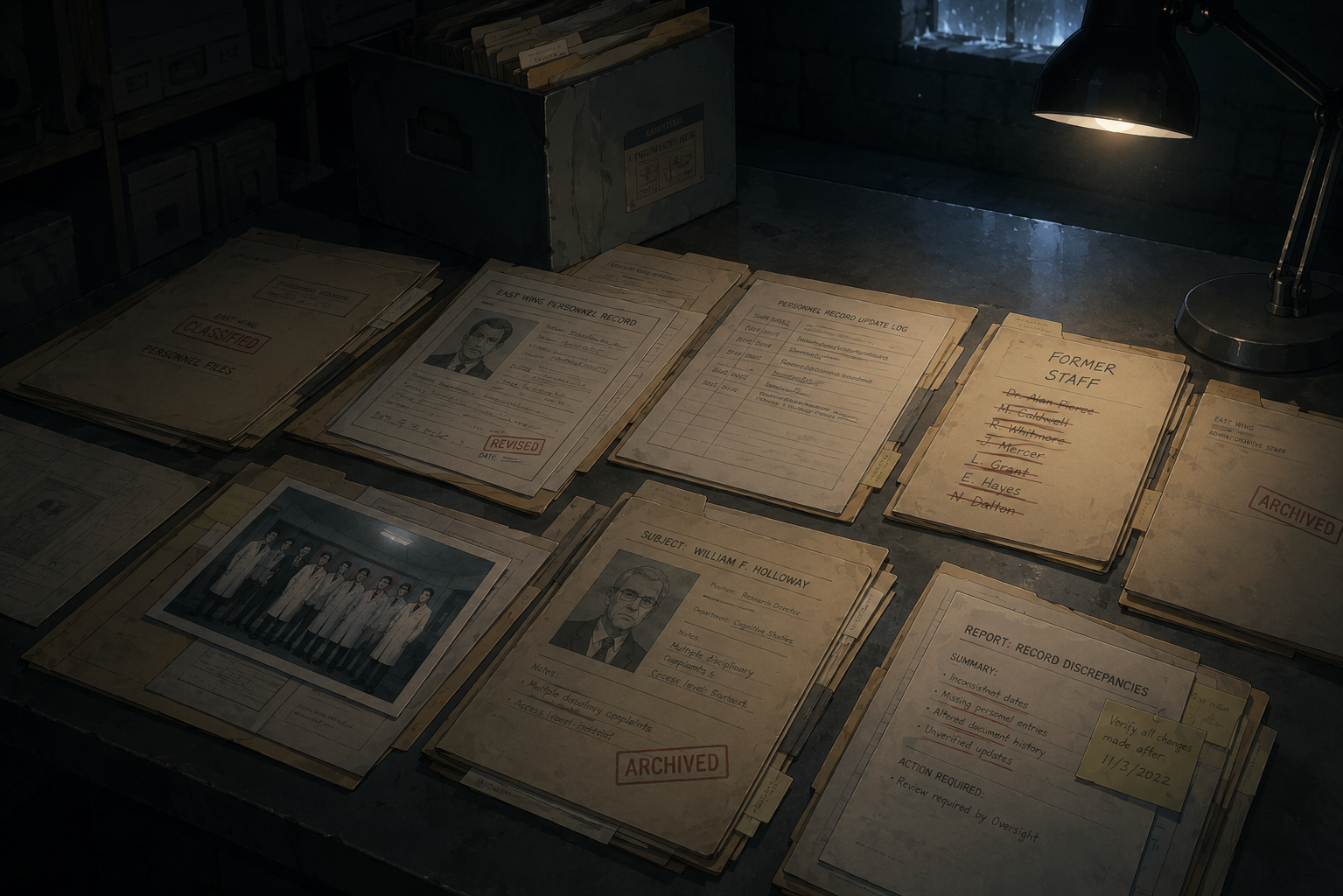
The records room occupied the lowest level of the administrative wing where the institute stored decades of paperwork nobody trusted enough to digitize completely. The air smelled faintly of dust, toner, and old cardboard softened by years of recycled ventilation. Evan sat alone beneath a dim desk lamp with several personnel folders spread across the table in front of him while rain continued tapping steadily against narrow basement windows near the ceiling. He should not have been there — not technically. But Harlan's conversation had left too many fractures in the shape of things.
Self-admitted. The words refused to settle correctly in his head. William did not behave like a man trapped somewhere against his will, but he also did not behave like a man choosing freedom either. The contradiction lingered beneath everything now, making the institute itself feel subtly distorted. Evan opened another archive folder. Most of the older records were heavily restricted or partially missing entirely. Entire project classifications had been removed from indexes with the kind of deliberate incompleteness that suggested authority rather than accident. Dates existed without context. Personnel references led nowhere. Some files simply ended mid-sentence beneath black redaction bars.
Then he found the photograph. Black and white, slightly curled at the corners with age. A research team standing together inside some kind of laboratory facility — older equipment lined the background while several men and women faced the camera with the restrained professionalism of people accustomed to clearance badges and internal documentation. Evan immediately recognized William. Younger, healthier, sharp-eyed. Not "The Count," not East Wing William. Just a man. The realization unsettled him more than the photograph itself. William stood near the center of the group wearing a pressed white shirt with sleeves rolled neatly at the forearms. His expression looked calm, intelligent, slightly distracted perhaps, but entirely present. And on his wrist — the relic. Even in black and white the faint glow remained visible beneath the grain of the photograph like pale static trapped under glass.
Evan leaned closer. Every other person in the image appeared ordinary. William did not, not anymore. He flipped the photograph over.
PROJECT OVERSIGHT DIVISION — AUTHORIZED PERSONNEL ONLY
Below that sat several names. Half had been crossed out in black ink. One line appeared scratched over so aggressively the paper itself had nearly torn. Evan frowned and checked the corresponding personnel file beside the photograph. Empty — not partially empty, but completely empty. No service history, no project assignment, no termination. Nothing. As if the individual had never existed at all.
A faint unease crept slowly across Evan's shoulders. He returned his attention to the photograph. The more he stared at it, the stranger it became — not overtly wrong, just subtly unstable somehow. One woman near the edge of the frame looked slightly blurred compared to everyone else despite standing perfectly still. Another man's identification badge appeared too dark to read clearly even under the desk lamp. Then Evan noticed something else. William was not looking at the camera. He was looking slightly past it, at someone standing outside the frame.
The basement lights flickered overhead. Evan looked up instinctively. Darkness swallowed the records room for half a second before the fluorescent lights stabilized again with a low electrical hum. When he looked back down at the photograph, something cold moved slowly through his stomach. One of the crossed-out names was different. Not dramatically. Just enough. Evan stared at it. He could have sworn the previous file listed the surname as Mercer. Now it read Merrow. His fingers tightened slightly against the edge of the folder. No. That wasn't possible. He closed his eyes briefly, replaying the page in his head. Mercer. It had definitely been Mercer. Hadn't it?
The fluorescent lights buzzed softly overhead. Rain tapped against the basement windows. Somewhere deeper in the records department, metal shelving creaked faintly as the building settled. Evan looked back toward the photograph again. William still stared slightly beyond the camera frame with that same distant expression. And for the first time since arriving at the institute, Evan found himself wondering whether the records were being altered intentionally — or revised by something else entirely.


.png)
.png)
.png)