%20(1).png)
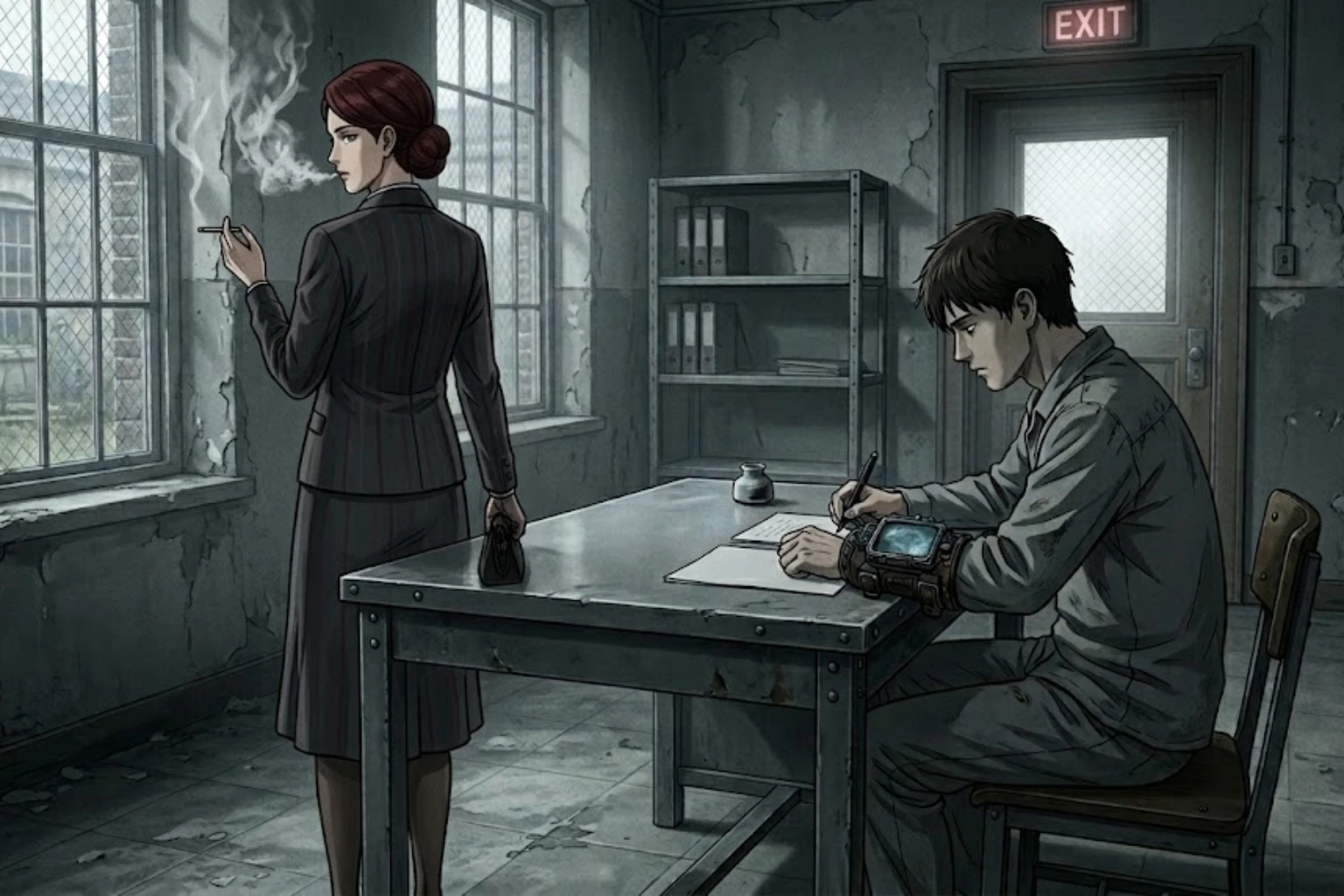
Morning arrived in the East Wing the way it always did: gray light filtering through reinforced glass, the soft tick of the radiator finding its rhythm, the distant clatter of a breakfast cart somewhere down the corridor. Evan woke to it the way he always woke to it, lying on his back beneath a thin institute blanket, staring up at a ceiling he had memorized down to its water stains.
He sat up. The room responded the way a room responds when nothing in it is new — the desk in its corner, bolted to the floor at a height someone had decided long ago was correct. The single window, reinforced, looking out over a stretch of dead lawn. The chair, the pen, the stack of blank paper squared against the edge of the desk like it had been waiting all night for him to notice it.
His left wrist ached, low and constant, the way it always ached in the mornings before he'd moved it enough to loosen whatever had stiffened overnight. He flexed his hand. The relic caught the gray light along its casing — dark, scarred metal, the clouded screen at its center holding a faint blue dimness that hadn't fully woken yet either. The leather strap had worn a permanent groove into his skin, soft and pale, like a mark that had stopped being an injury sometime in the past and become simply a feature of his arm.
He didn't look at it twice. There was no reason to. It was simply there, the way his own hand was there, the way the ceiling and the radiator and the smell of antiseptic floor wax were there.
He got up, dressed, and waited by the door for the sound of the cart.
It came on schedule. The slot at the bottom of the door slid open, and a tray appeared on the floor — toast, a boiled egg, water in a paper cup. He picked it up and ate sitting at the desk, the way he always did, and when he was finished he set the tray by the door and picked up the pen.
He didn't remember deciding to write. The decision, if there had been one, belonged to some earlier version of the morning he hadn't been present for. His hand simply moved, the nib finding the paper with the unthinking confidence of routine, and after a moment words were accumulating beneath it in a hand he recognized as his own, though he could not have said, if asked, what made it his rather than someone else's.
The girl in gray crossed the bridge before the bell rang twice.
He paused. Read the line back. It sat on the page the way an old photograph sits in a drawer you forgot you owned — familiar in a way that bypassed memory and went straight to recognition. He didn't ask himself where it had come from. The question simply didn't arrive. He kept writing, and the sentence that followed felt exactly as inevitable as the one before it, and somewhere beneath the writing, underneath the part of him that was forming letters, something colder noted that this was not the first morning this had happened, and would not be the last.
The relic's screen brightened by a degree he didn't notice.
—
Clarke came by a little after nine, the way he always did, keys at his hip catching the corridor light before the rest of him appeared through the small reinforced window. He unlocked the door, stepped in, glanced once at the stack of pages on the desk — three sheets now, filled top to bottom — and gave the small, professional nod he gave every morning.
"Sleep alright?"
"Fine," Evan said.
"No."
"Alright." Clarke lingered a moment longer than the question required, the way he always did, his eyes drifting briefly toward the window, the lawn, the gray sky pressing down on it. Then he left, and the lock turned over with its familiar double click, and the corridor swallowed the sound of his footsteps the way it swallowed everything eventually.
Evan sat with the pen still loose in his hand and looked at the door for a while after it had closed.
There was a thought trying to surface in him — small, persistent, shapeless, like a coin lodged somewhere it couldn't be reached. It had the texture of a name. He let his mind run toward it the way a tongue runs toward an aching tooth, testing without committing, and found nothing there to hold onto. Just the suggestion of an absence, smooth-edged, worn down by however long it had been wearing down. He had the distinct, fleeting impression that the room had once belonged to someone else's morning before it had belonged to his — that the groove in his wrist was old in a way his arm wasn't, that the desk's particular stains and scuffs had a history that predated whatever version of himself was sitting in front of them now.
The thought didn't frighten him. That was the strange part, the part that, if he'd had the distance to examine it, might have frightened him more than anything else. It simply passed through him and out the other side, the way water passes through something that was never built to hold it, and by the time Clarke's footsteps had faded down the hall, Evan had already picked the pen back up and returned to the page, and the thought was gone as completely as if it had never required holding in the first place.
—
Dark Rose came before lunch.
She didn't knock. Evan had never known her to knock — she simply entered the way weather enters a room through a window someone forgot to shut, with no particular ceremony and no real interruption to whatever stillness had preceded her. The lock turned, the door opened, and she stepped inside already mid-motion, her eyes going first to the desk and the small stack of finished pages rather than to Evan himself, as if he were the part of the room she had least reason to inventory.
"Morning," she said, in the flat, pleasant register she used for everything. It wasn't unfriendly. It was simply even, the way a level surface is even — without effort, without anything underneath it straining to stay that way.
"Morning," Evan said.
She crossed to the desk and gathered the pages with the same economical motion every time, squaring them against each other with two taps of her fingers before tucking them into the leather portfolio she carried under one arm. She didn't read them. She never read them in front of him — whatever interest she took in the words happened later, somewhere else, in some other room Evan had never seen and had no particular desire to picture. Her gaze passed once, briefly, over the handwriting at the top of the topmost page, the way a person's gaze passes over a familiar signature, confirming rather than examining, and then she closed the portfolio's clasp.
Her eyes moved, in the same unhurried sweep, to his wrist.
She didn't pause there either. There was no flicker, no held breath, none of the small fracture that had crossed Harlan's face that afternoon when his gaze had caught on the same place. Dark Rose looked at the relic the way she looked at the desk, the window, the bolted chair — as a fixed part of the room's furniture, present because it had always been present, requiring no more comment than the color of the walls. If anything, her attention lingered there a half-second longer than it had on the pages, but it was the lingering of routine maintenance, not surprise. A nurse checking a familiar dressing. Nothing more.
"How's the wrist today," she said. It wasn't quite a question. Her voice carried the same shape it always carried when she asked it — not concern exactly, but a kind of professional attentiveness that had worn into something almost like care over however long she'd been asking it.
"The same," Evan said, because it was, and because he understood, without being told, that this was the correct answer, the answer the question expected, the answer that closed the loop rather than opening it.
"Good." She said it the way Harlan had said it earlier — not as praise, but as confirmation that the machinery of the day was running the way it was supposed to run. She glanced toward the window, toward the dead lawn beyond it, and for a moment her face held something almost gentle, the kind of softness that surfaces in people who have been doing a hard, quiet job for long enough that the hardness has stopped registering as hardness at all.
"You're due more paper by tonight," she said. "I'll have someone bring it up before the evening rounds."
"Alright."
"You're writing well," she added, and there was no particular weight on it, no flattery, just an observation offered the way one might mention that the weather had held — true, mildly pleasant, requiring no response. "Keep at it."
She didn't ask if he remembered anything. She didn't ask how he was sleeping, or whether the nights felt different than they used to, or whether there had ever been a used to at all worth asking about. There was nothing in her manner that suggested these were questions that needed asking, because there was nothing in her manner that registered any version of the room's history other than the one currently sitting in front of her, writing in a hand she had apparently always recognized as his.
She turned for the door, portfolio tucked under her arm, and paused there for a moment with her hand on the frame — not hesitating, exactly, but allowing herself one final visual pass over the room, the way she might before leaving any room she was responsible for. Her gaze touched the desk. The window. Evan's wrist, one last time, with no more weight than before.
"I'll see you this evening," she said, and it carried the easy certainty of a woman who had said the exact same sentence, in the exact same doorway, more times than either of them could have counted even if counting had occurred to her.
Then she was gone, the lock turning over behind her, and the room settled back into the particular quiet it kept between visits — a quiet that held no trace of her having questioned anything, because there had been nothing, in her accounting of the world, that warranted question.
Evan sat for a while looking at the closed door.
He thought, distantly, that there should have been something strange in it — a woman walking into a room, collecting pages from a man whose presence there had no beginning she could name, looking at a relic fused to his arm without once asking how it had gotten there. He waited for the strangeness to arrive properly, to take the shape of alarm or unease, something he could hold onto and examine.
It didn't come. The room offered no resistance, and after a moment neither did he, and the absence of resistance was, in its own quiet way, the most unsettling fact in the room.
—
He went to physical recreation at the scheduled hour, walked the looping outdoor track within its tall chain fence for the allotted forty minutes, and returned to find his door already open, awaiting the routine search that always followed outdoor time. The orderly conducting it — not Clarke, someone younger, newer, a face Evan had seen only a handful of times — patted down his pockets with brisk efficiency and waved him back inside without comment.
"You're quiet today," the orderly said, almost as an afterthought, latching the door.
"Am I?"
"You usually ask about the weather." The orderly shrugged, not unkindly. "No big deal."
Evan considered this. He could not remember asking about the weather, not today and not on any other day he could specifically locate in his memory, and yet the observation didn't strike him as inaccurate. It struck him, instead, the way a description of a stranger's habit might strike him — plausible, perhaps even true, but disconnected from any memory he could personally verify. He let it go the way he'd let the coin-shaped thought go that morning, without resistance, because resistance required a foothold and there was none to find.
He sat back down at the desk. The pages from the morning were gone — collected sometime during recreation, he assumed, though he hadn't seen anyone come for them and didn't recall hearing the door. New paper sat squared against the desk's edge in their place, the same height, the same proportion, as though the desk itself enforced a kind of permanent inventory regardless of who replenished it.
He picked up the pen again. His wrist ached, the old familiar ache, and beneath the leather strap the relic's screen held its faint blue glow, patient, unbothered, exactly as it always was.
—
Director Harlan's visits came at irregular intervals, always brief, always conducted with the particular formality of a man checking a gauge rather than a man checking on a person. He arrived a little before two that afternoon, stepping into the room with his hands folded behind his back, and studied Evan for a moment with an expression that held no curiosity in it at all — only the practiced neutrality of long habit.
"How are you finding the days?" Harlan asked. It was the question he always asked. Evan understood this the way he understood the placement of the desk and the angle of the window — not as memory exactly, but as something closer to architecture, a fact about the room that didn't require remembering because it had never been otherwise.
"The same," Evan said.
"Good." Harlan's gaze dropped, briefly, to Evan's wrist, and something in his face tightened by a degree too small to name — there and gone, like a held breath released a half-second before anyone could notice it had been held at all. "And the writing?"
"It comes when it comes."
"It always does." Harlan nodded slowly, more to himself than to Evan, and for a moment the office formality slipped just slightly, revealing underneath it something that might, in a different man, have been read as tiredness, or grief, or the particular exhaustion of a man maintaining a structure whose original purpose he could no longer fully recall either. Then it was gone, folded back beneath the neutral mask, and Harlan straightened.
"Carry on," he said, and left.
The lock turned over. The corridor swallowed his footsteps.
Evan sat alone in the gray afternoon light, the pen resting against the paper, and for one suspended moment — shorter than a breath, gone before he could properly inhabit it — he had the sense that someone else's name had almost surfaced behind Harlan's question, riding just beneath How are you finding the days, as though the sentence had originally been built to address somebody else and had simply never been retired. He reached for it the way he'd reached for the coin that morning.
There was nothing there. There had never been anything there. The room held no record of anyone but him, and the institute's routine continued exactly as it always had — unbroken, unremarked, entirely certain of its own continuity — closing back over the moment the way still water closes over a stone too small to leave a ripple.
Evan picked the pen back up.
The girl in gray crossed the bridge before the bell rang twice, he wrote, though he had written it once already that morning and did not remember having done so, and beneath the words, beneath the desk, beneath the East Wing itself, the cycle that had always run through this room continued exactly as it had always run, with no seam anywhere a person might find to mark where one occupant had ended and another had simply, quietly, begun.


.png)
.png)
.png)