%20(1).png)
The stairs from the basement always felt significantly longer on the way up. Evan took them slowly, his hand trailing a deliberate inch away from the damp concrete wall. The building at night possessed a specific architecture of sound that was entirely absent during the day. During working hours, the asylum was a composite of harmless noises. The squeak of rubber soles, the clatter of rolling metal carts, the low, professional hum of voices muffled behind frosted glass doors. At two in the morning, that composite completely fell apart. You could hear individual pipes straining under the weight of the upper floors. You could hear the rain finding subtle weak spots in the old, poorly maintained roof. And, most unnervingly, you could hear your own breathing, which Evan was currently trying very hard to keep slow and even.
He reached his second-floor office, unlocked the heavy wooden door, and stepped inside. The room was dark, smelling faintly of old paper and dust. He did not turn on the overhead fluorescent tubes. Instead, he reached for the small, green-shaded desk lamp he had scavenged his second week on the job, clicking the rotary switch. A pool of warm, dim light spilled across the faux-wood surface of his desk.
He sat down and placed the manila folder in the center of the light.
His pulse was no longer racing. The vertigo that had gripped him at the bottom of the basement stairs had crystallized into something entirely different, something cold, sharp, and remarkably stable. It was the absolute, dangerous clarity of a man who had stared at a sprawling, chaotic mosaic for weeks and finally stepped back far enough to see the picture.
He opened the folder. The thirty pages lay exactly as he had arranged them, a chronological map of an unraveling mind that was not actually unraveling at all.
Evan reached for a blank legal pad and his black pen. He needed to write it down. He needed to see the logic physicalized in his own handwriting, outside the contaminating influence of the basement.
He wrote a single sentence at the top of the page. William was not sick in the way the asylum claimed.
He stared at the four words. For a month, the entire medical and administrative apparatus of the asylum had operated on the assumption that William's condition was a tragic, fascinating psychological collapse. Severe dissociative fugue. Schizophrenia. A brilliant mind fracturing under its own weight and spilling its contents onto paper. But madness was inherently disorganized. Madness contradicted itself. It forgot its own rules from one day to the next.
William's writings did not forget. They built. They constructed a coherent, breathing architecture of places like Veth and entities like the Black-Winged Woman. And more importantly, they echoed reality. They knew about the green glow of the wreck in the southern channel. They knew about the specific names murmured in passing by staff in the parking lots.
If William was not sick, then he was functional. He was operating exactly as something had designed him to operate.
Evan drew a line under the first premise and wrote the second. William is a conduit.
He thought about the photograph he had found two weeks ago, the younger William staring past the camera, an expression of mild, distracted attention on his face, as if he were listening to a frequency no one else in the room could hear. William had not retreated into his own mind. His mind had simply been repurposed. The stories he wrote were not fiction. They were transcripts. They were the raw, unfiltered data of parallel geographies, distant timelines, and other realities entirely, all broadcasting their weight against the seams of this one.
William was a radio receiver, helplessly cycling through stations, picking up tragedies and triumphs from worlds that had nothing to do with the asylum. He was transcribing the broadcasts because the broadcast was too loud to ignore.
But a radio receiver needs an antenna. It needs hardware. It needs a localized mechanism to draw those distant frequencies in and translate them into something a human hand could write down.
Evan leaned back in his squeaking chair. He had spent the last hour in the basement terrified that the hospital administrators were hiding a monster in the dark, or perhaps studying a massive, reality-bending object buried deep beneath the foundation of the building itself. He had imagined a sprawling conspiracy, a hidden sub-basement holding a localized anomaly.
He realized now how entirely wrong that assumption was. The perimeter wasn't the building. The perimeter was the man.
Evan closed his eyes and vividly pictured William's room in the East Wing. He pictured the heavy door, the reinforced glass observation window, the bolted-down desk. He pictured William sitting there, perfectly calm, his pen moving steadily across the paper. And then, Evan focused his memory on William's arm.
His left arm.
The asylum staff called it a specialized telemetry unit. It was the justification for keeping William under such extreme, isolated observation. Clarke had mentioned it once in passing, calling it some experimental biomonitor the higher-ups were testing, something to track neural decay and heart rate simultaneously. Dark Rose never mentioned it at all, treating it with the same silent, clinical detachment she applied to the rest of the room.
Evan opened his eyes.
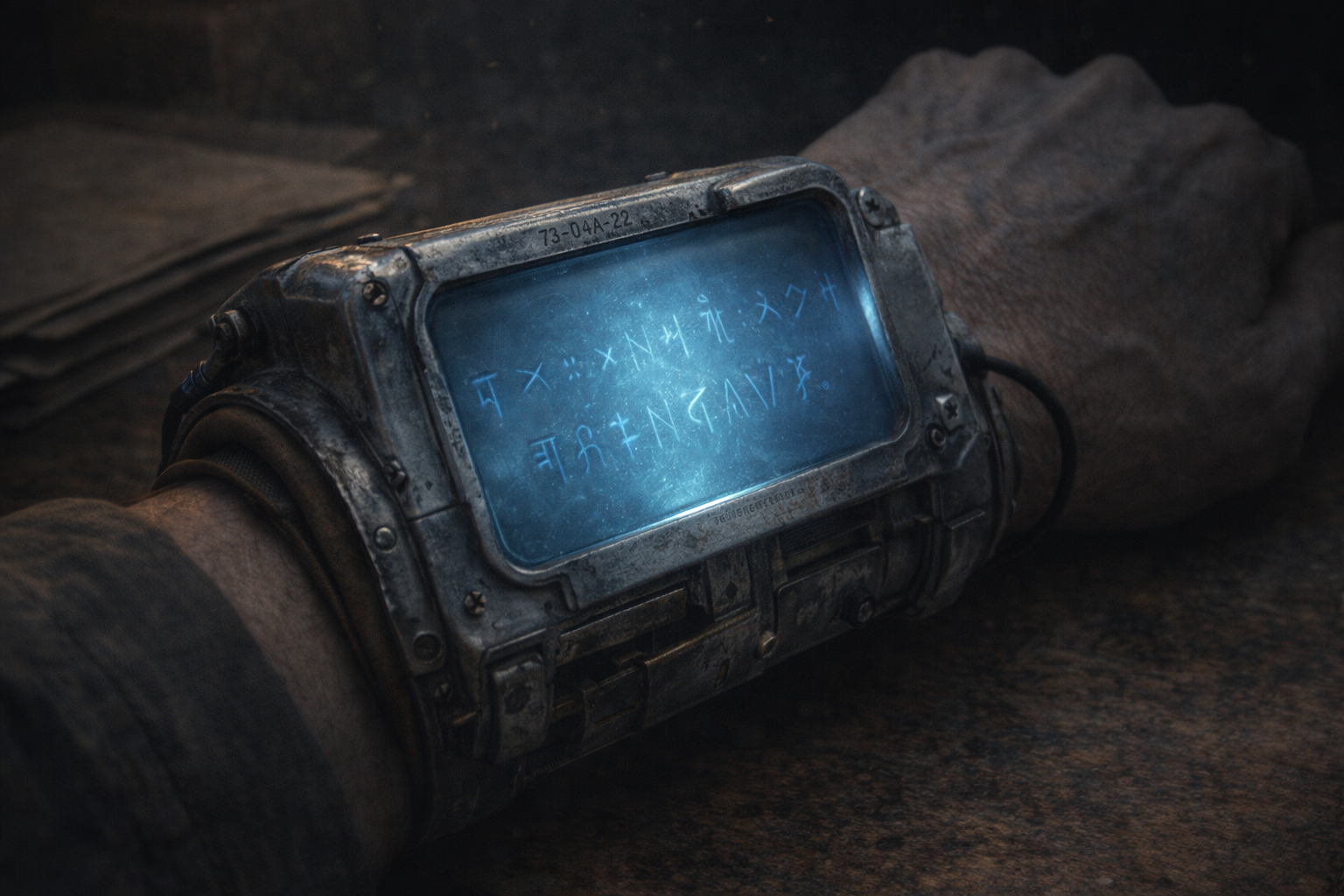
He thought about the physical reality of the device. He had only seen it through the observation glass, but the image was burned into his memory. It did not look like modern medical equipment. It was far too bulky, a heavy, brutalist piece of hardware that looked as though it had been machined from raw iron and scavenged aircraft parts. It clamped around William's forearm, thick metal brackets digging into the pale skin, secured by industrial screws that looked entirely out of place in a sterile hospital environment.
And there was the screen.
It wasn't a digital readout of pulse and oxygen saturation. It was a thick panel of clouded glass, glowing with a faint, persistent blue light. Evan had assumed the strange, shifting shapes on the screen were just graphical representations of brainwaves. But thinking about it now, remembering the sharp angles and the deliberate spacing of the lines that occasionally flared across the glass, he knew they weren't graphs. They were syntax. They were symbols.
The wrist device was the relic.
The realization hit Evan with the force of a physical blow, knocking the breath from his lungs. It was so perfectly, horrifyingly simple. The asylum wasn't hiding a machine in the basement. They were hiding it in plain sight, strapped to the wrist of a patient everyone had been instructed to write off as a tragic madman.
The East Wing was containment, yes, but not for a disease. It was containment for the hardware.
Everything began to snap into a terrifying alignment. Dark Rose's behavior. She didn't collect the pages because she was a diligent orderly keeping a patient's room tidy. She collected them because the pages were the output. The wrist machine was receiving the fragments, channeling them directly into William's nervous system, and William was simply the biological printer forced to transcribe the data. Dark Rose was gathering the data for whoever was actually running the East Wing.
The device was the anchor point. It was the thing that had pierced the veil. It was the reason the stories were bleeding into reality, the reason Evan was finding handwriting that wasn't William's in his own stacks. The machine was active, and it was getting louder.
Evan stood up from his desk. The quiet dread that had haunted his late-night shifts was gone, replaced by a cold, clinical urgency. He needed documentation. He needed to prove it.
If the device was a sanctioned piece of experimental medical hardware installed by the asylum, there would be a paper trail. The facility was a bureaucracy first and a hospital second. Nothing moved, nothing was installed, and nothing was attached to a patient without a requisition form, an inventory tracking number, and a detailed surgical report documenting the procedure.
He looked at the clock. It was nearly three in the morning. The main administrative archives on the third floor would be completely empty.
Evan left his office, locking the door securely behind him. He bypassed the elevators, not wanting to leave a digital footprint of his movements, and took the central stairwell up one flight. The third floor was the bureaucratic heart of the asylum, a sprawling grid of filing cabinets and long, shadow-drenched corridors where decades of patient histories were entombed in cardboard and steel.
He navigated the dark rows from memory, the beam of his small flashlight pointed firmly at the floor. He moved past the billing departments, past the deceased patient records, until he reached the high-security psychiatric annex files. These cabinets required a key, but Evan was the archivist. He had the master ring.
He found the bank of cabinets labeled with the letter W. He unlocked the heavy steel drawer and pulled it open. The metal rollers shrieked softly in the quiet room.
He thumbed through the dense, tightly packed folders until he found the name. William, no last name recorded. Patient ID 884-Alpha.
Evan pulled the thick, heavy file and carried it over to a nearby reading table. He set his flashlight down so the beam reflected off the pale wall, providing just enough ambient light to read by, and opened the cover.
He skipped the psychological evaluations, the endless pages of psychiatric babble diagnosing a condition that didn't exist. He went straight to the hardware. He looked for the medical device requisition forms. He looked for the inventory control tags. He looked for the surgical notes detailing the installation of a heavy, metal telemetry unit to the patient's left forearm.
He went through the entire first half of the file, page by page, date by date.
There was nothing.
Not a single form. Not a single signature authorizing experimental hardware. According to the official medical record of the asylum, William had no physical attachments, no pacemakers, no monitors, nothing. The device, officially, did not exist within the hospital's ecosystem.
Evan's hands began to tremble. A chill, deeper and more profound than the drafty air of the archive room, settled into his bones. If the asylum hadn't put the machine on William's wrist, then how had it gotten there?
He flipped to the very back of the folder, where the physical intake materials were kept. The personal effects log, the transfer paperwork, and the intake photographs.
Evan pulled the transfer paperwork first. He had always assumed William was a ward of the state, transferred from some overcrowded public facility when his condition worsened. But as Evan read the faded ink of the origin documents, his breath hitched.
The transfer had not originated from a hospital. The sending agency was listed under a heavily redacted black bar, but the secondary routing codes were visible. They did not belong to the department of health or the penal system. They belonged to a classified research sector. A privately funded think tank that Evan had only ever seen referenced in conspiracy forums and buried government budget audits.
The Institute.
Evan traced his finger over the smudged type. The asylum was the end of the line, not the beginning. William had not gone mad and then been brought here to be studied. William had been working at the Institute.
Evan carefully turned the page, uncovering a supplementary incident report that someone had carelessly stapled to the back of the transfer logs. It was a partial summary, mostly blacked out, detailing a catastrophic containment breach in a restricted sub-level laboratory at the Institute. The readable fragments of the report referenced an unclassified vault. It referenced unauthorized access. And it referenced William interacting directly with an unidentified artifact of unknown origin.
It all clicked together with the terrifying precision of a falling guillotine. William had encountered the relic during his time at the Institute. He had opened a door he wasn't supposed to open, or handled something he wasn't supposed to touch. He had put the machine on his wrist there. And wearing the relic was what had changed him.
The machine had opened his mind, turning him into a living receiver for frequencies that human biology was never meant to process. The Institute couldn't fix the damage. They couldn't remove the hardware without killing him or triggering something worse. So they had buried their mistake. They had transferred William to this remote asylum, setting up the East Wing not as a treatment center, but as a permanent, deniable listening post. They disguised the relic as a medical monitor and assigned people like Dark Rose to quietly collect the fallout.
The asylum was nothing more than a cage for the receiver. The asylum was the cover-up.
Evan set the transfer papers down and reached into the plastic sleeve at the very back of the folder. He pulled out the glossy intake photographs.
There were two pictures, stapled together. Evan held them up to the ambient light of his flashlight.
The first photograph was the standard arrival portrait. William standing against a gray cinderblock wall, wearing a set of plain paper scrubs. He looked younger, thinner, his eyes wide and vacant, staring hollowly at the camera lens.
Evan looked down at William's left arm in the picture.
The machine was already there.
It was not a clean, sterile piece of hospital equipment applied by cautious doctors. It looked ancient and incredibly heavy, the dark metal casing scarred and weathered. Thick, leather-like straps and metal clamps secured it to his forearm, digging deep into the flesh. The point of connection was what made Evan's stomach turn. The device did not look like it had been strapped on by human hands. The edges of the metal seemed to sink directly into William's skin, the pale flesh swelling slightly around the iron casing as if the body and the machine had long ago fused together into a single, agonizing organism. A thick, black cable emerged from the back of the unit, snaking directly into the crook of William's arm, vanishing beneath the skin with no visible surgical scar.
It had anchored itself to the conduit.
Evan stared at the glowing blue screen captured in the photograph. Even in the still image, the cloudy glass seemed to hold a terrible depth. He could see faint shapes on the screen, sharp angles and intersecting lines that looked like a language waiting to be spoken.
He sat in the dark archive room, the silence of the sleeping hospital pressing against his eardrums. He looked at the paperwork detailing the Institute. He looked at the photograph of the fused relic.
He finally understood what the final error was. It wasn't getting too close to a physical location beneath the building. The error was assuming that the handwritten stories were the mystery. The stories were just the exhaust. The mystery was the engine producing them, and the engine was currently sitting in a locked room on the first floor, quietly running its cycles, permanently fused to the arm of a man who could not turn it off.
Evan gathered the documents, his hands moving with rigid, mechanical precision. He slid the photos back into the plastic sleeve, closed the thick dossier, and locked it back inside the cabinet.
He knew what he had to do next. The paperwork had taken him as far as it could. The files had proven the lie, but they could not translate the broadcast. To understand what the Institute had found, to understand what William was actually seeing, he had to look directly at the receiver. He had to go to the East Wing. He had to stand at the observation glass. And he had to see what the screen on William's wrist was saying right now.


.png)
.png)
.png)