%20(1).png)
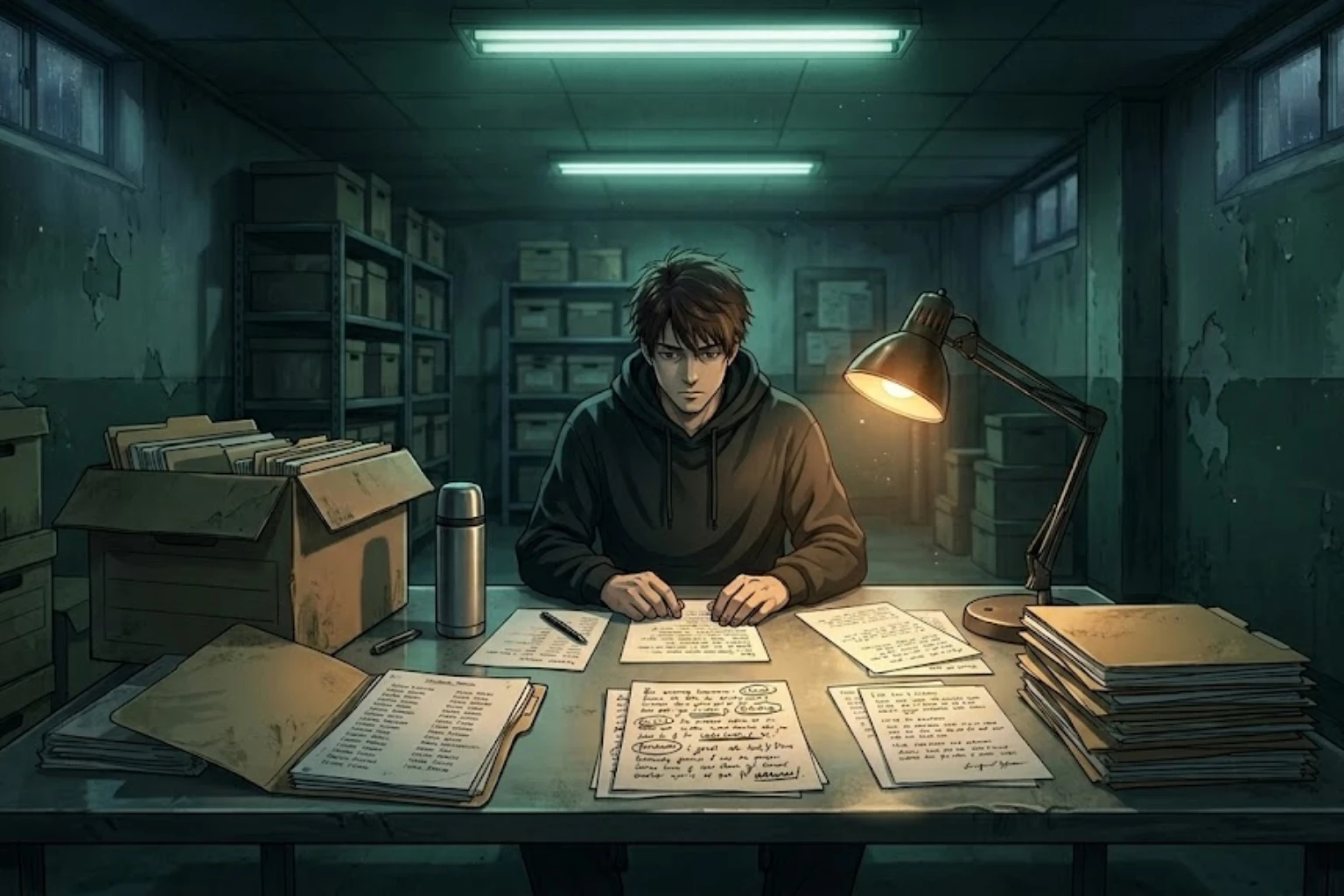
The archive room had stopped feeling like a basement and started feeling like a confessional.
Evan didn't notice the shift happen. It simply arrived one night between stacks of folders, somewhere around the hour when the building's pipes settled and the rain outside thinned to a fine, patient drizzle. He had brought a thermos of coffee that had long since gone cold, and he drank it anyway, because the cold felt appropriate to the room.
Tonight he wasn't reading personnel files. Tonight he had William's pages.
Not all of them — Dark Rose collected most before Evan ever saw them, and what remained behind after her visits felt less like leftovers than like things she had decided not to want. Evan had gathered nearly thirty loose sheets over the past several weeks, slipped from beneath the desk, left folded under the chair, abandoned mid-sentence on nights when William simply stopped writing and stared instead. He had copied each one by hand before returning the originals, a habit that felt obsessive even as he did it.
Now they were spread across the metal table in the order he guessed they belonged.
He had read them individually before. Fragments. A woman who didn't like being observed before she was finished. A static walker that wouldn't cross running water. A structure beneath the ice that should not have existed there. Each piece had felt like exactly what it appeared to be — the disordered output of a brilliant, broken mind organizing fear into narrative because narrative was the only shape fear could survive in.
Reading them together was different.
Evan had arranged the pages by handwriting pressure, a method he wasn't sure made sense until he tried it. The earliest pages — looser script, more crossed-out words — clustered together. The denser, more controlled pages clustered elsewhere. Whatever the metric actually tracked, it produced groups. And the groups told stories that continued.
He started with the lightest pressure, the earliest tier.
The girl in gray crossed the bridge before the bell rang twice. She always crossed before the second ring. The town did not know why this mattered until it stopped happening.
A different page, same tier, different ink:
They called him the Lantern Keeper of Veth, though no one living had seen him light a single lamp. The road remembered him better than the people did.
Evan stopped.
He read it again, slower.
Veth.
He didn't know why the word caught him the way it did — there was no reason it should have meant anything. It wasn't a real place. It wasn't on any map he'd ever seen, in any file he'd ever opened. And yet something in him reacted to it the way a tongue reacts to a tooth that has just gone wrong, testing the ache before fully believing in it.
He set the page aside and kept reading.
Names recurred. Not constantly — William's stories sprawled across dozens of settings, hundreds of unconnected figures — but often enough that Evan began keeping a separate sheet, jotting them down as they surfaced. The Order of the River. The Black-Winged Woman. Kuroha. Reina. Cael. Kaizen. Some appeared only once, a name dropped into a paragraph like a stone into still water, never explained, never returned to. Others recurred across pages written months apart, in handwriting that had visibly aged between them, as though William had returned to the same well over and over without remembering he'd already drawn from it.
Evan rubbed at his eyes. The fluorescent light buzzed faintly overhead, the sound a fly might make if it had given up trying to escape.
He picked up another page.
The southern channel took the ship down slow, the way deep water takes things it intends to keep. Three sailors swore afterward that the wreck still glowed at night, faint and green, like something underneath had decided to keep working.
The southern channel. The wreck.
Evan's pen hovered over his notes. He had heard those words before — not from William, not from any file in this basement.
He had heard them from Clarke.
It took him a long moment to place it, the memory surfacing slow and reluctant, like something rising through cloudy water. A week ago. The cafeteria, late, the two of them half-joking about ghost stories the orderlies told new hires to scare them straight. Clarke had mentioned a wreck once, off-hand, attached to no real place — some old story about a channel wreck that glows, my uncle used to tell it — and Evan had laughed and forgotten it within the hour.
Except Clarke's uncle's story and William's handwriting described the same wreck. The same glow. The same number of sailors.
Evan sat very still.
Coincidence, he told himself, and didn't believe it even as the word formed.
He went back through the pages with new attention now, no longer simply searching for pattern but searching for echo — phrases that matched things he had heard elsewhere, in passing, in places that had nothing to do with William or the East Wing or this building at all. A nurse's offhand comment about a string of luck running through her family like a chosen thread. A name overheard once on a phone call in the parking lot — Kaito — that meant nothing to him then and meant something uncomfortable now, sitting two pages away from a passage about a young man who walked black roads under a woman with wings made of something darker than feathers.
It would have been easier, Evan thought, if the stories had simply been strange. Strangeness he could file away as the byproduct of a damaged mind. What unsettled him instead was the specificity — names too exact, too consistent, too load-bearing to be invented from nothing. Real fiction wandered. It contradicted itself, forgot details, reinvented its own rules from page to page. William's pages didn't do that. They behaved like fragments of something whole, glimpsed from different angles, written by a man who was not inventing a world so much as transcribing one he kept losing access to.
Evan reached for the densest, most recent tier of pages — the controlled handwriting, the pressed-too-hard pen strokes that suggested either urgency or restraint, he couldn't tell which.
The first page in that pile made him go cold in a way the basement chill alone couldn't explain.
Aegis was not retrieved. Aegis was released. The difference will matter to whoever reads this next, though I no longer remember why it should matter to me.
Evan set the page down carefully, as though it might tip over and spill something.
Aegis must not return.
The strip of paper was still in his jacket pocket, three weeks old now, soft at the folds from handling. He hadn't shown it to anyone. He hadn't fully decided what he believed it was — a warning, a fragment of fiction, a name with no referent that simply happened to recur because William's mind kept circling the same drain. But sitting here, surrounded by thirty pages of a man's unraveling private mythology, the warning didn't feel like fiction anymore. It felt like the only sentence in the entire stack that wasn't trying to disguise itself as one.
He flipped to the next page.
The handwriting had changed — not William's at all. Smaller. Tighter. A different hand entirely, slotted into the stack as though it belonged there, though Evan was certain he hadn't copied it from William's room.
He stared at it for a long moment, trying to understand how a page in someone else's writing could be sitting inside his own copies.
He is close now. He believes proximity is understanding. Tell him it is the final error before he reaches it himself.
The sentence from before. The one Dark Rose had missed.
Except Evan hadn't copied that page. He remembered specifically deciding not to — some instinct telling him to leave it exactly where William had left it, untouched, as though copying it might count as something. He had read it. He hadn't taken it.
And yet here it was, in his own stack, in handwriting that wasn't his and wasn't William's.
The fluorescent light flickered once overhead. Evan looked up instinctively, the way he always did now, half expecting the dark to hold for longer than a second. It didn't. The light steadied. The room remained exactly as it had been — dust, toner, old cardboard, rain ticking faintly against the high basement windows.
When he looked back down at the page, the handwriting was William's again.
Evan didn't move for a long time.
He told himself, with the calm, deliberate insistence of a man building a wall he already suspected wouldn't hold, that he had simply misread it the first time. Tired eyes. Bad light. A trick of expectation laid over an ordinary page. He made himself reread the sentence three times until the explanation felt almost plausible.
He believes proximity is understanding. Tell him it is the final error before he reaches it himself.
Even in William's familiar hand, the sentence didn't soften. If anything, it sharpened — because now it sounded less like an observation written about some unnamed observer in some unnamed story, and more like a message left for somebody specific. Somebody who had been getting closer for weeks. Somebody sitting alone in a basement at midnight with thirty stolen pages spread in front of him like evidence in a trial only he had agreed to attend.
He thought of Harlan's voice in the office two nights before. It becomes dangerous later, when people start believing they finally understand what they're looking at.
Evan had assumed, at the time, that Harlan meant it generally. A philosophy. An old man's hard-earned caution, offered the way tired men offer caution to younger ones, half warning and half resignation. Now, sitting here, he wondered whether Harlan had meant it as something closer to a direct address. Whether the warning had been aimed, with more precision than Evan had credited, exactly at him.
He gathered the pages slowly, careful to keep them in the order he'd built, and slid them into the folder he used to smuggle his notes upstairs. His hands were steady. That surprised him more than anything else that night — that his hands, after everything, were still steady.
Before he closed the folder, he allowed himself one more pass through the names he'd collected. Veth. Kuroha. Aegis. The Order of the River. The Black-Winged Woman. Strung together on the page, they read like a table of contents for a book that didn't yet have covers, written by a man who couldn't decide whether he was the author or merely the place the book happened to be passing through.
He thought about the photograph from two weeks ago — the younger William staring past the camera at something outside the frame, an expression of mild, distracted attention on his face, as if he were listening to something nobody else in the room could hear. Evan wondered now whether that was the moment it had started. Whether somewhere beneath the ice, in a structure with no doors and no seams, William had not so much found something as been found.
The basement clock — an old analog model bolted above the door, kept mostly for show — read past one in the morning. Evan closed the folder fully, the cardboard cover soft and a little damp from handling, and sat for a moment longer in the buzzing light, listening to the rain tick steadily against glass too high to see out of.
He felt, for the first time since arriving at the institute, something closer to vertigo than curiosity. Not because the stories frightened him outright — though parts of them did, in a slow, accumulating way rather than a single sharp one — but because of what their coherence implied. Stories invented from nothing didn't behave like this. They didn't agree with strangers' offhand memories. They didn't echo names overheard in parking lots. They didn't, under any reasonable account of fiction, leave handwriting that wasn't the author's tucked between pages that were.
Evan had come into this basement believing he was closing in on an explanation — a diagnosis, a conspiracy, a buried research program with a name and a chain of command he could eventually trace to its end. What he found instead, spread across the table in thirty handwritten pages, felt less like an explanation and more like a perimeter. As if William's writing wasn't describing a separate reality breaking into this one, but mapping the edges of something that had already arrived, quietly, and simply hadn't finished moving in.
He thought of Dark Rose's voice in William's room. Those categories are not always separate things.
He thought of William himself, calm at his desk, pen moving steadily across paper as though performance and confession had become the same act for him long ago.
And he thought, finally, of the sentence in the unfamiliar hand, before it had quietly become William's hand again, as though the page itself had reconsidered who should be allowed to have written it.
He believes proximity is understanding.
Evan picked up the folder, switched off the desk lamp, and climbed the basement stairs into a building that, for once, felt no quieter than the room he was leaving behind.


.png)
.png)
.png)